
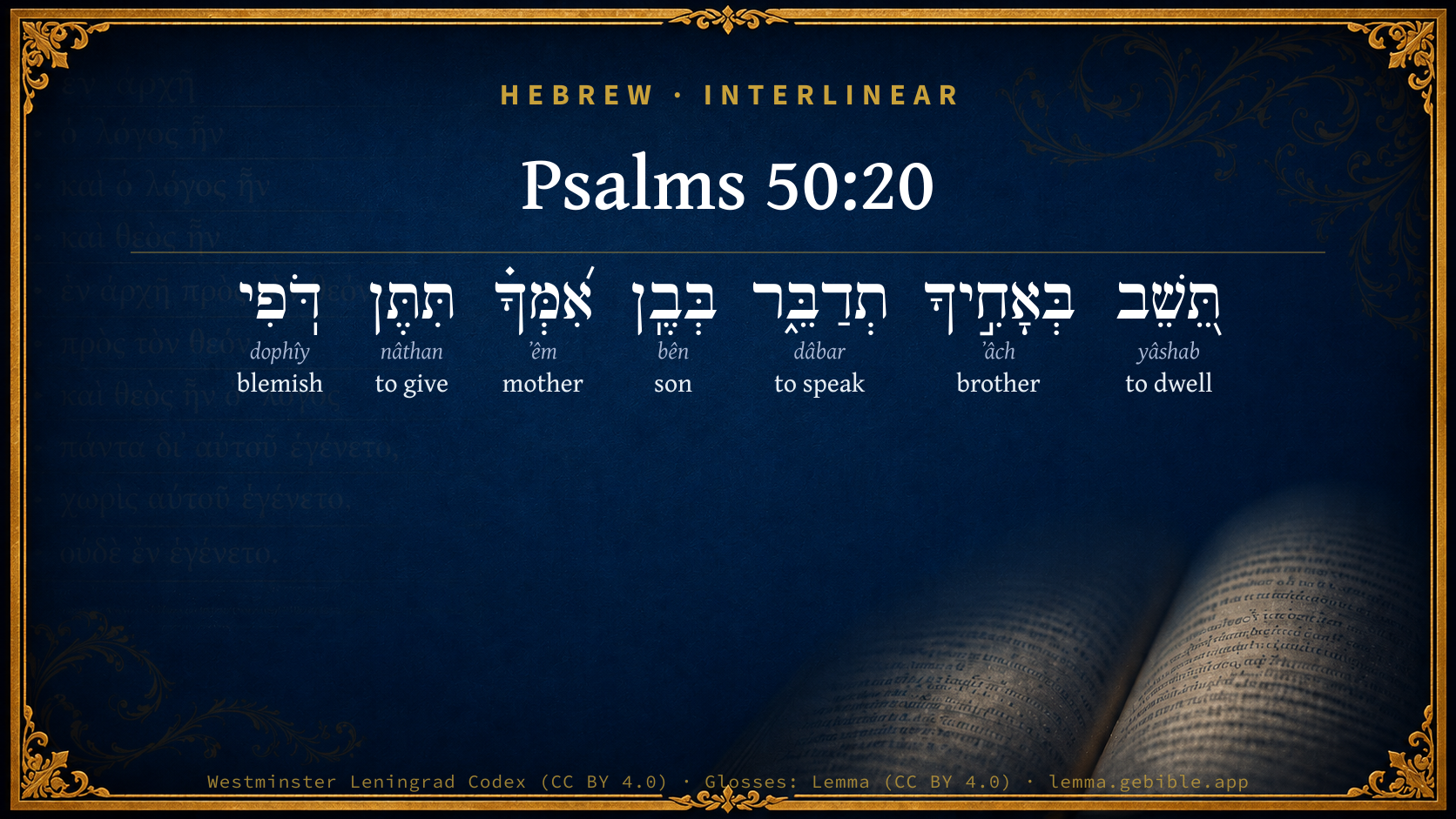
Psalms 50:20

Hebrew (Westminster Leningrad Codex) Psalms 50:20 appears in the Hebrew Old Testament. The text above is from the Westminster Leningrad Codex. Each word links to its Strong’s number, a concise gloss, and parsing drawn from the Open Scriptures Hebrew Bible morphology. Click any word for its full Brown-Driver-Briggs (BDB) entry.
Download image
Cite this verse

Psalms 50:20 (World English Bible). Public Domain. Lemma interlinear Bible study tool, https://lemma.gebible.app/v/psalms/50/20.

Show BibTeX & RIS
BibTeX
RIS
English Translation
You sit and speak against your brother. You slander your own mother's son.
World English Bible · Public Domain
Highlights
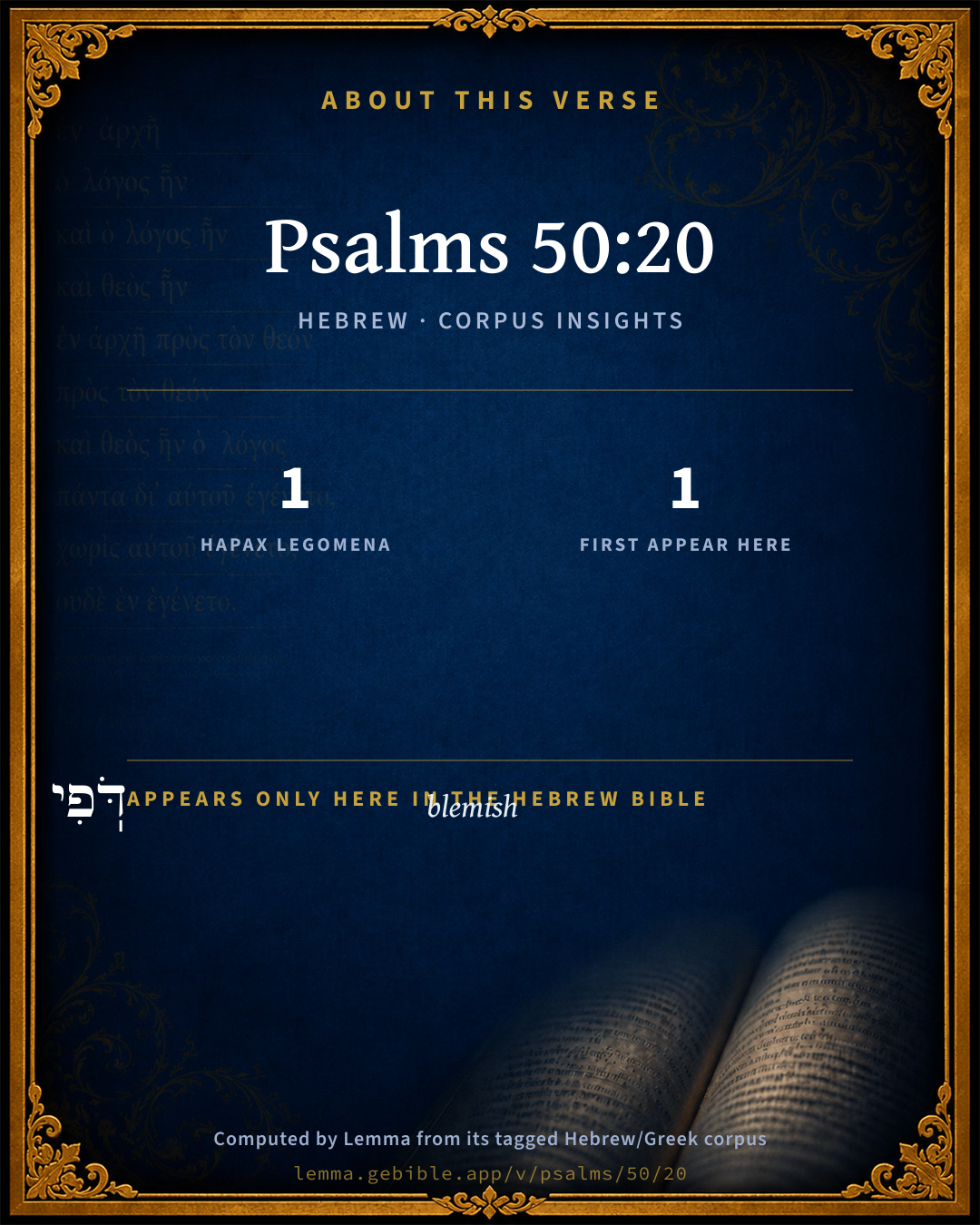
  • 1 hapax legomenon — only here in the Hebrew Bible
  • 1 first appearance in the Hebrew Bible
Full analysis ↓
Download a study sheet

One document with this verse’s original text, its word-by-word gloss line, the meaning frame, cross-references with their text, attributed commentary, and full source and license credits — printable, and it pastes into notes with its structure intact.

This verse Autodidact and up

Study sheet (.html) Plain text (.txt)

A passage Seminary Student

Up to 50 verses in one chapter. A passage sheet keeps up to 6 commentary sources and 12 cross-references per verse, in the order this page ranks them, and says so on the sheet whenever that leaves anything out. Ask for a single verse and you get the Autodidact verse sheet above.

Everything on this page stays free to read, with no account — the sheet is a download of what is already on screen, not access to it.

Want to remove ads? Support Godless Engineer
Compare translations 3

The same verse in 3 English versions, stacked beneath the original-language interlinear above. Click any original word for its lexicon entry.

Each is an independent rendering of the whole verse — the interlinear is not word-aligned to these translations.

Highlighted words mark where these versions differ — a whole-verse word diff, not a word-by-word alignment.

  • World English Bible Public Domain
    You sit and speak against your brother. You slander your own mother's son.
  • King James Version Public Domain
    Thou sittest and speakest against thy brother; thou slanderest thine own mother's son.
  • unfoldingWord Literal Text CC BY-SA 4.0
    You sit, you speak against your brother; you impute slander against the son of your mother.

unfoldingWord Literal Text — © unfoldingWord, licensed CC BY-SA 4.0. Word-aligned USFM3 via Door43 (git.door43.org/unfoldingWord/en_ult).

Versions to compare (up to 4)

3 of 4 selected

Show all 18 translations

Every available English version of this verse, each an independent rendering of the whole verse.

  • World English Bible Public Domain
    You sit and speak against your brother. You slander your own mother's son.
  • Berean Standard Bible Public Domain
    You sit and malign your brother; you slander your own mother’s son.
  • Majority Standard Bible Public Domain
    You sit and malign your brother; you slander your own mother’s son.
  • King James Version Public Domain
    Thou sittest and speakest against thy brother; thou slanderest thine own mother's son.
  • American Standard Version (1901) Public Domain
    Thou sittest and speakest against thy brother; Thou slanderest thine own mother's son.
  • Revised Version (1885) Public Domain
    Thou sittest and speakest against thy brother; thou slanderest thine own mother’s son.
  • Geneva Bible (1599) Public Domain
    Thou sittest, and speakest against thy brother, and slanderest thy mothers sonne.
  • Douay-Rheims (1899) Public Domain
    Sitting thou didst speak against thy brother, and didst lay a scandal against thy mother's son:
  • Young's Literal Translation Public Domain
    Thou sittest, against thy brother thou speakest, Against a son of thy mother givest slander.
  • Literal Standard Version CC BY-SA 4.0
    You sit, you speak against your brother, || You give slander against a son of your mother.
  • Unlocked Literal Bible CC BY-SA 4.0
    You sit and speak against your brother; you slander your own mother's son.
  • unfoldingWord Literal Text CC BY-SA 4.0
    You sit, you speak against your brother; you impute slander against the son of your mother.
  • Darby Bible Public Domain
    Thou sittest [and] speakest against thy brother, thou revilest thine own mother's son:
  • World Messianic Bible Public Domain
    You sit and speak against your brother. You slander your own mother’s son.
  • Webster's Bible Public Domain
    Thou sittest and speakest against thy brother; thou slanderest thy own mother's son.
  • Free Bible Version CC BY-SA 4.0
    You sit there and speak against your brother, slandering your own mother's son.
  • Bible in Basic English Public Domain
    You say evil of your brother; you make false statements against your mother's son.
  • JPS Tanakh (1917) Public Domain
    Thou sittest and speakest against thy brother; thou slanderest thine own mother's son.

Literal Standard Version (2020), Covenant Press — licensed CC BY-SA 4.0. Text via the HelloAO Bible API (eBible.org). Unlocked Literal Bible (unfoldingWord) — licensed CC BY-SA 4.0. Text via the HelloAO Bible API (eBible.org). unfoldingWord Literal Text — © unfoldingWord, licensed CC BY-SA 4.0. Word-aligned USFM3 via Door43 (git.door43.org/unfoldingWord/en_ult). Free Bible Version, Dr. Jonathan Gallagher — licensed CC BY-SA 4.0. Text via the HelloAO Bible API (eBible.org).

Word by word

More ways to search: Search by grammar → Find every occurrence → Compare this word →

Practice this passage: Drill this verse → Learn its vocabulary →

About this verse

These counts appear in no published source. They are computed here, from the morphology-tagged text and Lemma’s own curated glosses. What Lemma adds →

7
words
7
distinct lemmas
Wisdom
section

Notable vocabulary

1 hapax legomenon — a word that appears only here in the entire Hebrew Bible:

  • דֹּֽפִי blemish H1848

First appearance in Scripture

This word makes its first canonical appearance in the Hebrew Bible here:

  • דֹּֽפִי blemish H1848

Grammatical profile

  • 3 verbs
  • 4 nouns

Verb forms

  • תֵּ֭שֵׁב Qal · Imperfect
  • תְדַבֵּ֑ר Piel · Imperfect
  • תִּתֶּן Qal · Imperfect

Hebrew & Septuagint length

In English translation the verse runs 13 words from the Hebrew and 14 from the Septuagint (LXX English) — closely comparable.

A rough comparison of the two English renderings, which tokenize alike — not a word-level alignment.

Word counts can differ between the Hebrew and the Greek without any difference in meaning — e.g. the Hebrew direct-object marker אֵת has no separate Greek word, and Greek often adds the article ὁ.

Cross-references

9

Topical passages linked to Psalms 50:20 in the Treasury of Scripture Knowledge — connected by theme and wording, ordered by reader-vote popularity; previews shown in the World English Bible.

  • Matthew 10:21 "Brother will deliver up brother to death, and the father his child. Children will rise up against parents, and cause them to be put to death.
  • Leviticus 19:16 "'You shall not go up and down as a slanderer among your people; neither shall you stand against the life of your neighbor. I am Yahweh.
  • Proverbs 10:18 He who hides hatred has lying lips. He who utters a slander is a fool.
  • Psalms 31:18 Let the lying lips be mute, Which speak against the righteous insolently, with pride and contempt.
  • Matthew 5:11 "Blessed are you when people reproach you, persecute you, and say all kinds of evil against you falsely, for my sake.
  • Revelation 12:10 I heard a loud voice in heaven, saying, "Now is come the salvation, the power, and the Kingdom of our God, and the authority of his Christ; for the accuser of our brothers has been thrown down, who accuses them before our God day and night.
  • Luke 22:65 They spoke many other things against him, insulting him.
  • 1 Timothy 3:11 Their wives in the same way must be reverent, not slanderers, temperate, faithful in all things.
  • Titus 2:3 and that older women likewise be reverent in behavior, not slanderers nor enslaved to much wine, teachers of that which is good;

Cross-references courtesy of OpenBible.info (CC BY 4.0).

Hebrew and Greek witnesses Masoretic Hebrew ↔ Greek Septuagint

The same verse in the two great witnesses to the Old Testament, shown verse-for-verse.

You’re reading Greek Psalm 49 (Hebrew Psalm 50). The Septuagint counts the superscription, so verse numbers can differ from the Hebrew — chapter-level alignment, not verse-by-verse. Numbering follows Rahlfs.

These are two independent witnesses, not word-aligned to each other, and the Septuagint is shown in lemma (dictionary) form.

Hebrew Psalms 50:20 Masoretic · Westminster Leningrad Codex

תֵּ֭שֵׁב בְּאָחִ֣יךָ תְדַבֵּ֑ר בְּבֶֽן אִ֝מְּךָ֗ תִּתֶּן דֹּֽפִי

You sit and speak against your brother. You slander your own mother's son.

World English Bible · Public Domain

Greek LXX Greek Psalm 49:20 Septuagint · lemma form

καταἧμαι κατά ὁ ἀδελφός σύ καταλαλέω καί κατά ὁ υἱός ὁ μήτηρ σύ τίθημι σκάνδαλον

You did sit and speak against your brother, and did scandalize your mother's son.

LXX2012 (modern English Septuagint) · Public Domain

On this verse, Albert Barnes' Notes on the Bible discusses the Septuagint’s reading. Read the note in Commentary ↓

Hebrew: Westminster Leningrad Codex (CC BY 4.0). Greek: Septuagint (public domain); English from LXX2012 (modern English Septuagint) (Public Domain). How the Septuagint differs from the Hebrew →

Commentary

Notes on Psalms 50:20 from classic Christian and Jewish commentators (each source and its license shown beneath its notes). The classic Christian expositions comment on the surrounding passage and are grouped to its opening verse, so a note may address several verses; the Jewish commentaries on the Tanakh (Rashi and others) are per-verse, so they appear only where the commentator wrote on this verse.

Lemma curates 59 commentaries, every one of them public domain or Creative Commons licensed, each selected and text-cleaned for this edition rather than reprinted as found. About our sources →

Trapp's Complete Commentary

John Trapp

Psa 50:20 Thou sittest [and] speakest against thy brother; thou slanderest thine own mother’s son.

Ver. 20. Thou sittest] In the seat of the scornful, on the ale bench, &c.

And speakest against thy brother] Thy slanderous tongue, like a mad dog, biteth all it meeteth with; not thy near allies excepted: so inhuman are hypocrites.

John Trapp, A Commentary or Exposition upon All the Books of the Old and New Testament (1647–1656) — public domain. Text from a community e-Sword module.

J. A. Alexander on Psalms

Joseph Addison Alexander

20. (Psa 50:20) Thou wilt sit (and) against thy brother speak; at the son of thy mother thou wilt aim a blow. To the general charge of falsehood is now added the specific one of slander, not against strangers, but his nearest friends. The idea suggested by the future is that such behaviour may be confidently looked for on the part of such a character. Thou wilt sit, in the company of others, or more specifically of the wicked, or of other wicked slanderers, as one of them. See above, on Psa 50:18. As brother might be understood as meaning merely any other man, it is determined by the unambiguous phrase, thy mother's son. This is mentioned merely as an extreme case, not as excluding other relations and friends, but rather comprehending them. Aim a blow, literally give a thrust, so as to cast him down. The blow meant is a stroke of the tongue. Compare Jer 18:18.

Joseph Addison Alexander, The Psalms Translated and Explained (1850) — public domain. Text from a community e-Sword module.

Geneva Bible (1599)

Geneva Bible translators

He noteth the cruelty of hypocrites, which spare not in their talk or judgment their own mother’s sons.

Geneva Bible (1599) marginal notes — public domain. Text via Bolls.life.

Ellicott's Commentary for English Readers

(20) Sittest.—Rather, as in Psa_10:8; Psa_17:12, lurkest.

Slanderest.—Literally, givest a thrust; but, from the parallelism, used of words that often hurt more than blows.

Mother’s son.—In a country where polygamy was practised, this marks a closer relationship than the more general “brother” would do. (See Son_1:6, Note.)

A Bible Commentary for English Readers, edited by Charles John Ellicott (1878–1897) — public domain. Text from a community e-Sword module.

The Cambridge Bible for Schools and Colleges

gen. ed. J. J. S. Perowne

20. Thou sittest emphasises the deliberateness of the slander. Cp. “the session of scorners,” i. 1. Thy brother might mean any Israelite; but the alternative thine own mother’s son (cp. Psa_69:8, note) in the parallel line indicates that it is to be understood literally. The Psalmist describes a state of moral degeneracy in which even the closest ties of kinship are ignored. Cp. Mic_7:6; Jer_9:4.

thou slanderest] Lit. dost allege a fault against. This rendering suits the parallelism, but the phrase (which occurs here only) is of uncertain meaning, and may mean givest a thrust against (R.V. marg.), or, settest a stumbling block for.

The Cambridge Bible for Schools and Colleges (gen. ed. J. J. S. Perowne; Cambridge University Press, 1878–1918) — public domain. Text from a community e-Sword module.

John Gill's Exposition

These things hast thou done,.... "These evil works", as the Targum; which they had done over and over again without remorse, with the greatest pleasure, and with promises of impunity to themselves. This is a confirmation of the charge made by the omniscient God, who saw and knew all their actions;

and I kept silence; spoke not by terrible things in righteousness, deferred the execution of judgment, exercised forbearance and patience, and gave space to repent; which being despised, they were hardened yet more and more in sin; see Ecc 8:11. This refers to the space of time between the crucifixion of Christ and the destruction of Jerusalem;

thou thoughtest that I was altogether such an one as thyself; either that he did not see the things committed by them in secret, as the things before mentioned, theft, adultery, slander, and detraction, commonly are; because they could not see such actions done by others: or that he took pleasure in them, as they did, and that he approved of their crucifixion of Jesus of Nazareth, and of their contempt of his Gospel, and of the persecution of his followers;

but I will reprove thee: not verbally by the ministry of the word, much less effectually and savingly by his Spirit; nor in a way of fatherly correction and chastisement; but by sore judgments; by sending the Roman armies to burn their city and temple, and carry them captive;

and set them in order before thine eyes; that is, their sins, and thereby fully confute their vain imagination, that either he did not take notice of them, or else approved of them. This signifies a formal process against them, as in a court of judicature; bringing in a regular charge and accusation against them, and an orderly disposition of their sins, as to time, place, and circumstances, committed by them, and a strong evidence or thorough conviction of them, so as not to be denied and gainsaid by them: or a setting them in battle array, as in Job 6:4; in rank and file; sins being what war against men, and bring upon them utter ruin and destruction; as the sins of the Jews fought against them, and destroyed them; see Jer 2:19.

John Gill's Exposition of the Whole Bible (1746–1763) — public domain (CC PDM 1.0). Text via the HelloAO Bible API.

Albert Barnes' Notes on the Bible

Thou sittest and speakest against thy brother - To the general character of falsehood and slander there is now added the fact that they were guilty of this in the most aggravated manner conceivable - against their nearest relations, the members of their own families. They were not only guilty of the crime against neighbors - against strangers - against persons to whom they sustained no near relationship; but against those of their own households - those whose characters, on that account, ought to have been especially dear to them. The words ““thou sittest”” probably refer to the fact that they would do this when enjoying social contact with them; in confidential conversation; when words of peace, and not of slander, might be properly expected. The word “brother” “might” be used as denoting any other man, or any one of the same nation; but the phrase which is added, “thine own mother’s son,” shows that it is here to be taken in the strictest sense.

Thou slanderest - literally, “Thou givest to ruin.” Prof. Alexander renders it, “Thou wilt aim a blow.” The Septuagint, the Vulgate, Luther, and DeWette understand it of slander.

Thine own mother’s son - It is to be remembered that where polygamy prevailed there would be many children in the same family who had the same father, but not the same mother. The nearest relationship, therefore, was where there was the same mother as well as the same father. To speak of a brother, in the strictest sense, and as implying the nearest relationship, it would be natural to speak of one as having the same mother. The idea here is, that while professing religion, and performing its external rites with the most scrupulous care, they were guilty of the basest crimes, and showed an entire want of moral principle and of natural affection. External worship, however zealously performed, could not be acceptable in such circumstances to a holy God.

Albert Barnes' Notes on the Bible (1834–1885) — public domain. Text from a community e-Sword/MySword module.

Matthew Poole's English Annotations

Thou dost not only speak evil in a sudden passion, or upon some great provocation, but this is thy constant and deliberate practice and business, which thou dost pursue with great facility and complacency; all which this phrase implies.

Thy brother; strictly so called, as the next clause explains it; which is a great aggravation of the sin, and a proof of his inveterate and obstinate wickedness.

Thou slanderest; takest away his good name, which is better than all riches; yea, than life itself; which is contrary to my express and oft-repeated commands.

Matthew Poole's English Annotations on the Holy Bible (1683–1685) — public domain. Text from a community e-Sword/MySword module.

The Treasury of David

Charles H. Spurgeon

Ver. 20. Thou sittest and speakest against thy brother. He sits down to it, makes it his meat, studies it, resolves upon it, becomes a master of defamation, occupies the chair of calumny. His nearest friend is not safe, his dearest relative escapes not. Thou slanderest thine own mother's son. He ought to love him best, but he has an ill word for him. The son of one's own mother was to the Oriental a very tender relation; but the wretched slanderer knows no claims of kindred. He stabs his brother in the dark, and aims a blow at him who came forth of the same womb; yet he wraps himself in the robe of hypocrisy, and dreams that he is a favourite of heaven, an accepted worshipper of the Lord. Are such monsters to be met with nowadays? Alas! they pollute our churches still, and are roots of bitterness, spots on our solemn feasts, wandering stars for whom is reserved the blackness of darkness for ever. Perhaps some such may read these lines, but they will probably read them in vain; their eyes are too dim to see their own condition, their hearts are waxen gross, their ears are dull of hearing; they are given up to a strong delusion to believe a lie, that they may be damned.

Ver. 20. Thou sittest and speakest, etc. A man may both speak and do evil while he sits still and doth nothing; an idle posture may serve the turn for such work as that. Joseph Caryl.

Ver. 20. Thou sittest and speakest against thy brother, etc. When you are sitting still, and have nothing else to do, you are ever injuring your neighbour with your slanderous speech. Your table talk is abuse of your nearest friends. Samuel Horsley.

Ver. 20. Thine own mother's son. To understand the force of this expression, it is necessary to bear in mind that polygamy was allowed amongst the Israelites. Those who were born to the same father were all brethren, but a yet more intimate relationship subsisted between those who had the same mother, as well as the same father. French and Skinner.

Ver. 20-21.

1. Man speaking and God silent.

2. God speaking and man silent.

Psalms 50:21*

Ver. 20-21.

1. Man speaking and God silent.

2. God speaking and man silent.

Charles H. Spurgeon's The Treasury of David (1869–1885) — public domain. Psalms only. Text from a community e-Sword/MySword module.

Whedon's Commentary on the Bible

Daniel D. Whedon

20. Thou… speakest against—In Psa_50:19 they are seen framing “deceit,” now it comes out into public slander.

Thine own mother’s son—In polygamous countries brothers have not always the same mother. Here the idea of a common motherhood as well as fatherhood marks the closest relation, and the crime of alienation and slander is thereby aggravated.

Daniel D. Whedon (gen. ed.), Commentary on the Old and New Testaments (1874–1909) — public domain. Text from a community e-Sword module.

The Pulpit Commentary

Thou sittest and speakest against thy brother. Professor Cheyne understands by "brother" any fellow-Israelite; hut the parallel in the second hemistichThou slanderest thine own mother"s son implies that an actual brother is intended. It is one of the special characteristics of the reprobate to be "without natural affection". (Rom_1:31)

The Pulpit Commentary (1880–1919), ed. H.D.M. Spence-Jones & Joseph S. Exell — public domain. Text from a community e-Sword module.

Rashi

Rabbi Shlomo Yitzchaki (Rashi)

You sit in the company of the scorners.

your mother’s son with whom you have no [legal] quarrel, since he does not inherit with you.

slander Heb. דפי, defamation to cast him off, an expression of (Num. 35:20): “he pushes him off (יהדפנו).”

Rashi on the Tanakh — English translations: “The Judaica Press complete Tanach with Rashi, translated by A. J. Rosenberg” (CC BY 4.0); “Pentateuch with Rashi's commentary by M. Rosenbaum and A.M. Silbermann, 1929-1934” (public domain); “The Metsudah Tanach series, Lakewood, N.J” (CC BY 4.0); and “The Book of Joshua, Metsudah Publications, 1997” (CC BY 4.0). Text via Sefaria.

Lesson kit

Teaching starters — assembled from the data on this page, not authored interpretation. Every prompt links to the verse data it draws on. Edit before teaching.

Psalms, in the Wisdom, opens this verse with 7 words (7 distinct Hebrew lemmas). Its most distinctive word is dophîy (“blemish”). A historical commentator’s framing appears above. Read the whole chapter for the surrounding context.

Discussion questions

  1. The word dophîy carries the sense “blemish.” How does it shape the verse?
  2. 1 word here appears nowhere else in the Hebrew Bible. Why might the author reach for such rare wording?
  3. This is the first place “blemish” appears in Scripture (first appears here). What does its debut here establish?
  4. How does Matthew 10:21, which shares this passage’s theme, read alongside this verse?
  5. The translations on this page render this verse differently — a whole-verse word diff, not a word-by-word alignment. What might account for the different wordings?
  6. «תֵּ֭שֵׁב» is a Qal Imperfect verb. How does that grammatical form shape the action described?
  7. Compare how Trapp's Complete Commentary and J. A. Alexander on Psalms read this verse. Where do they agree or differ?

Things to notice

  • 1 word in this verse appears nowhere else in the Hebrew Bible.
  • 1 word makes its first canonical appearance in Scripture here.
  • These translations choose different wording for 11 words in this verse.
  • 7 distinct Hebrew lemmas span 7 words in this verse.

Reading settings

Reading text

Shown beneath each verse's original-language words.

Old Testament
Old Testament edition

Read the OT as the Masoretic Hebrew (MT) or the Greek Septuagint (LXX).

English shown for the Greek Septuagint (in the Hebrew ↔ Greek comparison).

Comparing translations? Open the Compare panel on any verse page to stack up to four side by side.