
Proverbs 19:26

Hebrew (Westminster Leningrad Codex) Proverbs 19:26 appears in the Hebrew Old Testament. The text above is from the Westminster Leningrad Codex. Each word links to its Strong’s number, a concise gloss, and parsing drawn from the Open Scriptures Hebrew Bible morphology. Click any word for its full Brown-Driver-Briggs (BDB) entry.
Download image
Cite this verse

Proverbs 19:26 (World English Bible). Public Domain. Lemma interlinear Bible study tool, https://lemma.gebible.app/v/proverbs/19/26.

Show BibTeX & RIS
BibTeX
RIS
English Translation
He who robs his father and drives away his mother, Is a son who causes shame and brings reproach.
World English Bible · Public Domain
Download a study sheet

One document with this verse’s original text, its word-by-word gloss line, the meaning frame, cross-references with their text, attributed commentary, and full source and license credits — printable, and it pastes into notes with its structure intact.

This verse Autodidact and up

Study sheet (.html) Plain text (.txt)

A passage Seminary Student

Up to 50 verses in one chapter. A passage sheet keeps up to 6 commentary sources and 12 cross-references per verse, in the order this page ranks them, and says so on the sheet whenever that leaves anything out. Ask for a single verse and you get the Autodidact verse sheet above.

Everything on this page stays free to read, with no account — the sheet is a download of what is already on screen, not access to it.

Want to remove ads? Support Godless Engineer
Compare translations 3

The same verse in 3 English versions, stacked beneath the original-language interlinear above. Click any original word for its lexicon entry.

Each is an independent rendering of the whole verse — the interlinear is not word-aligned to these translations.

Highlighted words mark where these versions differ — a whole-verse word diff, not a word-by-word alignment.

  • World English Bible Public Domain
    He who robs his father and drives away his mother, Is a son who causes shame and brings reproach.
  • King James Version Public Domain
    He that wasteth his father, and chaseth away his mother, is a son that causeth shame, and bringeth reproach.
  • unfoldingWord Literal Text CC BY-SA 4.0
    One who does violence a father, who causes a mother to flee, a son who causes shame and causes embarrassment.

unfoldingWord Literal Text — © unfoldingWord, licensed CC BY-SA 4.0. Word-aligned USFM3 via Door43 (git.door43.org/unfoldingWord/en_ult).

Versions to compare (up to 4)

3 of 4 selected

Show all 18 translations

Every available English version of this verse, each an independent rendering of the whole verse.

  • World English Bible Public Domain
    He who robs his father and drives away his mother, Is a son who causes shame and brings reproach.
  • Berean Standard Bible Public Domain
    He who assaults his father or evicts his mother is a son who brings shame and disgrace.
  • Majority Standard Bible Public Domain
    He who assaults his father or evicts his mother is a son who brings shame and disgrace.
  • King James Version Public Domain
    He that wasteth his father, and chaseth away his mother, is a son that causeth shame, and bringeth reproach.
  • American Standard Version (1901) Public Domain
    He that doeth violence to his father, and chaseth away his mother, Is a son that causeth shame and bringeth reproach.
  • Revised Version (1885) Public Domain
    He that spoileth his father, and chaseth away his mother, is a son that causeth shame and bringeth reproach.
  • Geneva Bible (1599) Public Domain
    He that destroyeth his father, or chaseth away his mother, is a lewde and shamefull childe.
  • Douay-Rheims (1899) Public Domain
    He that afflicteth his father, and chaseth away his mother, is infamous and unhappy.
  • Young's Literal Translation Public Domain
    Whoso is spoiling a father causeth a mother to flee, A son causing shame, and bringing confusion.
  • Literal Standard Version CC BY-SA 4.0
    Whoever is spoiling a father causes a mother to flee, || A son causing shame, and bringing confusion.
  • Unlocked Literal Bible CC BY-SA 4.0
    The one who robs his father and chases his mother away is a son who brings shame and reproach.
  • unfoldingWord Literal Text CC BY-SA 4.0
    One who does violence a father, who causes a mother to flee, a son who causes shame and causes embarrassment.
  • Darby Bible Public Domain
    He that ruineth [his] father and chaseth away [his] mother is a son that causeth shame and bringeth reproach.
  • World Messianic Bible Public Domain
    He who robs his father and drives away his mother is a son who causes shame and brings reproach.
  • Webster's Bible Public Domain
    He that wasteth his father, and chaseth away his mother, is a son that causeth shame, and bringeth reproach.
  • Free Bible Version CC BY-SA 4.0
    A son who abuses his father and chases away his mother brings shame and disgrace.
  • Bible in Basic English Public Domain
    He who is violent to his father, driving away his mother, is a son causing shame and a bad name.
  • JPS Tanakh (1917) Public Domain
    A son that dealeth shamefully and reproachfully will despoil his father, and chase away his mother.

Literal Standard Version (2020), Covenant Press — licensed CC BY-SA 4.0. Text via the HelloAO Bible API (eBible.org). Unlocked Literal Bible (unfoldingWord) — licensed CC BY-SA 4.0. Text via the HelloAO Bible API (eBible.org). unfoldingWord Literal Text — © unfoldingWord, licensed CC BY-SA 4.0. Word-aligned USFM3 via Door43 (git.door43.org/unfoldingWord/en_ult). Free Bible Version, Dr. Jonathan Gallagher — licensed CC BY-SA 4.0. Text via the HelloAO Bible API (eBible.org).

Word by word

More ways to search: Search by grammar → Find every occurrence → Compare this word →

Practice this passage: Drill this verse → Learn its vocabulary →

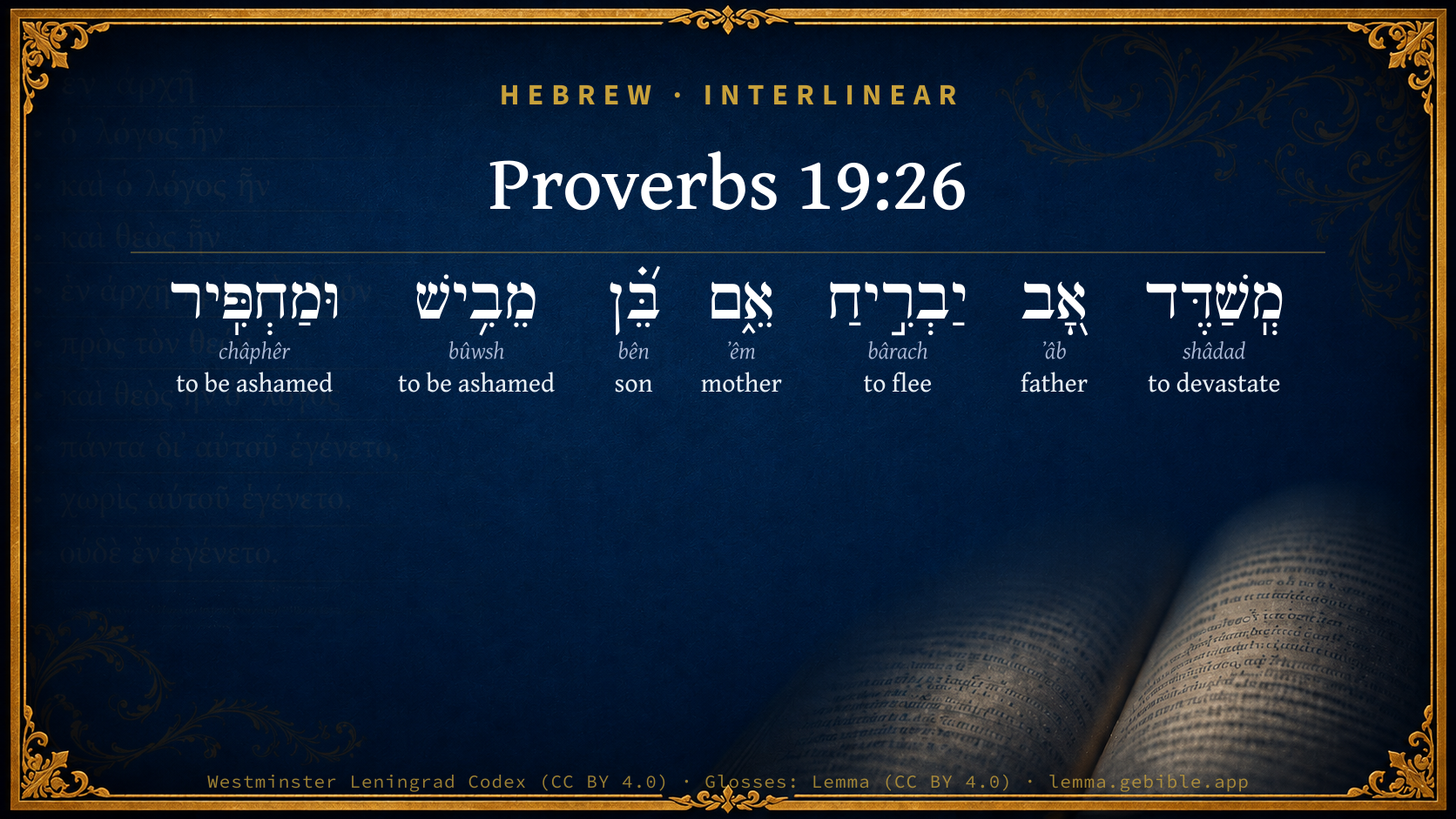
וּמַחְפִּֽיר
châphêr
H2659
“and · being ashamed”
Conjunction + Verb, Hiphil, Participle Active, Masculine, Singular, Absolute
Part of Speech
Conjunction + Verb
Stem
Hiphil
Form
Participle Active
Gender
Masculine
Number
Singular
State
Absolute
Full BDB Definition

Origin: a primitive root [perhaps rath, the same as H2658 through the idea of detection]

TWOT: 715

to be ashamed, be confounded, be abashed, feel abashed - (Qal) to be ashamed, be abashed - (Hiphil) to display shame, demonstrate shame, cause embarrassment
  1. מְֽשַׁדֶּד shâdad H7703 “devastating” Verb, Piel, Participle Active, Masculine, Singular, Construct
  2. אָ֭ב ʼâb H1 “father” Noun, Common, Masculine, Singular, Absolute
  3. יַבְרִ֣יחַ bârach H1272 “to flee” Verb, Hiphil, Imperfect, 3rd Person, Masculine, Singular
  4. אֵ֑ם ʼêm H517 “mother” Noun, Common, Feminine, Singular, Absolute
  5. בֵּ֝֗ן bên H1121 “son” Noun, Common, Masculine, Singular, Absolute
  6. מֵבִ֥ישׁ bûwsh H954 “being ashamed” Verb, Hiphil, Participle Active, Masculine, Singular, Absolute

About this verse

These counts appear in no published source. They are computed here, from the morphology-tagged text and Lemma’s own curated glosses. What Lemma adds →

7
words
7
distinct lemmas
Wisdom
section

Notable vocabulary

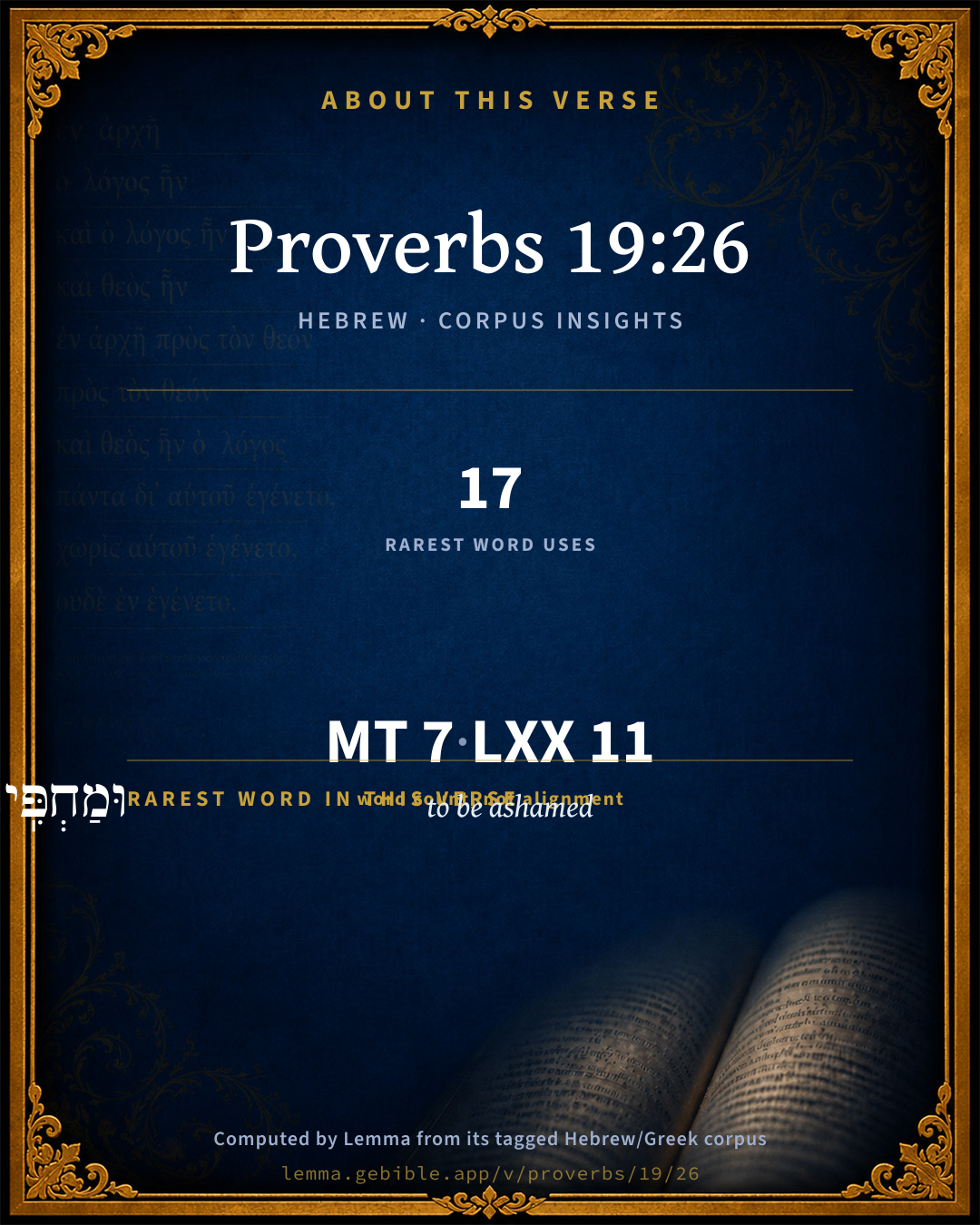
The rarest word here is וּמַחְפִּֽיר to be ashamed H2659 — appearing just 17 times in the whole Hebrew Bible.

Shared distinctive vocabulary

וּמַחְפִּֽיר to be ashamed H2659 occurs in 17 verses of the Hebrew Bible. Also found in:

Grammatical profile

  • 4 verbs
  • 3 nouns

Verb forms

  • מְֽשַׁדֶּד Piel · Participle Active
  • יַבְרִ֣יחַ Hiphil · Imperfect
  • מֵבִ֥ישׁ Hiphil · Participle Active
  • וּמַחְפִּֽיר Hiphil · Participle Active

Hebrew & Septuagint length

In English translation the verse runs 19 words from the Hebrew and 19 from the Septuagint (LXX English) — the same length.

A rough comparison of the two English renderings, which tokenize alike — not a word-level alignment.

Word counts can differ between the Hebrew and the Greek without any difference in meaning — e.g. the Hebrew direct-object marker אֵת has no separate Greek word, and Greek often adds the article ὁ.

In the original languages it is 7 Hebrew tokens and 11 Greek tokens — but the two are counted differently (Hebrew bundles its prefixes and suffixes into one token; the Greek is in lemma form), so that isn’t a like-for-like length.

Cross-references

13

Topical passages linked to Proverbs 19:26 in the Treasury of Scripture Knowledge — connected by theme and wording, ordered by reader-vote popularity; previews shown in the World English Bible.

  • Proverbs 10:5 He who gathers in summer is a wise son, But he who sleeps during the harvest is a son who causes shame.
  • Proverbs 17:2 A servant who deals wisely will rule over a son who causes shame, And shall have a part in the inheritance among the brothers.
  • Proverbs 28:24 Whoever robs his father or his mother, and says, "It's not wrong." He is a partner with a destroyer.
  • Proverbs 30:17 The eye that mocks at his father, And scorns obedience to his mother: The ravens of the valley shall pick it out, The young eagles shall eat it.
  • Deuteronomy 21:18–21 If a man have a stubborn and rebellious son, who will not obey the voice of his father, or the voice of his mother, and, though they chasten him, will not listen to them;
  • Proverbs 10:1 The proverbs of Solomon. A wise son makes a glad father; But a foolish son brings grief to his mother.
  • Proverbs 17:25 A foolish son brings grief to his father, And bitterness to her who bore him.
  • Proverbs 23:22–25 Listen to your father who gave you life, And don't despise your mother when she is old.
  • Proverbs 28:7 Whoever keeps the law is a wise son; But he who is a companion of gluttons shames his father.
  • Proverbs 28:14 Blessed is the man who always fears; But one who hardens his heart falls into trouble.
  • Proverbs 30:11 There is a generation that curses their father, And doesn't bless their mother.
  • Luke 15:12–16 The younger of them said to his father, 'Father, give me my share of your property.' He divided his livelihood between them.
  • Luke 15:30 But when this, your son, came, who has devoured your living with prostitutes, you killed the fattened calf for him.'

Cross-references courtesy of OpenBible.info (CC BY 4.0).

Hebrew and Greek witnesses Masoretic Hebrew ↔ Greek Septuagint

The same verse in the two great witnesses to the Old Testament, shown verse-for-verse.

These are two independent witnesses, not word-aligned to each other, and the Septuagint is shown in lemma (dictionary) form.

Hebrew Proverbs 19:26 Masoretic · Westminster Leningrad Codex

מְֽשַׁדֶּד אָ֭ב יַבְרִ֣יחַ אֵ֑ם בֵּ֝֗ן מֵבִ֥ישׁ וּמַחְפִּֽיר

He who robs his father and drives away his mother, Is a son who causes shame and brings reproach.

World English Bible · Public Domain

Greek LXX Proverbs 19:26 Septuagint · lemma form

ὁ ἀτιμάζω πατήρ καί ἀποὠθέω μήτηρ αὐτός κατααἰσχύνω καί ἐπονείδιστος εἰμί

He that dishonors his father, and drives away his mother, shall be disgraced and shall be exposed to reproach.

LXX2012 (modern English Septuagint) · Public Domain

Hebrew: Westminster Leningrad Codex (CC BY 4.0). Greek: Septuagint (public domain); English from LXX2012 (modern English Septuagint) (Public Domain). How the Septuagint differs from the Hebrew →

Commentary

Notes on Proverbs 19:26 from classic Christian and Jewish commentators (each source and its license shown beneath its notes). The classic Christian expositions comment on the surrounding passage and are grouped to its opening verse, so a note may address several verses; the Jewish commentaries on the Tanakh (Rashi and others) are per-verse, so they appear only where the commentator wrote on this verse.

Lemma curates 59 commentaries, every one of them public domain or Creative Commons licensed, each selected and text-cleaned for this edition rather than reprinted as found. About our sources →

Trapp's Complete Commentary

John Trapp

Pro 19:26 He that wasteth [his] father, [and] chaseth away [his] mother, [is] a son that causeth shame, and bringeth reproach.

Ver. 26. He that wasteth his father.] That spoileth, pilfereth, pillageth, preyeth upon his father; not so much as saying with that scapethrift in the gospel, "Give me the portion that falls to my share." {Luk 15:12} Idleness and incorrigibleness lead to this wickedness, as may appear by the context.

John Trapp, A Commentary or Exposition upon All the Books of the Old and New Testament (1647–1656) — public domain. Text from a community e-Sword module.

Joseph Benson's Commentary

Pro 19:26. He that wasteth his father — That is, his father’s estate, by unjust or riotous courses; and chaseth away his mother — Causes her to avoid and abhor his presence and society, and to go from the house where he is; is a son that causeth shame — Both to himself, and to his parents and family. But this verse ought rather to be rendered, A son that causeth shame, and bringeth reproach, wasteth his father, and chaseth away his mother; that is, as some interpret it, he gives them as much concern as if he were to waste his father’s substance, and turn his mother out of doors.

Joseph Benson's Commentary on the Old and New Testaments (1811–1818) — public domain. Text from a community e-Sword module.

The Preacher's Complete Homiletical Commentary

Joseph S. Exell (gen. ed.)

CRITICAL NOTES.—

Pro_19:27. Cease my son, &c. “That causeth” are not in the original and the instruction spoken of may therefore be evil or good. “Two conceptions are possible:

1. The instruction is that of wisdom itself, and therefore a good wholesome discipline that leads to life; then the words can be only ironical, presenting under the appearance of a dissuasion from discipline in wisdom a very urgent counsel to hear and receive it (so Ewald, Bertheau, Elster).

2. The instruction is evil and perverted, described in clause 2 as one that causes departure from the words of wisdom. Then the admonition is seriously intended” (Zöckler, in Lange’s Commentary). On Zöckler’s first interpretation Dr. Aiken remarks, “To call this ‘irony’ seems to us a misnomer. Cease to hear instruction only to despise it. What can be more direct or literally pertinent?” Delitzsch says, “The proverb is a dissuasive from hypocrisy, a warning against the self-deception of which Jas_1:22-24 speaks, against heightening one’s own condemnation, which is the case of that servant who knows his lord’s will and does it not (Luk_12:47.)”

MAIN HOMILETICS OF Pro_19:26-28

POSSIBILITIES OF HUMAN DEPRAVITY

I. The tenderest admonitions and the most solemn warnings sometimes fail to influence for good. Sometimes the most loving parental care seems utterly wasted upon an ungrateful child, and the more constant and tender the words of admonition the farther does he depart from the way in which he ought to go. There is many a man so in love with sin that he may be said to “devour iniquity” (Pro_19:28); and when this fatal appetite has taken possession of the soul all appeals to his better nature, and even to his own self-love, are vain.

II. When men are so hardened there is no depth of iniquity to which they may not sink. He who scoffs at all threats of retribution, both in this life and in that which is to come, has broken through all barriers of restraint, and will be capable of outraging all the tender ties of human relationship, even to the extent of bringing his parents to disgrace and shame. The most hardened sinners in the universe of God are not found in heathen lands, or among the ignorant at home, but they are those who, having heard instruction, have “erred from the words of knowledge.” Each day that they resist the good influence brought to bear upon them they increase their moral insensibility, and their final condemnation (Pro_19:29). Hence the admonition of Pro_19:27. (See Critical Notes.)

OUTLINES AND SUGGESTIVE COMMENTS

Pro_19:26. This were an admirable text for young men entering upon life and still at the expense of their parents. It is a great enormity either to waste the property of their father while he is alive, or after they have succeeded to expel the widowed mother from the premises.—Chalmers.

Pro_19:27. It is so proper and natural for a son to hear instruction, that the hearing instruction maketh to be a son.… But if thou hear instruction, hear it not—not to be the better for it. Instruction speaketh to keep thee from erring; do not thou hear it to err: instruction putteth into thee the words of knowledge; do not thou put them out by erring from them, by not following them.… Cease thus to hear, but hear still. For by hearing at length thine error may be corrected; whereas, if thou hear not, thou dost not only err, but deprivest thyself of the means that reduce thee from erring.—Jermin.

The Preacher's Complete Homiletical Commentary (gen. ed. Joseph S. Exell; Funk & Wagnalls, c. 1892) — public domain (pre-1929). A full-Bible homiletical/sermon-outline anthology covering 65 of 66 books (2 John is absent from the source module). Text from a community e-Sword module.

Keil & Delitzsch

C. F. Keil & F. Delitzsch

With Pro 19:26 there thus begins the fourth principal part of the Solomonic collection of proverbs introduced by chap. 1-9.

He that doeth violence to his father and chaseth his mother,

Is a son that bringeth shame and disgrace.

The right name is given in the second line to him who acts as is described in the first. שׁדּד means properly to barricade [obstruere], and then in general to do violence to, here: to ruin one both as to life and property. The part., which has the force of an attributive clause, is continued in the finite: qui matrem fugat; this is the rule of the Heb. style, which is not filome'tochos, Gesen. 134, Anm. 2. Regarding מבישׁ, vid., at Pro 10:5; regarding the placing together of הבישׁ והחפּיר, vid., Pro 13:5, where for הבישׁ, to make shame, to be scandalous, the word הבאישׁ, which is radically different, meaning to bring into bad odour, is used. The putting to shame is in בּושׁ ni si (kindred with Arab. bâth) thought of as disturbatio (cf. σύγχυσις) (cf. at Ps. 6:11), in חפר (khfr) as opertio (cf. Cicero's Cluent. 20: infamia et dedecore opertus), not, as I formerly thought, with Frst, as reddening, blushing (vid., Psa 34:6). Putting to shame would in this connection be too weak a meaning for מחפּיר. The paedagogic stamp which Pro 19:26 impresses on this fourth principal part is made yet further distinct in the verse that now follows.

Keil & Delitzsch — Biblical Commentary on the Old Testament (1861–1891) — public domain (CC PDM 1.0). Text via the HelloAO Bible API. (Old Testament only.)

Tyndale Open Study Notes

Tyndale Open Resources

19:26 See Exod 20:12; 21:15, 17.

Tyndale Open Study Notes — © Tyndale Open Resources, licensed CC BY-SA 4.0. Text via the HelloAO Bible API.

Matthew Henry's Commentary

Here is, 1. The sin of a prodigal son. Besides the wrong he does to himself, he is injurious to his good parents, and basely ungrateful to those that were instruments of his being and have taken so much care and pains about him, which is a great aggravation of his sin and renders it exceedingly sinful in the eyes of God and man: He wastes is father, wastes his estate which he should have to support him in his old age, wastes his spirits, and breaks his heart, and brings his gray head with sorrow to the grave. He chases away his mother, alienates her affections from him, which cannot be done without a great deal of regret and uneasiness to her; he makes her weary of the house, with his rudeness and insolence, and glad to retire for a little quietness; and, when he has spent all, he turns her out of doors. 2. The shame of a prodigal son. It is a shame to himself that he should be so brutish and unnatural. He makes himself odious to all mankind. It is a shame to his parents and family, who are reflected upon, though, perhaps, without just cause, for teaching him no better, or being in some way wanting to him.

Matthew Henry's Commentary on the Whole Bible (1708–1710) — public domain (CC PDM 1.0). Text via the HelloAO Bible API.

Jamieson, Fausset & Brown

Robert Jamieson, A. R. Fausset & David Brown

Unfilial conduct often condemned (Pro 17:21-25; Pro 20:20; Deu 21:18, Deu 21:21).

Jamieson, Fausset & Brown — Commentary Critical and Explanatory on the Whole Bible (1871) — public domain (CC PDM 1.0). Text via the HelloAO Bible API.

Adam Clarke's Commentary

Verse 26. He that wasteth his father] Destroys his substance by riotous or extravagant living, so as to embitter his latter end by poverty and affliction; and adds to this wickedness the expulsion of his aged widowed mother from the paternal house; is a son of shame - a most shameful man; and a son of reproach - one whose conduct cannot be sufficiently execrated. Who tormentith the fader, and fleeth the modir, schenful schal ben, and unblisful. - Old MS. Bible. The common reading of the Vulgate is, et fugat matrem, and expels his mother; but the Old Bible was taken from a copy that had fugit matrem, shuns his mother, flees away from her, leaves her to affliction and penury. It is prostitution of the term to call such, man.

Adam Clarke's Commentary on the Bible (1810–1826) — public domain. Text from a community e-Sword/MySword module.

The Cambridge Bible for Schools and Colleges

gen. ed. J. J. S. Perowne

26. wasteth] Rather, violently entreateth, R.V. marg.

The Cambridge Bible for Schools and Colleges (gen. ed. J. J. S. Perowne; Cambridge University Press, 1878–1918) — public domain. Text from a community e-Sword module.

John Gill's Exposition

He that wasteth his father,.... His father's substance, which he gave him first as his portion, and afterwards by paying his debts, and getting him out of prison and out of broils, and that wastes his spirits and his health, and brings his gray hairs with sorrow to the grave;

and chaseth away his mother: alienates her affections from him, who once had too great a fondness for him; causes her to quit her house, not being able to bear the sight of him and of his actions:

is a son that causeth shame, and bringeth reproach; causes shame to his parents, as well as to himself; and a reproach upon them, as well as on his own character. It may be read thus,

"a son that causeth shame, and bringeth reproach, wasteth his father, and chaseth away his mother (y).''

(y) So Gejerus, Schultens.

John Gill's Exposition of the Whole Bible (1746–1763) — public domain (CC PDM 1.0). Text via the HelloAO Bible API.

Albert Barnes' Notes on the Bible

Or, A son that causeth shame, and bringeth reproach, is one that wasteth his father, and chaseth away his mother.

Albert Barnes' Notes on the Bible (1834–1885) — public domain. Text from a community e-Sword/MySword module.

Haydock's Catholic Bible Commentary

Infamous. Hebrew, "a son of confusion and reproach;" a spendthrift.

George Leo Haydock (1774–1849), Haydock's Catholic Family Bible and Commentary, 1859 edition — public domain. Excludes Psalms (Douay-Rheims chapter numbering differs from Protestant) and Deuterocanonical books (Catholic canon only).

Matthew Poole's English Annotations

Wasteth his father, i.e. his father’s estate, by unjust or riotous courses.

Chaseth away his mother; causeth her to avoid and abhor his presence and society, and to go from the house where he is. Bringeth reproach; both to himself, and to his parents and family. But this verse may very well be rendered otherwise, the last words being made the subjects of the proposition, as is usual in Scripture;

A son that causeth shame, and bringeth reproach, ( upon himself and his friends by wicked ways,) wasteth his father’s (estate, and health, and comfort) and chaseth or driveth away his mother. These are the effects of his wickedness.

Matthew Poole's English Annotations on the Holy Bible (1683–1685) — public domain. Text from a community e-Sword/MySword module.

Whedon's Commentary on the Bible

Daniel D. Whedon

26. Wasteth his father — Despoils him of his property, so as to break up his father’s house, and make a fugitive of his mother. To good parents such disgraceful conduct in a son is as great a calamity as can well befall them.

Daniel D. Whedon (gen. ed.), Commentary on the Old and New Testaments (1874–1909) — public domain. Text from a community e-Sword module.

The Pulpit Commentary

Ver. 26-ch. Pro_24:15, may be taken in the sense of "to spoil," "to deprive of property;" but it is better to adopt a more general application, and to assign to it the meaning of "to maltreat," whether in person or property. Chaseth away his mother; by his shameless and evil life makes it impossible for her to continue under the same roof with him; or, it may be, so dissipates his parents" means that they are driven from their home. A son that causeth shame, and bringeth reproach. (comp. Pro_10:5 Pro_13:5 Pro_17:2)

The Pulpit Commentary (1880–1919), ed. H.D.M. Spence-Jones & Joseph S. Exell — public domain. Text from a community e-Sword module.

John Wesley's Explanatory Notes

Wasteth - His father's estate. Chaseth - Causes her to avoid his presence, and to go from the house where he is.

John Wesley, Explanatory Notes Upon the Whole Bible (1754–1765) — public domain. Text via the GEBible commentary corpus.

Bridges on Proverbs

Charles Bridges

This is, alas! not an ideal picture of recklessness. "Without natural affection" (Rom 1:30-31 ) — is an awful mark of unrestrained depravity. Man is the debased slave of his selfish lust. The profligate may waste his father’s substance by extravagance, and his spirits and health by his ill-conduct. Absalom wasted his father by his undutiful rebellion. (2Sa 15:1-14 .) And often has a mother’s tenderness been repaid with crushing unkindness. The insolence of an ungrateful son virtually chaseth her from her home. Her idol has become her curse! Such monsters in human shape, outraging every principle of humanity, have been found in every generation. Yet seldom do they escape without some mark of retributive justice even in this life. (Pro 30:11, Pro 30:17 .) And though they may be callous to public opinion, while causing shame, and bringing reproach on their names; yet conscience will speak (Isa 57:20 ); and, sooner or later, the stroke will fearfully fall. Children! A parent’s sorrows carry a heavy account before the bar of God. If "the commandment be with promise" (Eph 6:2 ), will not the breach of the commandment cut off the entail of the promise, with an awful and aggravated weight of condemnation?

Charles Bridges, An Exposition of the Book of Proverbs (1846) — public domain. Text from a community e-Sword module.

Kretzmann's Popular Commentary

Paul E. Kretzmann

v. 26. He that wasteth his father, attacking him violently, abusing him in words and possibly also in deeds, and chaseth away his mother, making life unbearable for her in her own home, is a son that causeth shame and bringeth reproach, his conduct causing grief to his parents not only by his disregard of their authority, but also by the fact that men will point the finger of scorn at them.

Paul E. Kretzmann, Popular Commentary of the Bible (1921–1924) — public domain. Text from a community e-Sword module.

unfoldingWord translationNotes

Door43 World Missions Community

brings shame and reproach

Possible meanings are 1) he brings it to himself. AT: "brings shame and reproach to himself" or 2) he brings it to his family. AT: "brings shame and reproach to his family" (See: Assumed Knowledge and Implicit Information)

If you cease to hear instruction

Here "listening and obeying" is spoken of as if it were "hearing." AT: "If you stop paying attention to instruction" or "If you stop obeying instruction" (See: Metonymy)

you will stray from

"you will abandon" or "you will turn your back on"

the words of knowledge

"knowledge"

translationWords

shame

reproach

word

know

unfoldingWord translationNotes — © Distant Shores Media and the Door43 World Missions Community, licensed CC BY-SA 4.0. Source: git.door43.org/Door43/en_tn.

Rashi

Rabbi Shlomo Yitzchaki (Rashi)

A son who causes shame and disgrace robs his father, puts his mother to flight Heb. יבריח, puts his mother to flight.

A son who causes shame and disgrace Whose ways are disgraceful. Since Sarah saw the son of the Egyptian maidservant making sport with idolatry and adultery, he caused his mother to be sent away, “and the matter displeased Abraham” (Gen. 21:11).

Rashi on the Tanakh — English translations: “The Judaica Press complete Tanach with Rashi, translated by A. J. Rosenberg” (CC BY 4.0); “Pentateuch with Rashi's commentary by M. Rosenbaum and A.M. Silbermann, 1929-1934” (public domain); “The Metsudah Tanach series, Lakewood, N.J” (CC BY 4.0); and “The Book of Joshua, Metsudah Publications, 1997” (CC BY 4.0). Text via Sefaria.

Lesson kit

Teaching starters — assembled from the data on this page, not authored interpretation. Every prompt links to the verse data it draws on. Edit before teaching.

Proverbs, in the Wisdom, opens this verse with 7 words (7 distinct Hebrew lemmas). Its most distinctive word is châphêr (“to be ashamed”). A historical commentator’s framing appears above. Read the whole chapter for the surrounding context.

Discussion questions

  1. How does “to be ashamed” (châphêr) shape what this verse is saying?
  2. How does Job 6:20, which shares the word «to be ashamed», read alongside this verse?
  3. These translations render this verse differently. What is at stake in choosing one wording over another?
  4. «מְֽשַׁדֶּד» is a Piel Participle Active verb. How does that grammatical form shape the action described?
  5. Compare how Trapp's Complete Commentary and Joseph Benson's Commentary read this verse. Where do they agree or differ?

Things to notice

Reading settings

Reading text

Shown beneath each verse's original-language words.

Old Testament
Old Testament edition

Read the OT as the Masoretic Hebrew (MT) or the Greek Septuagint (LXX).

English shown for the Greek Septuagint (in the Hebrew ↔ Greek comparison).

Comparing translations? Open the Compare panel on any verse page to stack up to four side by side.