
Jeremiah 15:8

Hebrew (Westminster Leningrad Codex) Jeremiah 15:8 appears in the Hebrew Old Testament. The text above is from the Westminster Leningrad Codex. Each word links to its Strong’s number, a concise gloss, and parsing drawn from the Open Scriptures Hebrew Bible morphology. Click any word for its full Brown-Driver-Briggs (BDB) entry.
Download image
Cite this verse

Jeremiah 15:8 (World English Bible). Public Domain. Lemma interlinear Bible study tool, https://lemma.gebible.app/v/jeremiah/15/8.

Show BibTeX & RIS
BibTeX
RIS
English Translation
Their widows are increased to me above the sand of the seas; I have brought on them against the mother of the young men a destroyer at noonday: I have caused anguish and terrors to fall on her suddenly.
World English Bible · Public Domain
Download a study sheet

One document with this verse’s original text, its word-by-word gloss line, the meaning frame, cross-references with their text, attributed commentary, and full source and license credits — printable, and it pastes into notes with its structure intact.

This verse Autodidact and up

Study sheet (.html) Plain text (.txt)

A passage Seminary Student

Up to 50 verses in one chapter. A passage sheet keeps up to 6 commentary sources and 12 cross-references per verse, in the order this page ranks them, and says so on the sheet whenever that leaves anything out. Ask for a single verse and you get the Autodidact verse sheet above.

Everything on this page stays free to read, with no account — the sheet is a download of what is already on screen, not access to it.

Want to remove ads? Support Godless Engineer
Compare translations 3

The same verse in 3 English versions, stacked beneath the original-language interlinear above. Click any original word for its lexicon entry.

Each is an independent rendering of the whole verse — the interlinear is not word-aligned to these translations.

Highlighted words mark where these versions differ — a whole-verse word diff, not a word-by-word alignment.

  • World English Bible Public Domain
    Their widows are increased to me above the sand of the seas; I have brought on them against the mother of the young men a destroyer at noonday: I have caused anguish and terrors to fall on her suddenly.
  • King James Version Public Domain
    Their widows are increased to me above the sand of the seas: I have brought upon them against the mother of the young men a spoiler at noonday: I have caused him to fall upon it suddenly, and terrors upon the city.
  • unfoldingWord Literal Text CC BY-SA 4.0
    Their widows will be numerous to me, more than the sand of the seas. I will bring to them, against the mother of the young men, one who destroys at the noonday; I will cause anguish and terror to fall on her suddenly.

unfoldingWord Literal Text — © unfoldingWord, licensed CC BY-SA 4.0. Word-aligned USFM3 via Door43 (git.door43.org/unfoldingWord/en_ult).

Versions to compare (up to 4)

3 of 4 selected

Show all 18 translations

Every available English version of this verse, each an independent rendering of the whole verse.

  • World English Bible Public Domain
    Their widows are increased to me above the sand of the seas; I have brought on them against the mother of the young men a destroyer at noonday: I have caused anguish and terrors to fall on her suddenly.
  • Berean Standard Bible Public Domain
    I will make their widows more numerous than the sand of the sea. I will bring a destroyer at noon against the mothers of young men. I will suddenly bring upon them anguish and dismay.
  • Majority Standard Bible Public Domain
    I will make their widows more numerous than the sand of the sea. I will bring a destroyer at noon against the mothers of young men. I will suddenly bring upon them anguish and dismay.
  • King James Version Public Domain
    Their widows are increased to me above the sand of the seas: I have brought upon them against the mother of the young men a spoiler at noonday: I have caused him to fall upon it suddenly, and terrors upon the city.
  • American Standard Version (1901) Public Domain
    Their widows are increased to me above the sand of the seas; I have brought upon them against the mother of the young men a destroyer at noonday: I have caused anguish and terrors to fall upon her suddenly.
  • Revised Version (1885) Public Domain
    Their widows are increased to me above the sand of the seas: I have brought upon them against the mother of the young men a spoiler at noonday: I have caused anguish and terrors to fall upon her suddenly.
  • Geneva Bible (1599) Public Domain
    Their widdowes are increased by mee aboue the sande of the sea: I haue brought vpon them, and against the assembly of the yong men a destroyer at noone day: I haue caused him to fal vpon them, and the citie suddenly, and speedily.
  • Douay-Rheims (1899) Public Domain
    Their widows are multiplied unto me above the sand of the sea: I have brought upon them against the mother of the young man a spoiler at noonday: I have cast a terror on a sudden upon the cities.
  • Young's Literal Translation Public Domain
    Its widows have been more to Me than the sand of the seas, I brought in to them -- against the mother -- A young man -- a spoiler -- at noon. I caused to fall upon her suddenly, wrath and trouble.
  • Literal Standard Version CC BY-SA 4.0
    Its widows have been more to Me than the sand of the seas, || I brought on them—against the mother—A young man—a spoiler—at noon. I caused wrath and trouble to fall on her suddenly.
  • Unlocked Literal Bible CC BY-SA 4.0
    I will make their widows number more than the sands of the seashore. Against the mothers of young men I will send the destroyer at noonday. I will make shock and horror suddenly fall on them.
  • unfoldingWord Literal Text CC BY-SA 4.0
    Their widows will be numerous to me, more than the sand of the seas. I will bring to them, against the mother of the young men, one who destroys at the noonday; I will cause anguish and terror to fall on her suddenly.
  • Darby Bible Public Domain
    Their widows are increased to me more than the sand of the seas; I have brought upon them, against the mother of the young men, a spoiler at noonday; I have caused anguish and terror to fall upon her suddenly.
  • World Messianic Bible Public Domain
    Their widows are increased more than the sand of the seas. I have brought on them against the mother of the young men a destroyer at noonday. I have caused anguish and terrors to fall on her suddenly.
  • Webster's Bible Public Domain
    Their widows are multiplied to me above the sand of the seas: I have brought upon them against the mother of the young men a spoiler at noon-day: I have caused him to fall upon it suddenly, and terrors upon the city.
  • Free Bible Version CC BY-SA 4.0
    There will be more widows than the sand of the sea. I will bring a destroyer at noon and mothers will lose their young sons. They will suddenly experience agony and shock.
  • Bible in Basic English Public Domain
    I have let their widows be increased in number more than the sand of the seas: I have sent against them, against the mother and the young men, one who makes waste in the heat of the day, causing pain and fears to come on her suddenly.
  • JPS Tanakh (1917) Public Domain
    Their widows are increased to Me above the sand of the seas; I bring upon them, against the mother, a chosen one, even a spoiler at noonday; I cause anguish and terrors to fall upon her suddenly.

Literal Standard Version (2020), Covenant Press — licensed CC BY-SA 4.0. Text via the HelloAO Bible API (eBible.org). Unlocked Literal Bible (unfoldingWord) — licensed CC BY-SA 4.0. Text via the HelloAO Bible API (eBible.org). unfoldingWord Literal Text — © unfoldingWord, licensed CC BY-SA 4.0. Word-aligned USFM3 via Door43 (git.door43.org/unfoldingWord/en_ult). Free Bible Version, Dr. Jonathan Gallagher — licensed CC BY-SA 4.0. Text via the HelloAO Bible API (eBible.org).

Word by word

More ways to search: Search by grammar → Find every occurrence → Compare this word →

Practice this passage: Drill this verse → Learn its vocabulary →

וּבֶהָלֽוֹת
behâlâh
H928
“and · dismay”
Conjunction + Noun, Common, Feminine, Plural, Absolute
Part of Speech
Conjunction + Noun
Type
Common
Gender
Feminine
Number
Plural
State
Absolute
Full BDB Definition

Origin: from H926

TWOT: 207a

dismay, sudden terror or ruin, alarm
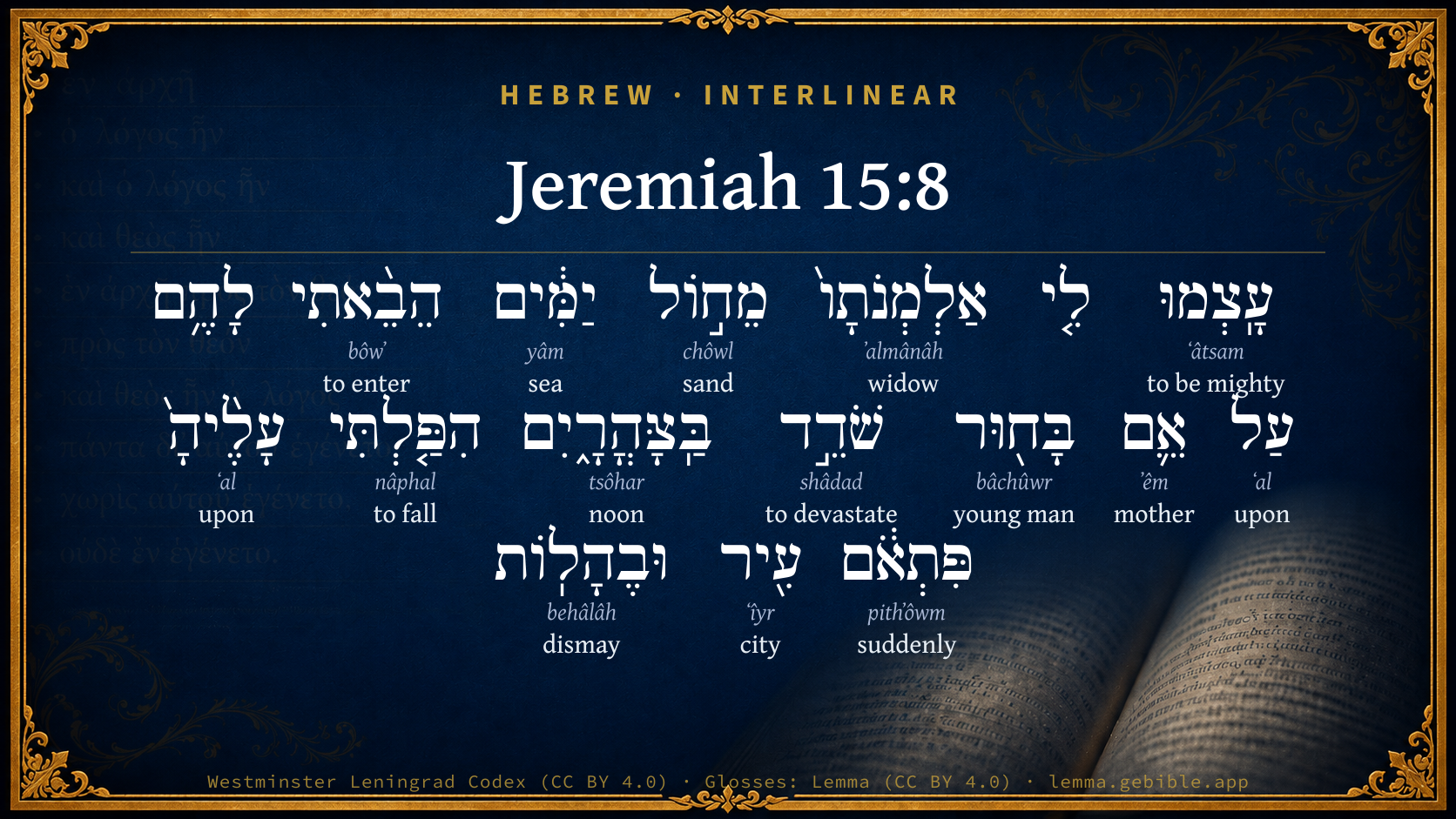
  1. עָֽצְמוּ ʻâtsam H6105 “to be mighty” Verb, Qal, Perfect, 3rd Person, Common, Plural
  2. אַלְמְנֹתָו֙ ʼalmânâh H490 “widows · his” Noun, Common, Feminine, Plural, Construct + Suffix, Personal, 3rd Person, Masculine, Singular
  3. מֵח֣וֹל chôwl H2344 “from · sand of” Preposition + Noun, Common, Masculine, Singular, Construct
  4. יַמִּ֔ים yâm H3220 “seas” Noun, Common, Masculine, Plural, Absolute
  5. הֵבֵ֨אתִי bôwʼ H935 “to enter” Verb, Hiphil, Perfect, 1st Person, Common, Singular
  6. עַל ʻal H5921 “upon” Preposition
  7. אֵ֛ם ʼêm H517 “mother” Noun, Common, Feminine, Singular, Absolute
  8. בָּח֖וּר bâchûwr H970 “young man” Noun, Common, Masculine, Singular, Absolute
  9. שֹׁדֵ֣ד shâdad H7703 “devastating” Verb, Qal, Participle Active, Masculine, Singular, Absolute
  10. בַּֽצָּהֳרָ֑יִם tsôhar H6672 “in/at the · noon” Preposition, Determined + Noun, Common, Masculine, Plural, Absolute
  11. הִפַּ֤לְתִּי nâphal H5307 “to fall” Verb, Hiphil, Perfect, 1st Person, Common, Singular
  12. עָלֶ֨יהָ֙ ʻal H5921 “upon · her” Preposition + Suffix, Personal, 3rd Person, Feminine, Singular
  13. פִּתְאֹ֔ם pithʼôwm H6597 “suddenly” Adverb
  14. עִ֖יר ʻîyr H5892 “city” Noun, Common, Masculine, Singular, Absolute

About this verse

These counts appear in no published source. They are computed here, from the morphology-tagged text and Lemma’s own curated glosses. What Lemma adds →

17
words
14
distinct lemmas
Prophets
section

Notable vocabulary

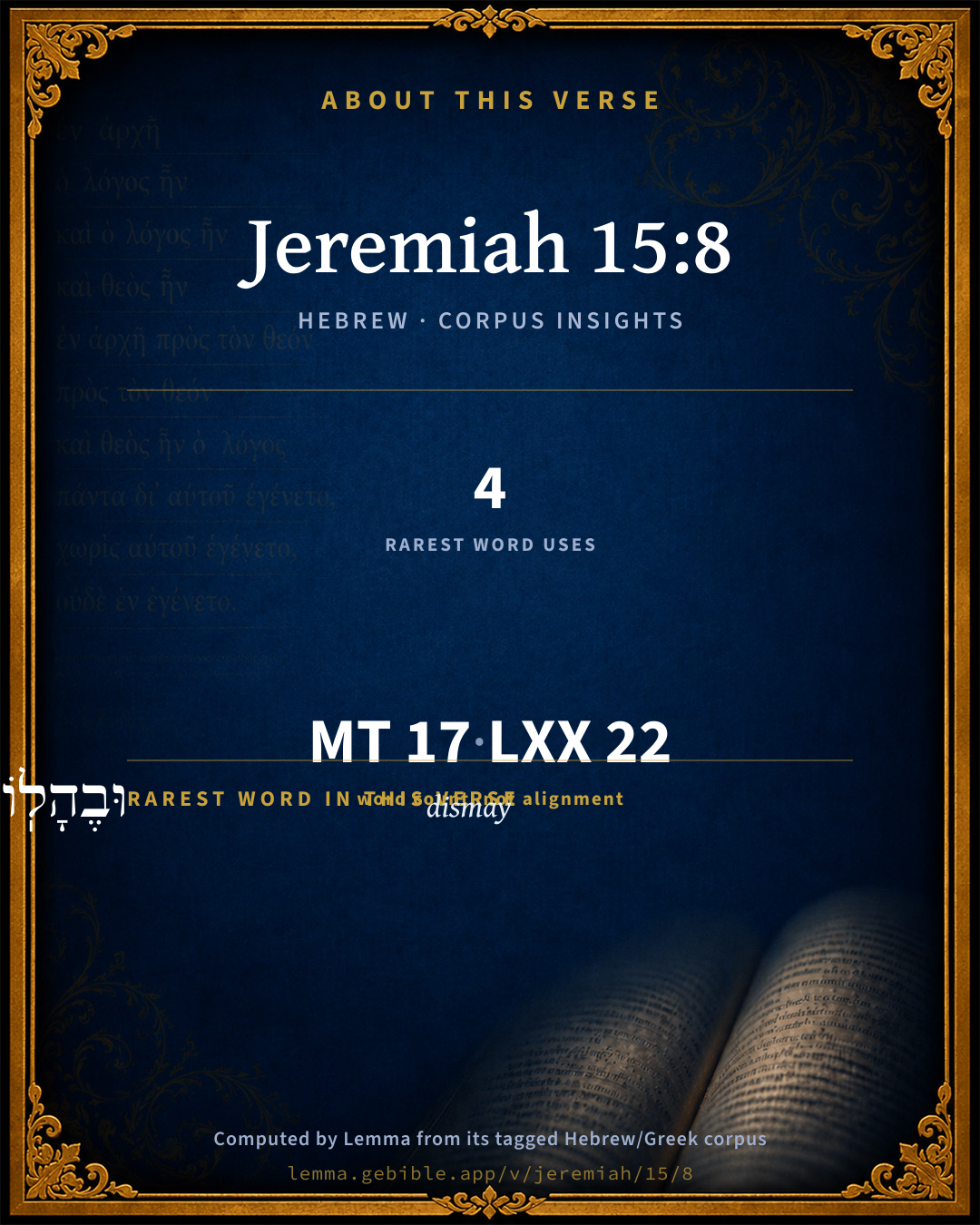
The rarest word here is וּבֶהָלֽוֹת dismay H928 — appearing just 4 times in the whole Hebrew Bible.

Shared distinctive vocabulary

וּבֶהָלֽוֹת dismay H928 occurs in 4 verses of the Hebrew Bible. Also found in:

Grammatical profile

  • 4 verbs
  • 8 nouns
  • 4 prepositions
  • 1 adverb

Verb forms

  • עָֽצְמוּ Qal · Perfect
  • הֵבֵ֨אתִי Hiphil · Perfect
  • שֹׁדֵ֣ד Qal · Participle Active
  • הִפַּ֤לְתִּי Hiphil · Perfect

Repetition

A word recurs within this verse — often emphatic in Hebrew:

Hebrew & Septuagint length

In the original languages it is 17 Hebrew tokens and 22 Greek tokens — but the two are counted differently (Hebrew bundles its prefixes and suffixes into one token; the Greek is in lemma form), so that isn’t a like-for-like length.

Cross-references

5

Topical passages linked to Jeremiah 15:8 in the Treasury of Scripture Knowledge — connected by theme and wording, ordered by reader-vote popularity; previews shown in the World English Bible.

  • Isaiah 3:25–4:1 Your men shall fall by the sword, And your mighty in the war.
  • Jeremiah 4:16 make you mention to the nations; behold, publish against Jerusalem, [that] watchers come from a far country, and give out their voice against the cities of Judah.
  • Jeremiah 5:6 Therefore a lion out of the forest shall kill them, a wolf of the evenings shall destroy them, a leopard shall watch against their cities; everyone who goes out there shall be torn in pieces; because their transgressions are many, [and] their backsliding is increased.
  • Jeremiah 6:4–5 Prepare you war against her; arise, and let us go up at noon. Woe to us! for the day declines, for the shadows of the evening are stretched out.
  • Luke 21:35 For it will come like a snare on all those who dwell on the surface of all the earth.

Cross-references courtesy of OpenBible.info (CC BY 4.0).

Hebrew and Greek witnesses Masoretic Hebrew ↔ Greek Septuagint

The same verse in the two great witnesses to the Old Testament, shown verse-for-verse.

These are two independent witnesses, not word-aligned to each other, and the Septuagint is shown in lemma (dictionary) form.

Hebrew Jeremiah 15:8 Masoretic · Westminster Leningrad Codex

עָֽצְמוּ לִ֤י אַלְמְנֹתָו֙ מֵח֣וֹל יַמִּ֔ים הֵבֵ֨אתִי לָהֶ֥ם עַל אֵ֛ם בָּח֖וּר שֹׁדֵ֣ד בַּֽצָּהֳרָ֑יִם הִפַּ֤לְתִּי עָלֶ֨יהָ֙ פִּתְאֹ֔ם עִ֖יר וּבֶהָלֽוֹת

Their widows are increased to me above the sand of the seas; I have brought on them against the mother of the young men a destroyer at noonday: I have caused anguish and terrors to fall on her suddenly.

World English Bible · Public Domain

Greek LXX Structure differs

In the Septuagint, Jeremiah is about an eighth shorter than the Hebrew and arranges its material differently — the Oracles Against the Nations (Hebrew chapters 46–51) appear in the middle of the Greek book, after 25:13. Because the chapter and verse boundaries do not line up, a verse-for-verse comparison with the Hebrew is not shown.

A verse-for-verse comparison isn’t shown here because the chapters and verses don’t line up. Switch to the LXX edition with the MT / LXX toggle above to read the Greek directly.

On this verse, Trapp's Complete Commentary discusses the Septuagint’s reading. Read the note in Commentary ↓

Hebrew: Westminster Leningrad Codex (CC BY 4.0). Greek: Septuagint (public domain); English from a public-domain English Septuagint. How the Septuagint differs from the Hebrew →

Targum (Aramaic paraphrase)

1

The Targum is the ancient Jewish Aramaic paraphrase of the Hebrew Scriptures — an interpretive translation, not the Hebrew text itself. Onkelos (literal) and Pseudo-Jonathan (expansive) render the Torah, and Jonathan the Prophets. Coverage is partial: where no permissively-licensed English translation exists for a verse, only the Aramaic is shown. This is verse-level text, not a word-by-word alignment to the Hebrew.

  1. Targum Jonathan Prophets (Joshua–Malachi)
    סַגִיאַת קָדָמַי אַרְמְלָתְהוֹן מֵחָל יַמְמִין אַיְתֵיתִי עֲלֵיהוֹן עַל סִיעַת עוּלֵימֵיהוֹן בְּזוֹזִין כַּד בְּטִיהֲרָא אַיְתֵיתִי עֲלֵיהוֹן מַשִׁרְיָן בִּתְכֵּיף וְחַבִּילָא קִרְוֵיהוֹן:

    (no public-domain English translation for this verse)

    Targum Jonathan — Aramaic: “Mikraot Gedolot” (public domain). English: “Sefaria Community Translation” (CC0 1.0 (public-domain dedication)); “London "Chaldee Paraphrase," 1871” (public domain). Text via Sefaria.

Commentary

Notes on Jeremiah 15:8 from classic Christian and Jewish commentators (each source and its license shown beneath its notes). The classic Christian expositions comment on the surrounding passage and are grouped to its opening verse, so a note may address several verses; the Jewish commentaries on the Tanakh (Rashi and others) are per-verse, so they appear only where the commentator wrote on this verse.

Lemma curates 59 commentaries, every one of them public domain or Creative Commons licensed, each selected and text-cleaned for this edition rather than reprinted as found. About our sources →

Trapp's Complete Commentary

John Trapp

Jer 15:8 Their widows are increased to me above the sand of the seas: I have brought upon them against the mother of the young men a spoiler at noonday: I have caused [him] to fall upon it suddenly, and terrors upon the city.

Ver. 8. The widows are increased to me.] Or, Before me; or, In my sight.

Above the sands of the seas.] Hyperbole.

A spoiler at noon day.] Nebuchadnezzar, that choice young man; for so some render the text. And so he was, when he came against Jerusalem and burned it, viz., in the eighteenth year of his reign.

And terrors upon the city.] Or, Terrors, even the city; that is, say the Septuagint and Chaldee, the army of the Chaldees, which for their numbers and order of pitching their tents, seemed to be a city.

John Trapp, A Commentary or Exposition upon All the Books of the Old and New Testament (1647–1656) — public domain. Text from a community e-Sword module.

Joseph Benson's Commentary

Jer 15:8. Their widows are increased above the sand of the seas — A hyperbolical expression. The prophet still speaks of things to come as if present. In Jehoiakim’s time we read of no great number of widows, but they were exceedingly multiplied when the city was besieged and taken in Zedekiah’s time. I have brought upon them against the mother, &c. — Blaney renders this and the next clause, I have brought against their mother a chosen one, spoiling at noon-day; I have caused to fall upon her suddenly an enemy and terrors. By the mother here we are to understand Jerusalem, the mother-city, as she is termed in the margin, against which Nebuchadnezzar, the spoiler, was sent, and who came, not secretly, as a thief by night, but openly, with an army at noon-day. “Nebuchadnezzar might be called a chosen one,” says Blaney, “as being selected by God to be the instrument and executioner of his vengeance. In the margin of our Bibles, בחורis rendered a young man; and this also would very properly characterize the same person. For Josephus (Contra Apion, lib. 1.) cites from Berosus, the Chaldean historian, a passage to the following purport: that ‘Nabopollassar, king of Babylon, hearing that the provinces of Egypt, Cœlo-Syria, and Phœnice had revolted, and being himself infirm through age, sent a part of his forces under his son Nebuchadnezzar, then in the prime of youth, οντι ετι εν ηλικια, by whom those provinces were again reduced.’ This was the expedition said to have been undertaken by him in the third year of Jehoiakim, king of Judah, in the course of which, after having first defeated the Egyptian army at Carchemish, he laid siege to Jerusalem, took and plundered it, carrying away much spoil and many captives to Babylon.” See Jer 46:2; Dan 1:1-3; 2Ki 24:1.

Joseph Benson's Commentary on the Old and New Testaments (1811–1818) — public domain. Text from a community e-Sword module.

Tyndale Open Study Notes

Tyndale Open Resources

15:8-9 Both the old and the young men would die.

Tyndale Open Study Notes — © Tyndale Open Resources, licensed CC BY-SA 4.0. Text via the HelloAO Bible API.

Geneva Bible (1599)

Geneva Bible translators

Or, mother.

Or, fearfully.

Because I had slain their husbands.

Geneva Bible (1599) marginal notes — public domain. Text via Bolls.life.

Jamieson, Fausset & Brown

Robert Jamieson, A. R. Fausset & David Brown

Their widows--My people's (Jer 15:7).

have brought--prophetical past: I will bring.

mother of the young men--"mother" is collective; after the "widows," He naturally mentions bereavement of their sons ("young men"), brought on the "mothers" by "the spoiler"; it was owing to the number of men slain that the "widows" were so many [CALVIN]. Others take "mother," as in Sa2 20:19, of Jerusalem, the metropolis; "I have brought on them, against the 'mother,' a young spoiler," namely, Nebuchadnezzar, sent by his father, Nabopolassar, to repulse the Egyptian invaders (Kg2 23:29; Kg2 24:1), and occupy Judea. But Jer 15:7 shows the future, not the past, is referred to; and "widows" being literal, "mother" is probably so, too.

at noonday--the hottest part of the day, when military operations were usually suspended; thus it means unexpectedly, answering to the parallel, "suddenly"; openly, as others explain it, will not suit the parallelism (compare Psa 91:6).

it--English Version seems to understand by "it" the mother city, and by "him" the "spoiler"; thus "it" will be parallel to "city." Rather, "I will cause to fall upon them (the 'mothers' about to be bereft of their sons) suddenly anguish and terrors."

the city--rather, from a root "heat," anguish, or consternation. So the Septuagint.

Jamieson, Fausset & Brown — Commentary Critical and Explanatory on the Whole Bible (1871) — public domain (CC PDM 1.0). Text via the HelloAO Bible API.

Adam Clarke's Commentary

Verse 8. The mother of the young men] The metropolis or mother city, Jerusalem.

Adam Clarke's Commentary on the Bible (1810–1826) — public domain. Text from a community e-Sword/MySword module.

John Calvin's Commentaries

He says first, Multiplied have been his widows; because the men had been almost all kined, in battle. If the Prophet is the speaker, the particle לי li, is redundant, but if the words be referred to God, we know that the people were in such a way under the government of God that he calls the widows his, as he calls the children his who were born Israelites. But in this there is no great importance, only that if we consider God to be speaker the sense will be this, “Behold, it is by no means unknown to me how numerous his widows are: as then I am merciful I have not heedlessly and without reason suffered such slaughters among the people.” The Prophet intended to shew that so great was the obstinacy of the Jews that they struggled against all the judgments of God; and it is a proof of dreadful impiety when men rush on heedlessly and pay no attention to any punishments. And this is what the Prophet means when he says that the widows were multiplied. And he adds, More than the sand of the sea This was surely a strange thing; so many slaughters were presented to their view that their great perverseness might become more evident, and yet he says that they were not moved.

What follows must be applied to God, I have made to come to them, on the troop of youths, a waster This is an explanation of the former clause, as though he had said, “The reason why there are so many widows is, because God has destroyed all the men.” As the Jews might have ascribed this to their enemies, God declares that he was the author of all the slaughters which they had suffered. He then shews that these slaughters were not fortuitous as men suppose who think that fortune prevails mostly in war, for they do not ascribe so much to the wisdom and valor of men as to fortune, being ignorant of the Providence of God. Here then God shews that the whole of the flower of the people had been indeed cut off by the swords of enemies, but that the Chaldeans or the Assyrians had not come of their own accord, or by an impulse of their own, but by a hidden impulse, and that of God, who had resolved to punish that irreclaimable people. This then is the reason why God not only speaks of a waster, but also intimates that the enemies were impelled by his influence, and carried on the war as it were under his banner, authority, and guidance.

He says, at mid-day, even when the Jews might have exercised greater watchfulness. But he shews that he was against them, for they were not taken by the craft of their enemies, as had often been the case, nor were they surprised by secret designs, but their enemies attacked them openly and boldly, even at the time when many of their cities were fortified, and the people thought that they had sufficient defences. As the enemies then dared to assail them in the middle of the day, (for such is the meaning of the Hebrew word) and during the clearest light, it was certainly a fuller proof of God’s vengeance; for under such a circumstance the contrivance and counsel of men were not so evident, but the hand of God, which he stretched forth from heaven as it were in an open and visible manner.

He afterwards adds, And I have cast, or caused to fall, upon them suddenly; some say, the city; others, the enemy; and עיר oir, means a city, and sometimes an enemy; but another explanation seems more probable, that God had sent on them a tumult and terrors, for the word עיר, oir, conms from the verb עור, our, which signifies to excite. It may therefore be taken for tumult, and this sense I prefer, for they who render the word city, are constrained to adopt a forced and far-fetched explanation, “To fall have I made suddenly the city,” that is, cities, “upon them.” There is first a change of number, and then, to fall have I made cities, that is, the ruins of cities, upon them, seems an unnatural phrase; but the sense would be most suitable were we to render the word tumult, for what immediately follows is, and terrors Some however render the word בהלות, belut, adverbially suddenly, and consider that the same thing is said twice. He had said just before, “I have cast upon her suddenly;” but now he says, “hastenings.” Such is the version, but not suitable, for the two words עיר oir, and בהלות, belut, are joined together. I therefore give this simple explanation — that the Jews were suddenly smitten with despair because they thought that their enemies were afar off, and that they had to apprehend no danger. Then it is, suddenly have I sent upon them a tumult and terrors He then adds —

John Calvin's Commentaries (1540-1563) — public domain. Text from the Calvin Translation Society English edition (1840s-50s) via the Christian Classics Ethereal Library (ccel.org). Calvin's coverage is partial (roughly two-thirds of the Bible); uncommented books and verses are honest gaps, never fabricated. The 19th-century editor's footnotes and remarks are omitted so the notes are faithfully Calvin's own voice.

Ellicott's Commentary for English Readers

(8) I have brought . . .—Better, I have brought upon them, even upon the mother of the young warrior (i.e., upon the woman who rejoices most in her son’s heroism), a spoiler at noon-day, i.e., coming, when least expected, at the hour when most armies rested. (See Note on Jer_6:4.)

I have caused him to fall upon it suddenly . . .—Better, I have brought suddenly upon her (the “mother” of the previous sentence) travail-pangs (as in Isa_13:8) and dismay. The Aramaic word for the anguish of childbirth is also the Hebrew word for “city,” and this has misled translators. The LXX. gives the true meaning.

A Bible Commentary for English Readers, edited by Charles John Ellicott (1878–1897) — public domain. Text from a community e-Sword module.

The Cambridge Bible for Schools and Colleges

gen. ed. J. J. S. Perowne

8. against the mother of the young men] mg. against the mother and the young men who have fallen in battle. If we may accept an emendation of MT. by Du., we shall read mother and suckling.

at noonday] i.e. at an unexpected time. Cp. Jer_6:4 with note.

anguish] The word occurs elsewhere only Hos_9:9, where it is rendered by “the city,” the ordinary sense of the Heb. word, but the reading of MT. there is suspected. Dr. (p. 361) suggests, but with hesitation, a root which would give the sense of excitement, or agitation of alarm.

8, 9. Co. considers the order of clauses to have suffered dislocation. He inserts “Their widows … the seas” after “… confounded” (Jer_15:9), thus improving both sense and Ḳinah rhythm.

The Cambridge Bible for Schools and Colleges (gen. ed. J. J. S. Perowne; Cambridge University Press, 1878–1918) — public domain. Text from a community e-Sword module.

John Gill's Exposition

Their widows are increased to me above the sand of the seas,.... Their husbands being slain; not in the times of Ahaz, when a hundred and twenty thousand men were slain in one day in Judah, by Pekah the son of Remaliah, Ch2 28:6, as Kimchi thinks; but in the times of Zedekiah, at the siege of Jerusalem, and the taking of it, and in the Babylonish captivity before predicted. The children of Israel were to be as the sand of the sea, and were very numerous; and here the widows are said to be so too, their husbands, who were numerous, being dead; and this, as it was of the Lord, so it was in his sight, and according to his counsel and will. Mention is made of "seas", in the plural, number, there being many in or near Judea, as the Red sea, the sea of Galilee, and the Mediterranean sea:

I have brought upon them against the mother of the young men a spoiler, at noonday; that is he would bring upon the Jews, against the mother of the young men, or mothers of them; for the young men being destroyed by the spoiler, it was against them; a calamity upon them, and a distress unto them, who have generally a tender concern for them. The Targum is,

"against the company of their young men;''

the Jews; or against Jerusalem, the mother city, the metropolis of the nation, full of young men fit for war: or, "against the mother", that is, Jerusalem, a "young man" (e); meaning Nebuchadnezzar, who came against Jerusalem in the first year of his reign; and, as some say, in the eighteenth year of his age; and who came not as a thief in the night, but as a spoiler at noonday; not in a secret insidious manner, but openly and with force of arms making his way through the land to Jerusalem, in defiance of the Jews, and in the face of them:

and I have caused him to fall upon it suddenly; that is, upon the city of Jerusalem: for though he came openly, his march was quick, and he was presently at Jerusalem, and laid siege to it at once:

and terrors upon the city; or, "city and terrors" (f); the city was immediately filled with terrors at the appearance of Nebuchadnezzar and his army. R. Joseph Kimchi interprets it, "an army and terrors", from Sa1 28:16, the Babylonian monarch, at the head of his army, which spread terrors where he came. Some render the word, from Dan 4:13, "a watcher and terrors" (g): meaning the Chaldean army, called watchers, Jer 4:16. The Targum is,

"I will bring an army upon them suddenly, and destroy their cities;''

it should be rendered "alienation of mind and terrors": from the use of the word, in the Arabic language (h).

(e) "contra metropolin, juvenem", Junius & Tremellius, De Dieu; "contra matrem", Piscator; "super matrem, juvenem", Cocceius. (f) "civitatem et terrores", Montanus; so Schmidt. (g) "Vigilem, vel vigiles et terrores", Gataker; "vigilias et terrores", Coeceius. (h) Ab "alteravit, mutavit et turbavit", Golius, Castel. Schindler.

John Gill's Exposition of the Whole Bible (1746–1763) — public domain (CC PDM 1.0). Text via the HelloAO Bible API.

Albert Barnes' Notes on the Bible

Translate, “I have brought upon them, even upon the mother of the young man, a spoiler etc.” The word rendered “young man” means a picked warrior. The mother has borne a valiant champion; but neither his prowess nor the numerous offspring of the other can avail to save those who gave them birth; war bereaves both alike.

At noonday - i. e., unexpectedly, as armies used to rest at noon (see Jer 6:4 note).

I have caused him ... - Rather, “I have brought suddenly upon her,” the mother of the young warrior, “anguish and terrors.”

Albert Barnes' Notes on the Bible (1834–1885) — public domain. Text from a community e-Sword/MySword module.

Haydock's Catholic Bible Commentary

Man, or "a spoiler of the young man," (Haydock) so that the widow shall also be deprived of her children. Hebrew, "the young spoiler," Nabuchodonosor. He shall not come like a night thief, to attack the metropolis.

George Leo Haydock (1774–1849), Haydock's Catholic Family Bible and Commentary, 1859 edition — public domain. Excludes Psalms (Douay-Rheims chapter numbering differs from Protestant) and Deuterocanonical books (Catholic canon only).

Matthew Poole's English Annotations

The prophet speaking in the name of that God who calleth things that are not as if they were, still continueth his style, speaking of things to come as if present. In Jehoiakim’s time we read of no such plenty of

widows; they were multiplied when the city was besieged and taken in Zedekiah’s time to a great number, hyperbolically compared to the sands of the sea. I have brought upon them against the mother of the young men a spoiler at noon-day: there is a great variety amongst interpreters as to their sense of this phrase, about which those that are curious may consult the English Annotations upon this verse. By

the spoiler at noon-day is meant Nebuchadnezzar, in the sense of the best interpreters, who came not like a thief, who cometh by night to rob and to spoil, but with an army in the day time: the question only is about those words

against the mother of the young men. The Hebrew word, which our translation renders young men, is בחור which properly signifieth a choice man, or a person chosen, from the Hebrew verb which signifieth to choose; so as it may as well be translated the mother of the chosen, as the mother of the young men. Because young men are looked upon as the choice men, whether for beauty, or strength and ability for any thing, the word often signifies a young man, Deu 32:25; 2Sa 6:1; Psa 148:12; Son 5:15; Isa 23:4; Eze 9:6, and in many other texts. Some will have the sense, (as in our margin,)

against the mother a young man, meaning by the young man Nebuchadnezzar, and by the mother Jerusalem. The Jews are in the Canticles called the daughters of Jerusalem, and Jerusalem which is above is by the apostle called the mother of us all. The Hebrew word is in the singular number; how we translate it young men I understand not. Pagnine translates it electi, the mother of the chosen. I do think that by the mother is meant Jerusalem, and that populi may be understood to electi. Jerusalem was the mother of the Jewish people, or Judea at least, against whom Nebuchadnezzar the spoiler at noon-day was sent; and we know that the Jews were God’s chosen people. I have caused him to fall upon it suddenly, and terrors upon the city: this last clause is yet more obscure than the other; word for word, as it is in the Hebrew, it is, I have caused to fall upon it suddenly, the city and terrors. The word here used ציד commonly signifies a city in Scripture, and is very rarely translated otherwise. Were it not for the adverb suddenly coming between it and city, the sense were plain, and thus, I will cause to fall upon that city terrors; others read it, I will cause him to fall upon it, terrors upon the city. The word sometimes in Scripture signifies enemies, and is so translated, 1Sa 28:16 Psa 139:20; Dan 4:19. In this signification of the word the sense is plain, I will send upon it the enemy and terrors. The learned author of our English Annotations observes it is translated a watcher, Dan 4:13,23, and thinks the sense may be thus, I have caused it to fall upon them suddenly, a watcher that bringeth terrors; to which purpose he tells us the Chaldean forces are compared to watchers, Jer 4:16,17; 5:6.

Matthew Poole's English Annotations on the Holy Bible (1683–1685) — public domain. Text from a community e-Sword/MySword module.

Whedon's Commentary on the Bible

Daniel D. Whedon

8, 9. This destruction is so sweeping that widows are increased… above the sand of the seas… mother of the young men — Literally, the young man, the word which is so rendered meaning young warrior. The picked warriors have fallen; so that though she has borne seven sons she is now defenceless against the spoiler.

Noonday — When one least looks for an attack.

Caused him to fall upon it — Rather, I caused to fall upon her (namely, the mother of the young men) anguish and terrors.

Sun is gone down while… yet day — Betokening violence and calamity.

Daniel D. Whedon (gen. ed.), Commentary on the Old and New Testaments (1874–1909) — public domain. Text from a community e-Sword module.

The Pulpit Commentary

To me; i.e. at my bidding. It is the dative of cause. Against the mother of the young men; rather, upon... young man. The widow has lost her husband, the mother her son, so that no human power can repel the barbarous foe. The word rendered "young man" is specially used for "young warriors," e.g. Jer_18:21 Jer_49:26 Jer_51:3. Others following Rashi, take "mother" in the sense of "metropolis," or "chief city" (see Authorized Version, margin), in which case "young man" must be connected with the participle rendered "a spoiler;" but though the word has this sense in 2Sa_20:19, it is there coupled with "city," so that no doubt can exist. Hero the prophet would certainly not have used the word in so unusual a sense without giving some guide to his meaning. The rendering adopted above has the support of Ewald, Hitzig, and Dr. Payne Smith. At noonday; at the most unlooked-for moment. (see on Jer_6:4) I have caused him, etc.; rather, I have caused pangs and terrors to fall upon her suddenly.

The Pulpit Commentary (1880–1919), ed. H.D.M. Spence-Jones & Joseph S. Exell — public domain. Text from a community e-Sword module.

John Wesley's Explanatory Notes

Their widows - The prophet still speaks of things to come as if present. In Jehoiakim's time we read of no such plenty of widows; they were multiplied when the city was besieged and taken in Zedekiah's time, to a great number, hyperbolically compared to the sands of the sea. The mother - Jerusalem was the mother of the Jewish people, against whom, Nebuchadnezzar the spoiler, at noon-day, was sent.

John Wesley, Explanatory Notes Upon the Whole Bible (1754–1765) — public domain. Text via the GEBible commentary corpus.

unfoldingWord translationNotes

Door43 World Missions Community

General Information:

Yahweh has just told them no one will care about them and that he will destroy his people since they would not turn from their wicked ways.

widows

women whose husbands have died

more than the sands of the seashore

"than the grains of sand on the seashore." This comparison is an exaggeration used to emphasize an uncountable number. AT: "more than you can count" (See: Hyperbole and Generalization)

Against the mothers of young men I will send the destroyer at noonday

This means that Yahweh will send an enemy army to kill young men, which will cause their mothers great sorrow. AT: "At noonday I will send an enemy army to destroy young men and cause their mothers to weep" (See: Assumed Knowledge and Implicit Information)

fall on them

This is an idiom. AT: "happen to them" (See: Idiom)

She will be ashamed and embarrassed

The words "ashamed" and "embarrassed" mean basically the same thing and emphasize the intensity of shame. AT: "She will be completely ashamed" (See: Doublet)

will waste away

This is an idiom. AT: "will grow faint" (See: Idiom)

Her sun will set while it is still day

This speaks of a woman becoming sorrowful because her children have died, as if her life were a day in which the sun had set early and turned to darkness. Here the darkness represents her sorrow. AT: "Because of her sorrow, it will be as though the sun has set and her day has turned to darkness" (See: Metaphor)

I will give those who remain to the sword in the presence of their enemies

Here the "sword" represents the enemy soldiers. This means that Yahweh will allow the enemy solider to kill any of her children that remain. AT: "I will allow the enemy soldiers to kill those of her children that remain alive" (See: Metonymy and Assumed Knowledge and Implicit Information)

this is Yahweh's declaration

Yahweh speaks of himself by name to express the certainty of what he is declaring. See how you translated this in Jeremiah 1:8. AT: "this is what Yahweh has declared" or "this is what I, Yahweh, have declared" (See: First, Second, or Third Person)

translationWords

send

shame

unfoldingWord translationNotes — © Distant Shores Media and the Door43 World Missions Community, licensed CC BY-SA 4.0. Source: git.door43.org/Door43/en_tn.

Rashi

Rabbi Shlomo Yitzchaki (Rashi)

are to Me more numerous His widows are more to Me.

upon a mother Upon Jerusalem, which is a city and a mother in Israel.

at midday Everything will be exposed before him, all their hidden treasures.

I have cast upon her suddenly a city I caused the troops of a city and many terrors to rest upon her. Some interpret עִיר as ‘an enemy.’ Cf. (I Sam. 28:16), “And has become [the supporter of] your adversary (עָרֶךָ)” (see also Dan. 4:16).

Rashi on the Tanakh — English translations: “The Judaica Press complete Tanach with Rashi, translated by A. J. Rosenberg” (CC BY 4.0); “Pentateuch with Rashi's commentary by M. Rosenbaum and A.M. Silbermann, 1929-1934” (public domain); “The Metsudah Tanach series, Lakewood, N.J” (CC BY 4.0); and “The Book of Joshua, Metsudah Publications, 1997” (CC BY 4.0). Text via Sefaria.

Lesson kit

Teaching starters — assembled from the data on this page, not authored interpretation. Every prompt links to the verse data it draws on. Edit before teaching.

Jeremiah, in the Prophets, opens this verse with 17 words (14 distinct Hebrew lemmas). Its most distinctive word is behâlâh (“dismay”). A historical commentator’s framing appears above. Read the whole chapter for the surrounding context.

Discussion questions

  1. What does “dismay” (behâlâh) contribute to the verse as a whole?
  2. How does Leviticus 26:16, which shares the word «dismay», read alongside this verse?
  3. What does the repetition of “upon” (2× in this one verse) do in this verse?
  4. These translations render this verse differently; the difference is in the English rendering, not the original. What questions does that raise?
  5. «עָֽצְמוּ» is a Qal Perfect verb. How does that grammatical form shape the action described?
  6. Compare how Trapp's Complete Commentary and Joseph Benson's Commentary read this verse. Where do they agree or differ?

Things to notice

Reading settings

Reading text

Shown beneath each verse's original-language words.

Old Testament
Old Testament edition

Read the OT as the Masoretic Hebrew (MT) or the Greek Septuagint (LXX).

English shown for the Greek Septuagint (in the Hebrew ↔ Greek comparison).

Comparing translations? Open the Compare panel on any verse page to stack up to four side by side.