
Lamentations 2:12

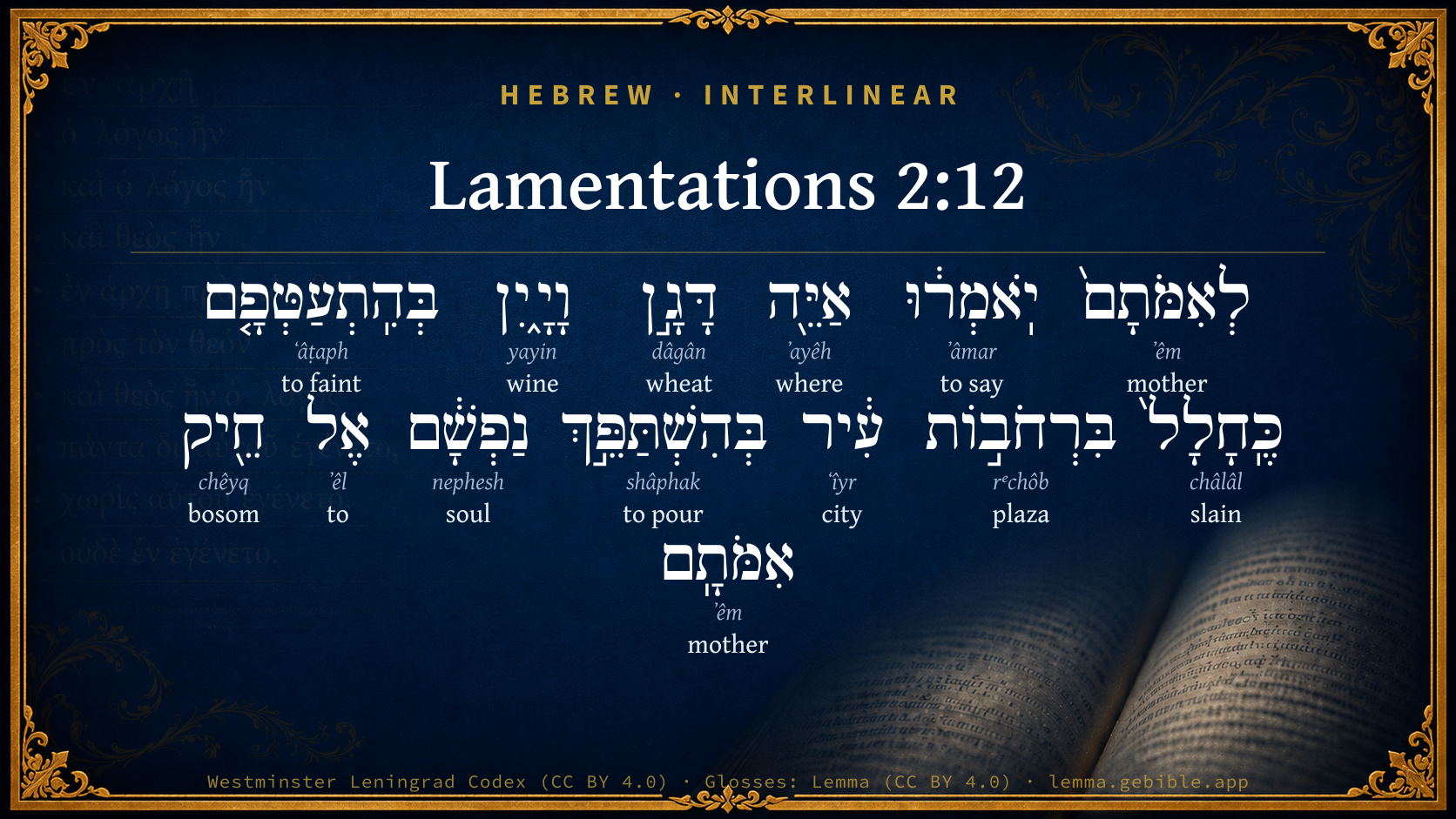
Hebrew (Westminster Leningrad Codex) Lamentations 2:12 appears in the Hebrew Old Testament. The text above is from the Westminster Leningrad Codex. Each word links to its Strong’s number, a concise gloss, and parsing drawn from the Open Scriptures Hebrew Bible morphology. Click any word for its full Brown-Driver-Briggs (BDB) entry.
Download image
Cite this verse

Lamentations 2:12 (World English Bible). Public Domain. Lemma interlinear Bible study tool, https://lemma.gebible.app/v/lamentations/2/12.

Show BibTeX & RIS
BibTeX
RIS
English Translation
They tell their mothers, Where is grain and wine? When they swoon as the wounded in the streets of the city, When their soul is poured out into their mothers' bosom.
World English Bible · Public Domain
Download a study sheet

One document with this verse’s original text, its word-by-word gloss line, the meaning frame, cross-references with their text, attributed commentary, and full source and license credits — printable, and it pastes into notes with its structure intact.

This verse Autodidact and up

Study sheet (.html) Plain text (.txt)

A passage Seminary Student

Up to 50 verses in one chapter. A passage sheet keeps up to 6 commentary sources and 12 cross-references per verse, in the order this page ranks them, and says so on the sheet whenever that leaves anything out. Ask for a single verse and you get the Autodidact verse sheet above.

Everything on this page stays free to read, with no account — the sheet is a download of what is already on screen, not access to it.

Want to remove ads? Support Godless Engineer
Compare translations 3

The same verse in 3 English versions, stacked beneath the original-language interlinear above. Click any original word for its lexicon entry.

Each is an independent rendering of the whole verse — the interlinear is not word-aligned to these translations.

Highlighted words mark where these versions differ — a whole-verse word diff, not a word-by-word alignment.

  • World English Bible Public Domain
    They tell their mothers, Where is grain and wine? When they swoon as the wounded in the streets of the city, When their soul is poured out into their mothers' bosom.
  • King James Version Public Domain
    They say to their mothers, Where is corn and wine? when they swooned as the wounded in the streets of the city, when their soul was poured out into their mothers' bosom.
  • unfoldingWord Literal Text CC BY-SA 4.0
    To their mothers they say, “Where is grain and wine?” when they faint like the slain in the streets of the city, when their life is poured out in the lap of their mothers. MEM

unfoldingWord Literal Text — © unfoldingWord, licensed CC BY-SA 4.0. Word-aligned USFM3 via Door43 (git.door43.org/unfoldingWord/en_ult).

Versions to compare (up to 4)

3 of 4 selected

Show all 18 translations

Every available English version of this verse, each an independent rendering of the whole verse.

  • World English Bible Public Domain
    They tell their mothers, Where is grain and wine? When they swoon as the wounded in the streets of the city, When their soul is poured out into their mothers' bosom.
  • Berean Standard Bible Public Domain
    They cry out to their mothers: “Where is the grain and wine?” as they faint like the wounded in the streets of the city, as their lives fade away in the arms of their mothers.
  • Majority Standard Bible Public Domain
    They cry out to their mothers: “Where is the grain and wine?” as they faint like the wounded in the streets of the city, as their lives fade away in the arms of their mothers.
  • King James Version Public Domain
    They say to their mothers, Where is corn and wine? when they swooned as the wounded in the streets of the city, when their soul was poured out into their mothers' bosom.
  • American Standard Version (1901) Public Domain
    They say to their mothers, Where is grain and wine? When they swoon as the wounded in the streets of the city, When their soul is poured out into their mothers' bosom.
  • Revised Version (1885) Public Domain
    They say to their mothers, Where is corn and wine? when they swoon as the wounded in the streets of the city, when their soul is poured out into their mothers’ bosom.
  • Geneva Bible (1599) Public Domain
    They haue sayd to their mothers, Where is bread and drinke? when they swooned as the wounded in the streetes of the citie, and whe they gaue vp the ghost in their mothers bosome.
  • Douay-Rheims (1899) Public Domain
    Lamed. They said to their mothers: Where is corn and wine? when they fainted away as the wounded in the streets of the city: when they breathed out their souls in the bosoms of their mothers.
  • Young's Literal Translation Public Domain
    To their mothers they say, `Where `are' corn and wine?' In their becoming feeble as a pierced one In the broad places of the city, In their soul pouring itself out into the bosom of their mothers.
  • Literal Standard Version CC BY-SA 4.0
    To their mothers they say, || “Where [are] grain and wine?” In their becoming feeble as a pierced one || In the broad places of the city, || In their soul pouring itself out into the bosom of their mothers.
  • Unlocked Literal Bible CC BY-SA 4.0
    They say to their mothers, “Where is grain and wine?” as they faint like a wounded man in the streets of the city, their lives are poured out on the bosom of their mothers.
  • unfoldingWord Literal Text CC BY-SA 4.0
    To their mothers they say, “Where is grain and wine?” when they faint like the slain in the streets of the city, when their life is poured out in the lap of their mothers. MEM
  • Darby Bible Public Domain
    They say to their mothers, Where is corn and wine? when they swoon as the wounded in the streets of the city; when they pour out their soul into their mothers' bosom.
  • World Messianic Bible Public Domain
    They ask their mothers, “Where is grain and wine?” when they swoon as the wounded in the streets of the city, when their soul is poured out into their mothers’ bosom.
  • Webster's Bible Public Domain
    They say to their mothers, Where is corn and wine? when they swooned as the wounded in the streets of the city, when their soul was poured out into their mothers' bosom.
  • Free Bible Version CC BY-SA 4.0
    They cry out to their mothers, “We need food and drink!” fainting in the city streets as if they're wounded, their lives fading away in their mothers' arms.
  • Bible in Basic English Public Domain
    They say to their mothers, Where is grain and wine? when they are falling like the wounded in the open squares of the town, when their life is drained out on their mother's breast.
  • JPS Tanakh (1917) Public Domain
    They say to their mothers: 'Where is corn and wine?' when they swoon as the wounded in the broad places of the city, when their soul is poured out into their mothers' bosom.

Literal Standard Version (2020), Covenant Press — licensed CC BY-SA 4.0. Text via the HelloAO Bible API (eBible.org). Unlocked Literal Bible (unfoldingWord) — licensed CC BY-SA 4.0. Text via the HelloAO Bible API (eBible.org). unfoldingWord Literal Text — © unfoldingWord, licensed CC BY-SA 4.0. Word-aligned USFM3 via Door43 (git.door43.org/unfoldingWord/en_ult). Free Bible Version, Dr. Jonathan Gallagher — licensed CC BY-SA 4.0. Text via the HelloAO Bible API (eBible.org).

Word by word

More ways to search: Search by grammar → Find every occurrence → Compare this word →

Practice this passage: Drill this verse → Learn its vocabulary →

בְּהִֽתְעַטְּפָ֤ם
ʻâṭaph
H5848
“in/at · to faint · them”
Preposition + Verb, Hithpael, Infinitive Construct + Suffix, Personal, 3rd Person, Masculine, Plural
Part of Speech
Preposition + Verb
Stem
Hithpael
Form
Infinitive Construct
Full BDB Definition

Origin: a primitive root

TWOT: 1605 , 1606 , 1607

to turn aside - (Qal) to turn aside, turn (in order to cover) - to envelop oneself - (Qal) to envelop oneself, cover - to be feeble, be faint, grow weak - (Qal) to be feeble, be faint - (Niphal) to faint - (Hiphil) to show feebleness - (Hithpael) to faint, faint away
  1. לְאִמֹּתָם֙ ʼêm H517 “to/for · mothers · their” Preposition + Noun, Common, Feminine, Plural, Construct + Suffix, Personal, 3rd Person, Masculine, Plural
  2. יֹֽאמְר֔וּ ʼâmar H559 “to say” Verb, Qal, Imperfect, 3rd Person, Masculine, Plural
  3. אַיֵּ֖ה ʼayêh H346 “where” Particle, Interrogative
  4. דָּגָ֣ן dâgân H1715 “wheat” Noun, Common, Masculine, Singular, Absolute
  5. וָיָ֑יִן yayin H3196 “and · wine” Conjunction + Noun, Common, Masculine, Singular, Absolute
  6. כֶּֽחָלָל֙ châlâl H2491 “like/as the · slain” Preposition, Determined + Adjective, Adjective, Masculine, Singular, Absolute
  7. בִּרְחֹב֣וֹת rᵉchôb H7339 “in/at · plazas of” Preposition + Noun, Common, Feminine, Plural, Construct
  8. עִ֔יר ʻîyr H5892 “city” Noun, Common, Feminine, Singular, Absolute
  9. בְּהִשְׁתַּפֵּ֣ךְ shâphak H8210 “in/at · to pour” Preposition + Verb, Hithpael, Infinitive Construct
  10. נַפְשָׁ֔ם nephesh H5315 “soul · their” Noun, Common, Both, Singular, Construct + Suffix, Personal, 3rd Person, Masculine, Plural
  11. אֶל ʼêl H413 “to” Preposition
  12. חֵ֖יק chêyq H2436 “bosom of” Noun, Common, Masculine, Singular, Construct
  13. אִמֹּתָֽם ʼêm H517 “mothers · their” Noun, Common, Feminine, Plural, Construct + Suffix, Personal, 3rd Person, Masculine, Plural

About this verse

These counts appear in no published source. They are computed here, from the morphology-tagged text and Lemma’s own curated glosses. What Lemma adds →

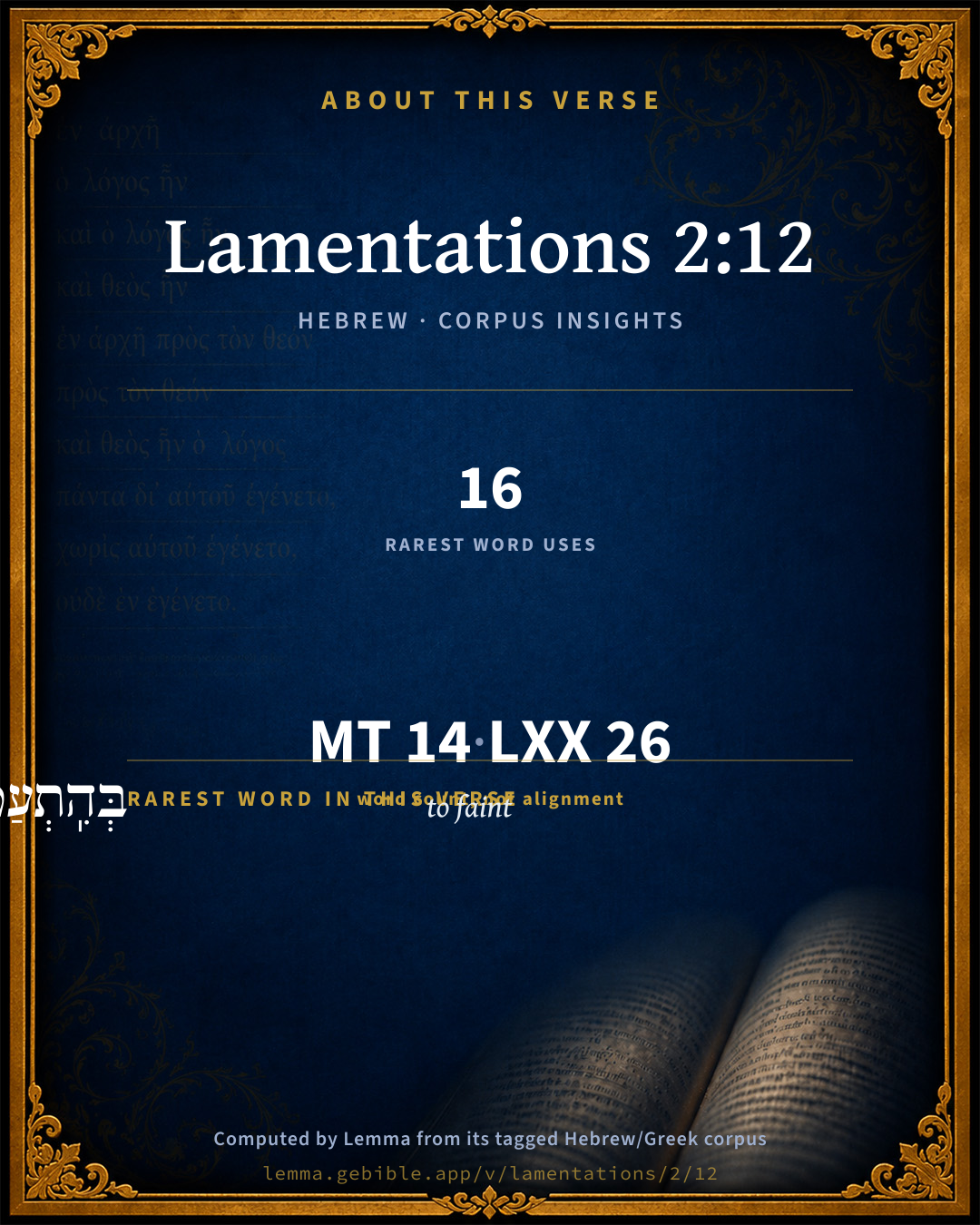
14
words
13
distinct lemmas
Prophets
section

Notable vocabulary

The rarest word here is בְּהִֽתְעַטְּפָ֤ם to faint H5848 — appearing just 16 times in the whole Hebrew Bible.

Shared distinctive vocabulary

בְּהִֽתְעַטְּפָ֤ם to faint H5848 occurs in 15 verses of the Hebrew Bible. Also found in:

Grammatical profile

  • 3 verbs
  • 8 nouns
  • 1 adjective
  • 1 preposition
  • 1 particle

Verb forms

  • יֹֽאמְר֔וּ Qal · Imperfect
  • בְּהִֽתְעַטְּפָ֤ם Hithpael · Infinitive Construct
  • בְּהִשְׁתַּפֵּ֣ךְ Hithpael · Infinitive Construct

Repetition

A word recurs within this verse — often emphatic in Hebrew:

  • לְאִמֹּתָם֙ mother H517 ×2

Hebrew & Septuagint length

In English translation the verse runs 31 words from the Hebrew and 33 from the Septuagint (LXX English) — closely comparable.

A rough comparison of the two English renderings, which tokenize alike — not a word-level alignment.

Word counts can differ between the Hebrew and the Greek without any difference in meaning — e.g. the Hebrew direct-object marker אֵת has no separate Greek word, and Greek often adds the article ὁ.

In the original languages it is 14 Hebrew tokens and 26 Greek tokens — but the two are counted differently (Hebrew bundles its prefixes and suffixes into one token; the Greek is in lemma form), so that isn’t a like-for-like length.

Cross-references

2

Topical passages linked to Lamentations 2:12 in the Treasury of Scripture Knowledge — connected by theme and wording, ordered by reader-vote popularity; previews shown in the World English Bible.

  • Isaiah 53:12 Therefore will I divide him a portion with the great, and he shall divide the spoil with the strong; because he poured out his soul to death, and was numbered with the transgressors: yet he bore the sin of many, and made intercession for the transgressors.
  • Ezekiel 30:24 I will strengthen the arms of the king of Babylon, and put my sword in his hand: but I will break the arms of Pharaoh, and he shall groan before him with the groanings of a deadly wounded man.

Cross-references courtesy of OpenBible.info (CC BY 4.0).

Hebrew and Greek witnesses Masoretic Hebrew ↔ Greek Septuagint

The same verse in the two great witnesses to the Old Testament, shown verse-for-verse.

These are two independent witnesses, not word-aligned to each other, and the Septuagint is shown in lemma (dictionary) form.

Hebrew Lamentations 2:12 Masoretic · Westminster Leningrad Codex

לְאִמֹּתָם֙ יֹֽאמְר֔וּ אַיֵּ֖ה דָּגָ֣ן וָיָ֑יִן בְּהִֽתְעַטְּפָ֤ם כֶּֽחָלָל֙ בִּרְחֹב֣וֹת עִ֔יר בְּהִשְׁתַּפֵּ֣ךְ נַפְשָׁ֔ם אֶל חֵ֖יק אִמֹּתָֽם

They tell their mothers, Where is grain and wine? When they swoon as the wounded in the streets of the city, When their soul is poured out into their mothers' bosom.

World English Bible · Public Domain

Greek LXX Lamentations 2:12 Septuagint · lemma form

ὁ μήτηρ αὐτός εἶπον ποῦ σῖτος καί οἶνος ἐν ὁ ἐκλύω αὐτός ὡς τραυματίας ἐν πλατύς πόλις ἐν ὁ ἐκχέω ψυχή αὐτός εἰς κόλπος μήτηρ αὐτός

LAMED. They said to their mothers, Where is corn and wine? while they fainted like wounded men in the streets of the city, while their souls were poured out into their mother's bosom.

LXX2012 (modern English Septuagint) · Public Domain

Hebrew: Westminster Leningrad Codex (CC BY 4.0). Greek: Septuagint (public domain); English from LXX2012 (modern English Septuagint) (Public Domain). How the Septuagint differs from the Hebrew →

Commentary

Notes on Lamentations 2:12 from classic Christian and Jewish commentators (each source and its license shown beneath its notes). The classic Christian expositions comment on the surrounding passage and are grouped to its opening verse, so a note may address several verses; the Jewish commentaries on the Tanakh (Rashi and others) are per-verse, so they appear only where the commentator wrote on this verse.

Lemma curates 59 commentaries, every one of them public domain or Creative Commons licensed, each selected and text-cleaned for this edition rather than reprinted as found. About our sources →

Trapp's Complete Commentary

John Trapp

Lam 2:12 They say to their mothers, Where [is] corn and wine? when they swooned as the wounded in the streets of the city, when their soul was poured out into their mothers’ bosom.

Ver. 12. They say to their mothers.] Lege et luge. Gather and mourne.

“ Tu quibus ista leges incertum est, Lector, ocellis:

Ipse quidem siccis scribere vix potui. ”

As oft as I read the Lamentations of Jeremiah, saith Gregory Nazianzen, {a} my voice faileth me, and I am overwhelmed with tears. The misery of that poor people cometh under my view, as it were, and my heart is therewith very much affected and afflicted.

Where is corn and wine.] Frumentum dicunt, non panem. They say grain not bread. Grain they would have been glad of, though unground, saith one; wine they ask for, and not water, which noteth an ill custom in their mothers to drink wine, and to give it their little ones; but by grain and wine here may be meant necessary food, to keep them alive.

When their soul was poured out into the mother’s bosom.] As it were giving them their lives again, seeing they yielded them no food to preserve them alive.

{a} Orat. i. Pacificat.

John Trapp, A Commentary or Exposition upon All the Books of the Old and New Testament (1647–1656) — public domain. Text from a community e-Sword module.

Geneva Bible (1599)

Geneva Bible translators

Hebrew, wheat and wine.

Hebrew, poured out the soul.

Geneva Bible (1599) marginal notes — public domain. Text via Bolls.life.

Jamieson, Fausset & Brown

Robert Jamieson, A. R. Fausset & David Brown

as the wounded--famine being as deadly as the sword (Jer 52:6).

soul . . . poured . . . into . . . mothers bosom--Instinctively turning to their mother's bosom, but finding no milk there, they breathe out their life as it were "into her bosom."

Jamieson, Fausset & Brown — Commentary Critical and Explanatory on the Whole Bible (1871) — public domain (CC PDM 1.0). Text via the HelloAO Bible API.

Adam Clarke's Commentary

Verse 12. When their soul was poured out into their mothers' bosom.] When, in endeavouring to draw nourishment from the breasts of their exhausted mothers, they breathed their last in their bosoms! How dreadfully afflicting was this!

Adam Clarke's Commentary on the Bible (1810–1826) — public domain. Text from a community e-Sword/MySword module.

John Calvin's Commentaries

There is either a personification in the words of the Prophet, or he speaks now of another party, for he cannot refer now to children sucking their mothers’ breasts, for they could not have expressly said, Where is corn and wine? and the use of wine is not allowed to infants. Then the words of the Prophets extend further, for not infants, but children somewhat grown up, could have thus spoken. And in this view there is nothing unreasonable or forced, for he spoke of little children, and to little children he joined infants. And now he refers only to one party, even that children, who could now speak, complained to their mothers that there was no bread nor wine, that is, no means of support, no food.

If, however, any one prefers a personification, I do not object; and this view would not be unsuitable, that even infants by their silence cried for food; for the tears of children speak more efficaciously than when one gives utterance to words.

However this may be, the Prophet intimates that such was the scarcity, that children died in the bosom of their mothers, and in vain sought food and cried that they were without support. He then says that they said to their mothers; by which expression he means that their complaints were the more pitiable, because their mothers could afford them no help. And we know how tender and affectionate are the feelings of mothers, for a mother would willingly nourish her own child, not only with her own milk, but even, if possible, with her life. When, therefore, the Prophet says that children cried to their mothers, he means to represent a sad spectacle, and which ought justly to produce horror in the minds of all. Where is bread and wine? he says, even when they vanished away (some say “fainted,” but I prefer, as I have said, this rendering) as a dead man in the streets; and further, when they poured out, a sadder thing still, — when they poured out their souls into the bosom of their mothers. It now follows, —

John Calvin's Commentaries (1540-1563) — public domain. Text from the Calvin Translation Society English edition (1840s-50s) via the Christian Classics Ethereal Library (ccel.org). Calvin's coverage is partial (roughly two-thirds of the Bible); uncommented books and verses are honest gaps, never fabricated. The 19th-century editor's footnotes and remarks are omitted so the notes are faithfully Calvin's own voice.

Ellicott's Commentary for English Readers

(12) They say . . .—The words seem to paint what was actually passing before the writer’s eye, but may be the vivid present which represents the past. The children cried for food, and their mothers had none to give them. They were like wounded men at their last gasp, and breathed out their life as they clung in their despair to their mothers’ breasts.

A Bible Commentary for English Readers, edited by Charles John Ellicott (1878–1897) — public domain. Text from a community e-Sword module.

The Cambridge Bible for Schools and Colleges

gen. ed. J. J. S. Perowne

12. corn and wine] Omit “and wine,” not only from the nature of the case, and for the sake of correct metre, but because the Heb. word is not that elsewhere used in combination with “corn.”

their soul is poured out, etc.] They swoon as the unhappy mother clasps them in her arms.

The Cambridge Bible for Schools and Colleges (gen. ed. J. J. S. Perowne; Cambridge University Press, 1878–1918) — public domain. Text from a community e-Sword module.

John Gill's Exposition

They say to their mothers, where is corn and wine?.... Not the sucklings who could not speak, nor were used to corn and wine, but the children more grown; both are before spoken of, but these are meant, even the young men of Israel, as the Targum; and such as had been brought up in the best manner, had been used to wine, and not water, and therefore ask for that as well as corn; both take in all the necessaries of life; and which they ask of their mothers, who had been used to feed them, and were most tender of them; but now not seeing and having their usual provisions, and not knowing what was the reason of it, inquire after them, being pressed with hunger:

when they swooned as the wounded in the streets of the city; having no food given them, though they asked for it time after time, they fainted away, and died a lingering death; as wounded persons do who are not killed at once, which is the more distressing:

when their soul was poured out into their mothers' bosom; meaning not the desires of their souls for food, expressed in moving and melting language as they sat in their mothers' laps, and lay in their bosoms; which must be piercing unto them, if no more was designed; but their souls or lives themselves, which they gave up through famine, as the Targum; expiring in their mothers' arms.

John Gill's Exposition of the Whole Bible (1746–1763) — public domain (CC PDM 1.0). Text via the HelloAO Bible API.

Albert Barnes' Notes on the Bible

They say - Or, “They keep saying:” it was an oft-repeated cry, even while expiring upon their mother’s bosom.

Albert Barnes' Notes on the Bible (1834–1885) — public domain. Text from a community e-Sword/MySword module.

Matthew Poole's English Annotations

The little children, ignorant of the cause of the failure of their usual food, called to their mothers for it as formerly, being ready to faint and die, as men mortally wounded, for want of spirits and blood, use to faint, and died in their mothers’ arms; for so I had rather interpret the phrase poured out their souls, than (as some) understand by souls the desires of their souls, for he is speaking of sucklings as well as more grown children: the phrase is capable of both senses.

Matthew Poole's English Annotations on the Holy Bible (1683–1685) — public domain. Text from a community e-Sword/MySword module.

The Pulpit Commentary

Corn. Either in the sense of parched corn (comp. Lev_23:14 1Sa_17:17 Pro_27:22) or a poetic expression for "bread" (comp. Exo_16:4 Ps 40)

The suffering of the children.

It must be noticed how the mention of the children follows on the mention of the elders. There is suffering at each extreme of life, and hence we are to infer that there is suffering all between. The eiders suffer in their way and the children and the sucklings suffer in theirs. The elders are bowed down with confusion, shame, and disappointment. The children know nothing of this, but they are tormented with the pangs of hunger; and what a pathetic touch is that which represents them as breathing out their little lives into the bosom of their mothers! The sins of the parents are being visited upon the children. It has often been represented as a monstrous iniquity that things should be put in such a light, but is it not an undeniable fact that the little ones suffer what they would not suffer if progenitors always did what was right? These children were not clamouring for dainties and luxuries. Corn and wine, the common food, the pleasant grape juice, what they had been used to and what all at once they began to miss. What is here said is a strong admonition to us to consider how the innocent and unsuspecting may be affected by our unrighteousness. All our conduct must affect others, and it may affect those who cannot lift a hand to avert ill consequences. The sufferings of children and infants, the immense mortality among them, these are things awful to contemplate; and yet nothing can be more certain than that the clearing away of prejudice and ignorance and hurtful habits founded on bare tradition would bring into child life that abundance of joy which a loving Creator of human nature meant children to attain. But even with all the suffering there are compensations. These hunger-stricken children cried for bread, and getting none they poured out their lives into their mothers" bosoms; but they had no self-reproach. Remorse did not add another degree of agony to starvation. The suffering which touches the conscience is the worst, and the little ones escape it altogether. Y.

The Pulpit Commentary (1880–1919), ed. H.D.M. Spence-Jones & Joseph S. Exell — public domain. Text from a community e-Sword module.

John Wesley's Explanatory Notes

Bosom - When they died in their mother's arms.

John Wesley, Explanatory Notes Upon the Whole Bible (1754–1765) — public domain. Text via the GEBible commentary corpus.

Lesson kit

Teaching starters — assembled from the data on this page, not authored interpretation. Every prompt links to the verse data it draws on. Edit before teaching.

Lamentations, in the Prophets, opens this verse with 14 words (13 distinct Hebrew lemmas). Its most distinctive word is ʻâṭaph (“to faint”). A historical commentator’s framing appears above. Read the whole chapter for the surrounding context.

Discussion questions

  1. The word ʻâṭaph carries the sense “to faint.” How does it shape the verse?
  2. Genesis 30:42 shares the word «to faint» with this verse. How do the two illuminate each other?
  3. “mother” occurs 2× in this one verse. What is the effect of the repetition?
  4. These translations render this verse differently. What is at stake in choosing one wording over another?
  5. The verb «יֹֽאמְר֔וּ» is Qal Imperfect. How does its form color the action?
  6. Reading how Trapp's Complete Commentary and Geneva Bible (1599) read this verse, where do the two commentators agree and where do they part?

Things to notice

Reading settings

Reading text

Shown beneath each verse's original-language words.

Old Testament
Old Testament edition

Read the OT as the Masoretic Hebrew (MT) or the Greek Septuagint (LXX).

English shown for the Greek Septuagint (in the Hebrew ↔ Greek comparison).

Comparing translations? Open the Compare panel on any verse page to stack up to four side by side.