
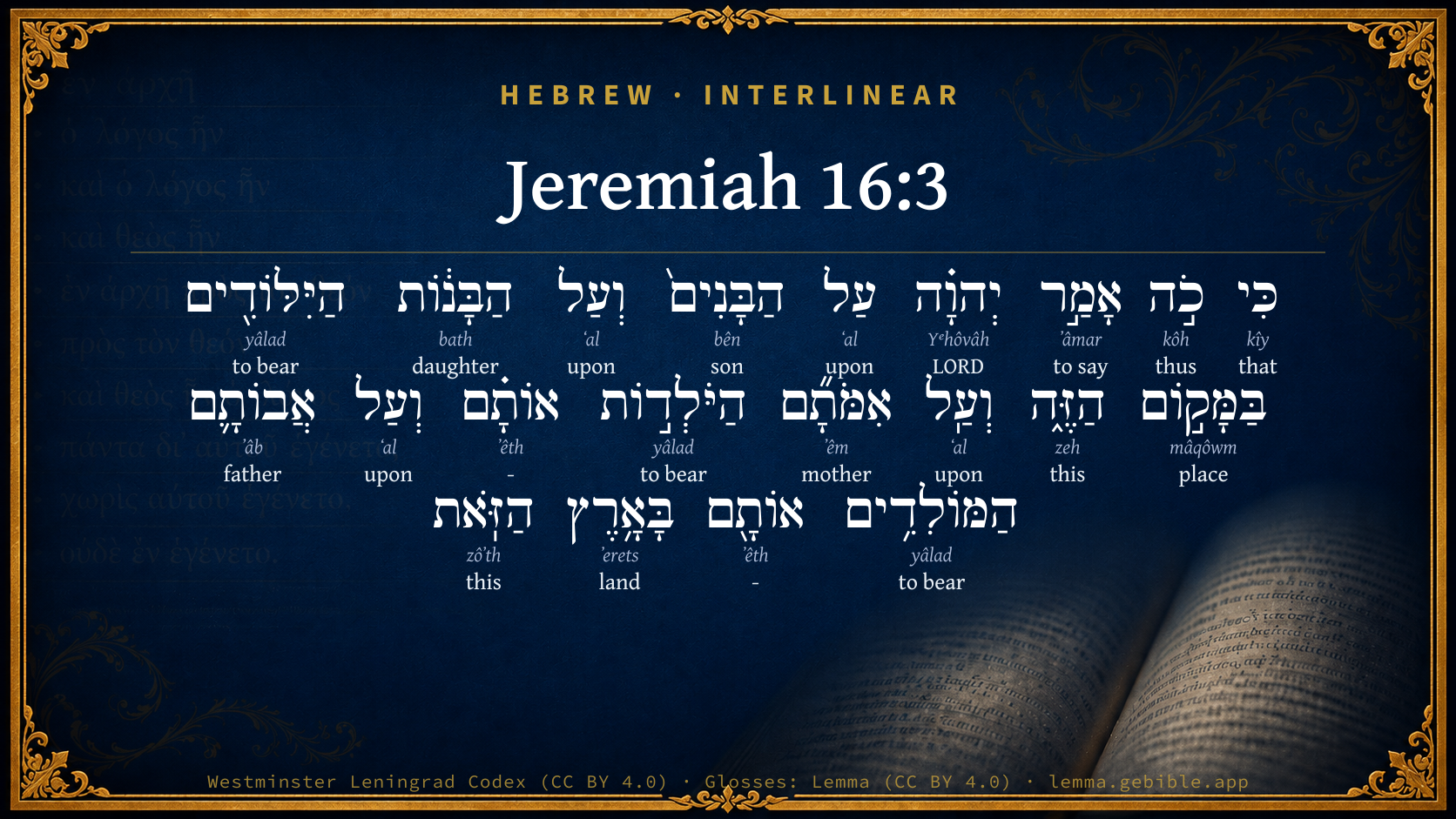
Jeremiah 16:3

Hebrew (Westminster Leningrad Codex) Jeremiah 16:3 appears in the Hebrew Old Testament. The text above is from the Westminster Leningrad Codex. Each word links to its Strong’s number, a concise gloss, and parsing drawn from the Open Scriptures Hebrew Bible morphology. Click any word for its full Brown-Driver-Briggs (BDB) entry.
Download image
Cite this verse

Jeremiah 16:3 (World English Bible). Public Domain. Lemma interlinear Bible study tool, https://lemma.gebible.app/v/jeremiah/16/3.

Show BibTeX & RIS
BibTeX
RIS
English Translation
For thus says Yahweh concerning the sons and concerning the daughters who are born in this place, and concerning their mothers who bore them, and concerning their fathers who became the father of them in this land:
World English Bible · Public Domain
Download a study sheet

One document with this verse’s original text, its word-by-word gloss line, the meaning frame, cross-references with their text, attributed commentary, and full source and license credits — printable, and it pastes into notes with its structure intact.

This verse Autodidact and up

Study sheet (.html) Plain text (.txt)

A passage Seminary Student

Up to 50 verses in one chapter. A passage sheet keeps up to 6 commentary sources and 12 cross-references per verse, in the order this page ranks them, and says so on the sheet whenever that leaves anything out. Ask for a single verse and you get the Autodidact verse sheet above.

Everything on this page stays free to read, with no account — the sheet is a download of what is already on screen, not access to it.

Want to remove ads? Support Godless Engineer
Compare translations 3

The same verse in 3 English versions, stacked beneath the original-language interlinear above. Click any original word for its lexicon entry.

Each is an independent rendering of the whole verse — the interlinear is not word-aligned to these translations.

Highlighted words mark where these versions differ — a whole-verse word diff, not a word-by-word alignment.

  • World English Bible Public Domain
    For thus says Yahweh concerning the sons and concerning the daughters who are born in this place, and concerning their mothers who bore them, and concerning their fathers who became the father of them in this land:
  • King James Version Public Domain
    For thus saith the LORD concerning the sons and concerning the daughters that are born in this place, and concerning their mothers that bare them, and concerning their fathers that begat them in this land;
  • unfoldingWord Literal Text CC BY-SA 4.0
    For thus says Yahweh about the sons and the daughters, the ones born in this place, and about their mothers who bear them, and about their fathers, the ones fathering them in this land,

unfoldingWord Literal Text — © unfoldingWord, licensed CC BY-SA 4.0. Word-aligned USFM3 via Door43 (git.door43.org/unfoldingWord/en_ult).

Versions to compare (up to 4)

3 of 4 selected

Show all 18 translations

Every available English version of this verse, each an independent rendering of the whole verse.

  • World English Bible Public Domain
    For thus says Yahweh concerning the sons and concerning the daughters who are born in this place, and concerning their mothers who bore them, and concerning their fathers who became the father of them in this land:
  • Berean Standard Bible Public Domain
    For this is what the LORD says concerning the sons and daughters born in this place, and the mothers who bore them, and the fathers who fathered them in this land:
  • Majority Standard Bible Public Domain
    For this is what the LORD says concerning the sons and daughters born in this place, and the mothers who bore them, and the fathers who fathered them in this land:
  • King James Version Public Domain
    For thus saith the LORD concerning the sons and concerning the daughters that are born in this place, and concerning their mothers that bare them, and concerning their fathers that begat them in this land;
  • American Standard Version (1901) Public Domain
    For thus saith Jehovah concerning the sons and concerning the daughters that are born in this place, and concerning their mothers that bare them, and concerning their fathers that begat them in this land:
  • Revised Version (1885) Public Domain
    For thus saith the LORD concerning the sons and concerning the daughters that are born in this place, and concerning their mothers that bare them, and concerning their fathers that begat them in this land:
  • Geneva Bible (1599) Public Domain
    For thus sayeth the Lord concerning the sonnes, and concerning the daughters that are borne in this place, and concerning their mothers that beare them, and concerning their fathers, that beget them in this land,
  • Douay-Rheims (1899) Public Domain
    For thus saith the Lord concerning the sons and daughters, that are born in this place, and concerning their mothers that bore them: and concerning their fathers, of whom they were born in this land:
  • Young's Literal Translation Public Domain
    For thus said Jehovah, Of the sons and of the daughters who are born in this place, And of their mothers -- those bearing them, And of their fathers -- those begetting them in this land:
  • Literal Standard Version CC BY-SA 4.0
    For thus said YHWH, || Of the sons and of the daughters who are born in this place, || And of their mothers—those bearing them, || And of their fathers—those begetting them in this land:
  • Unlocked Literal Bible CC BY-SA 4.0
    For Yahweh says this to the sons and daughters who are born in this place, to the mothers who bear them, and to the fathers who caused them to be born in this land,
  • unfoldingWord Literal Text CC BY-SA 4.0
    For thus says Yahweh about the sons and the daughters, the ones born in this place, and about their mothers who bear them, and about their fathers, the ones fathering them in this land,
  • Darby Bible Public Domain
    For thus saith Jehovah concerning the sons and concerning the daughters that are born in this place, and concerning their mothers that bear them, and concerning their fathers that beget them in this land:
  • World Messianic Bible Public Domain
    For the LORD says concerning the sons and concerning the daughters who are born in this place, and concerning their mothers who bore them, and concerning their fathers who became their father in this land:
  • Webster's Bible Public Domain
    For thus saith the LORD concerning the sons and concerning the daughters that are born in this place, and concerning their mothers that bore them, and concerning their fathers that begat them in this land;
  • Free Bible Version CC BY-SA 4.0
    This is what the Lord says about children born here, and about their mothers and fathers—their parents here in this country:
  • Bible in Basic English Public Domain
    For this is what the Lord has said about the sons and daughters who come to birth in this place, and about their mothers who have given them birth, and about their fathers who have given life to them in this land:
  • JPS Tanakh (1917) Public Domain
    For thus saith the LORD concerning the sons and concerning the daughters that are born in this place, and concerning their mothers that bore them, and concerning their fathers that begot them in this land:

Literal Standard Version (2020), Covenant Press — licensed CC BY-SA 4.0. Text via the HelloAO Bible API (eBible.org). Unlocked Literal Bible (unfoldingWord) — licensed CC BY-SA 4.0. Text via the HelloAO Bible API (eBible.org). unfoldingWord Literal Text — © unfoldingWord, licensed CC BY-SA 4.0. Word-aligned USFM3 via Door43 (git.door43.org/unfoldingWord/en_ult). Free Bible Version, Dr. Jonathan Gallagher — licensed CC BY-SA 4.0. Text via the HelloAO Bible API (eBible.org).

Word by word

More ways to search: Search by grammar → Find every occurrence → Compare this word →

Practice this passage: Drill this verse → Learn its vocabulary →

אִמֹּתָ֞ם
ʼêm
H517
“mothers · their”
Noun, Common, Feminine, Plural, Construct + Suffix, Personal, 3rd Person, Masculine, Plural
Part of Speech
Noun
Type
Common
Gender
Feminine
Number
Plural
State
Construct
Full BDB Definition

Origin: a primitive word

TWOT: 115a

mother - of humans - of Deborah's relationship to the people (figuratively) - of animals - point of departure or division
  1. כִּי kîy H3588 “that” Conjunction
  2. כֹ֣ה kôh H3541 “thus” Adverb
  3. אָמַ֣ר ʼâmar H559 “to say” Verb, Qal, Perfect, 3rd Person, Masculine, Singular
  4. יְהוָ֗ה Yᵉhôvâh H3068 “LORD” Noun, Proper
  5. עַל ʻal H5921 “upon” Preposition
  6. הַבָּנִים֙ bên H1121 “the · sons” Particle, Definite Article + Noun, Common, Masculine, Plural, Absolute
  7. וְעַל ʻal H5921 “and · upon” Conjunction + Preposition
  8. הַבָּנ֔וֹת bath H1323 “the · daughters” Particle, Definite Article + Noun, Common, Feminine, Plural, Absolute
  9. הַיִּלּוֹדִ֖ים yâlad H3205 “the · childbirth” Particle, Definite Article + Adjective, Adjective, Masculine, Plural, Absolute
  10. בַּמָּק֣וֹם mâqôwm H4725 “in/at the · place” Preposition, Determined + Noun, Common, Masculine, Singular, Absolute
  11. הַזֶּ֑ה zeh H2088 “the · this” Particle, Definite Article + Pronoun, Demonstrative, Masculine, Singular
  12. וְעַֽל ʻal H5921 “and · upon” Conjunction + Preposition
  13. הַיֹּלְד֣וֹת yâlad H3205 “the · bearing” Particle, Definite Article + Verb, Qal, Participle Active, Feminine, Plural, Absolute
  14. אוֹתָ֗ם ʼêth H853 “- · them” Particle, Direct Object + Suffix, Personal, 3rd Person, Masculine, Plural
  15. וְעַל ʻal H5921 “and · upon” Conjunction + Preposition
  16. אֲבוֹתָ֛ם ʼâb H1 “fathers · their” Noun, Common, Masculine, Plural, Construct + Suffix, Personal, 3rd Person, Masculine, Plural
  17. הַמּוֹלִדִ֥ים yâlad H3205 “the · bearing” Particle, Definite Article + Verb, Hiphil, Participle Active, Masculine, Plural, Absolute
  18. אוֹתָ֖ם ʼêth H853 “- · them” Particle, Direct Object + Suffix, Personal, 3rd Person, Masculine, Plural
  19. בָּאָ֥רֶץ ʼerets H776 “in/at the · land” Preposition, Determined + Noun, Common, Both, Singular, Absolute
  20. הַזֹּֽאת zôʼth H2063 “the · this” Particle, Definite Article + Pronoun, Demonstrative, Feminine, Singular

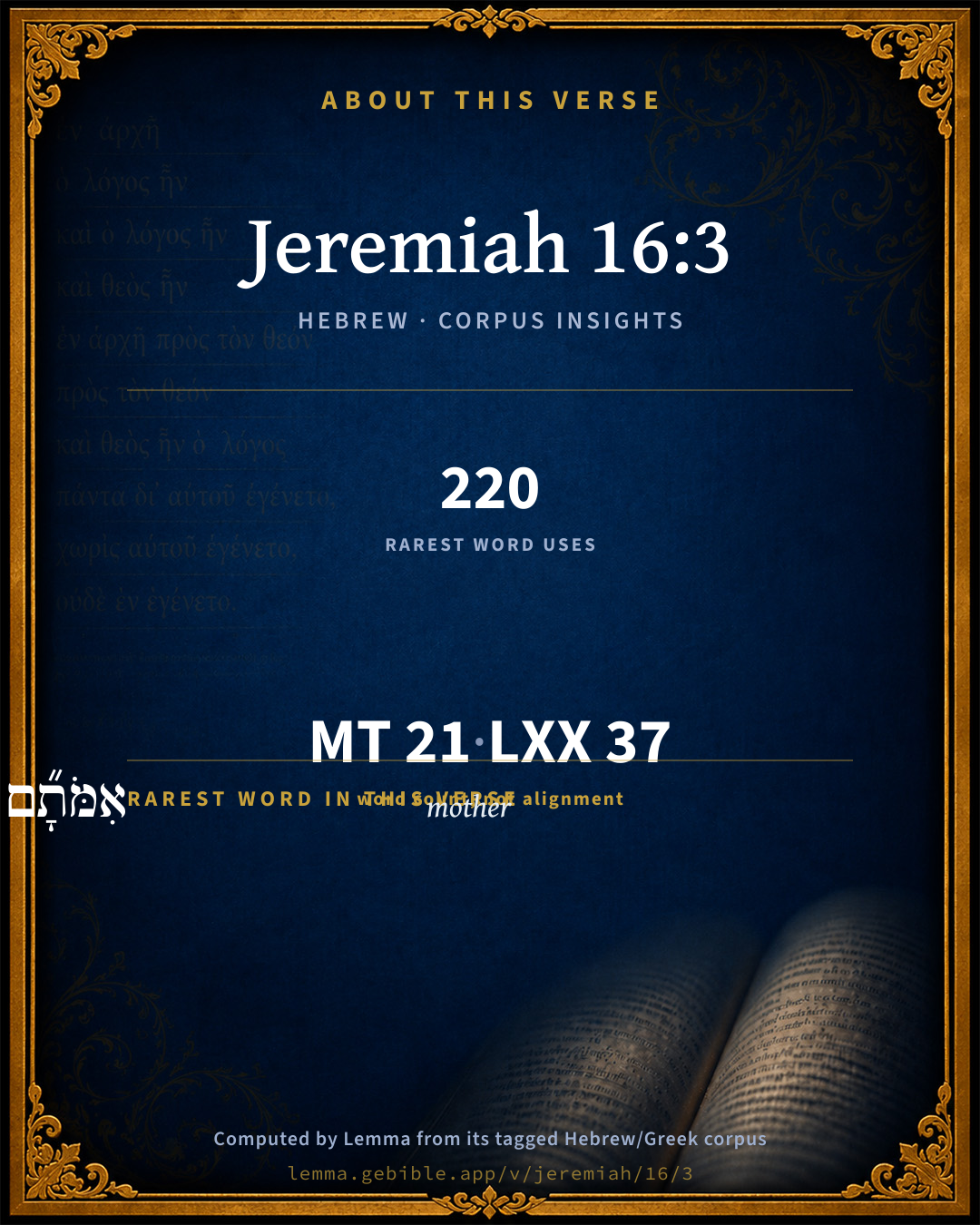
About this verse

These counts appear in no published source. They are computed here, from the morphology-tagged text and Lemma’s own curated glosses. What Lemma adds →

21
words
15
distinct lemmas
Prophets
section

Grammatical profile

  • 3 verbs
  • 7 nouns
  • 1 adjective
  • 2 pronouns
  • 4 prepositions
  • 1 conjunction
  • 1 adverb
  • 2 particles

Verb forms

  • אָמַ֣ר Qal · Perfect
  • הַיֹּלְד֣וֹת Qal · Participle Active
  • הַמּוֹלִדִ֥ים Hiphil · Participle Active

Repetition

Words recur within this verse — often emphatic in Hebrew:

  • עַל upon H5921 ×4
  • הַיִּלּוֹדִ֖ים to bear H3205 ×3

Hebrew & Septuagint length

In the original languages it is 21 Hebrew tokens and 37 Greek tokens — but the two are counted differently (Hebrew bundles its prefixes and suffixes into one token; the Greek is in lemma form), so that isn’t a like-for-like length.

Cross-references

3

Topical passages linked to Jeremiah 16:3 in the Treasury of Scripture Knowledge — connected by theme and wording, ordered by reader-vote popularity; previews shown in the World English Bible.

  • Jeremiah 6:21 Therefore thus says Yahweh, Behold, I will lay stumbling-blocks before this people; and the fathers and the sons together shall stumble against them; the neighbor and his friend shall perish.
  • Jeremiah 16:5 For thus says Yahweh, Don't enter into the house of mourning, neither go to lament, neither bemoan them; for I have taken away my peace from this people, says Yahweh, even loving kindness and tender mercies.
  • Jeremiah 16:9 For thus says Yahweh of Hosts, the God of Israel: Behold, I will cause to cease out of this place, before your eyes and in your days, the voice of mirth and the voice of gladness, the voice of the bridegroom and the voice of the bride.

Cross-references courtesy of OpenBible.info (CC BY 4.0).

Hebrew and Greek witnesses Masoretic Hebrew ↔ Greek Septuagint

The same verse in the two great witnesses to the Old Testament, shown verse-for-verse.

These are two independent witnesses, not word-aligned to each other, and the Septuagint is shown in lemma (dictionary) form.

Hebrew Jeremiah 16:3 Masoretic · Westminster Leningrad Codex

כִּי כֹ֣ה אָמַ֣ר יְהוָ֗ה עַל הַבָּנִים֙ וְעַל הַבָּנ֔וֹת הַיִּלּוֹדִ֖ים בַּמָּק֣וֹם הַזֶּ֑ה וְעַֽל אִמֹּתָ֞ם הַיֹּלְד֣וֹת אוֹתָ֗ם וְעַל אֲבוֹתָ֛ם הַמּוֹלִדִ֥ים אוֹתָ֖ם בָּאָ֥רֶץ הַזֹּֽאת

For thus says Yahweh concerning the sons and concerning the daughters who are born in this place, and concerning their mothers who bore them, and concerning their fathers who became the father of them in this land:

World English Bible · Public Domain

Greek LXX Structure differs

In the Septuagint, Jeremiah is about an eighth shorter than the Hebrew and arranges its material differently — the Oracles Against the Nations (Hebrew chapters 46–51) appear in the middle of the Greek book, after 25:13. Because the chapter and verse boundaries do not line up, a verse-for-verse comparison with the Hebrew is not shown.

A verse-for-verse comparison isn’t shown here because the chapters and verses don’t line up. Switch to the LXX edition with the MT / LXX toggle above to read the Greek directly.

Hebrew: Westminster Leningrad Codex (CC BY 4.0). Greek: Septuagint (public domain); English from a public-domain English Septuagint. How the Septuagint differs from the Hebrew →

Targum (Aramaic paraphrase)

1

The Targum is the ancient Jewish Aramaic paraphrase of the Hebrew Scriptures — an interpretive translation, not the Hebrew text itself. Onkelos (literal) and Pseudo-Jonathan (expansive) render the Torah, and Jonathan the Prophets. Coverage is partial: where no permissively-licensed English translation exists for a verse, only the Aramaic is shown. This is verse-level text, not a word-by-word alignment to the Hebrew.

  1. Targum Jonathan Prophets (Joshua–Malachi)
    אֲרֵי כִדְנַן אָמַר יְיָ עַל בְּנִין וְעַל בְּנָן דְמִתְיַלְדִין בְּאַתְרָא הָדֵין וְעַל אִמָתְהוֹן דְיָלְדִין יַתְהוֹן וְעַל אֲבָהַתְהוֹן דְמוֹלִידִין יַתְהוֹן בְּאַרְעָא הָדָא:

    (no public-domain English translation for this verse)

    Targum Jonathan — Aramaic: “Mikraot Gedolot” (public domain). English: “Sefaria Community Translation” (CC0 1.0 (public-domain dedication)); “London "Chaldee Paraphrase," 1871” (public domain). Text via Sefaria.

Commentary

Notes on Jeremiah 16:3 from classic Christian and Jewish commentators (each source and its license shown beneath its notes). The classic Christian expositions comment on the surrounding passage and are grouped to its opening verse, so a note may address several verses; the Jewish commentaries on the Tanakh (Rashi and others) are per-verse, so they appear only where the commentator wrote on this verse.

Lemma curates 59 commentaries, every one of them public domain or Creative Commons licensed, each selected and text-cleaned for this edition rather than reprinted as found. About our sources →

Trapp's Complete Commentary

John Trapp

Jer 16:3 For thus saith the LORD concerning the sons and concerning the daughters that are born in this place, and concerning their mothers that bare them, and concerning their fathers that begat them in this land;

Ver. 3. For thus saith the Lord concerning the sons - born in this place,] i.e., At Anathoth, say some; but others better, at Jerusalem. So great and grievous shall be the calamity, that married people shall be ready to wish, as Augustus did for another cause, Utinam aut caelebs vixissem, aut orbus periissem, Oh that either I had lived single, or else died childless!

John Trapp, A Commentary or Exposition upon All the Books of the Old and New Testament (1647–1656) — public domain. Text from a community e-Sword module.

Tyndale Open Study Notes

Tyndale Open Resources

16:3-4 Jeremiah’s lack of children was the basis for a lesson about the future. The time would soon come when so many children and parents would die that no one would remain to mourn for them or bury them.

Tyndale Open Study Notes — © Tyndale Open Resources, licensed CC BY-SA 4.0. Text via the HelloAO Bible API.

The Cambridge Bible for Schools and Colleges

gen. ed. J. J. S. Perowne

3. and concerning their mothers … this land] Possibly these words are a gloss, as being apparently irrelevant, but not (as Co.) the whole v., for then we should have no fitting reference for “they” of Jer_16:4.

The Cambridge Bible for Schools and Colleges (gen. ed. J. J. S. Perowne; Cambridge University Press, 1878–1918) — public domain. Text from a community e-Sword module.

John Gill's Exposition

They shall die of grievous deaths,.... Such as the sword, famine, and pestilence. The Targum particularly adds famine. It may be rendered, "deaths of diseases, or sicknesses" (u); such as are brought on by long sickness and lingering distempers; by which a man consumes gradually, as by famine, and is not snatched away at once; and which are very grievous to bear.

They shall not be lamented, neither shall they be buried; which two offices are usually done to the dead by their surviving relations; who mourn for them, and express their grief by various gestures, and which especially were used by the eastern nations; and take care that they have a decent burial: but neither of these would now be, which is mentioned as an aggravation of the calamity; that not only the deaths they should die of would be grievous ones, but after death no regard would be shown them; and that either because there would be none to do these things for them; or they would be so much taken up in providing for their own safety, and so much in concern for their own preservation, that they would not be at leisure to attend to the above things:

but they shall be as dung upon the face of the earth; lie and rot there, and be dung to the earth; which would be a just retaliation, for their filthy and abominable actions committed in the land:

and they shall be consumed by the sword, and by famine; the grievous deaths before mentioned; the sword without, and the famine within; the one more sudden, and at once, the other more lingering; and therefore may be more especially designed by the death of lingering sicknesses referred to:

and their carcasses shall be meat for the fowls of heaven, and for the beasts of the earth; lying unburied; see Jer 7:33.

(u) "mortibus aegrotationum", V. L. Pagninus, Montanus, "aegritudium", Munster, Vatablus; "mortibus morborum", Schmidt. So Stockius, p. 340, 597, who restrains it to the death of individuals by the pestilence.

John Gill's Exposition of the Whole Bible (1746–1763) — public domain (CC PDM 1.0). Text via the HelloAO Bible API.

Albert Barnes' Notes on the Bible

The times were such that for “the present distress” it was wise for all to abstain from marriage 1Co 7:26; Mat 24:19.

Albert Barnes' Notes on the Bible (1834–1885) — public domain. Text from a community e-Sword/MySword module.

Lesson kit

Teaching starters — assembled from the data on this page, not authored interpretation. Every prompt links to the verse data it draws on. Edit before teaching.

Jeremiah, in the Prophets, opens this verse with 21 words (15 distinct Hebrew lemmas). Its most distinctive word is ʼêm (“mother”). A historical commentator’s framing appears above. Read the whole chapter for the surrounding context.

Discussion questions

  1. How does “mother” (ʼêm) shape what this verse is saying?
  2. How does Jeremiah 6:21, which shares this passage’s theme, read alongside this verse?
  3. What does the repetition of “upon” (4× in this one verse) do in this verse?
  4. The translations on this page render this verse differently — a whole-verse word diff, not a word-by-word alignment. What might account for the different wordings?
  5. «אָמַ֣ר» is a Qal Perfect verb. How does that grammatical form shape the action described?
  6. Compare how Trapp's Complete Commentary and Tyndale Open Study Notes read this verse. Where do they agree or differ?

Things to notice

Reading settings

Reading text

Shown beneath each verse's original-language words.

Old Testament
Old Testament edition

Read the OT as the Masoretic Hebrew (MT) or the Greek Septuagint (LXX).

English shown for the Greek Septuagint (in the Hebrew ↔ Greek comparison).

Comparing translations? Open the Compare panel on any verse page to stack up to four side by side.