1 Samuel 2:19

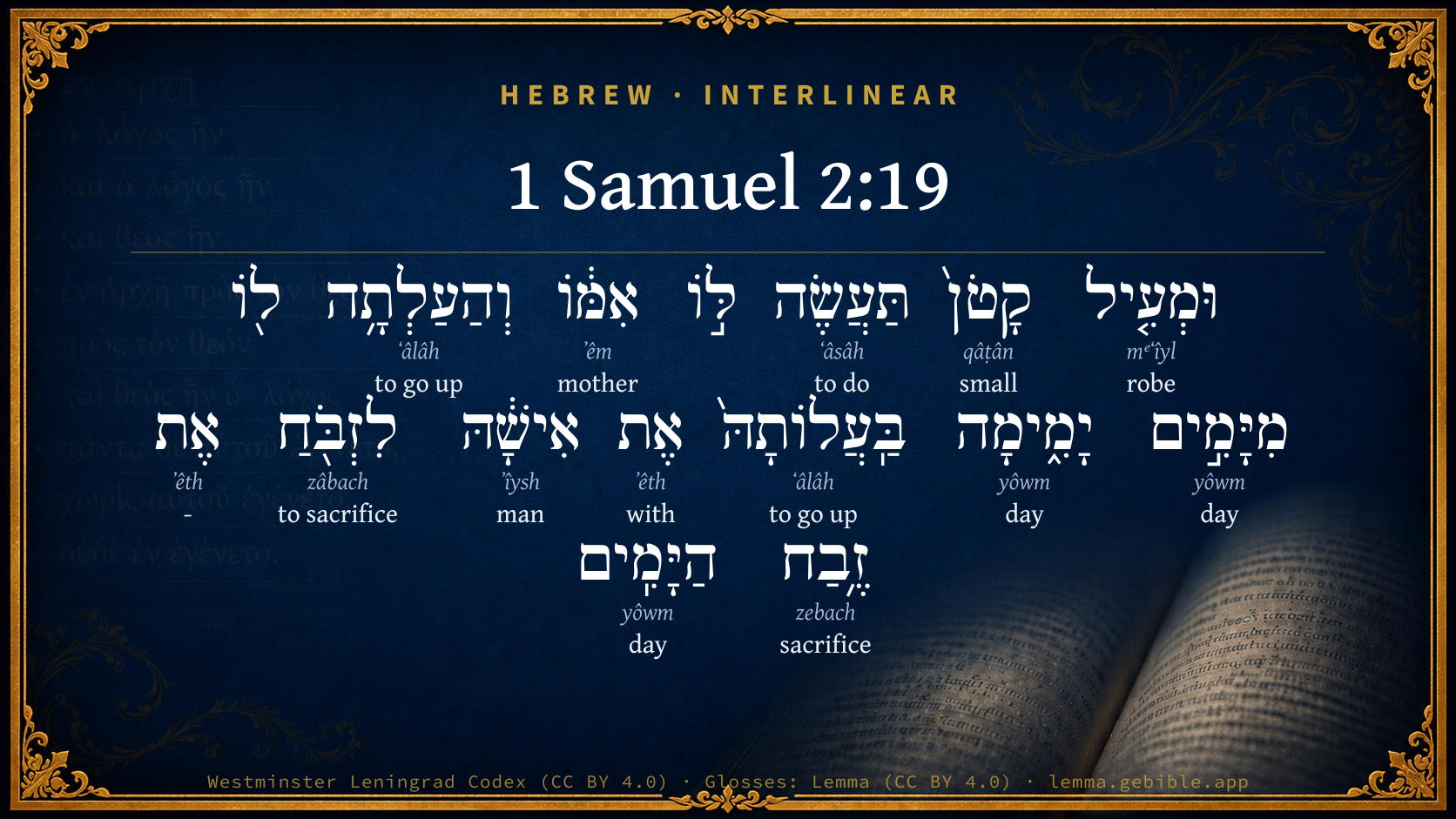
Hebrew (Westminster Leningrad Codex) 1 Samuel 2:19 appears in the Hebrew Old Testament. The text above is from the Westminster Leningrad Codex. Each word links to its Strong’s number, a concise gloss, and parsing drawn from the Open Scriptures Hebrew Bible morphology. Click any word for its full Brown-Driver-Briggs (BDB) entry.
Download image
Cite this verse

1 Samuel 2:19 (World English Bible). Public Domain. Lemma interlinear Bible study tool, https://lemma.gebible.app/v/1-samuel/2/19.

Show BibTeX & RIS
BibTeX
RIS
English Translation
Moreover his mother made him a little robe, and brought it to him from year to year, when she came up with her husband to offer the yearly sacrifice.
World English Bible · Public Domain
Download a study sheet

One document with this verse’s original text, its word-by-word gloss line, the meaning frame, cross-references with their text, attributed commentary, and full source and license credits — printable, and it pastes into notes with its structure intact.

This verse Autodidact and up

Study sheet (.html) Plain text (.txt)

A passage Seminary Student

Up to 50 verses in one chapter. A passage sheet keeps up to 6 commentary sources and 12 cross-references per verse, in the order this page ranks them, and says so on the sheet whenever that leaves anything out. Ask for a single verse and you get the Autodidact verse sheet above.

Everything on this page stays free to read, with no account — the sheet is a download of what is already on screen, not access to it.

Want to remove ads? Support Godless Engineer
Compare translations 3

The same verse in 3 English versions, stacked beneath the original-language interlinear above. Click any original word for its lexicon entry.

Each is an independent rendering of the whole verse — the interlinear is not word-aligned to these translations.

Highlighted words mark where these versions differ — a whole-verse word diff, not a word-by-word alignment.

  • World English Bible Public Domain
    Moreover his mother made him a little robe, and brought it to him from year to year, when she came up with her husband to offer the yearly sacrifice.
  • King James Version Public Domain
    Moreover his mother made him a little coat, and brought it to him from year to year, when she came up with her husband to offer the yearly sacrifice.
  • unfoldingWord Literal Text CC BY-SA 4.0
    And his mother would make a small robe for him, and she would bring to him from days to days, in her coming up with her husband to sacrifice the sacrifice of the days.

unfoldingWord Literal Text — © unfoldingWord, licensed CC BY-SA 4.0. Word-aligned USFM3 via Door43 (git.door43.org/unfoldingWord/en_ult).

Versions to compare (up to 4)

3 of 4 selected

Show all 18 translations

Every available English version of this verse, each an independent rendering of the whole verse.

  • World English Bible Public Domain
    Moreover his mother made him a little robe, and brought it to him from year to year, when she came up with her husband to offer the yearly sacrifice.
  • Berean Standard Bible Public Domain
    Each year his mother would make him a little robe and bring it to him when she went with her husband to offer the annual sacrifice.
  • Majority Standard Bible Public Domain
    Each year his mother would make him a little robe and bring it to him when she went with her husband to offer the annual sacrifice.
  • King James Version Public Domain
    Moreover his mother made him a little coat, and brought it to him from year to year, when she came up with her husband to offer the yearly sacrifice.
  • American Standard Version (1901) Public Domain
    Moreover his mother made him a little robe, and brought it to him from year to year, when she came up with her husband to offer the yearly sacrifice.
  • Revised Version (1885) Public Domain
    Moreover his mother made him a little robe, and brought it to him from year to year, when she came up with her husband to offer the yearly sacrifice.
  • Geneva Bible (1599) Public Domain
    And his mother made him a litle coat, and brought it to him from yeere to yeere, when she came vp with her husband, to offer the yerely sacrifice.
  • Douay-Rheims (1899) Public Domain
    And his mother made him a little coat, which she brought to him on the appointed days, when she went up with her husband, to offer the solemn sacrifice.
  • Young's Literal Translation Public Domain
    and a small upper coat doth his mother make to him, and she hath brought it up to him from time to time, in her coming up with her husband to sacrifice the sacrifice of the time.
  • Literal Standard Version CC BY-SA 4.0
    and his mother makes a small upper coat for him, and she has brought it up to him from time to time, in her coming up with her husband to sacrifice the sacrifice of the time.
  • Unlocked Literal Bible CC BY-SA 4.0
    His mother would make him a little robe and bring it to him from year to year, when she came up with her husband to offer the yearly sacrifice.
  • unfoldingWord Literal Text CC BY-SA 4.0
    And his mother would make a small robe for him, and she would bring to him from days to days, in her coming up with her husband to sacrifice the sacrifice of the days.
  • Darby Bible Public Domain
    And his mother made him a little coat, and brought it to him from year to year, when she came up with her husband to sacrifice the yearly sacrifice.
  • World Messianic Bible Public Domain
    Moreover his mother made him a little robe, and brought it to him from year to year when she came up with her husband to offer the yearly sacrifice.
  • Webster's Bible Public Domain
    Moreover his mother made him a little coat, and brought it to him from year to year, when she came up with her husband, to offer the yearly sacrifice.
  • Free Bible Version CC BY-SA 4.0
    Every year his mother made him a little robe and took it to him when she went with her husband to offer the annual sacrifice.
  • Bible in Basic English Public Domain
    And his mother made him a little robe and took it to him every year when she came with her husband for the year's offering.
  • JPS Tanakh (1917) Public Domain
    Moreover his mother made him a little robe, and brought it to him from year to year, when she came up with her husband to offer the yearly sacrifice.

Literal Standard Version (2020), Covenant Press — licensed CC BY-SA 4.0. Text via the HelloAO Bible API (eBible.org). Unlocked Literal Bible (unfoldingWord) — licensed CC BY-SA 4.0. Text via the HelloAO Bible API (eBible.org). unfoldingWord Literal Text — © unfoldingWord, licensed CC BY-SA 4.0. Word-aligned USFM3 via Door43 (git.door43.org/unfoldingWord/en_ult). Free Bible Version, Dr. Jonathan Gallagher — licensed CC BY-SA 4.0. Text via the HelloAO Bible API (eBible.org).

Word by word

More ways to search: Search by grammar → Find every occurrence → Compare this word →

Practice this passage: Drill this verse → Learn its vocabulary →

וּמְעִ֤יל
mᵉʻîyl
H4598
“and · robe”
Conjunction + Noun, Common, Masculine, Singular, Absolute
Part of Speech
Conjunction + Noun
Type
Common
Gender
Masculine
Number
Singular
State
Absolute
Full BDB Definition

Origin: from H4603 in the sense of covering

TWOT: 1230b

robe - a garment worn over a tunic by men of rank - a long garment worn by David's daughters - a garment of the high priest - (figuratively) of attributes
  1. קָטֹן֙ qâṭân H6996 “small” Adjective, Adjective, Masculine, Singular, Absolute
  2. תַּעֲשֶׂה ʻâsâh H6213 “to do” Verb, Qal, Imperfect, 3rd Person, Feminine, Singular
  3. אִמּ֔וֹ ʼêm H517 “mother · his” Noun, Common, Feminine, Singular, Construct + Suffix, Personal, 3rd Person, Masculine, Singular
  4. וְהַעַלְתָ֥ה ʻâlâh H5927 “and · to go up” Conjunction + Verb, Hiphil, Sequential Perfect, 3rd Person, Feminine, Singular
  5. מִיָּמִ֣ים yôwm H3117 “from · days” Preposition + Noun, Common, Masculine, Plural, Absolute
  6. יָמִ֑ימָה yôwm H3117 “days · toward” Noun, Common, Masculine, Plural, Absolute + Suffix, Demonstrative
  7. בַּֽעֲלוֹתָהּ֙ ʻâlâh H5927 “in/at · to go up · her” Preposition + Verb, Qal, Infinitive Construct + Suffix, Personal, 3rd Person, Feminine, Singular
  8. אֶת ʼêth H854 “with” Preposition
  9. אִישָׁ֔הּ ʼîysh H376 “man · her” Noun, Common, Masculine, Singular, Construct + Suffix, Personal, 3rd Person, Feminine, Singular
  10. לִזְבֹּ֖חַ zâbach H2076 “to sacrifice” Preposition + Verb, Qal, Infinitive Construct
  11. אֶת ʼêth H853 “-” Particle, Direct Object
  12. זֶ֥בַח zebach H2077 “sacrifice of” Noun, Common, Masculine, Singular, Construct
  13. הַיָּמִֽים yôwm H3117 “the · days” Particle, Definite Article + Noun, Common, Masculine, Plural, Absolute

About this verse

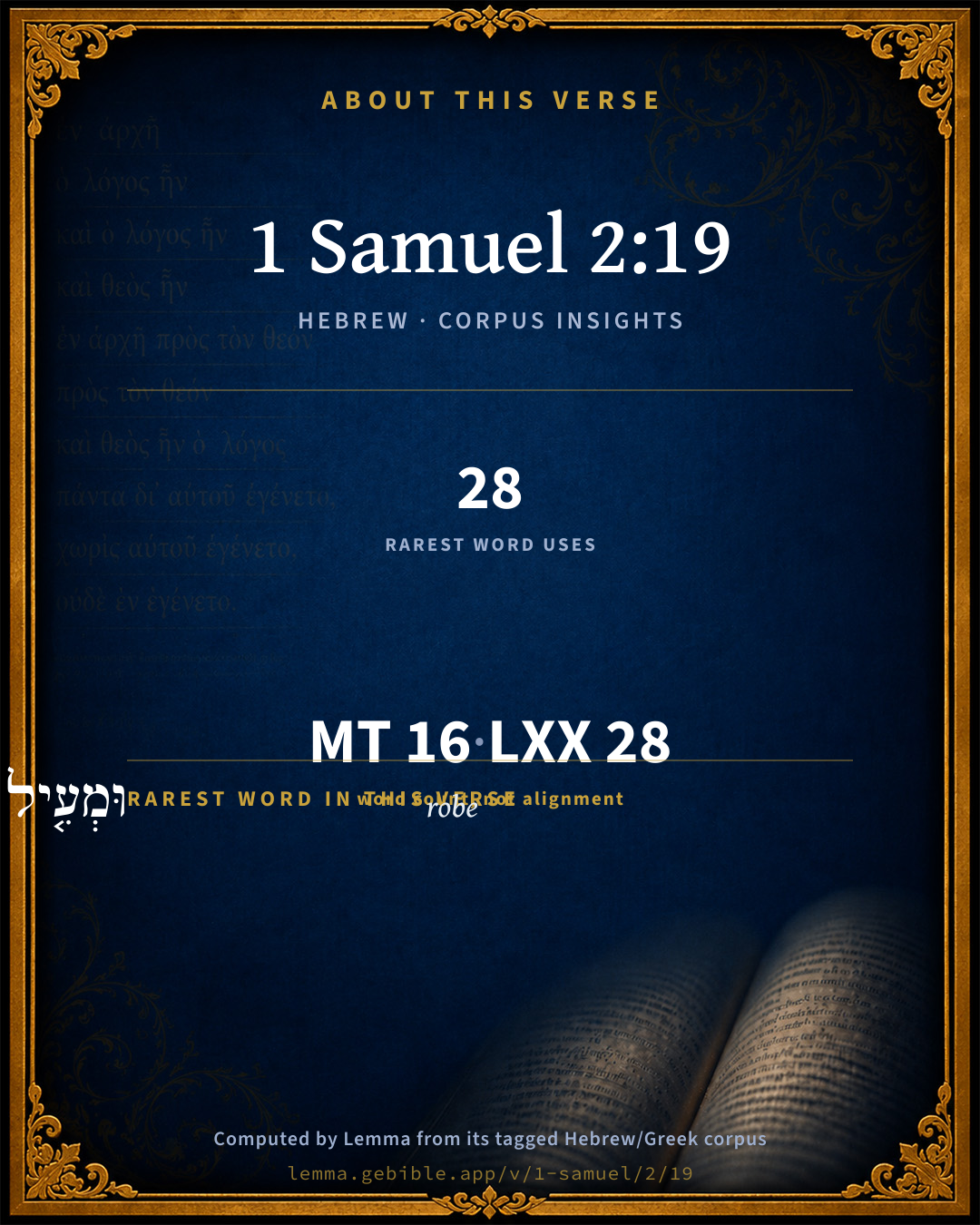
These counts appear in no published source. They are computed here, from the morphology-tagged text and Lemma’s own curated glosses. What Lemma adds →

16
words
11
distinct lemmas
Historical
section

Shared distinctive vocabulary

וּמְעִ֤יל robe H4598 occurs in 27 verses of the Hebrew Bible. Also found in:

Grammatical profile

  • 4 verbs
  • 7 nouns
  • 1 adjective
  • 3 prepositions
  • 1 particle

Verb forms

  • תַּעֲשֶׂה Qal · Imperfect
  • וְהַעַלְתָ֥ה Hiphil · Sequential Perfect
  • בַּֽעֲלוֹתָהּ֙ Qal · Infinitive Construct
  • לִזְבֹּ֖חַ Qal · Infinitive Construct

Repetition

Words recur within this verse — often emphatic in Hebrew:

  • מִיָּמִ֣ים day H3117 ×3
  • וְהַעַלְתָ֥ה to go up H5927 ×2

Hebrew & Septuagint length

In English translation the verse runs 29 words from the Hebrew and 31 from the Septuagint (LXX English) — closely comparable.

A rough comparison of the two English renderings, which tokenize alike — not a word-level alignment.

Word counts can differ between the Hebrew and the Greek without any difference in meaning — e.g. the Hebrew direct-object marker אֵת has no separate Greek word, and Greek often adds the article ὁ.

In the original languages it is 16 Hebrew tokens and 28 Greek tokens — but the two are counted differently (Hebrew bundles its prefixes and suffixes into one token; the Greek is in lemma form), so that isn’t a like-for-like length.

Cross-references

3

Topical passages linked to 1 Samuel 2:19 in the Treasury of Scripture Knowledge — connected by theme and wording, ordered by reader-vote popularity; previews shown in the World English Bible.

  • 1 Samuel 1:3 This man went up out of his city from year to year to worship and to sacrifice to Yahweh of Hosts in Shiloh. The two sons of Eli, Hophni and Phinehas, priests to Yahweh, were there.
  • 1 Samuel 1:21 The man Elkanah, and all his house, went up to offer to Yahweh the yearly sacrifice, and his vow.
  • Exodus 23:14 "You shall observe a feast to me three times a year.

Cross-references courtesy of OpenBible.info (CC BY 4.0).

Hebrew and Greek witnesses Masoretic Hebrew ↔ Greek Septuagint

The same verse in the two great witnesses to the Old Testament, shown verse-for-verse.

These are two independent witnesses, not word-aligned to each other, and the Septuagint is shown in lemma (dictionary) form.

Hebrew 1 Samuel 2:19 Masoretic · Westminster Leningrad Codex

וּמְעִ֤יל קָטֹן֙ תַּעֲשֶׂה לּ֣וֹ אִמּ֔וֹ וְהַעַלְתָ֥ה ל֖וֹ מִיָּמִ֣ים יָמִ֑ימָה בַּֽעֲלוֹתָהּ֙ אֶת אִישָׁ֔הּ לִזְבֹּ֖חַ אֶת זֶ֥בַח הַיָּמִֽים

Moreover his mother made him a little robe, and brought it to him from year to year, when she came up with her husband to offer the yearly sacrifice.

World English Bible · Public Domain

Greek LXX 1 Samuel 2:19 Septuagint · lemma form

καί διπλοΐς μικρός ποιέω αὐτός ὁ μήτηρ αὐτός καί ἀναφέρω αὐτός ἐκ ἡμέρα εἰς ἡμέρα ἐν ὁ ἀναβαίνω αὐτός μετά ὁ ἀνήρ αὐτός θύω ὁ θυσία ὁ ἡμέρα

And his mother made him a little doublet, and brought it to him from year to year, in her going up in company with her husband to offer the yearly sacrifice.

LXX2012 (modern English Septuagint) · Public Domain

Hebrew: Westminster Leningrad Codex (CC BY 4.0). Greek: Septuagint (public domain); English from LXX2012 (modern English Septuagint) (Public Domain). How the Septuagint differs from the Hebrew →

Targum (Aramaic paraphrase)

1

The Targum is the ancient Jewish Aramaic paraphrase of the Hebrew Scriptures — an interpretive translation, not the Hebrew text itself. Onkelos (literal) and Pseudo-Jonathan (expansive) render the Torah, and Jonathan the Prophets. Coverage is partial: where no permissively-licensed English translation exists for a verse, only the Aramaic is shown. This is verse-level text, not a word-by-word alignment to the Hebrew.

  1. Targum Jonathan Prophets (Joshua–Malachi)
    וּמְעִיל זְעֵיר עָבְדָא לֵיהּ אִמֵיהּ וּמַסְקָא לֵיהּ מִזְמַן מוֹעֵד לְמוֹעֵד בְּמִסְקָהּ עִם בַּעֲלָהּ לְדַבָּחָא יַת דְבַח מוֹעֲדַיָא:

    (no public-domain English translation for this verse)

    Targum Jonathan — Aramaic: “Mikraot Gedolot” (public domain). English: “Sefaria Community Translation” (CC0 1.0 (public-domain dedication)); “London "Chaldee Paraphrase," 1871” (public domain). Text via Sefaria.

Commentary

Notes on 1 Samuel 2:19 from classic Christian and Jewish commentators (each source and its license shown beneath its notes). The classic Christian expositions comment on the surrounding passage and are grouped to its opening verse, so a note may address several verses; the Jewish commentaries on the Tanakh (Rashi and others) are per-verse, so they appear only where the commentator wrote on this verse.

Lemma curates 59 commentaries, every one of them public domain or Creative Commons licensed, each selected and text-cleaned for this edition rather than reprinted as found. About our sources →

Trapp's Complete Commentary

John Trapp

1Sa 2:19 Moreover his mother made him a little coat, and brought [it] to him from year to year, when she came up with her husband to offer the yearly sacrifice.

Ver. 19. His mother made him a little coat.] To wear under his ephod at festival times, saith Pet. Martyr, and so showed her motherly care; and did something toward his maintenance.

John Trapp, A Commentary or Exposition upon All the Books of the Old and New Testament (1647–1656) — public domain. Text from a community e-Sword module.

Joseph Benson's Commentary

1Sa 2:19. His mother made him a little coat — The ephod, being used only in the service of God, was no doubt provided at the public expense. But for his ordinary wearing apparel Hannah took care to provide, that she might still express her piety in contributing to his maintenance at the house of God.

Joseph Benson's Commentary on the Old and New Testaments (1811–1818) — public domain. Text from a community e-Sword module.

Jamieson, Fausset & Brown

Robert Jamieson, A. R. Fausset & David Brown

his mother made him a little coat, and brought it to him from year to year--Aware that he could not yet render any useful service to the tabernacle, she undertook the expense of supplying him with wearing apparel. All weaving stuffs, manufacture of cloth, and making of suits were anciently the employment of women.

Jamieson, Fausset & Brown — Commentary Critical and Explanatory on the Whole Bible (1871) — public domain (CC PDM 1.0). Text via the HelloAO Bible API.

Adam Clarke's Commentary

Verse 19. Made him a little coat] מעיל קטן meil katon, a little cloak, or surtout, an upper garment: probably intended to keep him from the cold, and to save his other clothes from being abused in his meaner services. It is probable that she furnished him with a new one each year, when she came up to one of the annual sacrifices.

Adam Clarke's Commentary on the Bible (1810–1826) — public domain. Text from a community e-Sword/MySword module.

Ellicott's Commentary for English Readers

(19) A little coat.—The “little coat”—Hebrew, m’il—was, no doubt, closely resembling in shape the m’il, or robe worn apparently by the high priest, only the little m’il of Samuel was without the costly symbolical ornaments attached to the high priestly robe.

This strange, unusual dress was, no doubt, arranged for the boy by his protector and guardian, Eli, who looked on the child as destined for some great work in connection with the life of the chosen people. Not improbably the old man, too, well aware of the character of his own sons, hoped to train up the favoured child—whose connection with himself and the sanctuary had begun in so remarkable a manner—as his successor in the chief sacred and civil office in Israel.

A Bible Commentary for English Readers, edited by Charles John Ellicott (1878–1897) — public domain. Text from a community e-Sword module.

The Cambridge Bible for Schools and Colleges

gen. ed. J. J. S. Perowne

19. a little coat] The Heb. mĕîl denotes a kind of long upper tunic, worn by kings (1Ch_15:27), prophets (1Sa_15:27), men of position (Job_2:12), women of rank (2Sa_13:18). The term is applied to a part of the High Priest’s dress, the robe of the Ephod (Exo_28:31), and it is suggested in the Speaker’s Comm. that “the mention of the ephod and the robe as worn by the youthful Samuel taken in connexion with his after acts seems to point to an extraordinary and irregular priesthood to which he was called by God in an age when the provisions of the Levitical law were not yet in full operation.”

the yearly sacrifice] See note on 1Sa_1:3.

19, 20. Moreover, &c.] Lit. “And Hannah used to make … and bring it to him … And Eli used to bless … and they used to go unto his home.” The verbs are frequentative, describing an annual practice often repeated.

The Cambridge Bible for Schools and Colleges (gen. ed. J. J. S. Perowne; Cambridge University Press, 1878–1918) — public domain. Text from a community e-Sword module.

John Gill's Exposition

And Eli blessed Elkanah and his wife,.... Not only the first time they brought Samuel to him, and left him with him; but every year they came to worship, as the Jewish commentators mostly interpret it:

and said, the Lord give thee seed of this woman; children by her, year after year:

for the loan which is lent to the Lord; instead of Samuel, who was asked of the Lord and given to him again; and as they were thereby in some measure deprived of him, and could not always enjoy him, and be delighted with him, Eli prayed for them, and gave them his benediction as a priest, that they might be favoured with other children, who might be of delight and service to them when in old age:

and they went unto their own home; at Ramah, as in Sa1 2:11 or to his place (r), Elkanah's; hence Kimchi concludes that Hannah was of another city originally; but the Targum is,"to their place;''and indeed, what was now the place or home of the one, was of the other.

(r) "in locum suum", V. L. Pagninus, Montanus, Drusius, &c.

John Gill's Exposition of the Whole Bible (1746–1763) — public domain (CC PDM 1.0). Text via the HelloAO Bible API.

Albert Barnes' Notes on the Bible

A little coat - The robe of the ephod was also one of the garments worn by the High Priest (see Exo 28:31 note). This pointed mention of the ephod and the robe as worn by the youthful Samuel, seems to point to an extraordinary and irregular priesthood to which he was called by God in an age when the provisions of the Levitical law were not yet in full operation, and in which there was no impropriety in the eyes of his contemporaries, seeing that nonconformity to the whole Law was the rule rather than the exception throughout the days of the Judges.

Albert Barnes' Notes on the Bible (1834–1885) — public domain. Text from a community e-Sword/MySword module.

Haydock's Catholic Bible Commentary

Coat. Hebrew mehil, the outer garment. Hence it appears that the parents of the people consecrated to the Lord, furnished them with clothes, till they were able to serve the tabernacle, otherwise they would have been a burden to it. (Calmet)

George Leo Haydock (1774–1849), Haydock's Catholic Family Bible and Commentary, 1859 edition — public domain. Excludes Psalms (Douay-Rheims chapter numbering differs from Protestant) and Deuterocanonical books (Catholic canon only).

Matthew Poole's English Annotations

A little coat, suitable to his age and stature, to be worn ordinarily; for coats were their usual garments. See Gen 3:21; 37:3; 2Sa 15:32; Son 5:3; Dan 3:21; Luk 3:11; 9:3. Knowing that he could not yet do much service, she would not have him too burdensome to the tabernacle, and therefore she yearly provided him with a coat, which was the chief and upper garment; and under that his other garments possibly are comprehended.

Matthew Poole's English Annotations on the Holy Bible (1683–1685) — public domain. Text from a community e-Sword/MySword module.

Whedon's Commentary on the Bible

Daniel D. Whedon

19. Made him a little coat — Probably designed for use when not engaged in the service of the sanctuary. How artlessly this token of a mother’s tenderness and love is mentioned.

Daniel D. Whedon (gen. ed.), Commentary on the Old and New Testaments (1874–1909) — public domain. Text from a community e-Sword module.

The Pulpit Commentary

His mother made him a little coat. The coat, meil, was worn by priests, (Lev_8:7) by kings and their sons, (1Sa_18:4) by prophets (ibid. 28:14), and even by women. (2Sa_13:18) It was an under garment of wool, woven throughout without seam, with holes for the head and arms, and reaching nearly to the ground: when used by women it had sleeves (ibid. ). Under it they had a tunic or shirt fitting so closely that a man simply so clad was considered naked, (1Sa_19:24) and over it priests and Levites wore the ephod, and so also David on the occasion mentioned above. (1Ch_15:27) The meil seems, moreover, to have often been a handsome dress, as that of the priests was of purple blue, with embroidery of pomegranates in three colours, and golden bells; (Exo_28:31-34) and when made of delicate materials for the use of the rich, it and the tunic are the soft luxurious clothing spoken of in Mat_11:8. As the meal was the ordinary dress of all classes of people, it was made for Samuel at home, and can have no special meaning; but the ephod shows that he was brought up in the daffy practice of holy duties. This annual present, however, of clothing made by the mother"s hands proves that the dedication of her son to God was not allowed to interfere with home affections, and both parents and child must have looked forward with joy to happy meetings at each recurrence of the family visit to the sanctuary.

The Pulpit Commentary (1880–1919), ed. H.D.M. Spence-Jones & Joseph S. Exell — public domain. Text from a community e-Sword module.

Rashi

Rabbi Shlomo Yitzchaki (Rashi)

His mother would make for him a small robe. From year to year.

Rashi on the Tanakh — English translations: “The Judaica Press complete Tanach with Rashi, translated by A. J. Rosenberg” (CC BY 4.0); “Pentateuch with Rashi's commentary by M. Rosenbaum and A.M. Silbermann, 1929-1934” (public domain); “The Metsudah Tanach series, Lakewood, N.J” (CC BY 4.0); and “The Book of Joshua, Metsudah Publications, 1997” (CC BY 4.0). Text via Sefaria.

Lesson kit

Teaching starters — assembled from the data on this page, not authored interpretation. Every prompt links to the verse data it draws on. Edit before teaching.

1 Samuel, in the Historical, opens this verse with 16 words (11 distinct Hebrew lemmas). Its most distinctive word is mᵉʻîyl (“robe”). A historical commentator’s framing appears above. Read the whole chapter for the surrounding context.

Discussion questions

  1. What does “robe” (mᵉʻîyl) contribute to the verse as a whole?
  2. Exodus 28:4 shares the word «robe» with this verse. How do the two illuminate each other?
  3. “day” occurs 3× in this one verse. What is the effect of the repetition?
  4. These translations render this verse differently. What is at stake in choosing one wording over another?
  5. The verb «תַּעֲשֶׂה» is Qal Imperfect. How does its form color the action?
  6. Reading how Trapp's Complete Commentary and Joseph Benson's Commentary read this verse, where do the two commentators agree and where do they part?

Things to notice

Reading settings

Reading text

Shown beneath each verse's original-language words.

Old Testament
Old Testament edition

Read the OT as the Masoretic Hebrew (MT) or the Greek Septuagint (LXX).

English shown for the Greek Septuagint (in the Hebrew ↔ Greek comparison).

Comparing translations? Open the Compare panel on any verse page to stack up to four side by side.