
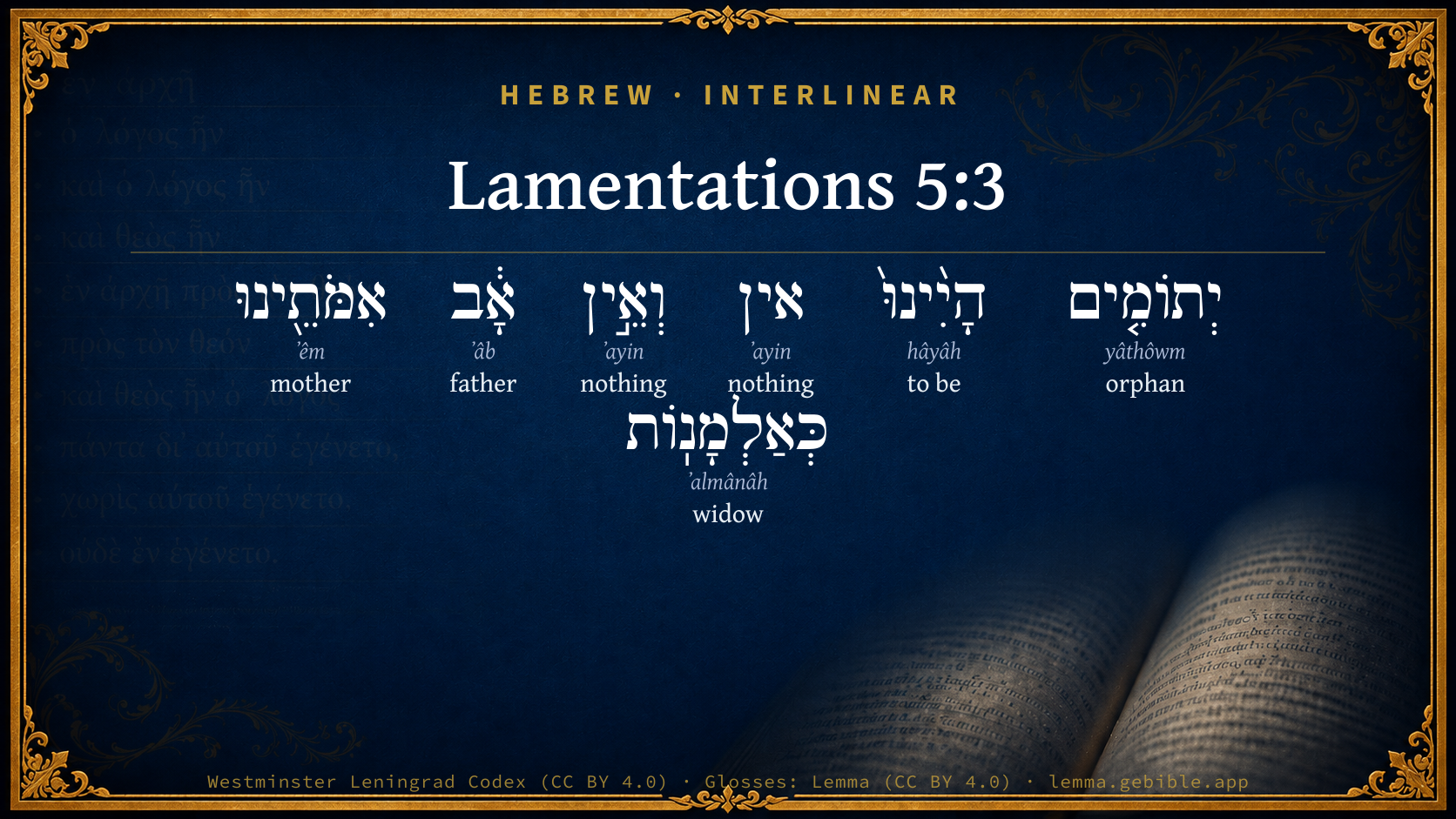
Lamentations 5:3

Hebrew (Westminster Leningrad Codex) Lamentations 5:3 appears in the Hebrew Old Testament. The text above is from the Westminster Leningrad Codex. Each word links to its Strong’s number, a concise gloss, and parsing drawn from the Open Scriptures Hebrew Bible morphology. Click any word for its full Brown-Driver-Briggs (BDB) entry.
Download image
Cite this verse

Lamentations 5:3 (World English Bible). Public Domain. Lemma interlinear Bible study tool, https://lemma.gebible.app/v/lamentations/5/3.

Show BibTeX & RIS
BibTeX
RIS
English Translation
We are orphans and fatherless; Our mothers are as widows.
World English Bible · Public Domain
Download a study sheet

One document with this verse’s original text, its word-by-word gloss line, the meaning frame, cross-references with their text, attributed commentary, and full source and license credits — printable, and it pastes into notes with its structure intact.

This verse Autodidact and up

Study sheet (.html) Plain text (.txt)

A passage Seminary Student

Up to 50 verses in one chapter. A passage sheet keeps up to 6 commentary sources and 12 cross-references per verse, in the order this page ranks them, and says so on the sheet whenever that leaves anything out. Ask for a single verse and you get the Autodidact verse sheet above.

Everything on this page stays free to read, with no account — the sheet is a download of what is already on screen, not access to it.

Want to remove ads? Support Godless Engineer
Compare translations 3

The same verse in 3 English versions, stacked beneath the original-language interlinear above. Click any original word for its lexicon entry.

Each is an independent rendering of the whole verse — the interlinear is not word-aligned to these translations.

Highlighted words mark where these versions differ — a whole-verse word diff, not a word-by-word alignment.

  • World English Bible Public Domain
    We are orphans and fatherless; Our mothers are as widows.
  • King James Version Public Domain
    We are orphans and fatherless, our mothers are as widows.
  • unfoldingWord Literal Text CC BY-SA 4.0
    We have become orphans, and there is no father; our mothers like widows.

unfoldingWord Literal Text — © unfoldingWord, licensed CC BY-SA 4.0. Word-aligned USFM3 via Door43 (git.door43.org/unfoldingWord/en_ult).

Versions to compare (up to 4)

3 of 4 selected

Show all 18 translations

Every available English version of this verse, each an independent rendering of the whole verse.

  • World English Bible Public Domain
    We are orphans and fatherless; Our mothers are as widows.
  • Berean Standard Bible Public Domain
    We have become fatherless orphans; our mothers are widows.
  • Majority Standard Bible Public Domain
    We have become fatherless orphans; our mothers are widows.
  • King James Version Public Domain
    We are orphans and fatherless, our mothers are as widows.
  • American Standard Version (1901) Public Domain
    We are orphans and fatherless; Our mothers are as widows.
  • Revised Version (1885) Public Domain
    We are orphans and fatherless, our mothers are as widows.
  • Geneva Bible (1599) Public Domain
    We are fatherles, euen without father, and our mothers are as widowes.
  • Douay-Rheims (1899) Public Domain
    We are become orphans without a father: our mothers are as widows.
  • Young's Literal Translation Public Domain
    Orphans we have been -- without a father, our mothers `are' as widows.
  • Literal Standard Version CC BY-SA 4.0
    Orphans we have been—without a father, our mothers [are] as widows.
  • Unlocked Literal Bible CC BY-SA 4.0
    We have become orphans, the fatherless, and our mothers are like widows.
  • unfoldingWord Literal Text CC BY-SA 4.0
    We have become orphans, and there is no father; our mothers like widows.
  • Darby Bible Public Domain
    We are orphans and fatherless, our mothers are as widows.
  • World Messianic Bible Public Domain
    We are orphans and fatherless. Our mothers are as widows.
  • Webster's Bible Public Domain
    We are orphans and fatherless, our mothers are as widows.
  • Free Bible Version CC BY-SA 4.0
    We have lost our fathers, and our mothers are widows.
  • Bible in Basic English Public Domain
    We are children without fathers, our mothers are like widows.
  • JPS Tanakh (1917) Public Domain
    We are become orphans and fatherless, our mothers are as widows.

Literal Standard Version (2020), Covenant Press — licensed CC BY-SA 4.0. Text via the HelloAO Bible API (eBible.org). Unlocked Literal Bible (unfoldingWord) — licensed CC BY-SA 4.0. Text via the HelloAO Bible API (eBible.org). unfoldingWord Literal Text — © unfoldingWord, licensed CC BY-SA 4.0. Word-aligned USFM3 via Door43 (git.door43.org/unfoldingWord/en_ult). Free Bible Version, Dr. Jonathan Gallagher — licensed CC BY-SA 4.0. Text via the HelloAO Bible API (eBible.org).

Word by word

More ways to search: Search by grammar → Find every occurrence → Compare this word →

Practice this passage: Drill this verse → Learn its vocabulary →

About this verse

These counts appear in no published source. They are computed here, from the morphology-tagged text and Lemma’s own curated glosses. What Lemma adds →

7
words
6
distinct lemmas
Prophets
section

Shared distinctive vocabulary

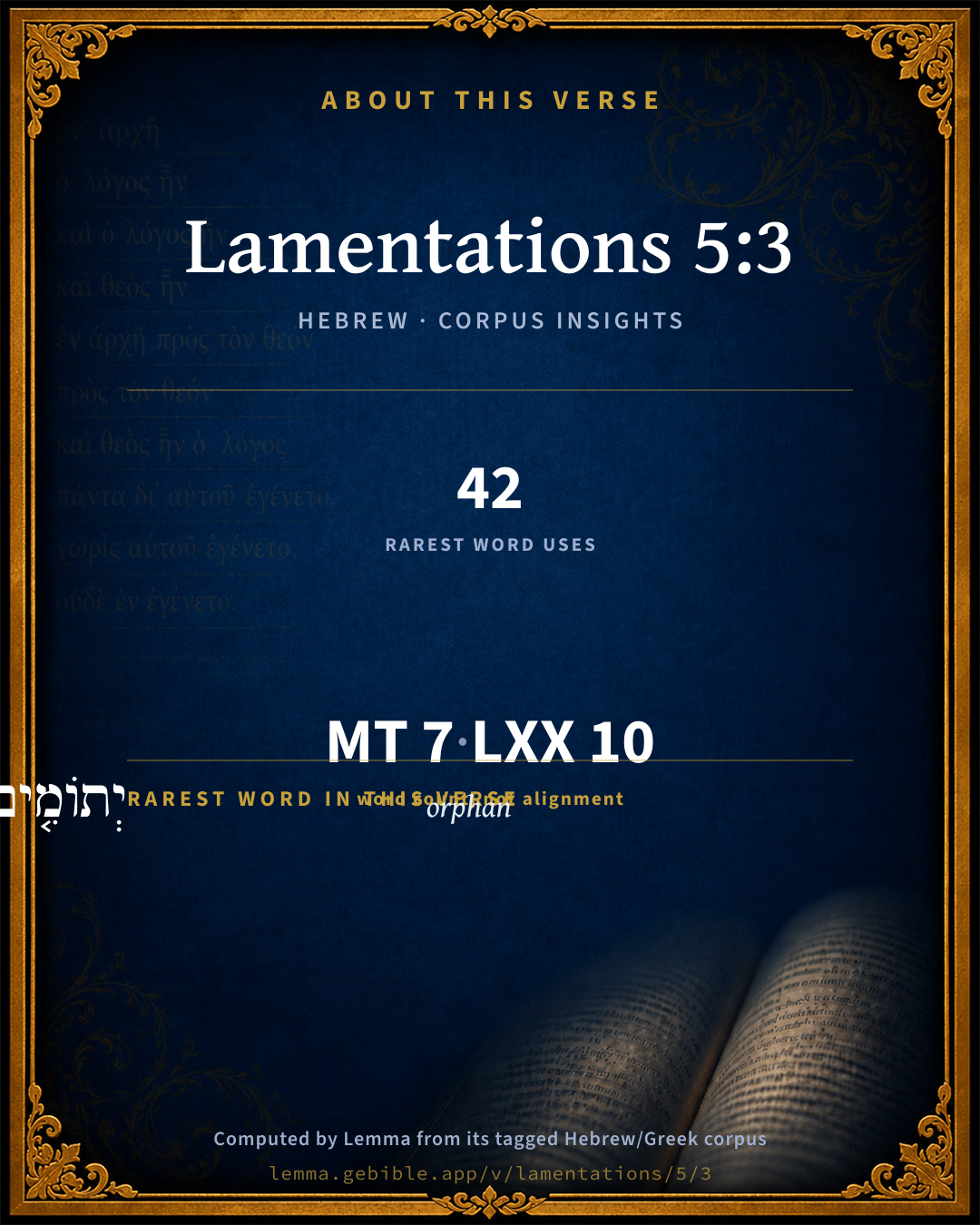
יְתוֹמִ֤ים orphan H3490 occurs in 42 verses of the Hebrew Bible. Also found in:

Grammatical profile

  • 1 verb
  • 4 nouns
  • 2 particles

Verb forms

  • הָיִ֨ינוּ֙ Qal · Perfect

Repetition

A word recurs within this verse — often emphatic in Hebrew:

  • אין nothing H369 ×2

Hebrew & Septuagint length

In English translation the verse runs 10 words from the Hebrew and 13 from the Septuagint (LXX English) — closely comparable.

A rough comparison of the two English renderings, which tokenize alike — not a word-level alignment.

Word counts can differ between the Hebrew and the Greek without any difference in meaning — e.g. the Hebrew direct-object marker אֵת has no separate Greek word, and Greek often adds the article ὁ.

In the original languages it is 7 Hebrew tokens and 10 Greek tokens — but the two are counted differently (Hebrew bundles its prefixes and suffixes into one token; the Greek is in lemma form), so that isn’t a like-for-like length.

Cross-references

4

Topical passages linked to Lamentations 5:3 in the Treasury of Scripture Knowledge — connected by theme and wording, ordered by reader-vote popularity; previews shown in the World English Bible.

  • Exodus 22:24 and my wrath will grow hot, and I will kill you with the sword; and your wives shall be widows, and your children fatherless.
  • Jeremiah 18:21 Therefore deliver up their children to the famine, and give them over to the power of the sword; and let their wives become childless, and widows; and let their men be slain of death, [and] their young men struck of the sword in battle.
  • Jeremiah 15:8 Their widows are increased to me above the sand of the seas; I have brought on them against the mother of the young men a destroyer at noonday: I have caused anguish and terrors to fall on her suddenly.
  • Hosea 14:3 Assyria can't save us. We won't ride on horses; Neither will we say any more to the work of our hands, 'Our gods!' For in you the fatherless finds mercy."

Cross-references courtesy of OpenBible.info (CC BY 4.0).

Hebrew and Greek witnesses Masoretic Hebrew ↔ Greek Septuagint

The same verse in the two great witnesses to the Old Testament, shown verse-for-verse.

These are two independent witnesses, not word-aligned to each other, and the Septuagint is shown in lemma (dictionary) form.

Hebrew Lamentations 5:3 Masoretic · Westminster Leningrad Codex

יְתוֹמִ֤ים הָיִ֨ינוּ֙ אין וְאֵ֣ין אָ֔ב אִמֹּתֵ֖ינוּ כְּאַלְמָנֽוֹת

We are orphans and fatherless; Our mothers are as widows.

World English Bible · Public Domain

Greek LXX Lamentations 5:3 Septuagint · lemma form

ὀρφανός γίγνομαι οὐ ὑποἄρχω πατήρ μήτηρ ἐγώ ὡς ὁ χήρα

we are become orphans, we have no father, our mothers are as widows.

LXX2012 (modern English Septuagint) · Public Domain

Hebrew: Westminster Leningrad Codex (CC BY 4.0). Greek: Septuagint (public domain); English from LXX2012 (modern English Septuagint) (Public Domain). How the Septuagint differs from the Hebrew →

Commentary

Notes on Lamentations 5:3 from classic Christian and Jewish commentators (each source and its license shown beneath its notes). The classic Christian expositions comment on the surrounding passage and are grouped to its opening verse, so a note may address several verses; the Jewish commentaries on the Tanakh (Rashi and others) are per-verse, so they appear only where the commentator wrote on this verse.

Lemma curates 59 commentaries, every one of them public domain or Creative Commons licensed, each selected and text-cleaned for this edition rather than reprinted as found. About our sources →

Trapp's Complete Commentary

John Trapp

Lam 5:3 We are orphans and fatherless, our mothers [are] as widows.

Ver. 3. We are orphans and fatherless.] And so are become thy clients, just objects of thy pity. {Hos 14:3}

John Trapp, A Commentary or Exposition upon All the Books of the Old and New Testament (1647–1656) — public domain. Text from a community e-Sword module.

Jamieson, Fausset & Brown

Robert Jamieson, A. R. Fausset & David Brown

fatherless--Our whole land is full of orphans [CALVIN]. Or, "we are fatherless," being abandoned by Thee our "Father" (Jer 3:19), [GROTIUS].

Jamieson, Fausset & Brown — Commentary Critical and Explanatory on the Whole Bible (1871) — public domain (CC PDM 1.0). Text via the HelloAO Bible API.

John Calvin's Commentaries

Here the Prophet not only speaks in the person of the whole people, but utters also the groans and complaints of each; for this could not have been suitable to the whole Church, as he speaks of fathers and mothers. We hence see that this verse does not apply to the whole body, but to individual members, though every one of the people might have said that widows and orphans were everywhere seen.

Now, this usually happens when a nation is consumed either by pestilence or by war; for in one battle all do not so fall that a whole country becomes full of orphans. But the Prophet sets forth here the orphanage and widowhood occasioned through the continued vengeance of God, for he had not ceased to afflict the people until by degrees they were exhausted. It was, indeed, a sad spectacle to see among the chosen people so many widows, and also so many children deprived of their fathers. It follows, —

John Calvin's Commentaries (1540-1563) — public domain. Text from the Calvin Translation Society English edition (1840s-50s) via the Christian Classics Ethereal Library (ccel.org). Calvin's coverage is partial (roughly two-thirds of the Bible); uncommented books and verses are honest gaps, never fabricated. The 19th-century editor's footnotes and remarks are omitted so the notes are faithfully Calvin's own voice.

Ellicott's Commentary for English Readers

(3) Our mothers are as widows—i.e., their husbands, though living, were carried into exile, and they were as destitute as though they had been deprived of them by death. The Chaldee paraphrase gives the same meaning to the last clause also, “We are like orphans.”

A Bible Commentary for English Readers, edited by Charles John Ellicott (1878–1897) — public domain. Text from a community e-Sword module.

The Cambridge Bible for Schools and Colleges

gen. ed. J. J. S. Perowne

3. orphans and fatherless] the fathers being in exile and the mothers thus “as widows,” without protection.

The Cambridge Bible for Schools and Colleges (gen. ed. J. J. S. Perowne; Cambridge University Press, 1878–1918) — public domain. Text from a community e-Sword module.

John Gill's Exposition

We are orphans and fatherless,.... In every sense; in a natural sense, their fathers having been cut off by the sword, famine, or pestilence; in a civil sense, their king being taken from them; and in a religious sense, God having forsaken them for their sins:

our mothers are as widows; either really so, their husbands being dead; or were as if they had no husbands, they not being able to provide for them, protect and deferred them. The Targum adds,

"whose husbands are gone to the cities of the sea, and it is doubtful whether they are alive.''

Some understand this politically, of their cities being desolate and defenceless.

John Gill's Exposition of the Whole Bible (1746–1763) — public domain (CC PDM 1.0). Text via the HelloAO Bible API.

Albert Barnes' Notes on the Bible

Our mothers are as widows - The particle “as” suggests that the whole verse is metaphorical. Our distress and desolation is comparable only to that of fatherless orphans or wives just bereaved of their husbands.

Albert Barnes' Notes on the Bible (1834–1885) — public domain. Text from a community e-Sword/MySword module.

Haydock's Catholic Bible Commentary

Father. Many had none surviving, and all had lost their king. (Worthington)

George Leo Haydock (1774–1849), Haydock's Catholic Family Bible and Commentary, 1859 edition — public domain. Excludes Psalms (Douay-Rheims chapter numbering differs from Protestant) and Deuterocanonical books (Catholic canon only).

Matthew Poole's English Annotations

We are all of us without a king, (who is the common father of the country,) we are deprived of thy fatherly care and protection, many young children amongst us are left without an earthly parent.

Our mothers are as widows; either our great cities are like widows, wanting magistrates; or, our women that were married are left widows.

Matthew Poole's English Annotations on the Holy Bible (1683–1685) — public domain. Text from a community e-Sword/MySword module.

Whedon's Commentary on the Bible

Daniel D. Whedon

3. Fatherless — Without a father. Many expositors find here a specific meaning, and understand by the term father, king; and others understand by mothers, the cities of Judah. But this is unnecessary, not to say puerile.

The meaning simply is: We are desolate and bereaved, like children without parents, or a wife mourning the loss of her husband.

Daniel D. Whedon (gen. ed.), Commentary on the Old and New Testaments (1874–1909) — public domain. Text from a community e-Sword module.

The Pulpit Commentary

We are orphans and fatherless; i.e. "We are like the most desolate of beings," as the Targum already explains it. Hence in the next clause the mothers of Israel ere likened to widows.

Orphanage and widowhood.

In the desolation of Jerusalem the inhabitants felt like orphans and widows, bereaved of the stay and comfort of life, uncured for and homeless. Many would be literally orphaned and widowed after the great slaughter of the siege, The sad condition of these greatest sufferers brings before our notice the similar trouble of those who are similarly situated in our own day.

I ORPHANAGE AND WIDOWHOOD INVOLVE OVERWHELMING SORROW. The mournful condition of the sufferers is the first thing to strike us. Their sorrow is keen because it concerns a nearest and dearest relative, and it is the more dreadful because it strikes a whole family. Moreover, the trouble is not simply one of affection. The breadwinner is lost. The prop and strength of the household is cut down. The protector of the helpless is removed. The guide and counsellor of the young is no more.

II ORPHANAGE AND WIDOWHOOD SHOW US THE BROKEN CHARACTER OF HUMAN LIFE. There is a oneness in a true family. All the members together constitute a unit. But when death claims the head the family is broken and its completeness destroyed. Then part is on earth and part in the other world. The widow and her children thus bear testimony to the imperfection of earth, to the transitoriness of what once seemed perfect, and to the need of a future life wherein the severed threads may be reunited and the Divine idea of the family realized.

III ORPHANAGE AND WIDOWHOOD ARE UNDER THE ESPECIAL CARE OF GOD. He is the "Father of the fatherless and the Judge of the widow". (Psa_68:5) If God sends exceptional trouble, he also feels exceptional compassion and gives exceptional aid. Helplessness is the greatest claim on the Divine pity. The heavier the need of any sufferers the more likely is it that God will come to their deliverance.

It is true that he may not restore lost comforts. A shadow; long and dark, may long lie across the path of orphans and widows. But unseen hands will be tending them, if not for their wealth and pleasure, yet for their peace and blessedness. God sometimes helps by raising up friends. He may also aid by rousing the faculties of the sufferers. Under the pressure of necessity a widow, left with the care of a family, may develop capacities that slumbered in neglect so long as they were not called for.

IV ORPHANAGE AND WIDOWHOOD HAVE A FIRST CLAIM ON CHRISTIAN CHARITY. Where God"s compassion is strongest ours should be also. If the trouble is great and the sufferers have not brought it upon themselves by their own folly or fault, the sympathy should be particularly large and active. The care of widows and orphans was one of the first characteristics of the Church, distinguishing it from the selfish indifference of paganism. With all our desire for the spiritual welfare of men, and all our zeal in preaching the gospel, this elementary duty of Christianity must have a first place in our energies if we would not be justly accounted hypocrites.

The Pulpit Commentary (1880–1919), ed. H.D.M. Spence-Jones & Joseph S. Exell — public domain. Text from a community e-Sword module.

John Wesley's Explanatory Notes

We - We are all of us without a king, (our common father) we are deprived of thy fatherly protection, and many young children among us are left without an earthly parent.

John Wesley, Explanatory Notes Upon the Whole Bible (1754–1765) — public domain. Text via the GEBible commentary corpus.

Lesson kit

Teaching starters — assembled from the data on this page, not authored interpretation. Every prompt links to the verse data it draws on. Edit before teaching.

Lamentations, in the Prophets, opens this verse with 7 words (6 distinct Hebrew lemmas). Its most distinctive word is yâthôwm (“orphan”). A historical commentator’s framing appears above. Read the whole chapter for the surrounding context.

Discussion questions

  1. The word yâthôwm carries the sense “orphan.” How does it shape the verse?
  2. How does Exodus 22:22, which shares the word «orphan», read alongside this verse?
  3. What does the repetition of “nothing” (2× in this one verse) do in this verse?
  4. These translations render this verse differently; the difference is in the English rendering, not the original. What questions does that raise?
  5. «הָיִ֨ינוּ֙» is a Qal Perfect verb. How does that grammatical form shape the action described?
  6. Compare how Trapp's Complete Commentary and Jamieson, Fausset & Brown read this verse. Where do they agree or differ?

Things to notice

Reading settings

Reading text

Shown beneath each verse's original-language words.

Old Testament
Old Testament edition

Read the OT as the Masoretic Hebrew (MT) or the Greek Septuagint (LXX).

English shown for the Greek Septuagint (in the Hebrew ↔ Greek comparison).

Comparing translations? Open the Compare panel on any verse page to stack up to four side by side.