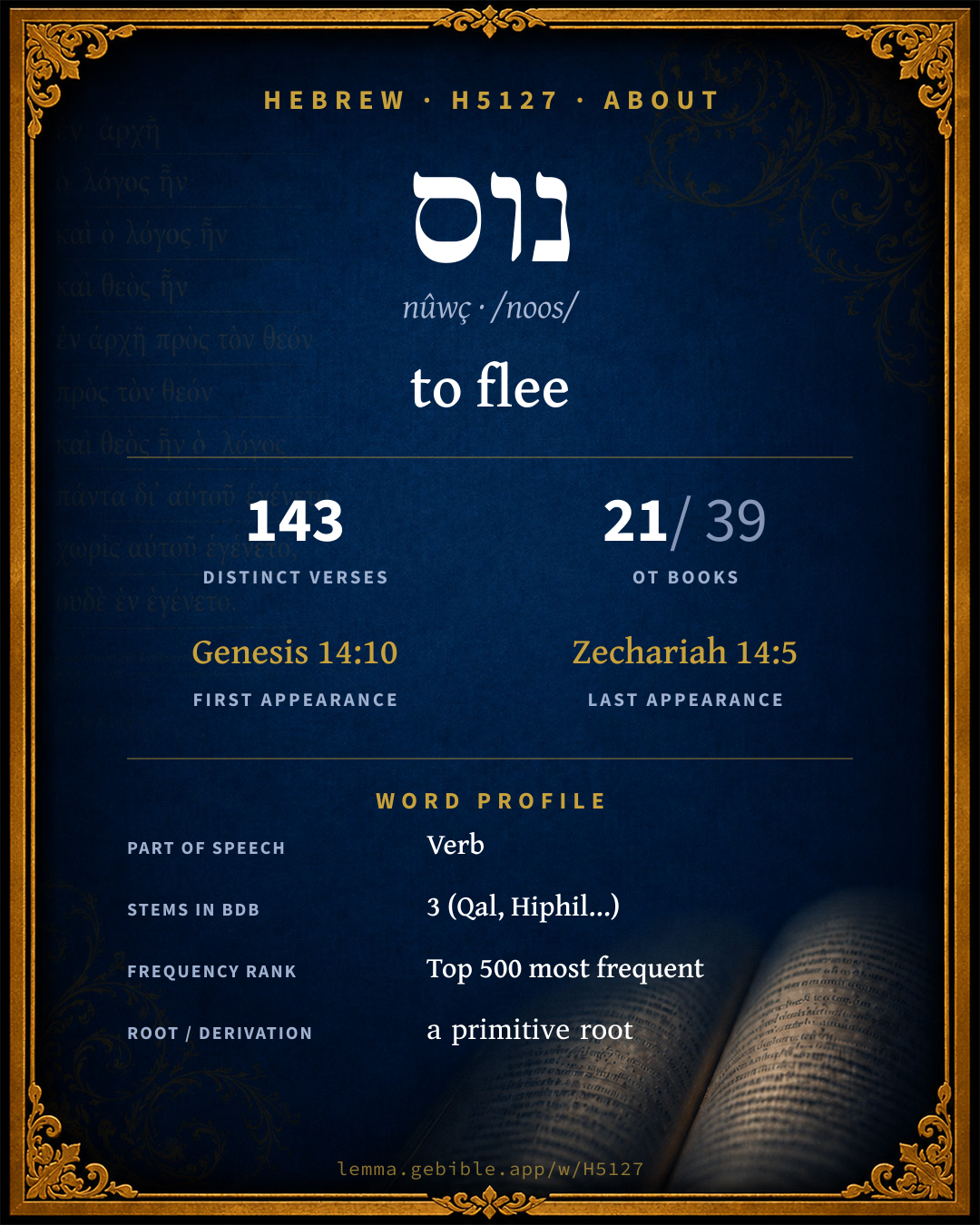
נוּס
to flee
‘to flee’ is one of 3 main senses fuller range ↓
Full lexicon entry — Brown-Driver-Briggs (BDB)
From Brown-Driver-Briggs (BDB)
Where this word appears
See every Qal verb in the Hebrew Bible →
Grammar key — what these labels mean
Part of speech
- Verb
- An action or state-of-being word.
Stem
- Qal
- The basic, simple active stem — the plain form of the verb (“he wrote”). Here: ‘flee’
- Hiphil
- The causative active stem (“he caused / brought about”). Here: ‘put to flight’
- Hithpolel
- The reflexive counterpart of the Polel.
- Polel
- A stem of hollow/geminate roots functioning like the Piel — intensive active.
Form
- Sequential Imperfect
- An imperfect with prefixed waw — the standard past-narrative form (waw-consecutive imperfect).
- Infinitive Construct
- A bound verbal noun, frequently with prepositions (“to write / in writing”).
- Perfect
- A completed action or state — Hebrew marks aspect (completeness) more than strict tense (“he wrote”).
- Imperfect
- An incomplete, ongoing, or future action (“he will / would write”).
- Sequential Perfect
- A perfect with prefixed waw continuing a preceding imperfect or command (waw-consecutive perfect).
- Participle Active
- A verbal adjective expressing ongoing or characteristic action (“writing / one who writes”).
- Imperative
- A direct command (“write!”).
- Infinitive Absolute
- An unbound verbal noun, often intensifying or standing in for a finite verb.
- Cohortative
- A first-person volitional form expressing wish or resolve (“let me / let us write”).
- Jussive
- A third- or second-person volitional form expressing wish or command (“let him write”).
State
- Absolute
- The independent form of a noun, not bound to a following word.
Person
- 3rd Person
- The one spoken about (“he / she / it / they”).
- 2nd Person
- The one addressed (“you”).
- 1st Person
- The speaker (“I / we”).
Gender
- Masculine
- Grammatically masculine.
- Common
- Either gender — not distinguished for this form.
- Feminine
- Grammatically feminine.
Number
- Plural
- More than one (in Hebrew, generally three or more).
- Singular
- One.
11 verses where H5127 appears in the Qal stem in the Book of Isaiah. Filtered view — show all forms. Click any verse to open its interlinear word-by-word view. Verse text shown in the World English Bible for context — . Each verse’s Hebrew form is shown with its reference; the English is not keyword-highlighted, since the data carries no word-level English alignment. Use “Compare translations” on any verse to read it across multiple English versions. This concordance covers the Hebrew Bible; Septuagint (Greek Old Testament) occurrences are not indexed here.
Isaiah
- Isaiah 10:3 תָּנ֣וּסוּ Qal impf 2mp What will you do in the day of visitation, and in the desolation which shall come from far? to whom will you flee for help? and where will you leave your glory?
- Isaiah 10:29 נָֽסָה Qal pf 3fs they are gone over the pass; they have taken up their lodging at Geba; Ramah trembles; Gibeah of Saul is fled.
- Isaiah 13:14 יָנֽוּסוּ Qal impf 3mp It shall happen, that as the chased roe, and as sheep that no man gathers, they shall turn every man to his own people, and shall flee every man to his own land.
- Isaiah 17:13 וְ/נָ֣ס conj + Qal wpf 3ms The nations shall rush like the rushing of many waters: but he shall rebuke them, and they shall flee far off, and shall be chased as the chaff of the mountains before the wind, and like the whirling dust before the storm.
- Isaiah 20:6 נַ֤סְנוּ Qal pf 1cp The inhabitant of this coast-land shall say in that day, Behold, such is our expectation, where we fled for help to be delivered from the king of Assyria: and we, how shall we escape?
- Isaiah 24:18 הַ/נָּ֞ס ptcl def.art + Qal ptcp.act ms It shall happen, that he who flees from the noise of the fear shall fall into the pit; and he who comes up out of the midst of the pit shall be taken in the snare: for the windows on high are opened, and the foundations of the earth tremble.
- Isaiah 30:16 נָנ֖וּס תְּנוּס֑וּ/ן Qal impf 1cp Qal impf 2mp + sfx n but you said, No, for we will flee on horses; therefore shall you flee: and, We will ride on the swift; therefore shall those who pursue you be swift.
- Isaiah 30:17 תָּנֻ֑סוּ Qal impf 2mp One thousand [shall flee] at the threat of one; at the threat of five shall you flee: until you be left as a beacon on the top of a mountain, and as an ensign on a hill.
- Isaiah 31:8 וְ/נָ֥ס conj + Qal wpf 3ms The Assyrian shall fall by the sword, not of man; and the sword, not of men, shall devour him; and he shall flee from the sword, and his young men shall become subject to forced labor.
- Isaiah 35:10 וְ/נָ֖סוּ conj + Qal wpf 3cp and the ransomed of Yahweh shall return, and come with singing to Zion; and everlasting joy shall be on their heads: they shall obtain gladness and joy, and sorrow and sighing shall flee away.
- Isaiah 51:11 נָ֖סוּ Qal pf 3cp The ransomed of Yahweh shall return, and come with singing to Zion; and everlasting joy shall be on their heads: they shall obtain gladness and joy; [and] sorrow and sighing shall flee away.
About this entry
At a glance — auto-summarized from this page’s data, not written by a person. Every figure links to its source below. This summary describes the numbers; it doesn’t interpret them.
נוס (nûwç) is a Hebrew verb most often rendered “to flee.” It first appears in Genesis 14:10. Spanning 143 verses in 21 books, it ranks among the common words of the Hebrew Bible. Across 3 stems, its meaning turns on the binyan (Qal, Hiphil). Related forms include מנוס and ניס. The sections below give every sense, occurrence, and version rendering.
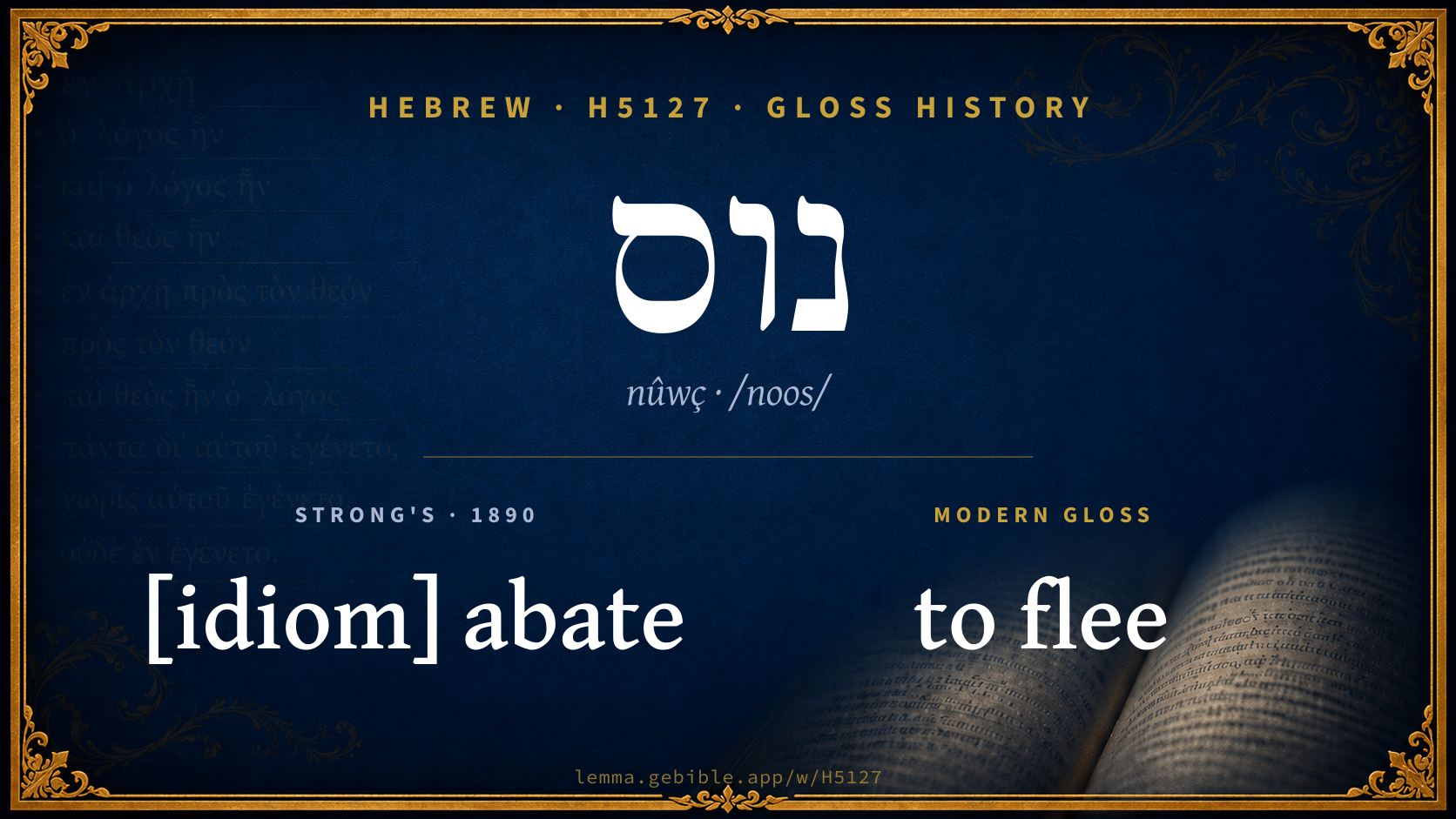
Gloss history
Strong's 1890 vs modern scholarship
About this word
Strong's H5127 catalogs a Hebrew word from the Hebrew Old Testament.
These counts are not copied from any lexicon or concordance. They are computed here, from the morphology-tagged Hebrew Old Testament. What Lemma adds →
- 143
- distinct verses
- The word appears in 143 distinct verses.
- 21 / 39
- OT books
- The word appears in 21 of 39 Old Testament books.
- #285
- by frequency
- Top 500 most frequent Hebrew words (rank 285 of 8,640 Hebrew words by occurrence).
View all 143 occurrences in the concordance →
By section of the Old Testament
By traditional corpus
Conventional, traditional groupings — biblical authorship is debated, so this is a traditional corpus grouping, not an authorship claim. Each share is this word’s portion of its verses in that division of the Hebrew canon. Each figure is a share of the word’s 143 distinct verses.
- Prophets (Nevi'im) 93 verses · 65%
- Torah (Pentateuch) 30 verses · 21%
- Writings (Ketuvim) 20 verses · 14%
How translations render this word
Counts come from each version’s own published word-to-Strong’s tagging or interlinear alignment — an approximate guide to how each version renders this word, not a word-level alignment the data otherwise carries. Because each total is that version’s own tagged count, the per-version totals vary from one another and need not match the appearance or distinct-verse counts above. These counts may also differ from a printed concordance because Lemma counts each distinctly tagged rendering and does not collapse phrase taggings into a single head-word total. This is a fixed set of word-tagged versions (KJV, ASV, BSB, ULT) and does not change with the reading translation you choose elsewhere. Each version’s license is shown beside its name below (and on Sources).
- King James Version: Fled 46×, Flee 15×, They fled 11×
- American Standard Version: Fled 41×, Flee 14×, They fled 11×
- Berean Standard Bible: Fled 39×, Flee 14×, Had fled 8×
- unfoldingWord Literal Text: Fled 44×, And 21×, They fled 15×
King James Version Public Domain
Renders H5127 across 160 tagged occurrences — most commonly:
Plus other, less common renderings. Plus 41 renderings that appear only once — usually multi-word phrases or single function words the recovered tagging swept in, not distinct renderings. Not rendered by a distinct English word in 1 further occurrence.
American Standard Version Public Domain
Renders H5127 across 160 tagged occurrences — most commonly:
Plus other, less common renderings. Plus 51 renderings that appear only once — usually multi-word phrases or single function words the recovered tagging swept in, not distinct renderings.
Berean Standard Bible Public Domain
Renders H5127 across 157 tagged occurrences — most commonly:
Plus other, less common renderings. Plus 39 renderings that appear only once — usually multi-word phrases or single function words the recovered tagging swept in, not distinct renderings. Not rendered by a distinct English word in 1 further occurrence.
unfoldingWord Literal Text CC BY-SA 4.0
Renders H5127 across 179 tagged occurrences — most commonly:
Plus other, less common renderings. Plus 32 renderings that appear only once — usually multi-word phrases or single function words the recovered tagging swept in, not distinct renderings.
10 senses and sub-senses in the full BDB
Hebrew verbs can shift meaning by stem (binyan): Qal is the basic action, Niphal is often passive or reflexive, Piel often intensifies or makes it factitive, and Hiphil is typically causative. The senses below are grouped under the stem BDB assigns to each. This entry also uses one or more reduplicated stems (the Pōlēl/Pilpēl type), which for hollow or geminate roots behave much like Piel — often intensive or iterative.
What do BDB’s symbols mean?
BDB uses these scholarly abbreviations:
| Symbol | Meaning |
|---|---|
| 𝔊 | the Septuagint (the ancient Greek translation, LXX) |
| 𝔙 | the Vulgate (the Latin translation) |
| 𝔖 | the Syriac version (the Peshitta) |
| 𝔗 | the Targum (the Aramaic translation) |
| ψ | the Psalms |
| √ | root (the underlying root or stem) |
| ‖ | parallel passage (a synonymous or contrasted parallel) |
| † | the dagger: every passage where the word occurs is cited |
The 10 senses and sub-senses the full Brown-Driver-Briggs lexicon distinguishes for this word, in lexicon order (not ranked by frequency), with BDB’s own verbatim wording and sub-sense lettering. Shown in Hebrew script with BDB’s own scholarly abbreviations. The condensed entry is in the Lexicon Entry tab. See also the Forms in the corpus table below.
Qal
- Pf. נָס Nu 35:25 +; נַ֫סְתָּה 2 K 9:3; נַ֫סְתִּי 1 S 4:16, etc.; Impf. יָנוּס Ex 21:13 +; וַיָּנָ֫ס Gn 39:12 +; יְנוּס֑וּן ψ 104:7, etc.; Imv. mpl. נֻ֫סוּ Je 48:6 + 4 times Je Zc; Inf. abs. נוֹס 2 S 18:3; cstr. לָנוּס (לָנֻס) Gn 19:20 +; Pt. נָס Am 9:1 +; נָסִים Ex 14:27 +; — e.g. Numbers 35:25
- 1. flee, abs. Gn 39:12, 15 Nu 16:34 (all J); Jos 10:16 (JE); Lv 26:17, 36 (H); fig. of sea ψ 114:3, 5 cf. 104:7; sq. acc. cogn. מָנוֹס Je 46:5, sq. דֶּרֶךְ Jos 8:15 (J), 2 K 9:27; sq. בְּדֶרֶךְ Dt 28:7, 25; נ׳ אֶל־נַפְשָׁם 2 K 7:7 flee for their life, נ׳ בְּרַגְלָיו Ju 4:15 flee on foot; + 44 times abs. (not elsewhere Hex); sq. אֶל־ loc. Dt 4:42; 19:5, 11 (D), Nu 35:32 Jos 20:4 (both P), Ju 4:17 1 K 2:28, 29 Is 13:14; sq. לְ 1 S 4:10 + 6 times + לִקְרָאתוֹ Ex 14:27 (E; not elsewhere Hex); sq. עַד Ju 7:22 + Pr 28:17 (עַד־בּוֹר, v. בּוֹר); sq. עַל־ Is 10:3; sq. ָה loc. Gn 14:10 + 4 times JE, Nu 35:6 + 6 times P, Dt 4:42; 19:3, 4 (D), + 6 times; sq. שָׁם Is 20:6; sq. acc. loc. Jos 8:20 (J), + 4 times; sq. מִמֶּרְחָק Is 17:13 = far away; sq. מִן from, Jos 20:6 (P), 1 S 4:16 + 3 times; מִתּוֹךְ Je 51:6; especially מִפְּנֵי from before Ex 4:3; 14:25 Nu 10:35 Jos 10:11 (all JE), 1 S 17:24 Je 48:44 (Qr הַנָּס, > Kt הניס), + 19 times; sq. לִפְנֵי Jos 7:4; 8:5, 6(×2) (all J), 1 S 4:17 2 S 24:13, מִלִּפְנֵי 1 Ch 19:18. e.g. Genesis 39:12
- 2. escape Am 9:1 (‖ נמלט) so Je 46:6; hence e.g. Amos 9:1
- 3. take flight, depart, disappear, only fig.; Dt 34:7 (JE) his freshness (לֵחֹה vigour) was not gone (‖ לֹא כָֽהֲתָה עינו); of shadows (at evening), Ct 2:17; 4:6; of sorrow etc. Is 35:10; 51:11. e.g. Deuteronomy 34:7
- 4. נ׳ עַל־סוּס Is 30:16 fly (to the attack) on horseback. e.g. Isaiah 30:16
Poʿlel
- Pf. Is 59:19 רוּחַ י׳ נֹסֲסָה בּוֹ the breath of י׳ driveth at it, driveth it on (cf. Hiph. 2). †Hithpoʿl. Inf. cstr. לְהִתְנוֹסֵס מִפְּנֵי ψ 60:6 in order to take flight before the bow (so Vrss Hup-Now but v. ii. [נסס]). e.g. Isaiah 59:19
Hiphil
- Pf. הֵנִיס Ex 9:20; Impf. יָנִיסוּ Dt 32:30 + Ju 7:21 Kt (Qr וַיָּנוּסוּ Qal); Inf. cstr. לְהָנִיס Ju 6:11;— e.g. Exodus 9:20
- 1. put to flight, sq. acc. Dt 32:30 (‖ רדף). e.g. Deuteronomy 32:30
- 2. drive hastily to a safe place Ex 9:20, sq. acc. + אֶל־. e.g. Exodus 9:20
- 3. cause to disappear, hide Ju 6:11 (no obj. expr.) sq. מִפְּנֵי. e.g. Judges 6:11
Senses from the full Brown-Driver-Briggs lexicon (Brown, Driver, Briggs; Oxford 1906 — public domain), digitized via Sefaria, supplemented by the OpenScriptures HebrewLexicon (CC BY 4.0). Full attribution on Sources.
Word origin
vb. flee, escape (Syriac ܢܳܣ tremble (rare), cf. Brock; Arabic نوس, نَاسَ move to and fro, be in commotion, dangle, Lane 2866);—
— Brown-Driver-Briggs (Oxford 1906, public domain), digitized via Sefaria, supplemented by the OpenScriptures HebrewLexicon (CC BY 4.0). See Sources.
Origin: a primitive root
Jastrow Dictionary
A second Hebrew/Aramaic lexicon for comparison, covering Aramaic and post-biblical (Talmudic, Targumic, Midrashic) usage that the biblical-Hebrew BDB does not. Matched by lemma rather than by Strong’s number, so a lemma may carry more than one Jastrow headword (shown separately below), and the entries cover usage well beyond the Bible.
נוּס
- (b. h.) to flee. Ex. R. s. 3 למה נָס why did he flee (before the serpent)? Yalk. Ex. 237 בכל מקים שהיה מצרי נס וכ׳ withersoever an Egyptian fled, the sea ran against him; Mekh. B’shall. 6 מצרים נָסִים; a. fr.
נוּס ²
- ch., v. נְסִס
A Dictionary of the Targumim, the Talmud Babli and Yerushalmi, and the Midrashic Literature (Marcus Jastrow; London, Luzac, 1903) — Public Domain. Digitized via Sefaria. Digitized via Sefaria. Full attribution on Sources.
Forms in the corpus
The 103 distinct written forms H5127 takes in the Hebrew Bible, most frequent first — each parse links to that stem’s occurrences in the concordance. Hebrew forms include their vowel points and cantillation, so a single lemma takes many written forms.
The 60 most common forms are shown; 43 rarer forms follow in the full concordance.
Same root — word family
Other BDB entries built from the same root as H5127, grouped by Strong’s listed origin. These share a root / origin per the lexicon — not necessarily a shared meaning. Each links to that word’s own entry.
Derived from this word
Compare all same-root words → They share a root, not necessarily a meaning.
Septuagint verse parallels
This word appears in 132 verses that also exist in the Greek Old Testament (Septuagint), out of the 143 Hebrew verses it occurs in. You can read those verses in Greek by switching the Old Testament edition to the Septuagint.
Read these verses in the Septuagint
- Genesis 14:10
- Exodus 4:3
- Leviticus 26:17
- Numbers 10:35
- Deuteronomy 4:42
- Joshua 7:4
- Judges 1:6
- 1 Samuel 4:10
- 2 Samuel 1:4
- 1 Kings 2:28
- 2 Kings 3:24
- 1 Chronicles 10:1
This is a verse-level parallel only — the same verses exist in both the Hebrew and Greek Old Testaments. No word-level Hebrew↔Greek correspondence is claimed: the data carries no such alignment, so no Greek word is shown as this Hebrew word’s translation. Coverage is not total — the Septuagint omits the deuterocanon and renumbers the Psalms, so some Hebrew verses have no direct Greek parallel.