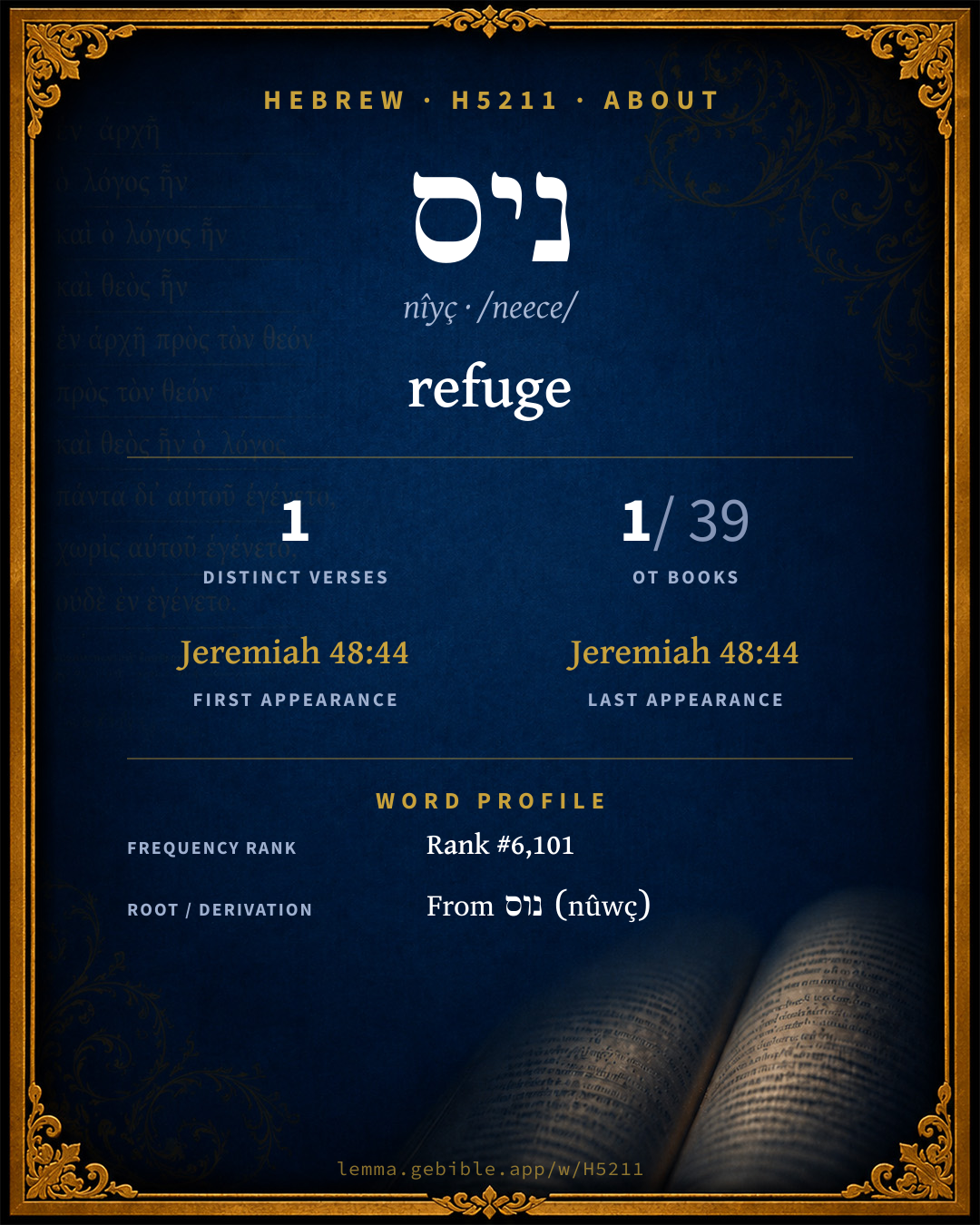
נִיס
refuge
Full lexicon entry — Brown-Driver-Briggs (BDB)
From Brown-Driver-Briggs (BDB)
Where this word appears
Grammar key — what these labels mean
Stem
- Qal
- The basic, simple active stem — the plain form of the verb (“he wrote”). Here: ‘flee’
Form
- Participle Active
- A verbal adjective expressing ongoing or characteristic action (“writing / one who writes”).
State
- Absolute
- The independent form of a noun, not bound to a following word.
Gender
- Masculine
- Grammatically masculine.
Number
- Singular
- One.
Every verse where H5211 appears — 1 distinct verse across 1 book. Click any verse to open its interlinear word-by-word view. Verse text shown in the World English Bible for context — . Each verse’s Hebrew form is shown with its reference; the English is not keyword-highlighted, since the data carries no word-level English alignment. Use “Compare translations” on any verse to read it across multiple English versions. This concordance covers the Hebrew Bible; Septuagint (Greek Old Testament) occurrences are not indexed here.
Jeremiah 1 verse
About this entry
At a glance — auto-summarized from this page’s data, not written by a person. Every figure links to its source below. This summary describes the numbers; it doesn’t interpret them.
ניס — transliterated nîyç — is a Hebrew word carrying the sense “refuge.” It is rare — just 1 verse in the entire Hebrew Bible. More than three-quarters of its appearances fall in Jeremiah. A true hapax — its single appearance is Jeremiah 48:44. Related forms include נוס and מנוס. See the sense tree, 1-verse concordance, and the renderings breakdown below.
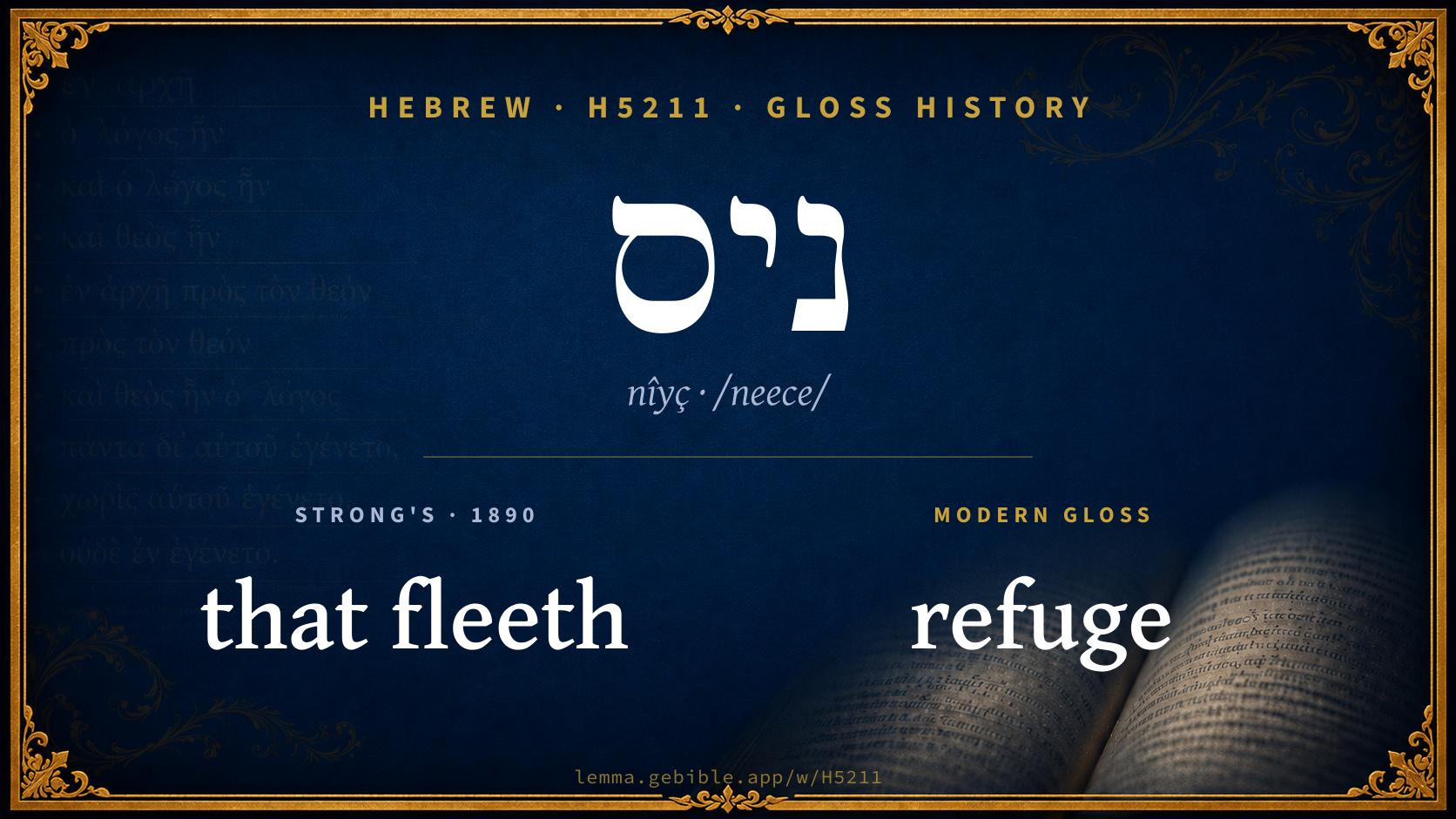
Gloss history
Strong's 1890 vs modern scholarship
About this word
Strong's H5211 catalogs a Hebrew word from the Hebrew Old Testament.
These counts are not copied from any lexicon or concordance. They are computed here, from the morphology-tagged Hebrew Old Testament. What Lemma adds →
- 1
- distinct verses
- The word appears in 1 distinct verse.
- 1 / 39
- OT books
- The word appears in 1 of 39 Old Testament books.
- #6,101
- by frequency
- Rank #6,101 (rank 6,101 of 8,640 Hebrew words by occurrence).
View all 1 occurrence in the concordance →
Most concentrated in
- Jeremiah 1 verse 100%
By section of the Old Testament
By traditional corpus
Conventional, traditional groupings — biblical authorship is debated, so this is a traditional corpus grouping, not an authorship claim. Each share is this word’s portion of its verses in that division of the Hebrew canon. Each figure is a share of the word’s 1 distinct verse.
- Prophets (Nevi'im) 1 verse · 100%
How translations render this word
Counts come from each version’s own published word-to-Strong’s tagging or interlinear alignment — an approximate guide to how each version renders this word, not a word-level alignment the data otherwise carries. Because each total is that version’s own tagged count, the per-version totals vary from one another and need not match the appearance or distinct-verse counts above. These counts may also differ from a printed concordance because Lemma counts each distinctly tagged rendering and does not collapse phrase taggings into a single head-word total. This is a fixed set of word-tagged versions (KJV, ASV, BSB, ULT) and does not change with the reading translation you choose elsewhere. Each version’s license is shown beside its name below (and on Sources).
- King James Version: not separately translated
- Berean Standard Bible: Whoever flees 1×
King James Version Public Domain
Does not render H5211 with a distinct English word (not separately translated in its 1 tagged occurrence).
Berean Standard Bible Public Domain
Renders H5211 across 1 tagged occurrence — most commonly:
10 senses and sub-senses in the full BDB
Hebrew verbs can shift meaning by stem (binyan): Qal is the basic action, Niphal is often passive or reflexive, Piel often intensifies or makes it factitive, and Hiphil is typically causative. The senses below are grouped under the stem BDB assigns to each. This entry also uses one or more reduplicated stems (the Pōlēl/Pilpēl type), which for hollow or geminate roots behave much like Piel — often intensive or iterative.
What do BDB’s symbols mean?
BDB uses these scholarly abbreviations:
| Symbol | Meaning |
|---|---|
| 𝔊 | the Septuagint (the ancient Greek translation, LXX) |
| 𝔙 | the Vulgate (the Latin translation) |
| 𝔖 | the Syriac version (the Peshitta) |
| 𝔗 | the Targum (the Aramaic translation) |
| ψ | the Psalms |
| √ | root (the underlying root or stem) |
| ‖ | parallel passage (a synonymous or contrasted parallel) |
| † | the dagger: every passage where the word occurs is cited |
The 10 senses and sub-senses the full Brown-Driver-Briggs lexicon distinguishes for this word, in lexicon order (not ranked by frequency), with BDB’s own verbatim wording and sub-sense lettering. Shown in Hebrew script with BDB’s own scholarly abbreviations. The condensed entry is in the Lexicon Entry tab.
Qal
- Pf. נָס Nu 35:25 +; נַ֫סְתָּה 2 K 9:3; נַ֫סְתִּי 1 S 4:16, etc.; Impf. יָנוּס Ex 21:13 +; וַיָּנָ֫ס Gn 39:12 +; יְנוּס֑וּן ψ 104:7, etc.; Imv. mpl. נֻ֫סוּ Je 48:6 + 4 times Je Zc; Inf. abs. נוֹס 2 S 18:3; cstr. לָנוּס (לָנֻס) Gn 19:20 +; Pt. נָס Am 9:1 +; נָסִים Ex 14:27 +; — e.g. Numbers 35:25
- 1. flee, abs. Gn 39:12, 15 Nu 16:34 (all J); Jos 10:16 (JE); Lv 26:17, 36 (H); fig. of sea ψ 114:3, 5 cf. 104:7; sq. acc. cogn. מָנוֹס Je 46:5, sq. דֶּרֶךְ Jos 8:15 (J), 2 K 9:27; sq. בְּדֶרֶךְ Dt 28:7, 25; נ׳ אֶל־נַפְשָׁם 2 K 7:7 flee for their life, נ׳ בְּרַגְלָיו Ju 4:15 flee on foot; + 44 times abs. (not elsewhere Hex); sq. אֶל־ loc. Dt 4:42; 19:5, 11 (D), Nu 35:32 Jos 20:4 (both P), Ju 4:17 1 K 2:28, 29 Is 13:14; sq. לְ 1 S 4:10 + 6 times + לִקְרָאתוֹ Ex 14:27 (E; not elsewhere Hex); sq. עַד Ju 7:22 + Pr 28:17 (עַד־בּוֹר, v. בּוֹר); sq. עַל־ Is 10:3; sq. ָה loc. Gn 14:10 + 4 times JE, Nu 35:6 + 6 times P, Dt 4:42; 19:3, 4 (D), + 6 times; sq. שָׁם Is 20:6; sq. acc. loc. Jos 8:20 (J), + 4 times; sq. מִמֶּרְחָק Is 17:13 = far away; sq. מִן from, Jos 20:6 (P), 1 S 4:16 + 3 times; מִתּוֹךְ Je 51:6; especially מִפְּנֵי from before Ex 4:3; 14:25 Nu 10:35 Jos 10:11 (all JE), 1 S 17:24 Je 48:44 (Qr הַנָּס, > Kt הניס), + 19 times; sq. לִפְנֵי Jos 7:4; 8:5, 6(×2) (all J), 1 S 4:17 2 S 24:13, מִלִּפְנֵי 1 Ch 19:18. e.g. Genesis 39:12
- 2. escape Am 9:1 (‖ נמלט) so Je 46:6; hence e.g. Amos 9:1
- 3. take flight, depart, disappear, only fig.; Dt 34:7 (JE) his freshness (לֵחֹה vigour) was not gone (‖ לֹא כָֽהֲתָה עינו); of shadows (at evening), Ct 2:17; 4:6; of sorrow etc. Is 35:10; 51:11. e.g. Deuteronomy 34:7
- 4. נ׳ עַל־סוּס Is 30:16 fly (to the attack) on horseback. e.g. Isaiah 30:16
Poʿlel
- Pf. Is 59:19 רוּחַ י׳ נֹסֲסָה בּוֹ the breath of י׳ driveth at it, driveth it on (cf. Hiph. 2). †Hithpoʿl. Inf. cstr. לְהִתְנוֹסֵס מִפְּנֵי ψ 60:6 in order to take flight before the bow (so Vrss Hup-Now but v. ii. [נסס]). e.g. Isaiah 59:19
Hiphil
- Pf. הֵנִיס Ex 9:20; Impf. יָנִיסוּ Dt 32:30 + Ju 7:21 Kt (Qr וַיָּנוּסוּ Qal); Inf. cstr. לְהָנִיס Ju 6:11;— e.g. Exodus 9:20
- 1. put to flight, sq. acc. Dt 32:30 (‖ רדף). e.g. Deuteronomy 32:30
- 2. drive hastily to a safe place Ex 9:20, sq. acc. + אֶל־. e.g. Exodus 9:20
- 3. cause to disappear, hide Ju 6:11 (no obj. expr.) sq. מִפְּנֵי. e.g. Judges 6:11
Senses from the full Brown-Driver-Briggs lexicon (Brown, Driver, Briggs; Oxford 1906 — public domain), digitized via Sefaria, supplemented by the OpenScriptures HebrewLexicon (CC BY 4.0). Full attribution on Sources.
Word origin
vb. flee, escape (Syriac ܢܳܣ tremble (rare), cf. Brock; Arabic نوس, نَاسَ move to and fro, be in commotion, dangle, Lane 2866);—
— Brown-Driver-Briggs (Oxford 1906, public domain), digitized via Sefaria, supplemented by the OpenScriptures HebrewLexicon (CC BY 4.0). See Sources.
Derived from נוס (nûwç) (H5127) — to flee.
Jastrow Dictionary
A second Hebrew/Aramaic lexicon for comparison, covering Aramaic and post-biblical (Talmudic, Targumic, Midrashic) usage that the biblical-Hebrew BDB does not. Matched by lemma rather than by Strong’s number, so a lemma may carry more than one Jastrow headword (shown separately below), and the entries cover usage well beyond the Bible.
נֵיס
- , pl. נִיסִּים, נִיסִּין, v. נֵס.
A Dictionary of the Targumim, the Talmud Babli and Yerushalmi, and the Midrashic Literature (Marcus Jastrow; London, Luzac, 1903) — Public Domain. Digitized via Sefaria. Digitized via Sefaria. Full attribution on Sources.
Same root — word family
Other BDB entries built from the same root as H5211, grouped by Strong’s listed origin. These share a root / origin per the lexicon — not necessarily a shared meaning. Each links to that word’s own entry.
Derives from
Shares the same root
Compare all same-root words → They share a root, not necessarily a meaning.