
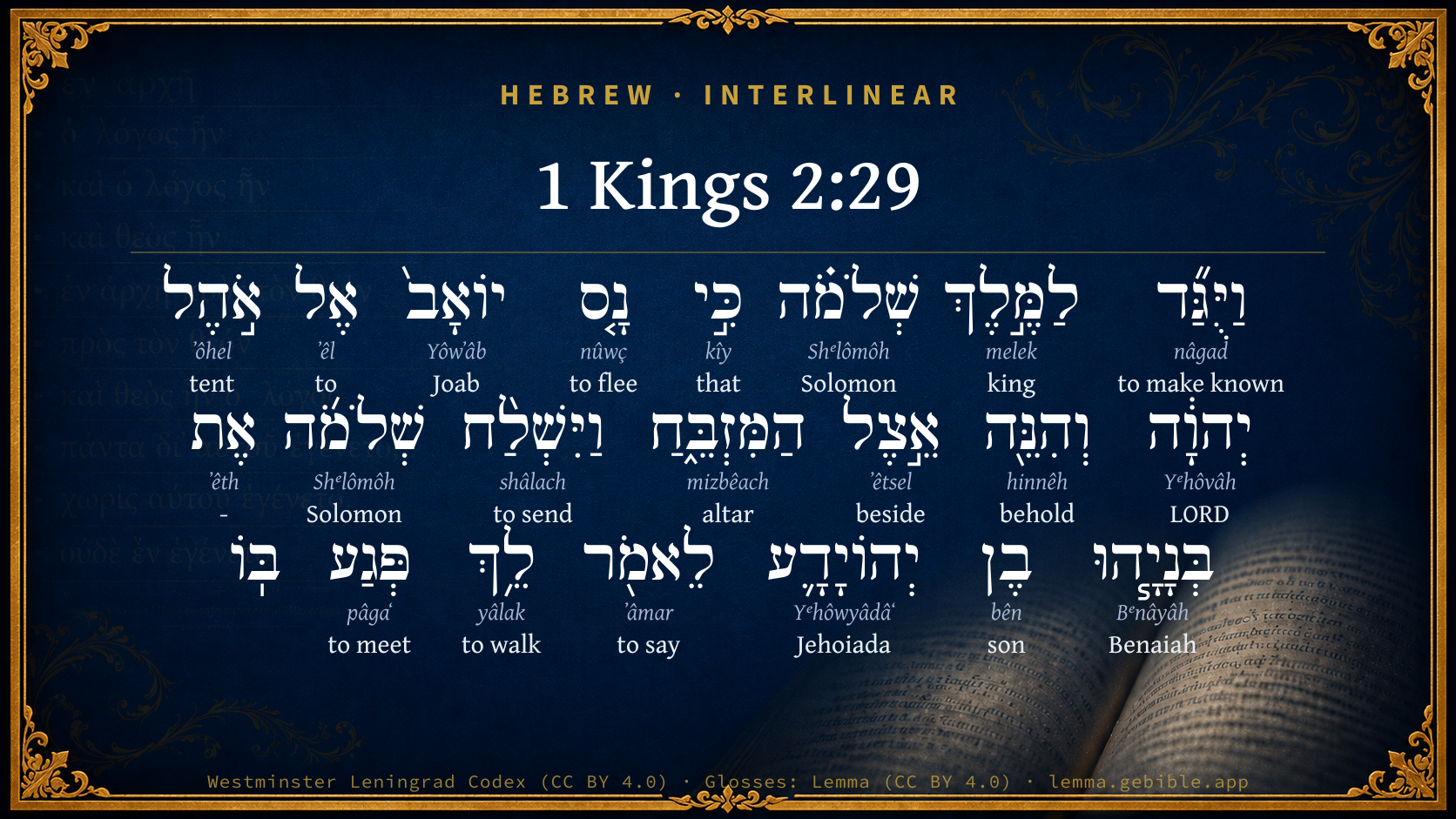
1 Kings 2:29

Hebrew (Westminster Leningrad Codex) 1 Kings 2:29 appears in the Hebrew Old Testament. The text above is from the Westminster Leningrad Codex. Each word links to its Strong’s number, a concise gloss, and parsing drawn from the Open Scriptures Hebrew Bible morphology. Click any word for its full Brown-Driver-Briggs (BDB) entry.
Download image
Cite this verse

1 Kings 2:29 (World English Bible). Public Domain. Lemma interlinear Bible study tool, https://lemma.gebible.app/v/1-kings/2/29.

Show BibTeX & RIS
BibTeX
RIS
English Translation
It was told king Solomon, Joab is fled to the Tent of Yahweh, and, behold, he is by the altar. Then Solomon sent Benaiah the son of Jehoiada, saying, Go, fall on him.
World English Bible · Public Domain
Download a study sheet

One document with this verse’s original text, its word-by-word gloss line, the meaning frame, cross-references with their text, attributed commentary, and full source and license credits — printable, and it pastes into notes with its structure intact.

This verse Autodidact and up

Study sheet (.html) Plain text (.txt)

A passage Seminary Student

Up to 50 verses in one chapter. A passage sheet keeps up to 6 commentary sources and 12 cross-references per verse, in the order this page ranks them, and says so on the sheet whenever that leaves anything out. Ask for a single verse and you get the Autodidact verse sheet above.

Everything on this page stays free to read, with no account — the sheet is a download of what is already on screen, not access to it.

Want to remove ads? Support Godless Engineer
Compare translations 3

The same verse in 3 English versions, stacked beneath the original-language interlinear above. Click any original word for its lexicon entry.

Each is an independent rendering of the whole verse — the interlinear is not word-aligned to these translations.

Highlighted words mark where these versions differ — a whole-verse word diff, not a word-by-word alignment.

  • World English Bible Public Domain
    It was told king Solomon, Joab is fled to the Tent of Yahweh, and, behold, he is by the altar. Then Solomon sent Benaiah the son of Jehoiada, saying, Go, fall on him.
  • King James Version Public Domain
    And it was told king Solomon that Joab was fled unto the tabernacle of the LORD; and, behold, he is by the altar. Then Solomon sent Benaiah the son of Jehoiada, saying, Go, fall upon him.
  • unfoldingWord Literal Text CC BY-SA 4.0
    And it was declared to King Solomon that Joab had fled to the tent of Yahweh, and behold, beside the altar. And Solomon sent Benaiah, the son of Jehoiada, saying, “Go, attack him.”

unfoldingWord Literal Text — © unfoldingWord, licensed CC BY-SA 4.0. Word-aligned USFM3 via Door43 (git.door43.org/unfoldingWord/en_ult).

Versions to compare (up to 4)

3 of 4 selected

Show all 18 translations

Every available English version of this verse, each an independent rendering of the whole verse.

  • World English Bible Public Domain
    It was told king Solomon, Joab is fled to the Tent of Yahweh, and, behold, he is by the altar. Then Solomon sent Benaiah the son of Jehoiada, saying, Go, fall on him.
  • Berean Standard Bible Public Domain
    It was reported to King Solomon: “Joab has fled to the tent of the LORD and is now beside the altar.” So Solomon sent Benaiah son of Jehoiada, saying, “Go, strike him down!”
  • Majority Standard Bible Public Domain
    It was reported to King Solomon: “Joab has fled to the tent of the LORD and is now beside the altar.” So Solomon sent Benaiah son of Jehoiada, saying, “Go, strike him down!”
  • King James Version Public Domain
    And it was told king Solomon that Joab was fled unto the tabernacle of the LORD; and, behold, he is by the altar. Then Solomon sent Benaiah the son of Jehoiada, saying, Go, fall upon him.
  • American Standard Version (1901) Public Domain
    And it was told king Solomon, Joab is fled unto the Tent of Jehovah, and, behold, he is by the altar. Then Solomon sent Benaiah the son of Jehoiada, saying, Go, fall upon him.
  • Revised Version (1885) Public Domain
    And it was told king Solomon, Joab is fled unto the Tent of the LORD, and, behold, he is by the altar. Then Solomon sent Benaiah the son of Jehoiada, saying, Go, fall upon him.
  • Geneva Bible (1599) Public Domain
    And it was tolde king Salomon, that Ioab was fled vnto the Tabernacle of the Lord, and beholde, he is by the altar. Then Salomon sent Benaiah the sonne of Iehoiada, saying, Goe, fall vpon him.
  • Douay-Rheims (1899) Public Domain
    And it was told king Solomon, that Joab was fled into the tabernacle of the Lord, and was by the altar: and Solomon sent Banaias the son of Joiada, saying: Go, kill him.
  • Young's Literal Translation Public Domain
    And it is declared to king Solomon that Joab hath fled unto the tent of Jehovah, and lo, near the altar; and Solomon sendeth Benaiah son of Jehoiada, saying, `Go, fall upon him.'
  • Literal Standard Version CC BY-SA 4.0
    And it is declared to King Solomon that Joab has fled to the tent of YHWH, and behold, [is] near the altar; and Solomon sends Benaiah son of Jehoiada, saying, “Go, fall on him.”
  • Unlocked Literal Bible CC BY-SA 4.0
    It was told King Solomon that Joab had fled to the tent of Yahweh and was now beside the altar. Then Solomon sent Benaiah son of Jehoiada, saying, “Go, execute him.”
  • unfoldingWord Literal Text CC BY-SA 4.0
    And it was declared to King Solomon that Joab had fled to the tent of Yahweh, and behold, beside the altar. And Solomon sent Benaiah, the son of Jehoiada, saying, “Go, attack him.”
  • Darby Bible Public Domain
    And it was told king Solomon that Joab had fled to the tent of Jehovah; and behold, he is by the altar. And Solomon sent Benaiah the son of Jehoiada, saying, Go, fall on him.
  • World Messianic Bible Public Domain
    King Solomon was told, “Joab has fled to the LORD’s Tent; and behold, he is by the altar.” Then Solomon sent Benaiah the son of Jehoiada, saying, “Go, fall on him.”
  • Webster's Bible Public Domain
    And it was told to king Solomon that Joab had fled to the tabernacle of the LORD; and behold, he is by the altar. Then Solomon sent Benaiah the son of Jehoiada, saying, Go, fall upon him.
  • Free Bible Version CC BY-SA 4.0
    When King Solomon was told that Joab was seeking sanctuary by the altar, he sent Benaiah, son of Jehoiada, to execute him.
  • Bible in Basic English Public Domain
    And they said to King Solomon, Joab has gone in flight to the Tent of the Lord and is by the altar. Then Solomon sent Benaiah, the son of Jehoiada, saying, Go, make an attack on him.
  • JPS Tanakh (1917) Public Domain
    And it was told king Solomon: 'Joab is fled unto the Tent of the LORD, and, behold, he is by the altar.' Then Solomon sent Benaiah the son of Jehoiada, saying: 'Go, fall upon him.'

Literal Standard Version (2020), Covenant Press — licensed CC BY-SA 4.0. Text via the HelloAO Bible API (eBible.org). Unlocked Literal Bible (unfoldingWord) — licensed CC BY-SA 4.0. Text via the HelloAO Bible API (eBible.org). unfoldingWord Literal Text — © unfoldingWord, licensed CC BY-SA 4.0. Word-aligned USFM3 via Door43 (git.door43.org/unfoldingWord/en_ult). Free Bible Version, Dr. Jonathan Gallagher — licensed CC BY-SA 4.0. Text via the HelloAO Bible API (eBible.org).

Word by word

More ways to search: Search by grammar → Find every occurrence → Compare this word →

Practice this passage: Drill this verse → Learn its vocabulary →

בְּנָיָ֧הוּ
Bᵉnâyâh
H1141
“Benaiah”
Noun, Proper
Part of Speech
Noun
Type
Proper
Full BDB Definition

Origin: from H1129 and H3050

TWOT: None

Benaiah = "Jehovah has built" or " Yahweh has built up" - one of David's mighty warriors, son of Jehoiada the chief priest, a Levite, set by David over his bodyguard, later having remained faithful to Solomon during Adonijah's attempt on the crown, was raised into the place of Joab as commander-in-chief of the army - the Pirathonite, an Ephraimite, one of David's thirty mighty warriors, and the captain of the eleventh monthly course - a Simeonite, a prince of the families of Simeon - a Levite in the time of David who played with a psaltery on Alamoth - a priest in the time of David, appointed to blow the trumpet before the ark - a Levite of the sons of Asaph - a Levite in the time of Hezekiah - Four Israelites in the time of Ezra who had taken strange wives - the father of Pelatiah
  1. וַיֻּגַּ֞ד nâgad H5046 “and · to make known” Conjunction + Verb, Hophal, Sequential Imperfect, 3rd Person, Masculine, Singular
  2. לַמֶּ֣לֶךְ melek H4428 “to/for the · king” Preposition, Determined + Noun, Common, Masculine, Singular, Absolute
  3. שְׁלֹמֹ֗ה Shᵉlômôh H8010 “Solomon” Noun, Proper
  4. כִּ֣י kîy H3588 “that” Conjunction
  5. נָ֤ס nûwç H5127 “to flee” Verb, Qal, Perfect, 3rd Person, Masculine, Singular
  6. יוֹאָב֙ Yôwʼâb H3097 “Joab” Noun, Proper
  7. אֶל ʼêl H413 “to” Preposition
  8. אֹ֣הֶל ʼôhel H168 “tent of” Noun, Common, Masculine, Singular, Construct
  9. יְהוָ֔ה Yᵉhôvâh H3068 “LORD” Noun, Proper
  10. וְהִנֵּ֖ה hinnêh H2009 “and · behold” Conjunction + Particle, Demonstrative
  11. אֵ֣צֶל ʼêtsel H681 “beside” Preposition
  12. הַמִּזְבֵּ֑חַ mizbêach H4196 “the · altar” Particle, Definite Article + Noun, Common, Masculine, Singular, Absolute
  13. וַיִּשְׁלַ֨ח shâlach H7971 “and · to send” Conjunction + Verb, Qal, Sequential Imperfect, 3rd Person, Masculine, Singular
  14. שְׁלֹמֹ֜ה Shᵉlômôh H8010 “Solomon” Noun, Proper
  15. אֶת ʼêth H853 “-” Particle, Direct Object
  16. בֶן bên H1121 “son of” Noun, Common, Masculine, Singular, Construct
  17. יְהוֹיָדָ֛ע Yᵉhôwyâdâʻ H3077 “Jehoiada” Noun, Proper
  18. לֵאמֹ֖ר ʼâmar H559 “to say” Preposition + Verb, Qal, Infinitive Construct
  19. לֵ֥ךְ yâlak H3212 “walk” Verb, Qal, Imperative, 2nd Person, Masculine, Singular
  20. פְּגַע pâgaʻ H6293 “meet” Verb, Qal, Imperative, 2nd Person, Masculine, Singular

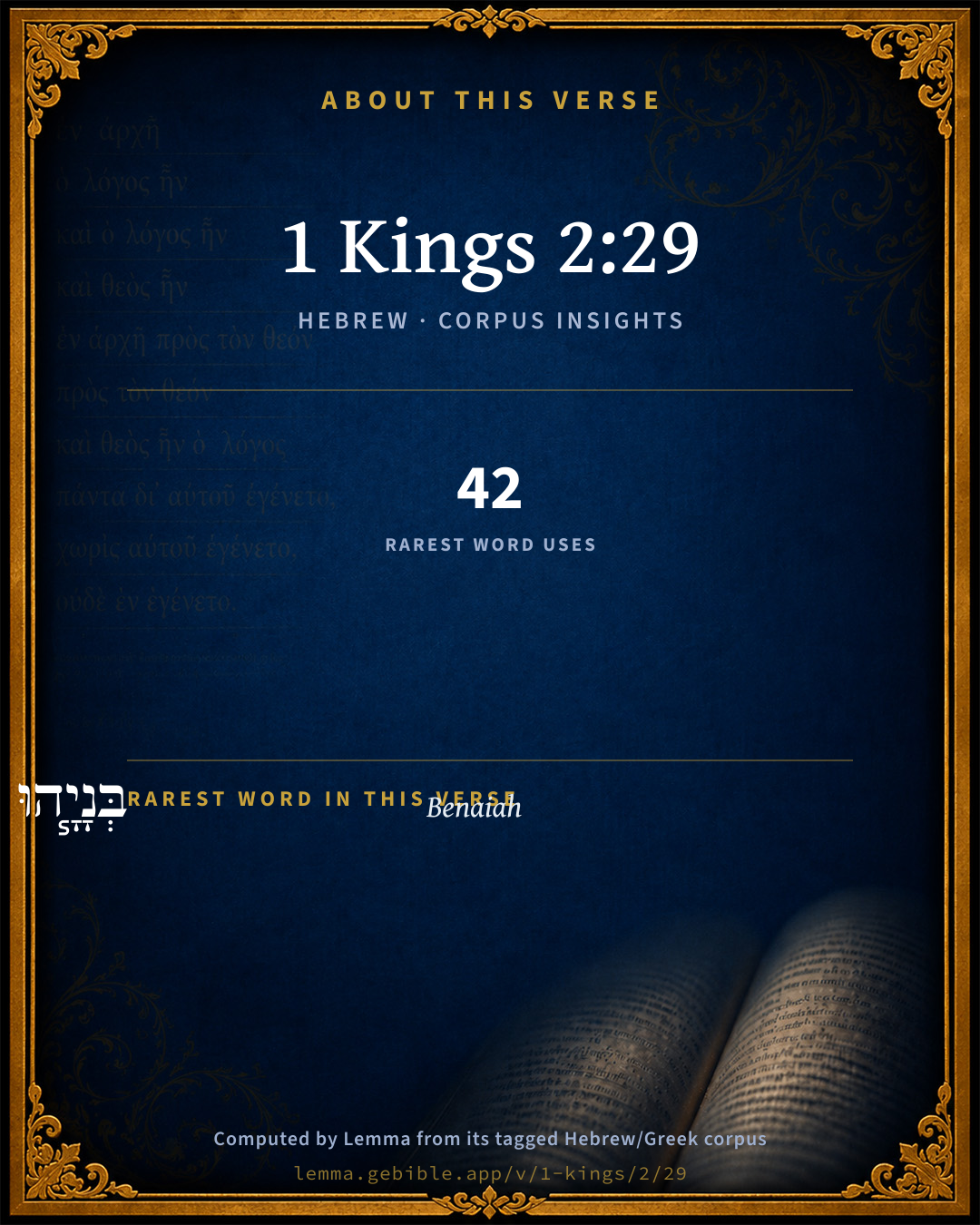
About this verse

These counts appear in no published source. They are computed here, from the morphology-tagged text and Lemma’s own curated glosses. What Lemma adds →

22
words
20
distinct lemmas
Historical
section

Shared distinctive vocabulary

בְּנָיָ֧הוּ Benaiah H1141 occurs in 41 verses of the Hebrew Bible. Also found in:

Grammatical profile

  • 6 verbs
  • 10 nouns
  • 3 prepositions
  • 1 conjunction
  • 2 particles

Verb forms

  • וַיֻּגַּ֞ד Hophal · Sequential Imperfect
  • נָ֤ס Qal · Perfect
  • וַיִּשְׁלַ֨ח Qal · Sequential Imperfect
  • לֵאמֹ֖ר Qal · Infinitive Construct
  • לֵ֥ךְ Qal · Imperative
  • פְּגַע Qal · Imperative

Repetition

A word recurs within this verse — often emphatic in Hebrew:

  • שְׁלֹמֹ֗ה Solomon H8010 ×2

Hebrew & Septuagint length

In English translation the verse runs 33 words from the Hebrew and 74 from the Septuagint (LXX English) — the Septuagint runs noticeably longer here. See the side-by-side →

A rough comparison of the two English renderings, which tokenize alike — not a word-level alignment.

Word counts can differ between the Hebrew and the Greek without any difference in meaning — e.g. the Hebrew direct-object marker אֵת has no separate Greek word, and Greek often adds the article ὁ.

Cross-references

6

Topical passages linked to 1 Kings 2:29 in the Treasury of Scripture Knowledge — connected by theme and wording, ordered by reader-vote popularity; previews shown in the World English Bible.

  • 1 Kings 2:25 King Solomon sent by Benaiah the son of Jehoiada; and he fell on him, so that he died.
  • Exodus 21:14 If a man schemes and comes presumptuously on his neighbor to kill him, you shall take him from my altar, that he may die.
  • 1 Kings 2:31 The king said to him, Do as he has said, and fall on him, and bury him; that you may take away the blood, which Joab shed without cause, from me and from my father's house.
  • 1 Kings 2:46 So the king commanded Benaiah the son of Jehoiada; and he went out, and fell on him, so that he died. The kingdom was established in the hand of Solomon.
  • Ezekiel 9:6 kill utterly the old man, the young man and the virgin, and little children and women; but don't come near any man on whom is the mark: and begin at my sanctuary. Then they began at the old men that were before the house.
  • 1 Peter 4:17 For the time has come for judgment to begin at the house of God. If it begins first with us, what will happen to those who don't obey the Gospel of God?

Cross-references courtesy of OpenBible.info (CC BY 4.0).

Hebrew and Greek witnesses Masoretic Hebrew ↔ Greek Septuagint

The same verse in the two great witnesses to the Old Testament, shown verse-for-verse.

Here the Septuagint runs noticeably longer than the Hebrew — LXX2012 (modern English Septuagint) 74 words vs World English Bible 33. A rough length comparison of the two English translations, not a word-level alignment — read both below.

These are two independent witnesses, not word-aligned to each other, and the Septuagint is shown in lemma (dictionary) form.

Hebrew 1 Kings 2:29 Masoretic · Westminster Leningrad Codex

וַיֻּגַּ֞ד לַמֶּ֣לֶךְ שְׁלֹמֹ֗ה כִּ֣י נָ֤ס יוֹאָב֙ אֶל אֹ֣הֶל יְהוָ֔ה וְהִנֵּ֖ה אֵ֣צֶל הַמִּזְבֵּ֑חַ וַיִּשְׁלַ֨ח שְׁלֹמֹ֜ה אֶת בְּנָיָ֧הוּ בֶן יְהוֹיָדָ֛ע לֵאמֹ֖ר לֵ֥ךְ פְּגַע בּֽוֹ

It was told king Solomon, Joab is fled to the Tent of Yahweh, and, behold, he is by the altar. Then Solomon sent Benaiah the son of Jehoiada, saying, Go, fall on him.

World English Bible · Public Domain

Greek LXX 1 Kings 2:29 Septuagint · lemma form

καί ἀποἀγγέλλω ὁ σαλωμών λέγω ὅτι φεύγω ιωαβ εἰς ὁ σκηνή ὁ κύριος καί ἰδού καταἔχω ὁ κέρας ὁ θυσιαστήριον καί ἀποστέλλω σαλωμών πρός ιωαβ λέγω τίς γίγνομαι σύ ὅτι φεύγω εἰς ὁ θυσιαστήριον καί εἶπον ιωαβ ὅτι φοβέω ἀπό πρόσωπον σύ καί φεύγω πρός κύριος καί ἀποστέλλω σαλωμών ὁ βασιλεύς ὁ βαναιας υἱός ιωδαε λέγω πορεύομαι καί ἀνααἱρέω αὐτός καί θάπτω αὐτός

And it was told Solomon, saying, Joab has fled to the tabernacle of the Lord, and behold! he has hold of the horns of the altar. And king Solomon sent to Joab, saying, What ails you, that you have fled to the altar? and Joab said, Because I was afraid of you, and fled for refuge to the Lord. And Solomon sent Banaeas son of Jodae, saying, Go and kill him, and bury him.

LXX2012 (modern English Septuagint) · Public Domain

On this verse, The Cambridge Bible for Schools and Colleges discusses the Septuagint’s reading. Read the note in Commentary ↓

Hebrew: Westminster Leningrad Codex (CC BY 4.0). Greek: Septuagint (public domain); English from LXX2012 (modern English Septuagint) (Public Domain). How the Septuagint differs from the Hebrew →

Targum (Aramaic paraphrase)

1

The Targum is the ancient Jewish Aramaic paraphrase of the Hebrew Scriptures — an interpretive translation, not the Hebrew text itself. Onkelos (literal) and Pseudo-Jonathan (expansive) render the Torah, and Jonathan the Prophets. Coverage is partial: where no permissively-licensed English translation exists for a verse, only the Aramaic is shown. This is verse-level text, not a word-by-word alignment to the Hebrew.

  1. Targum Jonathan Prophets (Joshua–Malachi)
    וְאִתְחַוָא לְמַלְכָּא שְׁלֹמֹה אֲרֵי אַפֵּיךְ יוֹאָב לְמַשְׁכְּנָא דַייָ וְהָא בִּסְטַר מַדְבְּחָא וּשְׁלַח שְׁלֹמֹה יַת בְּנָיָהוּ בַּר יְהוֹיָדָע לְמֵימָר אֱזֵיל שְׁלוֹט בֵּיהּ:

    (no public-domain English translation for this verse)

    Targum Jonathan — Aramaic: “Mikraot Gedolot” (public domain). English: “Sefaria Community Translation” (CC0 1.0 (public-domain dedication)); “London "Chaldee Paraphrase," 1871” (public domain). Text via Sefaria.

Commentary

Notes on 1 Kings 2:29 from classic Christian and Jewish commentators (each source and its license shown beneath its notes). The classic Christian expositions comment on the surrounding passage and are grouped to its opening verse, so a note may address several verses; the Jewish commentaries on the Tanakh (Rashi and others) are per-verse, so they appear only where the commentator wrote on this verse.

Lemma curates 59 commentaries, every one of them public domain or Creative Commons licensed, each selected and text-cleaned for this edition rather than reprinted as found. About our sources →

Trapp's Complete Commentary

John Trapp

1Ki 2:29 And it was told king Solomon that Joab was fled unto the tabernacle of the LORD; and, behold, [he is] by the altar. Then Solomon sent Benaiah the son of Jehoiada, saying, Go, fall upon him.

Ver. 29. Go, fall upon him.] Wilful murderers were to be drawn from the altar to the slaughter. {Exo 21:14}

John Trapp, A Commentary or Exposition upon All the Books of the Old and New Testament (1647–1656) — public domain. Text from a community e-Sword module.

Joseph Benson's Commentary

1Ki 2:29-30. Go, fall upon him — Namely if he will not come out from thence, as I foresee he will not. Thus saith the king, Come forth — That the king gave this command, though it be not mentioned before, is evident, both from the nature of the thing, for Solomon would not pollute the altar without necessity, and from Benaiah’s affirmation of it; for why should he tell a lie without a cause? It appears, also, from his returning to the king for new orders, upon Joab’s resolution not to come out thence, He said, Nay, but I will die here — For he supposed, either that Solomon would not defile that place with his blood, but would spare him for his respect to it, as he had done Adonijah; or, he had a superstitious conceit, that his dying there might give his guilty and miserable soul some advantage.

Joseph Benson's Commentary on the Old and New Testaments (1811–1818) — public domain. Text from a community e-Sword module.

Geneva Bible (1599)

Geneva Bible translators

Thinking to be saved by the holiness of the place.

Geneva Bible (1599) marginal notes — public domain. Text via Bolls.life.

The Cambridge Bible for Schools and Colleges

gen. ed. J. J. S. Perowne

29. he is by the altar] The LXX. has ‘he has taken hold of the horns of the altar’, after which that version adds ‘And Solomon the king sent to Joab, saying, What has happened to thee that thou hast fled to the altar? And Joab said, Because I was afraid of thee, and fled unto the Lord.’ These words seem merely an expansion of the narrative, and we need not suppose that they represent a lost clause of the Hebrew.

The Cambridge Bible for Schools and Colleges (gen. ed. J. J. S. Perowne; Cambridge University Press, 1878–1918) — public domain. Text from a community e-Sword module.

John Gill's Exposition

And Benaiah came to the tabernacle of the Lord,.... At Gibeon:

and said unto him; that is, to Joab:

thus saith the king, come forth; meaning, out of the tabernacle; which plainly shows that his orders were not to slay him in it:

and he said, nay, but I will die here; since he must die, he chose to die there; but what was his reason for it is not so clear; the Jews, some of them, say, to save his goods, and that they might come to his heirs, which would have been forfeited to the crown if he had been tried and condemned in a court of judicature; others, that he might be buried with his ancestors, whereas, had he been sentenced to death by the court, he would have been buried in the common place of malefactors; but rather he thought, or at least hoped, he should not die at all; either that, by gaining time, Solomon might be prevailed upon to pardon him; or however that he would not defile that sacred place with his blood; or, if he should die, he chose to die there, as being a sacred place, and so might hope to receive some benefit from it, as to his future state, where sacrifices were offered to atone for sin:

and Benaiah brought the king word again, saying, thus said Joab, and thus he answered me; told me he would not come out, and, if he must die, he would die there.

John Gill's Exposition of the Whole Bible (1746–1763) — public domain (CC PDM 1.0). Text via the HelloAO Bible API.

Matthew Poole's English Annotations

To wit, if he will not come thence, as I foresee he will not.

Matthew Poole's English Annotations on the Holy Bible (1683–1685) — public domain. Text from a community e-Sword/MySword module.

The Pulpit Commentary

And it was told king Solomon that Joab was fled unto the tabernacle of the Lord; and, behold, he is by the altar. The LXX here inserts, And Solomon the king sent to Joab, saying, What has happened thee, that thou art fled to the altar? And Joab said, Because I feared before thee, and I fled to the Lord. This is only a gloss, but it is an instructive one. It shows that the author regarded Joab"s flight as betraying a guilty conscience. Then Solomon sent Benaiah, the son of Jehoiada, saying, Go, fall upon him. The LXX adds, and bury him.

The Pulpit Commentary (1880–1919), ed. H.D.M. Spence-Jones & Joseph S. Exell — public domain. Text from a community e-Sword module.

Lesson kit

Teaching starters — assembled from the data on this page, not authored interpretation. Every prompt links to the verse data it draws on. Edit before teaching.

1 Kings, in the Historical, opens this verse with 22 words (20 distinct Hebrew lemmas). Its most distinctive word is Bᵉnâyâh (“Benaiah”). The Greek Septuagint runs longer here. A historical commentator’s framing appears above. Read the whole chapter for the surrounding context.

Discussion questions

  1. What does “Benaiah” (Bᵉnâyâh) contribute to the verse as a whole?
  2. 2 Samuel 8:18 shares the word «Benaiah» with this verse. How do the two illuminate each other?
  3. “Solomon” occurs 2× in this one verse. What is the effect of the repetition?
  4. Compared with the Hebrew, the Septuagint runs longer here. What questions does that raise?
  5. The translations on this page render this verse differently — a whole-verse word diff, not a word-by-word alignment. What might account for the different wordings?
  6. The verb «וַיֻּגַּ֞ד» is Hophal Sequential Imperfect. How does its form color the action?
  7. Reading how Trapp's Complete Commentary and Joseph Benson's Commentary read this verse, where do the two commentators agree and where do they part?

Things to notice

Reading settings

Reading text

Shown beneath each verse's original-language words.

Old Testament
Old Testament edition

Read the OT as the Masoretic Hebrew (MT) or the Greek Septuagint (LXX).

English shown for the Greek Septuagint (in the Hebrew ↔ Greek comparison).

Comparing translations? Open the Compare panel on any verse page to stack up to four side by side.