

1 Kings 12:18

Hebrew (Westminster Leningrad Codex) 1 Kings 12:18 appears in the Hebrew Old Testament. The text above is from the Westminster Leningrad Codex. Each word links to its Strong’s number, a concise gloss, and parsing drawn from the Open Scriptures Hebrew Bible morphology. Click any word for its full Brown-Driver-Briggs (BDB) entry.
Download image
Cite this verse

1 Kings 12:18 (World English Bible). Public Domain. Lemma interlinear Bible study tool, https://lemma.gebible.app/v/1-kings/12/18.

Show BibTeX & RIS
BibTeX
RIS
English Translation
Then king Rehoboam sent Adoram, who was over the men subject to forced labor; and all Israel stoned him to death with stones. King Rehoboam made speed to get him up to his chariot, to flee to Jerusalem.
World English Bible · Public Domain
Download a study sheet

One document with this verse’s original text, its word-by-word gloss line, the meaning frame, cross-references with their text, attributed commentary, and full source and license credits — printable, and it pastes into notes with its structure intact.

This verse Autodidact and up

Study sheet (.html) Plain text (.txt)

A passage Seminary Student

Up to 50 verses in one chapter. A passage sheet keeps up to 6 commentary sources and 12 cross-references per verse, in the order this page ranks them, and says so on the sheet whenever that leaves anything out. Ask for a single verse and you get the Autodidact verse sheet above.

Everything on this page stays free to read, with no account — the sheet is a download of what is already on screen, not access to it.

Want to remove ads? Support Godless Engineer
Compare translations 3

The same verse in 3 English versions, stacked beneath the original-language interlinear above. Click any original word for its lexicon entry.

Each is an independent rendering of the whole verse — the interlinear is not word-aligned to these translations.

Highlighted words mark where these versions differ — a whole-verse word diff, not a word-by-word alignment.

  • World English Bible Public Domain
    Then king Rehoboam sent Adoram, who was over the men subject to forced labor; and all Israel stoned him to death with stones. King Rehoboam made speed to get him up to his chariot, to flee to Jerusalem.
  • King James Version Public Domain
    Then king Rehoboam sent Adoram, who was over the tribute; and all Israel stoned him with stones, that he died. Therefore king Rehoboam made speed to get him up to his chariot, to flee to Jerusalem.
  • unfoldingWord Literal Text CC BY-SA 4.0
    And King Rehoboam sent Adoram, who over the forced labor, but all of Israel stoned him stone, and he died. And King Rehoboam strengthened himself to go up into the chariot to flee to Jerusalem.

unfoldingWord Literal Text — © unfoldingWord, licensed CC BY-SA 4.0. Word-aligned USFM3 via Door43 (git.door43.org/unfoldingWord/en_ult).

Versions to compare (up to 4)

3 of 4 selected

Show all 18 translations

Every available English version of this verse, each an independent rendering of the whole verse.

  • World English Bible Public Domain
    Then king Rehoboam sent Adoram, who was over the men subject to forced labor; and all Israel stoned him to death with stones. King Rehoboam made speed to get him up to his chariot, to flee to Jerusalem.
  • Berean Standard Bible Public Domain
    Then King Rehoboam sent out Adoram, who was in charge of the forced labor, but all Israel stoned him to death. And King Rehoboam mounted his chariot in haste and escaped to Jerusalem.
  • Majority Standard Bible Public Domain
    Then King Rehoboam sent out Adoram, who was in charge of the forced labor, but all Israel stoned him to death. And King Rehoboam mounted his chariot in haste and escaped to Jerusalem.
  • King James Version Public Domain
    Then king Rehoboam sent Adoram, who was over the tribute; and all Israel stoned him with stones, that he died. Therefore king Rehoboam made speed to get him up to his chariot, to flee to Jerusalem.
  • American Standard Version (1901) Public Domain
    Then king Rehoboam sent Adoram, who was over the men subject to taskwork; and all Israel stoned him to death with stones. And king Rehoboam made speed to get him up to his chariot, to flee to Jerusalem.
  • Revised Version (1885) Public Domain
    Then king Rehoboam sent Adoram, who was over the levy; and all Israel stoned him with stones, that he died. And king Rehoboam made speed to get him up to his chariot, to flee to Jerusalem.
  • Geneva Bible (1599) Public Domain
    Nowe the King Rehoboam sent Adoram the receiuer of the tribute, and all Israel stoned him to death: then King Rehoboam made speede to get him vp to his charet, to flee to Ierusalem.
  • Douay-Rheims (1899) Public Domain
    Then king Roboam sent Aduram, who was over the tribute: and all Israel stoned him, and he died. Wherefore king Roboam made haste to get him up into his chariot, and he fled to Jerusalem:
  • Young's Literal Translation Public Domain
    And king Rehoboam sendeth Adoram who `is' over the tribute, and all Israel cast at him stones, and he dieth; and king Rehoboam hath strengthened himself to go up into a chariot to flee to Jerusalem;
  • Literal Standard Version CC BY-SA 4.0
    And King Rehoboam sends Adoram who [is] over the tribute, and all Israel casts stones at him, and he dies; and King Rehoboam has strengthened himself to go up into a chariot to flee to Jerusalem;
  • Unlocked Literal Bible CC BY-SA 4.0
    Then King Rehoboam sent Adoniram, who was over the forced laborers, but all Israel stoned him to death with stones. King Rehoboam fled quickly in his chariot to Jerusalem.
  • unfoldingWord Literal Text CC BY-SA 4.0
    And King Rehoboam sent Adoram, who over the forced labor, but all of Israel stoned him stone, and he died. And King Rehoboam strengthened himself to go up into the chariot to flee to Jerusalem.
  • Darby Bible Public Domain
    And king Rehoboam sent Adoram, who was over the levy; but all Israel stoned him with stones, that he died. And king Rehoboam hastened to mount his chariot, to flee to Jerusalem.
  • World Messianic Bible Public Domain
    Then King Rehoboam sent Adoram, who was over the men subject to forced labor; and all Israel stoned him to death with stones. King Rehoboam hurried to get himself up to his chariot, to flee to Jerusalem.
  • Webster's Bible Public Domain
    Then king Rehoboam sent Adoram, who was over the tribute; and all Israel stoned him with stones, that he died. Therefore king Rehoboam made speed to enter his chariot, to flee to Jerusalem.
  • Free Bible Version CC BY-SA 4.0
    Then King Rehoboam sent out Hadoram, who was in charge of forced labor, but the Israelites stoned him to death. King Rehoboam quickly jumped into his chariot and raced back to Jerusalem.
  • Bible in Basic English Public Domain
    Then King Rehoboam sent Adoniram, the overseer of the forced work; and he was stoned to death by all Israel. And King Rehoboam went quickly and got into his carriage to go in flight to Jerusalem.
  • JPS Tanakh (1917) Public Domain
    Then king Rehoboam sent Adoram, who was over the levy; and all Israel stoned him with stones, so that he died. And king Rehoboam made speed to get him up to his chariot, to flee to Jerusalem.

Literal Standard Version (2020), Covenant Press — licensed CC BY-SA 4.0. Text via the HelloAO Bible API (eBible.org). Unlocked Literal Bible (unfoldingWord) — licensed CC BY-SA 4.0. Text via the HelloAO Bible API (eBible.org). unfoldingWord Literal Text — © unfoldingWord, licensed CC BY-SA 4.0. Word-aligned USFM3 via Door43 (git.door43.org/unfoldingWord/en_ult). Free Bible Version, Dr. Jonathan Gallagher — licensed CC BY-SA 4.0. Text via the HelloAO Bible API (eBible.org).

Word by word

More ways to search: Search by grammar → Find every occurrence → Compare this word →

Practice this passage: Drill this verse → Learn its vocabulary →

אֲדֹרָם֙
ʼĂdôrâm
H151
“Adoram”
Noun, Proper
Part of Speech
Noun
Type
Proper
Full BDB Definition

Origin: shortened form of H141 , Adoniram

TWOT: None

Adoram = "my lord is exalted" - an officer of David - an officer of Rehoboam
  1. וַיִּשְׁלַ֞ח shâlach H7971 “and · to send” Conjunction + Verb, Qal, Sequential Imperfect, 3rd Person, Masculine, Singular
  2. הַמֶּ֣לֶךְ melek H4428 “the · king” Particle, Definite Article + Noun, Common, Masculine, Singular, Absolute
  3. רְחַבְעָ֗ם Rᵉchabʻâm H7346 “Rehoboam” Noun, Proper
  4. אֶת ʼêth H853 “-” Particle, Direct Object
  5. אֲשֶׁ֣ר ʼăsher H834 “which” Particle, Relative
  6. עַל ʻal H5921 “upon” Preposition
  7. הַמַּ֔ס maç H4522 “the · forced labor” Particle, Definite Article + Noun, Common, Masculine, Singular, Absolute
  8. וַיִּרְגְּמ֨וּ râgam H7275 “and · to stone” Conjunction + Verb, Qal, Sequential Imperfect, 3rd Person, Masculine, Plural
  9. כָל kôl H3605 “all of” Noun, Common, Masculine, Singular, Construct
  10. יִשְׂרָאֵ֥ל Yisrâʼêl H3478 “Israel” Noun, Proper
  11. אֶ֖בֶן ʼeben H68 “stone” Noun, Common, Feminine, Singular, Absolute
  12. וַיָּמֹ֑ת mûwth H4191 “and · to die” Conjunction + Verb, Qal, Sequential Imperfect, 3rd Person, Masculine, Singular
  13. וְהַמֶּ֣לֶךְ melek H4428 “and · the · king” Conjunction + Particle, Definite Article + Noun, Common, Masculine, Singular, Absolute
  14. רְחַבְעָ֗ם Rᵉchabʻâm H7346 “Rehoboam” Noun, Proper
  15. הִתְאַמֵּץ֙ ʼâmats H553 “to be strong” Verb, Hithpael, Perfect, 3rd Person, Masculine, Singular
  16. לַעֲל֣וֹת ʻâlâh H5927 “to go up” Preposition + Verb, Qal, Infinitive Construct
  17. בַּמֶּרְכָּבָ֔ה merkâbâh H4818 “in/at the · chariot” Preposition, Determined + Noun, Common, Feminine, Singular, Absolute
  18. לָנ֖וּס nûwç H5127 “to flee” Preposition + Verb, Qal, Infinitive Construct
  19. יְרוּשָׁלִָֽם Yᵉrûwshâlaim H3389 “Jerusalem” Noun, Proper

About this verse

These counts appear in no published source. They are computed here, from the morphology-tagged text and Lemma’s own curated glosses. What Lemma adds →

21
words
18
distinct lemmas
Historical
section

Notable vocabulary

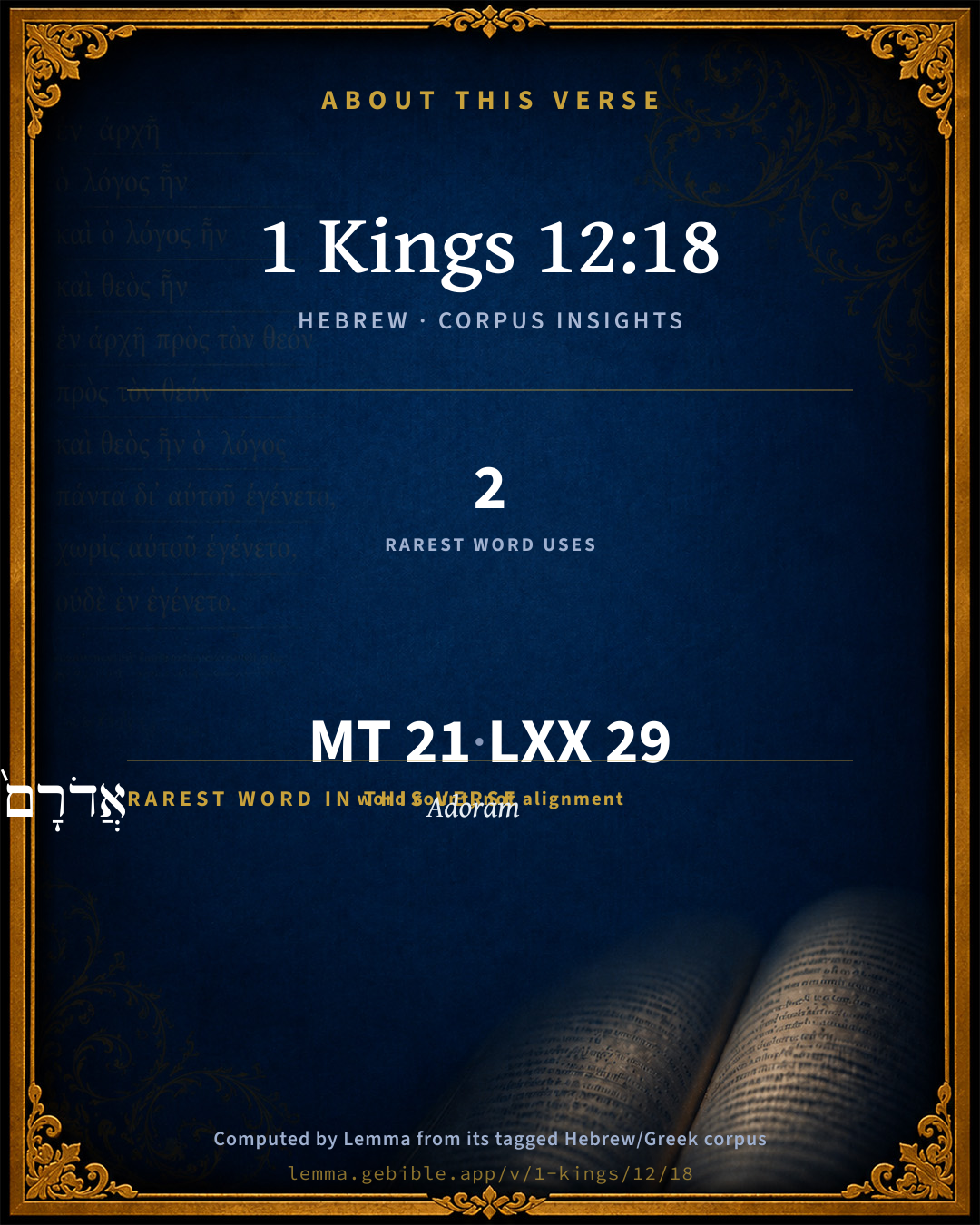
The rarest word here is אֲדֹרָם֙ Adoram H151 — appearing just 2 times in the whole Hebrew Bible.

Shared distinctive vocabulary

אֲדֹרָם֙ Adoram H151 occurs in 2 verses of the Hebrew Bible. Also found in:

Grammatical profile

  • 6 verbs
  • 11 nouns
  • 2 prepositions
  • 2 particles

Verb forms

  • וַיִּשְׁלַ֞ח Qal · Sequential Imperfect
  • וַיִּרְגְּמ֨וּ Qal · Sequential Imperfect
  • וַיָּמֹ֑ת Qal · Sequential Imperfect
  • הִתְאַמֵּץ֙ Hithpael · Perfect
  • לַעֲל֣וֹת Qal · Infinitive Construct
  • לָנ֖וּס Qal · Infinitive Construct

Repetition

Words recur within this verse — often emphatic in Hebrew:

  • הַמֶּ֣לֶךְ king H4428 ×2
  • רְחַבְעָ֗ם Rehoboam H7346 ×2

Hebrew & Septuagint length

In English translation the verse runs 38 words from the Hebrew and 30 from the Septuagint (LXX English) — closely comparable.

A rough comparison of the two English renderings, which tokenize alike — not a word-level alignment.

Word counts can differ between the Hebrew and the Greek without any difference in meaning — e.g. the Hebrew direct-object marker אֵת has no separate Greek word, and Greek often adds the article ὁ.

In the original languages it is 21 Hebrew tokens and 29 Greek tokens — but the two are counted differently (Hebrew bundles its prefixes and suffixes into one token; the Greek is in lemma form), so that isn’t a like-for-like length.

Cross-references

12

Topical passages linked to 1 Kings 12:18 in the Treasury of Scripture Knowledge — connected by theme and wording, ordered by reader-vote popularity; previews shown in the World English Bible.

  • 1 Kings 4:6 and Ahishar was over the household; and Adoniram the son of Abda was over the men subject to forced labor.
  • 2 Samuel 20:24 and Adoram was over the men subject to forced labor; and Jehoshaphat the son of Ahilud was the recorder;
  • 1 Kings 5:14 He sent them to Lebanon, ten thousand a month by courses; a month they were in Lebanon, and two months at home; and Adoniram was over the men subject to forced labor.
  • Acts 7:57–58 But they cried out with a loud voice, and stopped their ears, and rushed at him with one accord.
  • Exodus 17:4 Moses cried to Yahweh, saying, "What shall I do with these people? They are almost ready to stone me."
  • Numbers 14:10 But all the congregation bade stone them with stones. The glory of Yahweh appeared in the tent of meeting to all the children of Israel.
  • 1 Kings 20:18–20 He said, Whether they are come out for peace, take them alive, or whether they are come out for war, taken them alive.
  • 2 Chronicles 10:18 Then king Rehoboam sent Hadoram, who was over the men subject to forced labor; and the children of Israel stoned him to death with stones. King Rehoboam made speed to get him up to his chariot, to flee to Jerusalem.
  • 2 Chronicles 24:21 They conspired against him, and stoned him with stones at the commandment of the king in the court of the house of Yahweh.
  • Proverbs 28:1–2 The wicked flee when no one pursues; But the righteous are as bold as a lion.
  • Amos 2:16 And he who is courageous among the mighty will flee away naked in that day," says Yahweh.
  • Acts 5:26 Then the captain went with the officers, and brought them without violence, for they were afraid that the people might stone them.

Cross-references courtesy of OpenBible.info (CC BY 4.0).

Hebrew and Greek witnesses Masoretic Hebrew ↔ Greek Septuagint

The same verse in the two great witnesses to the Old Testament, shown verse-for-verse.

These are two independent witnesses, not word-aligned to each other, and the Septuagint is shown in lemma (dictionary) form.

Hebrew 1 Kings 12:18 Masoretic · Westminster Leningrad Codex

וַיִּשְׁלַ֞ח הַמֶּ֣לֶךְ רְחַבְעָ֗ם אֶת אֲדֹרָם֙ אֲשֶׁ֣ר עַל הַמַּ֔ס וַיִּרְגְּמ֨וּ כָל יִשְׂרָאֵ֥ל בּ֛וֹ אֶ֖בֶן וַיָּמֹ֑ת וְהַמֶּ֣לֶךְ רְחַבְעָ֗ם הִתְאַמֵּץ֙ לַעֲל֣וֹת בַּמֶּרְכָּבָ֔ה לָנ֖וּס יְרוּשָׁלִָֽם

Then king Rehoboam sent Adoram, who was over the men subject to forced labor; and all Israel stoned him to death with stones. King Rehoboam made speed to get him up to his chariot, to flee to Jerusalem.

World English Bible · Public Domain

Greek LXX 1 Kings 12:18 Septuagint · lemma form

καί ἀποστέλλω ὁ βασιλεύς ὁ αδωνιραμ ὁ ἐπί ὁ φόρος καί λιθοβολέω αὐτός πᾶς ἰσραήλ ἐν λίθος καί ἀποθνήσκω καί ὁ βασιλεύς ροβοαμ φθάνω ἀναβαίνω ὁ φεύγω εἰς ἰερουσαλήμ

And the king sent Adoniram who was over the tribute; and they stoned him with stones, and he died: and king Roboam made haste to rise to flee to Jerusalem.

LXX2012 (modern English Septuagint) · Public Domain

On this verse, The Cambridge Bible for Schools and Colleges discusses the Septuagint’s reading. Read the note in Commentary ↓

Hebrew: Westminster Leningrad Codex (CC BY 4.0). Greek: Septuagint (public domain); English from LXX2012 (modern English Septuagint) (Public Domain). How the Septuagint differs from the Hebrew →

Targum (Aramaic paraphrase)

1

The Targum is the ancient Jewish Aramaic paraphrase of the Hebrew Scriptures — an interpretive translation, not the Hebrew text itself. Onkelos (literal) and Pseudo-Jonathan (expansive) render the Torah, and Jonathan the Prophets. Coverage is partial: where no permissively-licensed English translation exists for a verse, only the Aramaic is shown. This is verse-level text, not a word-by-word alignment to the Hebrew.

  1. Targum Jonathan Prophets (Joshua–Malachi)
    וּשְׁלַח מַלְכָּא רְחַבְעָם יַת אֲדוֹרָם דִמְמַנָא עַל מַסְקֵי מִסִין וּרְגָמוּ כָל יִשְׂרָאֵל יָתֵיהּ בְּאַבָנָא וּמִית וּמַלְכָּא רְחַבְעָם אִתְקַף לְמִסַק בִּרְתִיכָא לְמִפַּךְ יְרוּשְׁלָם:

    (no public-domain English translation for this verse)

    Targum Jonathan — Aramaic: “Mikraot Gedolot” (public domain). English: “Sefaria Community Translation” (CC0 1.0 (public-domain dedication)); “London "Chaldee Paraphrase," 1871” (public domain). Text via Sefaria.

Commentary

Notes on 1 Kings 12:18 from classic Christian and Jewish commentators (each source and its license shown beneath its notes). The classic Christian expositions comment on the surrounding passage and are grouped to its opening verse, so a note may address several verses; the Jewish commentaries on the Tanakh (Rashi and others) are per-verse, so they appear only where the commentator wrote on this verse.

Lemma curates 59 commentaries, every one of them public domain or Creative Commons licensed, each selected and text-cleaned for this edition rather than reprinted as found. About our sources →

Trapp's Complete Commentary

John Trapp

1Ki 12:18 Then king Rehoboam sent Adoram, who [was] over the tribute; and all Israel stoned him with stones, that he died. Therefore king Rehoboam made speed to get him up to his chariot, to flee to Jerusalem.

Ver. 18. Sent Adoram, who was over the tribute.] But the sight of such an officer, he might well think, would enrage them rather. Herein therefore Rehoboam was also ill-advised: he should have considered that the rebellious multitude more regard commotioners than commissioners, and are more guided by rage than by right: flocking together, as clouds cluster against a storm, whilst violence and obstinacy, like two untamed horses, draw their desires in a blindfold career.

To flee to Jerusalem.] Whither he returned lighter now by a crown than when he went forth: yet in better condition than was once our Henry VI, when deposed by Edward IV; he was not only bereft of all, but also sent again prisoner to the Tower the same day that he had a year before been carried through the city of London, as it were, in triumph, and had heard the shouts of the commons in every street crying, God save King Henry. {a}

{a} Speed.

John Trapp, A Commentary or Exposition upon All the Books of the Old and New Testament (1647–1656) — public domain. Text from a community e-Sword module.

Joseph Benson's Commentary

1Ki 12:18. Then Rehoboam sent Adoram, who was over the tribute — To pursue the counsel which he had resolved upon, say some; to execute his office, and exact their tribute with rigour, and, if need were, with violence. But it is much more probable that he sent him to treat with them; which was a new piece of imprudence when they were so highly exasperated. And to send the person for this purpose, that was over the tribute, with promises, perhaps, of easing them, when it was too late, was certainly the height of folly; for people generally hate those that are any way employed in collecting the tributes and taxes imposed upon them. And all Israel stoned him with stones, that he died — He was so odious among them that the very sight of him made them outrageous, and in a general tumult; they committed this barbarous act, and thereby violated the law of all nations, which prohibits any injury to be offered to the person of a king’s ambassador. Therefore King Rehoboam made speed to flee to Jerusalem — From Shechem, where he yet was with his friends and guards about him. For, it seems, he had continued there in the midst of his kingdom, and among the seditious tribes, that he might overawe them by his presence, and repress any tumults in their first rise: but from thence, as soon as he saw himself in danger, he fled away in his chariot, with all speed, in the most cowardly manner, notwithstanding the haughtiness he had lately manifested, and the big words he had spoken. This seems to have been a still further degree of imprudence; for he should, if possible, have maintained his ground, and kept footing, as we speak, in the country of Israel, from whence it might not have been easy for them to expel him: but fear is a bad adviser. This is the first time that we find a king riding in a chariot; for we never read of Saul, or David, or Solomon riding in one. But after the division of the kingdom there is frequent mention of the use of chariots, both by the kings of Judah and Israel.

Joseph Benson's Commentary on the Old and New Testaments (1811–1818) — public domain. Text from a community e-Sword module.

Tyndale Open Study Notes

Tyndale Open Resources

12:18 Adoniram served under both David (2 Sam 20:24) and Solomon (1 Kgs 4:6; 5:13-14). His death by stoning showed the folly of Rehoboam’s decision to send the unpopular supervisor of the labor force to restore order in the north.

Tyndale Open Study Notes — © Tyndale Open Resources, licensed CC BY-SA 4.0. Text via the HelloAO Bible API.

Geneva Bible (1599)

Geneva Bible translators

Hebrew, strengthened himself.

Geneva Bible (1599) marginal notes — public domain. Text via Bolls.life.

Adam Clarke's Commentary

Verse 18. King Rehoboam sent Adoram] As this was the person who was superintendent over the tribute, he was probably sent to collect the ordinary taxes; but the people, indignant at the master who had given them such a brutish answer, stoned the servant to death. The sending of Adoram to collect the taxes, when the public mind was in such a state of fermentation, was another proof of Rehoboam's folly and incapacity to govern.

Adam Clarke's Commentary on the Bible (1810–1826) — public domain. Text from a community e-Sword/MySword module.

Ellicott's Commentary for English Readers

(18) Adoram, who was over the tribute (or levy).—In 2Sa_20:24, 1Ki_4:6; 1Ki_5:14, we find Adoram (or Adoniram, which is a longer form of the same name) described as holding this office in the later days of David and the reign of Solomon. The Adoram here mentioned must be identical with the officer of Solomon; but, though it is possible, it is not likely that he could have held office in David’s time. Probably the name and office were hereditary׳. The mission of Adoram shows that, too late, Renoboam desired to deal through him with the grievance of forced labour. But the sight of the man, who had been the taskmaster of their oppression, naturally stirred the multitude to a fresh burst of fury, venting itself in his murder, and perhaps threatening his master also, had he not fled hastily at once to Jerusalem.

A Bible Commentary for English Readers, edited by Charles John Ellicott (1878–1897) — public domain. Text from a community e-Sword module.

The Cambridge Bible for Schools and Colleges

gen. ed. J. J. S. Perowne

18. Then king Rehoboam sent Adoram] The same man who is called Adoniram in ch. 1Ki_4:6. He presided over the forced-labour service, and it was an additional sign of the infatuation of Rehoboam, that a person so likely to be obnoxious to the people should be sent as the king’s representative. Josephus tells us that Rehoboam’s design was to appease and mollify the irritation caused by his answer. He could hardly have found worse means for his end.

who was over the tribute] Read, with R.V. ‘over the levy.’ See above on 1Ki_4:6.

and all Israel stoned him] The LXX. omits ‘all Israel.’

Therefore king Rehoboam made speed] The marginal rendering of A.V. points out the literal meaning of the verb in this clause ‘he strengthened himself.’ The idea is ‘he made use of every effort,’ ‘exerted himself much,’ seeing that there was danger threatening him as well as his messenger. It appears from this verse, that little time had elapsed between the answer of Rehoboam and the sending of Adoram to appease the irritated leaders. All this was done and Adoram killed before Rehoboam left Shechem. The haughty stern answer and the sudden change to a policy of a more lenient nature are alike marks of the weak character of the new king.

The Cambridge Bible for Schools and Colleges (gen. ed. J. J. S. Perowne; Cambridge University Press, 1878–1918) — public domain. Text from a community e-Sword module.

John Gill's Exposition

So Israel rebelled against the house of David unto this day. In which the writer of this book lived, and so continued until their captivity by the king of Assyria. Their revolt is called a rebellion; for though it was according to the purpose and will of God, yet the people had no command or order from God for it, and was done without consulting him, and was a rejection of their lawful prince.

So Israel rebelled against the house of David unto this day. In which the writer of this book lived, and so continued until their captivity by the king of Assyria. Their revolt is called a rebellion; for though it was according to the purpose and will of God, yet the people had no command or order from God for it, and was done without consulting him, and was a rejection of their lawful prince.

1 Kings 12:20

kg1 12:20

kg1 12:20

kg1 12:20And it came to pass, when all Israel heard that Jeroboam was come again,.... Out of Egypt; the chief men knew of it before, for he had headed them in their approach and address to Rehoboam; but the people in common had not, and especially those of the various tribes besides that of Ephraim:

that they sent and called him unto the congregation, and made him king over all Israel; they sent for him from his tent or house, which probably was in Shechem, and gave him an invitation to come to their assembly, met together to deliberate about a king; when they unanimously chose him to be king over Israel, that is, over the ten tribes, and inaugurated him into his office:

there was none that followed the house of David but the tribe of Judah only; in which Benjamin was included, as appears from the following verse; that being joined to it, and mixed with it, and both having a part in Jerusalem, and so ever after the kingdom was denominated the kingdom of Judah.

John Gill's Exposition of the Whole Bible (1746–1763) — public domain (CC PDM 1.0). Text via the HelloAO Bible API.

Albert Barnes' Notes on the Bible

Adoram has been identified with Adoniram (marginal references), and even with the Adoram of 2Sa 20:24. But it is highly improbable that the same person was chief superintendent of the forced labors during the whole of Solomon’s long reign, and also during a part of David’s and Rehoboam’s. We may therefore conclude that the three names mark three distinct persons, perhaps of the same family, who were respectively contemporary with the three kings. Adoram was chosen, as best acquainted with the hardships whereof the rebels complained, to arrange some alleviation of their burthens.

Albert Barnes' Notes on the Bible (1834–1885) — public domain. Text from a community e-Sword/MySword module.

Haydock's Catholic Bible Commentary

Aduram. One of the same name had occupied this post under David, 2 Kings xx. 24. (Calmet) --- Some suppose that this is the same with Adoniram, chap. iv. 6. Roboam impudently sent him to appease the people, (Salien) or haughtily to demand the usual tribute; unless the king abandoned him to the fury of the populace, as an object of their horror. The people have often been appeased by the death of rapacious ministers. --- Haste. Hebrew, "he strengthened himself," or obstinately persisted in his resolution of reducing the people by force; and thus those, who might now have been easily reclaimed, were driven to choose another king, and the evil became irremediable. (Calmet)

George Leo Haydock (1774–1849), Haydock's Catholic Family Bible and Commentary, 1859 edition — public domain. Excludes Psalms (Douay-Rheims chapter numbering differs from Protestant) and Deuterocanonical books (Catholic canon only).

Matthew Poole's English Annotations

He sent Adoram, either,

1. To pacify the people, and promise them relief, now when it was too late. But then he would not have sent a person so ungrateful to the people, as that sort of men use to be. Or rather,

2. To pursue the counsel which he had resolved upon, and to execute his office, and exact their tribute with rigour and violence, if need were.

To flee to Jerusalem, from Shechem, where it seems he yet staid, and his guards and friends with him; that being there in the midst of his kingdom, and among the seditious tribes, he might overawe them by his presence, and repress any tumults in their first rise.

Matthew Poole's English Annotations on the Holy Bible (1683–1685) — public domain. Text from a community e-Sword/MySword module.

Whedon's Commentary on the Bible

Daniel D. Whedon

18. Rehoboam sent Adoram — This officer, called also Adoniram, (see note on 1Ki_4:6,) had accompanied the king to Shechem, and now was sent out, perhaps with instructions from Rehoboam to assure the seditious populace that the duties of his office should not be executed oppressively. But it was then too late to appease the indignant throng, and even the king was obliged to fly.

Daniel D. Whedon (gen. ed.), Commentary on the Old and New Testaments (1874–1909) — public domain. Text from a community e-Sword module.

The Pulpit Commentary

Then king Rehoboam sent Adoram, who was over the tribute Probably the same officer as the Adoniram of ch., 1Ki_4:6. For "Adoram," the LXX and other versions read "Adoniram" here. It is curious that a person of the same name, Adoram (LXX Adoniram) was over David"s levy. (2Sa_20:24) That there was a relationship, and that the office had descended from father to son, can hardly be doubted, but whether two persons or three are indicated it is impossible to say. It is of course just possible, though hardly likely that one and the same person (Ewald) can have been superintendent of servile work under David, Solomon, and Rehoboam. It is generally assumed that the young king sent this officer "to treat with the rebels and to appease them, as Josephus expressly says" (Bahr). It seems quite as likely that he was sent to coerce them, or to collect the taxes, as a summary way of showing that the king meant to enforce his rights and was not moved by their words. For it is hardly probable that such a proud and headstrong prince as Rehoboam would stoop, especially after the confident threats which he had just uttered, to parley with rebels. Such a man, guided by such counsellors, and inflated with a sense of his own power and importance, would naturally think of force rather than of conciliation or concessions. He would be for trying his whips of scorpions. And if conciliation had been his object, it is hardly likely that he would have employed Adoram, the superintendent of the levy, a man who would naturally be obnoxious to the people, to effect it. Moreover the sequel Adoram"s tragical end also favours the supposition that he was sent, not "to arrange some alleviation of their burdens" (Rawlinson), but to carry out the high-handed policy Of the king; and all Israel stoned him with stones "With one exception, this was a bloodless revolution" (Stanley). It has been remarked that the practice of stoning is first heard of in the stony desert (Arabia Petraea). But in reality it is older than the date of the Exodus, as Exo_8:26 shows. And it is an obvious and ready and summary way of despatching obnoxious persons (cf. Exo_17:4; 1Sa_30:6; 1Ki_21:10) It is to this day a favourite method of the East for testifying hatred and intolerance, that he died. Therefore king Rehoboam made speed So the LXX, efqasen. The Hebrew literally means, as margin, strengthened himeself." But the A.V gives the practical force of the word. He bestirred himself; he lost no time; the death of Adoram showed him the danger of a moment"s delay. "He saw those stones were thrown at him in his Adoram" (Hall). to get him up to his chariot, to flee to Jerusalem.

The Pulpit Commentary (1880–1919), ed. H.D.M. Spence-Jones & Joseph S. Exell — public domain. Text from a community e-Sword module.

John Wesley's Explanatory Notes

Sent Adoram - Probably to pursue the counsel which he had resolved upon, to execute his office, and exact their tribute with rigor and violence, if need were.

John Wesley, Explanatory Notes Upon the Whole Bible (1754–1765) — public domain. Text via the GEBible commentary corpus.

unfoldingWord translationNotes

Door43 World Missions Community

Adoniram

This is the name of a man. (See: How to Translate Names)

all Israel

Here "Israel" is a metonym for the people of Israel. "All Israel" is a generalization which means almost all the people of Israel. AT: "all the people of Israel who were there" (See: Metonymy and Hyperbole and Generalization)

the house of David

Here "house" is a metonym that represents family or descendants. AT: "the kings descended from David" (See: Metonymy)

to this day

"ever since that time." This refers to the time that the writer was actually writing this.

translationWords

labor

stone

die

king

chariot

Jerusalem

rebel

unfoldingWord translationNotes — © Distant Shores Media and the Door43 World Missions Community, licensed CC BY-SA 4.0. Source: git.door43.org/Door43/en_tn.

Rashi

Rabbi Shlomo Yitzchaki (Rashi)

Adoram. He was Adoniram.

Rashi on the Tanakh — English translations: “The Judaica Press complete Tanach with Rashi, translated by A. J. Rosenberg” (CC BY 4.0); “Pentateuch with Rashi's commentary by M. Rosenbaum and A.M. Silbermann, 1929-1934” (public domain); “The Metsudah Tanach series, Lakewood, N.J” (CC BY 4.0); and “The Book of Joshua, Metsudah Publications, 1997” (CC BY 4.0). Text via Sefaria.

Lesson kit

Teaching starters — assembled from the data on this page, not authored interpretation. Every prompt links to the verse data it draws on. Edit before teaching.

1 Kings, in the Historical, opens this verse with 21 words (18 distinct Hebrew lemmas). Its most distinctive word is ʼĂdôrâm (“Adoram”). A historical commentator’s framing appears above. Read the whole chapter for the surrounding context.

Discussion questions

  1. The word ʼĂdôrâm carries the sense “Adoram.” How does it shape the verse?
  2. How does 2 Samuel 20:24, which shares the word «Adoram», read alongside this verse?
  3. What does the repetition of “king” (2× in this one verse) do in this verse?
  4. These translations render this verse differently; the difference is in the English rendering, not the original. What questions does that raise?
  5. «וַיִּשְׁלַ֞ח» is a Qal Sequential Imperfect verb. How does that grammatical form shape the action described?
  6. Compare how Trapp's Complete Commentary and Joseph Benson's Commentary read this verse. Where do they agree or differ?

Things to notice

Reading settings

Reading text

Shown beneath each verse's original-language words.

Old Testament
Old Testament edition

Read the OT as the Masoretic Hebrew (MT) or the Greek Septuagint (LXX).

English shown for the Greek Septuagint (in the Hebrew ↔ Greek comparison).

Comparing translations? Open the Compare panel on any verse page to stack up to four side by side.