
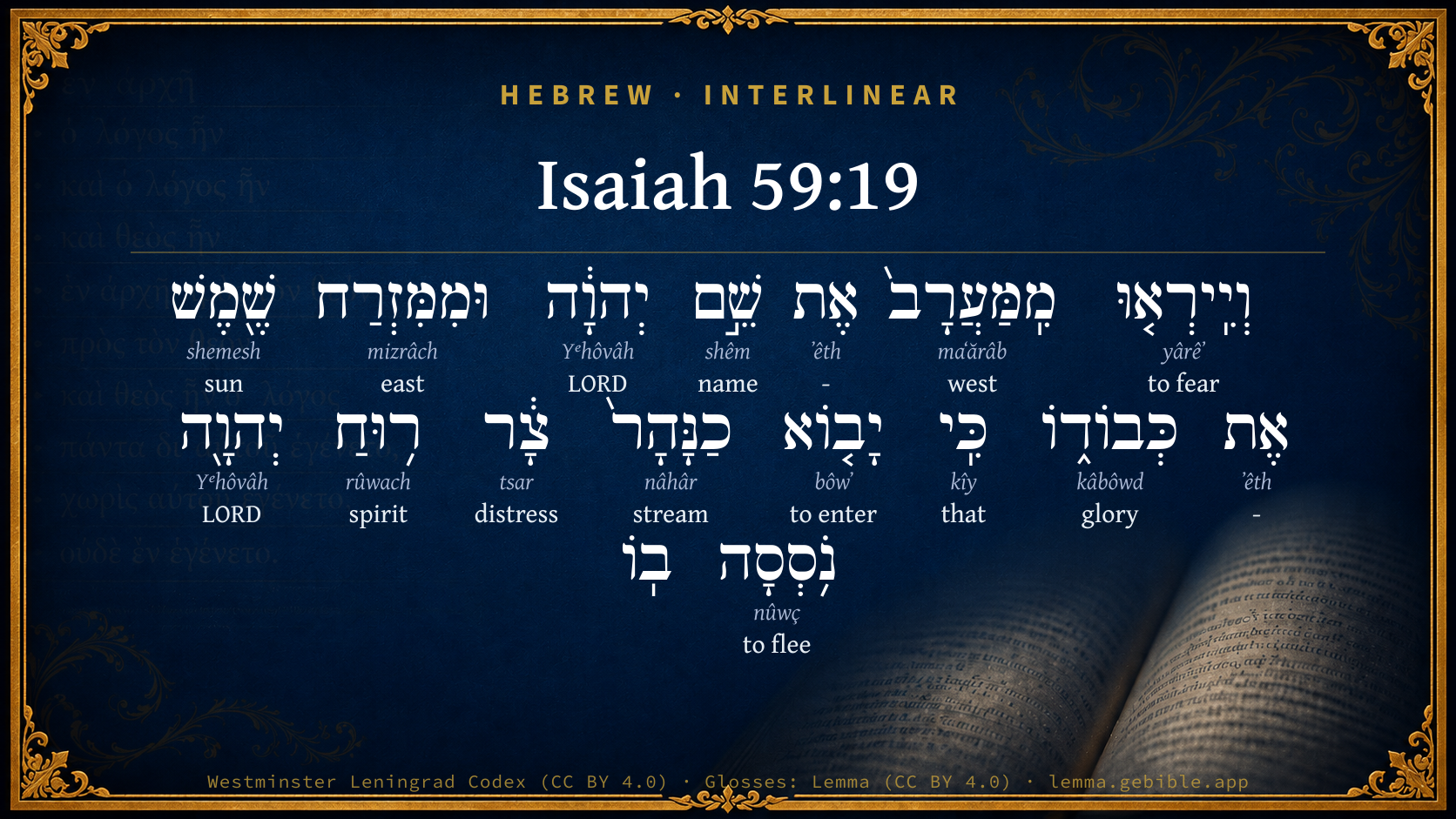
Isaiah 59:19

Hebrew (Westminster Leningrad Codex) Isaiah 59:19 appears in the Hebrew Old Testament. The text above is from the Westminster Leningrad Codex. Each word links to its Strong’s number, a concise gloss, and parsing drawn from the Open Scriptures Hebrew Bible morphology. Click any word for its full Brown-Driver-Briggs (BDB) entry.
Download image
Cite this verse

Isaiah 59:19 (World English Bible). Public Domain. Lemma interlinear Bible study tool, https://lemma.gebible.app/v/isaiah/59/19.

Show BibTeX & RIS
BibTeX
RIS
English Translation
So shall they fear the name of Yahweh from the west, and his glory from the rising of the sun; for he will come as a rushing stream, which the breath of Yahweh drives.
World English Bible · Public Domain
Download a study sheet

One document with this verse’s original text, its word-by-word gloss line, the meaning frame, cross-references with their text, attributed commentary, and full source and license credits — printable, and it pastes into notes with its structure intact.

This verse Autodidact and up

Study sheet (.html) Plain text (.txt)

A passage Seminary Student

Up to 50 verses in one chapter. A passage sheet keeps up to 6 commentary sources and 12 cross-references per verse, in the order this page ranks them, and says so on the sheet whenever that leaves anything out. Ask for a single verse and you get the Autodidact verse sheet above.

Everything on this page stays free to read, with no account — the sheet is a download of what is already on screen, not access to it.

Want to remove ads? Support Godless Engineer
Compare translations 3

The same verse in 3 English versions, stacked beneath the original-language interlinear above. Click any original word for its lexicon entry.

Each is an independent rendering of the whole verse — the interlinear is not word-aligned to these translations.

Highlighted words mark where these versions differ — a whole-verse word diff, not a word-by-word alignment.

  • World English Bible Public Domain
    So shall they fear the name of Yahweh from the west, and his glory from the rising of the sun; for he will come as a rushing stream, which the breath of Yahweh drives.
  • King James Version Public Domain
    So shall they fear the name of the LORD from the west, and his glory from the rising of the sun. When the enemy shall come in like a flood, the Spirit of the LORD shall lift up a standard against him.
  • unfoldingWord Literal Text CC BY-SA 4.0
    And they will fear the name of Yahweh from the setting, and his glory from the rising of the sun; for he will come like a narrow stream, the wind of Yahweh drives upon it.

unfoldingWord Literal Text — © unfoldingWord, licensed CC BY-SA 4.0. Word-aligned USFM3 via Door43 (git.door43.org/unfoldingWord/en_ult).

Versions to compare (up to 4)

3 of 4 selected

Show all 18 translations

Every available English version of this verse, each an independent rendering of the whole verse.

  • World English Bible Public Domain
    So shall they fear the name of Yahweh from the west, and his glory from the rising of the sun; for he will come as a rushing stream, which the breath of Yahweh drives.
  • Berean Standard Bible Public Domain
    So shall they fear the name of the LORD where the sun sets, and His glory where it rises. For He will come like a raging flood, driven by the breath of the LORD.
  • Majority Standard Bible Public Domain
    So shall they fear the name of the LORD where the sun sets, and His glory where it rises. For He will come like a raging flood, driven by the breath of the LORD.
  • King James Version Public Domain
    So shall they fear the name of the LORD from the west, and his glory from the rising of the sun. When the enemy shall come in like a flood, the Spirit of the LORD shall lift up a standard against him.
  • American Standard Version (1901) Public Domain
    So shall they fear the name of Jehovah from the west, and his glory from the rising of the sun; for he will come as a rushing stream, which the breath of Jehovah driveth.
  • Revised Version (1885) Public Domain
    So shall they fear the name of the LORD from the west, and his glory from the rising of the sun: for he shall come as a rushing stream, which the breath of the LORD driveth.
  • Geneva Bible (1599) Public Domain
    So shall they feare the Name of the Lord from the West, and his glory from the rising of the sunne: for the enemie shall come like a flood: but the Spirit of the Lord shall chase him away.
  • Douay-Rheims (1899) Public Domain
    And they from the west, shall fear the name of the Lord: and they from the rising of the sun, his glory: when he shall come as a violent stream, which the spirit of the Lord driveth on:
  • Young's Literal Translation Public Domain
    And they fear from the west the name of Jehovah, And from the rising of the sun -- His honour, When come in as a flood doth an adversary, The Spirit of Jehovah hath raised an ensign against him.
  • Literal Standard Version CC BY-SA 4.0
    And from the west they fear the Name of YHWH, || And from the rising of the sun—His glory, || When an adversary comes in as a flood, || The Spirit of YHWH has raised an ensign against him.
  • Unlocked Literal Bible CC BY-SA 4.0
    So they will fear the name of Yahweh from the west, and his glory from the sun's rising; for he will come as a rushing stream, driven by the breath of Yahweh.
  • unfoldingWord Literal Text CC BY-SA 4.0
    And they will fear the name of Yahweh from the setting, and his glory from the rising of the sun; for he will come like a narrow stream, the wind of Yahweh drives upon it.
  • Darby Bible Public Domain
    And they shall fear the name of Jehovah from the west, and from the rising of the sun, his glory. When the adversary shall come in like a flood, the Spirit of Jehovah will lift up a banner against him.
  • World Messianic Bible Public Domain
    So they will fear the LORD’s name from the west, and his glory from the rising of the sun; for he will come as a rushing stream, which the LORD’s breath drives.
  • Webster's Bible Public Domain
    So shall they fear the name of the LORD from the west, and his glory from the rising of the sun. When the enemy shall come in like a flood, the Spirit of the LORD will lift up a standard against him.
  • Free Bible Version CC BY-SA 4.0
    Those in the west will be in awe of the Lord, and those in the east will be amazed at his glory, for he will arrive like a raging flood, driven by the Spirit of the Lord.
  • Bible in Basic English Public Domain
    So they will see the name of the Lord from the west, and his glory from the east: for he will come like a rushing stream, forced on by a wind of the Lord.
  • JPS Tanakh (1917) Public Domain
    So shall they fear the name of the LORD from the west, and His glory from the rising of the sun; for distress will come in like a flood, which the breath of the LORD driveth.

Literal Standard Version (2020), Covenant Press — licensed CC BY-SA 4.0. Text via the HelloAO Bible API (eBible.org). Unlocked Literal Bible (unfoldingWord) — licensed CC BY-SA 4.0. Text via the HelloAO Bible API (eBible.org). unfoldingWord Literal Text — © unfoldingWord, licensed CC BY-SA 4.0. Word-aligned USFM3 via Door43 (git.door43.org/unfoldingWord/en_ult). Free Bible Version, Dr. Jonathan Gallagher — licensed CC BY-SA 4.0. Text via the HelloAO Bible API (eBible.org).

Word by word

More ways to search: Search by grammar → Find every occurrence → Compare this word →

Practice this passage: Drill this verse → Learn its vocabulary →

מִֽמַּעֲרָב֙
maʻărâb
H4628
“from · west”
Preposition + Noun, Common, Masculine, Singular, Absolute
Part of Speech
Preposition + Noun
Type
Common
Gender
Masculine
Number
Singular
State
Absolute
Full BDB Definition

Origin: from H6150 , in the sense of shading

TWOT: 1689b

setting place, west, westward
  1. וְיִֽירְא֤וּ yârêʼ H3372 “and · to fear” Conjunction + Verb, Qal, Imperfect, 3rd Person, Masculine, Plural
  2. אֶת ʼêth H853 “-” Particle, Direct Object
  3. שֵׁ֣ם shêm H8034 “name of” Noun, Common, Masculine, Singular, Construct
  4. יְהוָ֔ה Yᵉhôvâh H3068 “LORD” Noun, Proper
  5. וּמִמִּזְרַח mizrâch H4217 “and · from · east of” Conjunction + Preposition + Noun, Common, Masculine, Singular, Construct
  6. שֶׁ֖מֶשׁ shemesh H8121 “sun” Noun, Common, Both, Singular, Absolute
  7. אֶת ʼêth H853 “-” Particle, Direct Object
  8. כְּבוֹד֑וֹ kâbôwd H3519 “glory · his” Noun, Common, Both, Singular, Construct + Suffix, Personal, 3rd Person, Masculine, Singular
  9. כִּֽי kîy H3588 “that” Conjunction
  10. יָב֤וֹא bôwʼ H935 “to enter” Verb, Qal, Imperfect, 3rd Person, Masculine, Singular
  11. כַנָּהָר֙ nâhâr H5104 “like/as the · stream” Preposition, Determined + Noun, Common, Masculine, Singular, Absolute
  12. צָ֔ר tsar H6862 “distress” Verb, Qal, Participle Active, Masculine, Singular, Absolute
  13. ר֥וּחַ rûwach H7307 “spirit of” Noun, Common, Both, Singular, Construct
  14. יְהוָ֖ה Yᵉhôvâh H3068 “LORD” Noun, Proper
  15. נֹ֥סְסָה nûwç H5127 “to flee” Verb, Polel, Perfect, 3rd Person, Feminine, Singular

About this verse

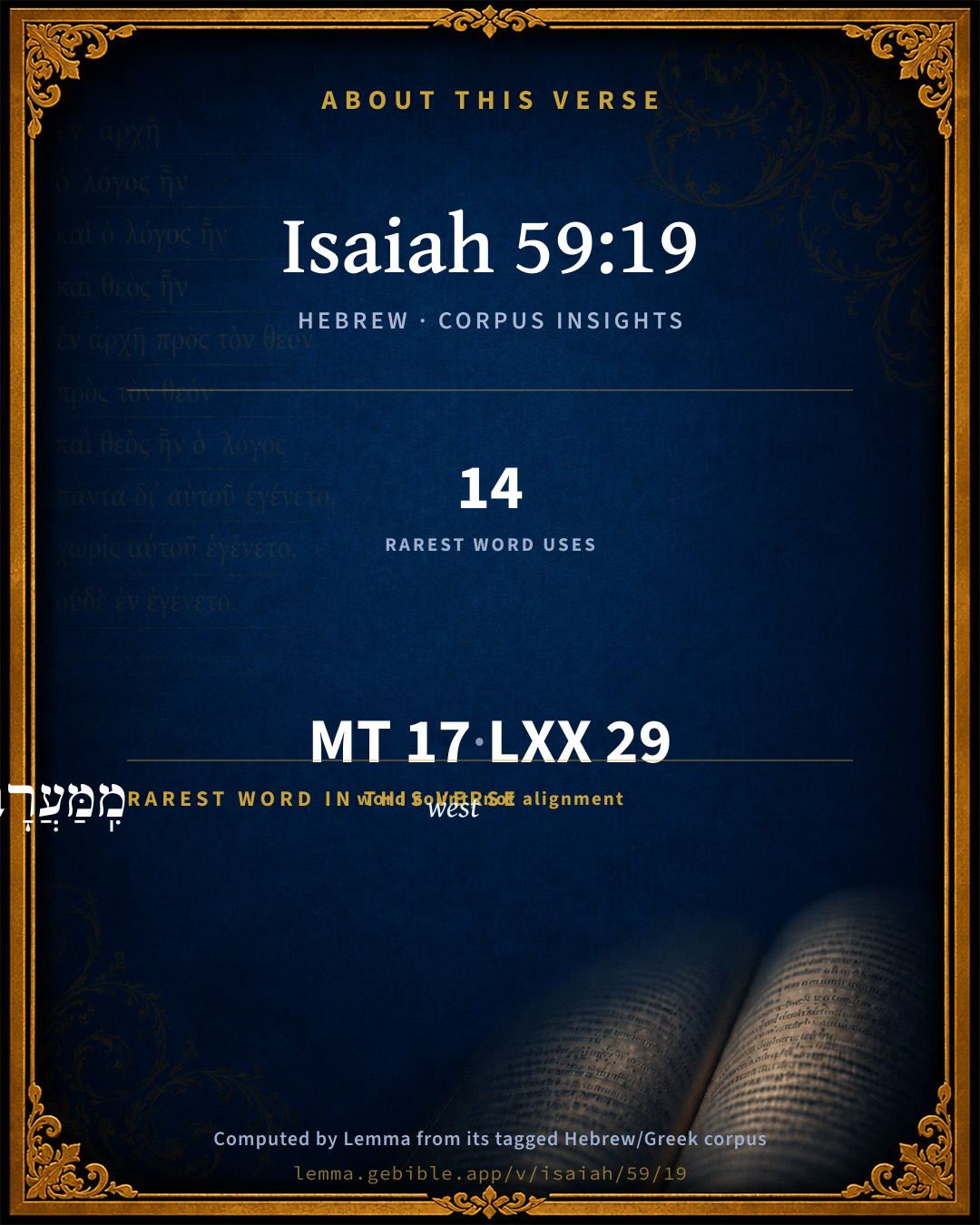
These counts appear in no published source. They are computed here, from the morphology-tagged text and Lemma’s own curated glosses. What Lemma adds →

17
words
14
distinct lemmas
Prophets
section

Notable vocabulary

The rarest word here is מִֽמַּעֲרָב֙ west H4628 — appearing just 14 times in the whole Hebrew Bible.

Shared distinctive vocabulary

מִֽמַּעֲרָב֙ west H4628 occurs in 14 verses of the Hebrew Bible. Also found in:

Grammatical profile

  • 4 verbs
  • 9 nouns
  • 1 preposition
  • 1 conjunction
  • 2 particles

Verb forms

  • וְיִֽירְא֤וּ Qal · Imperfect
  • יָב֤וֹא Qal · Imperfect
  • צָ֔ר Qal · Participle Active
  • נֹ֥סְסָה Polel · Perfect

Repetition

A word recurs within this verse — often emphatic in Hebrew:

  • יְהוָ֔ה LORD H3068 ×2

Hebrew & Septuagint length

In English translation the verse runs 34 words from the Hebrew and 42 from the Septuagint (LXX English) — closely comparable.

A rough comparison of the two English renderings, which tokenize alike — not a word-level alignment.

Word counts can differ between the Hebrew and the Greek without any difference in meaning — e.g. the Hebrew direct-object marker אֵת has no separate Greek word, and Greek often adds the article ὁ.

In the original languages it is 17 Hebrew tokens and 29 Greek tokens — but the two are counted differently (Hebrew bundles its prefixes and suffixes into one token; the Greek is in lemma form), so that isn’t a like-for-like length.

Cross-references

17

Topical passages linked to Isaiah 59:19 in the Treasury of Scripture Knowledge — connected by theme and wording, ordered by reader-vote popularity; previews shown in the World English Bible.

  • Daniel 7:27 The kingdom and the dominion, and the greatness of the kingdoms under the whole the sky, shall be given to the people of the saints of the Most High: his kingdom is an everlasting kingdom, and all dominions shall serve and obey him.
  • Psalms 113:3 From the rising of the sun to the going down of the same, Yahweh's name is to be praised.
  • Zechariah 4:6 Then he answered and spoke to me, saying, "This is the word of Yahweh to Zerubbabel, saying, 'Not by might, nor by power, but by my Spirit,' says Yahweh of Hosts.
  • Revelation 12:15–17 The serpent spewed water out of his mouth after the woman like a river, that he might cause her to be carried away by the stream.
  • Psalms 22:27 All the ends of the earth shall remember and turn to Yahweh. All the relatives of the nations shall worship before you.
  • Revelation 17:14–15 These will war against the Lamb, and the Lamb will overcome them, for he is Lord of lords, and King of kings. They also will overcome who are with him, called and chosen and faithful."
  • Zephaniah 3:8–9 "Therefore wait for me," says Yahweh, "until the day that I rise up to the prey, for my determination is to gather the nations, that I may assemble the kingdoms, to pour on them my indignation, even all my fierce anger, for all the earth will be devoured with the fire of my jealousy.
  • Malachi 1:11 For from the rising of the sun even to the going down of the same, my name is great among the nations, and in every place incense will be offered to my name, and a pure offering: for my name is great among the nations," says Yahweh of Hosts.
  • Revelation 12:10 I heard a loud voice in heaven, saying, "Now is come the salvation, the power, and the Kingdom of our God, and the authority of his Christ; for the accuser of our brothers has been thrown down, who accuses them before our God day and night.
  • Revelation 20:1–3 I saw an angel coming down out of heaven, having the key of the abyss and a great chain in his hand.
  • Psalms 102:15–16 So the nations will fear the name of Yahweh; All the kings of the earth your glory.
  • Isaiah 11:9–16 They shall not hurt nor destroy in all my holy mountain; for the earth shall be full of the knowledge of Yahweh, as the waters cover the sea.
  • Revelation 11:15 The seventh angel sounded, and great voices in heaven followed, saying, "The kingdom of the world has become the Kingdom of our Lord, and of his Christ. He will reign forever and ever!"
  • Isaiah 49:12 Behold, these shall come from far; and, behold, these from the north and from the west; and these from the land of Sinim.
  • 2 Thessalonians 2:8 Then the lawless one will be revealed, whom the Lord will kill with the breath of his mouth, and bring to nothing by the brightness of his coming;
  • Isaiah 24:14–16 These shall lift up their voice, they shall shout; for the majesty of Yahweh they cry aloud from the sea.
  • Isaiah 66:18–20 For I [know] their works and their thoughts: [the time] comes, that I will gather all nations and languages; and they shall come, and shall see my glory.

Cross-references courtesy of OpenBible.info (CC BY 4.0).

Hebrew and Greek witnesses Masoretic Hebrew ↔ Greek Septuagint

The same verse in the two great witnesses to the Old Testament, shown verse-for-verse.

These are two independent witnesses, not word-aligned to each other, and the Septuagint is shown in lemma (dictionary) form.

Hebrew Isaiah 59:19 Masoretic · Westminster Leningrad Codex

וְיִֽירְא֤וּ מִֽמַּעֲרָב֙ אֶת שֵׁ֣ם יְהוָ֔ה וּמִמִּזְרַח שֶׁ֖מֶשׁ אֶת כְּבוֹד֑וֹ כִּֽי יָב֤וֹא כַנָּהָר֙ צָ֔ר ר֥וּחַ יְהוָ֖ה נֹ֥סְסָה בֽוֹ

So shall they fear the name of Yahweh from the west, and his glory from the rising of the sun; for he will come as a rushing stream, which the breath of Yahweh drives.

World English Bible · Public Domain

Greek LXX Isaiah 59:19 Septuagint · lemma form

καί φοβέω ὁ ἀπό δυσμή ὁ ὄνομα κύριος καί ὁ ἀπό ἀνατολή ἥλιος ὁ ὄνομα ὁ ἔνδοξος ἥκω γάρ ὡς ποταμός βίαιος ὁ ὀργή παρά κύριος ἥκω μετά θυμός

So shall they of the west fear the name of the Lord, and they that come from the rising of the sun his glorious name: for the wrath of the Lord shall come as a mighty river, it shall come with fury.

LXX2012 (modern English Septuagint) · Public Domain

On this verse, The Cambridge Bible for Schools and Colleges discusses the Septuagint’s reading. Read the note in Commentary ↓

Hebrew: Westminster Leningrad Codex (CC BY 4.0). Greek: Septuagint (public domain); English from LXX2012 (modern English Septuagint) (Public Domain). How the Septuagint differs from the Hebrew →

Targum (Aramaic paraphrase)

1

The Targum is the ancient Jewish Aramaic paraphrase of the Hebrew Scriptures — an interpretive translation, not the Hebrew text itself. Onkelos (literal) and Pseudo-Jonathan (expansive) render the Torah, and Jonathan the Prophets. Coverage is partial: where no permissively-licensed English translation exists for a verse, only the Aramaic is shown. This is verse-level text, not a word-by-word alignment to the Hebrew.

  1. Targum Jonathan Prophets (Joshua–Malachi)
    וְיִדְחֲלוּן מִמַעֲרְבָא יַת שְׁמָא דַייָ וּמִמַדְנַח שִׁמְשָׁא יַת יְקָרֵהּ אֲרֵי יֵיתוּן כִּשְׁפַע נְהַר פְּרָת מְעִיקָן בְּמֵימְרָא דַייָ יִתַּבְּרוּן:

    They shall fear the name of the Lord from the west, and His glory from the rising of the sun. When the oppressors shall come in like an inundation of the river Euphrates, they shall be broken by the WORD of the Lord.

    Targum Jonathan — Aramaic: “Mikraot Gedolot” (public domain). English: “Sefaria Community Translation” (CC0 1.0 (public-domain dedication)); “London "Chaldee Paraphrase," 1871” (public domain). Text via Sefaria.

Commentary

Notes on Isaiah 59:19 from classic Christian and Jewish commentators (each source and its license shown beneath its notes). The classic Christian expositions comment on the surrounding passage and are grouped to its opening verse, so a note may address several verses; the Jewish commentaries on the Tanakh (Rashi and others) are per-verse, so they appear only where the commentator wrote on this verse.

Lemma curates 59 commentaries, every one of them public domain or Creative Commons licensed, each selected and text-cleaned for this edition rather than reprinted as found. About our sources →

Trapp's Complete Commentary

John Trapp

Isa 59:19 So shall they fear the name of the LORD from the west, and his glory from the rising of the sun. When the enemy shall come in like a flood, the Spirit of the LORD shall lift up a standard against him.

Ver. 19. So shall they fear the name of the Lord.] Christ shall get him a great name, as a renowned conqueror.

When the enemy shall come in like a flood.] When they shall pour out a deluge of evils upon the Church. {Rev 12:15}

The Spirit of the Lord shall lift up a standard against him,] i.e., Against strong temptations, corruptions, persecutions. The motto shall be, as once Christus nobiscum: state. stand with our Christ.

John Trapp, A Commentary or Exposition upon All the Books of the Old and New Testament (1647–1656) — public domain. Text from a community e-Sword module.

The Biblical Illustrator

Joseph S. Exell

Isa_59:19

When the enemy shall come in like a flood.

--

Moral invasions

These words suggest--

I. THE MORAL INVASION OF HUMAN SOULS.

1. The soul has an arch enemy. This enemy is called by different names. The old serpent, the devil, Satan, roaring lion, etc. He is characterized by great power, malignity, craft. He has mighty armies under his power. Principalities and powers, etc.

2. This arch enemy sometimes makes a tremendous onslaught. Cometh in like a flood. There are times in the human soul when evil seems to rush on it as an overwhelming torrent.

II. THE ALL-SUFFICIENT GUARDIAN OF HUMAN SOULS. The Spirit of the Lord shall lift up a standard against him. The soul that gives itself up to Divine guardianship has an impregnable fortress.

1. The Spirit of the Lord is stronger than the enemy.

2. The Spirit of the Lord is wiser than the enemy. The Spirit of the Lord has an intellect, that overrules, battles, subordinates all the workings of the foe. He makes his hellish discord swell the harmonies of the universe.

3. The Spirit of the Lord is nearer to the soul than the enemy. The soul does not live in the devil, but the soul lives in the Spirit; the soul can live without the devil, the soul cannot live without the Spirit.

(1) How great is man! The objects both of hellish and of heavenly interests and efforts.

(2) How critical is destiny! We are in an enemys territory. (Homilist.)

The great enemys opposition overcome

I. THE ENEMY.

1. Worldliness.

(1) Fashion.

(2) Business cares.

(3) Pleasures.

2. Political sins.

(1) Party spirit.

(2) License of vice.

II. CHARACTER OF THE ENEMYS OPPOSITION.

1. Active. Shall come in, etc.

2. Vehement. Like a flood.

III. THE ENEMY CONFRONTED. The Spirit of the Lord shall lift up a standard against him.

1. In the faithful, earnest preaching of the Gospel.

2. In the social services of the Church.

3. In the godly example of Christians. (J. S. Clomer.)

The standard of heaven lifted up against the powers of hell and their auxiliaries

I. AN ATTACK made by hell and its auxiliaries upon the kingdom and interest of Christ. The enemy shall come in like a flood. Notice--

1. By whom the attack is made. The enemy. The Church of God, or His saints in this world, have many enemies. They are expressed in the singular number, because of their unity in their designs against Christ and His kingdom, and because they attack under one principal leader and commander, namely, the god of this world, whose kingdom Christ came to overthrow.,

2. The manner of the enemys attack. He comes in like a flood, with great violence and noise, as though he would sweep away all clean before him Rev_12:15). It is no unusual thing, in Scripture, to represent the irruptions of hell and its armies upon the Church of God under the notion of a rapid flood or river, which threatens the ruin of everything that stands in its way (Psa_93:3).

3. The progress of the standard I understand Christ, who is not only a standard-bearer among ten thousand (Son_5:10), but the Standard or ensign itself (Isa_11:10). By the lifting up of the standard I understand the displays of the glory of Christ in a Gospel dispensation, accompanied with the efficacy of the Spirit of the Lord.

4. The repulse itself given to the enemy of the Spirit of the Lord He is put to flight (Marg.)

, or, as Calvin reads It, the Spirit of the Lord shall drive him back like the waters of Jordan, which were driven back towards their fountain, when they stood in the way of Israels entry upon the possession of the promised land.

5. The certainty of this promise of driving back the enemy--it is not a maybe, but a shall be. (E. Erskine.)

The enemy of the people of God

I. WHO IS THE ENEMY THAT COMES IN LIKE A FLOOD? The devil, called sometimes the god of this world.

1. Satan has a strong party within, to wit, indwelling sin.

2. The world without us is another main auxiliary of hell--the profits, pleasures and preferments of the world, called by the apostle, the lust of the flesh, the lust of the eves and the pride of life.

II. WHY THIS ENEMY IS LIKENED TO A FLOOD.

1. Because of the noise, made by error, persecution, defections, and violences of all kinds. The poor soul is many times put in such confusion, through the noise of these mighty waters, that it cannot hear the voice of God either in His Word or providences.

2. Because of their multitude.

3. Because of their unity in bending all one way in their opposition against Christ and His cause.

4. Floods are mighty, violent and rapid in their motion.

5. They are of a sweeping nature, and are ready to hurl down everything that is not well fixed.

6. A flood is in a continual motion; so the actings of sin and Satan and the world, against Christ and His cause, are incessant.

III. THE PROGRESS OF THE ENEMY. How far may he come in!

1. The enemy may come in within the borders of Zion (Mic_5:5-6).

2. The enemy comes in, not only within the borders, but even into the palaces of Zion, her public assemblies for divine worship (Job_1:6).

3. The enemy may come into the pulpits of the Church by an erroneous and corrupt ministry (Jud_1:4).

4. The enemy may come into the judicatories of the Church, which are the thrones of judgment; so far may the enemy come in as to influence those judicatories to join hands with the spoilers and oppressors of the people of God, instead of defending them.

5. The enemy may come into the dwellings of Jacob. The devil lodgeth in the house of the wicked, and he may come in and work much mischief in the house of a godly David.

6. He may come into your closets, and go along with you to your knees, when you would be alone with God.

7. The enemy may come into your very heart.

IV. THE CERTAINTY OF ALL THIS.

1. Plain Scripture testimony (Rev_2:10).

2. The state of the believer in this world--a militant state.

3. The experience of the saints of God in all ages.

V. INFERENCES.

1. This world is not the believers resting-place. If it were, of all men he would be the most miserable.

2. See, hence, why it is the believer frequently expresseth such longing desire to be away.

3. See, hence, the need that we have of Christ in his kingly office, to subdue, restrain, and conquer all His and our enemies.

4. See, hence, encouragement to poor tossed and tempted believers. Though the enemy come in like a flood, the Spirit of the Lord shall lift up a standard against him. (E. Erskine.)

Encouragement

1. Thy enemies are Gods as well as thine.

2. The Lord of hosts is with thee: God is upon thy side.

3. The enemy is already defeated and baffled by thy glorious Head and General; thou hast only a shattered enemy to grapple with.

4. There are many triumphing in glory, against whom the floods did run with as great violence as they do now against thee.

5. The battle will soon be over.

6. The word of command is given by the glorious General, Fight, the good fight of faith, stand fast in the faith, quit yourselves like men, be strong. (E. Erskine.)

The enemy coming in as a flood

1. He sometimes casts out a flood of error; he studies to corrupt the simplicity of the Gospel, and to turn men away from the pure and precious truths of God.

2. Sometimes the enemy comes in with a flood of open persecution.

3. Sometimes he comes in with a flood of manifold corruptions upon the visible Church. Sometimes he studies to corrupt the worship of God by superstition, mingling in ceremonies of mans inventions with the pure ordinances of Divine institution. Sometimes he breaks in upon the government and discipline of the Church, attempting to introduce schemes of government not warranted by the Word of God. Sometimes he comes in with a flood of profanity corrupting the lives of professors, to the scandal of religion; sometimes with a flood of neutrality and indifferency about the things of God, under the colour of moderation. (E. Erskine.)

Temptation overcome

I. THE CONFLICT. The enemy shall come in like a flood. It is a startling metaphor. Away up on the hills there is a lake or reservoir dammed up.

Suddenly the barrier breaks; and there comes a great rush of water down the hillside upon the unsuspecting valley beneath, sweeping away before it the hay-ricks, the stables of the cattle, the hovels of the poor, and the mansions of the great, overwhelming all life in one common watery grave, leaving presently, when it is passed, a desert where there had bloomed a garden of the Lord. Evil is always imminent just as the reservoir is always threatening. Not to watch against it, not sometimes to lift the eye to see whether the barrier holds, not to know that you are in danger, is insensate folly. But there are special crises of temptation comparable to the moment when the barrier breaks and the water pours down upon the land. So is it with the temptation of despair. So it is when we are tempted to sudden passion. Is this not true of the evil in society around us? The dragon has been pouring forth streams of water to sweep away the Word of God upon our world. It was so in the days of Pagan persecution; it was so in the days of mediaeval darkness; it was so just before Wyclif, our morning star, and Luther, the minor sun, protested against the evils of their time; it was so at the end of the eighteenth century, when the parsons were dissolute and drunken and fox-hunting; and when Socinian heresy filled Nonconformist pulpits, and when the masses of the people were drenched in stupidity and sin. Such times as these, when the enemy comes in like a flood, recur with periodicity in the history of men. We do well, then, to confess our impotence. You cannot resist that flood by your resolutions, by your pledges, by your endeavours; you may as well throw up your hands at once and cry with Jehoshaphat, We have no might against this great company that cometh against us; neither know we what to do: but our eyes are upon Thee. At such times we may always count upon God.

II. THE AUGUST AND LONELY WARRIOR depicted in the text. It would seem almost in this chapter as though He was like a warrior resting. He has put off His helmet and His breastplate, and divested Himself of His garments. But suddenly He sees the encroachment of the enemy over the lonely spirit or over the world. He steps forward and wins. He sees that there is none to help; He wonders that there is no intercessor, therefore His arm brings salvation. Mark that word--the arm of the living Christ brings salvation to man when no one else can help him.

III. OUR FATAL LIMITATIONS. Why is it that we are not always conquerors? The answer comes in verses 1-3. There is some fatal hindrance in your life that saps Christs power. (F. B. Meyer, B. A.)

The standard uplifted in the face of the foe

I. We shall take the general statement of the text as referring to THE CONFLICT WHICH IS RAGING IN THE CHRISTIANS INNER MAN.

1. It is well for us distinctly to understand the position of the Christian. This is not the land of our triumph, neither is this the period of our rest. There is one whose name is called the enemy, the evil one; he is the leader among your adversaries; hating God with all his might, he hates that which he sees of God in you.

2. The text leads us to look for seasons when this position will be more than ordinarily perilous.

3. It will be well for you who know the spiritual conflict to be thoroughly conscious of your own utter impotence against this terrific danger. What can a man do against a flood?

4. The text, after having plainly bidden us thoroughly realize our position, and after suggesting to us our weakness, bids us turn to our only help, a Helper mysterious but Divine.

5. We have then to fall back as to our present difficulty, whatever it may be, upon spiritual power. If the battle of salvation were to be fought by man alone, then you and I might throw down sword and shield and despairingly give it all up, but when we understand that the Spirit of God has laid bare His holy arm to save us, we are not afraid of the worst moment in the fight.

6. Let us now take two or three instances in which this great truth is conspicuous. This is true of a soul under conviction of sin. After conversion it frequently happens, and especially to those who have been guilty of gross sin before conversion, that temptation comes in with unusual force. Another case sometimes occurs to a Christian, when it is not so much enticement to sin as temptation to doubt.

II. Let us now turn to THE HOLY WAR WITHOUT US. The Christian Church is too conspicuous an object of Divine love not to be the butt of the malice of the powers of darkness. (C. H. Spurgeon.)

In time of flood

These heartening words were spoken to exiles who were preparing to return to the homeland. When they lifted their eyes to the possibilities of return they seemed to gaze upon range after range of accumulating difficulties which would obstruct their journey home. As often as the prophet proclaimed their deliverance they proclaimed their fears. Their fears were aid one by one, but as soon as one was laid another arose! The enemies on the right hand and the left hand, what about them? The hostile peoples will accept their chance, and will come down upon the returning company in destructive array I When the enemy shall come in like a flood, the Spirit of the Lord shall lift up a standard against him. We, too, are exiles returning to the homeland. We, too, have been in the dark realms of captivity, and by His redeeming grace our eyes have been lifted toward the better country. And we, too, are full of uncertainties and fears. There is a desert to traverse, a wilderness to cross, waters to pass through, mountains to climb, and we know not how we may safely reach our journeys end. And particularly are we beset by the enemy, who suddenly and unexpectedly roars down upon our path. But if we have the fears, ours, too, are the promises. Between the enemy and ourselves there shall be erected the standard of the Lord.

1. When the enemy shall come in like a flood. The figure is surely taken from the riverbeds of their native land. They had looked upon the dry, bleached ravines in time of drought, when scarcely a rivulet lisped down its rocky course. And then the rain had fallen on the hills, or the snow had melted upon the distant mountains, and the waters had torn down like a flood. I have picnicked away up in the solitudes of the higher Tees, when there was only a handful of water passing along, a little stream which even a child could cross. And once I saw what the natives call the roll coming away in the distance. Great rains had fallen upon the heights, and this was their issue; in a moment the quiet stream became a roaring torrent, and shouted along in thunderous flood. That, I think, is the figure of my text. Now, what are some of these flood times in life when the enemy comes against us in overwhelming power?

(1) There is the flood of passion. Floods always destroy something valuable and beautiful. And so it is with the flood of passion that sweeps through the soul. It always damages the life through which it flows. Some seed of the kingdom, just beginning to germinate, is washed out of the ground. Some tender growth is impaired or destroyed, some little plant of meekness, or gentleness, or faith, or hope, or love. Even onlookers can frequently see the ruin; and to the Lord the fruitful place must become a desert.

(2) Sometimes the flood is in the form of a great sorrow, and we are engulfed by it. There is a sorrow appointed of the Almighty, but it is never ordained to hurt or destroy. And yet how often this particular flood, rushing into a life, works havoc with spiritual things. In one of our churches a little while ago a flood occurred, and the two things that were injured were the heating apparatus and the organ. I could not but think of the destructiveness wrought in the soul by the gathering waters of sorrow. Very frequently they put out the fires of geniality, and they silence the music and the song. And so it is with all the perilous waters that arise in human life.

(3) Sometimes the flood gathers from a multitudinous contribution of petty cares. Now, whenever a flood in the life damages a life the work is the work of the devil. When I am tempted into overflowing passion, or into excessive sorrow, or into overwhelming care, it is the work of the enemy. I think that if we could realize this we should be greatly helped in these perilous and frequently recurring seasons. If we could only practise our eyes so as to see in the tempting circumstance the face of the evil one we should be less inclined to the snare.

2. The Spirit of the Lord will lift up a standard against him. King Canute had his regal chair carried down to the flowing tide, and he commanded the waters to retreat. The waters paid no heed, and the mighty flood advanced. But our King raises His standard against the threatening flood, and the retreat is absolutely assured. Have you noticed that wonderfully suggestive passage in the Book of Revelation where a promise is made of help in the time of flood? And the serpent cast out of his mouth water as a flood after the woman, that he might cause her to be carried away at the flood. And the earth helped the woman, and the earth opened her mouth, and swallowed up the flood which the dragon cast out of his mouth. That great promise has been abundantly confirmed in countless lives. Even the earth itself is our ally in contending with the foe. The beauties of nature will help us to contend with the forces of evil desire. But we have more than nature as our defence; we have the Lord of nature, the Lord in nature, not so much the supernatural as the Spirit who pervades nature and all things. And so, too, it is in the flood times of sorrow. The Spirit of the Lord will engage for us, lest we be swallowed up with overmuch sorrow. Have I not seen sorrow come into a life, and it has been entirely a minister of good and never of ill? The devil has not got hold of it, and used it as a destructive flood. It has been a minister of irrigation rather than destruction, and in the moist place of tears beautiful ferns have grown, the exquisite graces of compassion and long-suffering and peace. The Spirit of the Lord will lift up a standard! Well, then, let Him do it. Do not let us attempt to do it for ourselves. Let us hand it over to Him. Undertake Thou for me, O Lord. The life of faith just consists in a quiet, conscious, realizing trust in the all-willing and all-powerful Spirit of God. (J. H.Jowett, M. A.)

An overpowering manifestation of God

We explain the passage thus: Jehovah will come like a river, one hemmed in, which a wind of Jehovah (i.e a violent tempest) rolls along in rapid course. (F. Delitzsch, D. D.)

The Spirit of the Lord shall lift up a standard against him

The opposing standard

I. THE STANDARD-BEARER. The Spirit of the Lord.

II. THE STANDARD. Christ. He is fitly resembled to a standard on the following accounts.

1. The standard is a signal of war. When Christ descended to this lower world, and came upon an expedition of war against the god of this world, and his usurped empire over the children of men, this war was proclaimed Gen_3:15).

2. A standard is a signal of peace. When peace is proclaimed the white flag or ensign is displayed. As the appearance of God in the nature of man was a signal of war against hell, death and sin; so it was a signal of peace to man upon earth.

3. A standard is an ensign of victory. So a risen and living Redeemer is a signal of His victory over the powers of hell.

4. A standard is a signal of gathering. When the standard is set up, the army is to gather, volunteers are to be enlisted. The manifestation of Christ in the flesh, and the revelation of Him in the Gospel, is a signal to lost sinners to shake off the tyrannical yoke of sin and Satan, that they may, under Christs conduct, recover their ancient liberty (Gen_49:10; Isa_11:10).

5. A standard is for direction and order; when the army is to march, the standard goes before, and the soldiers know whereaway to move by the motion of their standard.

III. THE LIFTING UP OF THIS BLESSED STANDARD.

1. The first uplifting of it was in the eternal counsel of Heaven, before ever the foundation of the world was laid (Pro_8:23).

2. It was lifted up in the first promise (Gen_3:15).

3. In the actual incarnation, obedience and death of the Son of God.

4. By the resurrection of Christ from the dead, and His exaltation at the right hand of the Majesty on high.

5. In the dispensation of the everlasting Gospel.

6. When there is any remarkable appearance for Christ and His cause, in a Church or nation, in opposition to any of the works of the devil.

7. When God in His providence breaks and baffles wicked and blood-thirsty persecutors, who were making havoc of His Church, granting them respite and deliverance from trouble.

8. This royal Standard is lifted up by the Spirit of the Lord in the morning of conversion, when through discoveries of the glory of Christ, the soul is determined to make a surrender of its heart, and to lift up the everlasting doors, that this King of glory may come in.

9. The Spirit of the Lord lifts up the Standard in every renewed manifestation and discovery of the glory of Christ, especially after a dark night of desertion, temptation, and despondency.

IV. WHENCE IS IT THAT THE LIFTING UP OF THE STANDARD, OR THE DISPLAYING OF THE GLORY OF CHRIST BY THE SPIRIT OF THE LORD, GIVES A REPULSE TO THE ENEMY, OR DRIVES HIM BACK:

1. The displaying of the glory of Christ by the Spirit of the Lord, sets faith in a lively exercise, which is the great engine whereby we are enabled to overcome Satan, the world, and all our enemies.

2. By displays of the glory of Christ, love is inflamed.

3. Displays of the glory of Christ inspire the soul with courage and strength to oppose the enemy, when he comes in like a flood.

4. Displays of the glory of Christ, by the Word and Spirit of the Lord, dispirit the enemy, though coming in like a flood. (E. Erskine.)

The Churchs power

See, hence, what it is that makes a Church terrible as an army with banners, to the powers of hell, and the wicked of the world. It is not carnal wisdom and policy; it is not a yielding to the humours of men in the matters of Christ; it is not a squaring our conduct according to the wisdom of this world: no, it is the presence of the Spirit of the Lord, and a following the standard of the Word, which He has given for a lamp unto our feet, and a light unto our paths. (F. Delitzsch, D. D.)

The Biblical Illustrator, edited by Joseph S. Exell (c. 1880s–1900s) — public domain. Text from a community e-Sword module.

Joseph Benson's Commentary

Isa 59:19. So shall they fear the name of the Lord — Worship the Lord; from the west — The western parts of the world. And his glory — The glorious God; from the rising of the sun — The eastern parts. The sum is, the whole world shall fear and worship God, and make his name renowned, laying aside their idolatries: and it may be referred, 1st, To the deliverance of God’s people out of Babylon: men shall reverence and adore him when they shall hear how he hath delivered his people, and executed vengeance on their enemies. Or, 2d, To the redemption by Christ, and the calling of the Gentiles. See Mal 1:11. When the enemy shall come in like a flood, &c. — When nothing seems able to withstand the enemies of God’s church, but they carry all before them as a flood overruns a country, then God himself shall give them a remarkable check, and visibly interpose in behalf of his oppressed people. The prophet, however, may be understood as speaking of Satan, the grand enemy of God’s church, and as signifying that at what time soever he or his instruments should make violent attacks on God’s people, and should endeavour to bear down all before them, by an inundation of infidelity, impiety, and wickedness; the Spirit of God would lift up his standard, and call together his armies, to oppose these enemies’ progress, and subvert their cause. “There can be no doubt,” says Mr. Scott, “but the grand accomplishment of this prophecy is future: and as they, among whom iniquity so abounded, antecedent to this happy change, are spoken of as the professed people of God, and are not accused of idolatry, and as the Lord is represented as wondering that there was no intercessor among them, it is more natural to interpret it of corrupt and degenerate Protestants, than either of the Jews, who are avowed enemies to Christianity, or of Papists, who retain the worship of images, saints, and angels.”

Joseph Benson's Commentary on the Old and New Testaments (1811–1818) — public domain. Text from a community e-Sword module.

Whedon's Commentary on the Bible

Daniel D. Whedon

19, 20. The interposing Saviour is on his redeeming career. Hitherto, that is in Isa_59:16-19, in view of Israel’s having fallen morally so inextricably deep, and because no one appeared as a helper, an intercessor, Jehovah enters at once into service for his recovery; his own arm is laid bare; he puts on armour for Israel’s defence and upbringing, namely, righteousness as a breastplate, a protecting helmet for the safety of his head, and garments of vengeance for the onslaught in general against what it had belonged to all the appointed agencies in Israel’s history to do, namely, to train the nation into the virtues of justice, mercy, truth, righteousness, etc. — just such as were essential to qualify them to be a holy nation. At the discovery of this condition of his people, he was struck with dismay “that there was no man” at hand: (Isa_59:16 :) “man,” in the sense of a whole man, a hero, an “intercessor,” who, as in duty bound, should have wrought to the attainment of the character required among his people. The right man was wanting. True priest and prophet were long past, and Jehovah himself now undertakes the cause of Israel. Isa_59:17-18. In Isa_59:19 there begin to appear some results of his interposition. The Hebrew (in Isa_59:18) is complicated and difficult, but we obtain this sense — that, armed as he is with justice and salvation, vengeance and zeal, he carries out a general retributive judgment upon all adversaries, whether of distant “isles” or of inimical Israel — with the former especially, and brings them to capitulate, and they become friends.

So shall they fear the name of the Lord — Spoken of those who were at enmity with “the Lord,” and with his true Israel. “Fear” of God’s “name” is the suitable recognition of his claims and the reverence due to his authority.

From the west — They of the west — all Gentiles.

His glory — The “name” and “glory” of Jehovah are here not only parallels, but synonymes, as we learn from other places where the two terms are jointly and severally used to signify the manifested excellence or glorious presence of Jehovah. — Alexander. Isa_30:27; Isa_35:2; Isa_40:5; Isa_42:12.

From the rising of the sun — From the east as well as from the west. It is curious, at least, that the local directions are here reversed. Usually the order is from the east to the west. (See Isa_43:5; Mal_1:11.) This is the only note of time (if it be this) where the great events here indicated have their occurrence. Logically, and from the context, this term begins at the advent of Christ, and continues to what is technically called the millennial period. During this interval immense results — moral, spiritual, intellectual — travel from west to east.

When the enemy — All adversaries to the true religion.

Shall come in like a flood — As not unfrequently is the case during a long period in Messiah’s dispensation.

The Spirit of the Lord shall lift up a standard against him — The Hebrew, here, has had abundant interpretations varying from our English Version, but with little approval from the best critics. “The Spirit,” otherwise rendered “the Wind of Jehovah” — a driving wind — “shall dam up a straitened river.” The words, in Hebrew, are of that peculiar form which may be rendered either way. But the general sense or tenor of the context seems to call for a turning off from strict literalness (and that in the way of our Version) in order to preserve a consistent suitableness throughout.

Daniel D. Whedon (gen. ed.), Commentary on the Old and New Testaments (1874–1909) — public domain. Text from a community e-Sword module.

The Preacher's Complete Homiletical Commentary

Joseph S. Exell (gen. ed.)

SUPPORT AMIDST DANGER

Isa_59:19. When the enemy shall come in like a flood, &c.

Ever since the moment when the tempter appeared to the woman this world has been the battlefield of good and evil. It is so now. For God did not abandon man. We have here a vivid picture of these two forces. The standard of heaven is lifted up against the hosts of hell. Without attempting to trace the historic bearing of the text we shall simply apply it to personal Christian experience of spiritual danger and spiritual support.

I. Let me place before you YOUR DANGER.

The enemy will come in. The onslaught may be so impetuous as to defy all power of resistance.

1. We remind you of the personal character of your enemy. The struggle for the mastery of human hearts is described in Scripture as a personal struggle. We are warned against a real, living, subtle, wicked, powerful enemy (1Pe_5:8).

2. But he attacks usually by means of others.

The world is an instrument of temptation and danger. Its business, customs, &c., are sources of danger. And your weakness in great part arises from the fact that you cannot always rely on your own forces. You carry a traitor within. The battle between good and evil is really fought within our own hearts. It is life and death.

II. We point out YOUR SUPPORT.

Read the whole passage. Jehovah exposed the quarrel of His Church with her enemies. This is our encouragement when pressed hard by temptation.

1. The redeeming work of the Son of God has emasculated the power of the enemy. He espoused the cause of humanity, &c. (Heb_2:14-15).

2. He has secured the influence and help of the Holy Spirit. Christ sends His Spirit.

(1.) In His Word.

(2.) In His personal agency. If there is a Satanic influence acting in the soul there is also a Divine influence. He works within the heart so as to produce the repugnance to the enemy without which we shall not desire his overthrow. By a real, though imperceptible action on the heart, the Spirit of the Lord animates His people so that in the moment of temptation their prevailing disposition is with Him. And He influences the understanding and judgment so that true thoughts and holy motives come to the mind when the enemy comes in. The great truths and motives contained in the written Word—“The sword of the Spirit.”

Would you have the standard lifted up against the assaults of Satan?

1. Be acquainted with your exposure and your weakness. Self-confidence insures defeat.

2. Seek the Spirit’s help by constant prayer.

3. Watch as well as pray. When God lifts up His standard the victory is sure.—J. Rawlinson.

The enemy. I. There is an enemy. II. That enemy has tremendous influence—“like a flood.” III. That enemy is unable to overcome the resources of God. Apply—

1. This promise of the Spirit must not discourage watchfulness, but must—

2. Inspire hope.—J. Parker, D.D.

I. The foe. II. The onset. III. The defeat.

I. How the adversary assaults us. By error, iniquity, persecution, temptation. II. How the Holy Spirit withstands him. By His Word, providence, grace.

I. The enemy. Invisible, cruel, mighty, skilful, malignant. II. His assault. Sudden, impetuous, overwhelming. III. Our defence. The Spirit of God. Almighty, ever near, watchful, &c.

I. The object of reverence. God’s name. God’s glory. II. The expression of it. Fear. III. The prevalence of it.—Dr. Lyth.

Isa_59:20-21. I. The Redeemer.

1. His person.

2. His work. II. His advent. He comes to Zion, in human flesh. III. The persons specially interested in His coming. IV. The blessings consequent on His coming.

Isa_59:21. The New Testament covenant is—I. Inspired by the Holy Spirit. II. Announced by Jesus Christ. III. Enjoyed by His people. IV. Shall be perpetuated for ever (see Barnes’ Commentary in loco).—J. Lyth, D.D.

The Preacher's Complete Homiletical Commentary (gen. ed. Joseph S. Exell; Funk & Wagnalls, c. 1892) — public domain (pre-1929). A full-Bible homiletical/sermon-outline anthology covering 65 of 66 books (2 John is absent from the source module). Text from a community e-Sword module.

Keil & Delitzsch

C. F. Keil & F. Delitzsch

The prophet now proceeds to depict the ישׁוּעה, the symbol of which is the helmet upon Jehovah's head. "And they will fear the name of Jehovah from the west, and His glory from the rising of the sun: for He will come like a stream dammed up, which a tempest of Jehovah drives away. And a Redeemer comes for Zion, and for those who turn from apostasy in Jacob, saith Jehovah." Instead of ויראוּ, Knobel would strike out the metheg, and read ויראוּ, "and they will see;" but "seeing the name of Jehovah" (the usual expression is "seeing His glory") is a phrase that cannot be met with, though it is certainly a passable one; and the relation in which Isa 59:19 stands to Isa 59:19 does not recommend the alteration, since Isa 59:19 attributes that general fear of the name of Jehovah (cf., Deu 28:58) and of His glory (see the parallel overlooked by Knobel, Psa 102:16), which follows the manifestation of judgment on the part of Jehovah, to the manner in which this manifestation occurs. Moreover, the true Masoretic reading in this passage is not ויראו (as in Mic 7:17), but וייראו (see Norzi). The two מן in ממּערב (with the indispensable metheg before the chateph, and a second to ensure clearness of pronunciation)

(Note: See the law in Br's Metheg-Setzung, 29.)

and וּממּזרח־שׁמשׁ (also with the so-called strong metheg)

(Note: See idem, 28.)

indicate the terminus a quo. From all quarters of the globe will fear of the name and of the glory of Jehovah become naturalized among the nations of the world. For when God has withdrawn His name and His glory from the world's history, as during the Babylonian captivity (and also at the present time), the return of both is all the more intense and extraordinary; and this is represented here in a figure which recals Isa 30:27-28; Isa 10:22-23 (cf., Eze 43:2). The accentuation, which gives pashta to כנּהר, does indeed appear to make צר the subject, either in the sense of oppressor or adversary, as in Lam 4:12, or in that of oppression, as in Isa 25:4; Isa 26:16; Isa 30:20. The former is quite out of the question, since no such transition to a human instrument of the retributive judgment could well take place after the לצריו חמה in Isa 59:18. In support of the latter, it would be possible to quote Isa 48:18 and Isa 66:12, since צר is the antithesis to shâlōm. But according to such parallels as Isa 30:27-28, it is incomparably more natural to take Jehovah (His name, His glory) as the subject. Moreover, בּו, which must in any case refer to כנהר, is opposed to the idea that צר is the subject, to which בו would have the most natural claim to be referred - an explanation indeed which Stier and Hahn have really tried, taking נוססח as in Psa 60:4, and rendering it "The Spirit of Jehovah holds up a banner against him, viz., the enemy." If, however, Jehovah is the subject to יבא, צר כנּהר must be taken together (like מכסּים ... כּמּים, Isa 11:9; טובה רוּחך, Psa 143:10; Ges. 111, 2, b), either in the sense of "a hemming stream," one causing as it were a state of siege (from tsūr, Isa 21:2; Isa 29:3), or, better still, according to the adjective use of the noun צר (here with tzakeph, צר from צרר) in Isa 28:20; Job 41:7; Kg2 6:1, a closely confined stream, to whose waters the banks form a compressing dam, which it bursts through when agitated by a tempest, carrying everything away with it.

Accordingly, the explanation we adopt is this: Jehovah will come like the stream, a stream hemmed in, which a wind of Jehovah, i.e., (like "the mountains of God," "cedars of God," "garden of Jehovah," Isa 51:3, cf., Num 24:6) a strong tempestuous wind, sweeps away (בּו נססה, nōsesa-b-bô, with the tone drawn back and dagesh forte conj. in the monosyllable, the pilel of nūs with Beth: to hunt into, to press upon and put to flight) - a figure which also indicates that the Spirit of Jehovah is the driving force in this His judicially gracious revelation of Himself. Then, when the name of Jehovah makes itself legible once more as with letters of fire, when His glory comes like a sea of fire within the horizon of the world's history, all the world form west to east, from east to west, will begin to fear Him. But the true object of the love, which bursts forth through this revelation of wrath, is His church, which includes not only those who have retained their faith, but all who have been truly converted to Him. And He comes (וּבא) a continuation of יבא) for Zion a Redeemer, i.e., as a Redeemer (a closer definition of the predicate), and for those who turn away from apostasy (פשׁע שׁבי, compare Isa 1:27, and for the genitive connection Mic 2:8, מלחמה שׁוּבי, those who have turned away form the war). The Vav here does not signify "and indeed," as in Isa 57:18, but "more especially." He comes as a Redeemer for Zion, i.e., His church which has remained true, including those who turn again to Jehovah from their previous apostasy. In Rom 11:26 the apostle quotes this word of God, which is sealed with "Thus saith Jehovah," as a proof of the final restoration of all Israel; for יהוה (according to the Apocalypse, ὁ ὤν καὶ ὁ ἦν καὶ ὁ ἐρχόμενος) is to him the God who moves on through the Old Testament towards the goal of His incarnation, and through the New Testament towards that of His parousia in Christ, which will bring the world's history to a close. But this final close does not take place without its having become apparent at the same time that God "has concluded all in unbelief that He may have compassion upon all" (Rom 11:32).

Keil & Delitzsch — Biblical Commentary on the Old Testament (1861–1891) — public domain (CC PDM 1.0). Text via the HelloAO Bible API. (Old Testament only.)

Tyndale Open Study Notes

Tyndale Open Resources

59:19 In the west . . . in the east: I.e., in all parts of the world.

Tyndale Open Study Notes — © Tyndale Open Resources, licensed CC BY-SA 4.0. Text via the HelloAO Bible API.

Geneva Bible (1599)

Geneva Bible translators

He showeth that there shall be great affliction in the Church, but God will ever deliver his.

Geneva Bible (1599) marginal notes — public domain. Text via Bolls.life.

Jamieson, Fausset & Brown

Robert Jamieson, A. R. Fausset & David Brown

(Isa 45:6; Mal 1:11). The result of God's judgments (Isa 26:9; Isa 66:18-20).

like a flood-- (Jer 46:7-8; Rev 12:15).

lift up a standard--rather, from a different Hebrew root, "shall put him to flight," "drive him away" [MAURER]. LOWTH, giving a different sense to the Hebrew for "enemy" from that in Isa 59:18, and a forced meaning to the Hebrew for "Spirit of the Lord," translates, "When He shall come as a river straitened in its course, which a mighty wind drives along."

Jamieson, Fausset & Brown — Commentary Critical and Explanatory on the Whole Bible (1871) — public domain (CC PDM 1.0). Text via the HelloAO Bible API.

Adam Clarke's Commentary

Verse 19. When the enemy shall come in like a flood] This all the rabbins refer to the coming of the Messiah. If ye see a generation which endures much tribulation, then (say they) expect him, according to what is written: "When the enemy shall come in like a flood, the Spirit of the Lord shall lift up a standard against him."

Kimchi says, he that was the standard-bearer always began the battle by first smiting at the enemy. Here then the Spirit of the Lord is the standard-bearer, and strikes the first blow. They who go against sin and Satan with the Holy Spirit at their head, are sure to win the day.

The Spirit of the Lord shall lift up a standard against him - "Which a strong wind driveth along."] Quam spiritus Domini cogit, "Which the Spirit of the Lord drives on." - Vulg. נוססה nosesah, pihel a נוס nus fugit. Kimchi says his father thus explained this word: נוססה nosesah interpretatur in significatione fugae, et ait, spiritus Domini fugabit hostem; - nam secundum eum נוססה nosesah est ex conjugatione quadrata, ejusque radix est נוס nus: "nosesah he interpreted in the signification of flight, - The Spirit of the Lord shall put the enemy to flight; for according to him the root of the word is נוס nus, he put to flight." The object of this action I explain otherwise. The conjunction ו vau, prefixed to רוח ruach, seems necessary to the sense, it is added by the corrector in one of the Koningsberg MSS., collated by Lilienthal. It is added also in one of my own.

Adam Clarke's Commentary on the Bible (1810–1826) — public domain. Text from a community e-Sword/MySword module.

Ellicott's Commentary for English Readers

(19) When the enemy shall come in . . .—The noun admits of the senses “adversary,” “adversity,” “hemmed in,” “rushing,”and the verse has accordingly been very differently rendered. (1) He (Jehovah) shall come like a rushing stream which the breath of Jehovah (i.e., a strong and mighty wind) driveth. (2) Adversity shall come like a stream. The verse is difficult, but the Authorised Version is, at least, as tenable as any other rendering, and finds parallelisms in Jer_46:7-8 for the image of a flood, and in Psa_60:4 for that of the banner. (Comp.also Isa_11:10.)

A Bible Commentary for English Readers, edited by Charles John Ellicott (1878–1897) — public domain. Text from a community e-Sword module.

The Cambridge Bible for Schools and Colleges

gen. ed. J. J. S. Perowne

19. The effect of the judgement, as a manifestation of Jehovah’s glory, will be coextensive with humanity. The verse gives no hint that the judgement itself will be universal; the nations are affected by it only in so far as it reveals the character and deity of the God of Israel. Comp. ch. Isa_18:3.

fear the name of the Lord] Cf. Psa_102:15.

When the enemy shall come in, &c.] R.V. reads: for he shall come as a rushing stream (marg. a stream pent in), which the breath of the lord driveth. The rendering of A.V. is based on the Targ., Pesh., and Jewish commentators, and is followed by a few in recent times; that of R.V. has the authority of the LXX. (in part) and Vulg., and is adopted by nearly all the best modern authorities. The chief points of difference are (1) the construction of the word which A.V. translates by enemy (Heb. c̨âr). According to the Massoretic pointing and accentuation it is the subject of the sentence, and may be rendered indifferently “adversary” or “adversity.” On the other view it is an adjective qualifying “stream,” and may mean either as an act. part, “rushing,” or (less probably) “straitened,” “pent up.” (2) The verb for lift up a standard (R.V. “driveth,” Heb. nôṣçṣ). The A.V. understands it as a denominative from the common word for “standard” (see on ch. Isa_10:18), while the R.V. derives it from the verb for “flee” (Pil‘el = “drive forward”). The other differences need no elucidation. The second interpretation is alone suitable to the connexion, which “requires a continuous description of the theophany” (Cheyne). For the image in the last clause cf. ch. Isa_30:28 (“His breath is as an overflowing stream”).

The Cambridge Bible for Schools and Colleges (gen. ed. J. J. S. Perowne; Cambridge University Press, 1878–1918) — public domain. Text from a community e-Sword module.

John Gill's Exposition

So shall they fear the name of the Lord from the west, and his glory from the rising of the sun,.... The eastern and western antichrist being destroyed, way shall be made for the spread of the Gospel east and west; which shall be everywhere embraced, and the true worship of God set up; and the glorious name of the Lord, or the Lord who is glorious in his name, nature, perfections, and works, shall be feared and served from the rising of the sun to the setting of the same, or by all nations under the heavens; see Mal 1:11 and even those that are left in the antichristian states, and escape the general ruin, shall be frightened at his judgments, fear his great and awful name, and give glory to the God of heaven, Rev 11:13.

when the enemy shall come in like a flood; when Satan, the common "enemy" of mankind, the avowed and implacable enemy of Christ and his people, "shall come" into the world, and into the church, as he will in the latter day; and has already entered "like" an impetuous flood, threatening to carry all before him, introducing a flood of immorality and profaneness, as in the days of Noah and Lot, to which the times of the Son of Man's coming are likened, Luk 17:26 or else a flood of error and heresy of all sorts; see Rev 12:15 and likewise a flood of persecution, as will be at the slaying of the witnesses, that hour of temptation that will come upon all the earth, to try the inhabitants of it, Rev 3:10. Aben Ezra compares this passage with, and illustrates it by, that time of trouble which will be, such as never was since there was a nation, Dan 12:1 when this will be the case, which seems to be near at hand:

the Spirit of the Lord shall lift up a standard against him; Christ and his Gospel, or Christ the standard lifted up in the ministry of the Gospel, Isa 11:10 a set of ministers shall be raised up, having the everlasting Gospel, which they shall publish to all nations, and which shall have an universal spread; and by means of which the earth shall be filled with the knowledge of the Lord as the waters cover the sea; and which will be a sufficient check to the enemy's flood of immorality, error, and persecution; and which, after this, shall be no more; see Rev 14:6. Some render the words, "when he", the glorious name of the Lord, or he who is the glory of the Lord, the brightness of his glory;

shall come like a narrow flood, that flows with great swiftness and force, and carries all before it;

the Spirit of the Lord lifting him up for a standard (l), that is, in the ministry of the word; "so shall they fear", &c.; then multitudes shall serve the Lord, and worship him. The Targum is,

"they that afflict shall be as the overflowing of the river Euphrates; by the word of the Lord shall they be broken;''

and Vitringa thinks there is an allusion to the river Euphrates; interpreting the enemy of the Ottoman Turks, Tartars, and Scythians, stirred up by Satan to distress the church: all this may be applied to the case of particular believers under the assaults of Satan their grand enemy; who seeks all occasions to disturb their peace and destroy their comfort, though he cannot ruin their souls; he comes in, not only into their houses where they dwell, and gives them disturbance there; and into the house of God where they worship, and does all he can to hinder them in attending on the word and ordinances, and to prevent all usefulness, edification, and comfort thereby; but he enters into their hearts, and stirs up the corruptions of their nature, and causes these to rise like a flood, which threaten with bringing them into captivity to the law of sin and death; and attacks them with violent temptations, suggesting that they are not the people of God, the redeemed of the Lamb, or regenerated by the Spirit, but are hypocrites, and never had the work of grace on their hearts; aggravating their sins, and telling them they have sinned the sin against the Holy Ghost, and there is no pardon for them; and at other times filling their minds with blasphemous and atheistical thoughts; all which come upon them sometimes with so much force, that it is like an overflowing flood that threatens with utter destruction; when the Spirit of the Lord within them, who is greater than he that is in the world, lifts up Christ as an ensign or standard to them; and directs them to his blood for peace and pardon, for the cleansing of their souls and the atonement of their sins; where they may see and read, in legible characters, the free and full remission of their sins, and an entire satisfaction to the justice of God for them; and he holds up and holds out the righteousness of Christ unto them, with which God is well pleased, his justice satisfied, and his law made honourable; and by which they are justified from all things, and secured from all charges and condemnation; and who also leads them to the person, power, and grace of Christ, to preserve them in grace to glory, to keep them from falling, and present them faultless before the throne of God; the consequence of which is a check to Satan's temptations; an antidote to the doubts and fears he injects; and an abundance of spiritual peace and comfort; as well as it engages to fear the Lord and his goodness.

(l) "etenim veniet (sub. Dominus vel nomen Domini) instar fluminis angusti, spiritu Domini levante ipsum pro vexillo", Bootius, Animadv. I. 1. c. 1. p. 68.

John Gill's Exposition of the Whole Bible (1746–1763) — public domain (CC PDM 1.0). Text via the HelloAO Bible API.

Albert Barnes' Notes on the Bible

So shall they fear - That is, the result of the divine interposition to punish his enemies, shall be to secure the acknowledgment of the existence and perfections of Yahweh in every part of the world. See especially the notes at Isa 45:6.

When the enemy shall come in - There has been great variety in the interpretation of this passage, and it is remarkable that our translators have departed from all the ancient versions, and that the present translation differs from nearly all the modern expositions of the place. Lowth renders it:

When he shall come like a river straitened in his course,

Which a strong wind driveth along.

Jerome (the Vulgate) renders it, ‘When he shall come as a violent river which the Spirit of the Lord (spiritus Domini, or the wind of the Lord, that is, a strong wind) drives along. The Septuagint, ‘For the wrath of the Lord will come like an impetuous stream; it will come with fury.’ The Chaldee, ‘When they shall come who oppress, like an overflowing of the river Euphrates.’ The Syriac, ‘Because when the oppressor shall come as a river, the Spirit of the Lord shall humble him.’ The reason of this variety of interpretation is the ambiguity of the Hebrew words which occur in the verse. The word which in our common version is rendered ‘the enemy’ (צר tsâr, from צרר tsârar, to press, compress, bind up together; intrans. to be straitened, or compressed), may mean either:

1. “An adversary, enemy, persecutor,” synonymous with אויב 'ôyēb, as in Num 10:9; Deu 32:27; Job 16:9; or,

2. “Straits, affliction” Psa 4:2; Psa 18:7; Psa 44:11; or,

3. “Strait, narrow” Num 22:26; Job 41:7.

‘It may be, therefore, here either a noun meaning an enemy; or it maybe an adjective qualifying the word river, and then will denote a river that is closely confined within its banks, and that is urged forward by a mass of accumulating waters, or by a mighty wind. According to this, it will mean that Yahweh will come to take vengeance with the impetuosity of a river that swells and foams and is borne forward with violence in its course. The comparison of a warrior or hero with such a mighty and impetuous torrent, is exceedingly forcible and beautiful, and is not uncommon (see the notes at Isa 8:7). The phrase rendered ‘the Spirit of the Lord’ (יהוה רוח rûach yehovâh), may denote ‘the wind of Yahweh,’ or a strong, violent, mighty wind. The appropriate signification of the word רוח rûach, is wind, or breath; and it is well known that the name of God is often in the Scriptures used to denote that which is mighty or vast, as in the phrase, mountains of God, cedars of God, etc.

There is no reason why it should be here regarded as denoting ‘the Spirit of God,’ - the great agent of enlightening and reforming the world. It may be understood, as Lowth and others have applied it, to denote a strong and violent wind - a wind urging on a mass of waters through a compressed and straitened place, and thus increasing their impetuosity and violence. The phrase ‘Spirit of God’ (אלהים רוח rûach 'ĕlohı̂ym), is used to denote a strong wind, in 1Ki 18:12; 2Ki 2:16; Isa 40:7; Eze 12:14; Eze 13:13. The word rendered in our version, ‘shall lift up a standard’ (נססה nosesâh), rendered in the margin, ‘put him’ to flight,’ if derived from נסס nāsas, and if written with the points נססה nāsesâh, would denote to lift up, to elevate, as a standard or banner, or anything to oppose and retard a foe. But the word is probably derived from נוּס nûs, to flee, in the Piel נוסס nôsēs, “to impel, to cause to flee.”

Here it means, then, that the mighty wind impels or drives on the compressed waters of the stream, and the whole passage means that Yahweh would come to deliver his people, and to prostrate his foes with the impetuosity of a violent river compressed between narrow banks, and driven on by a mighty wind. True, therefore, as it is, that when a violent enemy assails the church; when he comes in with error, with violence, and with allies, like a flood, Yahweh will rear a standard against him, and the influences of the Spirit of God may be expected to interpose to arrest the evil; yet this passage does not teach that doctrine, nor should it be so applied. It does teach that Yahweh will go forth with energy and power to defend his people and to prostrate his foes.

Albert Barnes' Notes on the Bible (1834–1885) — public domain. Text from a community e-Sword/MySword module.

Haydock's Catholic Bible Commentary

On. Hebrew, "is standard-bearer." (Aquila) (St. Jerome) --- Cyrus, the figurative redeemer, proceeds rapidly.

George Leo Haydock (1774–1849), Haydock's Catholic Family Bible and Commentary, 1859 edition — public domain. Excludes Psalms (Douay-Rheims chapter numbering differs from Protestant) and Deuterocanonical books (Catholic canon only).

Matthew Poole's English Annotations

Fear the name of the Lord, i.e. either worship the Lord; for the name of God is put for God himself, as hath been often showed, and fear is put for his worship; or make his name renowned.

From the west, viz. the western part of the world.

His glory, or the glorious God.

From the rising of the sun, viz. the eastern parts of the world. The sum is, the whole world, either a synecdoche of the part for the whole, or if you divide the world through the poles, the one half will be east, and the other west, and so compriseth the whole world. It shall fear and worship God, and make his name renowned, laying aside their idolatries; whether you refer it to the deliverance of his people out of Babylon, when they shall hear how God hath executed vengeance on his enemies; or to the redemption by Christ, and his calling of the Gentiles, Mal 1:11.

When the enemy shall come in like a flood; either against the Babylonians, as some understand it, and so it is probably meant of Cyrus, who shall come like a violent flood, against whom there is no head to be made; him God would stir up against the Babylonians for the deliverance of the Jews. Or against his own people; and so it may have either,

1. A more particular respect to Jerusalem, when Sennacherib came up against it; which suits well with what God saith of him, Isa 8:7,8. Or,

2. More general, at what time soever the devil or his instruments shall make violent irruptions upon the church, Rev 12:15; for powerful enemies invading a country are oft compared to a river. See Poole "Isa 18:2". It is an allusion to the overflowing of Euphrates, which by its violent inundations was wont to do much hurt and damage to the Babylonians. The Spirit of the Lord shall lift up a standard against him: and here again, if it be taken in the first sense, viz. against the Babylonians, then the meaning is, God himself shall as it were carry the standard in the midst of Cyrus’s army, the Medes and Persians, and that with a great deal of fury, intimated here by the

Spirit of the Lord; for spirit is often used among the Hebrews for the passions of the soul, as anger, wrath, fury, &c. Or, as a violent blast or gale of wind, shall help forward the violence of the torrent; and if so, then

him, by an enallage of the number, which is frequent, is put for them. But if in either of the other two senses, viz. with particular respect to Sennacherib, then the Spirit of the Lord, as with a blast, only shall puff him away, which was made good, Isa 37:7,36,37. Or with more general reference to the violence of enemies against the church; then the meaning is, God shall make known himself to take their part and defend them, Psa 48:3-5, and cause the enemies to give back, or put them to flight, as in the margin, Isa 17:12-14, and that without power, but by his Spirit alone, as easy as by a puff of wind, Zec 4:6. Again, if you take this (as some learned men do) in a spiritual sense, then it notes the suddenness of the gospel’s spreading itself by the Spirit in the ministry of the apostles and evangelists, bearing down like a flood all that opposes it, the Lord Jesus Christ being lifted up in it as a banner or ensign: but this sense, though true, seems to be more forced, and as it relates to temporal deliverances, more genuine and natural: however, the prophet being about to speak of the spiritual deliverances and state of the church by Christ, he seems to slide, as it were, into it by such plain allusions and types, being to speak of it more directly in the following chapters.

Matthew Poole's English Annotations on the Holy Bible (1683–1685) — public domain. Text from a community e-Sword/MySword module.

The Pulpit Commentary

So shall they fear; rather, and they shall fear. The result of the triumphant exhibition of God"s might will be a conversion of the Gentiles, who will flock in both from the west the quarter of "the islandsand from the east, to do reverence to the name and to the glory of the Lord. When the enemy shall come in (rather, come on) like a flood; literally, like the river; i.e. the Euphrates. (comp. Isa_8:7, "The Lord bringeth up upon them the waters of the river, strong and many, even the King of Assyria and all his glory," etc.) When this shall be the case, then the Spirit of the Lord hypostasized or nearly soshall lift up a standard against him, (comp. Isa_10:18 Zec_9:16) and easily vanquish him. The metaphor of "lifting a standard" for making an armed resistance is common in Isaiah. (Isa_5:26 Isa_13:2 Isa_18:3 Isa_31:9, etc.)

The successful standard.

"When the enemy shall come in like a flood, the Spirit of the Lord shall lift up a standard against him." The standard is highly prized in war. On it are engraven the names of special victories and the fields of old renowned. It is the last disgrace to lose the standard, and in many a foray and fierce campaign men have fallen in heaps around the standard-bearer. Think

I OF THE VICTORIES ENGRAVEN ON THE STANDARD OF THE LORD. Of truth over error; righteousness over injustice; purity over lust; God over mammon.

II OF THE SPECIAL SEASONS IN WHICH INIQUITY COMES IN LIKE A FLOOD. Times such as those of the profligate Stuarts, when the sabbath was desecrated and debasing plays were acted. Times when the pride of priest craft and power drove out the faithful from the land. Times when the Bible itself was put under a ban, and the flood-gates of evil were left open. Nothing then withstood, and nothing will ever withstand, the tides of sin, but the Word of God. Utility, expediency, propriety, these are but thin "withes" that the giant snaps; these are but gossamer gates through which the torrent roars. Nothing is strong but the Spirit of the Lord working in us and with us. W.M.S.

The standard of the Spirit.

Cheyne"s translation is, "For he shall come like a rushing stream, which the breath of Jehovah driveth." The prophet regards the impending deliverance of the Jews as an act in the great drama of the world-judgment. Henderson translates, "The breath of Jehovah shall raise a standard against him;" and he treats the passage as prophetic of the resistance offered to the evil schemes of the enemies of the gospel. Probably the historical figure in the mind of the prophet, which gave the form to his expression, was the check given to Sennacherib, in his schemes against Jerusalem, by the plague-breath of Jehovah, which destroyed his host. Cheyne"s translation is supported by the Revised Version, and the person referred to appears to be Cyrus, the deliverer, regarded as urged to his work by Jehovah. These two historical references suggest different ways of applying the figure.

I THE FIGURE OF JEHOVAH"S BREATH. The same Hebrew word means "breath," "wind," "spirit." Distinguish between the anthropomorphic figures of the Lord"s hand or arm, and the anthropopathie figures of the Lord"s "anger" or "repentance." Distinguish between the "arm" or "hand," which indicates God"s active working in the sphere of things, and his "breath," as his secret working on the springs of life and motive. Sometime God works openly, and all can see his doings. But even more frequently he silently works at the heart of things, and only men of faith can trace his doings.

II THE FIGURE OF THE BREATH AS A RESISTANCE. Take the allusion to Sennacherib as illustration. Show how in life we constantly meet with difficulties that seem insoluble, and enemies that cannot be overcome. And yet presently the difficulties go out of the way, and the enemies can proceed no further. There are no evident reasons for these things, in any circumstances that we can observe. All that we can say is, "The Spirit of the Lord has lifted up a standard against them." Further illustrate from the way in which the plans of the Apostle Paul and his companions were blocked. "They assayed to go into Bithynia, but the Spirit suffered them not. " We seldom feel as we ought how graciously God helps us by shutting doors which we fain would enter.

III THE FIGURE OF THE BREATH AS AN IMPULSE. Take the allusion to Cyrus; and further illustrate from the impulse given to Philip to go and join the eunuch of Queen Candace. Open souls are ready and willing to be moved by the indwelling breath or spirit. Such open souls surely prove what it is to be led into all truth, strengthened for all duty, and sanctified through all fellowships. R.T.

The Pulpit Commentary (1880–1919), ed. H.D.M. Spence-Jones & Joseph S. Exell — public domain. Text from a community e-Sword module.

John Wesley's Explanatory Notes

Fear - Worship the Lord. The west - The western part of the world. His glory - The glorious God. The rising of the sun - The eastern parts. When - At what time soever the devil, or his instruments shall make violent irruptions upon the church. A standard - God shall make known himself to take their part and defend them, by his spirit alone.

John Wesley, Explanatory Notes Upon the Whole Bible (1754–1765) — public domain. Text via the GEBible commentary corpus.

J. A. Alexander on Isaiah

Joseph Addison Alexander

“And they shall Fear from the west the name of Jehovah, and from the rising of the sun His glory; for it shall come like a straitened stream, the spirit of Jehovah raising a banner in it.” The name and glory of Jehovah are here not only parallels but synonyms, as we learn from other places where the two terms are jointly or severally used to signify the manifested excellence or glorious presence of Jehovah. (See above, Isa 30:27; Isa 35:2; Isa 40:5; Isa 42:12). There is something pleasing, if no more, in the suggestion that the usual order of the east and west (Isa 43:5; Mal 1:11) is here reversed, as if to intimate that the diffusion of the truth shall one day take a new direction, an idea which has been applied specifically to the Christian missions of Great Britain and America, not only to new countries but to Asia, the cradle of the gospel, of the law, and of the human race. The last clause of this verse has been a famous subject of dispute among interpreters, who differ more or less in reference to every word, as well as to the general meaning of the whole. From the combination of these various senses have resulted several distinct interpretations of the whole clause, two of which deserve to be particularly mentioned, as the two between which most writers have been and are still divided. The first of these is the interpretation found, as to its essence, in several of the ancient versions, and especially the Vulgate, cam venerit quasi finvius violentus quenm Spiritus. Domini cogit. This is substantially retained by Luther and by Lowth, ‘when He shall come like a river straitened in his course, which a strong wind driveth along.’ It is also given by most of the recent German writers, with trivial variations. The other principal interpretation explains the whole to mean that ‘when the enemy shall come in like a flood, the Spirit of the Lord shall lift up a standard against him.’ This is the version of the English and Dutch Bibles, and of many eminent interpreters. Between these two main interpretations there are others too numerous to be recited, which agree essentially with one, but in some minor points coincide with the other, or dissent from both. The common version of this vexed clause is entirely defensible: and clearly preferable to the one which has so nearly superseded it. Considering, however, the objections to which both are open, it may be possible to come still nearer to the true sense by combining what is least objectionable in the other expositions. On the whole, the meaning of the verse appears to be, that the ends of the earth shall see and fear the name and glory of Jehovah, because when he approaches as their enemy, it will be like an overflowing stream, (Isa 8:7-8; Isa 28:15) in which His Spirit bears aloft the banner or the signal of victory.

Joseph Addison Alexander, The Prophecies of Isaiah (1846–1847; New York: Scribner, 1870–1878) — public domain. Text from a community e-Sword module.

Scofield Reference Notes

C. I. Scofield

fear

(See Scofield "Psa 19:9").

The Scofield Reference Bible (1917 edition), notes by C. I. Scofield — public domain. Text from a community e-Sword module.

unfoldingWord translationNotes

Door43 World Missions Community

General Information:

Isaiah continues speaking.

fear the name of Yahweh

Here "name" refers to Yahweh's reputation and character. AT: "fear Yahweh" (See: Metonymy)

from the west ... from the sun's rising

Isaiah combines these words to mean people in all places of the world. (See: Merism)

for he will come as a rushing stream

Narrow valleys in Judah were dry most of the year until a sudden, heavy rain turned them into fast-moving water. When that happened there was a lot of noise and wind. (See: Simile)

driven by the breath of Yahweh

This can be stated in active form. AT: "which the breath of Yahweh drives" (See: Active or Passive)

this is Yahweh's declaration

Yahweh speaks of himself by name to express the certainty of what he is declaring. Translate as in Isaiah 30:1. AT: "this is what Yahweh has declared" or "this is what I, Yahweh, have declared" (See: First, Second, or Third Person)

translationWords

fear

name

Yahweh

glory

breath

redeem

Zion

rebel

works

Jacob

declare

unfoldingWord translationNotes — © Distant Shores Media and the Door43 World Missions Community, licensed CC BY-SA 4.0. Source: git.door43.org/Door43/en_tn.

Rashi

Rabbi Shlomo Yitzchaki (Rashi)

For...shall come like a river distress upon His enemies.

is wondrous in it Heb. נֹסְסָה, is wondrous in it, an expression of a miracle (נֵס). Another explanation: נֹסְסָה [means:] eats into him like a worm in wood. Comp. (supra 10:18) “And it shall be as a tree eaten to powder by the worms.”

Rashi on the Tanakh — English translations: “The Judaica Press complete Tanach with Rashi, translated by A. J. Rosenberg” (CC BY 4.0); “Pentateuch with Rashi's commentary by M. Rosenbaum and A.M. Silbermann, 1929-1934” (public domain); “The Metsudah Tanach series, Lakewood, N.J” (CC BY 4.0); and “The Book of Joshua, Metsudah Publications, 1997” (CC BY 4.0). Text via Sefaria.

Ibn Ezra

Rabbi Abraham ibn Ezra

ויראו Some explain it, And they will fear; one י being omitted (וייראו═ויראו); others, paying strict regard to its orthography, render it, and they shall see.

The name of the Lord. His deeds, as proved by the parallelism of the verse; His glory in the second part corresponds to the name of the Lord, in the first part.

צר Distress. Comp. צר ומצק trouble and anguish (Ps. 119:143). It is a noun. In such a degree רוח יי נוססה בו the spirit of the Lord will wonderfully act therein. נוססה is derived from נס miracle. This verse is in perfect harmony with the prophecy, And there shall be a time of trouble such as never was, etc. (Dan. 12:1). At that time Israel alone will be saved; therefore this verse is followed by the words, And the Redeemer shall come to Zion.

Ibn Ezra on the Tanakh — English translations: “Sefaria Community Translation” (CC0 1.0 (public-domain dedication)); “Yalkut, Sifsei Chachomim Chumash, Metsudah Publications, 2009” (CC BY 4.0); and “Commentary of Ibn Ezra on Isaiah - trans. by M. Friedlander, 1873” (public domain). Text via Sefaria.

Lesson kit

Teaching starters — assembled from the data on this page, not authored interpretation. Every prompt links to the verse data it draws on. Edit before teaching.

Isaiah, in the Prophets, opens this verse with 17 words (14 distinct Hebrew lemmas). Its most distinctive word is maʻărâb (“west”). A historical commentator’s framing appears above. Read the whole chapter for the surrounding context.

Discussion questions

  1. The word maʻărâb carries the sense “west.” How does it shape the verse?
  2. How does 1 Chronicles 7:28, which shares the word «west», read alongside this verse?
  3. What does the repetition of “LORD” (2× in this one verse) do in this verse?
  4. These translations render this verse differently. What is at stake in choosing one wording over another?
  5. «וְיִֽירְא֤וּ» is a Qal Imperfect verb. How does that grammatical form shape the action described?
  6. Compare how Trapp's Complete Commentary and The Biblical Illustrator read this verse. Where do they agree or differ?

Things to notice

Reading settings

Reading text

Shown beneath each verse's original-language words.

Old Testament
Old Testament edition

Read the OT as the Masoretic Hebrew (MT) or the Greek Septuagint (LXX).

English shown for the Greek Septuagint (in the Hebrew ↔ Greek comparison).

Comparing translations? Open the Compare panel on any verse page to stack up to four side by side.