Isaiah 10:29

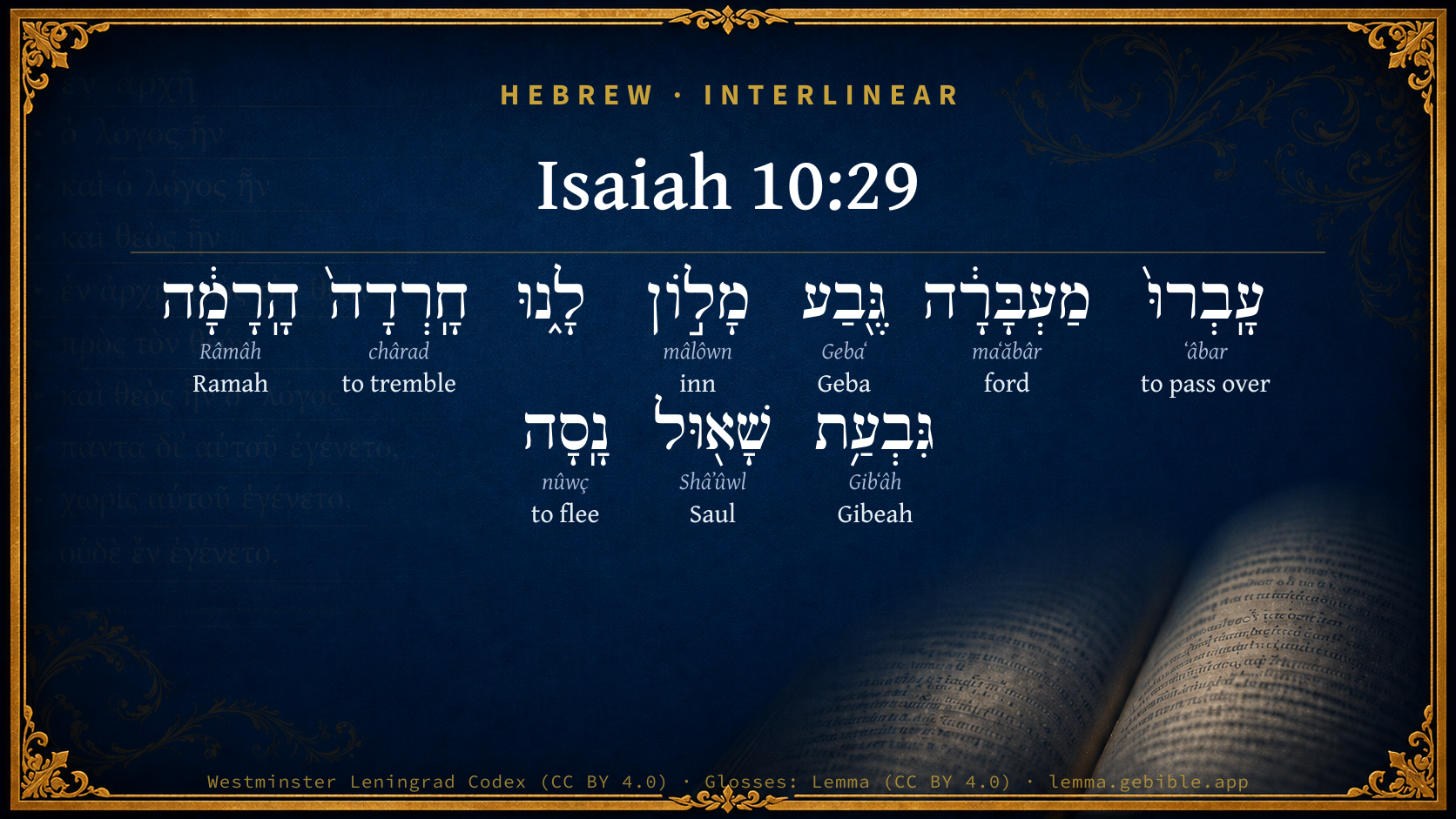
Hebrew (Westminster Leningrad Codex) Isaiah 10:29 appears in the Hebrew Old Testament. The text above is from the Westminster Leningrad Codex. Each word links to its Strong’s number, a concise gloss, and parsing drawn from the Open Scriptures Hebrew Bible morphology. Click any word for its full Brown-Driver-Briggs (BDB) entry.
Download image
Cite this verse

Isaiah 10:29 (World English Bible). Public Domain. Lemma interlinear Bible study tool, https://lemma.gebible.app/v/isaiah/10/29.

Show BibTeX & RIS
BibTeX
RIS
English Translation
they are gone over the pass; they have taken up their lodging at Geba; Ramah trembles; Gibeah of Saul is fled.
World English Bible · Public Domain
Download a study sheet

One document with this verse’s original text, its word-by-word gloss line, the meaning frame, cross-references with their text, attributed commentary, and full source and license credits — printable, and it pastes into notes with its structure intact.

This verse Autodidact and up

Study sheet (.html) Plain text (.txt)

A passage Seminary Student

Up to 50 verses in one chapter. A passage sheet keeps up to 6 commentary sources and 12 cross-references per verse, in the order this page ranks them, and says so on the sheet whenever that leaves anything out. Ask for a single verse and you get the Autodidact verse sheet above.

Everything on this page stays free to read, with no account — the sheet is a download of what is already on screen, not access to it.

Want to remove ads? Support Godless Engineer
Compare translations 3

The same verse in 3 English versions, stacked beneath the original-language interlinear above. Click any original word for its lexicon entry.

Each is an independent rendering of the whole verse — the interlinear is not word-aligned to these translations.

Highlighted words mark where these versions differ — a whole-verse word diff, not a word-by-word alignment.

  • World English Bible Public Domain
    they are gone over the pass; they have taken up their lodging at Geba; Ramah trembles; Gibeah of Saul is fled.
  • King James Version Public Domain
    They are gone over the passage: they have taken up their lodging at Geba; Ramah is afraid; Gibeah of Saul is fled.
  • unfoldingWord Literal Text CC BY-SA 4.0
    They have passed through the pass; “Geba a lodging for us.” Ramah trembles; Gibeah of Saul flees.

unfoldingWord Literal Text — © unfoldingWord, licensed CC BY-SA 4.0. Word-aligned USFM3 via Door43 (git.door43.org/unfoldingWord/en_ult).

Versions to compare (up to 4)

3 of 4 selected

Show all 18 translations

Every available English version of this verse, each an independent rendering of the whole verse.

  • World English Bible Public Domain
    they are gone over the pass; they have taken up their lodging at Geba; Ramah trembles; Gibeah of Saul is fled.
  • Berean Standard Bible Public Domain
    They have crossed at the ford: “We will spend the night at Geba.” Ramah trembles; Gibeah of Saul flees.
  • Majority Standard Bible Public Domain
    They have crossed at the ford: “We will spend the night at Geba.” Ramah trembles; Gibeah of Saul flees.
  • King James Version Public Domain
    They are gone over the passage: they have taken up their lodging at Geba; Ramah is afraid; Gibeah of Saul is fled.
  • American Standard Version (1901) Public Domain
    they are gone over the pass; they have taken up their lodging at Geba; Ramah trembleth; Gibeah of Saul is fled.
  • Revised Version (1885) Public Domain
    they are gone over the pass; they have taken up their lodging at Geba: Ramah trembleth; Gibeah of Saul is fled.
  • Geneva Bible (1599) Public Domain
    They haue gone ouer the foorde: they lodged in the lodging at Geba: Ramah is afraide: Gibeah of Saul is fled away.
  • Douay-Rheims (1899) Public Domain
    They have passed in haste, Gaba is our lodging: Rama was astonished, Gabaath of Saul fled away.
  • Young's Literal Translation Public Domain
    They have gone over the passage, Geba they have made a lodging place, Trembled hath Rama, Gibeah of Saul fled.
  • Literal Standard Version CC BY-SA 4.0
    They have gone over the passage, || They have made Geba a lodging place, || Rama has trembled, || Gibeah of Saul fled.
  • Unlocked Literal Bible CC BY-SA 4.0
    They have crossed over the pass and they lodge at Geba. Ramah trembles and Gibeah of Saul has fled.
  • unfoldingWord Literal Text CC BY-SA 4.0
    They have passed through the pass; “Geba a lodging for us.” Ramah trembles; Gibeah of Saul flees.
  • Darby Bible Public Domain
    They are gone through the pass; they make their lodging at Geba: Ramah trembleth, Gibeah of Saul is fled.
  • World Messianic Bible Public Domain
    They have gone over the pass. They have taken up their lodging at Geba. Ramah trembles. Gibeah of Saul has fled.
  • Webster's Bible Public Domain
    They have gone over the passage: they have taken up their lodging at Geba; Ramah is afraid; Gibeah of Saul hath fled.
  • Free Bible Version CC BY-SA 4.0
    They cross the pass, saying, “We'll stay overnight at Geba.” The people of Ramah tremble in fear; the inhabitants of Gibeah of Saul run away.
  • Bible in Basic English Public Domain
    They have gone across the mountain; Geba will be our resting-place tonight, they say: Ramah is shaking with fear; Gibeah of Saul has gone in flight.
  • JPS Tanakh (1917) Public Domain
    They are gone over the pass; they have taken up their lodging at Geba; Ramah trembleth; Gibeath-shaul is fled.

Literal Standard Version (2020), Covenant Press — licensed CC BY-SA 4.0. Text via the HelloAO Bible API (eBible.org). Unlocked Literal Bible (unfoldingWord) — licensed CC BY-SA 4.0. Text via the HelloAO Bible API (eBible.org). unfoldingWord Literal Text — © unfoldingWord, licensed CC BY-SA 4.0. Word-aligned USFM3 via Door43 (git.door43.org/unfoldingWord/en_ult). Free Bible Version, Dr. Jonathan Gallagher — licensed CC BY-SA 4.0. Text via the HelloAO Bible API (eBible.org).

Word by word

More ways to search: Search by grammar → Find every occurrence → Compare this word →

Practice this passage: Drill this verse → Learn its vocabulary →

About this verse

These counts appear in no published source. They are computed here, from the morphology-tagged text and Lemma’s own curated glosses. What Lemma adds →

10
words
9
distinct lemmas
Prophets
section

Notable vocabulary

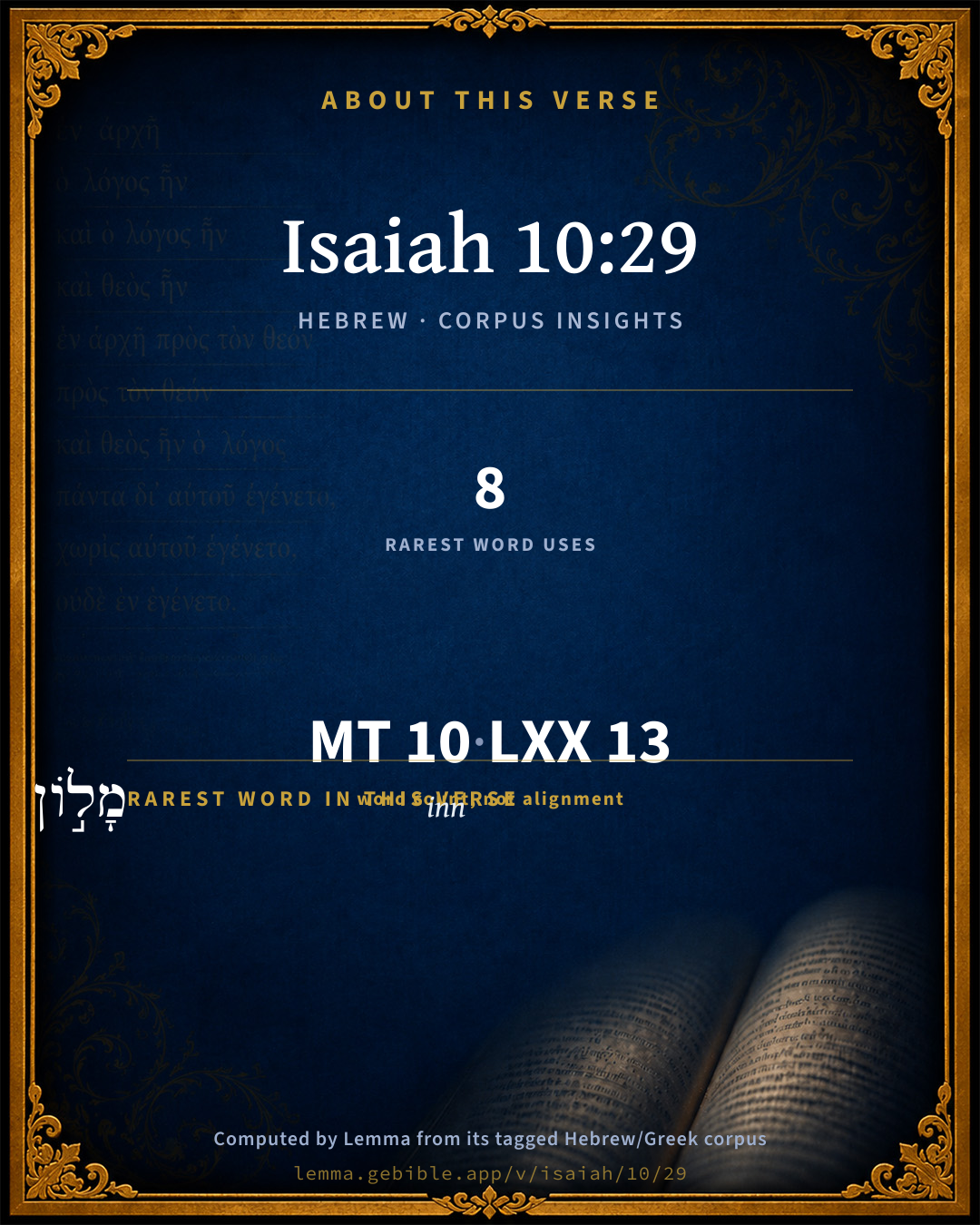
The rarest word here is מָל֣וֹן inn H4411 — appearing just 8 times in the whole Hebrew Bible.

Shared distinctive vocabulary

מָל֣וֹן inn H4411 occurs in 8 verses of the Hebrew Bible. Also found in:

Grammatical profile

  • 3 verbs
  • 6 nouns
  • 1 preposition

Verb forms

  • עָֽבְרוּ֙ Qal · Perfect
  • חָֽרְדָה֙ Qal · Perfect
  • נָֽסָה Qal · Perfect

Hebrew & Septuagint length

In English translation the verse runs 21 words from the Hebrew and 21 from the Septuagint (LXX English) — the same length.

A rough comparison of the two English renderings, which tokenize alike — not a word-level alignment.

Word counts can differ between the Hebrew and the Greek without any difference in meaning — e.g. the Hebrew direct-object marker אֵת has no separate Greek word, and Greek often adds the article ὁ.

In the original languages it is 10 Hebrew tokens and 13 Greek tokens — but the two are counted differently (Hebrew bundles its prefixes and suffixes into one token; the Greek is in lemma form), so that isn’t a like-for-like length.

Cross-references

15

Topical passages linked to Isaiah 10:29 in the Treasury of Scripture Knowledge — connected by theme and wording, ordered by reader-vote popularity; previews shown in the World English Bible.

  • 1 Samuel 7:17 His return was to Ramah, for there was his house; and there he judged Israel: and he built there an altar to Yahweh.
  • 1 Samuel 13:23 The garrison of the Philistines went out to the pass of Michmash.
  • Joshua 21:17 Out of the tribe of Benjamin, Gibeon with its suburbs, Geba with its suburbs,
  • 1 Samuel 11:4 Then came the messengers to Gibeah of Saul, and spoke these words in the ears of the people: and all the people lifted up their voice, and wept.
  • Jeremiah 31:15 Thus says Yahweh: A voice is heard in Ramah, lamentation, and bitter weeping, Rachel weeping for her children; she refuses to be comforted for her children, because they are no more.
  • Joshua 18:24–25 and Chephar Ammoni, and Ophni, and Geba; twelve cities with their villages:
  • Judges 19:12–15 His master said to him, We won't turn aside into the city of a foreigner, that is not of the children of Israel; but we will pass over to Gibeah.
  • 1 Samuel 13:2 Saul chose him three thousand men of Israel, of which two thousand were with Saul in Michmash and in the Mount of Bethel, and one thousand were with Jonathan in Gibeah of Benjamin: and the rest of the people he sent every man to his tent.
  • 1 Samuel 13:16 Saul, and Jonathan his son, and the people who were present with them, abode in Geba of Benjamin: but the Philistines encamped in Michmash.
  • 1 Samuel 14:4 Between the passes, by which Jonathan sought to go over to the Philistines' garrison, there was a rocky crag on the one side, and a rocky crag on the other side: and the name of the one was Bozez, and the name of the other Seneh.
  • 1 Samuel 15:34 Then Samuel went to Ramah; and Saul went up to his house to Gibeah of Saul.
  • 1 Kings 15:23 Now the rest of all the acts of Asa, and all his might, and all that he did, and the cities which he built, aren't they written in the book of the chronicles of the kings of Judah? But in the time of his old age he was diseased in his feet.
  • Hosea 5:8 "Blow the cornet in Gibeah, And the trumpet in Ramah! Sound a battle cry at Beth Aven, behind you, Benjamin!
  • Hosea 9:9 They have deeply corrupted themselves, As in the days of Gibeah. He will remember their iniquity. He will punish them for their sins.
  • Hosea 10:9 "Israel, you have sinned from the days of Gibeah. There they remained. The battle against the children of iniquity doesn't overtake them in Gibeah.

Cross-references courtesy of OpenBible.info (CC BY 4.0).

Hebrew and Greek witnesses Masoretic Hebrew ↔ Greek Septuagint

The same verse in the two great witnesses to the Old Testament, shown verse-for-verse.

These are two independent witnesses, not word-aligned to each other, and the Septuagint is shown in lemma (dictionary) form.

Hebrew Isaiah 10:29 Masoretic · Westminster Leningrad Codex

עָֽבְרוּ֙ מַעְבָּרָ֔ה גֶּ֖בַע מָל֣וֹן לָ֑נוּ חָֽרְדָה֙ הָֽרָמָ֔ה גִּבְעַ֥ת שָׁא֖וּל נָֽסָה

they are gone over the pass; they have taken up their lodging at Geba; Ramah trembles; Gibeah of Saul is fled.

World English Bible · Public Domain

Greek LXX Isaiah 10:29 Septuagint · lemma form

καί παραἔρχομαι φάραγξ καί ἥκω εἰς αγγαι φόβος λαμβάνω ραμα πόλις σαούλ φεύγω

And he shall pass by the valley, and shall arrive at Angai: fear shall seize upon Rama, the city of Saul.

LXX2012 (modern English Septuagint) · Public Domain

On this verse, Adam Clarke's Commentary discusses the Septuagint’s reading. Read the note in Commentary ↓

Hebrew: Westminster Leningrad Codex (CC BY 4.0). Greek: Septuagint (public domain); English from LXX2012 (modern English Septuagint) (Public Domain). How the Septuagint differs from the Hebrew →

Targum (Aramaic paraphrase)

1

The Targum is the ancient Jewish Aramaic paraphrase of the Hebrew Scriptures — an interpretive translation, not the Hebrew text itself. Onkelos (literal) and Pseudo-Jonathan (expansive) render the Torah, and Jonathan the Prophets. Coverage is partial: where no permissively-licensed English translation exists for a verse, only the Aramaic is shown. This is verse-level text, not a word-by-word alignment to the Hebrew.

  1. Targum Jonathan Prophets (Joshua–Malachi)
    גָזוּ עֲבָרוּ יַרְדְנָא בְּגֶבַע בָּתוּ לְהוֹן אִתְבָּרוּ יָתְבֵי רָמָתָא אֱנַשׁ גִבְעַת שָׁאוּל עֲרָקוּ:

    They waded, they passed through the Jordan: at Geba they passed the night; the inhabitants of Ramah are broken; the men of Gibeah of Saul have fled.

    Targum Jonathan — Aramaic: “Mikraot Gedolot” (public domain). English: “Sefaria Community Translation” (CC0 1.0 (public-domain dedication)); “London "Chaldee Paraphrase," 1871” (public domain). Text via Sefaria.

Commentary

Notes on Isaiah 10:29 from classic Christian and Jewish commentators (each source and its license shown beneath its notes). The classic Christian expositions comment on the surrounding passage and are grouped to its opening verse, so a note may address several verses; the Jewish commentaries on the Tanakh (Rashi and others) are per-verse, so they appear only where the commentator wrote on this verse.

Lemma curates 59 commentaries, every one of them public domain or Creative Commons licensed, each selected and text-cleaned for this edition rather than reprinted as found. About our sources →

Trapp's Complete Commentary

John Trapp

Isa 10:29 They are gone over the passage: they have taken up their lodging at Geba; Ramah is afraid; Gibeah of Saul is fled.

Ver. 29. They are gone over the passages,] i.e., The straits, between two rocks. {1Sa 13:22}

John Trapp, A Commentary or Exposition upon All the Books of the Old and New Testament (1647–1656) — public domain. Text from a community e-Sword module.

Jamieson, Fausset & Brown

Robert Jamieson, A. R. Fausset & David Brown

passage--the jaws of the wady or defile at Michmash (Sa1 13:23; Sa1 14:4-5).

lodging--their quarters for the night, after having passed the defile which might have been easily guarded against them.

Ramah--near Geba; seven miles from Jerusalem.

Gibeah of Saul--his birthplace and residence, in Benjamin (Sa1 11:4), distinct from Gibeah of Judah (Jos 15:57).

Jamieson, Fausset & Brown — Commentary Critical and Explanatory on the Whole Bible (1871) — public domain (CC PDM 1.0). Text via the HelloAO Bible API.

Adam Clarke's Commentary

Verse 29. They are gone over the passage - "They have passed the strait"] The strait here mentioned is that of Michmas, a very narrow passage between two sharp hills or rocks, (see 1Sa 14:4-5,) where a great army might have been opposed with advantage by a very inferior force. The author of the Book of Judith might perhaps mean this pass, at least among others: "Charging them to keep the passages of the hill country, for by them there was an entrance into Judea; and it was easy to stop them that would come up, because the passage was strait for two men at the most," Judith 4:7. The enemies having passed the strait without opposition, shows that all thoughts of making a stand in the open country were given up, and that their only resource was in the strength of the city.

Their lodging] The sense seems necessarily to require that we read למו lamo, to them, instead of לנו lanu, to us. These two words are in other places mistaken one for the other.

Thus Isa 44:7, for למו lamo, read לנו lanu, with the Chaldee; and in the same manner Ps 64:6, with the Syriac, and Ps 80:7, on the authority of the Septuagint and Syriac, besides the necessity of the sense.

Adam Clarke's Commentary on the Bible (1810–1826) — public domain. Text from a community e-Sword/MySword module.

John Gill's Exposition

Lift up that voice, O daughter of Gallim,.... In a mournful and lamentable manner, and yet with such a clear loud voice, as to be heard afar off: the word is sometimes used for making a joyful sound, and of the neighing of horses. The inhabitants of Gallim are meant by its daughter; of this place was Phalti, who married Michal, Saul's daughter; very probably it was in the tribe of Benjamin. Jerom (f) makes mention of Accaron, a village, which was called Gallim.

Cause it to be heard unto Laish; if this was the place the Danites took, and called it Dan, it was on the northern border of Judea, in the furthermost part of the land; hence the phrase, from Dan to Beersheba; it was near to Caesarea or Paneas, from whence the river Jordan took its rise; and was a great way off, either of Gallim or Anathoth, for the voice of them to be heard.

O poor Anathoth! this was a city in the tribe of Benjamin, Jos 21:18 it was the native place of the Prophet Jeremiah, Jer 1:1 according to Josephus (g), it was twenty furlongs from Jerusalem; and, according to Jerom (h), three miles: it is called "poor", because it was but a poor mean village; or because it would now become so, through the ravages of the Assyrian army.

(f) De locis Hebraicis, fol. 92. D. (g) Antiqu. l. 13. c. 7. sect. 3. (h) Comment. in Hieremiam, l. 1. fol. 121. H. & l. 2. fol. 132. F. & l. 6. 161. C.

John Gill's Exposition of the Whole Bible (1746–1763) — public domain (CC PDM 1.0). Text via the HelloAO Bible API.

Albert Barnes' Notes on the Bible

They are gone over the passage - The word “passage” (מעברה ma‛ebı̂râh) may refer to any passage or ford of a stream, a shallow part of a river where crossing was practicable; or it may refer to any narrow pass, or place of passing in mountains. The Chaldee Paraphrase renders this, ‘They have passed the Jordan;’ but this cannot be the meaning, as all the transactions referred to here occurred in the vicinity of Jerusalem, and long after they had crossed the Jordan. In 1Sa 13:23, the ‘passage of Michmash’ is mentioned as the boundary of the garrison of the Philistines. Between Jeb’a and Mukhmas there is now a steep, precipitous valley, which is probably the ‘passage’ here referred to. This wady, or valley, runs into another that joins it on the north, and then issues out upon the plain not far from Jericho. In the valley are two hills of a conical form, having steep rocky sides, which are probably the rocks mentioned, in connection with Jonathan’s adventure, as a narrow defile or way between the rock Bozez on the one side, and Seneh on tbe other; 1Sa 14:4-5. This valley appears at a later time to have been the dividing line between the tribes of Ephraim and Benjamin, for Geba on the south side of this valley was the northern limit of Judah and Benjamin 2Ki 23:8; while Bethel on its north side was on the southern border of Ephraim; Jdg 16:1-2. - Robinson’s “Bib. Researches,” ii. p. 116. Of course it was an important place, and could be easily guarded - like the strait of Thermopylae. By his having passed this place is denoted an advance toward Jerusalem, showing that nothing impeded his progress, and that he was rapidly hastening with his army to the city.

They have taken up their lodging at Geba - They have pitched their camp there, being entirely through the defile of Michmash. Hebrew, ‘Geba is a lodging place for us;’ that is, for the Assyrians. Perhaps, however. there is an error in the common Hebrew text here, and that it should be למו lāmô, ‘for them,’ instead of לנוּ lānû, ‘for us.’ The Septuagint and the Chaldee so read it, and so our translators have understood it. “Geba” here is not be confounded with ‘Gibeah of Saul,’ mentioned just after. It was in the tribe of Benjamin 1Ki 15:22; and was on the line, or nearly on the line, of Judah, so as to be its northern boundary; 2Ki 23:8. It was not far from Gibeah, or Gibeon. There are at present no traces of the place known.

Ramah - This city was in the tribe of Benjamin. It was between Geba and Gibea. It was called “Ramah,” from its being on elevated ground; compare the note at Mat 2:18. “Ramah,” now called “er-Ram,” lies on a high hill a little east of the road from Jerusalem to Bethel. It is now a miserable village, with few houses, and these in the summer mostly deserted. There are here large square stones, and also columns scattered about in the fields, indicating an ancient place of some importance. A small mosque is here with columns, which seems once to have been a church. Its situation is very conspicuous, and commands a fine prospect. It is near Gibeah, about six Roman miles from Jerusalem. So Jerome, “Commentary” in Hos 5:8 : ‘Rama quae est juxta Gabaa in septimo lapide a Jerosolymis sita.’ Josephus places it at forty stadia from Jerusalem; “Ant.” viii. 12, 3.

Is afraid - Is terrified and alarmed at the approach of Sennacherib - a beautiful variation in the description, denoting his rapid and certain advance on the city of Jerusalem, spreading consternation everywhere.

Gibeah of Saul - This was called ‘Gibeah of Saul,’ because it was the birthplace of Saul 1Sa 11:4; 1Sa 15:34; 2Sa 21:6; and to distinguish it from Gibea in the tribe of Judah Jos 15:57; and also a Gibeah where Eleazar was burled; Jos 24:33. Jerome mentions Gibeah as in his day level with the ground. - “Epis. 86, ad Eustoch.” It has been almost wholly, since his time, unnoticed by travelers. It is probably the same as the modern village of Jeba, lying in a direction to the southwest of Mukhmas. This village is small, and is half in ruins. Among these there are occasionally seen large hewn stones, indicating antiquity. There is here the ruin of a small tower almost solid, and a small building having the appearance of an ancient church. It is an elevated place from which several villages are visible. - Robinson’s “Bib. Researches,” ii. p. 113.

Is fled - That is, the inhabitants have fled. Such was the consternation produced by the march of the army of Sennacherib, that the city was thrown into commotion, and left empty.

Albert Barnes' Notes on the Bible (1834–1885) — public domain. Text from a community e-Sword/MySword module.

Haydock's Catholic Bible Commentary

Lodging. Here, say the Assyrians, we will encamp.

George Leo Haydock (1774–1849), Haydock's Catholic Family Bible and Commentary, 1859 edition — public domain. Excludes Psalms (Douay-Rheims chapter numbering differs from Protestant) and Deuterocanonical books (Catholic canon only).

Matthew Poole's English Annotations

The passage; some considerable passage then well known, possibly that 1Sa 14:4. The people fled to Jerusalem for fear of the Assyrian.

Matthew Poole's English Annotations on the Holy Bible (1683–1685) — public domain. Text from a community e-Sword/MySword module.

Whedon's Commentary on the Bible

Daniel D. Whedon

29-34. The towns or villages lay within from two to twelve miles (English) north-northeast from Jerusalem.

“He comes from Ayyath; (Ai, probably ten to twelve miles from Jerusalem;) passes through Migron, (a place not now identified.) In Michmash (two miles south of Ai) he leaves his baggage; (hills and gorges here are impassable to carriages:) they go through a pass. Let Geba be our quarters for the night. (This is a command to the army.) Ramah trembles; Gibeah of Saul flees; (both places are three or four miles bearing north.) Scream aloud, O daughter of Gallim; (twice mentioned in the Old Testament, but site unknown.) Only listen, O Laish. (The course is now doubtless zigzag.) Poor Anathoth! (Jeremiah’s home, a priestly city quite near to Jerusalem.) Madmenah hurries away. The inhabitants of Gebim rescued! He (the Assyrian) still halts at Nob today, (close upon Jerusalem;) swings his hand over the mountain of the daughter of Zion, the hill of Jerusalem. (Almighty providence now interferes.) Behold, the Lord Jehovah of hosts lops down the branches with terrible force, and those of towering growth are hewn down, and the lofty are humbled.” Branches… lofty… towering growth. (These terms imply the leaders of the army. Some crushing blow is seen to strike down the forest of leaders, nobles, commanders.) And he fells the thickets of the forest with iron. (The “thickets” are the serried battalions, cut down as by the sword of an unseen or unnamed army.) And Lebanon, it falls by a majestic one. (Assyria is the towering cedar, collectively named Lebanon, the mount in the north on which it grows.) Thus the fate of the imperial power of the world is given in this short, quick, and awful description. For geographical names the reader will be instructed by Smith’s Dictionary of the Bible. It is quite the habit of commentators to apply the above picture to Sennacherib, the great Assyrian king. Even those who claim this prophetic section, from chap. 7-12 inclusive, as belonging to and as having been delivered during the period of Ahaz, find it convenient to see Sennacherib as the foremost character in that scene. It may be so. But if so, the prophet overleaps dates and defined periods in the pictures he draws, and makes anachronisms of small account. And this is easy to believe. He sees things perspectively in juxtaposition, yet in some sort of succession, indeed; and some things may loom up and brighten on his vision, though beyond and out of range with the particular period about which in specific detail he may be treating. Sennacherib was in the last years of his troubling Syria and Egypt, and king Hezekiah; according to the canon of Ptolemy, in the last seven years, according to 2Ki_18:13 and Isa_36:1, in the last fifteen years, of Hezekiah’s reign. But it matters little. The chief object of the above picture was not to place Sennacherib as a great figure in it, though the prophet, for aught we know, may have seen him there according to laws of prophetic vision. The great object was illustrative instruction to Israel and Judah — to the latter, certainly, to Ahaz and those around him and the remnant, the better few — to trust in Jehovah and not to trust in nor fear the Assyrian, who, after his aid to Judah in quelling Syria and Ephraim, had turned to subject Judah to himself.

Daniel D. Whedon (gen. ed.), Commentary on the Old and New Testaments (1874–1909) — public domain. Text from a community e-Sword module.

The Pulpit Commentary

They are gone over the passage. The "passage of Michmash" (1Sa_13:23) the deeply sunken valley, called now the Wady Sutveinit, between Michmash (Mukkmas) and Geba (Jeba). They have taken up their lodging at Geba; or, at Geba they rest for the night. Having crossed the wady, they bivouac on the crest of the hills enclosing it on the south. Ramah... Gibeah of Saul. Ramah is, no doubt, Er-Ram , a village on an eminence, as the name implies, about six miles north of Jerusalem, and on the direct road from Beitin. Gibeah of Saul is thought to have occupied the site of the modern Tuleil-el-Ful, two miles nearer Jerusalem. It is certainly a distinct place from Geba. The inhabitants evacuate these two places during the night.

The Pulpit Commentary (1880–1919), ed. H.D.M. Spence-Jones & Joseph S. Exell — public domain. Text from a community e-Sword module.

John Wesley's Explanatory Notes

Fled - The people fled to Jerusalem for fear of the Assyrian.

John Wesley, Explanatory Notes Upon the Whole Bible (1754–1765) — public domain. Text via the GEBible commentary corpus.

J. A. Alexander on Isaiah

Joseph Addison Alexander

They have passed the pass, a narrow passage between Michmash and Geba, (1Sa 13:3; 1Sa 13:5 etc), a spot no doubt easily maintained against an enemy. Their passing it implies that they met with no resistance, or had overcome it, and that there was now little or nothing to impede their march. In Geba they have taken up their lodging (literally, lodged a lodging). Geba appears from 1Ki 15:22 to have been on or near the line between Benjamin and Judah. There is a small village now called Jeba, half in ruins, with large hewn stones and the remains of a square tower, on the opposite side of the valley from the ancient Michmash. This place Robinson and Smith supposed at first to be Geba, but afterwards concluded that it must be Gibeah of Saul, and that the site of Geba must be further down, where they heard of ruins, but had not time to explore (vol. 2. pp. 114, 115). Thus far he has described what the Assyrians themselves do - “they cross the line at Ajath - pass through Migron - leave their baggage at Michmash lodge at Geba”. Now he describes what the places themselves do; “Ramah trembles -Gibeah of Saul flees.” Ramah was a city of Benjamin, near Gibeah, but further from Jerusalem. It is still in existence as Er-ram. It is about half a mile nearly due west of Jeba, but hidden from it by intervening heights (Robinson, vol. 2. pp. 108-114). It is two hours north of Jerusalem, on the eastern side of the road to Nablus. The identity of this place with the ancient Ramah was long lost sight of, but has been clearly ascertained by Smith and Robinson. Ramah trembles (or is afraid) at the enemy’s approach, a strong and beautiful personification, or the place may be simply put for its inhabitants. The trembling and flight of these towns is naturally represented as occurring while the enemy was resting at Geba. It may imply, either that Ramah was not in the direct line of the march but within sight and hearing of it, or on the contrary, that it was the next place to be reached, and trembling in apprehension of it. A still stronger metaphor is used as to the next place. Gibeah of Saul, so called because it was his birth-place and residence, and to distinguish it from others of the same name, is fled. There is here a rapid but marked climax. “While Ramah trembles, Gibeah flees.”

Joseph Addison Alexander, The Prophecies of Isaiah (1846–1847; New York: Scribner, 1870–1878) — public domain. Text from a community e-Sword module.

Rashi

Rabbi Shlomo Yitzchaki (Rashi)

they lodged Heb. לָנוּ, an expression of lodging.

Gib’ath Saul fled Fled, they all fled because of his armies.

Rashi on the Tanakh — English translations: “The Judaica Press complete Tanach with Rashi, translated by A. J. Rosenberg” (CC BY 4.0); “Pentateuch with Rashi's commentary by M. Rosenbaum and A.M. Silbermann, 1929-1934” (public domain); “The Metsudah Tanach series, Lakewood, N.J” (CC BY 4.0); and “The Book of Joshua, Metsudah Publications, 1997” (CC BY 4.0). Text via Sefaria.

Ibn Ezra

Rabbi Abraham ibn Ezra

מעברה. The passage, or the name of a place.

לנו. They have taken up their lodgings. Comp. ללון, To stay over night. (Gen. 24:23.

Ibn Ezra on the Tanakh — English translations: “Sefaria Community Translation” (CC0 1.0 (public-domain dedication)); “Yalkut, Sifsei Chachomim Chumash, Metsudah Publications, 2009” (CC BY 4.0); and “Commentary of Ibn Ezra on Isaiah - trans. by M. Friedlander, 1873” (public domain). Text via Sefaria.

Lesson kit

Teaching starters — assembled from the data on this page, not authored interpretation. Every prompt links to the verse data it draws on. Edit before teaching.

Isaiah, in the Prophets, opens this verse with 10 words (9 distinct Hebrew lemmas). Its most distinctive word is mâlôwn (“inn”). A historical commentator’s framing appears above. Read the whole chapter for the surrounding context.

Discussion questions

  1. How does “inn” (mâlôwn) shape what this verse is saying?
  2. How does Genesis 42:27, which shares the word «inn», read alongside this verse?
  3. These translations render this verse differently; the difference is in the English rendering, not the original. What questions does that raise?
  4. «עָֽבְרוּ֙» is a Qal Perfect verb. How does that grammatical form shape the action described?
  5. Compare how Trapp's Complete Commentary and Jamieson, Fausset & Brown read this verse. Where do they agree or differ?

Things to notice

Reading settings

Reading text

Shown beneath each verse's original-language words.

Old Testament
Old Testament edition

Read the OT as the Masoretic Hebrew (MT) or the Greek Septuagint (LXX).

English shown for the Greek Septuagint (in the Hebrew ↔ Greek comparison).

Comparing translations? Open the Compare panel on any verse page to stack up to four side by side.