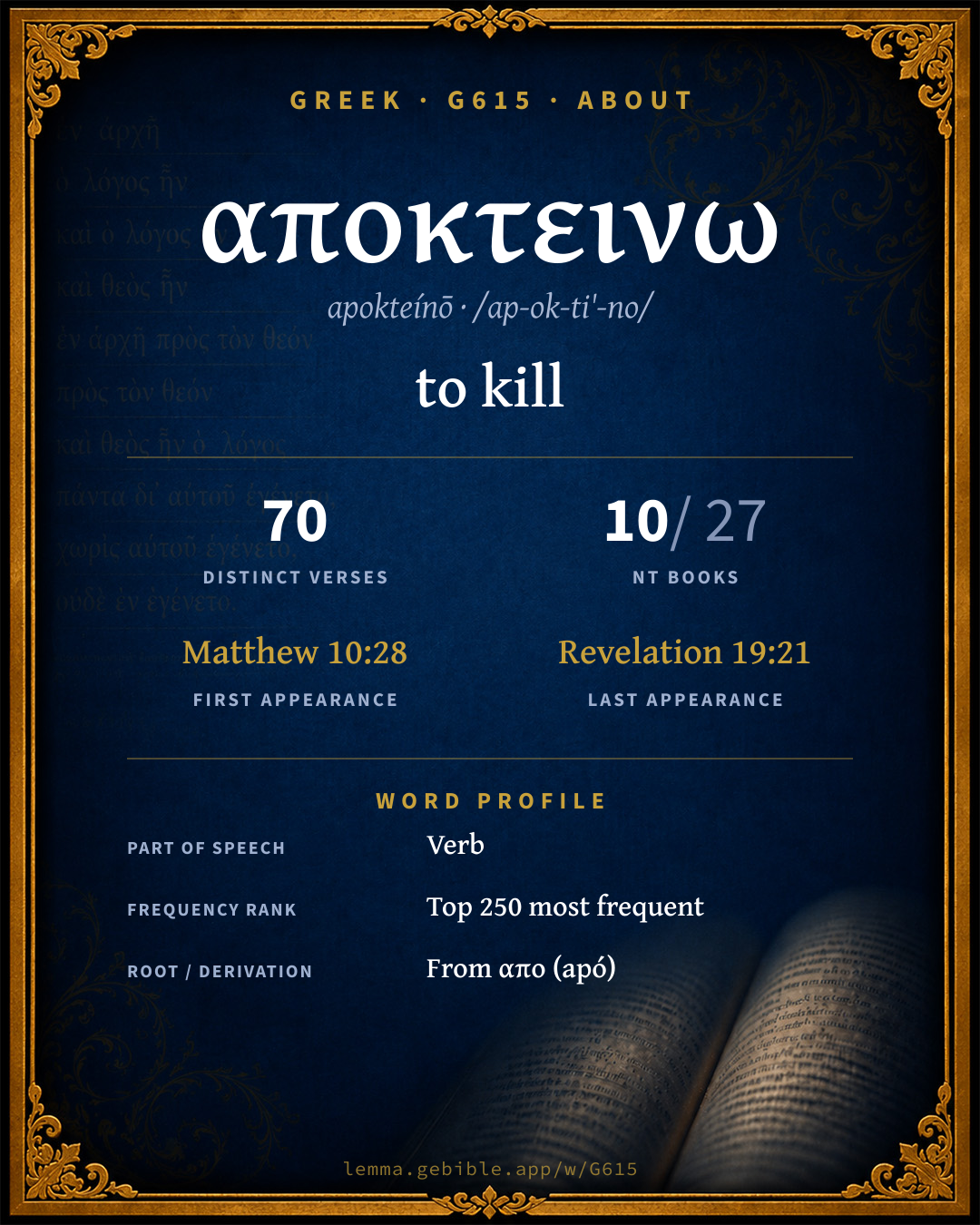
ἀποκτείνω
to kill
‘to kill’ is one of 2 main senses fuller range ↓
Full lexicon entry — Thayer's Greek Lexicon
From Thayer's Greek Lexicon
Where this word appears
See every Aorist-tense verb in the Greek New Testament →
Grammar key — what these labels mean
Part of speech
- Verb
- An action or state-of-being word.
Tense
- Aorist
- Action viewed as a simple whole, without regard to duration — often past (perfective aspect).
- Future
- Action expected in future time.
- Present
- Ongoing or general action in present time (imperfective aspect).
Voice
- Active
- The subject performs the action.
- Passive
- The subject receives the action.
Mood
- Infinitive
- A verbal noun (“to write”), unmarked for person or number.
- Indicative
- States a fact or asks a factual question (the mood of reality).
- Subjunctive
- Expresses probability, purpose, or possibility (the mood of contingency).
- Participle
- A verbal adjective (“writing,” “having written”).
Case
- Nominative
- The case of the subject (and the predicate nominative).
- Genitive
- The case of source, possession, or “of” — answers “whose / from what.”
Person
- 3rd person
- The one spoken about (“he / she / it / they”).
- 1st person
- The speaker (“I / we”).
- 2nd person
- The one addressed (“you”).
Gender
- Masculine
- Grammatically masculine.
- Feminine
- Grammatically feminine.
Number
- Plural
- More than one.
- Singular
- One.
Every verse where G615 appears in the Book of Matthew — 12 distinct verses. Click any verse to open its interlinear word-by-word view. Verse text shown in the World English Bible for context — . Each verse’s Greek form is shown with its reference; the English is not keyword-highlighted, since the data carries no word-level English alignment. Use “Compare translations” on any verse to read it across multiple English versions. This concordance covers the Greek New Testament; Septuagint (Greek Old Testament) occurrences of this word are not indexed here.
Matthew
- Matthew 10:28 ἀποκτεννόντων ἀποκτεῖναι pres act ptcp gen pl masc aor act inf Don't be afraid of those who kill the body, but are not able to kill the soul. Rather, fear him who is able to destroy both soul and body in Gehenna.
- Matthew 14:5 ἀποκτεῖναι aor act inf When he would have put him to death, he feared the multitude, because they counted him as a prophet.
- Matthew 16:21 ἀποκτανθῆναι aor pass inf From that time, Jesus began to show his disciples that he must go to Jerusalem and suffer many things from the elders, chief priests, and scribes, and be killed, and the third day be raised up.
- Matthew 17:23 ἀποκτενοῦσιν fut act ind 3pl and they will kill him, and the third day he will be raised up." They were exceedingly sorry.
- Matthew 21:35 ἀπέκτειναν aor act ind 3pl The farmers took his servants, beat one, killed another, and stoned another.
- Matthew 21:38 ἀποκτείνωμεν pres act subj 1pl But the farmers, when they saw the son, said among themselves, 'This is the heir. Come, let's kill him, and seize his inheritance.'
- Matthew 21:39 ἀπέκτειναν aor act ind 3pl So they took him, and threw him out of the vineyard, and killed him.
- Matthew 22:6 ἀπέκτειναν aor act ind 3pl and the rest grabbed his servants, and treated them shamefully, and killed them.
- Matthew 23:34 ἀποκτενεῖτε fut act ind 2pl Therefore, behold, I send to you prophets, wise men, and scribes. Some of them you will kill and crucify; and some of them you will scourge in your synagogues, and persecute from city to city;
- Matthew 23:37 ἀποκτείνουσα pres act ptcp nom sg fem "Jerusalem, Jerusalem, who kills the prophets, and stones those who are sent to her! How often would I have gathered your children together, even as a hen gathers her chickens under her wings, and you would not!
- Matthew 24:9 ἀποκτενοῦσιν fut act ind 3pl Then they will deliver you up to oppression, and will kill you. You will be hated by all of the nations for my name's sake.
- Matthew 26:4 ἀποκτείνωσιν aor act subj 3pl They took counsel together that they might take Jesus by deceit, and kill him.
About this entry
At a glance — auto-summarized from this page’s data, not written by a person. Every figure links to its source below. This summary describes the numbers; it doesn’t interpret them.
αποκτεινω (apokteínō) is a Greek verb most often rendered “to kill.” Scripture first uses it in Matthew 10:28. Spanning 70 verses in 10 books, it ranks among the moderately common words of the Greek New Testament. Ranging over 2 senses, it is not a single-sense word. Sharing its root, it stands alongside απο, απαγγελλω and απαγχομαι. For the data behind this summary, explore the sense tree and the renderings breakdown below.
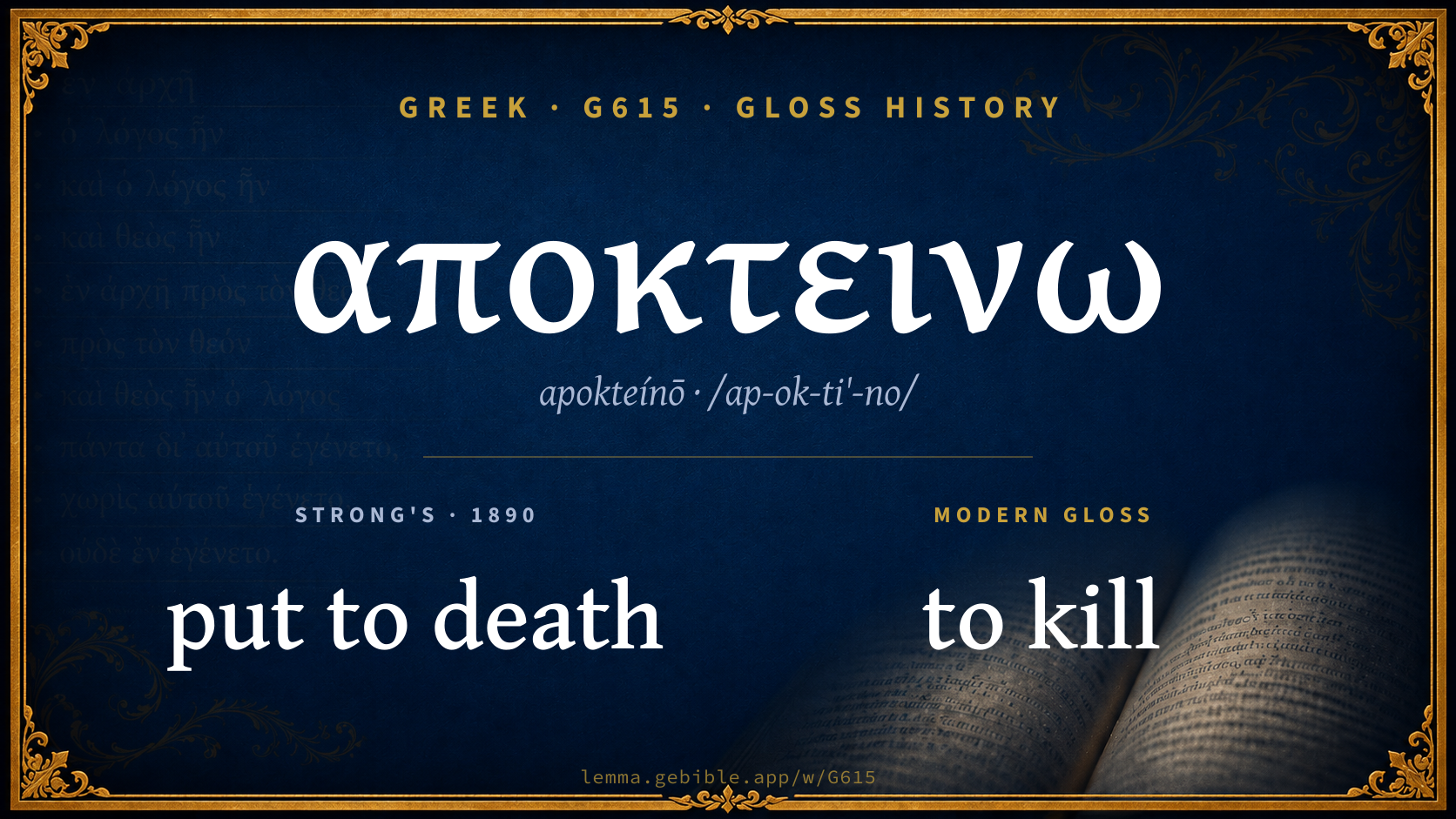
Gloss history
Strong's 1890 vs modern scholarship
About this word
Strong's G615 catalogs a Greek word from the Greek New Testament.
These counts are not copied from any lexicon or concordance. They are computed here, from the morphology-tagged Greek New Testament. What Lemma adds →
- 70
- distinct verses
- The word appears in 70 distinct verses.
- 10 / 27
- NT books
- The word appears in 10 of 27 New Testament books.
- #231
- by frequency
- Top 250 most frequent Greek words (rank 231 of 5,347 Greek words by occurrence).
View all 70 occurrences in the concordance →
Most concentrated in
- Revelation 14 verses 20%
- Matthew 12 verses 17%
- Luke 12 verses 17%
By section of the New Testament
By traditional corpus
Conventional, traditional groupings — biblical authorship is debated, so this is a traditional corpus grouping, not an authorship claim. Some books belong to more than one corpus (Luke is in both the Gospels and the Lukan corpus, and so on), so these shares overlap and need not total 100%. Each figure is a share of the word’s 70 distinct verses.
- Gospels 45 verses · 64%
- Johannine 26 verses · 37%
- Lukan (Luke–Acts) 18 verses · 26%
- Revelation 14 verses · 20%
- Pauline corpus 5 verses · 7%
How translations render this word
Counts come from each version’s own published word-to-Strong’s tagging or interlinear alignment — an approximate guide to how each version renders this word, not a word-level alignment the data otherwise carries. Because each total is that version’s own tagged count, the per-version totals vary from one another and need not match the appearance or distinct-verse counts above. These counts may also differ from a printed concordance because Lemma counts each distinctly tagged rendering and does not collapse phrase taggings into a single head-word total. This is a fixed set of word-tagged versions (KJV, ASV, BSB, ULT) and does not change with the reading translation you choose elsewhere. Each version’s license is shown beside its name below (and on Sources).
- King James Version: Kill 18×, Killed 9×, Be killed 5×
- American Standard Version: Kill 18×, Killed 9×, Be killed 5×
- Berean Standard Bible: Kill 25×, Killed 10×, Kills 4×
- unfoldingWord Literal Text: Kill 17×, Killed 8×, Be killed 7×
King James Version Public Domain
Renders G615 across 81 tagged occurrences — most commonly:
Plus 23 renderings that appear only once — usually multi-word phrases or single function words the recovered tagging swept in, not distinct renderings. Not rendered by a distinct English word in 2 further occurrences.
American Standard Version Public Domain
Renders G615 across 78 tagged occurrences — most commonly:
Plus 28 renderings that appear only once — usually multi-word phrases or single function words the recovered tagging swept in, not distinct renderings.
Berean Standard Bible Public Domain
Renders G615 across 73 tagged occurrences — most commonly:
Plus 15 renderings that appear only once — usually multi-word phrases or single function words the recovered tagging swept in, not distinct renderings. Not rendered by a distinct English word in 1 further occurrence.
unfoldingWord Literal Text CC BY-SA 4.0
Renders G615 across 87 tagged occurrences — most commonly:
Plus 23 renderings that appear only once — usually multi-word phrases or single function words the recovered tagging swept in, not distinct renderings.
Senses in Thayer's
The 2 senses Thayer's distinguishes for this word, in lexicon order (not ranked by frequency or importance). The full entry — with sub-senses — is in the Lexicon Entry tab.
- to kill in any way whatever
- metaph. to extinguish, abolish
Word origin
Derived from απο (apó) (G575) — from.
From G575 and κτείνω kteinō (to slay ); to kill outright; figuratively to destroy : - put to death kill slay.
— Strong’s Exhaustive Concordance (1890), public domain.
Forms in the corpus
The 22 distinct written forms G615 takes in the Greek New Testament, most frequent first — each parse links to that tense’s occurrences in the concordance.
Same root — word family
Other Thayer's entries built from the same root as G615, grouped by Strong’s listed origin. These share a root / origin per the lexicon — not necessarily a shared meaning. Each links to that word’s own entry.
Derives from
Shares the same root
- απαγγελλω apangéllō G518 to report
- απαγχομαι apánchomai G519 to strangle
- απαγω apágō G520 to lead away
- απαιρω apaírō G522 to take away
- απαιτεω apaitéō G523 to demand back
- απαλγεω apalgéō G524 to cease grieving
- απαλλασσω apallássō G525 to depart
- απαλλοτριοω apallotrióō G526 to estrange
- απανταω apantáō G528 to meet
- απαρνεομαι aparnéomai G533 to deny
- απαρτι apárti G534 henceforth
- απαρχη aparchḗ G536 to offer firstfruits
- απαυγασμα apaúgasma G541 brightness
- απειδω apeídō G542 to look away
- απειμι ápeimi G548 to depart
- απειμι ápeimi G549 to depart
- απειπομην apeipómēn G550 to declare
- απεκδεχομαι apekdéchomai G553 waiting for
- απεκδυομαι apekdýomai G554 to despoil
- απελαυνω apelaúnō G556 to drive away
- απελεγμος apelegmós G557 censure
- απελευθερος apeleútheros G558 freedman
- απελπιζω apelpízō G560 not despairing
- απεναντι apénanti G561 opposite
+85 more words share this root (not shown).
Compare all same-root words → Showing 4 of 111 — not the complete family. They share a root, not necessarily a meaning.
Septuagint usage
The same Greek word αποκτεινω appears 169 times in the Greek Old Testament (Septuagint), across 163 verses in 27 books.
- 169
- LXX occurrences
- Tagged occurrences of this Greek word in the Septuagint.
- 163
- verses
- Distinct Septuagint verses containing this word.
- 27 / 39
- OT books
- The word appears in 27 of the 39 Old Testament books.
Sample Septuagint occurrences
- Genesis 4:8 ἀποκτείνω
- Exodus 1:16 ἀποκτείνω
- Leviticus 20:4 ἀποκτείνω
- Numbers 11:15 ἀποκτείνω
- Deuteronomy 9:28 ἀποκτείνω
- Joshua 7:5 ἀποκτείνω
- Judges 7:25 ἀποκτείνω
- 1 Samuel 15:3 ἀποκτείνω
- 2 Samuel 4:10 ἀποκτείνω
- 1 Kings 2:5 ἀποκτείνω
- 2 Kings 8:12 ἀποκτείνω
- 1 Chronicles 2:3 ἀποκτείνω
Septuagint occurrences (same lexeme)
Every verse where the same Strong’s number (G615) appears in the Greek Septuagint — showing the first 50 of 163. Verse text shown in the World English Bible for context; the Greek form is the matched word — the English is not keyword-highlighted.
- Genesis 4:8 ἀποκτείνω Cain said to Abel, his brother, "Let's go into the field." It happened, when they were in the field, that Cain rose up against Abel, his brother, and killed him.
- Genesis 4:14 ἀποκτείνω Behold, you have driven me out this day from the surface of the ground. I will be hidden from your face, and I will be a fugitive and a wanderer in the earth. It will happen that whoever finds me will kill me."
- Genesis 4:15 ἀποκτείνω Yahweh said to him, "Therefore whoever slays Cain, vengeance will be taken on him sevenfold." Yahweh appointed a sign for Cain, lest any finding him should strike him.
- Genesis 4:23 ἀποκτείνω Lamech said to his wives, "Adah and Zillah, Hear my voice, You wives of Lamech, listen to my speech, For I have slain a man for wounding me, A young man for bruising me.
- Genesis 4:25 ἀποκτείνω Adam knew his wife again. She gave birth to a son, and named him Seth. For, she said, "God has appointed me another child instead of Abel, for Cain killed him."
- Genesis 12:12 ἀποκτείνω It will happen, when the Egyptians will see you, that they will say, 'This is his wife.' They will kill me, but they will save you alive.
- Genesis 18:25 ἀποκτείνω Be it far from you to do things like that, to kill the righteous with the wicked, that so the righteous should be as the wicked. May that be far from you. Shouldn't the Judge of all the earth do right?"
- Genesis 20:2 ἀποκτείνω Abraham said about Sarah his wife, "She is my sister." Abimelech king of Gerar sent, and took Sarah.
- Genesis 20:11 ἀποκτείνω Abraham said, "Because I thought, 'Surely the fear of God is not in this place. They will kill me for my wife's sake.'
- Genesis 26:7 ἀποκτείνω The men of the place asked him about his wife. He said, "She is my sister," for he was afraid to say, "My wife," lest, he thought, the men of the place might kill me for Rebekah, because she was beautiful to look on.
- Genesis 27:41 ἀποκτείνω Esau hated Jacob because of the blessing with which his father blessed him. Esau said in his heart, "The days of mourning for my father are at hand. Then I will kill my brother Jacob."
- Genesis 27:42 ἀποκτείνω The words of Esau, her elder son, were told to Rebekah. She sent and called Jacob her younger son, and said to him, "Behold, your brother Esau comforts himself about you by planning to kill you.
- Genesis 34:25 ἀποκτείνω It happened on the third day, when they were sore, that two of Jacob's sons, Simeon and Levi, Dinah's brothers, each took his sword, came upon the unsuspecting city, and killed all the males.
- Genesis 34:26 ἀποκτείνω They killed Hamor and Shechem, his son, with the edge of the sword, and took Dinah out of Shechem's house, and went away.
- Genesis 37:18 ἀποκτείνω They saw him afar off, and before he came near to them, they conspired against him to kill him.
- Genesis 37:20 ἀποκτείνω Come now therefore, and let's kill him, and cast him into one of the pits, and we will say, 'An evil animal has devoured him.' We will see what will become of his dreams."
- Genesis 37:26 ἀποκτείνω Judah said to his brothers, "What profit is it if we kill our brother and conceal his blood?
- Genesis 38:7 ἀποκτείνω Er, Judah's firstborn, was wicked in the sight of Yahweh. Yahweh killed him.
- Genesis 42:37 ἀποκτείνω Reuben spoke to his father, saying, "Kill my two sons, if I don't bring him to you. Deliver him into my hand, and I will bring him to you again."
- Genesis 49:6 ἀποκτείνω My soul, don't come into their council; My glory, don't be united to their assembly; For in their anger they killed a man, In their self-will they hamstrung an ox.
- Exodus 1:16 ἀποκτείνω and he said, "When you perform the duty of a midwife to the Hebrew women, and see them on the birth stool; if it is a son, then you shall kill him; but if it is a daughter, then she shall live."
- Exodus 4:23 ἀποκτείνω and I have said to you, "Let my son go, that he may serve me;" and you have refused to let him go. Behold, I will kill your son, your firstborn.'"
- Exodus 4:24 ἀποκτείνω It happened on the way at a lodging place, that Yahweh met him and wanted to kill him.
- Exodus 5:21 ἀποκτείνω and they said to them, "May Yahweh look at you, and judge, because you have made us a stench to be abhorred in the eyes of Pharaoh, and in the eyes of his servants, to put a sword in their hand to kill us."
- Exodus 13:15 ἀποκτείνω and it happened, when Pharaoh would hardly let us go, that Yahweh killed all the firstborn in the land of Egypt, both the firstborn of man, and the firstborn of animal. Therefore I sacrifice to Yahweh all that opens the womb, being males; but all the firstborn of my sons I redeem.'
- Exodus 16:3 ἀποκτείνω and the children of Israel said to them, "We wish that we had died by the hand of Yahweh in the land of Egypt, when we sat by the flesh-pots, when we ate our fill of bread, for you have brought us out into this wilderness, to kill this whole assembly with hunger."
- Exodus 17:3 ἀποκτείνω The people were thirsty for water there; and the people murmured against Moses, and said, "Why have you brought us up out of Egypt, to kill us, our children, and our livestock with thirst?"
- Exodus 21:14 ἀποκτείνω If a man schemes and comes presumptuously on his neighbor to kill him, you shall take him from my altar, that he may die.
- Exodus 22:18 ἀποκτείνω "You shall not allow a sorceress to live.
- Exodus 22:23 ἀποκτείνω If you take advantage of them at all, and they cry at all to me, I will surely hear their cry;
- Exodus 23:7 ἀποκτείνω "Keep far from a false charge, and don't kill the innocent and righteous: for I will not justify the wicked.
- Exodus 32:12 ἀποκτείνω Why should the Egyptians speak, saying, 'He brought them forth for evil, to kill them in the mountains, and to consume them from the surface of the earth?' Turn from your fierce wrath, and repent of this evil against your people.
- Exodus 32:27 ἀποκτείνω He said to them, "Thus says Yahweh, the God of Israel, 'Every man put his sword on his thigh, and go back and forth from gate to gate throughout the camp, and every man kill his brother, and every man his companion, and every man his neighbor."
- Leviticus 20:4 ἀποκτείνω If the people of the land all hide their eyes from that person, when he gives of his seed to Molech, and don't put him to death;
- Leviticus 20:15 ἀποκτείνω "'If a man lies with an animal, he shall surely be put to death; and you shall kill the animal.
- Leviticus 20:16 ἀποκτείνω "'If a woman approaches any animal, and lies down with it, you shall kill the woman, and the animal: they shall surely be put to death; their blood shall be upon them.
- Numbers 11:15 ἀποκτείνω If you deal thus with me, please kill me out of hand, if I have found favor in your sight; and let me not see my wretchedness.
- Numbers 16:13 ἀποκτείνω is it a small thing that you have brought us up out of a land flowing with milk and honey, to kill us in the wilderness, but you must needs make yourself also a prince over us?
- Numbers 17:6 ἀποκτείνω Moses spoke to the children of Israel; and all their princes gave him rods, for each prince one, according to their fathers' houses, even twelve rods: and the rod of Aaron was among their rods.
- Numbers 20:4 ἀποκτείνω Why have you brought the assembly of Yahweh into this wilderness, that we should die there, we and our animals?
- Numbers 21:5 ἀποκτείνω The people spoke against God, and against Moses, Why have you brought us up out of Egypt to die in the wilderness? for there is no bread, and there is no water; and our soul loathes this light bread.
- Numbers 22:33 ἀποκτείνω and the donkey saw me, and turned aside before me these three times: unless she had turned aside from me, surely now I had even slain you, and saved her alive.
- Numbers 25:5 ἀποκτείνω Moses said to the judges of Israel, Kill you everyone his men who have joined themselves to Baal Peor.
- Numbers 31:7 ἀποκτείνω They warred against Midian, as Yahweh commanded Moses; and they killed every male.
- Numbers 31:8 ἀποκτείνω They killed the kings of Midian with the rest of their slain: Evi, and Rekem, and Zur, and Hur, and Reba, the five kings of Midian: Balaam also the son of Beor they killed with the sword.
- Numbers 31:17 ἀποκτείνω Now therefore kill every male among the little ones, and kill every woman who has known man by lying with him.
- Numbers 35:19 ἀποκτείνω The avenger of blood shall himself put the murderer to death: when he meets him, he shall put him to death.
- Numbers 35:21 ἀποκτείνω or in enmity struck him with his hand, so that he died; he who struck him shall surely be put to death; he is a murderer: the avenger of blood shall put the murderer to death, when he meets him.
- Deuteronomy 9:28 ἀποκτείνω lest the land whence you brought us out say, Because Yahweh was not able to bring them into the land which he promised to them, and because he hated them, he has brought them out to kill them in the wilderness.
- Deuteronomy 13:10 ἀποκτείνω You shall stone him to death with stones, because he has sought to draw you away from Yahweh your God, who brought you out of the land of Egypt, out of the house of bondage.
These are occurrences of the same Greek lexeme (G615) in the Septuagint — not a translation of any one Hebrew word. The store carries no word-level Hebrew↔Greek alignment, so no Hebrew original is asserted here. Counts come from the recovered LXX Strong's tagging — high-frequency vocabulary is well covered, while rare or late forms may be untagged — so they reflect tagged occurrences and may slightly undercount.