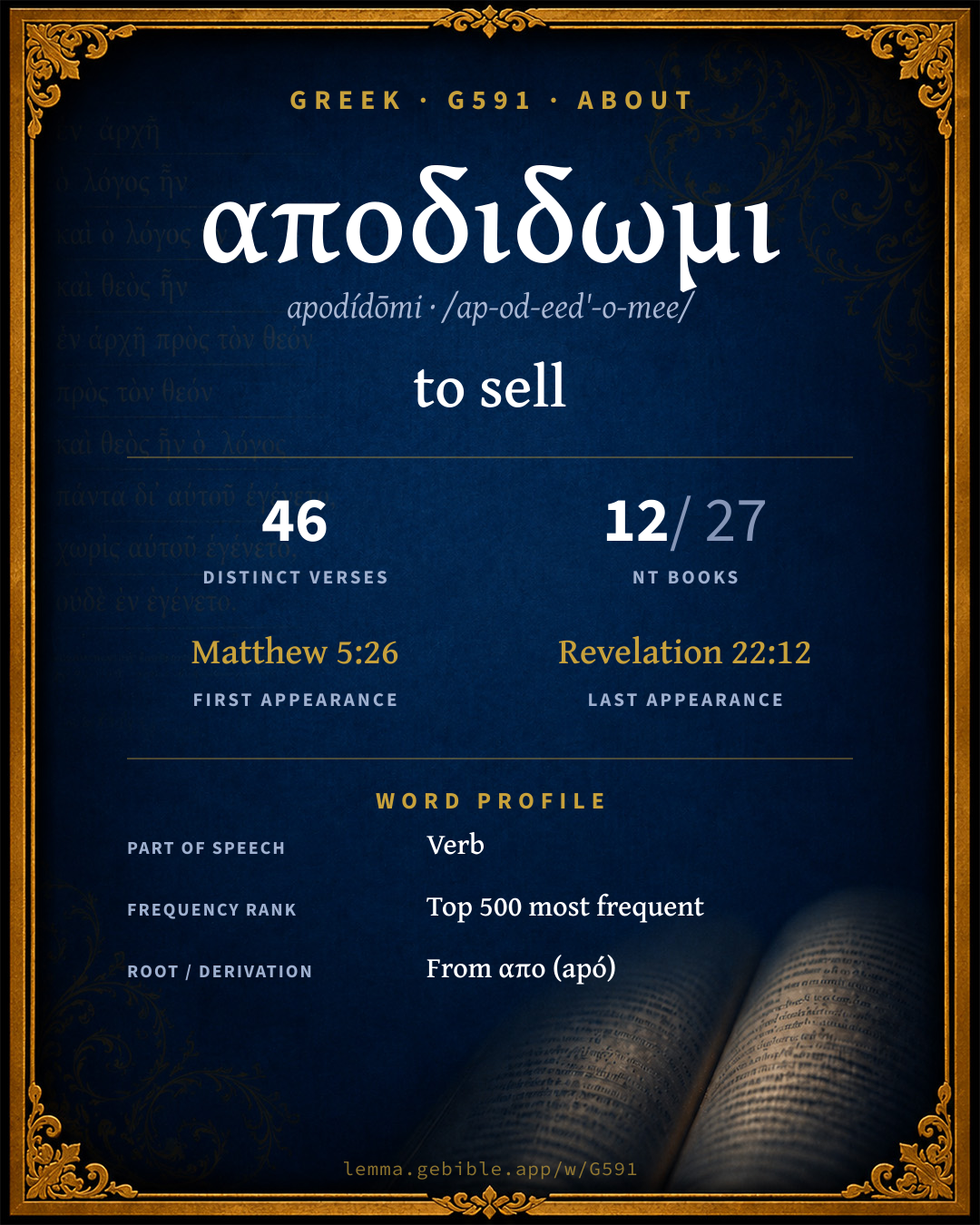
ἀποδίδωμι
to sell
‘to sell’ is one of 4 main senses fuller range ↓
Full lexicon entry — Thayer's Greek Lexicon
From Thayer's Greek Lexicon
Where this word appears
See every Future-tense verb in the Greek New Testament →
Grammar key — what these labels mean
Part of speech
- Verb
- An action or state-of-being word.
Tense
- Future
- Action expected in future time.
- Aorist
- Action viewed as a simple whole, without regard to duration — often past (perfective aspect).
- Present
- Ongoing or general action in present time (imperfective aspect).
- Imperfect
- Continuous or repeated action in past time (“was writing”).
Voice
- Active
- The subject performs the action.
- Passive
- The subject receives the action.
- Middle
- The subject acts on or for itself, or with special interest in the action.
Mood
- Indicative
- States a fact or asks a factual question (the mood of reality).
- Imperative
- Expresses a command or request.
- Infinitive
- A verbal noun (“to write”), unmarked for person or number.
- Subjunctive
- Expresses probability, purpose, or possibility (the mood of contingency).
- Participle
- A verbal adjective (“writing,” “having written”).
Case
- Nominative
- The case of the subject (and the predicate nominative).
- Accusative
- The case of the direct object and of extent.
Person
- 3rd person
- The one spoken about (“he / she / it / they”).
- 2nd person
- The one addressed (“you”).
- 1st person
- The speaker (“I / we”).
Gender
- Masculine
- Grammatically masculine.
Number
- Singular
- One.
- Plural
- More than one.
9 verses where G591 appears in the Future tense in the Book of Matthew. Filtered view — show all forms. Click any verse to open its interlinear word-by-word view. Verse text shown in the World English Bible for context — . Each verse’s Greek form is shown with its reference; the English is not keyword-highlighted, since the data carries no word-level English alignment. Use “Compare translations” on any verse to read it across multiple English versions. This concordance covers the Greek New Testament; Septuagint (Greek Old Testament) occurrences of this word are not indexed here.
Matthew
- Matthew 5:33 ἀποδώσεις fut act ind 2sg "Again you have heard that it was said to them of old time, 'You shall not make false vows, but shall perform to the Lord your vows,'
- Matthew 6:4 ἀποδώσει fut act ind 3sg so that your merciful deeds may be in secret, then your Father who sees in secret will reward you openly.
- Matthew 6:6 ἀποδώσει fut act ind 3sg But you, when you pray, enter into your inner chamber, and having shut your door, pray to your Father who is in secret, and your Father who sees in secret will reward you openly.
- Matthew 6:18 ἀποδώσει fut act ind 3sg so that you are not seen by men to be fasting, but by your Father who is in secret, and your Father, who sees in secret, will reward you.
- Matthew 12:36 ἀποδώσουσιν fut act ind 3pl I tell you that every idle word that men speak, they will give account of it in the day of judgment.
- Matthew 16:27 ἀποδώσει fut act ind 3sg For the Son of Man will come in the glory of his Father with his angels, and then he will render to everyone according to his deeds.
- Matthew 18:26 ἀποδώσω fut act ind 1sg The servant therefore fell down and kneeled before him, saying, 'Lord, have patience with me, and I will repay you all!'
- Matthew 18:29 ἀποδώσω fut act ind 1sg "So his fellow servant fell down at his feet and begged him, saying, 'Have patience with me, and I will repay you!'
- Matthew 21:41 ἀποδώσουσιν fut act ind 3pl They told him, "He will miserably destroy those miserable men, and will lease out the vineyard to other farmers, who will give him the fruit in its season."
About this entry
At a glance — auto-summarized from this page’s data, not written by a person. Every figure links to its source below. This summary describes the numbers; it doesn’t interpret them.
αποδιδωμι (apodídōmi) is a Greek verb most often rendered “to sell.” Ranging over 4 senses, it is not a single-sense word. With 46 verses in 12 books, it is a moderately common word in the Greek New Testament. It concentrates in Matthew, which alone accounts for 37% of its uses. It first appears in Matthew 5:26. For the data behind this summary, explore the sense tree and the renderings breakdown below.
Gloss history
Strong's 1890 vs modern scholarship
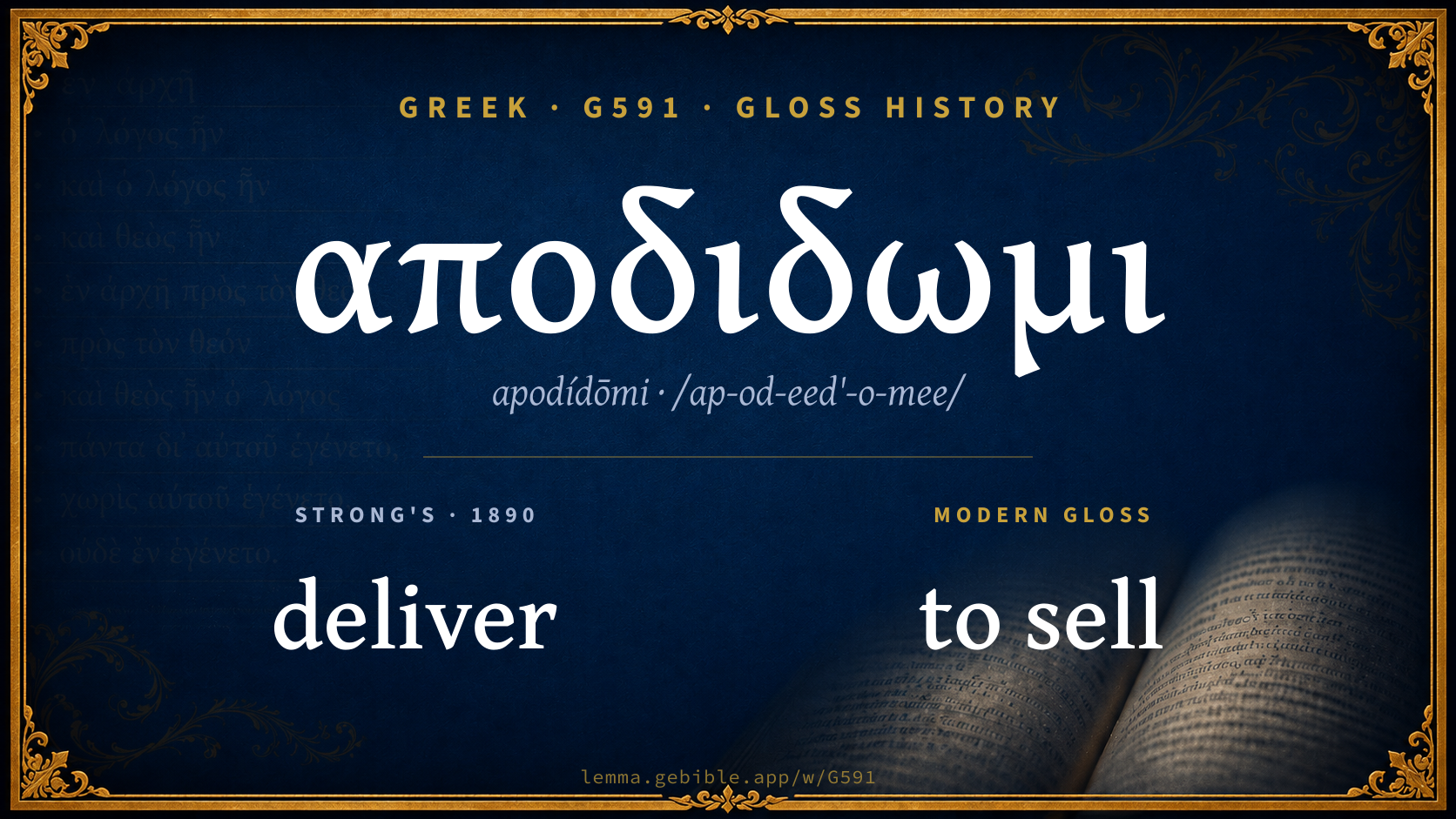
About this word
Strong's G591 catalogs a Greek word from the Greek New Testament.
These counts are not copied from any lexicon or concordance. They are computed here, from the morphology-tagged Greek New Testament. What Lemma adds →
- 46
- distinct verses
- The word appears in 46 distinct verses.
- 12 / 27
- NT books
- The word appears in 12 of 27 New Testament books.
- #322
- by frequency
- Top 500 most frequent Greek words (rank 322 of 5,347 Greek words by occurrence).
View all 46 occurrences in the concordance →
By section of the New Testament
By traditional corpus
Conventional, traditional groupings — biblical authorship is debated, so this is a traditional corpus grouping, not an authorship claim. Some books belong to more than one corpus (Luke is in both the Gospels and the Lukan corpus, and so on), so these shares overlap and need not total 100%. Each figure is a share of the word’s 46 distinct verses.
- Gospels 26 verses · 57%
- Lukan (Luke–Acts) 12 verses · 26%
- Pauline corpus 8 verses · 17%
- Johannine 3 verses · 7%
- Hebrews 3 verses · 7%
- Revelation 3 verses · 7%
- General (Catholic) Epistles 2 verses · 4%
How translations render this word
Counts come from each version’s own published word-to-Strong’s tagging or interlinear alignment — an approximate guide to how each version renders this word, not a word-level alignment the data otherwise carries. Because each total is that version’s own tagged count, the per-version totals vary from one another and need not match the appearance or distinct-verse counts above. These counts may also differ from a printed concordance because Lemma counts each distinctly tagged rendering and does not collapse phrase taggings into a single head-word total. This is a fixed set of word-tagged versions (KJV, ASV, BSB, ULT) and does not change with the reading translation you choose elsewhere. Each version’s license is shown beside its name below (and on Sources).
- King James Version: Render 6×, Give 4×, Pay 3×
- American Standard Version: Render 9×, Gave 3×, Pay 3×
- Berean Standard Bible: Give 4×, Pay 4×, Will repay 3×
- unfoldingWord Literal Text: Give back 4×, Give 3×, Repay 3×
King James Version Public Domain
Renders G591 across 49 tagged occurrences — most commonly:
Plus 21 renderings that appear only once — usually multi-word phrases or single function words the recovered tagging swept in, not distinct renderings. Not rendered by a distinct English word in 1 further occurrence.
American Standard Version Public Domain
Renders G591 across 49 tagged occurrences — most commonly:
Plus 19 renderings that appear only once — usually multi-word phrases or single function words the recovered tagging swept in, not distinct renderings.
Berean Standard Bible Public Domain
Renders G591 across 47 tagged occurrences — most commonly:
Plus 25 renderings that appear only once — usually multi-word phrases or single function words the recovered tagging swept in, not distinct renderings. Not rendered by a distinct English word in 1 further occurrence.
unfoldingWord Literal Text CC BY-SA 4.0
Renders G591 across 52 tagged occurrences — most commonly:
Plus 27 renderings that appear only once — usually multi-word phrases or single function words the recovered tagging swept in, not distinct renderings.
Senses in Thayer's
The 4 senses Thayer's distinguishes for this word, in lexicon order (not ranked by frequency or importance). The full entry — with sub-senses — is in the Lexicon Entry tab.
- to deliver, to give away for one's own profit what is one's own, to sell
- to pay off, discharge what is due
- to give back, restore
- to requite, recompense in a good or a bad sense
Word origin
Derived from απο (apó) (G575) — from.
Forms in the corpus
The 24 distinct written forms G591 takes in the Greek New Testament, most frequent first — each parse links to that tense’s occurrences in the concordance.
Same root — word family
Other Thayer's entries built from the same root as G591, grouped by Strong’s listed origin. These share a root / origin per the lexicon — not necessarily a shared meaning. Each links to that word’s own entry.
Derives from
Shares the same root
- απαγγελλω apangéllō G518 to report
- απαγχομαι apánchomai G519 to strangle
- απαγω apágō G520 to lead away
- απαιρω apaírō G522 to take away
- απαιτεω apaitéō G523 to demand back
- απαλγεω apalgéō G524 to cease grieving
- απαλλασσω apallássō G525 to depart
- απαλλοτριοω apallotrióō G526 to estrange
- απανταω apantáō G528 to meet
- απαρνεομαι aparnéomai G533 to deny
- απαρτι apárti G534 henceforth
- απαρχη aparchḗ G536 to offer firstfruits
- απαυγασμα apaúgasma G541 brightness
- απειδω apeídō G542 to look away
- απειμι ápeimi G548 to depart
- απειμι ápeimi G549 to depart
- απειπομην apeipómēn G550 to declare
- απεκδεχομαι apekdéchomai G553 waiting for
- απεκδυομαι apekdýomai G554 to despoil
- απελαυνω apelaúnō G556 to drive away
- απελεγμος apelegmós G557 censure
- απελευθερος apeleútheros G558 freedman
- απελπιζω apelpízō G560 not despairing
- απεναντι apénanti G561 opposite
+85 more words share this root (not shown).
Compare all same-root words → Showing 4 of 111 — not the complete family. They share a root, not necessarily a meaning.
Septuagint usage
The same Greek word αποδιδωμι appears 222 times in the Greek Old Testament (Septuagint), across 197 verses in 28 books.
- 222
- LXX occurrences
- Tagged occurrences of this Greek word in the Septuagint.
- 197
- verses
- Distinct Septuagint verses containing this word.
- 28 / 39
- OT books
- The word appears in 28 of the 39 Old Testament books.
Sample Septuagint occurrences
- Genesis 20:7 ἀποδίδωμι
- Exodus 5:18 ἀποδίδωμι
- Leviticus 5:23 ἀποδίδωμι
- Numbers 5:7 ἀποδίδωμι
- Deuteronomy 2:28 ἀποδίδωμι
- Judges 1:7 ἀποδίδωμι
- 1 Samuel 6:3 ἀποδίδωμι
- 2 Samuel 3:14 ἀποδίδωμι
- 1 Kings 2:44 ἀποδίδωμι
- 2 Kings 4:7 ἀποδίδωμι
- 2 Chronicles 6:23 ἀποδίδωμι
- Ezra 15:12 ἀποδίδωμι
Septuagint occurrences (same lexeme)
Every verse where the same Strong’s number (G591) appears in the Greek Septuagint — showing the first 50 of 197. Verse text shown in the World English Bible for context; the Greek form is the matched word — the English is not keyword-highlighted.
- Genesis 20:7 ἀποδίδωμι Now therefore, restore the man's wife. For he is a prophet, and he will pray for you, and you will live. If you don't restore her, know for sure that you will die, you, and all who are yours."
- Genesis 20:14 ἀποδίδωμι Abimelech took sheep and oxen, men-servants and women-servants, and gave them to Abraham, and restored Sarah, his wife to him.
- Genesis 25:31 ἀποδίδωμι Jacob said, "First, sell me your birthright."
- Genesis 25:33 ἀποδίδωμι Jacob said, "Swear to me first." He swore to him. He sold his birthright to Jacob.
- Genesis 29:21 ἀποδίδωμι Jacob said to Laban, "Give me my wife, for my days are fulfilled, that I may go in to her."
- Genesis 30:26 ἀποδίδωμι Give me my wives and my children for whom I have served you, and let me go: for you know my service with which I have served you."
- Genesis 37:22 ἀποδίδωμι Reuben said to them, "Shed no blood. Throw him into this pit that is in the wilderness, but lay no hand on him"-- that he might deliver him out of their hand, to restore him to his father.
- Genesis 37:27 ἀποδίδωμι Come, and let's sell him to the Ishmaelites, and not let our hand be on him; for he is our brother, our flesh." His brothers listened to him.
- Genesis 37:28 ἀποδίδωμι Midianites who were merchants passed by, and they drew and lifted up Joseph out of the pit, and sold Joseph to the Ishmaelites for twenty pieces of silver. They brought Joseph into Egypt.
- Genesis 37:36 ἀποδίδωμι The Midianites sold him into Egypt to Potiphar, an officer of Pharaoh's, the captain of the guard.
- Genesis 42:25 ἀποδίδωμι Then Joseph commanded to fill their bags with grain, and to restore every man's money into his sack, and to give them food for the way. So it done to them.
- Genesis 42:28 ἀποδίδωμι He said to his brothers, "My money is restored! Behold, it is even in my sack." Their hearts failed them, and they turned trembling one to another, saying, "What is this that God has done to us?"
- Genesis 42:34 ἀποδίδωμι Bring your youngest brother to me. Then I will know that you are not spies, but that you are honest men. So I will deliver your brother to you, and you shall trade in the land.'"
- Genesis 44:4 ἀποδίδωμι When they had gone out of the city, and were not yet far off, Joseph said to his steward, "Up, follow after the men. When you overtake them, ask them, 'Why have you rewarded evil for good?
- Genesis 45:4 ἀποδίδωμι Joseph said to his brothers, "Come near to me, please." They came near. "He said, I am Joseph, your brother, whom you sold into Egypt.
- Genesis 45:5 ἀποδίδωμι Now don't be grieved, nor angry with yourselves, that you sold me here, for God sent me before you to preserve life.
- Genesis 47:20 ἀποδίδωμι So Joseph bought all the land of Egypt for Pharaoh, for the Egyptians sold every man his field, because the famine was severe on them, and the land became Pharaoh's.
- Genesis 47:22 ἀποδίδωμι Only he didn't buy the land of the priests, for the priests had a portion from Pharaoh, and ate their portion which Pharaoh gave them. That is why they didn't sell their land.
- Genesis 50:15 ἀποδίδωμι When Joseph's brothers saw that their father was dead, they said, "It may be that Joseph will hate us, and will fully pay us back for all of the evil which we did to him.
- Exodus 5:18 ἀποδίδωμι Go therefore now, and work, for no straw shall be given to you, yet shall you deliver the same number of bricks!"
- Exodus 20:5 ἀποδίδωμι you shall not bow yourself down to them, nor serve them, for I, Yahweh your God, am a jealous God, visiting the iniquity of the fathers on the children, on the third and on the fourth generation of those who hate me,
- Exodus 21:7 ἀποδίδωμι "If a man sells his daughter to be a maid-servant, she shall not go out as the men-servants do.
- Exodus 21:17 ἀποδίδωμι "Anyone who curses his father or his mother shall surely be put to death.
- Exodus 21:35 ἀποδίδωμι "If one man's bull injures another's, so that it dies, then they shall sell the live bull, and divide its price; and they shall also divide the dead animal.
- Exodus 21:37 ἀποδίδωμι
- Exodus 22:25 ἀποδίδωμι "If you lend money to any of my people with you who is poor, you shall not be to him as a creditor; neither shall you charge him interest.
- Exodus 22:29 ἀποδίδωμι "You shall not delay to offer from your harvest and from the outflow of your presses. "You shall give the firstborn of your sons to me.
- Exodus 23:4 ἀποδίδωμι "If you meet your enemy's ox or his donkey going astray, you shall surely bring it back to him again.
- Leviticus 5:23 ἀποδίδωμι
- Leviticus 5:24 ἀποδίδωμι
- Leviticus 18:25 ἀποδίδωμι The land was defiled: therefore I punished its iniquity, and the land vomitted out her inhabitants.
- Leviticus 25:14 ἀποδίδωμι "'If you sell anything to your neighbor, or buy from your neighbor, you shall not wrong one another.
- Leviticus 25:15 ἀποδίδωμι According to the number of years after the Jubilee you shall buy from your neighbor. According to the number of years of the crops he shall sell to you.
- Leviticus 25:16 ἀποδίδωμι According to the length of the years you shall increase the price of it, and according to the shortness of the years you shall diminish the price of it; for he is selling the number of the crops to you.
- Leviticus 25:25 ἀποδίδωμι "'If your brother becomes poor, and sells some of his possessions, then his kinsman who is next to him shall come, and redeem that which his brother has sold.
- Leviticus 25:27 ἀποδίδωμι then let him reckon the years since the sale of it, and restore the surplus to the man to whom he sold it; and he shall return to his property.
- Leviticus 25:28 ἀποδίδωμι But if he isn't able to get it back for himself, then what he has sold shall remain in the hand of him who has bought it until the Year of Jubilee: and in the Jubilee it shall be released, and he shall return to his propery.
- Leviticus 25:29 ἀποδίδωμι "'If a man sells a dwelling house in a walled city, then he may redeem it within a whole year after it has been sold. For a full year he shall have the right of redemption.
- Leviticus 25:50 ἀποδίδωμι He shall reckon with him who bought him from the year that he sold himself to him to the Year of Jubilee: and the price of his sale shall be according to the number of years; according to the time of a hired servant shall he be with him.
- Leviticus 25:51 ἀποδίδωμι If there are yet many years, according to them he shall give back the price of his redemption out of the money that he was bought for.
- Leviticus 25:52 ἀποδίδωμι If there remain but a few years to the year of jubilee, then he shall reckon with him; according to his years of service he shall give back the price of his redemption.
- Leviticus 26:4 ἀποδίδωμι then I will give you your rains in their season, and the land shall yield its increase, and the trees of the field shall yield their fruit.
- Leviticus 26:26 ἀποδίδωμι When I break your staff of bread, ten women shall bake your bread in one oven, and they shall deliver your bread again by weight: and you shall eat, and not be satisfied.
- Leviticus 27:20 ἀποδίδωμι If he will not redeem the field, or if he has sold the field to another man, it shall not be redeemed any more;
- Leviticus 27:23 ἀποδίδωμι then the priest shall reckon to him the worth of your valuation up to the Year of Jubilee; and he shall give your valuation on that day, as a holy thing to Yahweh.
- Leviticus 27:24 ἀποδίδωμι In the Year of Jubilee the field shall return to him from whom it was bought, even to him to whom the possession of the land belongs.
- Leviticus 27:28 ἀποδίδωμι "'Notwithstanding, no devoted thing, that a man shall devote to Yahweh of all that he has, whether of man or animal, or of the field of his possession, shall be sold or redeemed: every devoted thing is most holy to Yahweh.
- Numbers 5:7 ἀποδίδωμι then he shall confess his sin which he has done, and he shall make restitution for his guilt in full, and add to it the fifth part of it, and give it to him in respect of whom he has been guilty.
- Numbers 5:8 ἀποδίδωμι But if the man has no kinsman to whom restitution may be made for the guilt, the restitution for guilt which is made to Yahweh shall be the priest's; besides the ram of the atonement, by which atonement shall be made for him.
- Numbers 8:13 ἀποδίδωμι You shall set the Levites before Aaron, and before his sons, and offer them as a wave offering to Yahweh.
These are occurrences of the same Greek lexeme (G591) in the Septuagint — not a translation of any one Hebrew word. The store carries no word-level Hebrew↔Greek alignment, so no Hebrew original is asserted here. Counts come from the recovered LXX Strong's tagging — high-frequency vocabulary is well covered, while rare or late forms may be untagged — so they reflect tagged occurrences and may slightly undercount.