Leviticus 25:15

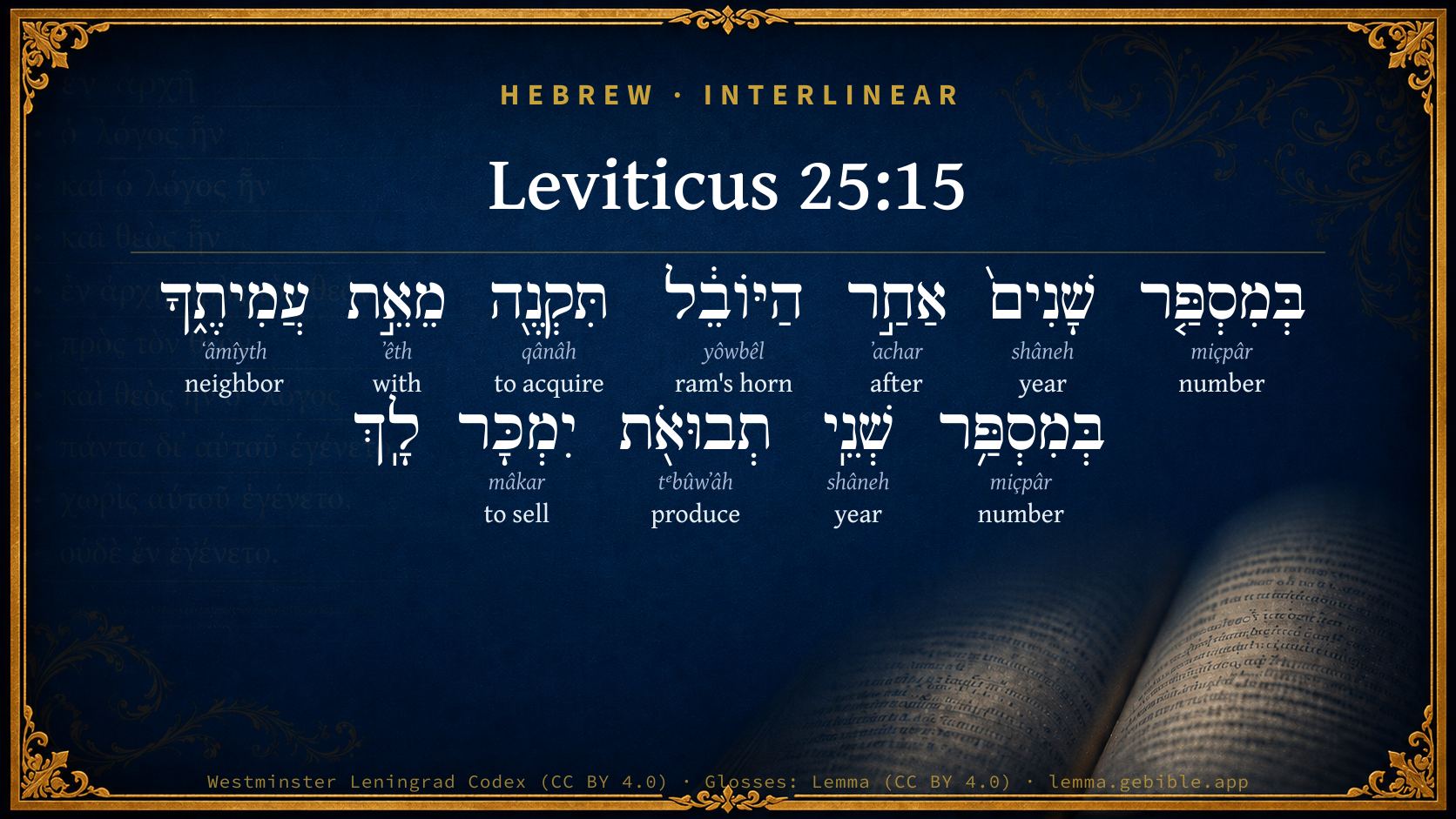
Hebrew (Westminster Leningrad Codex) Leviticus 25:15 appears in the Hebrew Old Testament. The text above is from the Westminster Leningrad Codex. Each word links to its Strong’s number, a concise gloss, and parsing drawn from the Open Scriptures Hebrew Bible morphology. Click any word for its full Brown-Driver-Briggs (BDB) entry.
Download image
Cite this verse

Leviticus 25:15 (World English Bible). Public Domain. Lemma interlinear Bible study tool, https://lemma.gebible.app/v/leviticus/25/15.

Show BibTeX & RIS
BibTeX
RIS
English Translation
According to the number of years after the Jubilee you shall buy from your neighbor. According to the number of years of the crops he shall sell to you.
World English Bible · Public Domain
Download a study sheet

One document with this verse’s original text, its word-by-word gloss line, the meaning frame, cross-references with their text, attributed commentary, and full source and license credits — printable, and it pastes into notes with its structure intact.

This verse Autodidact and up

Study sheet (.html) Plain text (.txt)

A passage Seminary Student

Up to 50 verses in one chapter. A passage sheet keeps up to 6 commentary sources and 12 cross-references per verse, in the order this page ranks them, and says so on the sheet whenever that leaves anything out. Ask for a single verse and you get the Autodidact verse sheet above.

Everything on this page stays free to read, with no account — the sheet is a download of what is already on screen, not access to it.

Want to remove ads? Support Godless Engineer
Compare translations 3

The same verse in 3 English versions, stacked beneath the original-language interlinear above. Click any original word for its lexicon entry.

Each is an independent rendering of the whole verse — the interlinear is not word-aligned to these translations.

Highlighted words mark where these versions differ — a whole-verse word diff, not a word-by-word alignment.

  • World English Bible Public Domain
    According to the number of years after the Jubilee you shall buy from your neighbor. According to the number of years of the crops he shall sell to you.
  • King James Version Public Domain
    According to the number of years after the jubilee thou shalt buy of thy neighbor, and according unto the number of years of the fruits he shall sell unto thee:
  • unfoldingWord Literal Text CC BY-SA 4.0
    According to the number of years after the Jubilee you shall buy from your fellow. According to the number of years of crops he shall sell to you.

unfoldingWord Literal Text — © unfoldingWord, licensed CC BY-SA 4.0. Word-aligned USFM3 via Door43 (git.door43.org/unfoldingWord/en_ult).

Versions to compare (up to 4)

3 of 4 selected

Show all 18 translations

Every available English version of this verse, each an independent rendering of the whole verse.

  • World English Bible Public Domain
    According to the number of years after the Jubilee you shall buy from your neighbor. According to the number of years of the crops he shall sell to you.
  • Berean Standard Bible Public Domain
    You are to buy from your neighbor according to the number of years since the last Jubilee; he is to sell to you according to the number of harvest years remaining.
  • Majority Standard Bible Public Domain
    You are to buy from your neighbor according to the number of years since the last Jubilee; he is to sell to you according to the number of harvest years remaining.
  • King James Version Public Domain
    According to the number of years after the jubilee thou shalt buy of thy neighbor, and according unto the number of years of the fruits he shall sell unto thee:
  • American Standard Version (1901) Public Domain
    According to the number of years after the jubilee thou shalt buy of thy neighbor, `and' according unto the number of years of the crops he shall sell unto thee.
  • Revised Version (1885) Public Domain
    according to the number of years after the jubile thou shalt buy of thy neighbour, and according unto the number of years of the crops he shall sell unto thee.
  • Geneva Bible (1599) Public Domain
    But according to the nomber of yeeres after the Iubile thou shalt bye of thy neighbour: also according to the nomber of the yeeres of the reuenues, he shall sell vnto thee.
  • Douay-Rheims (1899) Public Domain
    And he shall sell to thee according to the computation of the fruits.
  • Young's Literal Translation Public Domain
    by the number of years after the jubilee thou dost buy from thy fellow; by the number of the years of increase he doth sell to thee;
  • Literal Standard Version CC BY-SA 4.0
    you buy from your fellow by the number of years after the Jubilee; he sells to you by the number of the years of increase;
  • Unlocked Literal Bible CC BY-SA 4.0
    If you buy land from your neighbor, consider the number of years and crops that can be harvested until the next Jubilee. Your neighbor selling the land must consider that also.
  • unfoldingWord Literal Text CC BY-SA 4.0
    According to the number of years after the Jubilee you shall buy from your fellow. According to the number of years of crops he shall sell to you.
  • Darby Bible Public Domain
    According to the number of years since the jubilee, thou shalt buy of thy neighbour; according to the number of years of the produce, he shall sell unto thee.
  • World Messianic Bible Public Domain
    According to the number of years after the Jubilee you shall buy from your neighbor. According to the number of years of the crops he shall sell to you.
  • Webster's Bible Public Domain
    According to the number of years after the jubilee thou shalt buy of thy neighbor, and according to the number of years of the fruits he shall sell to thee:
  • Free Bible Version CC BY-SA 4.0
    When you buy from your neighbor work out how many years have passed since the last Jubilee, for he is to sell to you depending on how many years of harvest remain.
  • Bible in Basic English Public Domain
    Let your exchange of goods with your neighbours have relation to the number of years after the year of Jubilee, and the number of times the earth has given her produce.
  • JPS Tanakh (1917) Public Domain
    According to the number of years after the jubilee thou shalt buy of thy neighbour, and according unto the number of years of the crops he shall sell unto thee.

Literal Standard Version (2020), Covenant Press — licensed CC BY-SA 4.0. Text via the HelloAO Bible API (eBible.org). Unlocked Literal Bible (unfoldingWord) — licensed CC BY-SA 4.0. Text via the HelloAO Bible API (eBible.org). unfoldingWord Literal Text — © unfoldingWord, licensed CC BY-SA 4.0. Word-aligned USFM3 via Door43 (git.door43.org/unfoldingWord/en_ult). Free Bible Version, Dr. Jonathan Gallagher — licensed CC BY-SA 4.0. Text via the HelloAO Bible API (eBible.org).

Word by word

More ways to search: Search by grammar → Find every occurrence → Compare this word →

Practice this passage: Drill this verse → Learn its vocabulary →

עֲמִיתֶ֑ךָ
ʻâmîyth
H5997
“neighbor · your”
Noun, Common, Masculine, Singular, Construct + Suffix, Personal, 2nd Person, Masculine, Singular
Part of Speech
Noun
Type
Common
Gender
Masculine
Number
Singular
State
Construct
Full BDB Definition

Origin: from a primitive root meaning to associate

TWOT: 1638a

relation, neighbour, associate, fellow
  1. בְּמִסְפַּ֤ר miçpâr H4557 “in/at · number of” Preposition + Noun, Common, Masculine, Singular, Construct
  2. שָׁנִים֙ shâneh H8141 “years” Noun, Common, Feminine, Plural, Absolute
  3. אַחַ֣ר ʼachar H310 “after” Preposition
  4. הַיּוֹבֵ֔ל yôwbêl H3104 “the · ram's horn” Particle, Definite Article + Noun, Common, Masculine, Singular, Absolute
  5. תִּקְנֶ֖ה qânâh H7069 “to acquire” Verb, Qal, Imperfect, 2nd Person, Masculine, Singular
  6. מֵאֵ֣ת ʼêth H854 “from · with” Preposition + Preposition
  7. בְּמִסְפַּ֥ר miçpâr H4557 “in/at · number of” Preposition + Noun, Common, Masculine, Singular, Construct
  8. שְׁנֵֽי shâneh H8141 “year” Adjective, Cardinal number, Masculine, Dual, Construct
  9. תְבוּאֹ֖ת tᵉbûwʼâh H8393 “produce” Noun, Common, Feminine, Plural, Absolute
  10. יִמְכָּר mâkar H4376 “to sell” Verb, Qal, Imperfect, 3rd Person, Masculine, Singular

About this verse

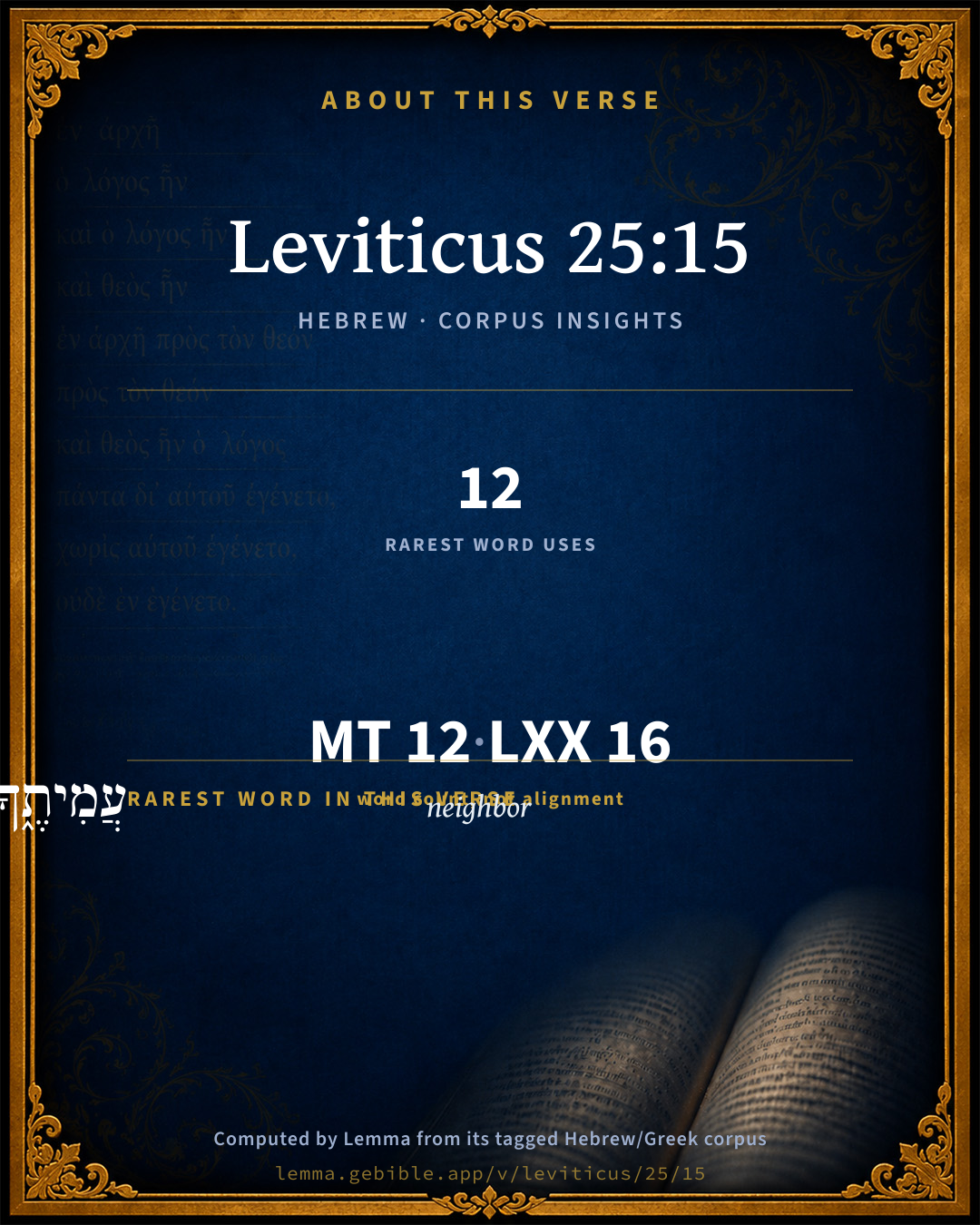
These counts appear in no published source. They are computed here, from the morphology-tagged text and Lemma’s own curated glosses. What Lemma adds →

12
words
9
distinct lemmas
Pentateuch
section

Notable vocabulary

The rarest word here is עֲמִיתֶ֑ךָ neighbor H5997 — appearing just 12 times in the whole Hebrew Bible.

Shared distinctive vocabulary

עֲמִיתֶ֑ךָ neighbor H5997 occurs in 10 verses of the Hebrew Bible. Also found in:

Grammatical profile

  • 2 verbs
  • 6 nouns
  • 1 adjective
  • 3 prepositions

Verb forms

  • תִּקְנֶ֖ה Qal · Imperfect
  • יִמְכָּר Qal · Imperfect

Repetition

Words recur within this verse — often emphatic in Hebrew:

  • בְּמִסְפַּ֤ר number H4557 ×2
  • שָׁנִים֙ year H8141 ×2

Hebrew & Septuagint length

In English translation the verse runs 29 words from the Hebrew and 29 from the Septuagint (LXX English) — the same length.

A rough comparison of the two English renderings, which tokenize alike — not a word-level alignment.

Word counts can differ between the Hebrew and the Greek without any difference in meaning — e.g. the Hebrew direct-object marker אֵת has no separate Greek word, and Greek often adds the article ὁ.

In the original languages it is 12 Hebrew tokens and 16 Greek tokens — but the two are counted differently (Hebrew bundles its prefixes and suffixes into one token; the Greek is in lemma form), so that isn’t a like-for-like length.

Cross-references

2

Topical passages linked to Leviticus 25:15 in the Treasury of Scripture Knowledge — connected by theme and wording, ordered by reader-vote popularity; previews shown in the World English Bible.

  • Leviticus 27:18–23 But if he dedicates his field after the Jubilee, then the priest shall reckon to him the money according to the years that remain to the Year of Jubilee; and an abatement shall be made from your valuation.
  • Philippians 4:5 Let your gentleness be known to all men. The Lord is at hand.

Cross-references courtesy of OpenBible.info (CC BY 4.0).

Hebrew and Greek witnesses Masoretic Hebrew ↔ Greek Septuagint

The same verse in the two great witnesses to the Old Testament, shown verse-for-verse.

These are two independent witnesses, not word-aligned to each other, and the Septuagint is shown in lemma (dictionary) form.

Hebrew Leviticus 25:15 Masoretic · Westminster Leningrad Codex

בְּמִסְפַּ֤ר שָׁנִים֙ אַחַ֣ר הַיּוֹבֵ֔ל תִּקְנֶ֖ה מֵאֵ֣ת עֲמִיתֶ֑ךָ בְּמִסְפַּ֥ר שְׁנֵֽי תְבוּאֹ֖ת יִמְכָּר לָֽךְ

According to the number of years after the Jubilee you shall buy from your neighbor. According to the number of years of the crops he shall sell to you.

World English Bible · Public Domain

Greek LXX Leviticus 25:15 Septuagint · lemma form

κατά ἀριθμός ἔτος μετά ὁ σημασία κτάομαι παρά ὁ πλησίον κατά ἀριθμός ἐνιαυτός γένημα ἀποδίδωμι σύ

According to the number of years after the jubilee shall you buy of your neighbor, according to the number of years of the fruits shall he sell to you.

LXX2012 (modern English Septuagint) · Public Domain

Hebrew: Westminster Leningrad Codex (CC BY 4.0). Greek: Septuagint (public domain); English from LXX2012 (modern English Septuagint) (Public Domain). How the Septuagint differs from the Hebrew →

Targum (Aramaic paraphrase)

2

The Targum is the ancient Jewish Aramaic paraphrase of the Hebrew Scriptures — an interpretive translation, not the Hebrew text itself. Onkelos (literal) and Pseudo-Jonathan (expansive) render the Torah, and Jonathan the Prophets. Coverage is partial: where no permissively-licensed English translation exists for a verse, only the Aramaic is shown. This is verse-level text, not a word-by-word alignment to the Hebrew.

  1. Targum Onkelos Torah (Genesis–Deuteronomy)
    בְּמִנְיַן שְׁנַיָא בָּתַר יוֹבֵלָא תִּזְבֵּן מִן חַבְרָךְ בְּמִנְיַן שְׁנֵי עֲלַלְתָּא יְזַבֶּן לָךְ

    (no public-domain English translation for this verse)

    Targum Onkelos — Aramaic: “Onkelos Genesis” (public domain); “Onkelos Exodus” (public domain); “Onkelos Leviticus” (public domain); “Onkelos Numbers” (public domain); “Onkelos Deuteronomy” (public domain). English: “Sefaria Community Translation” (CC0 1.0 (public-domain dedication)); “J.W. Etheridge. The Targums of Onkelos and Jonathan Ben Uzziel on the Pentateuch. London: Longmans, Green, 1862” (public domain). Text via Sefaria.

  2. Targum Pseudo-Jonathan Torah (Genesis–Deuteronomy)
    עַמִי בְּנֵי יִשְרָאֵל אִין אַתּוּן זַבְנִין חֲקִיל אוֹ כַרְמָא בְּמִנְיַן סְכוֹם שְׁנַייָא בָּתַר יוּבְלָא תִּזְבְּנוּן מִן חַבְרֵיכוֹן כְּמִנְיַין שְׁנַיָיא דִכְנִישׁוּת עֲלַלְתָּא יְזַבְּנוּן לְכוֹן

    Sons of Israel, My people, if you sell a field or a vineyard, according to the sum of the number of years after the Jubela you shall buy of your neighbour; according to the number of years for gathering the produce they shall sell it to you;

    Targum Pseudo-Jonathan — Aramaic: “Targum Jonathan on Genesis” (public domain); “Targum Jonathan on Exodus” (public domain); “Targum Jonathan on Leviticus” (public domain); “Targum Jonathan on Numbers” (public domain); “Targum Jonathan on Deuteronomy” (public domain). English: “The Targum of Jonathan ben Uzziel, trans. J. W. Etheridge, London, 1862” (public domain). Text via Sefaria.

Commentary

Notes on Leviticus 25:15 from classic Christian and Jewish commentators (each source and its license shown beneath its notes). The classic Christian expositions comment on the surrounding passage and are grouped to its opening verse, so a note may address several verses; the Jewish commentaries on the Tanakh (Rashi and others) are per-verse, so they appear only where the commentator wrote on this verse.

Lemma curates 59 commentaries, every one of them public domain or Creative Commons licensed, each selected and text-cleaned for this edition rather than reprinted as found. About our sources →

Trapp's Complete Commentary

John Trapp

Lev 25:15 According to the number of years after the jubile thou shalt buy of thy neighbour, [and] according unto the number of years of the fruits he shall sell unto thee:

Ver. 15. Years of the fruits.] The land was not properly sold, but the fruits and revenues thereof.

John Trapp, A Commentary or Exposition upon All the Books of the Old and New Testament (1647–1656) — public domain. Text from a community e-Sword module.

Joseph Benson's Commentary

Lev 25:15. According to the number of years — thou shalt buy — The purchase of all lands, houses, or estates, was to be at a price proportionable to the greater or less number of years that remained from the time of the purchase to the next jubilee. Years of fruits — Years in which, having sowed, they reaped the fruits of the land, in opposition to those years in which they were neither allowed to sow nor reap.

Joseph Benson's Commentary on the Old and New Testaments (1811–1818) — public domain. Text from a community e-Sword module.

Tyndale Open Study Notes

Tyndale Open Resources

25:15-16 the number of years: The law did not allow the land to be sold in perpetuity. It was God’s, and Israel was simply permitted to use it (25:23). However, if the owner was forced to give it up due to financial distress, it could be leased for up to forty-nine years (until the next jubilee). The price was adjusted according to the length of the lease. At the end of that time, the land was to revert to the family of the original owner.

Tyndale Open Study Notes — © Tyndale Open Resources, licensed CC BY-SA 4.0. Text via the HelloAO Bible API.

Geneva Bible (1599)

Geneva Bible translators

If the Jubilee to come be near, thou shalt sell better cheap: if it be far off, dearer.

Geneva Bible (1599) marginal notes — public domain. Text via Bolls.life.

Adam Clarke's Commentary

Verse 15. According to the number of years] The purchases that were to be made of lands were to be regulated by the number of years unelapsed of the current jubilee. This was something like buying the unexpired term of a lease among us; the purchase is always regulated by the number of years between the time of purchase and the expiration of the term.

Adam Clarke's Commentary on the Bible (1810–1826) — public domain. Text from a community e-Sword/MySword module.

Ellicott's Commentary for English Readers

(15) According to the number of years . . . thou shalt buy.—The promised land, according to the Law, was to be divided by lot in equal parts among the Israelites. The plot which should thus come into the possession of each family is to be absolutely inalienable, and for ever continue to be the property of the descendants of the original possessor. Hence it is here enacted that where a proprietor being pressed by poverty is compelled to sell a field, it could not be bought of him for a longer period than up to the time of the next jubile, when it reverted to the original possessor, or to his family. In purchasing a plot of and the purchaser is to reckon how many years had elapsed since the last jubile, since this would show him the exact period during which he would be entitled to hold it. It thus corresponds to what with us is buying the unexpired term of a lease.

Of thy neighbour.—From this it was deduced that the Israelite who was reduced to poverty could only sell his land to a fellow-Israelite, but not to a Gentile.

The number of years of the fruit he shall sell.—Whilst the purchaser is to take into consideration the number of years which the lease has still to run, the vendor has to consider how many sabbatical years there will be from the time of the sale till next jubile, since the sale was not so much of the land as of the produce of so many years. Hence the fallow sabbatical years are not to be included. As the plural “number of years “is here used, the authorities during the second Temple concluded that the vendor could not sell it for less than two productive years, exclusive of a sabbatical year, a year of barrenness, and of the first harvest if the purchase was effected shortly before the seventh month, with the ripe produce in the field.

A Bible Commentary for English Readers, edited by Charles John Ellicott (1878–1897) — public domain. Text from a community e-Sword module.

The Cambridge Bible for Schools and Colleges

gen. ed. J. J. S. Perowne

15, 16. The purchase is in fact not of the soil, but of the expectation of a greater or less number of years’ fruits.

The Cambridge Bible for Schools and Colleges (gen. ed. J. J. S. Perowne; Cambridge University Press, 1878–1918) — public domain. Text from a community e-Sword module.

John Gill's Exposition

According to the number of years after the jubilee thou shalt buy of thy neighbour,.... That is, reckoning how many years had past since the last jubilee, and how many there were to come to the next, and so give as many years' purchase as were yet to come:

and according to the number of years of the fruits he shall sell unto thee; only care was to be taken, that as many years as were sabbatical ones, which were not years of fruit, should be deducted out of the account by the seller; since these were years the buyer could have no profit by the estate, and therefore it was not reasonable that such years should be reckoned into the purchase; and hence the Jewish writers gather, that when a man had sold his field, he could not redeem it in less than two years, because a number of years cannot be less than two, and that if even the buyer agreed to it, it might not be done (b).

(b) Misn. Eracin, c. 9. sect. 1. Maimon. & Bartenora in. ib.

John Gill's Exposition of the Whole Bible (1746–1763) — public domain (CC PDM 1.0). Text via the HelloAO Bible API.

Albert Barnes' Notes on the Bible

The number of years of the fruits - i. e. according to the number of harvests. The average value of a yearly crop might of course be estimated, and the sabbatical years were to be deducted from the series.

Albert Barnes' Notes on the Bible (1834–1885) — public domain. Text from a community e-Sword/MySword module.

Matthew Poole's English Annotations

Or,

of years of fruits, or, of fruitful years; for there were some unfruitful years, to wit, such wherein they were not allowed to sow or reap, &c.

Matthew Poole's English Annotations on the Holy Bible (1683–1685) — public domain. Text from a community e-Sword/MySword module.

Whedon's Commentary on the Bible

Daniel D. Whedon

15. The number of years of the fruits — The price of the usufruct of the land, not of the fee simple, was calculated on the years of tillage, exclusive of the years of rest, which would deprive the purchaser of a number of crops before the jubilee. Josephus describes the terms on which the buyer resigned the field in the year of jubilee to the original proprietor. The former produced a statement of the value of the crops and of his expenses. If the expenses exceeded in value the income, the balance was paid by the proprietor before the field was restored. But if the balance was on the other side, the proprietor simply took back the field, and the purchaser retained the profit. This arrangement would remove the objection to permanent improvements on the part of the purchaser, while it kept estates from deterioration.

Daniel D. Whedon (gen. ed.), Commentary on the Old and New Testaments (1874–1909) — public domain. Text from a community e-Sword module.

John Wesley's Explanatory Notes

Years of fruits - Or, fruitful years; for there were some unfruitful years; those wherein they were not allowed to sow or reap.

John Wesley, Explanatory Notes Upon the Whole Bible (1754–1765) — public domain. Text via the GEBible commentary corpus.

unfoldingWord translationNotes

Door43 World Missions Community

General Information:

God continues telling Moses what the people must do.

that can be harvested

This can be stated in active form. AT: "that you can harvest" (See: Active or Passive)

the next Jubilee

"the next year of restoration" or "the next year to return land"

translationWords

neighbor

wrong

honor

God

Yahweh

unfoldingWord translationNotes — © Distant Shores Media and the Door43 World Missions Community, licensed CC BY-SA 4.0. Source: git.door43.org/Door43/en_tn.

Rashi

Rabbi Shlomo Yitzchaki (Rashi)

במספר שנים אחר היובל תקנה ACCORDING TO THE NUMBER OF YEARS AFTER THE JUBILEE THOU SHALT BUY [OF THY COMPANION] — This (the following) is the literal sense fitting in the clauses of the verse as required by the context: Scripture intends here to warn against wronging prohibited in the preceding verse: When you sell or buy landed property take into account how many years there are until the Jubilee, and according to the years and the crops of the field which it can be expected to yield shall the vendor sell and the purchaser buy, for in the end he (the purchaser) will have to return it to him (to the vendor) in the Jubilee-year. Consequently if there are only a few years until the Jubilee and this man sells it at a high price it follows that the purchaser has been overreached. If, on the other hand, there are still many years until the Jubilee so that he eats from it many crops the seller is overreached if you give him only a low price. It must therefore be purchased according to the period remaining until the Jubilee. That is what Scripture means when it states: “According to the number of the years of the fruits he shall sell unto,"thee," i. e. according to the number of years of crops that it (the field) will remain in the hand of the purchaser you shall sell it to him. Our Rabbis, however, derived from here the law that one who sells his field has no right to repurchase it before the elapse of at least two years, — that it must remain in the possession of the purchaser two full years reckoning from date to date, and even though there may be three crops in these two years, as, for instance, if he sold it when it had its corn standing. And in this interpretation the word שני does not lose its literal meaning, viz., that of years, (the words שני תבואות are not taken in this interpretation to mean “two crops” as you might at first think) — the phrase means מספר שנים של תבואות the number of years of crops (i. e. שני is the construct of שנים) and not of years when the corn is smitten by blast, and you know that the minimum number implied in the plural שנים is two (this is how the Rabbis derived the law that the vendor must leave the field at least two years in possession of the purchaser) (Arakhin 29b).

Rashi on the Tanakh — English translations: “The Judaica Press complete Tanach with Rashi, translated by A. J. Rosenberg” (CC BY 4.0); “Pentateuch with Rashi's commentary by M. Rosenbaum and A.M. Silbermann, 1929-1934” (public domain); “The Metsudah Tanach series, Lakewood, N.J” (CC BY 4.0); and “The Book of Joshua, Metsudah Publications, 1997” (CC BY 4.0). Text via Sefaria.

Lesson kit

Teaching starters — assembled from the data on this page, not authored interpretation. Every prompt links to the verse data it draws on. Edit before teaching.

Leviticus, in the Pentateuch, opens this verse with 12 words (9 distinct Hebrew lemmas). Its most distinctive word is ʻâmîyth (“neighbor”). A historical commentator’s framing appears above. Read the whole chapter for the surrounding context.

Discussion questions

  1. How does “neighbor” (ʻâmîyth) shape what this verse is saying?
  2. How does Leviticus 6:2, which shares the word «neighbor», read alongside this verse?
  3. What does the repetition of “number” (2× in this one verse) do in this verse?
  4. These translations render this verse differently. What is at stake in choosing one wording over another?
  5. «תִּקְנֶ֖ה» is a Qal Imperfect verb. How does that grammatical form shape the action described?
  6. Compare how Trapp's Complete Commentary and Joseph Benson's Commentary read this verse. Where do they agree or differ?

Things to notice

Reading settings

Reading text

Shown beneath each verse's original-language words.

Old Testament
Old Testament edition

Read the OT as the Masoretic Hebrew (MT) or the Greek Septuagint (LXX).

English shown for the Greek Septuagint (in the Hebrew ↔ Greek comparison).

Comparing translations? Open the Compare panel on any verse page to stack up to four side by side.