Numbers 8:13

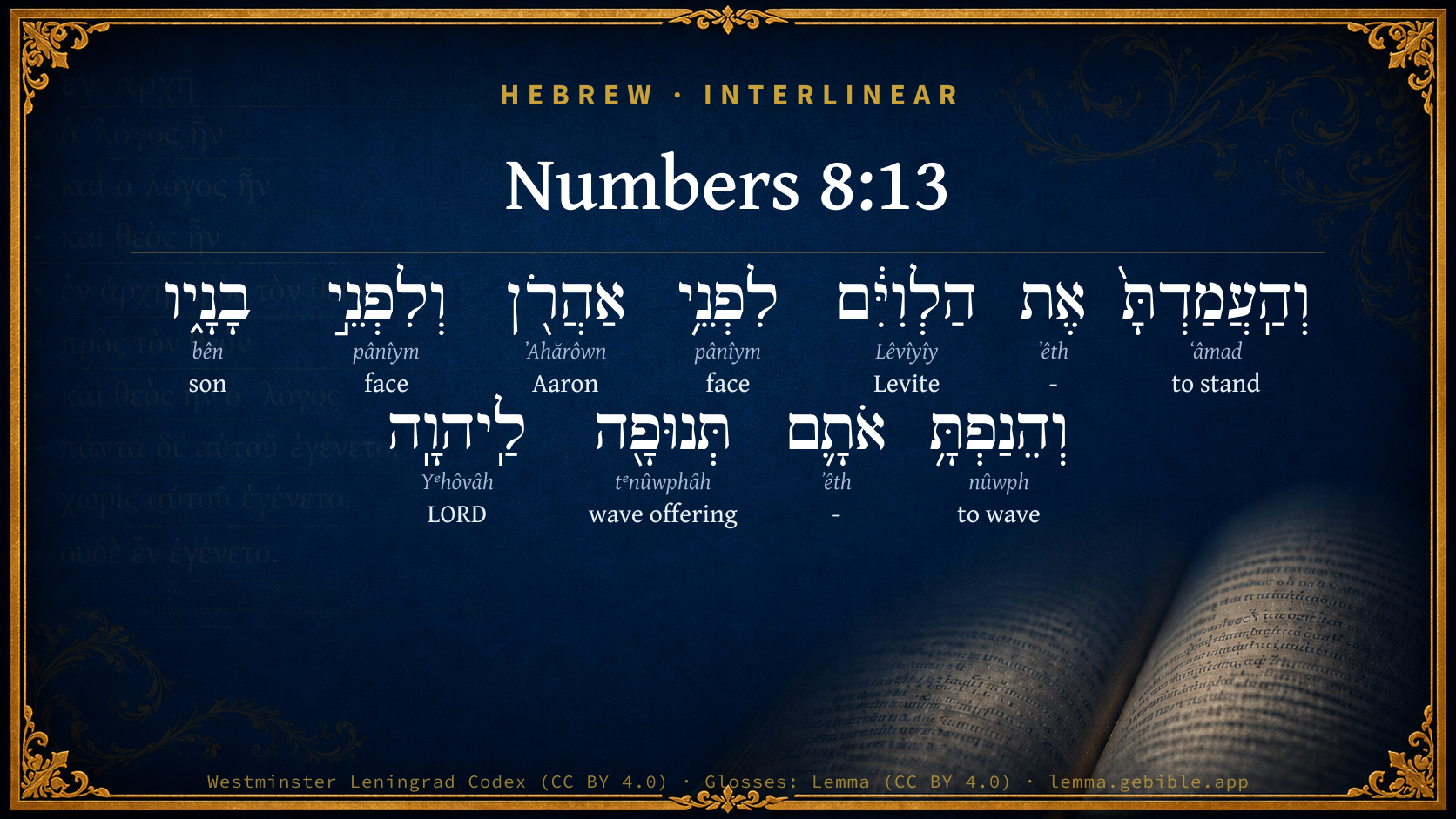
Hebrew (Westminster Leningrad Codex) Numbers 8:13 appears in the Hebrew Old Testament. The text above is from the Westminster Leningrad Codex. Each word links to its Strong’s number, a concise gloss, and parsing drawn from the Open Scriptures Hebrew Bible morphology. Click any word for its full Brown-Driver-Briggs (BDB) entry.
Download image
Cite this verse

Numbers 8:13 (World English Bible). Public Domain. Lemma interlinear Bible study tool, https://lemma.gebible.app/v/numbers/8/13.

Show BibTeX & RIS
BibTeX
RIS
English Translation
You shall set the Levites before Aaron, and before his sons, and offer them as a wave offering to Yahweh.
World English Bible · Public Domain
Download a study sheet

One document with this verse’s original text, its word-by-word gloss line, the meaning frame, cross-references with their text, attributed commentary, and full source and license credits — printable, and it pastes into notes with its structure intact.

This verse Autodidact and up

Study sheet (.html) Plain text (.txt)

A passage Seminary Student

Up to 50 verses in one chapter. A passage sheet keeps up to 6 commentary sources and 12 cross-references per verse, in the order this page ranks them, and says so on the sheet whenever that leaves anything out. Ask for a single verse and you get the Autodidact verse sheet above.

Everything on this page stays free to read, with no account — the sheet is a download of what is already on screen, not access to it.

Want to remove ads? Support Godless Engineer
Compare translations 3

The same verse in 3 English versions, stacked beneath the original-language interlinear above. Click any original word for its lexicon entry.

Each is an independent rendering of the whole verse — the interlinear is not word-aligned to these translations.

Highlighted words mark where these versions differ — a whole-verse word diff, not a word-by-word alignment.

  • World English Bible Public Domain
    You shall set the Levites before Aaron, and before his sons, and offer them as a wave offering to Yahweh.
  • King James Version Public Domain
    And thou shalt set the Levites before Aaron, and before his sons, and offer them for an offering unto the LORD.
  • unfoldingWord Literal Text CC BY-SA 4.0
    And you shall stand the Levites to the face of Aaron and to the face of his sons, and you shall raise them a raised offering to Yahweh.

unfoldingWord Literal Text — © unfoldingWord, licensed CC BY-SA 4.0. Word-aligned USFM3 via Door43 (git.door43.org/unfoldingWord/en_ult).

Versions to compare (up to 4)

3 of 4 selected

Show all 18 translations

Every available English version of this verse, each an independent rendering of the whole verse.

  • World English Bible Public Domain
    You shall set the Levites before Aaron, and before his sons, and offer them as a wave offering to Yahweh.
  • Berean Standard Bible Public Domain
    You are to have the Levites stand before Aaron and his sons and then present them before the LORD as a wave offering.
  • Majority Standard Bible Public Domain
    You are to have the Levites stand before Aaron and his sons and then present them before the LORD as a wave offering.
  • King James Version Public Domain
    And thou shalt set the Levites before Aaron, and before his sons, and offer them for an offering unto the LORD.
  • American Standard Version (1901) Public Domain
    And thou shalt set the Levites before Aaron, and before his sons, and offer them for a wave-offering unto Jehovah.
  • Revised Version (1885) Public Domain
    And thou shalt set the Levites before Aaron, and before his sons, and offer them for a wave offering unto the LORD.
  • Geneva Bible (1599) Public Domain
    And thou shalt set the Leuites before Aaron and before his sonnes, and offer the as a shake offring to the Lord.
  • Douay-Rheims (1899) Public Domain
    And thou shalt set the Levites in the sight of Aaron and of his sons, and shalt consecrate them being offered to the Lord,
  • Young's Literal Translation Public Domain
    and thou hast caused the Levites to stand before Aaron, and before his sons, and hast waved them -- a wave-offering to Jehovah;
  • Literal Standard Version CC BY-SA 4.0
    And you have caused the Levites to stand before Aaron, and before his sons, and have waved them [as] a wave-offering to YHWH;
  • Unlocked Literal Bible CC BY-SA 4.0
    Present the Levites before Aaron and before his sons, and lift them up as a wave offering to me.
  • unfoldingWord Literal Text CC BY-SA 4.0
    And you shall stand the Levites to the face of Aaron and to the face of his sons, and you shall raise them a raised offering to Yahweh.
  • Darby Bible Public Domain
    And thou shalt set the Levites before Aaron, and before his sons, and offer them as a wave-offering to Jehovah.
  • World Messianic Bible Public Domain
    You shall set the Levites before Aaron and before his sons, and offer them as a wave offering to the LORD.
  • Webster's Bible Public Domain
    And thou shalt set the Levites before Aaron, and before his sons, and offer them for an offering to the LORD.
  • Free Bible Version CC BY-SA 4.0
    Have the Levites stand in front of Aaron and his sons and present them to the Lord as a wave offering.
  • Bible in Basic English Public Domain
    Then the Levites are to be put before Aaron and his sons, to be offered as a wave offering to the Lord.
  • JPS Tanakh (1917) Public Domain
    And thou shalt set the Levites before Aaron, and before his sons, and offer them for a wave-offering unto the LORD.

Literal Standard Version (2020), Covenant Press — licensed CC BY-SA 4.0. Text via the HelloAO Bible API (eBible.org). Unlocked Literal Bible (unfoldingWord) — licensed CC BY-SA 4.0. Text via the HelloAO Bible API (eBible.org). unfoldingWord Literal Text — © unfoldingWord, licensed CC BY-SA 4.0. Word-aligned USFM3 via Door43 (git.door43.org/unfoldingWord/en_ult). Free Bible Version, Dr. Jonathan Gallagher — licensed CC BY-SA 4.0. Text via the HelloAO Bible API (eBible.org).

Word by word

More ways to search: Search by grammar → Find every occurrence → Compare this word →

Practice this passage: Drill this verse → Learn its vocabulary →

תְּנוּפָ֖ה
tᵉnûwphâh
H8573
“wave offering”
Noun, Common, Feminine, Singular, Absolute
Part of Speech
Noun
Type
Common
Gender
Feminine
Number
Singular
State
Absolute
Full BDB Definition

Origin: from H5130

TWOT: 1330b

swinging, waving, wave offering, offering - a swinging, brandishing - of God's hand, weapons - waving, wave-offering (technical term of sacrifice) - offering (of gold or brass)
  1. וְהַֽעֲמַדְתָּ֙ ʻâmad H5975 “and · to stand” Conjunction + Verb, Hiphil, Sequential Perfect, 2nd Person, Masculine, Singular
  2. אֶת ʼêth H853 “-” Particle, Direct Object
  3. הַלְוִיִּ֔ם Lêvîyîy H3881 “the · Levites” Particle, Definite Article + Noun, Gentilic, Masculine, Plural, Absolute
  4. לִפְנֵ֥י pânîym H6440 “to/for · face(s) of” Preposition + Noun, Common, Both, Plural, Construct
  5. אַהֲרֹ֖ן ʼAhărôwn H175 “Aaron” Noun, Proper
  6. וְלִפְנֵ֣י pânîym H6440 “and · to/for · face(s) of” Conjunction + Preposition + Noun, Common, Both, Plural, Construct
  7. בָנָ֑יו bên H1121 “sons · his” Noun, Common, Masculine, Plural, Construct + Suffix, Personal, 3rd Person, Masculine, Singular
  8. וְהֵנַפְתָּ֥ nûwph H5130 “and · to wave” Conjunction + Verb, Hiphil, Sequential Perfect, 2nd Person, Masculine, Singular
  9. אֹתָ֛ם ʼêth H853 “- · them” Particle, Direct Object + Suffix, Personal, 3rd Person, Masculine, Plural
  10. לַֽיהוָֽה Yᵉhôvâh H3068 “to/for · LORD” Preposition + Noun, Proper

About this verse

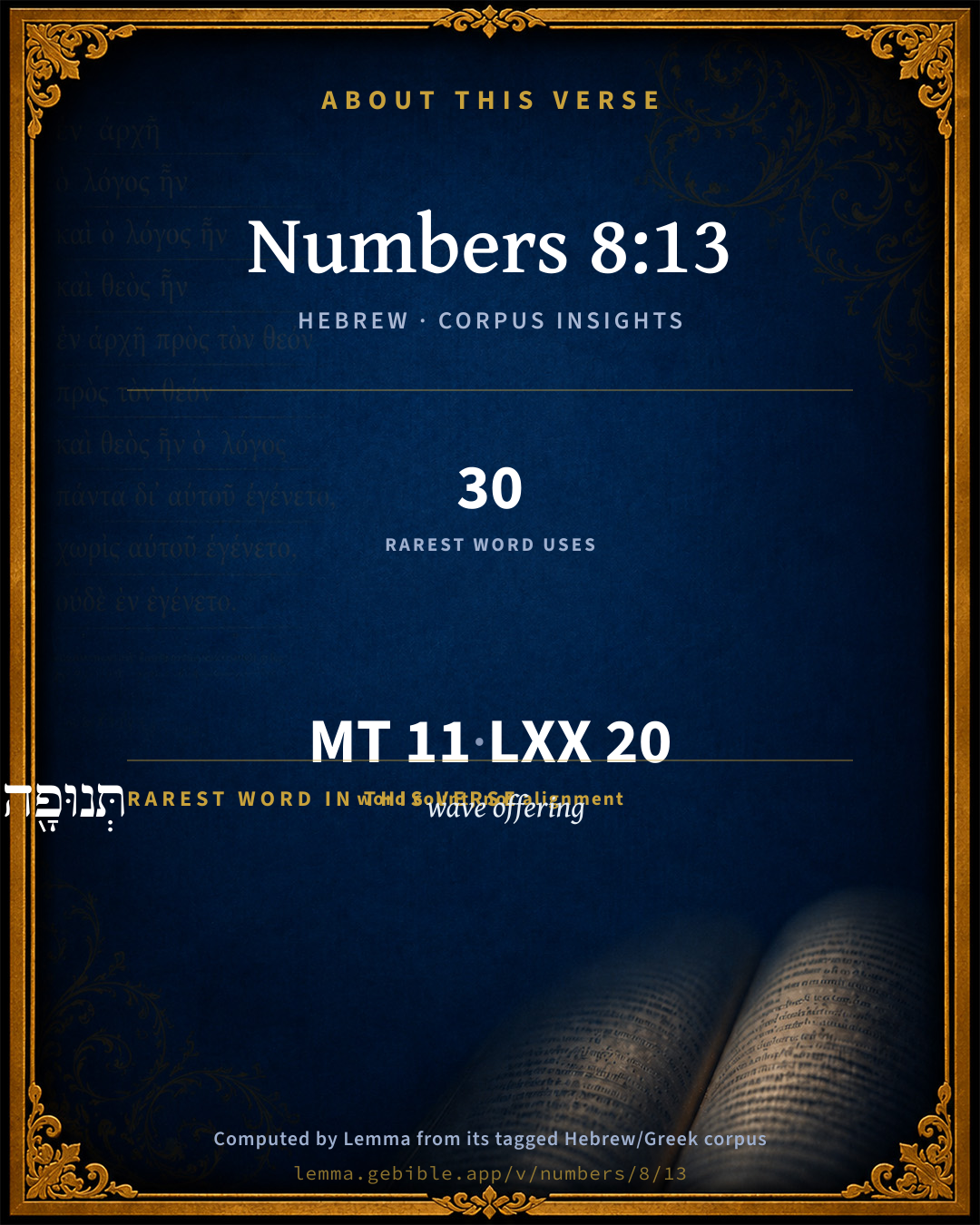
These counts appear in no published source. They are computed here, from the morphology-tagged text and Lemma’s own curated glosses. What Lemma adds →

11
words
9
distinct lemmas
Pentateuch
section

Shared distinctive vocabulary

תְּנוּפָ֖ה wave offering H8573 occurs in 28 verses of the Hebrew Bible. Also found in:

Grammatical profile

  • 2 verbs
  • 7 nouns
  • 2 particles

Verb forms

  • וְהַֽעֲמַדְתָּ֙ Hiphil · Sequential Perfect
  • וְהֵנַפְתָּ֥ Hiphil · Sequential Perfect

Repetition

A word recurs within this verse — often emphatic in Hebrew:

  • לִפְנֵ֥י face H6440 ×2

Hebrew & Septuagint length

In English translation the verse runs 20 words from the Hebrew and 27 from the Septuagint (LXX English) — closely comparable.

A rough comparison of the two English renderings, which tokenize alike — not a word-level alignment.

Word counts can differ between the Hebrew and the Greek without any difference in meaning — e.g. the Hebrew direct-object marker אֵת has no separate Greek word, and Greek often adds the article ὁ.

In the original languages it is 11 Hebrew tokens and 20 Greek tokens — but the two are counted differently (Hebrew bundles its prefixes and suffixes into one token; the Greek is in lemma form), so that isn’t a like-for-like length.

Cross-references

5

Topical passages linked to Numbers 8:13 in the Treasury of Scripture Knowledge — connected by theme and wording, ordered by reader-vote popularity; previews shown in the World English Bible.

  • Numbers 8:11 and Aaron shall offer the Levites before Yahweh for a wave offering, on the behalf of the children of Israel, that it may be theirs to do the service of Yahweh.
  • Numbers 8:21 The Levites purified themselves from sin, and they washed their clothes; and Aaron offered them for a wave offering before Yahweh; and Aaron made atonement for them to cleanse them.
  • Numbers 18:6 I, behold, I have taken your brothers the Levites from among the children of Israel: to you they are a gift, given to Yahweh, to do the service of the tent of meeting.
  • Romans 12:1 Therefore I urge you, brothers, by the mercies of God, to present your bodies a living sacrifice, holy, acceptable to God, which is your spiritual service.
  • Romans 15:16 that I should be a servant of Christ Jesus to the Gentiles, ministering as a priest the Gospel of God, that the offering up of the Gentiles might be made acceptable, sanctified by the Holy Spirit.

Cross-references courtesy of OpenBible.info (CC BY 4.0).

Hebrew and Greek witnesses Masoretic Hebrew ↔ Greek Septuagint

The same verse in the two great witnesses to the Old Testament, shown verse-for-verse.

These are two independent witnesses, not word-aligned to each other, and the Septuagint is shown in lemma (dictionary) form.

Hebrew Numbers 8:13 Masoretic · Westminster Leningrad Codex

וְהַֽעֲמַדְתָּ֙ אֶת הַלְוִיִּ֔ם לִפְנֵ֥י אַהֲרֹ֖ן וְלִפְנֵ֣י בָנָ֑יו וְהֵנַפְתָּ֥ אֹתָ֛ם תְּנוּפָ֖ה לַֽיהוָֽה

You shall set the Levites before Aaron, and before his sons, and offer them as a wave offering to Yahweh.

World English Bible · Public Domain

Greek LXX Numbers 8:13 Septuagint · lemma form

καί ἵστημι ὁ λευίτης ἔναντι κύριος καί ἔναντι ἀαρών καί ἔναντι ὁ υἱός αὐτός καί ἀποδίδωμι αὐτός ἀπόδομα ἔναντι κύριος

And you shall set the Levites before the Lord, and before Aaron, and before his sons; and you shall give them as a gift before the Lord.

LXX2012 (modern English Septuagint) · Public Domain

Hebrew: Westminster Leningrad Codex (CC BY 4.0). Greek: Septuagint (public domain); English from LXX2012 (modern English Septuagint) (Public Domain). How the Septuagint differs from the Hebrew →

Targum (Aramaic paraphrase)

2

The Targum is the ancient Jewish Aramaic paraphrase of the Hebrew Scriptures — an interpretive translation, not the Hebrew text itself. Onkelos (literal) and Pseudo-Jonathan (expansive) render the Torah, and Jonathan the Prophets. Coverage is partial: where no permissively-licensed English translation exists for a verse, only the Aramaic is shown. This is verse-level text, not a word-by-word alignment to the Hebrew.

  1. Targum Onkelos Torah (Genesis–Deuteronomy)
    וּתְקֵם יָת לֵוָאֵי קֳדָם אַהֲרֹן וְקֳדָם בְּנוֹהִי וּתְרֵים יָתְהוֹן אֲרָמָא קֳדָם יְיָ

    (no public-domain English translation for this verse)

    Targum Onkelos — Aramaic: “Onkelos Genesis” (public domain); “Onkelos Exodus” (public domain); “Onkelos Leviticus” (public domain); “Onkelos Numbers” (public domain); “Onkelos Deuteronomy” (public domain). English: “Sefaria Community Translation” (CC0 1.0 (public-domain dedication)); “J.W. Etheridge. The Targums of Onkelos and Jonathan Ben Uzziel on the Pentateuch. London: Longmans, Green, 1862” (public domain). Text via Sefaria.

  2. Targum Pseudo-Jonathan Torah (Genesis–Deuteronomy)
    וּתְקֵים יַת לֵיוָאֵי קֳדָם אַהֲרן וְקָדָם בְּנוֹי וּתְרֵים יַתְהוֹן אֲרָמָא קֳדָם יְיָ

    And thou shalt place the Levites before Aharon and his sons, and present them (as) an elevation before the Lord;

    Targum Pseudo-Jonathan — Aramaic: “Targum Jonathan on Genesis” (public domain); “Targum Jonathan on Exodus” (public domain); “Targum Jonathan on Leviticus” (public domain); “Targum Jonathan on Numbers” (public domain); “Targum Jonathan on Deuteronomy” (public domain). English: “The Targum of Jonathan ben Uzziel, trans. J. W. Etheridge, London, 1862” (public domain). Text via Sefaria.

Commentary

Notes on Numbers 8:13 from classic Christian and Jewish commentators (each source and its license shown beneath its notes). The classic Christian expositions comment on the surrounding passage and are grouped to its opening verse, so a note may address several verses; the Jewish commentaries on the Tanakh (Rashi and others) are per-verse, so they appear only where the commentator wrote on this verse.

Lemma curates 59 commentaries, every one of them public domain or Creative Commons licensed, each selected and text-cleaned for this edition rather than reprinted as found. About our sources →

Ellicott's Commentary for English Readers

(13) And offer them for an offering.—Literally, and wave them as a wave- offering, as in Num_8:11. So also in Num_8:15.

A Bible Commentary for English Readers, edited by Charles John Ellicott (1878–1897) — public domain. Text from a community e-Sword module.

The Cambridge Bible for Schools and Colleges

gen. ed. J. J. S. Perowne

13. The Levites are formally handed over to the priests as their ministers.

The Cambridge Bible for Schools and Colleges (gen. ed. J. J. S. Perowne; Cambridge University Press, 1878–1918) — public domain. Text from a community e-Sword module.

John Gill's Exposition

And thou shalt set the Levites before Aaron, and before his sons,.... After atonement was made for them, as Aben Ezra observes; then they were presented to Aaron and his sons, to whom they were given to he their ministers, and assistants to them:

and offer them for an offering unto the Lord: or, and "waved them", &c. as before, that is, order them to be waved; for not Moses, but Aaron, did this, and indeed was done already; and therefore should rather be rendered, as by Bishop Patrick, after thou hast offered, or waved them.

John Gill's Exposition of the Whole Bible (1746–1763) — public domain (CC PDM 1.0). Text via the HelloAO Bible API.

Matthew Poole's English Annotations

Before Aaron and his sons, i.e. put them into the power of Aaron and his sons, to employ them in holy ministrations; for so that phrase is sometimes used, as Gen 13:9,

the land is before thee, i.e. in thy power, to use or enjoy it. Or setting the Levites before them did signify the giving the Levites to them, or to their service.

For an offering unto to the Lord; for to him they were first properly offered, and by him given to the priests in order to his service.

Matthew Poole's English Annotations on the Holy Bible (1683–1685) — public domain. Text from a community e-Sword/MySword module.

The Pulpit Commentary

And thou shalt set the Levites before Aaron. This is not an additional command, but repeats in a slightly different form the previous orders. A similar repetition occurs in verse 15b.

HOMILIES BY W. BINNIE Ver. 14. The separation of the Levites; or an ordination service in the wilderness.

"Thus shalt thou separate the Levites from among the children of Israel: and the Levites shall be mine." There was a threefold reason why the Levites were separated from the rest of the nation and wholly dedicated to the Lord"s service. In the first place, they were to stand instead of the firstborn, whom the Lord had specially claimed for himself (verses 16-18). It was judged expedient that to the service of the sanctuary one whole tribe should be dedicated, rather than individuals out of all the tribes. Secondly, the due serving of the tabernacle being much too burdensome for the single family of Aaron, their brethren of the tribe of Levi were appointed to help them. But there was a third and deeper reason. All the chosen people are the Lord"s, and he claims their service. But all cannot, in person, serve him in the way of keeping the charge of the sanctuary. Some of them must be separated to this ministry. Official service is necessary under the gospel.

Much more was it necessary under the law. Hence the separation of the Levites. When the time came for the Levites to enter on duty, they were set apart in a service, not so solemn indeed as the service on the occasion of Aaron"s consecration, nevertheless highly impressive, and fitted to suggest many a lesson worthy to be laid to heart by us on similar occasions.

I Let us begin by taking A GENERAL VIEW OF THIS ORDINATION SERVICE. The outstanding features were these. It took place at the door of the tabernacle and in presence of the whole congregation. The Levites being marched in, the congregation put their hands on them, q.d.: "We are thine, O Lord. Thou hast redeemed us and brought us out for thyself, to be to thee a kingdom and priests. With respect to the charge of this thy sanctuary, thou hast made choice of these our brethren to minister to thee in our stead. We freely give them up to thee, and renounce all the rightful claim we should otherwise have had upon their service in peace and war." This done, Aaron "offered" the Levites to the Lord as a "wave offering." Finally, Aaron in turn accepted the Levites as the Lord"s gift to him, to aid him in the tabernacle. Who can fail to see the significance of all this? Besides suggesting

(1) how fit it is that men who are entering on a life of official service in the Church should be solemnly set apart to their office and charge, it plainly teaches

(2) that ordination to sacred office should take place in the face of the congregation. It ought not to be performed in a corner. The people are vitally interested, and have a right to be present. This is the rule, I believe, in all evangelical Churches.

(3) When a man has been set apart to sacred service, at the instance of his brethren and in their presence, a relation is formed between him and them which involves reciprocal obligation. He is to lay out his strength in their service; and they are to charge themselves with his maintenance while he does so. The people of Israel having laid their hands on the Levites, were thenceforward to communicate with them in all good things. (see Deu_12:19 Deu_14:27) When Dr. Carey consented to go down into the pit of heathendom, it was only fair and just that the brethren at whose instance he went should "hold the rope," as he stipulated that they should.

II BESIDES THESE MORE CATHOLIC AND SPIRITUAL SERVICES, THE LEVITES" ORDINATION WAS ACCOMPANIED WITH OTHERS PURELY CEREMONIAL. These were of three kinds.

1. Lustral (verse 7). First, Aaron sprinkled the Levites with water of purifying either that described chapter 19, or, more likely, spring-water, such as was used in the laver. Then the Levites, on their part, shaved off their hair and washed their clothes, q.d.: "Lord, we are not meet for thy house and service. Holiness becometh thine house. Thou art of purer eyes than to behold evil. And we are unclean. But thou canst make us clean. As thou hast sprinkled our persons with clean water, so do thou remove all filthiness from our hearts. And we, for our parts, are resolved by thy grace to put away the evils of our past lives and to follow after holiness henceforward.

2. Expiatory (verses 8, 12). The Levites were to bring a sin offering for atonement; laying their hands upon it with confession of sin. (see Le 4) They were thus reminded of their guilt as well as impurity, and were encouraged to believe that there is forgiveness with God, on the ground of which they might hope to be accepted in their persons and service.

3. Dedicatory. The sin offering was to be followed by a burnt offering to signify that the Levites presented their whole persons to the Lord, a living sacrifice, to be employed in his service all their days. Blessed be God, we are rid of these burdensome and carnal rites. Care must be taken not to let anything like them creep again into the sanctuary. But the ideas they set forth the great realities of purification, and pardon, and dedication ought to be often present to our minds and hearts in the house of God. B.

The Pulpit Commentary (1880–1919), ed. H.D.M. Spence-Jones & Joseph S. Exell — public domain. Text from a community e-Sword module.

John Wesley's Explanatory Notes

Set the Levites before Aaron - Give the Levites to them, or to their service. Unto the Lord - For to him they were first properly offered, and by him given to the priests in order to his service.

John Wesley, Explanatory Notes Upon the Whole Bible (1754–1765) — public domain. Text via the GEBible commentary corpus.

Lesson kit

Teaching starters — assembled from the data on this page, not authored interpretation. Every prompt links to the verse data it draws on. Edit before teaching.

Numbers, in the Pentateuch, opens this verse with 11 words (9 distinct Hebrew lemmas). Its most distinctive word is tᵉnûwphâh (“wave offering”). A historical commentator’s framing appears above. Read the whole chapter for the surrounding context.

Discussion questions

  1. What does “wave offering” (tᵉnûwphâh) contribute to the verse as a whole?
  2. Exodus 29:24 shares the word «wave offering» with this verse. How do the two illuminate each other?
  3. “face” occurs 2× in this one verse. What is the effect of the repetition?
  4. The translations on this page render this verse differently — a whole-verse word diff, not a word-by-word alignment. What might account for the different wordings?
  5. The verb «וְהַֽעֲמַדְתָּ֙» is Hiphil Sequential Perfect. How does its form color the action?
  6. Reading how Ellicott's Commentary for English Readers and The Cambridge Bible for Schools and Colleges read this verse, where do the two commentators agree and where do they part?

Things to notice

Reading settings

Reading text

Shown beneath each verse's original-language words.

Old Testament
Old Testament edition

Read the OT as the Masoretic Hebrew (MT) or the Greek Septuagint (LXX).

English shown for the Greek Septuagint (in the Hebrew ↔ Greek comparison).

Comparing translations? Open the Compare panel on any verse page to stack up to four side by side.