
Leviticus 25:50

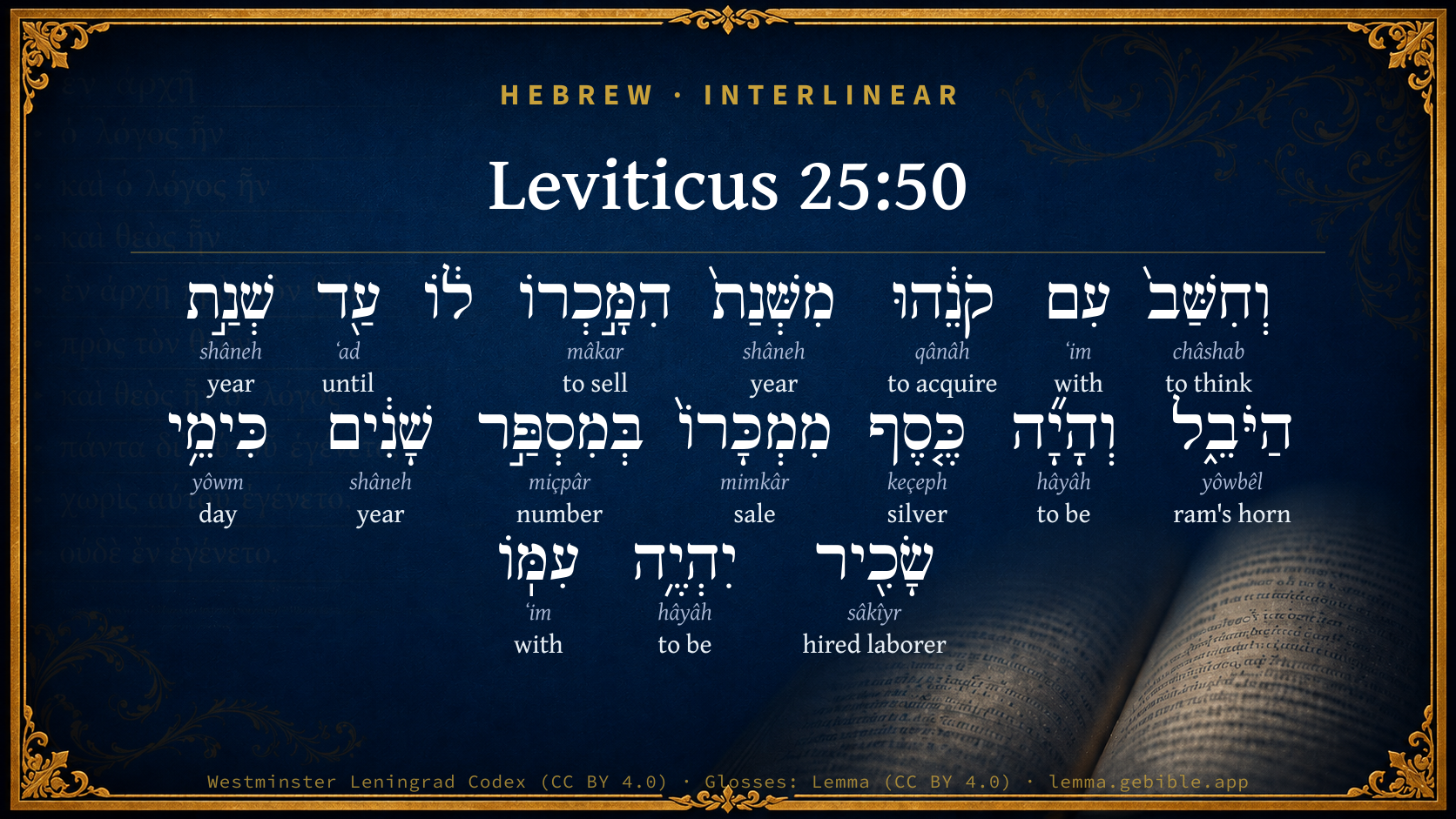
Hebrew (Westminster Leningrad Codex) Leviticus 25:50 appears in the Hebrew Old Testament. The text above is from the Westminster Leningrad Codex. Each word links to its Strong’s number, a concise gloss, and parsing drawn from the Open Scriptures Hebrew Bible morphology. Click any word for its full Brown-Driver-Briggs (BDB) entry.
Download image
Cite this verse

Leviticus 25:50 (World English Bible). Public Domain. Lemma interlinear Bible study tool, https://lemma.gebible.app/v/leviticus/25/50.

Show BibTeX & RIS
BibTeX
RIS
English Translation
He shall reckon with him who bought him from the year that he sold himself to him to the Year of Jubilee: and the price of his sale shall be according to the number of years; according to the time of a hired servant shall he be with him.
World English Bible · Public Domain
Download a study sheet

One document with this verse’s original text, its word-by-word gloss line, the meaning frame, cross-references with their text, attributed commentary, and full source and license credits — printable, and it pastes into notes with its structure intact.

This verse Autodidact and up

Study sheet (.html) Plain text (.txt)

A passage Seminary Student

Up to 50 verses in one chapter. A passage sheet keeps up to 6 commentary sources and 12 cross-references per verse, in the order this page ranks them, and says so on the sheet whenever that leaves anything out. Ask for a single verse and you get the Autodidact verse sheet above.

Everything on this page stays free to read, with no account — the sheet is a download of what is already on screen, not access to it.

Want to remove ads? Support Godless Engineer
Compare translations 3

The same verse in 3 English versions, stacked beneath the original-language interlinear above. Click any original word for its lexicon entry.

Each is an independent rendering of the whole verse — the interlinear is not word-aligned to these translations.

Highlighted words mark where these versions differ — a whole-verse word diff, not a word-by-word alignment.

  • World English Bible Public Domain
    He shall reckon with him who bought him from the year that he sold himself to him to the Year of Jubilee: and the price of his sale shall be according to the number of years; according to the time of a hired servant shall he be with him.
  • King James Version Public Domain
    And he shall reckon with him that bought him from the year that he was sold to him unto the year of jubilee: and the price of his sale shall be according unto the number of years, according to the time of an hired servant shall it be with him.
  • unfoldingWord Literal Text CC BY-SA 4.0
    And he shall calculate with his buyer from the year of his selling himself to him until the Year of Jubilee, and the silver of his sale shall be by the number of years. Like the days of a hired worker he shall be with him.

unfoldingWord Literal Text — © unfoldingWord, licensed CC BY-SA 4.0. Word-aligned USFM3 via Door43 (git.door43.org/unfoldingWord/en_ult).

Versions to compare (up to 4)

3 of 4 selected

Show all 18 translations

Every available English version of this verse, each an independent rendering of the whole verse.

  • World English Bible Public Domain
    He shall reckon with him who bought him from the year that he sold himself to him to the Year of Jubilee: and the price of his sale shall be according to the number of years; according to the time of a hired servant shall he be with him.
  • Berean Standard Bible Public Domain
    He and his purchaser will then count the time from the year he sold himself up to the Year of Jubilee. The price of his sale will be determined by the number of years, based on the daily wages of a hired hand.
  • Majority Standard Bible Public Domain
    He and his purchaser will then count the time from the year he sold himself up to the Year of Jubilee. The price of his sale will be determined by the number of years, based on the daily wages of a hired hand.
  • King James Version Public Domain
    And he shall reckon with him that bought him from the year that he was sold to him unto the year of jubilee: and the price of his sale shall be according unto the number of years, according to the time of an hired servant shall it be with him.
  • American Standard Version (1901) Public Domain
    And he shall reckon with him that bought him from the year that he sold himself to him unto the year of jubilee: and the price of his sale shall be according unto the number of years; according to the time of a hired servant shall he be with him.
  • Revised Version (1885) Public Domain
    And he shall reckon with him that bought him from the year that he sold himself to him unto the year of jubile: and the price of his sale shall be according unto the number of years; according to the time of an hired servant shall he be with him.
  • Geneva Bible (1599) Public Domain
    Then he shall recken with his byer from the yeere that he was solde to him, vnto the yere of Iubile: and the money of his sale shalbe according to the number of yeeres: according to the time of an hyred seruant shall he be with him.
  • Douay-Rheims (1899) Public Domain
    Counting only the years from the time of his selling unto the year of the jubilee: and counting the money that he was sold for, according to the number of the years and the reckoning of a hired servant,
  • Young's Literal Translation Public Domain
    `And he hath reckoned with his buyer from the year of his being sold to him till the year of jubilee, and the money of his sale hath been by the number of years; as the days of an hireling it is with him.
  • Literal Standard Version CC BY-SA 4.0
    And he has reckoned with his buyer from the year of his being sold to him until the Year of Jubilee, and the money of his sale has been by the number of years; it is with him as the days of a hired worker.
  • Unlocked Literal Bible CC BY-SA 4.0
    He must bargain with the man who bought him; they must count the years from the year he sold himself to his purchaser until the year of Jubilee. The price of his redemption must be figured in keeping with the rate paid to a hired servant, for the number of years he might continue to work for the one who bought him.
  • unfoldingWord Literal Text CC BY-SA 4.0
    And he shall calculate with his buyer from the year of his selling himself to him until the Year of Jubilee, and the silver of his sale shall be by the number of years. Like the days of a hired worker he shall be with him.
  • Darby Bible Public Domain
    And he shall reckon with him that bought him from the year that he was sold to him unto the year of jubilee; and the price of his sale shall be according to the number of the years, according to the days of a hired servant shall he be with him.
  • World Messianic Bible Public Domain
    He shall reckon with him who bought him from the year that he sold himself to him to the Year of Jubilee. The price of his sale shall be according to the number of years; he shall be with him according to the time of a hired servant.
  • Webster's Bible Public Domain
    And he shall reckon with him that bought him, from the year that he was sold to him, to the year of jubilee: and the price of his sale shall be according to the number of years, according to the time of a hired servant shall it be with him.
  • Free Bible Version CC BY-SA 4.0
    The person concerned and their buyer will work out the time from the year of the sale up to the Jubilee Year. The price will depend on the number of years, calculated using the daily rate for a paid worker.
  • Bible in Basic English Public Domain
    And let the years be numbered from the time when he gave himself to his owner till the year of Jubilee, and the price given for him will be in relation to the number of years, on the scale of the payment of a servant.
  • JPS Tanakh (1917) Public Domain
    And he shall reckon with him that bought him from the year that he sold himself to him unto the year of jubilee; and the price of his sale shall be according unto the number of years; according to the time of a hired servant shall he be with him.

Literal Standard Version (2020), Covenant Press — licensed CC BY-SA 4.0. Text via the HelloAO Bible API (eBible.org). Unlocked Literal Bible (unfoldingWord) — licensed CC BY-SA 4.0. Text via the HelloAO Bible API (eBible.org). unfoldingWord Literal Text — © unfoldingWord, licensed CC BY-SA 4.0. Word-aligned USFM3 via Door43 (git.door43.org/unfoldingWord/en_ult). Free Bible Version, Dr. Jonathan Gallagher — licensed CC BY-SA 4.0. Text via the HelloAO Bible API (eBible.org).

Word by word

More ways to search: Search by grammar → Find every occurrence → Compare this word →

Practice this passage: Drill this verse → Learn its vocabulary →

מִמְכָּרוֹ֙
mimkâr
H4465
“sale · his”
Noun, Common, Masculine, Singular, Construct + Suffix, Personal, 3rd Person, Masculine, Singular
Part of Speech
Noun
Type
Common
Gender
Masculine
Number
Singular
State
Construct
Full BDB Definition

Origin: from H4376

TWOT: 1194b

sale, ware, thing sold
  1. וְחִשַּׁב֙ châshab H2803 “and · to think” Conjunction + Verb, Piel, Sequential Perfect, 3rd Person, Masculine, Singular
  2. עִם ʻim H5973 “with” Preposition
  3. קֹנֵ֔הוּ qânâh H7069 “acquiring · him” Verb, Qal, Participle Active, Masculine, Singular, Construct + Suffix, Personal, 3rd Person, Masculine, Singular
  4. מִשְּׁנַת֙ shâneh H8141 “from · year of” Preposition + Noun, Common, Feminine, Singular, Construct
  5. הִמָּ֣כְרוֹ mâkar H4376 “to sell · him” Verb, Niphal, Infinitive Construct + Suffix, Personal, 3rd Person, Masculine, Singular
  6. עַ֖ד ʻad H5704 “until” Preposition
  7. שְׁנַ֣ת shâneh H8141 “year of” Noun, Common, Feminine, Singular, Construct
  8. הַיֹּבֵ֑ל yôwbêl H3104 “the · ram's horn” Particle, Definite Article + Noun, Common, Masculine, Singular, Absolute
  9. וְהָיָ֞ה hâyâh H1961 “and · to be” Conjunction + Verb, Qal, Sequential Perfect, 3rd Person, Masculine, Singular
  10. כֶּ֤סֶף keçeph H3701 “silver of” Noun, Common, Masculine, Singular, Construct
  11. בְּמִסְפַּ֣ר miçpâr H4557 “in/at · number of” Preposition + Noun, Common, Masculine, Singular, Construct
  12. שָׁנִ֔ים shâneh H8141 “years” Noun, Common, Feminine, Plural, Absolute
  13. כִּימֵ֥י yôwm H3117 “like/as · days of” Preposition + Noun, Common, Masculine, Plural, Construct
  14. שָׂכִ֖יר sâkîyr H7916 “hired laborer” Adjective, Adjective, Masculine, Singular, Absolute
  15. יִהְיֶ֥ה hâyâh H1961 “to be” Verb, Qal, Imperfect, 3rd Person, Masculine, Singular
  16. עִמּֽוֹ ʻim H5973 “with · him” Preposition + Suffix, Personal, 3rd Person, Masculine, Singular

About this verse

These counts appear in no published source. They are computed here, from the morphology-tagged text and Lemma’s own curated glosses. What Lemma adds →

18
words
13
distinct lemmas
Pentateuch
section

Notable vocabulary

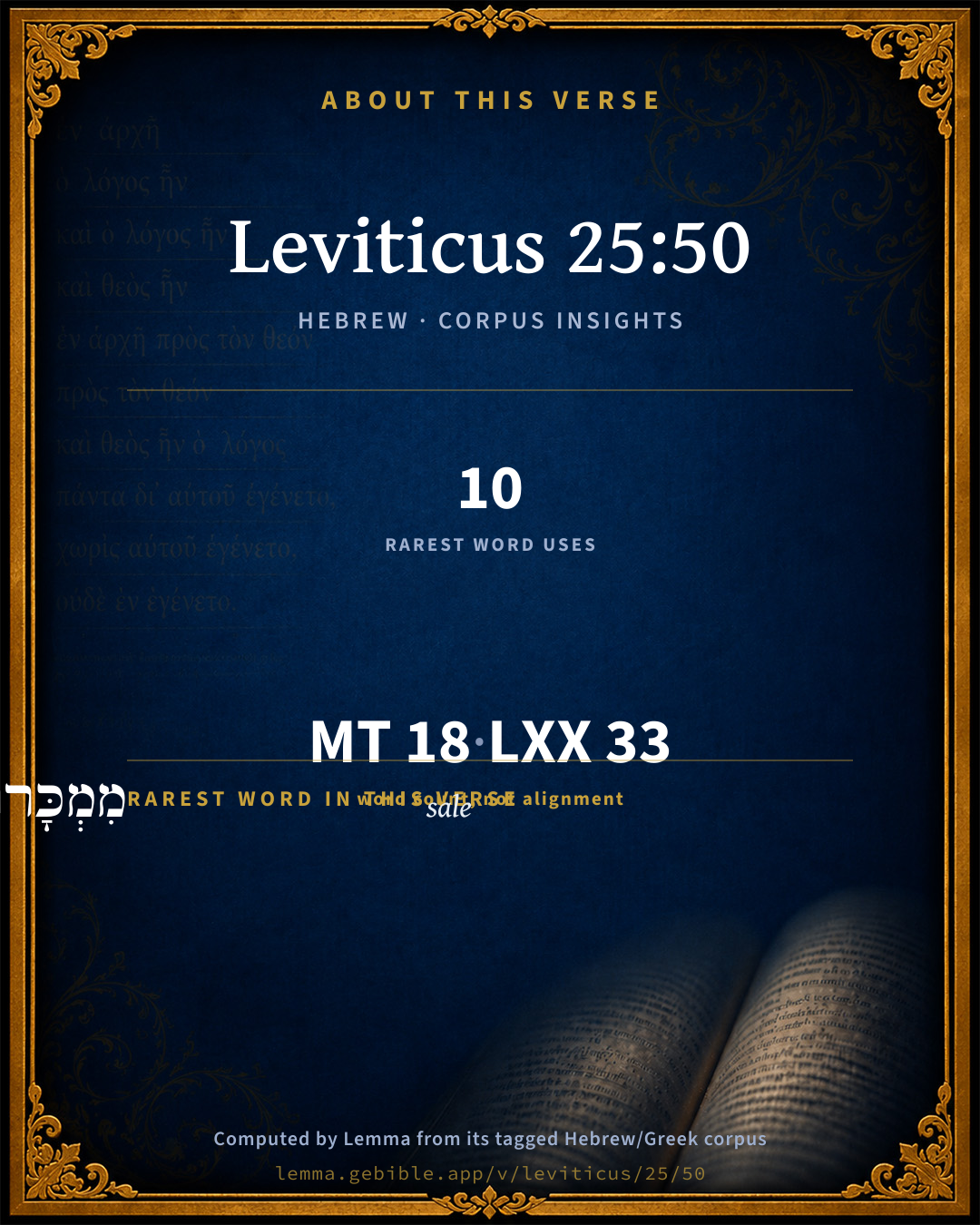
The rarest word here is מִמְכָּרוֹ֙ sale H4465 — appearing just 10 times in the whole Hebrew Bible.

Shared distinctive vocabulary

מִמְכָּרוֹ֙ sale H4465 occurs in 10 verses of the Hebrew Bible. Also found in:

Grammatical profile

  • 5 verbs
  • 8 nouns
  • 1 adjective
  • 4 prepositions

Verb forms

  • וְחִשַּׁב֙ Piel · Sequential Perfect
  • קֹנֵ֔הוּ Qal · Participle Active
  • הִמָּ֣כְרוֹ Niphal · Infinitive Construct
  • וְהָיָ֞ה Qal · Sequential Perfect
  • יִהְיֶ֥ה Qal · Imperfect

Repetition

Words recur within this verse — often emphatic in Hebrew:

  • מִשְּׁנַת֙ year H8141 ×3
  • וְהָיָ֞ה to be H1961 ×2
  • עִם with H5973 ×2

Hebrew & Septuagint length

In English translation the verse runs 49 words from the Hebrew and 43 from the Septuagint (LXX English) — closely comparable.

A rough comparison of the two English renderings, which tokenize alike — not a word-level alignment.

Word counts can differ between the Hebrew and the Greek without any difference in meaning — e.g. the Hebrew direct-object marker אֵת has no separate Greek word, and Greek often adds the article ὁ.

In the original languages it is 18 Hebrew tokens and 33 Greek tokens — but the two are counted differently (Hebrew bundles its prefixes and suffixes into one token; the Greek is in lemma form), so that isn’t a like-for-like length.

Cross-references

7

Topical passages linked to Leviticus 25:50 in the Treasury of Scripture Knowledge — connected by theme and wording, ordered by reader-vote popularity; previews shown in the World English Bible.

  • Isaiah 16:14 But now Yahweh has spoken, saying, Within three years, as the years of a hireling, the glory of Moab shall be brought into contempt, with all his great multitude; and the remnant shall be very small and of no account.
  • Isaiah 21:16 For thus has the Lord said to me, Within a year, according to the years of a hireling, all the glory of Kedar shall fail;
  • Leviticus 25:40 As a hired servant, and as a sojourner, he shall be with you; he shall serve with you until the Year of Jubilee:
  • Leviticus 25:53 As a servant hired year by year shall he be with him: he shall not rule with harshness over him in your sight.
  • Deuteronomy 15:18 It shall not seem hard to you, when you let him go free from you; for to the double of the hire of a hireling has he served you six years: and Yahweh your God will bless you in all that you do.
  • Job 7:1–2 "Isn't a man forced to labor on earth? Aren't his days like the days of a hired hand?
  • Job 14:6 Look away from him, that he may rest, Until he shall accomplish, as a hireling, his day.

Cross-references courtesy of OpenBible.info (CC BY 4.0).

Hebrew and Greek witnesses Masoretic Hebrew ↔ Greek Septuagint

The same verse in the two great witnesses to the Old Testament, shown verse-for-verse.

These are two independent witnesses, not word-aligned to each other, and the Septuagint is shown in lemma (dictionary) form.

Hebrew Leviticus 25:50 Masoretic · Westminster Leningrad Codex

וְחִשַּׁב֙ עִם קֹנֵ֔הוּ מִשְּׁנַת֙ הִמָּ֣כְרוֹ ל֔וֹ עַ֖ד שְׁנַ֣ת הַיֹּבֵ֑ל וְהָיָ֞ה כֶּ֤סֶף מִמְכָּרוֹ֙ בְּמִסְפַּ֣ר שָׁנִ֔ים כִּימֵ֥י שָׂכִ֖יר יִהְיֶ֥ה עִמּֽוֹ

He shall reckon with him who bought him from the year that he sold himself to him to the Year of Jubilee: and the price of his sale shall be according to the number of years; according to the time of a hired servant shall he be with him.

World English Bible · Public Domain

Greek LXX Leviticus 25:50 Septuagint · lemma form

καί συνλογίζω πρός ὁ κτάομαι αὐτός ἀπό ὁ ἔτος ὅς ἀποδίδωμι ἑαυτοῦ αὐτός ἕως ὁ ἐνιαυτός ὁ ἄφεσις καί εἰμί ὁ ἀργύριον ὁ πρᾶσις αὐτός ὡς μίσθιος ἔτος ἐκ ἔτος εἰμί μετά αὐτός

then shall he calculate with his purchaser from the year that he sold himself to him until the year of release: and the money of his purchase shall be as that of a hireling, he shall be with him from year to year.

LXX2012 (modern English Septuagint) · Public Domain

Hebrew: Westminster Leningrad Codex (CC BY 4.0). Greek: Septuagint (public domain); English from LXX2012 (modern English Septuagint) (Public Domain). How the Septuagint differs from the Hebrew →

Targum (Aramaic paraphrase)

2

The Targum is the ancient Jewish Aramaic paraphrase of the Hebrew Scriptures — an interpretive translation, not the Hebrew text itself. Onkelos (literal) and Pseudo-Jonathan (expansive) render the Torah, and Jonathan the Prophets. Coverage is partial: where no permissively-licensed English translation exists for a verse, only the Aramaic is shown. This is verse-level text, not a word-by-word alignment to the Hebrew.

  1. Targum Onkelos Torah (Genesis–Deuteronomy)
    וִיחַשֵׁב עִם זָבְנֵהּ מִשַׁתָּא דְאִזְדַבַּן לֵהּ עַד שַׁתָּא דְיוֹבֵלָא וִיהֵי כְּסַף זְבִינוֹהִי בְּמִנְיַן שְׁנַיָא כְּיוֹמֵי אֲגִירָא יְהֵי עִמֵהּ

    (no public-domain English translation for this verse)

    Targum Onkelos — Aramaic: “Onkelos Genesis” (public domain); “Onkelos Exodus” (public domain); “Onkelos Leviticus” (public domain); “Onkelos Numbers” (public domain); “Onkelos Deuteronomy” (public domain). English: “Sefaria Community Translation” (CC0 1.0 (public-domain dedication)); “J.W. Etheridge. The Targums of Onkelos and Jonathan Ben Uzziel on the Pentateuch. London: Longmans, Green, 1862” (public domain). Text via Sefaria.

  2. Targum Pseudo-Jonathan Torah (Genesis–Deuteronomy)
    וִידַיֵיק עִם עַרְלָאָה דְזַבְּנֵיהּ מִשַׁתָּא דְיִזְדַבֵּן לֵיהּ עַד שַׁתָּא דְיוֹבְלָא וִיהֵי כְסַף זַבִּינוֹ כְּמִנְיַן שְׁנַיָא הֵי כְיוֹמֵי אֲגִירָא יְהֵי עִמֵיהּ

    And he shall account with the uncircumcised person who had bought him, from the year that he was sold until the year of Jubela, and the price of his repurchase shall be according to the number of the years; according to the days of an hireling shall it be with him.

    Targum Pseudo-Jonathan — Aramaic: “Targum Jonathan on Genesis” (public domain); “Targum Jonathan on Exodus” (public domain); “Targum Jonathan on Leviticus” (public domain); “Targum Jonathan on Numbers” (public domain); “Targum Jonathan on Deuteronomy” (public domain). English: “The Targum of Jonathan ben Uzziel, trans. J. W. Etheridge, London, 1862” (public domain). Text via Sefaria.

Commentary

Notes on Leviticus 25:50 from classic Christian and Jewish commentators (each source and its license shown beneath its notes). The classic Christian expositions comment on the surrounding passage and are grouped to its opening verse, so a note may address several verses; the Jewish commentaries on the Tanakh (Rashi and others) are per-verse, so they appear only where the commentator wrote on this verse.

Lemma curates 59 commentaries, every one of them public domain or Creative Commons licensed, each selected and text-cleaned for this edition rather than reprinted as found. About our sources →

Joseph Benson's Commentary

Lev 25:50. According to the time of a hired servant — Allowance shall be made for the time wherein he hath served, proportionable to that which was given to a hired servant for so long service, because his condition is in this like theirs; it is not properly his person, but his work and labour that were sold.

Joseph Benson's Commentary on the Old and New Testaments (1811–1818) — public domain. Text from a community e-Sword module.

Geneva Bible (1599)

Geneva Bible translators

Which remain yet to the Jubilee.

Geneva Bible (1599) marginal notes — public domain. Text via Bolls.life.

Adam Clarke's Commentary

Verse 50. The price of his sale shall be, c.] This was a very equitable law, both for the sojourner to whom the man was sold, and to the Israelite who had been thus sold. The Israelite might redeem himself, or one of his kindred might redeem him but this must not be done to the prejudice of his master, the sojourner. They were therefore to reckon the years he must have served from that time till the jubilee; and then, taking the current wages of a servant per year at that time, multiply the remaining years by that sum, and the aggregate was the sum to be given to his master for his redemption. The Jews hold that the kindred of such a person were bound, if in their power, to redeem him, lest he should be swallowed up among the heathen; and we find, from Ne 5:8, that this was done by the Jews on their return from the Babylonish captivity: We, after our ability, have redeemed our brethren the Jews, who were sold unto the heathen.

Adam Clarke's Commentary on the Bible (1810–1826) — public domain. Text from a community e-Sword/MySword module.

Ellicott's Commentary for English Readers

(50-52) And he shall reckon with him.—That is, either the man himself when he is able to redeem himself, or his kindred. The authorities during the second Temple rightly point out that this passage enjoins the Hebrew to treat the heathen master fairly by duly compensating and compounding for the number of years he has still to serve till jubile, and to take no advantage of the idolater.

A Bible Commentary for English Readers, edited by Charles John Ellicott (1878–1897) — public domain. Text from a community e-Sword module.

John Gill's Exposition

And he shall reckon with him that bought him,.... That is, either the man himself should reckon with him, or whoever undertook to redeem him:

from the year that he was sold to him unto the year of jubilee; and so count how many years he had served, and how many were yet to come; and by this it appears, that one thus sold was not released at the end of six years, or the sabbatical year did not free him:

and the price of his sale shall be according to the number of years; whether more or fewer, as after explained:

according to the time of an hired servant shall it be with him; the time of service he had served his master shall be reckoned, as if he had been hired for so much a year; and according to the number of years he had been with him, so much per annum was to be deducted from the original purchase, and the rest to be made for his redemption to him that bought him.

John Gill's Exposition of the Whole Bible (1746–1763) — public domain (CC PDM 1.0). Text via the HelloAO Bible API.

Matthew Poole's English Annotations

Allowance shall be made for the time wherein he hath served, proportionable to that which is given to a hired servant for so long service, because his condition is in this like theirs; that it is not properly his person, but his work and labour that was sold.

Matthew Poole's English Annotations on the Holy Bible (1683–1685) — public domain. Text from a community e-Sword/MySword module.

Whedon's Commentary on the Bible

Daniel D. Whedon

50. Unto the year of jubilee — We apply the same principles of interpretation here as in the note to Lev_25:36; Lev_25:40. It is unreasonable to suppose that the Hebrew master was required to lift the yoke from his brother at the end of six years or of the jubilee period, whichever was nearest, and that the heathen master, under Hebrew jurisdiction, could hold the poor Israelite in servitude forty-nine years.

The price of his sale — Lest the master might exact an exorbitant ransom the price was fixed by an equitable law. The yearly current wages of a hired servant were to be multiplied by the number of years of service due.

Daniel D. Whedon (gen. ed.), Commentary on the Old and New Testaments (1874–1909) — public domain. Text from a community e-Sword module.

John Wesley's Explanatory Notes

According to the time of an hired servant - Allowance shall be made for the time wherein he hath served, proportionable to that which is given to an hired servant for so long service, because his condition is in this like theirs; it is not properly his person, but his work and labour that was sold.

John Wesley, Explanatory Notes Upon the Whole Bible (1754–1765) — public domain. Text via the GEBible commentary corpus.

Rashi

Rabbi Shlomo Yitzchaki (Rashi)

עד שנת היובל [AND HE SHALL RECKON WITH HIM…] UNTO THE YEAR OF THE JUBILEE — for after all, essentially he has bought him only to work for him till the Jubilee, for surely you must admit in the Jubilee he is to go free, as Scripture states later,on (v. 54) “[and if he be not redeemed in these ways], then he shall go out in the year of the Jubilee”. And, of course, Scripture is speaking here of a heathen who is under your control (i. e. who has to submit to your jurisdiction, for otherwise Scripture could not dictate to him) (Sifra, Behar, Chapter 9 3; Kiddushin 16a). But nevertheless you must not practise crooked ways against him because this would result in a desecration of the Name of the Lord (Bava Kamma 113a), but when he wishes to be redeemed he must be exact in his calculation — only just as much as is due each year shall the heathen allow him as a deduction from the purchase-money: (i. e. the Jew cannot demand a larger deduction); if e. g., there were twenty years from the date when he was sold till the Jubilee and he has bought him for twenty manehs — and consequently the heathen has purchased the labour of each year for one maneh — if he (the Jewish servant) stayed with him five years and then wishes to be redeemed, he (the master) has to allow him only a deduction of five manehs from the purchase-money, so that the servant must repay him fifteen manehs. This is the meaning of: והיה כסף ממכרו במספר שנים; AND THE PRICE OF HIS SALE SHALL BE CALCULATED AS HAVING BEEN ACCORDING TO THE NUMBER OF YEARS;

כימי שכיר יהיה עמו AS AT THE RATE OF THE DAYS OF AN HIRED SERVANT SHALL HE HAVE BEEN WITH HIM — i. e. he shall calculate the amount due for each year as though he had hired himself out with him e. g., at one maneh per year and that amount only he (the master) has to allow him.

Rashi on the Tanakh — English translations: “The Judaica Press complete Tanach with Rashi, translated by A. J. Rosenberg” (CC BY 4.0); “Pentateuch with Rashi's commentary by M. Rosenbaum and A.M. Silbermann, 1929-1934” (public domain); “The Metsudah Tanach series, Lakewood, N.J” (CC BY 4.0); and “The Book of Joshua, Metsudah Publications, 1997” (CC BY 4.0). Text via Sefaria.

Lesson kit

Teaching starters — assembled from the data on this page, not authored interpretation. Every prompt links to the verse data it draws on. Edit before teaching.

Leviticus, in the Pentateuch, opens this verse with 18 words (13 distinct Hebrew lemmas). Its most distinctive word is mimkâr (“sale”). A historical commentator’s framing appears above. Read the whole chapter for the surrounding context.

Discussion questions

  1. The word mimkâr carries the sense “sale.” How does it shape the verse?
  2. Leviticus 25:14 shares the word «sale» with this verse. How do the two illuminate each other?
  3. “year” occurs 3× in this one verse. What is the effect of the repetition?
  4. These translations render this verse differently. What is at stake in choosing one wording over another?
  5. The verb «וְחִשַּׁב֙» is Piel Sequential Perfect. How does its form color the action?
  6. Reading how Joseph Benson's Commentary and Geneva Bible (1599) read this verse, where do the two commentators agree and where do they part?

Things to notice

Reading settings

Reading text

Shown beneath each verse's original-language words.

Old Testament
Old Testament edition

Read the OT as the Masoretic Hebrew (MT) or the Greek Septuagint (LXX).

English shown for the Greek Septuagint (in the Hebrew ↔ Greek comparison).

Comparing translations? Open the Compare panel on any verse page to stack up to four side by side.