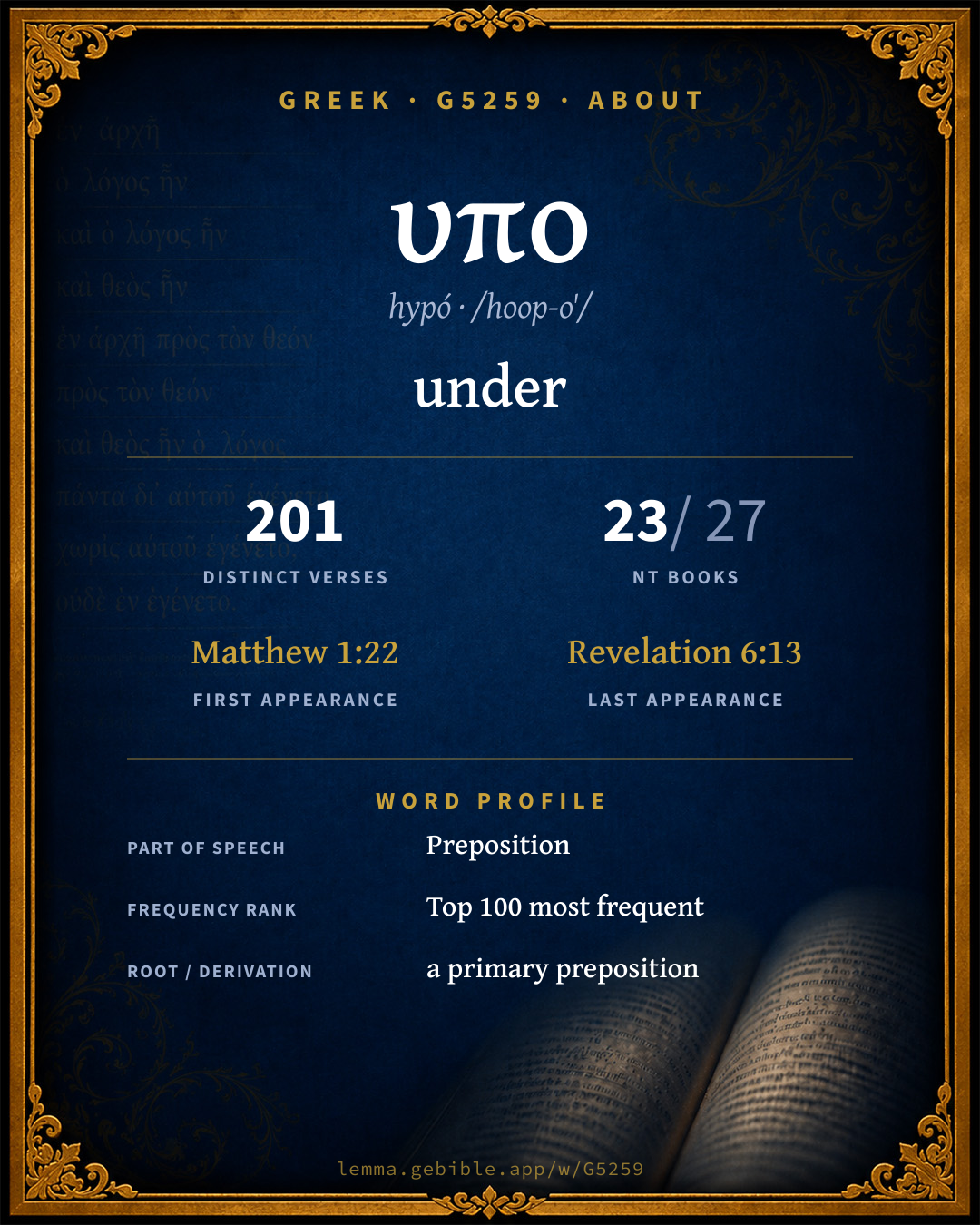
ὑπό
under
Full lexicon entry — Thayer's Greek Lexicon
From Thayer's Greek Lexicon
Where this word appears
Grammar key — what these labels mean
Part of speech
- Preposition
- A relational word governing a noun in a particular case.
Every verse where G5259 appears in the Book of 2 Corinthians — 11 distinct verses. Click any verse to open its interlinear word-by-word view. Verse text shown in the World English Bible for context — . Each verse’s Greek form is shown with its reference; the English is not keyword-highlighted, since the data carries no word-level English alignment. Use “Compare translations” on any verse to read it across multiple English versions. This concordance covers the Greek New Testament; Septuagint (Greek Old Testament) occurrences of this word are not indexed here.
2 Corinthians
- 2 Corinthians 1:4 ὑπὸ prep who comforts us in all our affliction, that we may be able to comfort those who are in any affliction, through the comfort with which we ourselves are comforted by God.
- 2 Corinthians 1:16 ὑφ’ prep and by you to pass into Macedonia, and again from Macedonia to come to you, and to be sent forward by you on my journey to Judea.
- 2 Corinthians 2:6 ὑπὸ prep Sufficient to such a one is this punishment which was inflicted by the many;
- 2 Corinthians 2:11 ὑπὸ prep that no advantage may be gained over us by Satan; for we are not ignorant of his schemes.
- 2 Corinthians 3:2 ὑπὸ prep You are our letter, written in our hearts, known and read by all men;
- 2 Corinthians 3:3 ὑφ’ prep being revealed that you are a letter of Christ, ministered by us, written not with ink, but with the Spirit of the living God; not in tablets of stone, but in tablets that are hearts of flesh.
- 2 Corinthians 5:4 ὑπὸ prep For indeed we who are in this tent do groan, being burdened; not that we desire to be unclothed, but that we desire to be clothed, that what is mortal may be swallowed up by life.
- 2 Corinthians 8:19 ὑπὸ ὑφ’ prep prep Not only so, but who was also appointed by the assemblies to travel with us in this grace, which is served by us to the glory of the Lord himself, and to show our readiness.
- 2 Corinthians 8:20 ὑφ’ prep We are avoiding this, that any man should blame us concerning this abundance which is administered by us.
- 2 Corinthians 11:24 ὑπὸ prep Five times from the Jews I received forty stripes minus one.
- 2 Corinthians 12:11 ὑφ’ prep I have become foolish in boasting. You compelled me, for I ought to have been commended by you, for in nothing was I inferior to the very best apostles, though I am nothing.
About this entry
At a glance — auto-summarized from this page’s data, not written by a person. Every figure links to its source below. This summary describes the numbers; it doesn’t interpret them.
υπο (hypó) is a Greek preposition most often rendered “under.” Debuting at Matthew 1:22, it then recurs through the corpus. With 201 verses in 23 books, it is a common word in the Greek New Testament. From the same root come υπαγω, υπακουω and υπανδρος. For the data behind this summary, explore the sense tree and the renderings breakdown below.
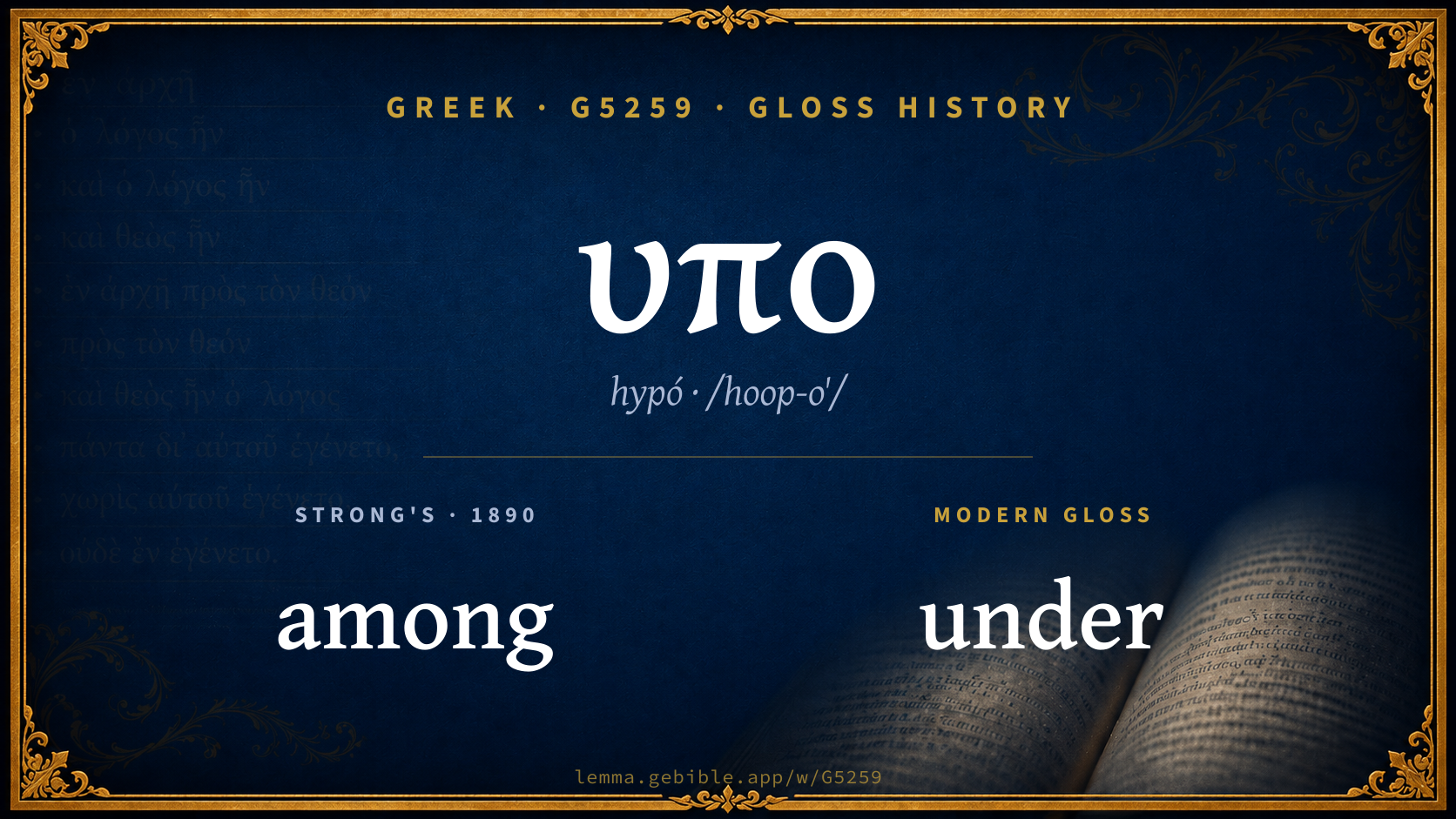
Gloss history
Strong's 1890 vs modern scholarship
About this word
Strong's G5259 catalogs a Greek word from the Greek New Testament.
These counts are not copied from any lexicon or concordance. They are computed here, from the morphology-tagged Greek New Testament. What Lemma adds →
- 201
- distinct verses
- The word appears in 201 distinct verses.
- 23 / 27
- NT books
- The word appears in 23 of 27 New Testament books.
- #73
- by frequency
- Top 100 most frequent Greek words (rank 73 of 5,347 Greek words by occurrence).
View all 201 occurrences in the concordance →
By section of the New Testament
By traditional corpus
Conventional, traditional groupings — biblical authorship is debated, so this is a traditional corpus grouping, not an authorship claim. Some books belong to more than one corpus (Luke is in both the Gospels and the Lukan corpus, and so on), so these shares overlap and need not total 100%. Each figure is a share of the word’s 201 distinct verses.
- Gospels 68 verses · 34%
- Lukan (Luke–Acts) 68 verses · 34%
- Pauline corpus 65 verses · 32%
- General (Catholic) Epistles 17 verses · 8%
- Hebrews 9 verses · 4%
- Johannine 6 verses · 3%
- Revelation 2 verses · 1%
How translations render this word
Counts come from each version’s own published word-to-Strong’s tagging or interlinear alignment — an approximate guide to how each version renders this word, not a word-level alignment the data otherwise carries. Because each total is that version’s own tagged count, the per-version totals vary from one another and need not match the appearance or distinct-verse counts above. These counts may also differ from a printed concordance because Lemma counts each distinctly tagged rendering and does not collapse phrase taggings into a single head-word total. This is a fixed set of word-tagged versions (KJV, ASV, BSB, ULT) and does not change with the reading translation you choose elsewhere. Each version’s license is shown beside its name below (and on Sources).
- King James Version: Of 115×, By 42×, Under 40×
- American Standard Version: Of 80×, By 67×, Under 40×
- Berean Standard Bible: By 98×, Under 42×, From 8×
- unfoldingWord Literal Text: By 165×, Under 47×, From 6×
King James Version Public Domain
Renders G5259 across 229 tagged occurrences — most commonly:
Plus 12 renderings that appear only once — usually multi-word phrases or single function words the recovered tagging swept in, not distinct renderings. Not rendered by a distinct English word in 1 further occurrence.
American Standard Version Public Domain
Renders G5259 across 222 tagged occurrences — most commonly:
Plus 22 renderings that appear only once — usually multi-word phrases or single function words the recovered tagging swept in, not distinct renderings.
Berean Standard Bible Public Domain
Renders G5259 across 161 tagged occurrences — most commonly:
Plus 7 renderings that appear only once — usually multi-word phrases or single function words the recovered tagging swept in, not distinct renderings. Not rendered by a distinct English word in 55 further occurrences.
unfoldingWord Literal Text CC BY-SA 4.0
Renders G5259 across 221 tagged occurrences — most commonly:
Plus 3 renderings that appear only once — usually multi-word phrases or single function words the recovered tagging swept in, not distinct renderings.
Senses in Thayer's
The 1 sense Thayer's distinguishes for this word, in lexicon order (not ranked by frequency or importance). The full entry — with sub-senses — is in the Lexicon Entry tab.
- by, under
Word origin
Origin: a primary preposition
A primary preposition; under that is (with the genitive) of place ( beneath ) or with verbs (the agency or means through ); (with the accusative) of place (whither [ underneath ] or where [ below ]) or time (when [i at ]) : - among by from in of under with. In compounds it retains the same genitive applications especially of inferior position or condition and specifically covertly or moderately .
— Strong’s Exhaustive Concordance (1890), public domain.
Forms in the corpus
The 4 distinct written forms G5259 takes in the Greek New Testament, most frequent first — each parse links to that case’s occurrences in the concordance.
| Form | Parsing | Example | Uses |
|---|---|---|---|
| ὑπὸ hypò | Preposition | Matthew 1:22 | 182 |
| ὑπ’ hyp | Preposition | Matthew 3:6 | 25 |
| ὑφ’ hyph | Preposition | Acts 4:11 | 9 |
| ὑπό hypó | Preposition | Luke 9:7 | 5 |
Same root — word family
Other Thayer's entries built from the same root as G5259, grouped by Strong’s listed origin. These share a root / origin per the lexicon — not necessarily a shared meaning. Each links to that word’s own entry.
Derived from this word
- υπαγω hypágō G5217 to depart
- υπακουω hypakoúō G5219 to listen
- υπανδρος hýpandros G5220 under (married)
- υπανταω hypantáō G5221 to meet
- υπαρχω hypárchō G5225 to be at hand
- υπεικω hypeíkō G5226 to yield
- υπεναντιος hypenantíos G5227 adversary
- υπεχω hypéchō G5254 to sustain
- υπηρετης hypērétēs G5257 servant
- υπνος hýpnos G5258 sleep
- υποβαλλω hypobállō G5260 to instigate
- υπογραμμος hypogrammós G5261 example
- υποδεικνυμι hypodeíknymi G5263 to demonstrate
- υποδεχομαι hypodéchomai G5264 to welcome
- υποδεω hypodéō G5265 to bind on
- υποδικος hypódikos G5267 debtor
- υποζυγιον hypozýgion G5268 beast of burden
- υποζωννυμι hypozṓnnymi G5269 to undergird
- υποκατω hypokátō G5270 underneath
- υποκρινομαι hypokrínomai G5271 to pretend
- υπολαμβανω hypolambánō G5274 to welcome
- υποληνιον hypolḗnion G5276 wine pit
- υπομενω hypoménō G5278 to endure
- υπομιμνησκω hypomimnḗskō G5279 to remind
+16 more words derive from G5259 (not shown).
Compare all same-root words → Showing 4 of 41 — not the complete family. They share a root, not necessarily a meaning.
Septuagint usage
The same Greek word υπο appears 269 times in the Greek Old Testament (Septuagint), across 256 verses in 27 books.
- 269
- LXX occurrences
- Tagged occurrences of this Greek word in the Septuagint.
- 256
- verses
- Distinct Septuagint verses containing this word.
- 27 / 39
- OT books
- The word appears in 27 of the 39 Old Testament books.
Sample Septuagint occurrences
- Genesis 9:2 ὑπό
- Exodus 3:1 ὑπό
- Leviticus 10:6 ὑπό
- Numbers 4:27 ὑπό
- Deuteronomy 3:17 ὑπό
- Joshua 4:9 ὑπό
- Judges 3:16 ὑπό
- Ruth 2:12 ὑπό
- 1 Samuel 14:2 ὑπό
- 2 Samuel 3:39 ὑπό
- 1 Kings 2:46 ὑπό
- 1 Chronicles 10:12 ὑπό
Septuagint occurrences (same lexeme)
Every verse where the same Strong’s number (G5259) appears in the Greek Septuagint — showing the first 50 of 256. Verse text shown in the World English Bible for context; the Greek form is the matched word — the English is not keyword-highlighted.
- Genesis 9:2 ὑπό The fear of you and the dread of you will be on every animal of the earth, and on every bird of the sky. Everything that the ground teems with, and all the fish of the sea are delivered into your hand.
- Genesis 16:9 ὑπό The angel of Yahweh said to her, "Return to your mistress, and submit yourself under her hands."
- Genesis 18:4 ὑπό Now let a little water be fetched, wash your feet, and rest yourselves under the tree.
- Genesis 18:8 ὑπό He took butter, milk, and the calf which he had dressed, and set it before them. He stood by them under the tree, and they ate.
- Genesis 19:8 ὑπό See now, I have two virgin daughters. Please let me bring them out to you, and do you to them as is good in your eyes. Only don't do anything to these men, because they have come under the shadow of my roof."
- Genesis 24:2 ὑπό Abraham said to his servant, the elder of his house, who ruled over all that he had, "Please put your hand under my thigh.
- Genesis 24:9 ὑπό The servant put his hand under the thigh of Abraham his master, and swore to him concerning this matter.
- Genesis 26:29 ὑπό that you will do us no harm, as we have not touched you, and as we have done to you nothing but good, and have sent you away in peace.' You are now the blessed of Yahweh."
- Genesis 35:4 ὑπό They gave to Jacob all the foreign gods which were in their hands, and the rings which were in their ears; and Jacob hid them under the oak which was by Shechem.
- Genesis 35:8 ὑπό Deborah, Rebekah's nurse, died, and she was buried below Bethel under the oak; and the name of it was called Allon Bacuth.
- Genesis 39:9 ὑπο He isn't greater in this house than I, neither has he kept back anything from me but you, because you are his wife. How then can I do this great wickedness, and sin against God?"
- Genesis 41:35 ὑπό Let them gather all the food of these good years that come, and lay up grain under the hand of Pharaoh for food in the cities, and let them keep it.
- Genesis 45:21 ὑπό The sons of Israel did so. Joseph gave them wagons, according to the commandment of Pharaoh, and gave them provision for the way.
- Genesis 45:27 ὑπό They told him all the words of Joseph, which he had said to them. When he saw the wagons which Joseph had sent to carry him, the spirit of Jacob, their father, revived.
- Genesis 47:29 ὑπό The time drew near that Israel must die, and he called his son Joseph, and said to him, "If now I have found favor in your sight, please put your hand under my thigh, and deal kindly and truly with me. Please don't bury me in Egypt,
- Exodus 3:1 ὑπό Now Moses was keeping the flock of Jethro, his father-in-law, the priest of Midian, and he led the flock to the back of the wilderness, and came to God's mountain, to Horeb.
- Exodus 5:14 ὑπό The officers of the children of Israel, whom Pharaoh's taskmasters had set over them, were beaten, and demanded, "Why haven't you fulfilled your quota both yesterday and today, in making brick as before?"
- Exodus 14:27 ὑπό Moses stretched out his hand over the sea, and the sea returned to its strength when the morning appeared; and the Egyptians fled against it. Yahweh overthrew the Egyptians in the midst of the sea.
- Exodus 16:3 ὑπό and the children of Israel said to them, "We wish that we had died by the hand of Yahweh in the land of Egypt, when we sat by the flesh-pots, when we ate our fill of bread, for you have brought us out into this wilderness, to kill this whole assembly with hunger."
- Exodus 17:12 ὑπό But Moses' hands were heavy; and they took a stone, and put it under him, and he sat on it. Aaron and Hur held up his hands, the one on the one side, and the other on the other side. His hands were steady until sunset.
- Exodus 17:14 ὑπό Yahweh said to Moses, "Write this for a memorial in a book, and rehearse it in the ears of Joshua: that I will utterly blot out the memory of Amalek from under the sky."
- Exodus 19:17 ὑπό Moses led the people out of the camp to meet God; and they stood at the lower part of the mountain.
- Exodus 21:20 ὑπό "If a man strikes his servant or his maid with a rod, and he dies under his hand, he shall surely be punished.
- Exodus 22:29 ὑπό "You shall not delay to offer from your harvest and from the outflow of your presses. "You shall give the firstborn of your sons to me.
- Exodus 23:5 ὑπό If you see the donkey of him who hates you fallen down under his burden, don't leave him, you shall surely help him with it.
- Exodus 24:4 ὑπό Moses wrote all the words of Yahweh, and rose up early in the morning, and built an altar under the mountain, and twelve pillars for the twelve tribes of Israel.
- Exodus 24:10 ὑπό They saw the God of Israel. Under his feet was like a paved work of sapphire stone, like the skies for clearness.
- Exodus 25:27 ὑπό the rings shall be close to the rim, for places for the poles to carry the table.
- Exodus 25:35 ὑπό and a bud under two branches of one piece with it, and a bud under two branches of one piece with it, and a bud under two branches of one piece with it, for the six branches going out of the lampstand.
- Exodus 27:5 ὑπό You shall put it under the ledge around the altar beneath, that the net may reach halfway up the altar.
- Exodus 30:4 ὑπό You shall make two golden rings for it under its molding; on its two ribs, on its two sides you shall make them; and they shall be for places for poles with which to bear it.
- Exodus 32:19 ὑπό It happened, as soon as he came near to the camp, that he saw the calf and the dancing: and Moses' anger grew hot, and he threw the tablets out of his hands, and broke them beneath the mountain.
- Exodus 36:29 ὑπό They were double beneath, and in like manner they were all the way to the top of it to one ring. He did thus to both of them in the two corners.
- Exodus 38:24 ὑπό All the gold that was used for the work in all the work of the sanctuary, even the gold of the offering, was twenty-nine talents, and seven hundred thirty shekels, after the shekel of the sanctuary.
- Exodus 40:20 ὑπό He took and put the testimony into the ark, and set the poles on the ark, and put the mercy seat above on the ark.
- Leviticus 10:6 ὑπό Moses said to Aaron, and to Eleazar and to Ithamar, his sons, "Don't let the hair of your heads go loose, neither tear your clothes; that you don't die, and that he not be angry with all the congregation: but let your brothers, the whole house of Israel, bewail the burning which Yahweh has kindled.
- Leviticus 20:16 ὑπό "'If a woman approaches any animal, and lies down with it, you shall kill the woman, and the animal: they shall surely be put to death; their blood shall be upon them.
- Leviticus 22:27 ὑπό "When a bull, or a sheep, or a goat, is born, then it shall remain seven days with its mother; and from the eighth day and thenceforth it shall be accepted for the offering of an offering made by fire to Yahweh.
- Leviticus 26:43 ὑπό The land also will be left by them, and will enjoy its sabbaths while it lies desolate without them: and they will accept the punishment of their iniquity; because, even because they rejected my ordinances, and their soul abhorred my statutes.
- Leviticus 27:32 ὑπό All the tithe of the herds or the flocks, whatever passes under the rod, the tenth shall be holy to Yahweh.
- Numbers 4:27 ὑπό At the commandment of Aaron and his sons shall be all the service of the sons of the Gershonites, in all their burden, and in all their service; and you shall appoint to them in charge all their burden.
- Numbers 4:31 ὑπό This is the charge of their burden, according to all their service in the Tent of Meeting: the tabernacle's boards, its bars, its pillars, its sockets,
- Numbers 4:32 ὑπό and the pillars of the court around it, and their sockets, and their pins, and their cords, with all their instruments, and with all their service: and by name you shall appoint the instruments of the charge of their burden.
- Numbers 5:19 ὑπό The priest shall cause her to swear, and shall tell the woman, 'If no man has lain with you, and if you haven't gone aside to uncleanness, being under your husband, be free from this water of bitterness that brings a curse.
- Numbers 5:20 ὑπό But if you have gone astray, being under your husband, and if you are defiled, and some man has lain with you besides your husband:'
- Numbers 5:29 ὑπό "This is the law of jealousy, when a wife, being under her husband, goes astray, and is defiled;
- Numbers 6:18 ὑπό The Nazirite shall shave the head of his separation at the door of the Tent of Meeting, and shall take the hair of the head of his separation, and put it on the fire which is under the sacrifice of peace offerings.
- Numbers 26:64 ὑπό But among these there was not a man of them who were numbered by Moses and Aaron the priest, who numbered the children of Israel in the wilderness of Sinai.
- Deuteronomy 3:17 ὑπό the Arabah also, and the Jordan and the border [of it], from Chinnereth even to the sea of the Arabah, the Salt Sea, under the slopes of Pisgah eastward.
- Deuteronomy 4:11 ὑπό You came near and stood under the mountain; and the mountain burned with fire to the heart of the sky, with darkness, cloud, and thick darkness.
These are occurrences of the same Greek lexeme (G5259) in the Septuagint — not a translation of any one Hebrew word. The store carries no word-level Hebrew↔Greek alignment, so no Hebrew original is asserted here. Counts come from the recovered LXX Strong's tagging — high-frequency vocabulary is well covered, while rare or late forms may be untagged — so they reflect tagged occurrences and may slightly undercount.