2 Corinthians 1:16

Greek (Tischendorf 8th ed.) 2 Corinthians 1:16 appears in the Greek New Testament. The text above is from the Tischendorf 8th edition. Each word links to its Strong’s number and a concise gloss. Click any word for its full Thayer’s Greek Lexicon entry.
Download image
Cite this verse

2 Corinthians 1:16 (World English Bible). Public Domain. Lemma interlinear Bible study tool, https://lemma.gebible.app/v/2-corinthians/1/16.

Show BibTeX & RIS
BibTeX
RIS
English Translation
and by you to pass into Macedonia, and again from Macedonia to come to you, and to be sent forward by you on my journey to Judea.
World English Bible · Public Domain
Download a study sheet

One document with this verse’s original text, its word-by-word gloss line, the meaning frame, cross-references with their text, attributed commentary, and full source and license credits — printable, and it pastes into notes with its structure intact.

This verse Autodidact and up

Study sheet (.html) Plain text (.txt)

A passage Seminary Student

Up to 50 verses in one chapter. A passage sheet keeps up to 6 commentary sources and 12 cross-references per verse, in the order this page ranks them, and says so on the sheet whenever that leaves anything out. Ask for a single verse and you get the Autodidact verse sheet above.

Everything on this page stays free to read, with no account — the sheet is a download of what is already on screen, not access to it.

Want to remove ads? Support Godless Engineer
Compare translations 3

The same verse in 3 English versions, stacked beneath the original-language interlinear above. Click any original word for its lexicon entry.

Each is an independent rendering of the whole verse — the interlinear is not word-aligned to these translations.

Highlighted words mark where these versions differ — a whole-verse word diff, not a word-by-word alignment.

  • World English Bible Public Domain
    and by you to pass into Macedonia, and again from Macedonia to come to you, and to be sent forward by you on my journey to Judea.
  • King James Version Public Domain
    And to pass by you into Macedonia, and to come again out of Macedonia unto you, and of you to be brought on my way toward Judaea.
  • unfoldingWord Literal Text CC BY-SA 4.0
    and to pass through you into Macedonia and to come to you again from Macedonia and to be sent ahead to Judea by you.

unfoldingWord Literal Text — © unfoldingWord, licensed CC BY-SA 4.0. Word-aligned USFM3 via Door43 (git.door43.org/unfoldingWord/en_ult).

Versions to compare (up to 4)

3 of 4 selected

Show all 19 translations

Every available English version of this verse, each an independent rendering of the whole verse.

  • World English Bible Public Domain
    and by you to pass into Macedonia, and again from Macedonia to come to you, and to be sent forward by you on my journey to Judea.
  • Berean Standard Bible Public Domain
    I wanted to visit you on my way to Macedonia, and to return to you from Macedonia, and then to have you help me on my way to Judea.
  • Majority Standard Bible Public Domain
    I wanted to visit you on my way to Macedonia, and to return to you from Macedonia, and then to have you help me on my way to Judea.
  • King James Version Public Domain
    And to pass by you into Macedonia, and to come again out of Macedonia unto you, and of you to be brought on my way toward Judaea.
  • American Standard Version (1901) Public Domain
    and by you to pass into Macedonia, and again from Macedonia to come unto you, and of you to be set forward on my journey unto Judaea.
  • Revised Version (1885) Public Domain
    and by you to pass into Macedonia, and again from Macedonia to come unto you, and of you to be set forward on my journey unto Judaea.
  • Geneva Bible (1599) Public Domain
    And to passe by you into Macedonia, and to come againe out of Macedonia vnto you, and to be led foorth towarde Iudea of you.
  • Douay-Rheims (1899) Public Domain
    And to pass by you into Macedonia, and again from Macedonia to come to you, and by you to be brought on my way towards Judea.
  • Young's Literal Translation Public Domain
    and through you to pass to Macedonia, and again from Macedonia to come unto you, and by you to be sent forward to Judea.
  • Literal Standard Version CC BY-SA 4.0
    and to pass to Macedonia through you, and to come to you again from Macedonia, and to be sent forward by you to Judea.
  • Unlocked Literal Bible CC BY-SA 4.0
    I was planning to visit you on my way to Macedonia. Then I wanted to visit you again on my trip from Macedonia, and then for you to send me on my way to Judea.
  • unfoldingWord Literal Text CC BY-SA 4.0
    and to pass through you into Macedonia and to come to you again from Macedonia and to be sent ahead to Judea by you.
  • Darby Bible Public Domain
    and to pass through to Macedonia by you, and again from Macedonia to come to you, and to be set forward by you to Judaea.
  • World Messianic Bible Public Domain
    and by you to pass into Macedonia, and again from Macedonia to come to you, and to be sent forward by you on my journey to Judea.
  • Webster's Bible Public Domain
    And to pass by you into Macedonia, and to come again from Macedonia to you, and by you to be brought on my way towards Judea.
  • Free Bible Version CC BY-SA 4.0
    as I would go on from you to Macedonia, and then return from Macedonia to you. Then I would have had you send me on my way to Judea.
  • Bible in Basic English Public Domain
    And by way of Corinth to go into Macedonia, and from there to come back again to you, so that you might send me on my way to Judaea.
  • Text-Critical English NT CC BY 4.0
    I wanted to visit you on my way to Macedonia and return to you from Macedonia, and then have you send me on my way to Judea.
  • Tyndale New Testament (1534) Public Domain
    and to have passed by you into Macedonia and to have come agayne out of Macedonia vnto you and to have bene ledde forth to Iewrye warde of you.

Literal Standard Version (2020), Covenant Press — licensed CC BY-SA 4.0. Text via the HelloAO Bible API (eBible.org). Unlocked Literal Bible (unfoldingWord) — licensed CC BY-SA 4.0. Text via the HelloAO Bible API (eBible.org). unfoldingWord Literal Text — © unfoldingWord, licensed CC BY-SA 4.0. Word-aligned USFM3 via Door43 (git.door43.org/unfoldingWord/en_ult). Free Bible Version, Dr. Jonathan Gallagher — licensed CC BY-SA 4.0. Text via the HelloAO Bible API (eBible.org).

Word by word

More ways to search: Search by grammar → Find every occurrence → Compare this word →

Practice this passage: Drill this verse → Learn its vocabulary →

προπεμφθῆναι
propémpō
G4311
“to send before”
Verb, Aorist, Passive, Infinitive
Part of Speech
Verb
Tense
Aorist
Voice
Passive
Mood
Infinitive
Full Thayer's Definition

Origin: from G4253 and G3992

TDNT: None

1. to send before 2. to send forward, bring on the way, accompany or escort 3. to set one forward, fit him out with the requisites for a journey
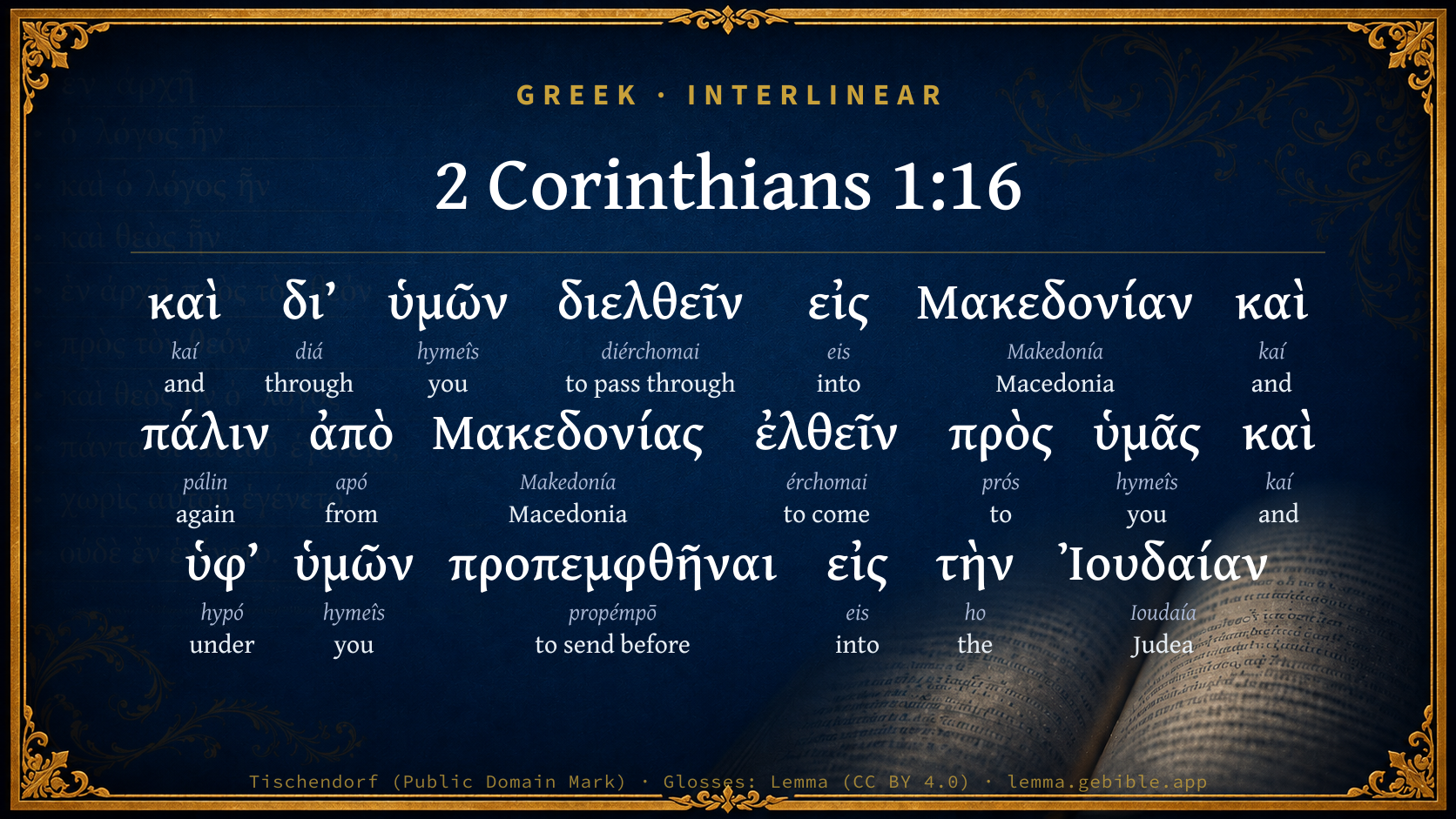
  1. καὶ kaí G2532 “and” Conjunction
  2. δι’ diá G1223 “through” Preposition
  3. ὑμῶν hymeîs G5210 “you” Personal pronoun, 2nd person, Genitive, Plural
  4. διελθεῖν diérchomai G1330 “to pass through” Verb, Aorist, Active, Infinitive
  5. εἰς eis G1519 “into” Preposition
  6. Μακεδονίαν Makedonía G3109 “Macedonia” Noun, Accusative, Singular, Feminine
  7. καὶ kaí G2532 “and” Conjunction
  8. πάλιν pálin G3825 “again” Adverb
  9. ἀπὸ apó G575 “from” Preposition
  10. Μακεδονίας Makedonía G3109 “Macedonia” Noun, Genitive, Singular, Feminine
  11. ἐλθεῖν érchomai G2064 “to come” Verb, Aorist, Active, Infinitive
  12. πρὸς prós G4314 “to” Preposition
  13. ὑμᾶς hymeîs G5210 “you” Personal pronoun, 2nd person, Accusative, Plural
  14. καὶ kaí G2532 “and” Conjunction
  15. ὑφ’ hypó G5259 “under” Preposition
  16. ὑμῶν hymeîs G5210 “you” Personal pronoun, 2nd person, Genitive, Plural
  17. εἰς eis G1519 “into” Preposition
  18. τὴν ho G3588 “the” Article, Accusative, Singular, Feminine
  19. Ἰουδαίαν Ioudaía G2449 “Judea” Noun, Accusative, Singular, Feminine

About this verse

These counts appear in no published source. They are computed here, from the morphology-tagged text and Lemma’s own curated glosses. What Lemma adds →

20
words
14
distinct lemmas
Pauline Epistles
section

Notable vocabulary

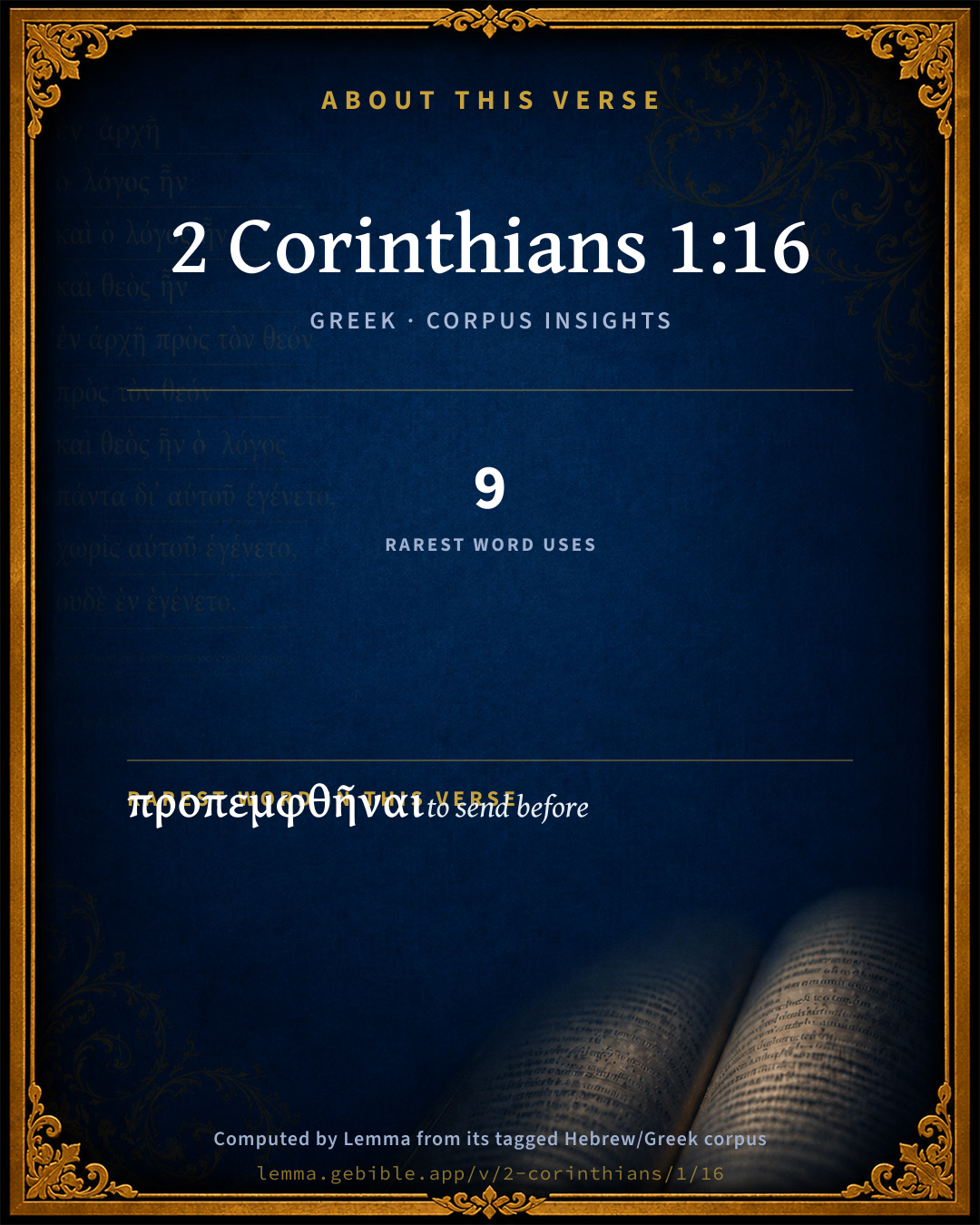
The rarest word here is προπεμφθῆναι to send before G4311 — appearing just 9 times in the whole Greek New Testament.

Shared distinctive vocabulary

προπεμφθῆναι to send before G4311 occurs in 9 verses of the Greek New Testament. Also found in:

Repetition

Words recur within this verse:

  • εἰς into G1519 ×2
  • Μακεδονίαν Macedonia G3109 ×2
  • καὶ and G2532 ×3
  • ὑμῶν you G5210 ×3

Cross-references

3

Topical passages linked to 2 Corinthians 1:16 in the Treasury of Scripture Knowledge — connected by theme and wording, ordered by reader-vote popularity; previews shown in the World English Bible.

  • 1 Corinthians 16:5–7 But I will come to you when I have passed through Macedonia, for I am passing through Macedonia.
  • Acts 19:21–22 Now after these things had ended, Paul determined in the spirit, when he had passed through Macedonia and Achaia, to go to Jerusalem, saying, "After I have been there, I must also see Rome."
  • Acts 21:5 When it happened that we had accomplished the days, we departed and went on our journey. They all, with wives and children, brought us on our way until we were out of the city. Kneeling down on the beach, we prayed.

Cross-references courtesy of OpenBible.info (CC BY 4.0).

Commentary

Notes on 2 Corinthians 1:16 from classic Christian and Jewish commentators (each source and its license shown beneath its notes). The classic Christian expositions comment on the surrounding passage and are grouped to its opening verse, so a note may address several verses; the Jewish commentaries on the Tanakh (Rashi and others) are per-verse, so they appear only where the commentator wrote on this verse.

Lemma curates 59 commentaries, every one of them public domain or Creative Commons licensed, each selected and text-cleaned for this edition rather than reprinted as found. About our sources →

Godbey's Commentary on the New Testament

William B. Godbey

YEA AND NAY, AND YEA

2Co 1:16-24.

16. He traveled from Asia across the sea to Northern Greece, and then through Macedonia down into Achaia, spending the winter of A. D. 57-58 at Corinth, and writing the epistle to the Romans, leaving early in the spring for Jerusalem again, to visit the dear saints and bear to them the benefactions of the Gentile churches.

17. “Then wishing this, whether then did I use lightness a purpose or whatsoever things I wish, whether do I wish according to the flesh, in order that it may be with me yea, yea, and nay, nay.

18. “But God is faithful, because our word toward you is not yea and nay.

19. “For Christ Jesus, the Son of God, who is among you, having been preached by us, through me and Silas and Timothy, was not yea and nay, but in Him it was yea.

20. “For so many promises of God in Him are yea: therefore indeed through Him it is amen unto God for glory through us.

21. “He that strengthened us along with you, and anointeth us, is God,

22. “Who also having sealed us, and given us the earnest of the Spirit in our hearts.” This paragraph is regarded as very obscure. I realize the light shining through it clear and cloudless, and feel that you will not only be enabled to receive it, but find a blessing in it. Paul’s original plan while over in Asia was to sail into Achaia first and then proceed on into Macedonia. This plan had been communicated to them by Timothy while Paul was still at Ephesus. He afterward changed his plan, in order to give them more time to repent, wheel into line, and straighten up all their irregularities before his arrival, lest he find it necessary severely to administer the disciplinary rod. This change of plan on the part of Paul should be profitable to you and me, illustrating the difference between the human and the Divine leadership. Paul had been preaching in Asia three years, finally getting around to Europe again. I have appointments out now for the next three years. That is a human program, which is innocent within itself, but final in no case, because it is liable to be changed anywhere and everywhere by the Divine leadership, which is not anticipatory at long range like human plans, but is in the present tense. Hence, responding to calls in all parts of the continent, and giving dates far out in the future, I constantly insert “D. V.,” which means “God willing,” giving me all needed latitude and longitude to go anywhere in this world or up to Heaven, instead of fulfilling the list of appointments. Some of the people at Corinth were charging Paul with instability because he changed his program and went to Macedonia first. Of course, God knew all the time that He was going to lead him into Macedonia first and from there down into Achaia; but we see that Paul, like the rest of us, had a human program which was every day and hour liable to be interrupted by the Divine leadership, bringing to him no disappointment whatever, because his will was lost in God, and, while we do not feel free to ignore the adumbrations of our future pilgrimage, yet we recognize the perpetual Divine leadership in the present tense, Jesus walking by my side and leading me with His hand. Here Paul castigates the Corinthians for imputing to him human motives involving personal instability. Hence he assures them that it is not with him “yea and nay,” like the worldly people who talk about “luck” and “failure,” and “good luck” and “bad luck.” That is the language of the card-table and the horserace. So he corrects it by referring to our Savior, with whom it was not “yea and nay,” but in Him all things are “yea.” What is the meaning of that? Worldly people are tossed amid ambiguities, and have haphazardous adventures all the time. Everything with them is a matter of “luck” and “failure,” “success” and “disappointment.” With God’s holy people, who are lost in His will, there is no such a thing as “bad luck,” “failure” or “disappointment”. Because

“all things work together for good to them who love God, who are the elect according to His purpose” (Rom 8:29).

Since “my will is the will of my God,” and if I am true to Him I know that His will is carried out in my behalf all the time, therefore there is no such a thing as disappointment, because the Lord’s will is constantly verified if I am true and obedient. Hence everything is “good luck” to me. It is all “yea,” and there is no “nay” about it. My whole life is made up of positives and no negatives; victories and no defeats. The blessed indwelling Holy Spirit is to us the Earnest, i. e., the prelibation, of Heaven.

23. “I call God to witness to my soul that sparing you I came not into Corinth.” If he had come at the time they were looking for him, he would have been under the necessity of enforcing severe discipline and turning a lot of them out of the church. As it was he had judiciously delayed, at the same time sending to them these powerful letters in which all the heresies, abuses, disorders and irregularities were corrected, and sending to them first Timothy and then Silas to preach to them and lead them into repentance necessary to satisfy the demands of God’s Word. The whole scheme worked out in perfect harmony, so that when he came they had nothing to do but meet him with a shout, and sit down and enjoy his powerful preaching.

24. “Not that we domineer over your faith, but we are fellow-partakers of your joy: for by faith you stand.” Paul was far from the attitude of an ecclesiastical autocrat, demanding of them loyalty and obedience to a lot of ecclesiastical institutions. There was nothing of that kind. All he asked of them was to be true to God, taking His precious Word as their only authority, and he was ready to shout with them. Faith is the great fundamental grace underlying all others, and holding up the superstructure of Christian character. Yet faith must have standing ground, which is in case of the sinner a radical and complete repentance and in case of the Christian a thorough and unequivocal consecration.

William B. Godbey, Commentary on the New Testament (1896–1900) — public domain. Text from a community e-Sword module.

Bengel's Gnomon

Johann Albrecht Bengel

2Co 1:16. Προπεμφθῆναι, to be brought on my way) to commit myself to you to be escorted [conducted] forward.

Bengel's Gnomon of the New Testament — English translation (T&T Clark, Edinburgh, 1860) — public domain. Text from a community e-Sword module.

Expositor's Greek Testament

ed. W. Robertson Nicoll

2Co 1:16 . προπεμφθῆναι : “to be set forward on my journey”. The practice of speeding fellow-Christians on their journeys, of “seeing them off” in safety, is often mentioned in Acts , and is inculcated more than once as a duty by St. Paul (see reff.).

The Expositor's Greek Testament, edited by W. Robertson Nicoll (1897–1910) — public domain. Text from a community e-Sword module.

Jamieson, Fausset & Brown

Robert Jamieson, A. R. Fausset & David Brown

This intention of visiting them on the way to Macedonia, as well as after having passed through it, must have reached the ears of the Corinthians in some way or other--perhaps in the lost Epistle (Co1 4:18; Co1 5:9). The sense comes out more clearly in the Greek order, "By you to pass into Macedonia, and from Macedonia to come again unto you."

Jamieson, Fausset & Brown — Commentary Critical and Explanatory on the Whole Bible (1871) — public domain (CC PDM 1.0). Text via the HelloAO Bible API.

Adam Clarke's Commentary

Verse 16. To pass by you into Macedonia] He had purposed to go to Macedonia first, and then from Macedonia return to them, and probably winter in Corinth. Therefore we must understand the δι' ὑμων, by you, as implying that he would sail up the AEgean Sea, leaving Corinth to the west; though he might have taken it in his way, and have gone by land through Greece up to Macedonia. Some think that the meaning is, that he purposed to take Achaia in his way to Macedonia, without calling at Corinth; but Achaia was out of his way considerably, and he could scarcely go through Achaia without passing close by Corinth. I consider the words, therefore, as implying that he purposed not to call at Corinth at that time, but to pass by it, as before stated.

Adam Clarke's Commentary on the Bible (1810–1826) — public domain. Text from a community e-Sword/MySword module.

Ellicott's Commentary for English Readers

(16) To be brought on my way.—The change of word is significant. He did not intend merely to go from Corinth to Judaea. He expected the Corinthians to further his intentions, to help him on, to escort him solemnly to the ship in which he was to sail, perhaps to accompany him to Asia. (Comp. the use of the word in Act_15:3; Act_20:38, “accompanied”; 21:5; Rom_15:24; 1Co_16:6-11.) The wish had been stated in 1Co_16:6, but without more than a hint (1Co_16:4), that his destination might be Jerusalem,

A Bible Commentary for English Readers, edited by Charles John Ellicott (1878–1897) — public domain. Text from a community e-Sword module.

The Cambridge Bible for Schools and Colleges

gen. ed. J. J. S. Perowne

16. to pass by you into Macedonia] It was probably when this resolution (which may have been announced in the lost Epistle, see 1Co_5:9) was given up, that the mission of Timothy referred to in 1Co_4:17, and in Act_19:22 was substituted, and as still more urgent necessity arose, that of Titus, ch. 2Co_8:16-24, 2Co_12:17-18.

and of you to be brought on my way toward Judæa] The exact opposite of this was what actually took place. St Paul went through Macedonia on his way to Corinth, and returned through Macedonia, and was brought on his way toward Judæa by the Macedonian Churches. The word translated ‘brought on my way’ is used of the pecuniary and other assistance given by the Churches towards the journeys of the brethren. See Act_15:3; Act_20:38; Act_21:5; Rom_15:24; 1Co_16:6; 1Co_16:11; Tit_3:13; 3Jn_1:6, and note on 1Co_16:6.

The Cambridge Bible for Schools and Colleges (gen. ed. J. J. S. Perowne; Cambridge University Press, 1878–1918) — public domain. Text from a community e-Sword module.

John Gill's Exposition

And to pass by you into Macedonia,.... It was his first intention and determination to have come first to Corinth, and then to Macedonia, to have took this city in his way thither; which was an argument of his love to them, and his great desire to see them; since he might have gone, as he did, a nearer way to Macedonia, than by Corinth:

and to come again out of Macedonia to you; when he had gone through that, and done his business there unto the Corinthians; and after some stay with them,

of you to be brought on my way towards Judea; where he intended to go, with the collections he had made for the poor saints at Jerusalem, in the several churches in Asia; but though this was his first resolution, which he had signified either by letter, or messengers, yet he afterwards changed his mind, for some reasons within himself; it may be, having heard some things disagreeable of them, which he thought more convenient to acquaint them with in an epistle first, and to try what effect that would have upon them, before he came in person: that he changed his mind, appears from the former epistle, Co1 16:5, where he says, "I will come unto you, when I shall pass through Macedonia"; and upon this account it is he excuses and vindicates himself in the following verse.

John Gill's Exposition of the Whole Bible (1746–1763) — public domain (CC PDM 1.0). Text via the HelloAO Bible API.

Trapp's Complete Commentary

John Trapp

16 And to pass by you into Macedonia, and to come again out of Macedonia unto you, and of you to be brought on my way toward Judaea.

Ver. 16. And to pass by you] So indefatigable and unsatisfiable was he in doing God service. Calvin said, Ne decem quidem maria, &c., that it would not grieve him to sail over 10 seas, about a uniform draught for religion.

John Trapp, A Commentary or Exposition upon All the Books of the Old and New Testament (1647–1656) — public domain. Text from a community e-Sword module.

Albert Barnes' Notes on the Bible

And to pass by you - Through δι ̓ di' you; that is, through your city, or province; or to take them, as we say, in his way. His design was to pass through Corinth and Achaia on his journey. This was not the direct way from Ephesus to Macedonia. An inspection of a map will show at one view that the direct way was that which he concluded finally to take - that by Troas. Yet he had designed to go out of his way in order to make them a visit; and intended also, perhaps, to make them also a longer visit on his return. The former part of the plan he had been induced to abandon.

Into Macedonia - A part of Greece having Thrace on the north, Thessaly south, Epirus west and the AEgean Sea east; see the note, Act 16:9.

And of you to be brought on my way - By you; see the note, 1Co 16:6.

Toward Judea - His object in going to Judea was to convey the collection for the poor saints which he had been at so much pains to collect throughout the churches of the Gentiles; see the notes, Rom 15:25-26; compare 1Co 16:3-4.

Albert Barnes' Notes on the Bible (1834–1885) — public domain. Text from a community e-Sword/MySword module.

Matthew Poole's English Annotations

He had purposed to take Corinth in his way unto Macedonia, and after he had finished his business in Macedonia, his resolutions were to have come back to Corinth, and to stay with them some time, hoping to have some of their company some part of the way toward Judea: but it seems, though he thus purposed, yet God had otherwise ordered his motions.

Matthew Poole's English Annotations on the Holy Bible (1683–1685) — public domain. Text from a community e-Sword/MySword module.

Whedon's Commentary on the Bible

Daniel D. Whedon

16. And—By the plan here proposed Corinth was to have been both Paul’s sallying and his rallying point—his centre and capital—during this European visit. But the news brought by the Chloe folks, confirmed by Stephanas and his colleagues, shook Corinth out of its supreme place in his confidence. This sinking of Corinth capital is implied in 1Co_16:5, and probably became known at Corinth through Stephanas and colleagues, and, perhaps, through Titus and Timothy, and gave vantage ground to St. Paul’s detractors.

Into… out of—He would have crossed the AEgean, straight from Ephesus to Corinth; thence he would have visited Macedonia and gone back again.

Of you to be brought on my way—By a furnishing of travelling outfit and an escort of honour. So high did the Corinthian saints stand in the apostle’s expectations. Then to be told (1Co_16:5) that they were to be an incident subordinate to Macedonia, was a severe check upon Corinth. St. Paul’s opponents could now say that he was fickle; was vexed because Corinth had not sufficiently idolized him; and that thence he was a self-seeking pseudo-apostle. Paul will now give a different version of his change of purpose.

Daniel D. Whedon (gen. ed.), Commentary on the Old and New Testaments (1874–1909) — public domain. Text from a community e-Sword module.

The Pulpit Commentary

To be brought on my way (see note on 1Co_16:6) toward Judaea. (1Co_16:4-6)

The Pulpit Commentary (1880–1919), ed. H.D.M. Spence-Jones & Joseph S. Exell — public domain. Text from a community e-Sword module.

Burkitt's Expository Notes on the New Testament

William Burkitt

Observe here, 1. How the heart of this holy apostle was carried forth in the service of God and souls, and how accordingly he orders all his journeys from one place to another, and determines his continuance and stay, longer in one place than another, as the glory of God, the advantage of the gospel, and the church’s necessities, did require: I design to pass by you into Macedonia, &c. It is the duty of the ministers of Christ not only to lay out themselves for the glory of God, and the good of souls, but to project, forecast, and contrive how they may do it in the best and most advantageous manner, for the furtherance of the gospel.

Yet, 2. Observe the difference between this extraordinary apostle then, and ordinary pastor of the church now. The apostles had an universal commission to plant churches in all places; they were to be in constant travels up and down the world, itinerary preachers from place to place; but the office of an ordinary pastor now is, to watch over a particular flock, and to keep constant residence amongst them.

Yet though by actual relation he is tied and bound to a particular flock, he is by habitual and aptitudinal disposition a minister of the universal church, and a debtor to the public good thereof. He is first made a minister in the universal church, and then a pastor of a particular congregation; and accordingly, though he seeks to serve the interest of his own flock first, yet it is his duty, by prayer, by study, by preaching, by writing, by all other edifying ways and methods, to promote the universal good and benefit of the whole church of Christ according to his power, both far and near.

William Burkitt's Expository Notes on the New Testament (1700–1703) — public domain. Text from a community e-Sword module.

McGarvey & Pendleton's Commentaries

J. W. McGarvey

and by you to pass into Macedonia, and again from Macedonia to come unto you, and of you to be set forward on my journey unto Judaea . [i. e., trusting in our mutual love, it was my intention to visit you before visiting the Macedonians, that you might have two visits or benefits, one before I went into Macedonia and one when I came out; and I also, trusting in your love, looked to you, instead of to others, to forward me on my journey. The apostle had evidently told the Corinthians of this plan in the lost letter which has already been mentioned. See Introduction to 1 Corinthians, page 49; also 1Co_5:9 . And then he had changed his plan, as we see by 1Co_16:5-7 ; and note. This change of plan gave Paul's enemies a chance to accuse him of unprincipled equivocation, as though he said: (1) "Yes, I will come to you first: no, I will come to the Macedonians first." (2) "Yes, I will pay you two visits: no, I will pay you only one visit." (3) "Yes, I am coming soon: no, I am not coming soon."]

J. W. McGarvey (with Philip Y. Pendleton), Commentaries on the New Testament (The Fourfold Gospel, 1914; Acts; and the epistles) — public domain. Text from a community e-Sword/MySword module.

Cambridge Greek Testament for Schools and Colleges

16. διʼ ὑμῶν διελθεῖν εἰς Μακεδονίαν. ‘To pass by you into M.’ (A.V.) suggests ‘pass by without visiting you,’ which is the opposite of the meaning. ‘By you to pass into M.’ (R.V.) suggests ‘by your help to pass on to M.’ which is not the meaning. The meaning is, through you to pass on unto M., and again from M. to come to you, and by you to be set forward on my way unto Judaea. The changes, εἰς … πρός … εἰς should be marked in translation; ‘unto … to … unto,’ or ‘into … unto … into’: not ‘into … unto … toward’ (A.V.), nor ‘into … unto … unto’ (R.V.).

Cambridge Greek Testament for Schools and Colleges (Cambridge University Press, 1896; 21 vols, various authors incl. Carr, Maclear, Plummer, Farrar, Lumby, Moule, M. R. James, Simcox) — public domain. Text from a community e-Sword module.

Alford’s Greek Testament

Henry Alford

16.] If this is the same journey which is announced in 1Co 16:5, the idea of visiting them in the way to Macedonia as well as after having passed through it, must have occurred to him subsequently to the sending of that Epistle; or may even then have been a wish, but not expressed, from uncertainty as to its possibility,—the main and longer visit being there principally dwelt on. But perhaps the following is the more likely account of the matter. He had announced to them in the lost Epistle (see 1Co 5:9) his intention, as here, of visiting them on his way to Macedonia: but the intelligence from “them of Chloe” had altered his intention, so that, in 1Co_16, he speaks of visiting them after he should have passed through Macedonia. For this he was accused of levity of purpose. Certainly, some intention of coming to them seems to have been mentioned in that lost Epistle: see 1Co 4:18. But the προπεμφθῆναι εἰς τὴν Ἰουδαίαν can hardly but be coincident with the alms-bearing scheme of 1Co 16:4; in which case the two plans certainly are modifications of one and the same.

Henry Alford, The Greek Testament (1849–1861) — public domain. Text from a community e-Sword module.

International Critical Commentary

16. καὶ διʼ ὑμῶν … εἰς τ. Ἰουδαίαν. Both AV and RV are somewhat misleading, and neither marks the sequence of prepositions (εἰς…πρὸς … εἰς) correctly. ‘Pass by you’ may mean ‘go past without visiting you’; and ‘by you to pass’ may mean ‘to be sent on by you’; both of which are wrong. Translate, ‘Through you to pass on unto M., and again from M. to come to you, and by you to be set forward on my way unto Judaea.’

διελθεῖν (א B C D3 E K L, Latt.) rather than ἀπελθεῖν (A D* F G P, Copt. Arm.).

International Critical Commentary — older volumes (1896–1929), various authors — public domain. Text from a community e-Sword module.

Lesson kit

Teaching starters — assembled from the data on this page, not authored interpretation. Every prompt links to the verse data it draws on. Edit before teaching.

2 Corinthians, in the Pauline Epistles, opens this verse with 20 words (14 distinct Greek lemmas). Its most distinctive word is propémpō (“to send before”). A historical commentator’s framing appears above. Read the whole chapter for the surrounding context.

Discussion questions

  1. The word propémpō carries the sense “to send before.” How does it shape the verse?
  2. Acts 15:3 shares the word «to send before» with this verse. How do the two illuminate each other?
  3. “into” occurs 2× in this one verse. What is the effect of the repetition?
  4. The translations on this page render this verse differently — a whole-verse word diff, not a word-by-word alignment. What might account for the different wordings?
  5. Reading how Godbey's Commentary on the New Testament and Bengel's Gnomon read this verse, where do the two commentators agree and where do they part?

Things to notice

Reading settings

Reading text

Shown beneath each verse's original-language words.

Old Testament
Old Testament edition

Read the OT as the Masoretic Hebrew (MT) or the Greek Septuagint (LXX).

English shown for the Greek Septuagint (in the Hebrew ↔ Greek comparison).

Comparing translations? Open the Compare panel on any verse page to stack up to four side by side.