Numbers 5:20

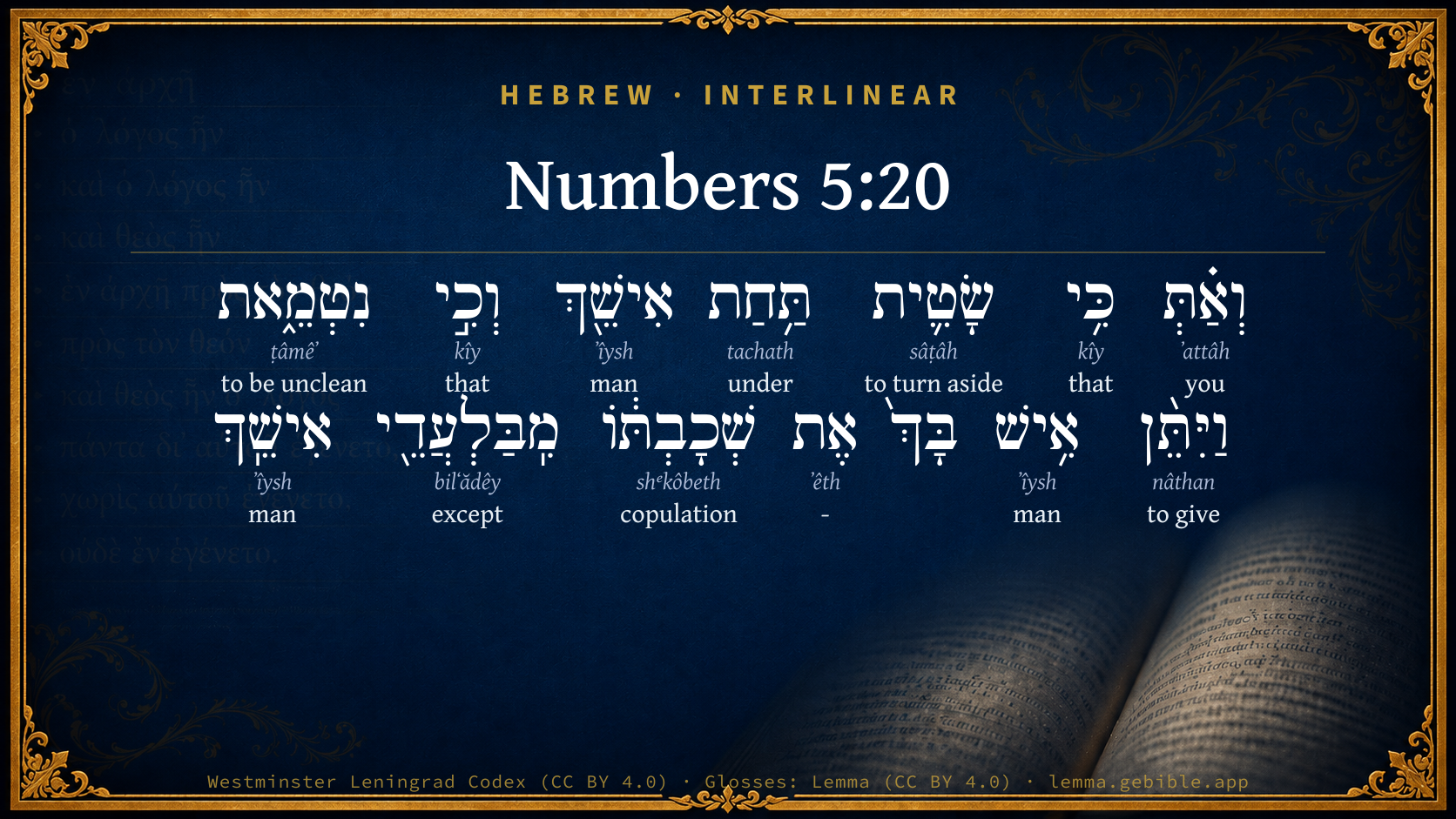
Hebrew (Westminster Leningrad Codex) Numbers 5:20 appears in the Hebrew Old Testament. The text above is from the Westminster Leningrad Codex. Each word links to its Strong’s number, a concise gloss, and parsing drawn from the Open Scriptures Hebrew Bible morphology. Click any word for its full Brown-Driver-Briggs (BDB) entry.
Download image
Cite this verse

Numbers 5:20 (World English Bible). Public Domain. Lemma interlinear Bible study tool, https://lemma.gebible.app/v/numbers/5/20.

Show BibTeX & RIS
BibTeX
RIS
English Translation
But if you have gone astray, being under your husband, and if you are defiled, and some man has lain with you besides your husband:'
World English Bible · Public Domain
Download a study sheet

One document with this verse’s original text, its word-by-word gloss line, the meaning frame, cross-references with their text, attributed commentary, and full source and license credits — printable, and it pastes into notes with its structure intact.

This verse Autodidact and up

Study sheet (.html) Plain text (.txt)

A passage Seminary Student

Up to 50 verses in one chapter. A passage sheet keeps up to 6 commentary sources and 12 cross-references per verse, in the order this page ranks them, and says so on the sheet whenever that leaves anything out. Ask for a single verse and you get the Autodidact verse sheet above.

Everything on this page stays free to read, with no account — the sheet is a download of what is already on screen, not access to it.

Want to remove ads? Support Godless Engineer
Compare translations 3

The same verse in 3 English versions, stacked beneath the original-language interlinear above. Click any original word for its lexicon entry.

Each is an independent rendering of the whole verse — the interlinear is not word-aligned to these translations.

Highlighted words mark where these versions differ — a whole-verse word diff, not a word-by-word alignment.

  • World English Bible Public Domain
    But if you have gone astray, being under your husband, and if you are defiled, and some man has lain with you besides your husband:'
  • King James Version Public Domain
    But if thou hast gone aside to another instead of thy husband, and if thou be defiled, and some man have lain with thee beside thine husband:
  • unfoldingWord Literal Text CC BY-SA 4.0
    But you, if you did turn aside under your husband, and if you were made unclean and a man gave his lying in you besides your husband,”

unfoldingWord Literal Text — © unfoldingWord, licensed CC BY-SA 4.0. Word-aligned USFM3 via Door43 (git.door43.org/unfoldingWord/en_ult).

Versions to compare (up to 4)

3 of 4 selected

Show all 18 translations

Every available English version of this verse, each an independent rendering of the whole verse.

  • World English Bible Public Domain
    But if you have gone astray, being under your husband, and if you are defiled, and some man has lain with you besides your husband:'
  • Berean Standard Bible Public Domain
    But if you have gone astray while under your husband’s authority and have defiled yourself and lain carnally with a man other than your husband’—
  • Majority Standard Bible Public Domain
    But if you have gone astray while under your husband’s authority and have defiled yourself and lain carnally with a man other than your husband’—
  • King James Version Public Domain
    But if thou hast gone aside to another instead of thy husband, and if thou be defiled, and some man have lain with thee beside thine husband:
  • American Standard Version (1901) Public Domain
    But if thou have gone aside, being under thy husband, and if thou be defiled, and some man have lain with thee besides thy husband:
  • Revised Version (1885) Public Domain
    but if thou hast gone aside, being under thy husband, and if thou be defiled, and some man have lain with thee besides thine husband:
  • Geneva Bible (1599) Public Domain
    But if thou hast turned from thine husband, and so art defiled, and some man hath lyen with thee beside thine husband,
  • Douay-Rheims (1899) Public Domain
    But if thou hast gone aside from thy husband, and art defiled, and hast lain with another man:
  • Young's Literal Translation Public Domain
    and thou, if thou hast turned aside under thy husband, and if thou hast been defiled, and any man doth give his copulation to thee besides thy husband --
  • Literal Standard Version CC BY-SA 4.0
    and you, if you have turned aside under your husband, and if you have been defiled, and a man commits his intercourse with you besides your husband—
  • Unlocked Literal Bible CC BY-SA 4.0
    But if you, a woman under her husband, have gone astray, if you are defiled, and if some other man has slept with you,
  • unfoldingWord Literal Text CC BY-SA 4.0
    But you, if you did turn aside under your husband, and if you were made unclean and a man gave his lying in you besides your husband,”
  • Darby Bible Public Domain
    But if thou hast gone astray to another instead of thy husband, and hast been defiled, and a man other than thy husband have lain with thee,
  • World Messianic Bible Public Domain
    But if you have gone astray, being under your husband’s authority, and if you are defiled, and some man has lain with you besides your husband—”
  • Webster's Bible Public Domain
    But if thou hast gone aside to another instead of thy husband, and if thou art defiled, and some man hath lain with thee besides thy husband:
  • Free Bible Version CC BY-SA 4.0
    But if you have been unfaithful while married to your husband and have become unclean and have had sex with someone else…’”
  • Bible in Basic English Public Domain
    But if you have been with another in place of your husband and have made yourself unclean with a lover:
  • JPS Tanakh (1917) Public Domain
    but if thou hast gone aside, being under thy husband, and if thou be defiled, and some man have lain with thee besides thy husband —

Literal Standard Version (2020), Covenant Press — licensed CC BY-SA 4.0. Text via the HelloAO Bible API (eBible.org). Unlocked Literal Bible (unfoldingWord) — licensed CC BY-SA 4.0. Text via the HelloAO Bible API (eBible.org). unfoldingWord Literal Text — © unfoldingWord, licensed CC BY-SA 4.0. Word-aligned USFM3 via Door43 (git.door43.org/unfoldingWord/en_ult). Free Bible Version, Dr. Jonathan Gallagher — licensed CC BY-SA 4.0. Text via the HelloAO Bible API (eBible.org).

Word by word

More ways to search: Search by grammar → Find every occurrence → Compare this word →

Practice this passage: Drill this verse → Learn its vocabulary →

שְׁכָבְתּ֔וֹ
shᵉkôbeth
H7903
“copulation · his”
Noun, Common, Feminine, Singular, Construct + Suffix, Personal, 3rd Person, Masculine, Singular
Part of Speech
Noun
Type
Common
Gender
Feminine
Number
Singular
State
Construct
Full BDB Definition

Origin: from H7901

TWOT: 2381b

copulation
  1. וְאַ֗תְּ ʼattâh H859 “and · you” Conjunction + Pronoun, Personal, 2nd Person, Feminine, Singular
  2. כִּ֥י kîy H3588 “that” Conjunction
  3. שָׂטִ֛ית sâṭâh H7847 “to turn aside” Verb, Qal, Perfect, 2nd Person, Feminine, Singular
  4. תַּ֥חַת tachath H8478 “under” Preposition
  5. אִישֵׁ֖ךְ ʼîysh H376 “man · your” Noun, Common, Masculine, Singular, Construct + Suffix, Personal, 2nd Person, Feminine, Singular
  6. וְכִ֣י kîy H3588 “and · that” Conjunction + Conjunction
  7. נִטְמֵ֑את ṭâmêʼ H2930 “to be unclean” Verb, Niphal, Perfect, 2nd Person, Feminine, Singular
  8. וַיִּתֵּ֨ן nâthan H5414 “and · to give” Conjunction + Verb, Qal, Sequential Imperfect, 3rd Person, Masculine, Singular
  9. אִ֥ישׁ ʼîysh H376 “man” Noun, Common, Masculine, Singular, Absolute
  10. אֶת ʼêth H853 “-” Particle, Direct Object
  11. מִֽבַּלְעֲדֵ֖י bilʻădêy H1107 “from · except” Preposition + Preposition
  12. אִישֵֽׁךְ ʼîysh H376 “man · your” Noun, Common, Masculine, Singular, Construct + Suffix, Personal, 2nd Person, Feminine, Singular

About this verse

These counts appear in no published source. They are computed here, from the morphology-tagged text and Lemma’s own curated glosses. What Lemma adds →

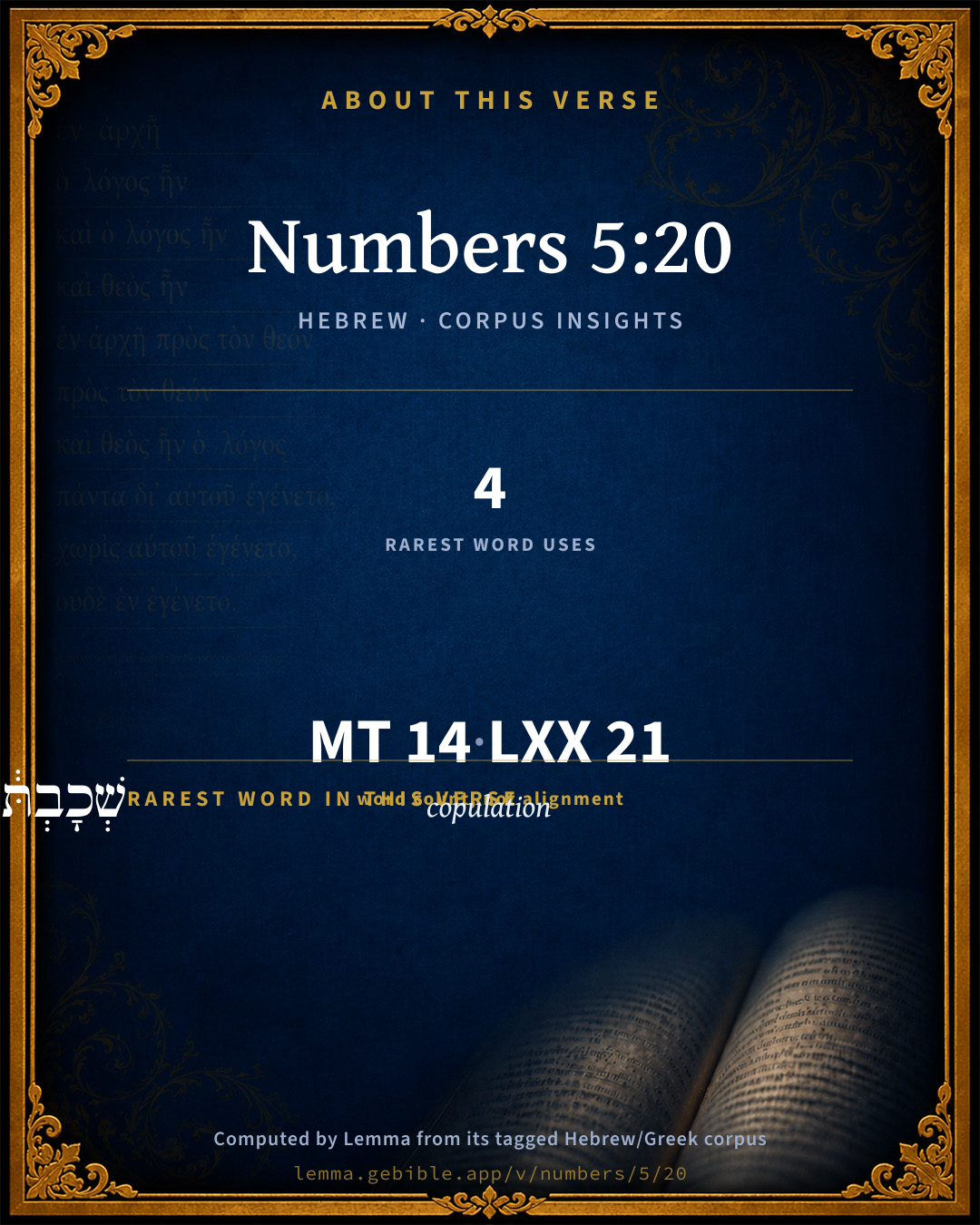
14
words
10
distinct lemmas
Pentateuch
section

Notable vocabulary

The rarest word here is שְׁכָבְתּ֔וֹ copulation H7903 — appearing just 4 times in the whole Hebrew Bible.

Shared distinctive vocabulary

שְׁכָבְתּ֔וֹ copulation H7903 occurs in 4 verses of the Hebrew Bible. Also found in:

Grammatical profile

  • 3 verbs
  • 4 nouns
  • 1 pronoun
  • 3 prepositions
  • 2 conjunctions
  • 1 particle

Verb forms

  • שָׂטִ֛ית Qal · Perfect
  • נִטְמֵ֑את Niphal · Perfect
  • וַיִּתֵּ֨ן Qal · Sequential Imperfect

Repetition

Words recur within this verse — often emphatic in Hebrew:

  • אִישֵׁ֖ךְ man H376 ×3
  • כִּ֥י that H3588 ×2

Hebrew & Septuagint length

In English translation the verse runs 25 words from the Hebrew and 22 from the Septuagint (LXX English) — closely comparable.

A rough comparison of the two English renderings, which tokenize alike — not a word-level alignment.

Word counts can differ between the Hebrew and the Greek without any difference in meaning — e.g. the Hebrew direct-object marker אֵת has no separate Greek word, and Greek often adds the article ὁ.

In the original languages it is 14 Hebrew tokens and 21 Greek tokens — but the two are counted differently (Hebrew bundles its prefixes and suffixes into one token; the Greek is in lemma form), so that isn’t a like-for-like length.

Cross-references

1

Topical passages linked to Numbers 5:20 in the Treasury of Scripture Knowledge — connected by theme and wording, ordered by reader-vote popularity; previews shown in the World English Bible.

  • Numbers 5:12 "Speak to the children of Israel, and tell them: If any man's wife goes astray, and is unfaithful to him,

Cross-references courtesy of OpenBible.info (CC BY 4.0).

Hebrew and Greek witnesses Masoretic Hebrew ↔ Greek Septuagint

The same verse in the two great witnesses to the Old Testament, shown verse-for-verse.

These are two independent witnesses, not word-aligned to each other, and the Septuagint is shown in lemma (dictionary) form.

Hebrew Numbers 5:20 Masoretic · Westminster Leningrad Codex

וְאַ֗תְּ כִּ֥י שָׂטִ֛ית תַּ֥חַת אִישֵׁ֖ךְ וְכִ֣י נִטְמֵ֑את וַיִּתֵּ֨ן אִ֥ישׁ בָּךְ֙ אֶת שְׁכָבְתּ֔וֹ מִֽבַּלְעֲדֵ֖י אִישֵֽׁךְ

But if you have gone astray, being under your husband, and if you are defiled, and some man has lain with you besides your husband:'

World English Bible · Public Domain

Greek LXX Numbers 5:20 Septuagint · lemma form

εἰ δέ σύ παραβαίνω ὑπό ἀνήρ εἰμί ἤ μιαίνω καί δίδωμι τις ὁ κοίτη αὐτός ἐν σύ πλήν ὁ ἀνήρ σύ

But if being a married woman you have transgressed, or been polluted, and any one has lain with you, beside your husband:

LXX2012 (modern English Septuagint) · Public Domain

Hebrew: Westminster Leningrad Codex (CC BY 4.0). Greek: Septuagint (public domain); English from LXX2012 (modern English Septuagint) (Public Domain). How the Septuagint differs from the Hebrew →

Targum (Aramaic paraphrase)

2

The Targum is the ancient Jewish Aramaic paraphrase of the Hebrew Scriptures — an interpretive translation, not the Hebrew text itself. Onkelos (literal) and Pseudo-Jonathan (expansive) render the Torah, and Jonathan the Prophets. Coverage is partial: where no permissively-licensed English translation exists for a verse, only the Aramaic is shown. This is verse-level text, not a word-by-word alignment to the Hebrew.

  1. Targum Onkelos Torah (Genesis–Deuteronomy)
    וְאַתְּ אֲרֵי סְטִית בַּר מִבַּעֲלִיךְ וַאֲרֵי אִסְתָּאָבְתְּ וִיהַב גְבַר בִּיךְ יָת שְׁכֻבְתֵּהּ בַּר מִבַּעֲלִיךְ

    (no public-domain English translation for this verse)

    Targum Onkelos — Aramaic: “Onkelos Genesis” (public domain); “Onkelos Exodus” (public domain); “Onkelos Leviticus” (public domain); “Onkelos Numbers” (public domain); “Onkelos Deuteronomy” (public domain). English: “Sefaria Community Translation” (CC0 1.0 (public-domain dedication)); “J.W. Etheridge. The Targums of Onkelos and Jonathan Ben Uzziel on the Pentateuch. London: Longmans, Green, 1862” (public domain). Text via Sefaria.

  2. Targum Pseudo-Jonathan Torah (Genesis–Deuteronomy)
    וְאַנְתְּ אֲרוּם סַטְיָת בַּר מִן רְשׁוּתָא דְבַעֲלִיךְ וַאֲרוּם אִסְתְּאָבַת בְּתַּשְׁמִישׁ דְעָרִיס וִיהַב גְבַר בִּיךְ יַת תַּשְׁמִישֵׁיהּ בַּר מִן רְשׁוּתָא דְבַעֲלִיךְ

    But if thou hast turned aside against the right of thy husband, and art defiled in having shared the bed with a man against thy husband's right:-

    Targum Pseudo-Jonathan — Aramaic: “Targum Jonathan on Genesis” (public domain); “Targum Jonathan on Exodus” (public domain); “Targum Jonathan on Leviticus” (public domain); “Targum Jonathan on Numbers” (public domain); “Targum Jonathan on Deuteronomy” (public domain). English: “The Targum of Jonathan ben Uzziel, trans. J. W. Etheridge, London, 1862” (public domain). Text via Sefaria.

Commentary

Notes on Numbers 5:20 from classic Christian and Jewish commentators (each source and its license shown beneath its notes). The classic Christian expositions comment on the surrounding passage and are grouped to its opening verse, so a note may address several verses; the Jewish commentaries on the Tanakh (Rashi and others) are per-verse, so they appear only where the commentator wrote on this verse.

Lemma curates 59 commentaries, every one of them public domain or Creative Commons licensed, each selected and text-cleaned for this edition rather than reprinted as found. About our sources →

John Gill's Exposition

But if thou hast gone aside to another instead of thy husband,.... Gone aside from the paths of modesty and chastity, and betook herself to another man's bed instead of her husband's:

and if thou be defiled, by committing adultery:

and some man hath lain with thee beside thy husband; these phrases are all synonymous, and a heap of words are made use of to express the sin, and that there might be no evasion of it, and that it might be clear what was intended, this being said on oath.

John Gill's Exposition of the Whole Bible (1746–1763) — public domain (CC PDM 1.0). Text via the HelloAO Bible API.

unfoldingWord translationNotes

Door43 World Missions Community

under her husband

This phrase means that she is under her husband's authority. AT: "under her husband's authority" (See: Metonymy)

have gone astray

The words "gone astray" is an idiom that means "to be unfaithful." AT: "have been unfaithful to your husband" (See: Idiom)

you are defiled

This can be stated in active form. AT: "you have defiled yourself" (See: Active or Passive)

that can bring down a curse on her

The phrase "bring down a curse" is an idiom meaning for a curse to come upon her. AT: "that can cause a curse to come upon her" (See: Idiom)

Yahweh will make you into a curse ... your people to be such

Here the author speaks about the woman bearing the curse that Yahweh gives her, which causes other people to curse her. This is spoken of as if the woman herself becomes a curse. AT: "Because Yahweh curses you, other people will curse you as well, and Yahweh will show people that you are truly cursed" (See: Metaphor)

that will be shown to your people to be such

This can be stated in active form. AT: "that he will show to your people as a curse" (See: Active or Passive)

your thigh to waste away and your abdomen to swell

Possible meanings are 1) that the woman will become unable to have children or 2) that the woman's pregnancy will end too early and the baby will die.

your thigh to waste away

Here the word "thigh" is a polite way of referring to the woman's womb or her private parts. AT: "your womb to be useless" (See: Euphemism)

translationWords

defile

priest

people group

waste

unfoldingWord translationNotes — © Distant Shores Media and the Door43 World Missions Community, licensed CC BY-SA 4.0. Source: git.door43.org/Door43/en_tn.

Rashi

Rabbi Shlomo Yitzchaki (Rashi)

ואת כי שטית BUT IF THOU HAST BUT IF THOU HAST GONE ASIDE ASIDE — The word כי must here be employed in the meaning of “if” (cf. Rashi on Genesis 18:15).

Rashi on the Tanakh — English translations: “The Judaica Press complete Tanach with Rashi, translated by A. J. Rosenberg” (CC BY 4.0); “Pentateuch with Rashi's commentary by M. Rosenbaum and A.M. Silbermann, 1929-1934” (public domain); “The Metsudah Tanach series, Lakewood, N.J” (CC BY 4.0); and “The Book of Joshua, Metsudah Publications, 1997” (CC BY 4.0). Text via Sefaria.

Ramban (Nachmanides)

Rabbi Moshe ben Nachman (Ramban / Nachmanides)

BUT IF THOU HAST GONE ASIDE. This is connected with [the expression in the following verse], the Eternal make thee, the verses stating: “But if thou hast gone aside to uncleanness, being under thy husband, and if thou be defiled, and some man have lain with thee besides thy husband — the Eternal make thee a curse, and an oath among thy people. ” But due to the length of the conditions [mentioned in Verses 19-20] Scripture restates [in the following Verse 21] and the priest shall cause the woman to swear [although that has already been said at the beginning of Verse 19; and accordingly the phrase before us in Verse 20, but if thou hast gone aside etc. is connected with the expression the Eternal make thee in Verse 21], in order to explain that [the Eternal make thee a curse etc.] constitutes the oath of cursing. And Rabbi Abraham ibn Ezra commented that the first expression of swearing [and the priest shall cause her to swear, in Verse 19] means [that she must swear] by G-d’s Name, and the second one [in Verse 21] implies by means of the curse, as is clearly explained there [in Verse 21: and the priest shall cause the woman to swear with the oath of cursing]. But it is not correct, for the priest would not have caused her to swear by the Name of G-d using an expression of “if” [as in Verse 19: and the priest shall cause her to swear, and shall say unto the woman: ‘If’ no man have lain with thee etc.]. Now there is nothing amongst all the ordinances of the Torah which depends upon a miracle, except for this matter, which is a permanent wonder and miracle that will happen in Israel, when the majority of the people live in accordance with the Will of G-d; for He was pleased for His righteousness’ sake to teach the women that they do not do after the lewdness of the other nations, and to purify Israel from adulterous offspring, so that they are worthy that the Divine Presence dwell among them. Therefore this matter [i.e., the effect of the water on the sotah] stopped from the time that the people became debauched with [sexual] sins, as the Rabbis have said: “When adulterers became frequent, the water of sotah is a woman suspected of adultery, and is subject to the laws explained further on in Verses 11-31. The law concerning her meal-offering is found in Verse 15, where it is called a meal-offering of jealousy. ceased, for it is said, I will not punish your daughters when they commit harlotry, nor your daughters-in-law when they commit adultery; for they themselves consort with lewd women, and they sacrifice with harlots, and the people that is without understanding is distraught. Now this verse does not mean to say that adulterous women will be free from [punishment for their] sin, because their husbands [likewise] commit adultery; it [is only saying] that this great miracle will not be done for them, for it occurs as a sign of honor for them because of their being a holy people, but they do not understand this goodness, nor do they desire it. Therefore the verse states, and the people that is without understanding is ‘yilaveit’ (distraught), that is to say, trapped by its foolishness. Similarly, but a prating fool ‘yilaveit, ’ which the Jerusalem Targum translated: “but the fool is caught by his lips.” This is the reason for what the Sages have said: “And the man shall be clear from iniquity. When the man is clear of iniquity, the water [of the sotah] tests his wife; but if the man is himself not free from iniquity, the water does not put his wife to the proof.” Now the “freedom from iniquity” of the husband means [in this context] that he had no sexual relations with her after he had warned her and she [nevertheless] had secret contact [with the suspected adulterer]. And there are scholars 2:8. who explain that if the husband had ever in his lifetime had a forbidden sexual intercourse, the water [of the sotah] no longer tests his wife. And according to the final decision of the law, even if his sons or daughters committed adultery and he did not rebuke them the water did not put his wife to the test [even though he himself is clear from iniquity]. In short, this procedure was miraculous, as [a sign of] honor for Israel.

Ramban (Nachmanides) on the Tanakh — English translation: “Commentary on the Torah by Ramban (Nachmanides). Translated and annotated by Charles B. Chavel. New York, Shilo Pub. House, 1971-1976” (CC BY 4.0). Text via Sefaria.

Lesson kit

Teaching starters — assembled from the data on this page, not authored interpretation. Every prompt links to the verse data it draws on. Edit before teaching.

Numbers, in the Pentateuch, opens this verse with 14 words (10 distinct Hebrew lemmas). Its most distinctive word is shᵉkôbeth (“copulation”). A historical commentator’s framing appears above. Read the whole chapter for the surrounding context.

Discussion questions

  1. What does “copulation” (shᵉkôbeth) contribute to the verse as a whole?
  2. How does Leviticus 18:20, which shares the word «copulation», read alongside this verse?
  3. What does the repetition of “man” (3× in this one verse) do in this verse?
  4. These translations render this verse differently; the difference is in the English rendering, not the original. What questions does that raise?
  5. «שָׂטִ֛ית» is a Qal Perfect verb. How does that grammatical form shape the action described?
  6. Compare how John Gill's Exposition and unfoldingWord translationNotes read this verse. Where do they agree or differ?

Things to notice

Reading settings

Reading text

Shown beneath each verse's original-language words.

Old Testament
Old Testament edition

Read the OT as the Masoretic Hebrew (MT) or the Greek Septuagint (LXX).

English shown for the Greek Septuagint (in the Hebrew ↔ Greek comparison).

Comparing translations? Open the Compare panel on any verse page to stack up to four side by side.