2 Corinthians 2:6

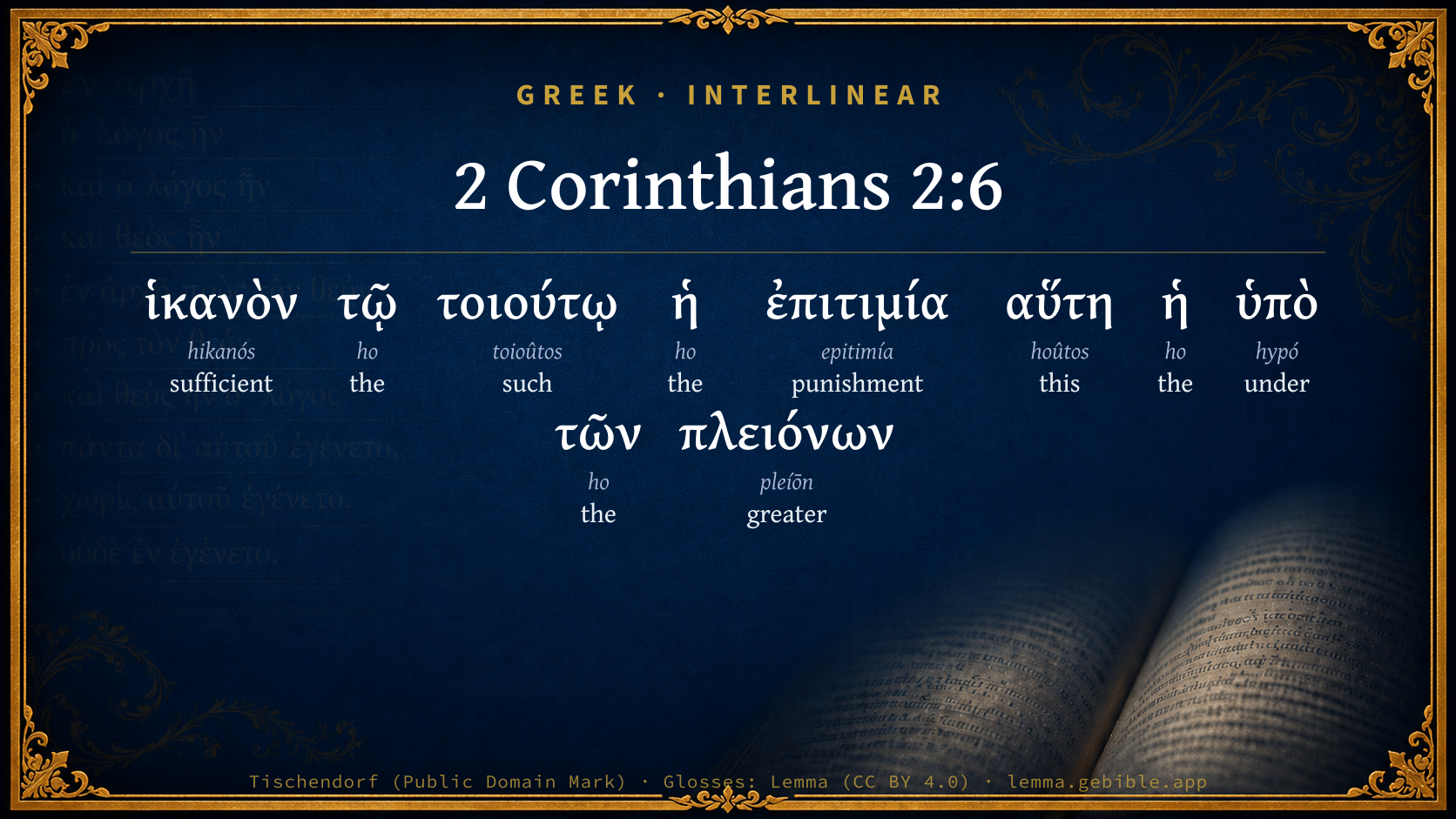
Greek (Tischendorf 8th ed.) 2 Corinthians 2:6 appears in the Greek New Testament. The text above is from the Tischendorf 8th edition. Each word links to its Strong’s number and a concise gloss. Click any word for its full Thayer’s Greek Lexicon entry.
Download image
Cite this verse

2 Corinthians 2:6 (World English Bible). Public Domain. Lemma interlinear Bible study tool, https://lemma.gebible.app/v/2-corinthians/2/6.

Show BibTeX & RIS
BibTeX
RIS
English Translation
Sufficient to such a one is this punishment which was inflicted by the many;
World English Bible · Public Domain
Highlights
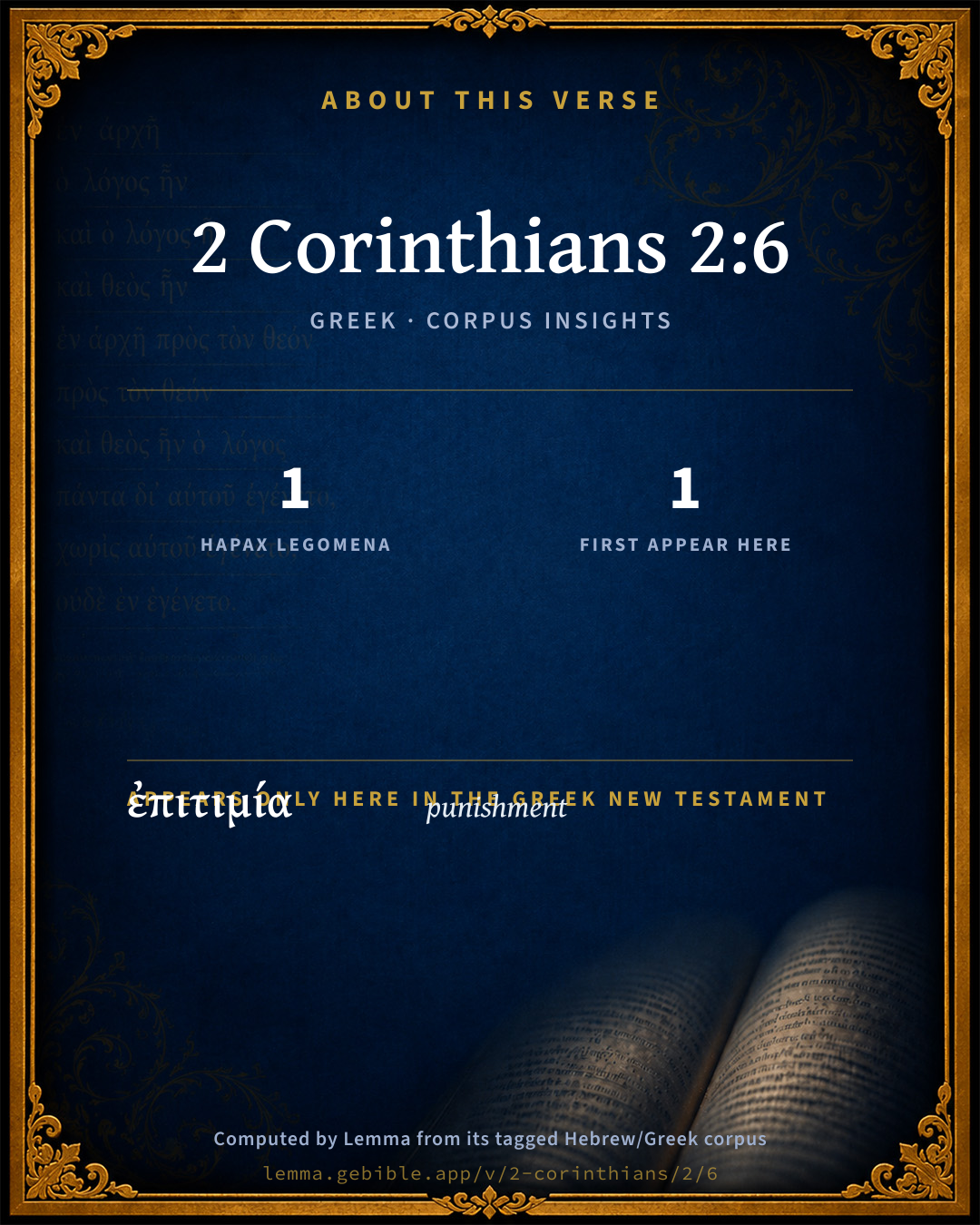
  • 1 hapax legomenon — only here in the Greek New Testament
  • 1 first appearance in the Greek New Testament
Full analysis ↓
Download a study sheet

One document with this verse’s original text, its word-by-word gloss line, the meaning frame, cross-references with their text, attributed commentary, and full source and license credits — printable, and it pastes into notes with its structure intact.

This verse Autodidact and up

Study sheet (.html) Plain text (.txt)

A passage Seminary Student

Up to 50 verses in one chapter. A passage sheet keeps up to 6 commentary sources and 12 cross-references per verse, in the order this page ranks them, and says so on the sheet whenever that leaves anything out. Ask for a single verse and you get the Autodidact verse sheet above.

Everything on this page stays free to read, with no account — the sheet is a download of what is already on screen, not access to it.

Want to remove ads? Support Godless Engineer
Compare translations 3

The same verse in 3 English versions, stacked beneath the original-language interlinear above. Click any original word for its lexicon entry.

Each is an independent rendering of the whole verse — the interlinear is not word-aligned to these translations.

Highlighted words mark where these versions differ — a whole-verse word diff, not a word-by-word alignment.

  • World English Bible Public Domain
    Sufficient to such a one is this punishment which was inflicted by the many;
  • King James Version Public Domain
    Sufficient to such a man is this punishment, which was inflicted of many.
  • unfoldingWord Literal Text CC BY-SA 4.0
    This punishment on such a by the majority sufficient,

unfoldingWord Literal Text — © unfoldingWord, licensed CC BY-SA 4.0. Word-aligned USFM3 via Door43 (git.door43.org/unfoldingWord/en_ult).

Versions to compare (up to 4)

3 of 4 selected

Show all 19 translations

Every available English version of this verse, each an independent rendering of the whole verse.

  • World English Bible Public Domain
    Sufficient to such a one is this punishment which was inflicted by the many;
  • Berean Standard Bible Public Domain
    The punishment imposed on him by the majority is sufficient for him.
  • Majority Standard Bible Public Domain
    The punishment imposed on him by the majority is sufficient for him.
  • King James Version Public Domain
    Sufficient to such a man is this punishment, which was inflicted of many.
  • American Standard Version (1901) Public Domain
    Sufficient to such a one is this punishment which was `inflicted' by the many;
  • Revised Version (1885) Public Domain
    Sufficient to such a one is this punishment which was inflicted by the many;
  • Geneva Bible (1599) Public Domain
    It is sufficient vnto the same man, that hee was rebuked of many.
  • Douay-Rheims (1899) Public Domain
    To him who is such a one, this rebuke is sufficient, which is given by many:
  • Young's Literal Translation Public Domain
    sufficient to such a one is this punishment, that `is' by the more part,
  • Literal Standard Version CC BY-SA 4.0
    sufficient to such a one is this punishment, that [is] by the greater part,
  • Unlocked Literal Bible CC BY-SA 4.0
    This punishment of that person by the majority is enough.
  • unfoldingWord Literal Text CC BY-SA 4.0
    This punishment on such a by the majority sufficient,
  • Darby Bible Public Domain
    Sufficient to such a one [is] this rebuke which [has been inflicted] by the many;
  • World Messianic Bible Public Domain
    This punishment which was inflicted by the many is sufficient for such a one;
  • Webster's Bible Public Domain
    Sufficient to such a man is this punishment, which was inflicted by many.
  • Free Bible Version CC BY-SA 4.0
    This person suffered enough punishment from the majority of you,
  • Bible in Basic English Public Domain
    Let it be enough for such a man to have undergone the punishment which the church put on him;
  • Text-Critical English NT CC BY 4.0
    This punishment by the majority is enough for that person.
  • Tyndale New Testament (1534) Public Domain
    It is sufficient vnto the same man that he was rebuked of many. So that now contrary wyse ye ought to forgeve him and comforte him:

Literal Standard Version (2020), Covenant Press — licensed CC BY-SA 4.0. Text via the HelloAO Bible API (eBible.org). Unlocked Literal Bible (unfoldingWord) — licensed CC BY-SA 4.0. Text via the HelloAO Bible API (eBible.org). unfoldingWord Literal Text — © unfoldingWord, licensed CC BY-SA 4.0. Word-aligned USFM3 via Door43 (git.door43.org/unfoldingWord/en_ult). Free Bible Version, Dr. Jonathan Gallagher — licensed CC BY-SA 4.0. Text via the HelloAO Bible API (eBible.org).

Word by word

More ways to search: Search by grammar → Find every occurrence → Compare this word →

Practice this passage: Drill this verse → Learn its vocabulary →

About this verse

These counts appear in no published source. They are computed here, from the morphology-tagged text and Lemma’s own curated glosses. What Lemma adds →

10
words
7
distinct lemmas
Pauline Epistles
section

Notable vocabulary

1 hapax legomenon — a word that appears only here in the entire Greek New Testament:

  • ἐπιτιμία punishment G2009

First appearance in Scripture

This word makes its first canonical appearance in the Greek New Testament here:

  • ἐπιτιμία punishment G2009

Shared distinctive vocabulary

ἱκανὸν sufficient G2425 occurs in 40 verses of the Greek New Testament. Also found in:

Repetition

A word recurs within this verse:

Cross-references

4

Topical passages linked to 2 Corinthians 2:6 in the Treasury of Scripture Knowledge — connected by theme and wording, ordered by reader-vote popularity; previews shown in the World English Bible.

  • 1 Corinthians 5:4–5 In the name of our Lord Jesus Christ, you being gathered together, and my spirit, with the power of our Lord Jesus Christ,
  • 1 Timothy 5:20 Those who sin, reprove in the sight of all, that the rest also may be in fear.
  • 2 Corinthians 7:11 For behold, this same thing, that you were made sorry in a godly way, what earnest care it worked in you. Yes, what defense, indignation, fear, longing, zeal, and vengeance! In everything you demonstrated yourselves to be pure in the matter.
  • 2 Corinthians 13:10 For this cause I write these things while absent, that I may not deal sharply when present, according to the authority which the Lord gave me for building up, and not for tearing down.

Cross-references courtesy of OpenBible.info (CC BY 4.0).

Commentary

Notes on 2 Corinthians 2:6 from classic Christian and Jewish commentators (each source and its license shown beneath its notes). The classic Christian expositions comment on the surrounding passage and are grouped to its opening verse, so a note may address several verses; the Jewish commentaries on the Tanakh (Rashi and others) are per-verse, so they appear only where the commentator wrote on this verse.

Lemma curates 59 commentaries, every one of them public domain or Creative Commons licensed, each selected and text-cleaned for this edition rather than reprinted as found. About our sources →

Joseph Benson's Commentary

2Co 2:6-11. Sufficient to such a man — With what remarkable tenderness does the apostle treat this offender! He never once mentions his name, nor does he here so much as mention his crime; but speaks of him in the most indefinite manner that was consistent with giving such directions in his case as love required; is this punishment, inflicted by many — Not only by the rulers of the church, the whole congregation acquiesced in the sentence. So that contrariwise — Instead of proceeding further against him; ye ought rather to forgive him — To release him from the censure, and receive him again into the church; and comfort him — This penitent sinner; lest he should be swallowed up with overmuch sorrow — Driven to despair by the excessive grief which the continuance of your sentence might occasion. Wherefore confirm your love toward him — Assure him of your love by receiving him into your favour, and by all offices of kindness. For to this end did I write — Both in my former epistle that you would censure him, and now that you would release him; that I might know the proof of you — That I might have experience of you; whether ye would be obedient in all things — To my apostolical instructions and decisions; to whom ye forgive — He makes no question of their complying with his direction; any thing — So mildly does he speak of that heinous sin after it was repented of; I forgive also — I also shall be ready to forgive it; if I forgave — If heretofore I alone received any to mercy; for your sakes I forgave it — To show you an example of lenity as well as severity; in the person of Christ — In his name, and by the authority wherewith he has invested me. “St. Paul’s conduct in this affair is worthy of the imitation of the ministers of the gospel. They are to do nothing to grieve their people, unless love require it for their good. And when they are obliged to have recourse to the wholesome discipline which Christ hath instituted in his church, they ought to exercise it, not from resentment, but from a tender regard to the spiritual welfare of the offender. And when he is reclaimed by the censures of the church, they ought, with joy, to restore him to the communion of the faithful, remembering that Satan is ever watchful to turn the hopes and fears, the joys and sorrows of Christians, into an occasion of their ruin.” — Macknight. Lest Satan — To whom he had been delivered, and who sought to destroy, not only his flesh, but his soul also; should get an advantage of us — If the punishment of him be carried to any excess; and should turn that severity into an occasion of mischief to the offender, to his brethren, and to others, either by driving any to despair by too much rigour, or drawing any to profaneness by too much lenity: for the loss of one soul is a common loss. And we are not ignorant of his devices — And of the great variety of stratagems which he is continually making use of to injure us, and turn even discipline itself to the reproach of the church, and the destruction of souls.

Joseph Benson's Commentary on the Old and New Testaments (1811–1818) — public domain. Text from a community e-Sword module.

Bengel's Gnomon

Johann Albrecht Bengel

2Co 2:6. Ἱκανὸν) Neuter, in place of a substantive; it is sufficient for such a one, so that no more can be demanded of him: ἱκανὸν, a forensic term. It is the part of Christian prudence to maintain moderation. A considerably long time intervened between the writing of the two epistles.—ἐπιτιμία, reproof) In antithesis to forgive, as also, to comfort, 2Co 2:7.—τῶν πλειόνων, by many) not merely by those, who ruled [the bishops and ministers.] The Church at large bears the keys.

Bengel's Gnomon of the New Testament — English translation (T&T Clark, Edinburgh, 1860) — public domain. Text from a community e-Sword module.

Meyer's Critical & Exegetical Commentary

Heinrich August Wilhelm Meyer

2Co_2:6. Ἱκανόν] something sufficient is, etc. Regarding this substantive use of the neuter of the predicate adjective, see Matthiae, p. 982; Kühner, II. p. 45. Comp. Mat_6:34.

τῷ τοιούτῳ] for one of such a nature; how forbearing it is here that no more definite designation is given!

ἡ ἐπιτιμια αὕτη] this punishment. What it was, every reader knew. Comp. on 2Co_2:3. ἡ ἐπιτιμία (which in classic writers denotes the franchise of a citizen, Demosthenes, 230, 10, al.), in the signification poena, like the Greek τὸ ἐπιτίμιον (Dem. 915, 1; 939, 27, al.), ἡ ἐπιτίμησις (Wis_12:26), and τὸ ἐπιτίμημα (Inscript.), occurs only here in the N. T., but elsewhere also in Wis_3:10, in ecclesiastical writers, and in acts of councils (not in Philo). It is not merely objurgatio (Vulgate; comp. Beza, Calvin, and others).

ἡ ὑπὸ τῶν πλειόνων] which by the majority (of the church) has been assigned to him. That the presbyterium is not meant (Augustine, Beza, Grotius, Valesius, and others), is shown by the article. There is a further question here, whether the excommunication enjoined by Paul, 5, was carried out or not (Beza, Calvin, Morus, Rückert, Hofmann). Most assume the former, so that they refer ἱκανόν to the sufficient duration of the excommunication.[141] But an accomplished full excommunication is not to be assumed on account of the very ὑπὸ τῶν πλειόνων; but it is probable that the majority of the church members, in consequence of the ἘΞΆΡΑΤΕ ΤῸΝ ΠΟΝΗΡΌΝ (1Co_5:13; comp. 2Co_2:2), had considered the sinner as one excommunicated, and had given up all fellowship with him. By this the majority had for the present sufficiently complied with the expressed will of the apostle. To the minority there may have belonged partly the most lax in morals, and partly also opponents of the apostle, the latter resisting him on principle.

Rückert, however, supported by Baur and Räbiger, regards Pauls judgment ἹΚΑΝῸΝ Κ.Τ.Λ., as a prudent turn given to the matter, by which, in order to avoid an open rupture, he represents what would have happened even without his will to be his own wish. But what justifies any one in attributing to him conduct so untruthful? The real and great repentance of the sinner (2Co_2:7) induced the apostle to overlook the incompleteness in carrying out his orders for excommunication, and now from real sincere conviction to pronounce the ἱκανόν and desire his pardon. Comp. above on 2Co_2:5-11. Had Paul not been really convinced that the repentance of the evil-doer had already begun (as even Lipsius, Rechtfertigungsl. p. 183, is inclined to suppose), he would here have pursued a policy of church-discipline quite at variance with his character. Calvin judges very rightly of this passage: Locus diligenter observandus; docet enim, qua aequitate et clementia temperanda sit disciplina ecclesiae, ne rigor modum excedat. Severitate opus est, ne impunitate (quae peccandi illecebra merito vocatur) mali reddantur audaciores; sed rursus, quia periculum est, ne is qui castigatur animum despondeat, hic adhibenda est moderatio, nempe ut ecclesia, simulatque resipiscentiam illius certo cognoverit, ad dandam veniam sit parata.

[141] Most strange is the judgment of Grotius, that the apostle is here speaking not de restituenda communione, but de auferendo morbo, quem ei Satanas ad preces piorum Corinthiorum immiserat. Paul had, in fact, not really ordained the giving over to Satan at all. See on 1Co_5:5.

Meyer — Critical and Exegetical Commentary on the New Testament — English translation by Peter Christie, edited by Frederick Crombie (T&T Clark, 1880) — public domain. Text from a community e-Sword module.

Expositor's Greek Testament

ed. W. Robertson Nicoll

2Co 2:6 . ἱκανὸν τῷ τοιούτῳ κ . τ . λ .: sufficient to such an one (the word used in 1Co 5:5 to indicate the offender) is this punishment ( which was inflicted ) by the majority . The directions given by the Apostle for dealing with the offender had probably been carried out with harshness and severity; he now suggests that the punishment might be remitted, and the guilty man forgiven. ἐπιτιμία in the Attic orators is used for “the possession of political rights,” but it came to mean (see reff.) penalty or requital ; the punishment (see 1Co 5:5 ) would seem to have been of a disciplinary , and not merely punitive , character; it was probably like the formal excommunication of a later age ( cf. also 1Ti 1:20 ), and involved the exclusion of the guilty person from the privileges of the Christian Society. That it was inflicted only by “the majority” (for so we must translate τῶν πλειόνων ; see reff.) is sufficiently accounted for by remembering the presence of an anti-Pauline party at Corinth, who would not be likely to follow the Apostle’s instructions. The construction ἱκανὸν … ἡ ἐπιτιμία ( ἐστι , rather than ἔστω , is the verb to be supplied) affords an instance of a neuter adjectival predicate set over against a feminine subject ( cf. Mat 6:34 ); ἱκανὸν seems to be used here like the Latin satis.

The Expositor's Greek Testament, edited by W. Robertson Nicoll (1897–1910) — public domain. Text from a community e-Sword module.

Jamieson, Fausset & Brown

Robert Jamieson, A. R. Fausset & David Brown

Sufficient--without increasing it, which would only drive him to despair (Co2 2:7), whereas the object of the punishment was, "that (his) spirit might be saved" in the last day.

to such a man--a milder designation of the offender than if he had been named [MEYER]. Rather, it expresses estrangement from such a one who had caused such grief to the Church, and scandal to religion (Act 22:22; Co1 5:5).

this punishment--His being "delivered to Satan for the destruction of the flesh"; not only excommunication, but bodily disease (see on Co1 5:4-5).

inflicted of many--rather, "by the majority" (the more part of you). Not by an individual priest, as in the Church of Rome, nor by the bishops and clergy alone, but by the whole body of the Church.

Jamieson, Fausset & Brown — Commentary Critical and Explanatory on the Whole Bible (1871) — public domain (CC PDM 1.0). Text via the HelloAO Bible API.

Adam Clarke's Commentary

Verse 6. Sufficient to such a man is this punishment] That is, the man has already suffered sufficiently. Here he gives a proof of his parental tenderness towards this great transgressor. He had been disowned by the Church; he had deeply repented; and now the apostle pleads for him.

Adam Clarke's Commentary on the Bible (1810–1826) — public domain. Text from a community e-Sword/MySword module.

John Calvin's Commentaries

6. Sufficient. He now extends kindness even to the man who had sinned more grievously than the others, and on whose account his anger had been kindled against them all, inasmuch as they had connived at his crime. In his showing indulgence even to one who was deserving of severer punishment, the Corinthians have a striking instance to convince them, how much he disliked excessive harshness. It is true, that he does not act this part merely for the sake of the Corinthians, but because he was naturally of a forgiving temper; but still, in this instance of mildness, the Corinthians could not but perceive his remarkable kindness of disposition. In addition to this, he does not merely show himself to be indulgent, but exhorts others to receive him into favor, in the exercise of the same mildness.

Let us, however, consider these things a little more minutely. He refers to the man who had defiled himself by an incestuous marriage with his mother-in-law. As the iniquity was not to be tolerated, Paul had given orders, that the man should be excommunicated. He had, also, severely reproved the Corinthians, because they had so long given encouragement to that enormity by their dissimulation and patient endurance. It appears from this passage, that he had been brought to repentance, after having been admonished by the Church. Hence Paul gives orders, that he be forgiven, and that he be also supported by consolation.

This passage ought to be carefully observed, as it shows us, with what equity and clemency the discipline of the Church ought to be regulated, in order that there may not be undue severity. There is need of strictness, in order that the wicked may not be rendered more daring by impunity, which is justly pronounced an allurement to vice. But on the other hand, as there is a danger of the person, who is chastised, becoming dispirited, moderation must be used as to this — so that the Church shall be prepared to extend forgiveness, so soon as she is fully satisfied as to his penitence. In this department, I find a lack of wisdom on the part of the ancient bishops; and indeed they ought not to be excused, but on the contrary, we ought rather to mark their error, that we may learn to avoid it. Paul is satisfied with the repentance of the offender, that a reconciliation may take place with the Church. They, on the other hand, by making no account of his repentance, have issued out canons as to repentance during three years, during seven years, and in some cases during life. By these they exclude poor unhappy men from the fellowship of the Church. And, in this way, the offender is either alienated the more from the Church, or is induced to practice hypocrisy. But even if the enactment were more plausible in itself, this consideration would, in my view, be enough to condemn it — that it is at variance with the rule of the Holy Spirit, which the Apostle here prescribes.

John Calvin's Commentaries (1540-1563) — public domain. Text from the Calvin Translation Society English edition (1840s-50s) via the Christian Classics Ethereal Library (ccel.org). Calvin's coverage is partial (roughly two-thirds of the Bible); uncommented books and verses are honest gaps, never fabricated. The 19th-century editor's footnotes and remarks are omitted so the notes are faithfully Calvin's own voice.

Ellicott's Commentary for English Readers

(6) Sufficient to such a man is this punishment.—Better, perhaps, this censure, or rebuke: the Greek word epitimia being different from those in Mat_25:46, and in Heb_10:29. It is natural to infer that this was somewhat after the pattern of the course marked out in 1Co_5:3-5. A meeting of the Church had been held, and the man delivered to Satan. Possibly this was followed by some suffering of body, supernaturally inflicted, or coming as the natural consequence (not less divine because natural) of remorse and shame. It was almost certainly followed by ex-communication and exclusion from religious and social fellowship. St. Paul had clearly heard what it had been, and thought that it had been enough.

Which was inflicted of many.—Actually, by the majority. The decision, then, had not been unanimous. The minority may have been either members of the Judaising “Cephas “party, resenting what they would look upon as St. Paul’s dictation, and perhaps falling back on the Jewish casuistry, which taught that all the natural relationships of a proselyte were cancelled by his conversion; or the party of license, against whom the Apostle reasons in 1 Corinthians 6-8, and who boasted of their freedom. The Passover argument and the form of the sentence in 1 Corinthians 5 alike suggest the idea that the offender and those who defended him were Jews. On the other hand, see Note on 2Co_7:12.

A Bible Commentary for English Readers, edited by Charles John Ellicott (1878–1897) — public domain. Text from a community e-Sword module.

The Cambridge Bible for Schools and Colleges

gen. ed. J. J. S. Perowne

6. Sufficient to such a man is this punishment] See note on 1Co_5:3-5. The discipline of the Apostolic Church, which had as its main object the restoration of the offender, was content when this object was attained. As soon as the offender renounced his sin, the end of the discipline was reached, and there was no further need of punishment. It was no desire of the Church in the Apostle’s times, however much that important principle may have been lost sight of afterwards, that the offender should be ‘swallowed up with overmuch sorrow.’ “A plan diligently to be observed, for it teaches with what equity and clemency the discipline of the Church should be tempered, lest its rigour should exceed proper bounds.” Calvin.

punishment] (Blamynge, Wiclif.) The word in the original signifies rebuke as well as punishment. Perhaps here it partakes of both senses. The public rebuke, coupled with separation from the Christian community and formal delivery over to Satan which St Paul prescribed (1Co_5:5), was itself a severe punishment.

which was inflicted of many] Literally, by the majority. Some, perhaps, may have declined to take part in it, for there were many, as the latter part of the Epistle plainly shews, who still refused to acknowledge St Paul’s authority.

The Cambridge Bible for Schools and Colleges (gen. ed. J. J. S. Perowne; Cambridge University Press, 1878–1918) — public domain. Text from a community e-Sword module.

John Gill's Exposition

Sufficient to such a man is this punishment,.... By this punishment is meant, the excommunication of the incestuous person, or the censure that was laid upon him by the church: for this

was inflicted by many; not by the pastor only, or by the elders or more eminent persons in the church, but by the multitude, by the whole congregation, at least , "by the more"; the greater, or major part; and not by one, or a few only: in inflicting this punishment, or laying on this censure in the public manner they did, they were certainly right, and to be commended; but inasmuch as there appeared signs of true repentance, it was sufficient, it had answered the purpose for which it was inflicted, and therefore it was high time to remove it: from whence we learn, that in case of gross enormities, there ought to be a public excommunication; and that this is to be done by the vote, and with the consent of the whole church, or the major part of it; and that in process of time, when the person thus dealt with has given the church satisfaction as to the truth and genuineness of his repentance, the censure ought to be taken off and he be cordially received into the communion of the church again. This "punishment", or "rebuke", "by many", is the same which the Jews call (e) , "a reproof by many"; which is given by many, or in the presence of many.

(e) R. Eliahu in Adderet, c. 3. apud Trigland. de Sect. Karaeorum, p. 166.

John Gill's Exposition of the Whole Bible (1746–1763) — public domain (CC PDM 1.0). Text via the HelloAO Bible API.

Trapp's Complete Commentary

John Trapp

6 Sufficient to such a man is this punishment, which was inflicted of many.

Ver. 6. Sufficient to such a man] The Novatians therefore were out, that refused to receive in those that repented of their former faults and follies. The Papists burnt some that recanted at the stake, saying, that they would send them out of the world while they were in a good mind.

John Trapp, A Commentary or Exposition upon All the Books of the Old and New Testament (1647–1656) — public domain. Text from a community e-Sword module.

Albert Barnes' Notes on the Bible

Sufficient to such a man - The incestuous person who had been by Paul’s direction removed from the church. The object of Paul here is to have him again restored. For that purpose he says that the punishment which they had inflicted on him was “sufficient.” It was:

A sufficient expression of the evil of the offence, and of the readiness of the church to preserve itself pure; and, It was a sufficient punishment to the offender.

It had accomplished all that he had desired. It had humbled him, and brought him to repentance; and doubtless led him to put away his “wife”; compare note, 1Co 5:1. As that had been done, it was proper now that he should be again restored to the privileges of the church. No evil would result from such a restoration, and their duty to their penitent brother demanded it. Mr. Locke has remarked that Paul conducts this subject here with very great tenderness and delicacy. The entire passage from 2Co 2:5 to 2Co 2:10 relates solely to this offending brother, yet he never once mentions his name, nor does he mention his crime. He speaks of him only in the soft terms of “such a one” and “any one:” nor does he use an epithet which would be calculated to wound his feelings, or to transmit his name to posterity, or to communicate it to other churches. So that though this Epistle should be read, as Paul doubtless intended, by other churches, and be transmitted to future times, yet no one would ever be acquainted with the name of the individual. How different this from the temper of those who would emblazon abroad the names of offenders, or make a permanent record to carry them down with dishonor to posterity?

Which was inflicted of many - By the church in its collective capacity; see the note on 1Co 5:4. Paul had required the church to administer this act of discipline, and they had promptly done it. It is evident that the whole church was concerned in the administration of the act of discipline; as the words “of many” (ἀπὸ τῶν πλείονων apo tōn pleionōn are not applicable either to a single” bishop, or a single minister, or a presbytery, or a bench of elders: nor can they be so regarded, except by a forced and unnatural construction. Paul had directed it to be done by the assembled church 1Co 5:4, and this phrase shows that they had followed his instructions. Locke supposes that the phrase means, “by the majority;” Macknight renders it, “by the greater number;” Bloomfield supposes that it means that the “punishment was carried into effect by all.” Doddridge paraphrases it, “by the whole body of your society.” The expression proves beyond a doubt that the whole body of the society was concerned in the act of the excommunication, and that is a proper way of administering discipline. Whether it proves, however, that that is the mode which is to be observed in all instances, may admit of a doubt, as the example of the early churches, in a particular case, does not prove that that mode has the force of a binding rule on all.

(It cannot fairly be argued from this verse, that the “many” or the whole congregation, were judicially concerned in the act of excommunication; yet as their concurrence was essential, in order to carry the sentence into effect, it was “inflicted of many” in a most emphatic sense. The refusal, on the part of the members of the church, to have any more social contact with the incestuous man, carried into effect what the apostle had judicially pronounced. See the supplementary note on 1Co 5:4.)

Albert Barnes' Notes on the Bible (1834–1885) — public domain. Text from a community e-Sword/MySword module.

Haydock's Catholic Bible Commentary

This rebuke already given him, may suffice, and I would have you pardon and comfort him, lest he be overwhelmed, and as it were swallowed up [1] and devoured by and excess of grief, so that by the artifices of Satan, which we are acquainted with, it turn to his greater prejudice. I wrote, and proceeded in that manner, to know by experience, how far you are obedient to me, and to the ministers of Christ. (Witham)

George Leo Haydock (1774–1849), Haydock's Catholic Family Bible and Commentary, 1859 edition — public domain. Excludes Psalms (Douay-Rheims chapter numbering differs from Protestant) and Deuterocanonical books (Catholic canon only).

Matthew Poole's English Annotations

This verse maketh it clear, that by any, 2Co 2:5, he means the incestuous person, mentioned in 1Co 5:1-13, whom he had ordered to be cast out, and delivered to Satan; which (as appeareth from this verse) they had done, which is the punishment mentioned in this verse. They who think, that the punishment here mentioned was not excommunication, but another being delivered to Satan, and vexed by him:

1. Beg a grave question, viz. Whether delivering to Satan in this place signifieth any more than a casting of the person out of Christ’s kingdom on earth, (which is his church), and making him one of the world again, of which Satan is the god?

2. They seem not to consider, that if this church had delivered him to Satan, they could have done no more: so as the apostle would not have said:

Sufficient is this punishment, when it was the greatest that they could inflict.

Some object, that it is not probable that the apostle (had he been cast out of the communion of the church, for so notorious a crime) would have given order for his being restored in so short a time, as was that between his writing the First and this his Second Epistle.

1. Some think, that he was as yet only under a suspension, and the church had not proceeded to excommunication: this opinion is favoured by the Greek word here used, which is επιτιμια, the gentlest of all the words in use in that language to express punishment by.

2. Though in the times following the apostles’, a longer time was set after excommunication, for testifying the repentance of sinners notoriously scandalous, before the church did again admit them into her fellowship: yet that it was so in the apostles’ time, is more than appears. Possibly it might be so ordered afterwards, when, as the church multiplied, so sin more abounded; and they might, from many experiences of relapses, be quickened to make such orders.

3. The gift of discerning spirits was more usual in the apostles’ times than afterward; so that though in following times, when the apostles were dead, and the extraordinary gift of discerning spirits was failed or abeted, the church being not able any other way to judge of the truth of sinners’ repentance, than from their changed life and conversation, which asked time, might set a longer time for suck penitents; yet there might not be the same reason for the apostles doing it.

4. Notwithstanding any thing that appears, there might be the distance of a year or two between Paul’s writing these two Epistles.

Which was inflicted of many: who these many were, by whom the apostle saith this punishment was inflicted, is a little disputed; whether the presbytery, or the community. Their opinion seemeth (to me) best, who think that the officers of the church of Corinth heard and judged of matters of faith, and reported it to the community; but he was not cast out without the consent and approbation of the community.

Matthew Poole's English Annotations on the Holy Bible (1683–1685) — public domain. Text from a community e-Sword/MySword module.

Whedon's Commentary on the Bible

Daniel D. Whedon

6. Such a man—The such implies such penitence as to justify forgiveness, and the next verse shows that his sensibilities were liable to become extreme.

Punishment—Paul avoids naming the penalty as well as the crime. It was, probably, suspension of fellowship by a vote of many, or, more accurately, of the majority.

Daniel D. Whedon (gen. ed.), Commentary on the Old and New Testaments (1874–1909) — public domain. Text from a community e-Sword module.

The Pulpit Commentary

Sufficient to such a man is this punishment. What the punishment was we do not know, but of course the Corinthians knew that what St. Paul had directed them to do was to summon the Church together, and there,by excommunicating the man, "to hand him over to Satan." But this handing over to Satan was, as we have seen, designed solely for a merciful purpose, and to awaken his repentance, so as to secure his ultimate salvation. (1Co_5:4:5) Whether the Corinthians had done exactly as St. Paul bade them is uncertain; but whatever they had done is here acquiesced in by St. Paul, and even if (as we may suspect) they had dealt more leniently with the offender than he originally intended, he here not only refrains from urging them to use greater severity, but even exhorts them to a still more absolute condonation. St. Paul"s object had not been that they should take a particular course of action, but that they should bring about a desired result. The result had been achieved, and now the matter might rest. To such a man. St. Paul mercifully abstains from recording his name or from thrusting him into unnecessary prominence before the assembly in which the letter would be read. The apostle evidently entered into the Jewish feeling that there is a criminal cruelty in needlessly calling a blush of shame into a brother"s face. This punishment. The word epitimia, which occurs here only in the New Testament, but is also found in RAPC Wis 3:10, means "punishment," as in later Greek, and is not used in its classical sense of "rebuke" (Vulgate, objurgatio); but the mildness of the word, perhaps, implies that the Corinthians had not resorted to the severest measures. Which was inflicted of many; rather, by the majority. The verb is expressed in the original, and St. Paul seems to allude to the steps taken, whatever they were, with a certain dignified reticence. It is obvious that there were still some opponents of St. Paul in the Church, who retained in this matter their "inflated" sentiments of spurious independence; and this may, perhaps, have driven others into too rigid an attitude of severity.

The Pulpit Commentary (1880–1919), ed. H.D.M. Spence-Jones & Joseph S. Exell — public domain. Text from a community e-Sword module.

John Wesley's Explanatory Notes

Sufficient for such an one - With what a remarkable tenderness does St. Paul treat this offender! He never once mentions his name. Nor does he here so much as mention his crime. By many - Not only by the rulers of the church: the whole congregation acquiesced in the sentence.

John Wesley, Explanatory Notes Upon the Whole Bible (1754–1765) — public domain. Text via the GEBible commentary corpus.

Burkitt's Expository Notes on the New Testament

William Burkitt

Observe here, 1. The nature of that punishment which the holy apostle thought and adjudged, to be sufficient for the guilty person’s sin; and that was excision, not destruction; excommunication, not death. The rejection of such a sinner from the communion of the church, by church-censure and discipline, was the punishment pronounced.

Observe, 2. By whom, and before, this punishment of excommunication was executed and inflicted, namely, by the officers and governors of the church, (who had and have the power of the keys,) in the presence and with the consent of the whole church.

In the primitive church, we have reason to believe, when any offender was to be excommunicated, the people were acquainted with the crime: the guilty person pleaded in their presence, they judged as your jurymen do of the matter of fact, they consented to the condemnation; but the sentence was not pronounced by them, but by the governors and officers of the church, before them and in their presence.

And as the church or body of the people consented to the offenders’ rejection, so likewise to his re-admission to the communion of the church; but their actual admission was by the pastor and governor of the church, and not by the people.

Contrary to this primitive practice, is the modern practice of those who have snatched the keys out of the hands of the pastors, (where Christ placed them,) and put them into the hands of the people.

William Burkitt's Expository Notes on the New Testament (1700–1703) — public domain. Text from a community e-Sword module.

McGarvey & Pendleton's Commentaries

J. W. McGarvey

Sufficient to such a one is this punishment which was inflicted by the many ;

J. W. McGarvey (with Philip Y. Pendleton), Commentaries on the New Testament (The Fourfold Gospel, 1914; Acts; and the epistles) — public domain. Text from a community e-Sword/MySword module.

The People's New Testament

B. W. Johnson

6. Sufficient to such a man is this punishment. The excommunication of the offender (1 Cor. 5:4, 5). Inflicted by the many. Literally, by the majority. This shows that the whole church took action, and implies that there were dissenters. The command of Paul was endorsed by the action of the church. So ought the decision of the officers of a congregation always be submitted for approval.

B. W. Johnson's The People's New Testament with Notes (1889–1891) — public domain. Electronic text from the Christian Classics Ethereal Library (CCEL) ThML edition.

Cambridge Greek Testament for Schools and Colleges

6. ἱκανὸν τῷ τοιούτῳ ἡ ἐπιτιμία αὕτη. Not, ‘This is a sufficient punishment for such a one,’ but This punishment is for such a one a sufficient thing; it satisfies the requirements. Perhaps ἱκανόν is here verbum forense (Bengel), used in the sense of legal satisfaction. Legal words are rather frequent in this letter; ἀπολογία, πρᾶγμα (2Co 7:11), ἀδικέω (2Co 7:12), ἐκδικέω (2Co 10:6), ἀρραβών (2Co 1:22, 2Co 5:5), κυρόω (2Co 2:8). With the substantive use of the neuter, when a feminine noun follows, comp. ἀρκετὸν τῇ ἡμέρᾳ ἡ κακία αὐτῆς (Mat 6:34): ἀρεστὸν τοῖς Ἰουδαίοις ἡ ἐπιχείρησις αὐτοῦ (Act 12:3 D). Blass § 31. 2. S. Paul’s readers would know who was meant by ὁ τοιοῦτος, as they did in the case of the incestuous man (1Co 5:5); and they would also know what the punishment in this case had been. It is clear from this verse that in some way he had been treated as a guilty person. In the N.T. we have various words for punishment; κόλασις (Mat 25:46; 1Jn 4:18), τιμωρία (Heb 10:29), ἐκδίκησις (1Pe 2:14), δίκη (2Th 1:9; Jud 1:7). Nowhere else in the N.T. does ἐπιτιμία occur, and in the LXX. only in Wis 3:10. In classical Greek it commonly means ‘citizenship,’ the connecting link between this and ‘penalty’ being the idea of assessment. The citizen has the rights of which he is thought worthy, and the offender has the punishment of which he is thought worthy. Liddell and Scott quote C. I. G. 4957. 43 for ‘penalty.’ The use of ὁ τοιοῦτος here and 1Co 5:5 is no evidence that the same offender is meant in both places: in 2 Corinthians 12 :2 S. Paul uses ὁ τοιοῦτος of himself. Comp. 2Co 10:11; Gal 6:1; and οἱ τοιοῦτοι 2Co 11:13; 1Co 7:28; Rom 16:18.

ἡ ὑπὸ τῶν πλειόνων. Which was inflicted by the majority (1Co 15:6; 1Co 10:5), rather than simply ‘many’ (A.V.). The A.V. has a similar inaccuracy 2Co 4:15, 2Co 9:2; Php 1:14: but Blass holds that in all these passages ‘many’ or ‘several’ may be right (§ 44. 4). At any rate the article must not be ignored (see on 2Co 2:16), and we must say, by the many (R.V.), which implies a division into many and few, majority and minority. This might mean that not all were present when sentence was pronounced. It more probably means that a minority dissented from the decision as to the penalty. But in which direction? Did they regard the punishment as insufficient, or as too severe? It is commonly assumed that this minority thought it too severe for one whom they did not regard as a serious offender: and it is thought that some of S. Paul’s opponents may have openly sympathized with the censured man. But the context rather implies that the minority were devoted adherents of the Apostle, who protested against the penalty inflicted ὑπὸ τῶν πλειόνων as inadequate. S. Paul does not condemn or reproach this minority for abetting or condoning rebellion. He merely tells them that the ἐπιτιμία ἡ ὑπὸ τῶν πλειόνων is ἱκανόν, and that τοὐναντίον, ‘contrariwise,’ they may forgive the offender. ‘Contrariwise’ implies that previously they had been unwilling to forgive him; not that they had previously wished him to be very leniently treated. See Kennedy, Second and Third Corinthians, pp. 100 ff.

Cambridge Greek Testament for Schools and Colleges (Cambridge University Press, 1896; 21 vols, various authors incl. Carr, Maclear, Plummer, Farrar, Lumby, Moule, M. R. James, Simcox) — public domain. Text from a community e-Sword module.

Alford’s Greek Testament

Henry Alford

6.] ἱκανόν, sc. either ἐστιν or ἔστω.

τῷ τοιούτῳ] Meyer remarks on the expression as being used in mildness, not to designate any particular person: but the same designation is employed in 1Co 5:5, παραδοῦναι τὸν τοιοῦτον τῷ σατανᾷ.

ἡ ἐπιτ. αὕτη] This punishment (= ἐπιτίμιον, see reff.): what it was, we are unable with certainty to say; but 1Co_5 seems to point to excommunication as forming at least a part of it. But it was not a formal and public, only a voluntary individual abstinence from communion with him, as is shewn by ὑπὸ τῶν πλειόνων: the anti-pauline party probably refusing compliance with the Apostle’s command.

ἱκανόν] enough, not in duration, though that would be the case, but in magnitude: sufficient, as having produced its desired effect, penitence.

Henry Alford, The Greek Testament (1849–1861) — public domain. Text from a community e-Sword module.

International Critical Commentary

6. ἱκανὸν τῷ τοιούτῳ ἡ ἐπιτιμία αὕτη. ‘A sufficient thing for such a person is this punishment.’ We may understand ἔστω, but ἐστιν is more probable. This substantival use of the neuter adjective accompanied by a feminine substantive is found elsewhere; ἀρκετὸν τῇ ἡμέρᾳ ἡ κακία αὐτῆς (Mat 6:34); ἀρεστόν ἐστιν τοῖς Ἰουδαίοις ἡ ἐπιχείρησις αὐτοῦ (the reading of D and other authorities, Act 12:3); ἡ ψυχὴ πλεῖόν ἐστιν τῆς τροφῆς (Luk 12:23). Blass, § 31. 2, quotes also ἱκανόν ἐστιν (Luk 22:38), but the meaning there is, ‘Enough of this subject,’ not, ‘two swords are a sufficient thing.’ There is perhaps a slight difference of meaning between ἱκανόν and ἱκανή. The latter would mean that the existing ἐπιτιμία need not be prolonged. The former means that no additional penalty need be imposed. But this cannot be insisted on. † The meaning here is that ‘the punishment is a sufficient thing.’ It is not said that it is adequate to the offence, but that it satisfies the requirements of the case. ‡ Apostolic authority has been defied, and the Church, acting through the majority, has censured the offender. Nothing further is necessary.

In Wisd. 3:10 we have οἱ δὲ ἀσεβεῖς καθʼ ἃ ἐλογίσαντο ἕξουσιν ἐπιτιμίαν, but nowhere else in Bibl. Grk. does ἐπιτιμία occur. In Attic Grk. it means ‘possession of political rights,’ ‘citizenship.’ The transition to ‘punishment’ is curious, the intermediate step being ‘getting one’s due’: the citizen gets his due, and the criminal gets his. Cf. the Biblical use of ἐπιτιμᾶν = ‘rebuke, censure severely,’ and the classical use of τὸ ἐπιτίμιον = ‘legal penalty.’ The Latin renderings of ἐπιτιμία vary; increpatio (Tert.), correptio (Aug.), objurgatio (Vulg.); in Wisd. 3:10, Vulg. has correptio. It is possible that both ἱκανόν and ἐπιτιμία are forensic terms. In 2Th 1:9 St Paul has δίκη = ‘punishment,’ a word of somewhat similar history, passing from ‘customary rights,’ through ‘legal action’ to ‘penalty.’ ‘Punish’ and ‘punishment’ are freq. in O.T., but not so in N.T.

ἡ ὑπὸ τῶν πλειόνων. ‘Which was inflicted by the many’ (RV) or ‘by the majority,’ rather than ‘by many’ (AV). A similar correction should be made 4:15, 9:2; 1Co 10:5; Php 1:14; cf. 1Co 15:6. It may be lawful to translate οἰ πλείονες ‘many’ or even ‘several’ (Blass, § 44. 4), but in this and other places in N.T. ‘the many’ or ‘the majority’ is probably right. They are contrasted with a minority who did not concur in what was done by οἱ πλείονες, and it is often assumed that this minority opposed the infliction of the ἐπιτιμία as being excessive, or as being altogether undeserved. Those who hold this view remind us that there was an anti-Pauline party at Corinth which would be sure to refuse to punish a man whose only offence was that of having defied St Paul. But there is no hint that this minority had been patronizing a rebel. St Paul tells them that ‘contrariwise they should rather forgive’ the rebel, which implies that hitherto they had refused to forgive him. It is more likely that the minority were the Paul party (1Co 1:12, 1Co 1:13), who thought that one who defied the Apostle ought to be much more severely punished; and it is this minority whom he is specially addressing. Kennedy, Second and Third Corinthians, pp. 100 f.; Lake, Earlier Epistles, p. 171.

International Critical Commentary — older volumes (1896–1929), various authors — public domain. Text from a community e-Sword module.

Vincent's Word Studies in the New Testament

Marvin R. Vincent

Many [των πλειονων] . Rev., correctly, the many : the majority of the Church.

Marvin R. Vincent, Word Studies in the New Testament (1887–1900) — public domain. Text from a community e-Sword/MySword module.

Lesson kit

Teaching starters — assembled from the data on this page, not authored interpretation. Every prompt links to the verse data it draws on. Edit before teaching.

2 Corinthians, in the Pauline Epistles, opens this verse with 10 words (7 distinct Greek lemmas). Its most distinctive word is epitimía (“punishment”). A historical commentator’s framing appears above. Read the whole chapter for the surrounding context.

Discussion questions

  1. How does “punishment” (epitimía) shape what this verse is saying?
  2. This verse holds 1 word here found nowhere else in the Greek New Testament. What might the rare word draw attention to?
  3. The word “punishment” first appears here in Scripture. What is being introduced at this debut?
  4. Matthew 3:11 shares the word «sufficient» with this verse. How do the two illuminate each other?
  5. “the” occurs 4× in this one verse. What is the effect of the repetition?
  6. These translations render this verse differently. What is at stake in choosing one wording over another?
  7. Reading how Joseph Benson's Commentary and Bengel's Gnomon read this verse, where do the two commentators agree and where do they part?

Things to notice

  • 1 word in this verse appears nowhere else in the Greek New Testament.
  • 1 word makes its first canonical appearance in Scripture here.
  • These translations choose different wording for 6 words in this verse.
  • “the” occurs 4× in this single verse.
  • 7 distinct Greek lemmas span 10 words in this verse.

Reading settings

Reading text

Shown beneath each verse's original-language words.

Old Testament
Old Testament edition

Read the OT as the Masoretic Hebrew (MT) or the Greek Septuagint (LXX).

English shown for the Greek Septuagint (in the Hebrew ↔ Greek comparison).

Comparing translations? Open the Compare panel on any verse page to stack up to four side by side.