
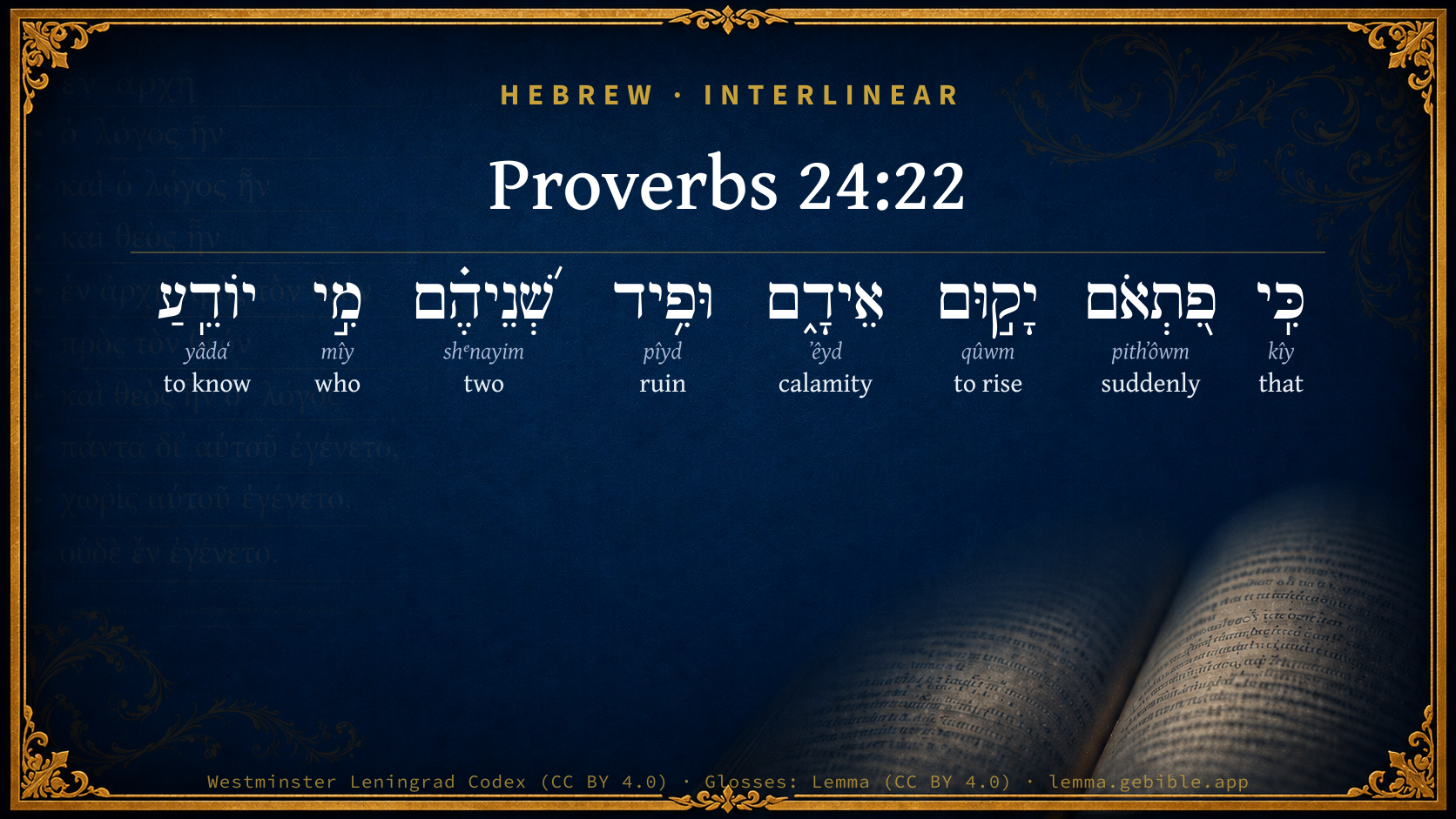
Proverbs 24:22

Hebrew (Westminster Leningrad Codex) Proverbs 24:22 appears in the Hebrew Old Testament. The text above is from the Westminster Leningrad Codex. Each word links to its Strong’s number, a concise gloss, and parsing drawn from the Open Scriptures Hebrew Bible morphology. Click any word for its full Brown-Driver-Briggs (BDB) entry.
Download image
Cite this verse

Proverbs 24:22 (World English Bible). Public Domain. Lemma interlinear Bible study tool, https://lemma.gebible.app/v/proverbs/24/22.

Show BibTeX & RIS
BibTeX
RIS
English Translation
For their calamity will rise suddenly; The destruction from them both--who knows?
World English Bible · Public Domain
Download a study sheet

One document with this verse’s original text, its word-by-word gloss line, the meaning frame, cross-references with their text, attributed commentary, and full source and license credits — printable, and it pastes into notes with its structure intact.

This verse Autodidact and up

Study sheet (.html) Plain text (.txt)

A passage Seminary Student

Up to 50 verses in one chapter. A passage sheet keeps up to 6 commentary sources and 12 cross-references per verse, in the order this page ranks them, and says so on the sheet whenever that leaves anything out. Ask for a single verse and you get the Autodidact verse sheet above.

Everything on this page stays free to read, with no account — the sheet is a download of what is already on screen, not access to it.

Want to remove ads? Support Godless Engineer
Compare translations 3

The same verse in 3 English versions, stacked beneath the original-language interlinear above. Click any original word for its lexicon entry.

Each is an independent rendering of the whole verse — the interlinear is not word-aligned to these translations.

Highlighted words mark where these versions differ — a whole-verse word diff, not a word-by-word alignment.

  • World English Bible Public Domain
    For their calamity will rise suddenly; The destruction from them both--who knows?
  • King James Version Public Domain
    For their calamity shall rise suddenly; and who knoweth the ruin of them both?
  • unfoldingWord Literal Text CC BY-SA 4.0
    For suddenly their calamity will arise, and who knowing the destruction of the two of them?

unfoldingWord Literal Text — © unfoldingWord, licensed CC BY-SA 4.0. Word-aligned USFM3 via Door43 (git.door43.org/unfoldingWord/en_ult).

Versions to compare (up to 4)

3 of 4 selected

Show all 18 translations

Every available English version of this verse, each an independent rendering of the whole verse.

  • World English Bible Public Domain
    For their calamity will rise suddenly; The destruction from them both--who knows?
  • Berean Standard Bible Public Domain
    For they will bring sudden destruction. Who knows what ruin they can bring?
  • Majority Standard Bible Public Domain
    For they will bring sudden destruction. Who knows what ruin they can bring?
  • King James Version Public Domain
    For their calamity shall rise suddenly; and who knoweth the ruin of them both?
  • American Standard Version (1901) Public Domain
    For their calamity shall rise suddenly; And the destruction from them both, who knoweth it?
  • Revised Version (1885) Public Domain
    For their calamity shall rise suddenly; and who knoweth the destruction of them both?
  • Geneva Bible (1599) Public Domain
    For their destruction shall rise suddenly, and who knoweth the ruine of them both?
  • Douay-Rheims (1899) Public Domain
    For their destruction shall rise suddenly: and who knoweth the ruin of both?
  • Young's Literal Translation Public Domain
    For suddenly doth their calamity rise, And the ruin of them both -- who knoweth!
  • Literal Standard Version CC BY-SA 4.0
    For their calamity rises suddenly, || And the ruin of them both—who knows!
  • Unlocked Literal Bible CC BY-SA 4.0
    for suddenly their disaster will come and who knows the extent of the destruction that will come from both of them?
  • unfoldingWord Literal Text CC BY-SA 4.0
    For suddenly their calamity will arise, and who knowing the destruction of the two of them?
  • Darby Bible Public Domain
    For their calamity shall rise suddenly; and who knoweth the ruin of them both?
  • World Messianic Bible Public Domain
    for their calamity will rise suddenly. Who knows what destruction may come from them both?
  • Webster's Bible Public Domain
    For their calamity shall rise suddenly; and who knoweth the ruin of them both?
  • Free Bible Version CC BY-SA 4.0
    for disaster will suddenly fall on them. Who knows how the Lord and king will punish them?
  • Bible in Basic English Public Domain
    For their downfall will come suddenly; and who has knowledge of the destruction of those in high positions?
  • JPS Tanakh (1917) Public Domain
    For their calamity shall rise suddenly; and who knoweth the ruin from them both?

Literal Standard Version (2020), Covenant Press — licensed CC BY-SA 4.0. Text via the HelloAO Bible API (eBible.org). Unlocked Literal Bible (unfoldingWord) — licensed CC BY-SA 4.0. Text via the HelloAO Bible API (eBible.org). unfoldingWord Literal Text — © unfoldingWord, licensed CC BY-SA 4.0. Word-aligned USFM3 via Door43 (git.door43.org/unfoldingWord/en_ult). Free Bible Version, Dr. Jonathan Gallagher — licensed CC BY-SA 4.0. Text via the HelloAO Bible API (eBible.org).

Word by word

More ways to search: Search by grammar → Find every occurrence → Compare this word →

Practice this passage: Drill this verse → Learn its vocabulary →

About this verse

These counts appear in no published source. They are computed here, from the morphology-tagged text and Lemma’s own curated glosses. What Lemma adds →

8
words
8
distinct lemmas
Wisdom
section

Notable vocabulary

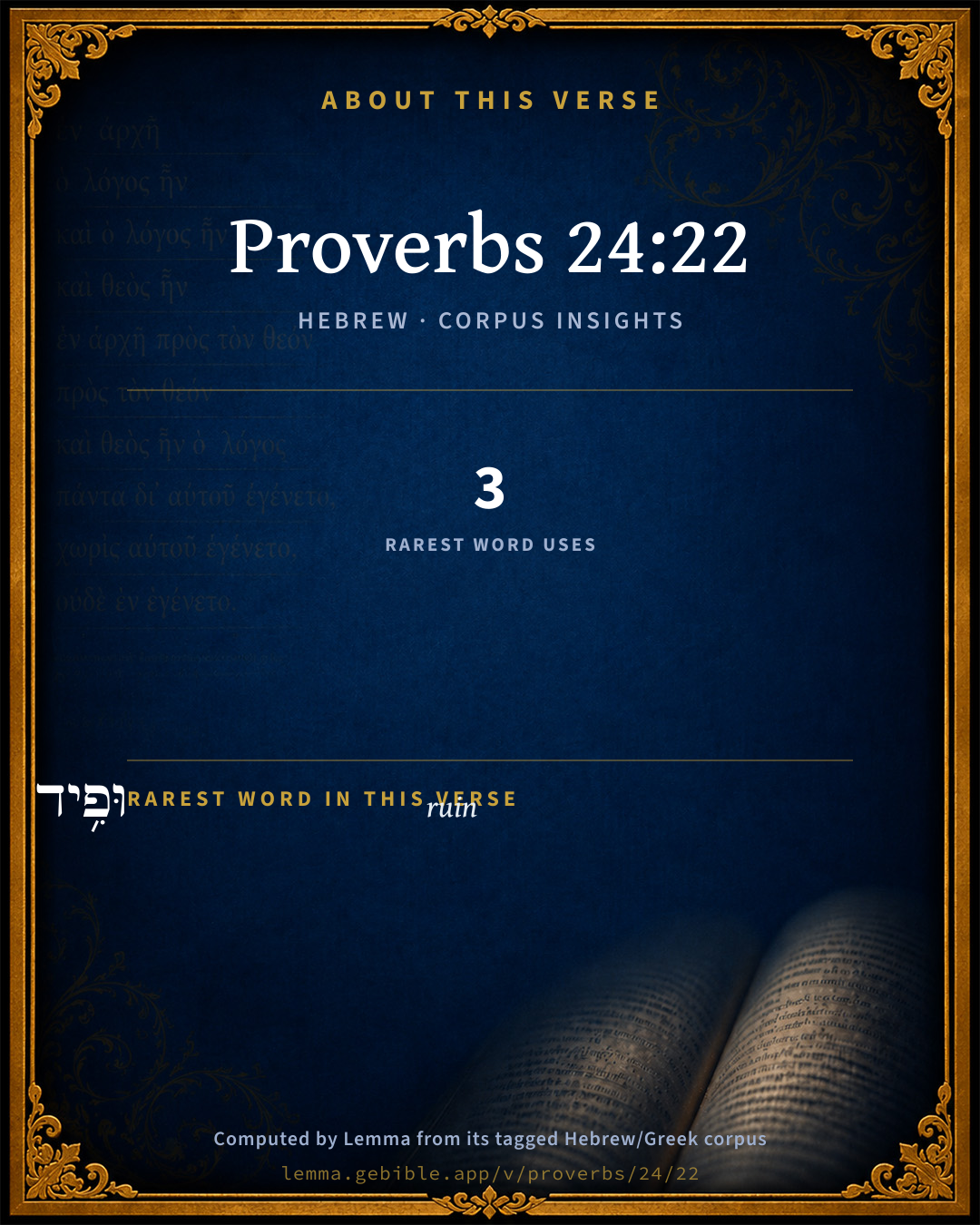
The rarest word here is וּפִ֥יד ruin H6365 — appearing just 3 times in the whole Hebrew Bible.

Shared distinctive vocabulary

וּפִ֥יד ruin H6365 occurs in 3 verses of the Hebrew Bible. Also found in:

Grammatical profile

  • 2 verbs
  • 2 nouns
  • 1 adjective
  • 1 conjunction
  • 1 adverb
  • 1 particle

Verb forms

  • יָק֣וּם Qal · Imperfect
  • יוֹדֵֽעַ Qal · Participle Active

Hebrew & Septuagint length

In English translation the verse runs 12 words from the Hebrew and 121 from the Septuagint (LXX English) — the Septuagint runs noticeably longer here. See the side-by-side →

A rough comparison of the two English renderings, which tokenize alike — not a word-level alignment.

Word counts can differ between the Hebrew and the Greek without any difference in meaning — e.g. the Hebrew direct-object marker אֵת has no separate Greek word, and Greek often adds the article ὁ.

Cross-references

9

Topical passages linked to Proverbs 24:22 in the Treasury of Scripture Knowledge — connected by theme and wording, ordered by reader-vote popularity; previews shown in the World English Bible.

  • Numbers 16:31–35 It happened, as he made an end of speaking all these words, that the ground split apart that was under them;
  • 2 Samuel 18:7–8 The people of Israel were struck there before the servants of David, and there was a great slaughter there that day of twenty thousand men.
  • 2 Chronicles 13:16–17 The children of Israel fled before Judah; and God delivered them into their hand.
  • Psalms 90:11 Who knows the power of your anger, Your wrath according to the fear that is due to you?
  • Hosea 5:11 Ephraim is oppressed, He is crushed in judgment; Because he is intent in his pursuit of idols.
  • 1 Samuel 31:1–7 Now the Philistines fought against Israel: and the men of Israel fled from before the Philistines, and fell down slain on Mount Gilboa.
  • Proverbs 16:14 The king's wrath is a messenger of death, But a wise man will pacify it.
  • Proverbs 20:2 The terror of a king is like the roaring of a lion: He who provokes him to anger forfeits his own life.
  • Hosea 13:10–11 Where is your king now, that he may save you in all your cities? And your judges, of whom you said, 'Give me a king and princes?'

Cross-references courtesy of OpenBible.info (CC BY 4.0).

Hebrew and Greek witnesses Masoretic Hebrew ↔ Greek Septuagint

The same verse in the two great witnesses to the Old Testament, shown verse-for-verse.

Here the Septuagint runs noticeably longer than the Hebrew — LXX2012 (modern English Septuagint) 121 words vs World English Bible 12. A rough length comparison of the two English translations, not a word-level alignment — read both below.

These are two independent witnesses, not word-aligned to each other, and the Septuagint is shown in lemma (dictionary) form.

Hebrew Proverbs 24:22 Masoretic · Westminster Leningrad Codex

כִּֽי פִ֭תְאֹם יָק֣וּם אֵידָ֑ם וּפִ֥יד שְׁ֝נֵיהֶ֗ם מִ֣י יוֹדֵֽעַ

For their calamity will rise suddenly; The destruction from them both--who knows?

World English Bible · Public Domain

Greek LXX Proverbs 24:22 Septuagint · lemma form

ἐξαίφνης γάρ τίνω ὁ ἀσεβής ὁ δέ τιμωρία ἀμφότεροι τίς γιγνώσκω λόγος φυλάσσω υἱός ἀπώλεια ἐκτός εἰμί δέχομαι δέ δέχομαι αὐτός μηδείς ψεύδος ἀπό γλῶσσα βασιλεύς λέγω καί οὐδείς ψεύδος ἀπό γλῶσσα αὐτός οὐ μή ἐκἔρχομαι μάχαιρα γλῶσσα βασιλεύς καί οὐ σάρκινος ὅς δέ ἄν παραδίδωμι συντρίβω ἐάν γάρ ὀξύνω ὁ θυμός αὐτός σύν νεῦρον ἄνθρωπος ἀναἁλίσκω καί ὀστέον ἄνθρωπος κατατρώγω καί συνκαίω ὥσπερ φλόξ ὥστε ἄβρωτος εἰμί νεοσσός ἀετός

For they will suddenly punish the ungodly, and who can know the vengeance inflicted by both? [A son that keeps the commandment shall escape destruction; for such an one has fully received it. Let no falsehood be spoken by the king from the tongue; yes, let no falsehood proceed from his tongue. The king's tongue is a sword, and not one of flesh; and whoever shall be given up to it shall be destroyed: for if his wrath should be provoked, he destroys men with cords, and devours men's bones, and burns them up as a flame, so that they are not even fit to be eaten by the young eagles. My son, reverence my words, and receive them, and repent.]

LXX2012 (modern English Septuagint) · Public Domain

On this verse, The Pulpit Commentary discusses the Septuagint’s reading. Read the note in Commentary ↓

Hebrew: Westminster Leningrad Codex (CC BY 4.0). Greek: Septuagint (public domain); English from LXX2012 (modern English Septuagint) (Public Domain). How the Septuagint differs from the Hebrew →

Commentary

Notes on Proverbs 24:22 from classic Christian and Jewish commentators (each source and its license shown beneath its notes). The classic Christian expositions comment on the surrounding passage and are grouped to its opening verse, so a note may address several verses; the Jewish commentaries on the Tanakh (Rashi and others) are per-verse, so they appear only where the commentator wrote on this verse.

Lemma curates 59 commentaries, every one of them public domain or Creative Commons licensed, each selected and text-cleaned for this edition rather than reprinted as found. About our sources →

Trapp's Complete Commentary

John Trapp

Pro 24:22 For their calamity shall rise suddenly; and who knoweth the ruin of them both?

Ver. 22. For their calamity shall rise suddenly.] When they think they have made all cock sure. "Had Zimri peace that killed his master?" Had Absalom; Sheba; Rodolphus, Duke of Suevia; Sanders; Story; Parry; Campian; the gunpowder plotters; Raviliac, &c.? Canute, the first Danish king, caused the false Edric’s head, that had been his agent, to be set upon the highest part of the Tower of London, therein performing his promise of advancing him above any lord in the land. {a} James I, king of Scots, was murdered in Perth by Walter, Earl of Athol, in hopes to attain the crown. Crowned indeed he was, but not as his witches and sorcerers had ambiguously insinuated, with the crown of that realm, but with a crown of red-hot iron clapt upon his head, being one of the tortures wherewith he ended at once his wicked days and desires. {b}

And who knoweth the ruin of them both?] i.e., That both God and the king will inflict upon the rebels; or "of them both" - i.e., both of the king, if a tyrant, and of those that seditiously move against him.

{a} Daniel’s Hist.

{b} Speed’s Chron.

John Trapp, A Commentary or Exposition upon All the Books of the Old and New Testament (1647–1656) — public domain. Text from a community e-Sword module.

The Pulpit Commentary

For their calamity shall rise suddenly. Though these dissidents seem to succeed for a time, yet retribution shall fall suddenly upon them. And who knoweth the ruin of them both? This seems to mean the two classes, those who dishonour God and those who dishonour the king; but no such distinction is made in the previous verse; the rebels are classed under one category. Wordsworth renders, "the stroke of vengeance from them both," i.e. from God and the king. Otherwise, we must give another signification to and, with the Syriac and many modern commentators, take it in the sense of "years," which will bear, as Job_36:11, and translate, "The destruction equivalent to "end of their years, who knoweth?" No one can tell when the crisis of their fate shall come; but it will arrive some day, and then the time of their prosperity will be at an end. Septuagint, "For they (God and the king) will suddenly punish the ungodly; and who shall know the vengeance of both (taav amfoterwn )?" After this the LXX inserts three proverbs not found now in the Hebrew, which, however, Ewald ("Jahrb. der Bibl. Wissensch.," 11:17, etc.) considers to have been translated from a Hebrew original: "A son that keepeth the commandment shall be safe from destruction, (Pro_29:27, Vulgate) and he hath fully received it (the word). Let no lie be spoken by the tongue of the king; and no he shall proceed from his tongue. The king"s tongue is a sword, and not of flesh; and whosoever shall be delivered unto it shall be destroyed; for if his anger be inflamed, he consumes men with their nerves, and devours men"s bones, and burns them up as a flame, so that they are not food for the young eagles." The allusion at the end is to animals killed by lightning. Here follows the series of proverbs (Pro_30:1-14) called in the Hebrew, "The words of Agur." The second part of "the words of Agur," and "the words of Lemuel" (Pro_30:15-33; Pro_31:1-9) follow in the Greek after Pro_24:34 of the Hebrew. Delitzsch explains the matter thus: In the copy from which the Alexandrines translated, the appendix (Pr 30-31:9) was divided into two parts, half of it standing after "the words of the wise", (Pro 22:17-24:22) and half after the supplement containing further sayings of wise men. (Pro_24:23-34)

The Pulpit Commentary (1880–1919), ed. H.D.M. Spence-Jones & Joseph S. Exell — public domain. Text from a community e-Sword module.

Geneva Bible (1599)

Geneva Bible translators

Meaning, either of the wicked and seditious, as verse 19 and 21, or, of them that fear not God, nor obey their King.

Geneva Bible (1599) marginal notes — public domain. Text via Bolls.life.

Jamieson, Fausset & Brown

Robert Jamieson, A. R. Fausset & David Brown

their calamity, &c.--either what God and the king inflict, or what changers and their company suffer; better the first.

Jamieson, Fausset & Brown — Commentary Critical and Explanatory on the Whole Bible (1871) — public domain (CC PDM 1.0). Text via the HelloAO Bible API.

Adam Clarke's Commentary

Verse 22. The ruin of them both?] Of them who do not fear the LORD; and of them that do not reverence the KING.

Adam Clarke's Commentary on the Bible (1810–1826) — public domain. Text from a community e-Sword/MySword module.

Ellicott's Commentary for English Readers

(22) The ruin of them both—i.e., the rebels against God and the king.

A Bible Commentary for English Readers, edited by Charles John Ellicott (1878–1897) — public domain. Text from a community e-Sword module.

The Cambridge Bible for Schools and Colleges

gen. ed. J. J. S. Perowne

22. of them both] i.e. those who are given to change, whether against God or against the king (Pro_24:21); ruinam utriusque quis novit? Vulg. Others understand, the destruction inflicted by them both, sc. both God and the king. Comp. calamity from God, lit. the calamity of (inflicted by) God, Job_31:23. Another rendering, of their years, i.e. which shall bring to an end their life is noticed in R.V. margin.

The Cambridge Bible for Schools and Colleges (gen. ed. J. J. S. Perowne; Cambridge University Press, 1878–1918) — public domain. Text from a community e-Sword module.

John Gill's Exposition

These things also belong to the wise,.... Both what is said before concerning fearing God and the king; these belong to the wise and unwise, rich and poor, great and small; particularly judges and civil magistrates, and all subordinate governors, who have, or ought to have, a competency of wisdom; these ought to fear God and the king, as well as private subjects; and also what follows after, especially in this verse and Pro 24:24. Some render the words, "these things also are the sayings of wise men" (u); not of Solomon, but of other wise men in his time, or who lived after him, and before the men of Hezekiah copied out the proverbs in the following chapters; see Pro 25:1; but it seems more than probable that what follows to the end of the chapter are the words of Solomon, as Pro 24:33 most clearly are, compared with Pro 6:10;

it is not good to have respect of persons in judgment; in trying causes in a court of judicature, no regard should be had to the persons of men by the judge on the bench, as the rich more than to the poor; or to a relation, a friend, an intimate acquaintance, more than to a stranger; but the justice of the cause ought to be attended to, and sentence given according to it, let it fall as it will: God does not accept persons, nor regard the rich more than the poor; nor should they that stand in his stead, and who in some sense represent him, Lev 19:15, Deu 1:17; nor should Christians in their communities act such a partial part, Jam 2:1.

(u) "haec quoqne sapientum sunt", Tigurine version; "etiam haec sapientibus profecta sunt", Piscator; "etiam haecce sapientum", Cocceius, Schultens, so Grotius.

John Gill's Exposition of the Whole Bible (1746–1763) — public domain (CC PDM 1.0). Text via the HelloAO Bible API.

Albert Barnes' Notes on the Bible

Both - Those who fear not God, and those who fear not the king.

Albert Barnes' Notes on the Bible (1834–1885) — public domain. Text from a community e-Sword/MySword module.

Matthew Poole's English Annotations

Who knoweth? who can conceive how sore and sudden it will be?

The ruin of them both; of them that fear not God, and of them that fear not the king, for they have two potent and terrible enemies; and therefore if they will not obey them out of conscience, as their duty binds them, yet they should do it at least for their own sakes, and for fear of those severe punishments which they will certainly inflict upon rebels.

Matthew Poole's English Annotations on the Holy Bible (1683–1685) — public domain. Text from a community e-Sword/MySword module.

Whedon's Commentary on the Bible

Daniel D. Whedon

22. The ruin of them both — That is, the ruin that proceeds from God and the king, who knoweth how, or how soon, it will come? So some: but others take it to be that of which these revolters — those who fear not God and those who fear not the king — are the authors. Comp. Pro_16:14.

Here commences what many commentators regard as a new section, an addendum to this part of the book.

Daniel D. Whedon (gen. ed.), Commentary on the Old and New Testaments (1874–1909) — public domain. Text from a community e-Sword module.

John Wesley's Explanatory Notes

Who knoweth - Who can conceive how sore and sudden will be the ruin of them that fear not God, and the king.

John Wesley, Explanatory Notes Upon the Whole Bible (1754–1765) — public domain. Text via the GEBible commentary corpus.

Kretzmann's Popular Commentary

Paul E. Kretzmann

v. 22. for their calamity, the misfortune sent upon them by God, shall rise suddenly, striking them with unexpected suddenness; and who knoweth the ruin of them both? For those who rebel against the constituted and existing government thereby rebel against the Lord. —

Paul E. Kretzmann, Popular Commentary of the Bible (1921–1924) — public domain. Text from a community e-Sword module.

Rashi

Rabbi Shlomo Yitzchaki (Rashi)

and the ruin of both of them The ruin of the idol and the ruin of its worshippers.

Rashi on the Tanakh — English translations: “The Judaica Press complete Tanach with Rashi, translated by A. J. Rosenberg” (CC BY 4.0); “Pentateuch with Rashi's commentary by M. Rosenbaum and A.M. Silbermann, 1929-1934” (public domain); “The Metsudah Tanach series, Lakewood, N.J” (CC BY 4.0); and “The Book of Joshua, Metsudah Publications, 1997” (CC BY 4.0). Text via Sefaria.

Lesson kit

Teaching starters — assembled from the data on this page, not authored interpretation. Every prompt links to the verse data it draws on. Edit before teaching.

Proverbs, in the Wisdom, opens this verse with 8 words (8 distinct Hebrew lemmas). Its most distinctive word is pîyd (“ruin”). The Greek Septuagint runs longer here. A historical commentator’s framing appears above. Read the whole chapter for the surrounding context.

Discussion questions

  1. The word pîyd carries the sense “ruin.” How does it shape the verse?
  2. How does Job 30:24, which shares the word «ruin», read alongside this verse?
  3. The Septuagint runs longer here than the Hebrew. What might account for the difference?
  4. These translations render this verse differently; the difference is in the English rendering, not the original. What questions does that raise?
  5. «יָק֣וּם» is a Qal Imperfect verb. How does that grammatical form shape the action described?
  6. Compare how Trapp's Complete Commentary and The Pulpit Commentary read this verse. Where do they agree or differ?

Things to notice

Reading settings

Reading text

Shown beneath each verse's original-language words.

Old Testament
Old Testament edition

Read the OT as the Masoretic Hebrew (MT) or the Greek Septuagint (LXX).

English shown for the Greek Septuagint (in the Hebrew ↔ Greek comparison).

Comparing translations? Open the Compare panel on any verse page to stack up to four side by side.