
1 Timothy 4:12

Greek (Tischendorf 8th ed.) 1 Timothy 4:12 appears in the Greek New Testament. The text above is from the Tischendorf 8th edition. Each word links to its Strong’s number and a concise gloss. Click any word for its full Thayer’s Greek Lexicon entry.
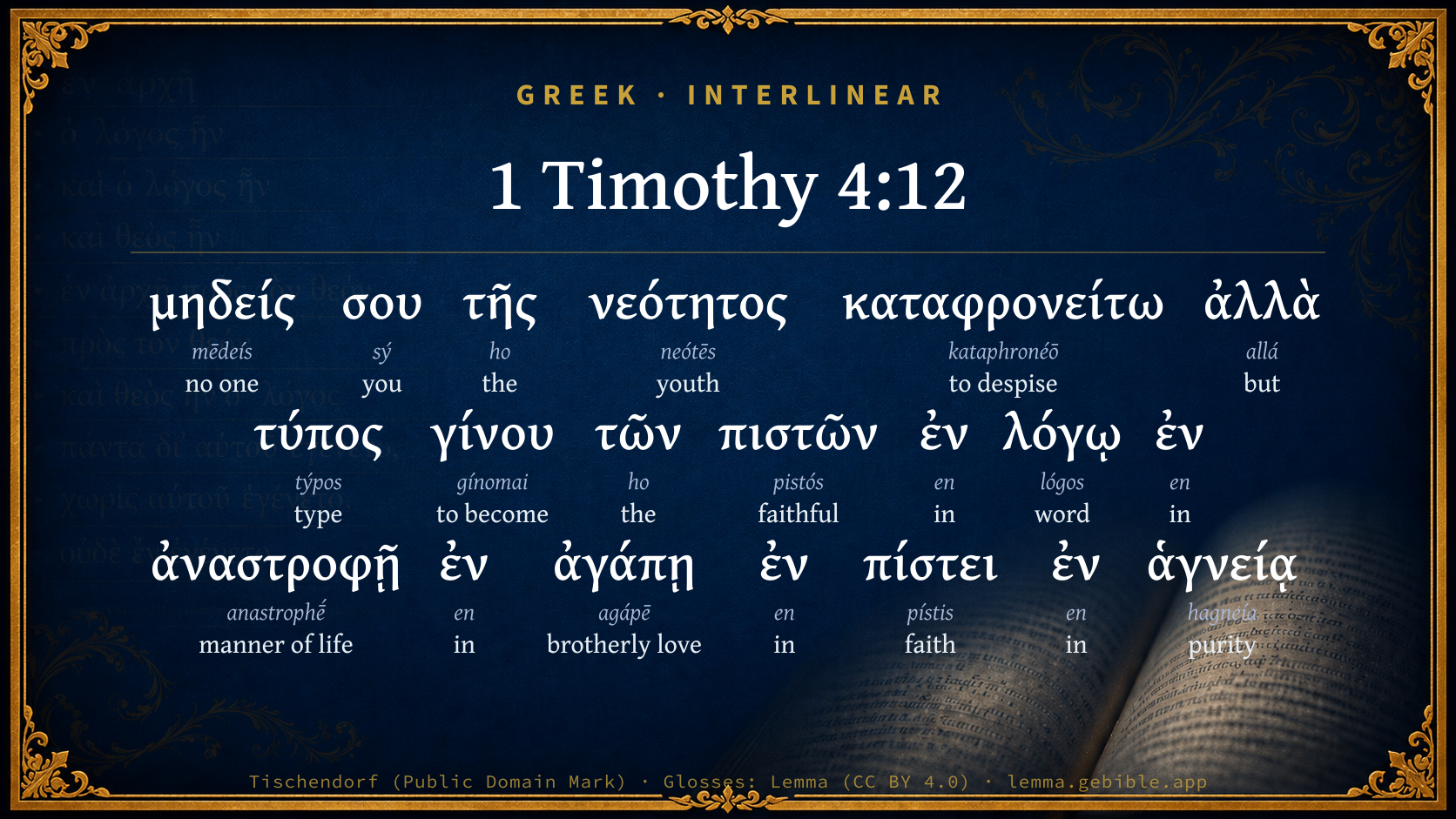
Download image
Cite this verse

1 Timothy 4:12 (World English Bible). Public Domain. Lemma interlinear Bible study tool, https://lemma.gebible.app/v/1-timothy/4/12.

Show BibTeX & RIS
BibTeX
RIS
English Translation
Let no man despise your youth; but be an example to those who believe, in word, in your way of life, in love, in spirit, in faith, and in purity.
World English Bible · Public Domain
Highlights
  • 1 first appearance in the Greek New Testament
Full analysis ↓
Download a study sheet

One document with this verse’s original text, its word-by-word gloss line, the meaning frame, cross-references with their text, attributed commentary, and full source and license credits — printable, and it pastes into notes with its structure intact.

This verse Autodidact and up

Study sheet (.html) Plain text (.txt)

A passage Seminary Student

Up to 50 verses in one chapter. A passage sheet keeps up to 6 commentary sources and 12 cross-references per verse, in the order this page ranks them, and says so on the sheet whenever that leaves anything out. Ask for a single verse and you get the Autodidact verse sheet above.

Everything on this page stays free to read, with no account — the sheet is a download of what is already on screen, not access to it.

Want to remove ads? Support Godless Engineer
Compare translations 3

The same verse in 3 English versions, stacked beneath the original-language interlinear above. Click any original word for its lexicon entry.

Each is an independent rendering of the whole verse — the interlinear is not word-aligned to these translations.

Highlighted words mark where these versions differ — a whole-verse word diff, not a word-by-word alignment.

  • World English Bible Public Domain
    Let no man despise your youth; but be an example to those who believe, in word, in your way of life, in love, in spirit, in faith, and in purity.
  • King James Version Public Domain
    Let no man despise thy youth; but be thou an example of the believers, in word, in conversation, in charity, in spirit, in faith, in purity.
  • unfoldingWord Literal Text CC BY-SA 4.0
    Let no one despise your youth, but be an example for the believers in word, in conduct, in love, in faith, in purity.

unfoldingWord Literal Text — © unfoldingWord, licensed CC BY-SA 4.0. Word-aligned USFM3 via Door43 (git.door43.org/unfoldingWord/en_ult).

Versions to compare (up to 4)

3 of 4 selected

Show all 19 translations

Every available English version of this verse, each an independent rendering of the whole verse.

  • World English Bible Public Domain
    Let no man despise your youth; but be an example to those who believe, in word, in your way of life, in love, in spirit, in faith, and in purity.
  • Berean Standard Bible Public Domain
    Let no one despise your youth, but set an example for the believers in speech, in conduct, in love, in faith, in purity.
  • Majority Standard Bible Public Domain
    Let no one despise your youth, but set an example for the believers in speech, in conduct, in love, in spirit, in faith, in purity.
  • King James Version Public Domain
    Let no man despise thy youth; but be thou an example of the believers, in word, in conversation, in charity, in spirit, in faith, in purity.
  • American Standard Version (1901) Public Domain
    Let no man despise thy youth; but be thou an ensample to them that believe, in word, in manner of life, in love, in faith, in purity.
  • Revised Version (1885) Public Domain
    Let no man despise thy youth; but be thou an ensample to them that believe, in word, in manner of life, in love, in faith, in purity.
  • Geneva Bible (1599) Public Domain
    Let no man despise thy youth, but be vnto them that beleeue, an ensample, in worde, in conuersation, in loue, in spirit, in faith, and in purenesse.
  • Douay-Rheims (1899) Public Domain
    Let no man despise thy youth: but be thou an example of the faithful in word, in conversation, in charity, in faith, in chastity.
  • Young's Literal Translation Public Domain
    let no one despise thy youth, but a pattern become thou of those believing in word, in behaviour, in love, in spirit, in faith, in purity;
  • Literal Standard Version CC BY-SA 4.0
    let no one despise your youth, but become a pattern of those believing in word, in behavior, in love, in spirit, in faith, in purity;
  • Unlocked Literal Bible CC BY-SA 4.0
    Let no one despise your youth. Instead, be an example for those who believe, in speech, conduct, love, faithfulness, and purity.
  • unfoldingWord Literal Text CC BY-SA 4.0
    Let no one despise your youth, but be an example for the believers in word, in conduct, in love, in faith, in purity.
  • Darby Bible Public Domain
    Let no one despise thy youth, but be a model of the believers, in word, in conduct, in love, in faith, in purity.
  • World Messianic Bible Public Domain
    Let no man despise your youth; but be an example to those who believe, in word, in your way of life, in love, in spirit, in faith, and in purity.
  • Webster's Bible Public Domain
    Let no man despise thy youth; but be thou an example of the believers, in word, in deportment, in charity, in spirit, in faith, in purity.
  • Free Bible Version CC BY-SA 4.0
    Don't let anyone look down on you because you are young. Be an example to those who trust in God—in the way you speak, the kind of life you live, in love, in trust, and in purity.
  • Bible in Basic English Public Domain
    Let no one make little of you because you are young, but be an example to the church in word, in behaviour, in love, in faith, in holy living.
  • Text-Critical English NT CC BY 4.0
    Let no one despise yoʋ because yoʋ are young, but set an example for the believers in yoʋr speech, conduct, love, spirit, faith, and purity.
  • Tyndale New Testament (1534) Public Domain
    Let no man despyse thy youth: but be vnto them that beleve an insample in worde in conversacion in love in sprete in fayth and in purenes.

Literal Standard Version (2020), Covenant Press — licensed CC BY-SA 4.0. Text via the HelloAO Bible API (eBible.org). Unlocked Literal Bible (unfoldingWord) — licensed CC BY-SA 4.0. Text via the HelloAO Bible API (eBible.org). unfoldingWord Literal Text — © unfoldingWord, licensed CC BY-SA 4.0. Word-aligned USFM3 via Door43 (git.door43.org/unfoldingWord/en_ult). Free Bible Version, Dr. Jonathan Gallagher — licensed CC BY-SA 4.0. Text via the HelloAO Bible API (eBible.org).

Word by word

More ways to search: Search by grammar → Find every occurrence → Compare this word →

Practice this passage: Drill this verse → Learn its vocabulary →

ἁγνείᾳ
hagneía
G47
“purity”
Noun, Dative, Singular, Feminine
Part of Speech
Noun
Case
Dative
Number
Singular
Gender
Feminine
Full Thayer's Definition

Origin: from G53

TDNT: 03:03,2

1. purity, sinlessness of life
  1. μηδείς mēdeís G3367 “no one” Adjective, Nominative, Singular, Masculine, Negative
  2. σου sý G4771 “you” Personal pronoun, 2nd person, Genitive, Singular
  3. τῆς ho G3588 “the” Article, Genitive, Singular, Feminine
  4. νεότητος neótēs G3503 “youth” Noun, Genitive, Singular, Feminine
  5. καταφρονείτω kataphronéō G2706 “to despise” Verb, Present, Active, Imperative, 3rd person, Singular
  6. ἀλλὰ allá G235 “but” Conjunction
  7. τύπος týpos G5179 “type” Noun, Nominative, Singular, Masculine
  8. γίνου gínomai G1096 “to become” Verb, Present, Middle or Passive deponent, Imperative, 2nd person, Singular
  9. τῶν ho G3588 “the” Article, Genitive, Plural, Masculine
  10. πιστῶν pistós G4103 “faithful” Adjective, Genitive, Plural, Masculine
  11. ἐν en G1722 “in” Preposition
  12. λόγῳ lógos G3056 “word” Noun, Dative, Singular, Masculine
  13. ἐν en G1722 “in” Preposition
  14. ἀναστροφῇ anastrophḗ G391 “manner of life” Noun, Dative, Singular, Feminine
  15. ἐν en G1722 “in” Preposition
  16. ἀγάπῃ agápē G26 “brotherly love” Noun, Dative, Singular, Feminine
  17. ἐν en G1722 “in” Preposition
  18. πίστει pístis G4102 “faith” Noun, Dative, Singular, Feminine
  19. ἐν en G1722 “in” Preposition

About this verse

These counts appear in no published source. They are computed here, from the morphology-tagged text and Lemma’s own curated glosses. What Lemma adds →

20
words
15
distinct lemmas
Pauline Epistles
section

Notable vocabulary

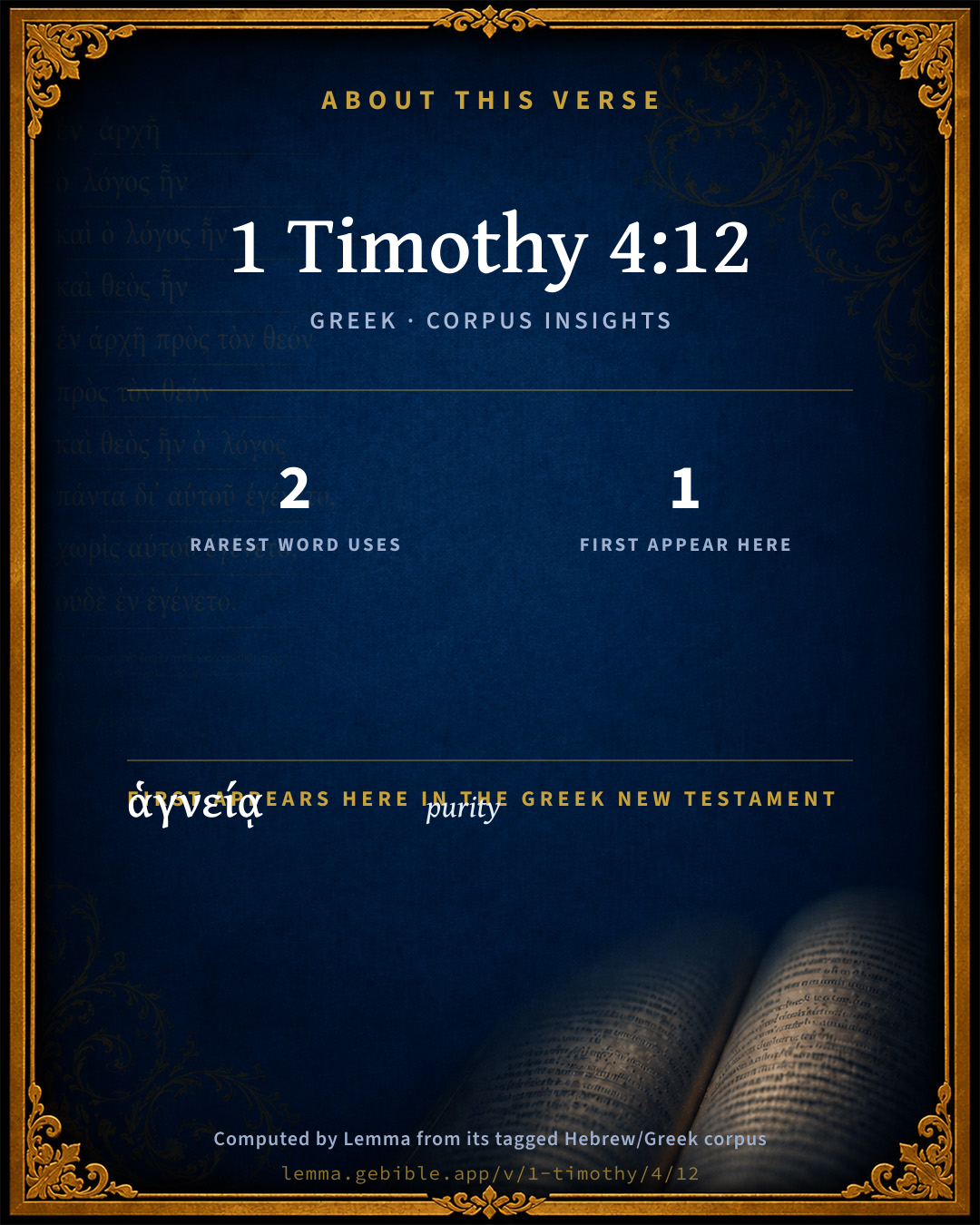
The rarest word here is ἁγνείᾳ purity G47 — appearing just 2 times in the whole Greek New Testament.

First appearance in Scripture

This word makes its first canonical appearance in the Greek New Testament here:

  • ἁγνείᾳ purity G47

Shared distinctive vocabulary

ἁγνείᾳ purity G47 occurs in 2 verses of the Greek New Testament. Also found in:
Repetition

Words recur within this verse:

Cross-references

18

Topical passages linked to 1 Timothy 4:12 in the Treasury of Scripture Knowledge — connected by theme and wording, ordered by reader-vote popularity; previews shown in the World English Bible.

  • Titus 2:7 in all things showing yourself an example of good works; in your teaching showing integrity, seriousness, incorruptibility,
  • 2 Timothy 2:22 Flee from youthful lusts; but pursue righteousness, faith, love, and peace with those who call on the Lord out of a pure heart.
  • 2 Timothy 2:15 Give diligence to present yourself approved by God, a workman who doesn't need to be ashamed, properly handling the Word of Truth.
  • 1 Peter 5:3 neither as lording it over the charge allotted to you, but making yourselves examples to the flock.
  • 2 Peter 1:5–8 Yes, and for this very cause adding on your part all diligence, in your faith supply moral excellence; and in moral excellence, knowledge;
  • 1 Corinthians 11:1 Be imitators of me, even as I also am of Christ.
  • 1 Thessalonians 1:6 You became imitators of us, and of the Lord, having received the word in much affliction, with joy of the Holy Spirit,
  • 2 Timothy 2:7 Consider what I say, and may the Lord give you understanding in all things.
  • Titus 2:15 Say these things and exhort and reprove with all authority. Let no man despise you.
  • Matthew 18:10 See that you don't despise one of these little ones, for I tell you that in heaven their angels always see the face of my Father who is in heaven.
  • James 3:17 But the wisdom that is from above is first pure, then peaceful, gentle, reasonable, full of mercy and good fruits, without partiality, and without hypocrisy.
  • James 3:13 Who is wise and understanding among you? Let him show by his good conduct that his deeds are done in gentleness of wisdom.
  • Philippians 4:8 Finally, brothers, whatever things are true, whatever things are honorable, whatever things are just, whatever things are pure, whatever things are lovely, whatever things are of good report; if there is any virtue, and if there is any praise, think about these things.
  • 1 Corinthians 16:10–11 Now if Timothy comes, see that he is with you without fear, for he does the work of the Lord, as I also do.
  • 1 Thessalonians 2:10 You are witnesses with God, how holy, righteously, and blamelessly we behaved ourselves toward you who believe.
  • 2 Corinthians 6:4–17 but in everything commending ourselves, as servants of God, in great endurance, in afflictions, in hardships, in distresses,
  • 2 Thessalonians 3:7–9 For you know how you ought to imitate us. For we didn't behave ourselves rebelliously among you,
  • 1 Timothy 1:14 The grace of our Lord abounded exceedingly with faith and love which is in Christ Jesus.

Cross-references courtesy of OpenBible.info (CC BY 4.0).

Where the printed editions differ

1 variant

Places in this verse where the major printed Greek editions disagree on the wording in a way that affects the translation — a comparison of editions, not a manuscript-by-manuscript collation. The editions are the modern critical texts (Nestlé-Aland 28/27, SBL, Westcott-Hort, Tregelles, Tyndale House) and the traditional texts behind the KJV (the Textus Receptus and the Byzantine/Majority text). It is not a claim about which reading is original.

  1. Extra text
    ἐν πνεύματι,

    “in spirit”

    In TRByz Not in NA28NA27TynSBLWHTreg

    ἐν πνεύματι, (en pneumati) 'in spirit' is only in traditional manuscripts (TR+Byz)

Textual data: Translators Amalgamated Greek New Testament (STEPBible TAGNT) · CC BY 4.0.

Commentary

Notes on 1 Timothy 4:12 from classic Christian and Jewish commentators (each source and its license shown beneath its notes). The classic Christian expositions comment on the surrounding passage and are grouped to its opening verse, so a note may address several verses; the Jewish commentaries on the Tanakh (Rashi and others) are per-verse, so they appear only where the commentator wrote on this verse.

Lemma curates 59 commentaries, every one of them public domain or Creative Commons licensed, each selected and text-cleaned for this edition rather than reprinted as found. About our sources →

Joseph Benson's Commentary

1Ti 4:12-13. Let no man despise thy youth — That is, let no one have reason to despise it, but conduct thyself with such gravity, wisdom, and steadiness, as, instead of exposing thee to contempt, will rather gain thee respect and reverence. In particular, be thou an example of the believers — A pattern worthy of their imitation; in word — In prudent and edifying discourse, whether public or private; in conversation — Greek, αναστροφη, in behaviour; in charity — Or love, rather, namely to God, his people, and all mankind; in spirit — In thy whole temper; in faith — In thy sincere and constant belief of, and adherence to, the truth as it is in Jesus; in thy profession of it, and faithfulness to thy trust in the execution of thy office. When faith is placed in the midst of several other Christian graces, it generally means fidelity, or faithfulness; in purity — Of heart and life. Till I come — To take thee along with me; give attendance to reading — Both publicly and privately. Study the Scriptures diligently, and read and expound them to the people, whose instructer thou art appointed to be. “Enthusiasts, observe this! expect no end without the means.” — Wesley. “Besides reading the Jewish Scriptures to the brethren in their assemblies for worship, after the example of the synagogue, Timothy was here directed to read these Scriptures in private likewise for his own improvement, (1Ti 4:15,) that he might be able to confute the Jews and Judaizers, who founded their errors on misinterpretations of them. Thus understood, the direction, as the ancient commentators observe, is a useful lesson to the ministers of the gospel in all ages. For if a teacher, who possessed the spiritual gifts, was commanded to read the Scriptures for improving himself in the knowledge of the doctrines of religion, how much more necessary is that help to those teachers who must derive all their knowledge of the gospel from the Scriptures, and who cannot, without much study, be supposed to know the customs, manners, and opinions alluded to in these writings.” — Macknight.

Joseph Benson's Commentary on the Old and New Testaments (1811–1818) — public domain. Text from a community e-Sword module.

The Preacher's Complete Homiletical Commentary

Joseph S. Exell (gen. ed.)

CRITICAL AND EXPLANATORY NOTES

1Ti_4:12. Let no man despise thy youth.—It is not upon any official position that St. Paul would demand respect, but on the worth of personal character. It is a poor thing when a distinction has to be made between the man as man and as official.

MAIN HOMILETICS OF 1Ti_4:12

The Power of a Good Example—

I. Commands respect in spite of youthfulness.—“Let no man despise thy youth.” Timothy was a mere youth—probably between twenty and twenty-five years of age—when Paul selected him as a missionary companion (Act_16:1-3). Eleven years had elapsed since then to the time subsequent to Paul’s first imprisonment. He was therefore still comparatively young, especially considered in relation to the elderly presbyters he was authorised to appoint and ordain, a work that seemed more fitting to the sedateness and gravity of age, and especially in relation to the aged Paul, who was evidently anxious to prepare Timothy to be in some sort his successor. Youthfulness is no disability in doing good. It is possible so to act as to win the esteem of all classes. Youth has great influence, and therefore great responsibility. “Tell me what is the character of the young,” said an old statesman, “and I’ll tell you the character of the next generation.”

II. Is based on consistency of religious life.—

1. In speech. “But be thou an example of the believers in word.” The tendency of youth is to exaggerate in speech, and the danger is that what begins in mere playfulness may degenerate into wanton misrepresentation. Speech is an index of character. During the war between Alexander the Great and Darius, king of Persia, a soldier in the army of the latter thought to ingratiate himself with Memnon, the Persian general, by uttering the fiercest invectives against Alexander. Memnon gently touched the fellow with his spear and said, “Friend, I pay you to fight against Alexander, not to revile him.”

2. In conduct. “In conversation.” The young minister should so behave in the Church, the family, and in intercourse with the world as to gain respect both for his office and his work.

3. In spirit. “In charity, in spirit, in faith.” Faith and love are the spring and sustenance of a becoming Christian spirit. The spirit that animates us will make itself evident in word and action.

4. In holiness. “In purity.” The minister should cultivate the deepest experiences of the spiritual life, and be holy in thought, in word, and in intention. Simplicity of holy motive should be followed out in consistency of holy action. The same Greek word signifies a fool and a child; and the Hebrew word for youth signifies blackness or darkness. Few Macarinses are to be found, who, for his gravity in youth, was surnamed “the old young man.”

III. Is a guide and inspiration to others.—“Be thou an example to the believers.” The young as well as the old may be an example for good, and so be an encouragement to young and old. It is a noble ambition to be not the first but the best among the good. A single example of valour and devotion is a stimulus to others. Whilst stationed in Scotland, Colonel Durnford happened to be between Berwick and Holy Island, where a small craft had stuck on the coast during a storm. Seeing the hesitation of the fishermen to go to the rescue, he jumped into a boat, calling out, “Will none of you come with me? If not, I shall go alone.” A volunteer crew at once joined him and succeeded in rescuing those in peril.

Lessons.—

1. A good example is the product of genuine religion.

2. An example of youthful fidelity is an inspiration to many.

3. We should study not so much to be an example to others as to be good ourselves.

The Preacher's Complete Homiletical Commentary (gen. ed. Joseph S. Exell; Funk & Wagnalls, c. 1892) — public domain (pre-1929). A full-Bible homiletical/sermon-outline anthology covering 65 of 66 books (2 John is absent from the source module). Text from a community e-Sword module.

Tyndale Open Study Notes

Tyndale Open Resources

4:12 Be an example: Only those whose lives are shaped by the Good News are worthy teachers of it (cp. 2 Tim 3:10-11; Titus 2:7; Heb 13:7). The false teachers were not.

Tyndale Open Study Notes — © Tyndale Open Resources, licensed CC BY-SA 4.0. Text via the HelloAO Bible API.

Bengel's Gnomon

Johann Albrecht Bengel

1Ti 4:12. Μηδεὶς, no man) Conduct thyself so, that no one can despise thee on the ground of being a young man. Worthless old men are glad to do so.—τύπος, a type, an example) The way of obtaining true authority.—ἐν λόγῳ, in word) public and private.—ἐν ἀναστροφῇ) in daily intercourse or conversation.—ἐν ἀγάτῃ—ἐν πνεύματι, in love—in the Spirit) 2Co 6:6, note.[38]—ἐν πίστει, in faith) Faith, considered apart from its office in justification, enters often into the middle of an enumeration of this kind, and denotes sincerity of the mind trusting in God, in prosperity and adversity: ch. 1Ti 6:11; 2Ti 2:22: comp. Gal 5:22, which passage has faith likewise in the middle of the enumeration.—ἐν ἁγνείᾳ, in purity) ch. 1Ti 5:2.

[38] “By the Holy Ghost, by love unfeigned.” Love follows immediately after mention of the Spirit, as being its principal fruit, and that which governs the use of spiritual gifts.—ED.

Bengel's Gnomon of the New Testament — English translation (T&T Clark, Edinburgh, 1860) — public domain. Text from a community e-Sword module.

Meyer's Critical & Exegetical Commentary

Heinrich August Wilhelm Meyer

1Ti_4:12. From this verse on to the end of the chapter, Paul instructs Timothy how he is to behave towards the community that his παραγγέλλειν καὶ διδάσκειν (1Ti_4:11) may not be in vain.

μηδείς σου τῆς νεότητος καταφρονείτω] σου is dependent on τῆς νεότητος, which is the object of καταφρον. Wahl, on the contrary (followed by Leo and Matthies), construes σου directly with καταφρ., and takes τῆς νεότ. as a genitive defining the substantive more precisely (= μηδεὶς διὰ τὴν νεότητα καταφρονήσῃ σου, Chrysostom), so that καταφρ. here (like κατηγορεῖν) would be connected with a double genitive (comp. Buttmann, p. 143). This construction, however, is more forced than the former, and καταφρ. occurs nowhere else with it.

According to the form of the sentence, the command is directed to the community, but in sense to Timothy. Timothy is not to permit the authority entrusted to him as representative of the apostle, to be limited on account of his youth: permit no one to despise thy youth. The ἀλλά, however, attached to this injunction shows that he is to effect this especially by his Christian conduct; most expositors find here only this last thought.

That he may retain respect, he is to make himself an example to all: ἀλλὰ τύπος γίνου τῶν πιστῶν. A comma is not unsuitably placed after πιστῶν, giving the clause greater independence, and making the qualifications that follow: ἐν λόγῳ κ.τ.λ., more emphatic. On the exhortation τύπος γίνου, comp. besides Tit_2:7; Php_3:17; 2Th_3:9; 1Pe_5:3. Γίνου does not mean become, as if Timothy had not been so hitherto, but be. The next five words: ἐν λόγῳ κ.τ.λ., tell wherein Timothy is to be an example to believers. We cannot but observe that there is a certain order in the succession of the words. First we have ἐν λόγῳ and ἐν ἀναστροφῇ. Λόγος includes every kind of speaking (not merely doctrine), i.e. teaching, exhorting, warning, comforting, etc., both in public assemblies and in private intercourse. Ἀναστροφή is the life as embodied in deeds. Word and life are the two forms of revealing the inner hidden disposition. To this inner life we are directed by the next words: ἐν ἀγάπῃ, ἐν πίστει, which denote the powers that give motion to the Christian life. The last word: ἐν ἁγνείᾳ, gives, finally, the nature of the life that is rooted in faith and love. The word does not denote here specially chastity in the relation of sex, but generally purity of moral behaviour (Hofmann); comp. ἁγνός, 1Ti_5:22; 2Co_7:11; Jam_3:17; ἁγνότης, 2Co_6:6; ἁγνίζειν, Jam_4:8; 1Pe_1:22; 1Jn_3:3.

Meyer — Critical and Exegetical Commentary on the New Testament — English translation by Peter Christie, edited by Frederick Crombie (T&T Clark, 1880) — public domain. Text from a community e-Sword module.

Expositor's Greek Testament

ed. W. Robertson Nicoll

1Ti 4:12 . μηδείς καταφρονείτω (“ Libenter id faciunt senes inanes ,” Bengel). Many, probably, of the Ephesian presbyters were older than Timothy. For μηδείς in this position, cf. 1Co 3:18 ; 1Co 10:24 ; Eph 5:6 ; Col 2:18 ; Tit 2:15 ; Jas 1:13 . καταφρονέω connotes that the contempt felt in the mind is displayed in injurious action. (See Moulton and Milligan, Expositor , vi., viii. 432). The meaning of this direction is qualified by the following ἀλλὰ τύπος γίνου , κ . τ . λ . It means, Assert the dignity of your office even though men may think you young to hold it. Let no one push you aside as a boy . Compare the corresponding direction Tit 2:15 , μηδείς σου περιφρονείτω . On the other hand, St. Paul shows Timothy “a more excellent way” than self-assertion for the keeping up of his dignity: Give no one any ground by any fault of character for despising thy youth.

σου depends on τῆς νεότητος . Field supports this by an exact parallel from Diodorus Siculus. The two genitives do not, in strict grammar, depend on καταφρον ., despise thee for thy youth .

τῆς νεότητος : St. Paul had met Timothy on the second missionary journey, dated by Harnack in A.D. 47, and by Lightfoot in A.D. 51. About the year 57, St. Paul says of Timothy, “Let no man despise him” (1Co 16:11 ). 1 Tim. may be dated not more than a year before St. Paul’s martyrdom, which Harnack fixes in A.D. 64, and Lightfoot in A.D. 67. The question arises, Could Timothy’s νεότης have lasted all that time, about fifteen or sixteen years? We must remember that we have no information about Timothy’s age when he joined St. Paul’s company. But if he had been then fifteen or sixteen, or even seventeen, νεότης here need cause no difficulty. Lightfoot ( Apostolic Fathers , Part II. vol. i. p. 448) adduces evidence from Polybius and Galen to show that a man might be called νεός up to the age of thirty-four or thirty-five. In any case, the terms “young” and “old” are used relatively to the average age at which men attain to positions in the world. Forty is reckoned old for a captain in the army, young for a bishop, very young for a Prime Minister. In an instructive parallel passage, Ignatius commends the Magnesians (§ 3) and their presbyters for not presuming upon the youth of their bishop. For Timothy’s comparative youth, cf. 2Ti 2:22 , τὰς δὲ νεωτερικὰς ἐπιθυμίας φεῦγε .

τύπος γίνου : For the sentiment, compare reff. and 1Co 4:16 , Phi 4:9 .

τύπος is followed by the genitive of the person for whose edification the τύπος exists in 1Co 10:6 , 1Pe 5:3 .

In the following enumeration, λόγος is coupled with ἀναστροφή as words with deeds (Rom 15:18 ; Col 3:17 ). These refer to Timothy’s public life; while love, faith and purity refer to his private life, in reference to which they are found in conjunction in 1Ti 2:15 .

The Expositor's Greek Testament, edited by W. Robertson Nicoll (1897–1910) — public domain. Text from a community e-Sword module.

Geneva Bible (1599)

Geneva Bible translators

Now he returneth to that exhortation, showing which are the virtues of a Pastor, whereby he may come to be reverenced, although he be but young, to wit, such speech and life as are witnesses of charity, zeal, faith, and purity, but here is no mention made of the crosier staff, ring, cloak, and such other foolish and childish toys.

Geneva Bible (1599) marginal notes — public domain. Text via Bolls.life.

Jamieson, Fausset & Brown

Robert Jamieson, A. R. Fausset & David Brown

Let no man despise thy youth--Act so as to be respected in spite of thy youth (Co1 16:11; Tit 2:15); compare "youthful" as to Timothy (Ti2 2:22). He was but a mere youth when he joined Paul (Act 16:1-3). Eleven years had elapsed since then to the time subsequent to Paul's first imprisonment. He was, therefore, still young; especially in comparison with Paul, whose place he was filling; also in relation to elderly presbyters whom he should "entreat as a father" (Ti1 5:1), and generally in respect to his duties in rebuking, exhorting, and ordaining (Ti1 3:1), which ordinarily accord best with an elderly person (Ti1 5:19).

be thou an example--Greek, "become a pattern" (Tit 2:7); the true way of making men not to despise (slight, or disregard) thy youth.

in word--in all that thou sayest in public and private.

conversation--that is, "behavior" the Old English sense of the word.

in charity . . . faith--the two cardinal principles of the Christian (Gal 5:6). The oldest manuscripts omit, "in spirit."

in purity--simplicity of holy motive followed out in consistency of holy action [ALFORD] (Ti1 5:22; Co2 6:6; Jam 3:17; Jam 4:8; Pe1 1:22).

Jamieson, Fausset & Brown — Commentary Critical and Explanatory on the Whole Bible (1871) — public domain (CC PDM 1.0). Text via the HelloAO Bible API.

Adam Clarke's Commentary

Verse 12. Let no man despise thy youth] Act with all the gravity and decorum which become thy situation in the Church. As thou art in the place of an elder, act as an elder. Boyish playfulness ill becomes a minister of the Gospel, whatever his age may be. Concerning Timothy's age see the conclusion of the preface to this epistle.

Be thou an example of the believers] It is natural for the flock to follow the shepherd; if he go wrong, they will go wrong also.

"Himself a wanderer from the narrow way,

His silly sheep, no wonder if they stray."

Though, according to the just judgement of God, they who die in their sins have their blood on their own head; yet, if they have either gone into sin or continued in it through the watchman's fault, their blood will God require at his hand. How many have endeavoured to excuse their transgressions by alleging, in vindication of their conduct, "Our minister does so, and he is more wise and learned than we." What an awful account must such have to give to the Head of the Church when he appears!

In word] εν λογω. In doctrine; teach nothing but the truth of God, because nothing but that will save souls.

In conversation] εν αναστροφη. In the whole of thy conduct in every department which thou fillest in all thy domestic as well as public relations, behave thyself well.

In charity] εν αγαπη. In love to God and man; show that this is the principle and motive of all thy conduct.

In spirit] εν πνευματι. In the manner and disposition in which thou dost all things. How often is a holy or charitable work done in an unholy, uncharitable, and peevish spirit! To the doer, such work is unfruitful.

These words are wanting in ACDFG, and several others; both the Syriac, Erpen's Arabic, AEthiopic, Armenian, Vulgate, and Itala, and many of the fathers. Griesbach leaves them out of the text. They have in all probability been added by a later hand.

In faith] εν πιστει. This word πιστις is probably taken here for fidelity, a sense which it often bears in the New Testament. It cannot mean doctrine, for that has been referred to before. Be faithful to thy trust, to thy flock, to thy domestics, to the public, to thy GOD. Fidelity consists in honestly keeping, preserving, and delivering up when required, whatever is intrusted to our care; as also in improving whatever is delivered in trust for that purpose. Lose nothing that God gives, and improve every gift that he bestows.

In purity.] εν αγνεια. Chastity of body and mind; a direction peculiarly necessary for a young minister, who has more temptations to break its rules than perhaps any other person. "Converse sparingly with women, and especially with young women," was the advice of a very holy and experienced minister of Christ.

Adam Clarke's Commentary on the Bible (1810–1826) — public domain. Text from a community e-Sword/MySword module.

John Calvin's Commentaries

12 Let no man despise thy youth He says this, both in regard to others, and to Timothy himself. As to others, he does not wish that the age of Timothy should prevent him from obtaining that reverence which he deserves, provided that, in other respects, he conduct himself as becomes a minister of Christ. And, at the same time, he instructs Timothy to supply by gravity of demeanor what is wanting in his age. As if he had said, “Take care that, by gravity of demeanor, thou procure for thyself so great reverence, that thy youthful age, which, in other respects lays one open to contempt, may take nothing from thy authority.” Hence we learn that Timothy was still young, though he held a place of distinguished excellence among many pastors; and that it is a grievous mistake to estimate by the number of years how much is due to a person.

But be an example of the believers He next informs him what are the true ornaments; not external marks, such as the crosier, the ring, the cloak, and such like trifles, or children’s rattles; but soundness of doctrine and holiness of life. When he says, by speech and conversation, the meaning is the same as if he had said, “by words and actions,” and therefore by the whole life.

Those which follow are parts of a godly conversation — charity, spirit faith, chastity. By the word spirit, I understand ardor of zeal for God, if it be not thought better to interpret it more generally, to which I have no objection. Chastity is not merely contrasted with uncleanness, but denotes purity of the whole life. Hence we learn, that they act a foolish and absurd part, who complain that no honor is paid to them, while they have nothing about them that is worthy of applause, but, on the contrary, expose themselves to contempt, both by their ignorance, and by a detestable example of life, or by levity or other abominations. The only way of procuring reverence is, by excellent virtues, to guard ourselves against contempt.

John Calvin's Commentaries (1540-1563) — public domain. Text from the Calvin Translation Society English edition (1840s-50s) via the Christian Classics Ethereal Library (ccel.org). Calvin's coverage is partial (roughly two-thirds of the Bible); uncommented books and verses are honest gaps, never fabricated. The 19th-century editor's footnotes and remarks are omitted so the notes are faithfully Calvin's own voice.

Ellicott's Commentary for English Readers

(12) Let no man despise thy youth.—If Timothy desired that his teaching should be listened to with respectful earnest attention, if he hoped to use a holy influence over the flock, let him be very careful that his comparative youth prove no stumbling-block. To Paul the aged, his son in the faith seemed still youthful—at this time Timothy could not have been more than forty years of age. The old master would have his young disciple supply the want of years by a gravity of life; he would have him, while fearless, at the same time modest and free from all that pretentious assumption, unhappily so often seen when the comparatively young are placed in positions of dignity and authority. Paul proceeds further to explain his solemn warning by instancing the especial points in which Timothy was to be a pattern to the other believers. These gentle words of warning, such notices as we find in 1Ti_5:23 and in 1Co_16:10-11, seem to point to the fact of there being nothing winning in the personal appearance of Timothy, but rather the contrary. It is deserving of comment that among the more famous of the early Christian leaders, beauty of face and form appears to have been the exception rather than the rule. This was, of course, utterly different from the old Grecian idea of gods and heroes. It was no doubt part of the counsel of God that this world-religion should owe nothing to the ordinary conditions of human success. The teaching was novel and opposed to the maxims which guided and influenced the old world. The noblest ideals proposed for Christian imitation were strange and hitherto unheard of. The very foremost preachers of the faith of Christ, as in the case of Timothy, seem to have owed nothing to those personal gifts so highly prized among Pagan nations. So the appearance of St. Paul, the greatest of the early Christian leaders, seems to have been mean and insignificant, “ein armes diirres Männlein” as Luther has it. The blessed Founder of the religion is described by Tertullian, who lived in the same century with those who must have conversed with Christ’s disciples, as “having no human beauty, much less any celestial splendour.” Clement of Alexandria, Justin Martyr, and other very early writers, join in the same testimony. It is, however, only fair to say that on this point the view of Origen appears to have been different. The Messianic prophecies evidently looked forward to this as the will of the Most High. (See Psa_22:6-7; Psa_22:15; Psa_22:17; Isa_52:14; Isa_53:2-4.)

In word.—This refers to the public utterances in teaching and exhortation, but more particularly to the words used by Timothy in social intercourse. These, in such a life as that of the young presiding elder of the Ephesian Church, must have been of the deepest importance. The tone of his conversation was no doubt imitated by many, it would influence for good or evil the whole Christian society of that great centre. The words of men placed in such a position should ever be true and generous, helpful and encouraging, and, above all, free from slander, from all low and pitiful conceptions of others.

In conversation.—This rendering might mislead—the Greek word signifies rather “manner of life,” or “conduct.”

In charity.—Better rendered, in love. This and the following “in faith,” comprehend the great graces in that inner Christian life of which the “words of the mouth,” and “conduct,” are the outward manifestations. He was to be the example to the flock in “love” to his neighbours, and in “faith” towards God.

The words “in spirit,” which in the English version occur between “in charity,” and “in faith,” are found in none of the older authorities.

In purity.—Chastity of mind as well as body is here signified. The ruler of a church—among whose members evidently a school of teaching existed in which a life of stern asceticism was urged on the Christian believer as the only acceptable or even possible way of life for the servant of Christ—must be above all things watchful lest he should seem to set a careless example in the matter of morality.

A Bible Commentary for English Readers, edited by Charles John Ellicott (1878–1897) — public domain. Text from a community e-Sword module.

The Cambridge Bible for Schools and Colleges

gen. ed. J. J. S. Perowne

12. in conversation] In behaviour; the verb occurs above 1Ti_3:15; see note. It is an especial favourite of St Peter’s, noun and verb occurring 10 times in his short Epistles. The five words describe five stages, from the most defined external to the most defined internal characteristics—speech, behaviour, love, faith, purity; love as it were belonging equally to the inner and the outer self, and combining all. ‘The greatest is love.’ Yet the special emphasis is on ‘purity,’ the word itself occurring only here and in 1Ti_5:2, though another form of the word is used in the similar catalogue, 2Co_6:6. The same connexion of ‘youth’ and ‘purity’ is in St Paul’s mind in 2Ti_2:22, ‘flee also youthful lusts.’ Timothy, at 36 years, was young compared with St Paul and the presbyters. See Introd. pp. 56 sqq. Cf. also the use of the Latin iuvenis, for military service up to 40 years; e.g. Liv. i. 43.

in charity, in spirit, in faith] There is no sufficient ms. authority for ‘in spirit’; it is curious that A reads ‘in spirit’ instead of ‘in faith’ in 1Ti_2:7. The phrase, most common in St Paul’s earlier Epistles, has left his latest language.

The Cambridge Bible for Schools and Colleges (gen. ed. J. J. S. Perowne; Cambridge University Press, 1878–1918) — public domain. Text from a community e-Sword module.

John Gill's Exposition

Till I come,.... To Ephesus; where the apostle hoped to be shortly, but was prevented; he afterwards came to Miletus, and sent for the elders of Ephesus thither, when he took his final leave of them. He mentions this circumstance, not as if Timothy was to attend to the following things no longer, but to quicken him to an attendance to them from the consideration of his being shortly with him.

Give attendance to reading; that is, of the Scriptures, which the Jews call "reading". (l).

"Says R. Tanchum Bar Chanilai, for ever let a man divide his years or life into three parts; one third (let him spend) in the Mikra, (the Scriptures, and the reading of them,) another third in the Misna, and the other third in the Talmud.''

And this is to be understood, not of the reading of the Scriptures in public, for the advantage of others, a custom which obtained in the Jewish synagogues; see Act 13:15 but in private, for his own use and service, that he might be more perfect, and more thoroughly furnished to the work and office to which he was called; for the Scriptures are the fund of spiritual knowledge, as well as the test and standard of doctrine, out of which all must be fetched, and by which it must be tried; and if Timothy, who had known the Scriptures from a child, had been trained up in them, and was always conversant with them, had need to give diligent attention to the reading of them, then much more others: as also

to exhortation, to doctrine; as he was privately to read the Scriptures, for his own benefit, he was publicly to expound them, or preach from them, to the advantage of others; for these two, exhortation and doctrine, are branches of the ministerial work, which reading furnishes and qualifies for. "Exhortation" intends the stirring up of believers to the exercise of grace, and the discharge of duty; and is a considerable part of the work of the ministry, and on which a minister of Christ should much insist; and it becomes the saints to suffer every word of exhortation from them, and receive it kindly, Ti2 4:2, Rom 12:8, Heb 13:22. The word signifies also "consolation", and which is another branch of the ministry. Believers are oftentimes disconsolate through the prevalence of corruptions, the power of Satan's temptations, and the hidings of God's face, and need comfort; when the ministers of the Gospel should be Barnabases, sons of consolation, and should speak comfortably to them; for which they are qualified by the God of all comfort, who comforts them in all their tribulations, that they might be capable of speaking good and comfortable words to others. "Doctrine" designs the teaching and instructing of the church in the mysteries of the Gospel; opening and explaining the truths of it; defending them against all opposers, and refuting errors and heresies contrary to them. This is the evangelic Talmud; and these three, "reading", "exhortation", and "doctrine", may answer to the above three things the Jew advises men to divide their time among, the Mikra, Misna, and Talmud: reading answers to the Mikra, and indeed is no other; and exhortation to the Misna, or oral law; and doctrine to the Talmud, and which also that word signifies: but the apostle would have Timothy spend his time in, and give his attention to that which might be truly beneficial to himself, and profitable unto others.

(l) T. Bab. Avoda Zara, fol. 19. 2.

John Gill's Exposition of the Whole Bible (1746–1763) — public domain (CC PDM 1.0). Text via the HelloAO Bible API.

Trapp's Complete Commentary

John Trapp

12 Let no man despise thy youth; but be thou an example of the believers, in word, in conversation, in charity, in spirit, in faith, in purity.

Ver. 12. Let no man despise, &c.] But how should I help it? might he say; the apostle answereth, "Be thou an example to the believers, a pattern of piety;" for holiness hath honour, wisdom maketh the face to shine; natural conscience cannot but stoop to the image of God, wherever and in whomsoever it discerneth it: ου γαρ το νεον ευκαταφρονητον οτας Θεω ανακειμενον η, saith Ignatius (Epist. ad Magnes.) Youth seasoned with the fear Of God is not easily despised.

But be thou an example] Gr. τυπος, such a thing as maketh the stamp upon the coin. Exemplis sciola hac aetate magis aedificant ministri quam concionibus. Reason indeed should rule, and is therefore placed in the head. But when reason cannot prevail, example will.

John Trapp, A Commentary or Exposition upon All the Books of the Old and New Testament (1647–1656) — public domain. Text from a community e-Sword module.

Albert Barnes' Notes on the Bible

Let no man despise thy youth - That is, do not act in such a manner that any shall despise you on account of your youth. Act as becomes a minister of the gospel in all things, and in such a way that people will respect you as such, though you are young. It is clear from this that Timothy was then a young man, but his exact age there is no means of determining. It is implied here:

(1) That there was danger that, by the levity and indiscretion to which youth are so much exposed, the ministry might be regarded with contempt; and,

(2) That it was possible that his deportment should be so grave, serious, and every way appropriate, that the ministry would not be blamed, but honored. The “way” in which Timothy was to live so that the ministry would not be despised on account of his youth, the apostle proceeds immediately to specify.

But be thou an example of the believers - One of the constant duties of a minister of the gospel, no matter what his age. A minister should so live, that if all his people should closely follow his example, their salvation would be secure, and they would make the highest possible attainments in piety. On the meaning of the word rendered “example,” see the notes on Phi 3:17; 1Th 1:7.

In word - In “speech,” that is, your manner of conversation. This does not refer to his “public teaching” - in which he could not probably be an “example” to them - but to his usual and familiar conversation.

In conversation - In general deportment. See this word explained in the notes on Phi 1:27.

In charity - Love to the brethren, and to all; see notes on 1 Cor. 13.

In spirit - In the government of your passions, and in a mild, meek, forgiving disposition.

In faith - At all times, and in all trials show to believers by your example, how they ought to maintain unshaken confidence in God.

In purity - In chasteness of life; see 1Ti 5:2. There should be nothing in your contact with the other sex that would give rise to scandal. The papists, with great impropriety, understand this as enjoining celibacy - as if there could be no “purity” in that holy relation which God appointed in Eden, and which he has declared to “be honorable in all” Heb 13:4, and which he has made so essential to the wellbeing of mankind. If the apostle had wished to produce the highest possible degree of corruption in the church, he would have enjoined the celibacy of the clergy and the celibacy of an indefinite number of nuns and monks. There are no other institutions on the earth which have done so much to corrupt the chastity of the race, as those which have grown out of the doctrine that celibacy is more honorable than marriage.

Albert Barnes' Notes on the Bible (1834–1885) — public domain. Text from a community e-Sword/MySword module.

Haydock's Catholic Bible Commentary

Let no man despise thy youth. That is, let thy behaviour be such that no one can have occasion to despise thee. He seems then about the age of forty. (Witham)

George Leo Haydock (1774–1849), Haydock's Catholic Family Bible and Commentary, 1859 edition — public domain. Excludes Psalms (Douay-Rheims chapter numbering differs from Protestant) and Deuterocanonical books (Catholic canon only).

Matthew Poole's English Annotations

Let no man despise thy youth; so carry thyself in thy office, as not to give occasion to any to despise thee because thou art but a young man.

But be thou an example of the believers: which thou wilt do if thou so livest as to be a just pattern unto Christians, imitable by them

in word, in thy common and ordinary discourse, (for he speaks not of his being a pattern only to other ministers, but to believers in the generality), not talking frothily or profanely, or idly and impertinently, but seriously and gravely, but things that are good, to the use of edifying, that it may administer grace to the hearers.

In conversation; and in all thy converse with men behaving thyself justly, and comelily, and gravely.

In charity; performing also to all, all offices of charity and brotherly love.

In spirit; in zeal, and warmth of spirit, truly inflamed with the love of Christ, and for his glory.

In faith; in a steady confession and profession of the doctrine of the gospel; and

in purity; in all cleanness and holiness of life and conversation. This is the way for the ministers of the gospel not to be despised: let them use what other methods they will, they will find what God said of Hophni and Phinehas will be made good, 1Sa 2:30; Them that honour me I will honour, and they that despise me shall be lightly esteemed; nor will any titles, or habits, or severities secure them from that curse, which will cleave to them.

Matthew Poole's English Annotations on the Holy Bible (1683–1685) — public domain. Text from a community e-Sword/MySword module.

Whedon's Commentary on the Bible

Daniel D. Whedon

12. Despise thy youth—To be avoided by a perfectly circumspect conduct. Though Timothy was probably thirty-five years old, he was younger than many, perhaps, under his administration. At any rate he was young to Paul; just as pupils and sons often never grow old to teacher or father. “In those times,” says Grotius, “presbyters were accustomed to be what their name signifies, persons of advanced age.”

Daniel D. Whedon (gen. ed.), Commentary on the Old and New Testaments (1874–1909) — public domain. Text from a community e-Sword module.

The Pulpit Commentary

An ensample to them that believe for an example of the believers, A.V; manner of fife for conversation, A.V; love for charity, A.V; R.T. omits in spirit, A.V and T.R. Let no man despise thy youth. (1Co_16:11; Tit_2:15) The construction of the sentence is manifestly that adopted in the A.V and followed in the R.V Timothy would certainly be under forty years at this time, and might be not above thirty-five. Either age would be decidedly early for so responsible an office one in which he would have many elders (presbuteroi) under. (1Ti_5:1, 1Ti_5:17, 1Ti_5:19) An ensample (tupov); properly the original "pattern" or "model" after which anything is made or fashioned; hence a "pattern" or "example." It is used in the same sense as here in Php_3:17; 1Th_1:7; 2Th_3:9; Tit_2:7 1Pe_5:3. Them that believe. The R.V has apparently so translated twn pistwn in order to assimilate it with the pistwn in ver. 10. But oiJ pistoi are simply "believers," or "Christians flock," as St. Peter has it, and had better be so rendered. Timothy is exhorted to make it impossible for any one to question his authority on the score of his youth by being a model of the Christian graces required in believers. In word. Specially in his teaching. The exhortation to Titus (2:1, 7, etc.) is very similar, "Speak thou the things which befit the sound doctrine. In all things showing thyself an ensample of good works; in thy doctrine showing uncorrupt-ness, gravity, sound speech (logon uJgih)" etc.. (comp. too 1Ti_5:17; 2Ti_1:13) Manner of life (ajnastrofh; 1Ti_3:15, note) Purity (aJgneia); elsewhere in the New Testament only inv, 1Ti_5:2, where it has the same special sense. (compare ajgno 2Co_11:2; 1Ti_5:22; Titus. 1Pe_3:2)

A young teacher.

no man despise thy youth." Apart from the direct reference of these words to the Christian apostolate, they are appropriate to us all in the season of youth. Spring-time is so different from autumn! Nature then is full of promise. As in spring the buds are bursting, and the birds building, and Nature"s flower-show preparing, and her orchestra tuning, still we pause to think what may come. Locusts may eat up all green things; the hot sirocco winds may wither the verdure, and the fruit of the vine may fail. Still there is a blessed promise in early days. No sane man will be found to despise youth in itself. As well despise the acorn because it is not an oak, or the orange blossom because it has not fruited. The spirit of the text is this Do not act so as to lead men to despise you.

I MEN DESPISE MERE WORD-HEROISM. Be an example in word; in conversation, which means citizenship; in charity, which means every aspect of love to God and man; in spirit, which means the atmosphere that surrounds your life; in faith, which means vital obedience to the doctrines of the gospel; and in purity, the absence of which was the curse of Asia Minor and the cities of the East. Nothing gives greater power than conduct. "Character," says Ossili, "is higher than intellect.

II MEN DESPISE THE TRIFLER AND THE IDLER. If the word and the conversation be frivolous; as death and life are in the power of the tongue; then the man who is the rattle-brain of society is not likely to be the ornament of the Church or the admiration of the world. Men will, and ought, to despise such. There may be a dignified youth as well as a dignified age. It is not necessary to have a formal and unnatural decorum, but it is necessary for those who speak on the high matters of religion to show that they live in that world of solemn realities of which they speak. W.M.S.

The Pulpit Commentary (1880–1919), ed. H.D.M. Spence-Jones & Joseph S. Exell — public domain. Text from a community e-Sword module.

John Wesley's Explanatory Notes

Let no one have reason to despise thee for thy youth. To prevent this, Be a pattern in word - Public and private. In spirit - In your whole temper. In faith - When this is placed in the midst of several other Christian graces, it generally means a particular branch of it; fidelity or faithfulness.

John Wesley, Explanatory Notes Upon the Whole Bible (1754–1765) — public domain. Text via the GEBible commentary corpus.

Fairbairn on Ezekiel, Jonah & the Pastoral Epistles

Patrick Fairbairn

Ver. 12. Let no one despise thy youth. This is, doubtless, the proper rendering, although the position of the pronoun is somewhat peculiar, σου τῆς νεότητος καταφρονείτω; but it again occurs in 1Ti 4:15, where also the governing substantive follows. The sense plainly is, “Let no one despise thee on account of thy youth,” as Chrysostom expressly puts it. The youth of Timothy, as mentioned in the Introduction, must be understood relatively: though a person in the full vigour of manhood, he still was young for such a charge as had been devolved on him—much younger, in all probability, than some on whom he had to exercise disciplinary treatment; and if the apostle himself, who was not only considerably older than Timothy, but invested also with higher official dignity, found it difficult at times to maintain his authority in the face of the aspiring and disputatious spirits that sought to have pre-eminence in the church, we can easily understand how persons of that description would be ready to take advantage of Timothy’s comparative youth. The natural’ disposition of Timothy, also, formed rather for helping and obeying than commanding, could scarcely fail to aggravate the danger; so that against this, as a weak point in his position, he was fitly called by the apostle to guard. Respect for the sacred interests entrusted to him, required that he should be manly and firm.

But become thou a pattern of the believers in word, in behaviour, in love, (The ἐν πνεύματι after this in the received text is wanting in the best authorities.) in faith, in purity. A sort of counteractive to the danger indicated in the preceding clause; as much as to say. If thou wouldst properly retain thy place, and overcome the disadvantage connected with thy youth, take heed that thou be such an exemplar of Christian excellence and worth, that all true believers will be disposed to esteem and love thee. The specific points, though not mentioned in any logical order, comprise all the leading characteristics that should distinguish a Christian minister: in word,—careful of what he might say, whether in the assemblies of the faithful or in his private intercourse with individuals,—in behaviour equally careful as to what he might do in the general course and tenor of his life; in love, in faith,—showing that, with the form, he also knew and exercised the two grand motive powers of a Christian life; finally, in purity (ἁγνείᾳ),—such in his bearing toward the female portion of society, as to prevent even the suspicion from entering that he was otherwise than scrupulously observant of the rules of chastity. It is of incalculable importance for the youthful minister that he establish for himself a character in these respects; a palpable failure in any one of them will be fatal to his success.

Patrick Fairbairn — An Exposition of Ezekiel (1851), Jonah (1849), and The Pastoral Epistles (1874) — public domain. Text from a community e-Sword module.

Kretzmann's Popular Commentary

Paul E. Kretzmann

Timothy’s spiritual growth:

v. 12. Let no man despise thy youth; but be thou an example of the believers, in word, in conversation, in charity, in spirit, in faith, in purity.

v. 13. Till I come, give attendance to reading, to exhortation, to doctrine.

v. 14. Neglect not the gift that is in thee, which was given thee by prophecy, with the laying on of the hands of the presbytery.

v. 15. Meditate upon these things, give thyself wholly to them, that thy profiting may appear to all.

v. 16. Take heed unto thyself and unto the doctrine; continue in them; for in doing this thou shalt both save thy self, and them that hear thee.

The rules of conduct which the apostle here gives not only retain their interest, but also their full value to this day, and should be heeded by both pastors and hearers. A very important point is that made in the first admonition: Let no one despise thy youth, but set thyself as an example of the believers, in word, in conduct, in love, in faith, in purity. Timothy was at that time probably somewhat over thirty years old, thus being still regarded, especially in comparison with the apostle, as a young man. The admonition of Paul, therefore, although implying that a congregation owes due reverence to its pastors as God’s representatives, is meant principally for Timothy. He should at all times comport himself in such a manlier as to give no one occasion to despise his youthfulness. How this may be done the apostle himself indicates by bidding him become, set himself as, an example of the believers. In full accordance with the dignity of his office and with the authority vested in him, his behavior should serve as an example to all Christian brethren. Whenever he spoke or taught, it was to be done with the consciousness that all men mere looking upon him as the teacher of the congregation, and that he must avoid all offense. The same was true in his daily conduct and life, where the people would expect him to practice what he preached. The wise pastor will keep this in remembrance at all times and therefore avoid even the appearance of evil and the giving of offense in matters indifferent, where this can be done without denial of the truth. In this way some of the great virtues may well be practiced, especially love and faith. Wherever true faith is found, the certainty of salvation resting in Christ Jesus, there its chief fruit will be love toward God and one’s neighbor. Particularly in the case of the Christian minister the hearers must be able to notice and to feel that his knowledge is not a mere understanding of the mind, but a conviction of the heart. If a preacher is persuaded of this fact, then this faith will be reflected in his entire behavior in his ministry; his every act Till be an expression of the verse: "The love of Christ constraints us. " in that case also purity, cleanness of the soul in every respect, will be found. All laxity of morals in a preacher reacts upon his entire office and upon his whole congregation. A minister cannot be too careful in preserving his heart and mind unsullied from all forms of impurity.

In order to reach this ideal, however, to maintain the high standard demanded by the Word of God, one thing is necessary: Till I come, attend to thy reading, to exhortation, to doctrine. The apostle intended to visit or meet his pupil as soon as possible, but the arrangements had not yet been completed. Meanwhile, Timothy was to be actively engaged in the work of his calling, he was to give his entire attention to three functions of his office, reading, exhortation, and doctrine. The reading may refer to the public reciting or declaiming of the prescribed lessons from the Old Testament, but here probably at least includes Timothy’s personal study. For his own person lie was to be most diligent in the study of the Holy Scriptures: he was ever to broaden and deepen his knowledge and understanding. And of the knowledge thus gained he was to make proper use and application in the work of his office, both in individual exhortation, in pastoral care, and in public teaching, in his sermons before the whole congregation. These three parts of a minister’s work are still the most important in his office and should at all times be given the attention they deserve as such Or, as Luther puts it: "Watch, study, attend to reading! Pray, read, study, be diligent! Truly, there is no time to idle, to snore, and to sleep in this bad and wicked age. Use the gift which has been entrusted to you and reveal the mystery of Christ!"

This thought the apostle carries out more fully in writing: Do not neglect the gift of grace in thee, which was given thee through prophecy with laying on of hands of the presbytery. At the time when Timothy had been ordained for the ministerial office, he had received a special gift of grace, namely, that of teaching, of presenting matters of the Word of God clearly. Through prophecy this gift had come to him. Having learned the prophetic sections of the Word of God from his youth and having received further instruction in the Scriptures from Paul, especially also as to the Gospel-message, Timothy had been declared fully prepared for the office of a teacher in the Church. This declaration of his fitness had been made in the presence of the assembled congregation. The laying on of hands by the members of the presbytery at Lystra was therefore largely, if not entirely, symbolical. Thus Timothy was called and inducted into office, the Lord incidentally giving him the cheerful confidence and boldness to preach the Word without fear.

The apostle considers this point, that Timothy make use of the gift of teaching which he possessed with all diligence, of such importance that he summarizes: Practice these things, be wrapped up in them, that your progress may be open to all. These matters, study, exhortation, teaching, were to be Timothy’s first care, they must be the prime concern of every true pastor. So assiduously was Timothy to attend to the work of his office, in doctrine and in life, that he would be entirely absorbed in them, in holly wrapped up in them, forgetting all other considerations. The minister that expects pleasure and an easy life in his office, that is always complaining and sighing for work of a different kind, has an altogether wrong conception of the highest of all offices. Only a complete and all absorbing devotion will satisfy the dignity and glory of this calling. In that case, however, the progress of the pastor in his work is bound to be noticed by his hearers as well as by others; it is the only proper may in which he may let his light shine, to the glory of Him who has counted him worthy of the grace to preach the unsearchable riches of God.

The apostle now concludes with the admonition: Attend to thyself and to the doctrine, continue herein; for in doing this thou wilt save as well thyself as those that hear thee. This verse would serve as an excellent motto for every minister. He that would teach others must begin with himself, must watch over his own person, over his every word and act. Incidentally, a faithful pastor, after the example of Timothy, cannot be too careful in preparing the matter which he uses in his public teaching. Every ambiguous, and above all, every false expression, must be avoided; vigilance in this point cannot be too strict. It is a case of restless, tireless watchfulness, of attending to these things, of heeding them always and always again. But the goal that is held out before the faithful pastor is certainly worth the most strenuous efforts, for, in the first place, it aids toward his own salvation, as a reward of grace, of course, not of merit. A faithful pastor searching the Word of God day by day, taking care of all the work of his office with loving devotion, will soon find that his trust in God and his certainty of salvation will be strengthened mightily, enabling him to overcome every attack of the old Evil Foe and to remain steadfast in his faith till the end. And the same wonderful object he will bring about in the case of many of his hearers. It is true, indeed, that many people hear with their ears only and do not accept the truth of God with their hearts. But where the entire counsel of God for the salvation of men is proclaimed with all faithfulness and in all purity, there will always be such as receive the Word with a willing heart and therefore will be kept unto life eternal. That fact is a source of comfort and strength to many a faithful pastor in his responsible work.

Summary.The apostle again discusses the errors of the latter times and then addresses himself to Timothy in words of counsel and admonition as to the work of his office and the preparation which he must continue in order to be an example to his hearers in both doctrine and life.

Paul E. Kretzmann, Popular Commentary of the Bible (1921–1924) — public domain. Text from a community e-Sword module.

Godbey's Commentary on the New Testament

William B. Godbey

ARGUMENT 12

TIMOTHY’S MINISTRY

12. “—Be an example of the faithful word.” Greek is logos, the Divine Word, and not rhema, man’s word. Hence, Timothy was to speak only “as the oracles of God.” In deportment—not conversation, as E.V.—the Greek means every turn he makes with soul, mind, and body. The gospel ministry takes in the whole man “In Divine love.” This is the very quintessence of the Christian religion, and must be lived every moment. “In faith.” This is the basis of all salvation, and must be ever unshaken as Gibraltar. “In purity.” This is the climax of ministerial as well as Christian character. Hence, Timothy must abide in entire sanctification forever.

13. “Give your attention to reading, exhortation, teaching.” The great work of the preacher is to read. God’s Word to the people, teach them the meaning of it, and exhort them to obey it. The modern sermonizing was unknown in the apostolic age. Paul utterly discarded it, lest the faith of the people might. stand in the wisdom of men, rather than in the power of God. Really sermon-making is no part of gospel preaching, but a modern science, cunningly and adroitly manipulated by demons, thus wearing out the preachers and wasting their time, which is so much needed in soul- saving labor. The man who preaches all the week, day and night, with the Holy Ghost sent down from heaven, simultaneously making a hundred pastoral visits, only in the interests of souls, carrying his Bible, reading a paragraph ever and anon, and studying it as he runs, and expounding it to the people, will preach infinitely better sermons on Sunday than his neighbor, who spent all the week with his books, crazing his brain to manufacture a heterogeneous conglomeration of all science, history, literature, and theology, with a ten per cent admixture of gospel truth. This is no exaggeration. I am satisfied I have heard sermons which had cost much hard study and great investigation, and did not contain one per cent of simple gospel truth. This is the reason why our metropolitan Churches are dying by the wholesale, and nearly all now in a north pole climate, while our poor little Churches in the mountains, piny woods, and deserts are like blooming oases in the great Sahara. They are served by our poor little preachers, who never rubbed against a college. Therefore, they know nothing but their Bibles and their experiences. Consequently they either have to preach the gospel, or keep their mouths shut. The issue of the matter is, that these penniless rustics and uncouth pioneers get the pure, unadulterated gospel, and lots of it; for these illiterate preachers are delighted to preach all day instead of thirty minutes, and souls flourish like trees planted by the riverside. On the contrary, the collegiate pastors of the rich city Churches only preach fifteen to thirty minutes, and have to give the people a variety of everything they have on hand. Consequently they don’t get gospel enough to make soup for a sick grasshopper. Of course, they starve to death and go to hell in platoons, from the simple fact that a little bit of science, literature, and theology has no spiritual nutriment. The shepherd goes out on Sunday morning with a bag on his shoulder to feed the sheep, all running and huddling nearly starved to death, many so poor they have to lean against the fence to bleat. Here comes the shepherd and strews the meal in the trough; but, behold! it turns out to be sawdust and chips and cockle-burrs, with a very slight admixture of meal, which the sheep can’t get for the trash; and if they could get it all, there is not enough to keep one in a hundred from starving to death. The simple truth of this mournful problem looks me squarely in the face; our large and popular Churches are everywhere dead and dying of starvation for the want of the plain, nutritious gospel bread, which, I am sorry to say, they are not getting. As in my peregrinations I preach afternoon and night every day, I frequently, on Sunday morning, slip away and hear some great metropolitan pastor. Hence, I know whereof I affirm. We live amid the sad fulfillments of the woeful latter-day prophecies, and contemplate with horror this distressing “famine of bread.” The eye of God is on this appalling state of things. In condescending mercy he is raising up an army of evangelists, regardless of race, rank, culture, color, or sex, and sending them out to do just what Paul here commands Timothy, “Give attention to reading, exhortation, teaching.” Fortunately these preachers have no sermons, and few of them are competent to make any, and they have gumption enough “to keep their hands off the ark.” Therefore, unencumbered with “dry-bone” sermons, they go out with their Bibles in their hands and the Holy Ghost in their hearts. They read God’s Word, exhort the people to receive it, and teach them how to get religion, spend nights of prayer, and God puts his seal on their labors of love. Do you know that this is the very preaching commanded in the commission?

To preach simply means to proclaim; not a sermon which we have made, but God’s truth revealed in the Bible. Satan has so utterly captured the modern pulpit as to humbug the preachers out of the very definition of gospel; i.e., “the dynamite of God unto salvation to every one that believeth.” Hence, where there is no spiritual dynamite to blow sins and devils out of the people, there is no gospel. O how the dead Churches do need this blowing up! In harmony with these facts, our Savior selected “unlearned and ignorant men” when he gathered around him the inspired twelve to head the gospel army going forth to conquer the world. If he had selected collegiate graduates, they would most likely have mixed up human learning with the gospel. All collegiate learning is good if baptized with the Holy Ghost and fire; but without it, a bad investment for the preacher, and a dangerous thing.

14. “Do not neglect the gift which is in thee, which was conferred on thee through prophecy, with the laying on of the hands of the Presbytery.” Prophecy is laid down in the catalogue of extraordinary spiritual gifts. (1 Corinthians 12.) These gifts constitute the Christian’s panoply, and qualify the sanctified for their great and responsible work of saving others. Here we have an allusion to Timothy’s ordination, which simply consisted of the intercessory prayers of the older and more spiritual members of the Church; meanwhile their hands are laid on him. There is an indescribable and a mysterious impressibility in the human organism, and an indefinable transmissibility of graces from one to another. When you pray for a person you will augment the efficiency of your petition by the imposition of the hand. Successful altar work utilizes the hand as well as the heart. Human ecclesiasticisms have long ago appropriated the New Testament ordination, and subsidized it to clerical intrigue. In its original simplicity it was simply the environment of candidates for gospel work with the elderly and more spiritual saints, and a union of prayer with simultaneous imposition of hands for the coming of the Holy Ghost on the candidates, and the impartation of his extraordinary gifts, the only available enduement for soul-saving work. Paul and Barnabas at Antioch were thus consecrated for the evangelization of the Gentiles

15. “Meditate on these things, live in them, in order that your promptitude may be manifest to all.” The Lord’s preachers make an awful mistake when they try to fill up their heads with everything. John Wesley said that sanctification made him “homo unius libri, a man of one book.” So was Timothy. At this point Satan sidetracks the preachers by wholesale. I preached fifteen years unsanctified, studied myself almost to death to make a preacher. In sanctification the preacher died, and I was perfectly willing to give up preaching and everything else for Christ’s sake. Then the Holy Ghost so filled me as to make me a preaching machine, a regular automation, never to stop again. So, for the last twenty-nine years I have been every moment ready to preach and to die. When presiding elder twenty years ago, I preached nine hundred sermons a year.

16. “Take heed to yourself and to the teaching; abide in these; for, doing this, you will save both yourself and those who hear you.” O the emphasis Paul lays on the teaching of God’s Word! What a mournful contrast with the diluted, humanized, despiritualized, and degospelized, misnamed gospel of the present day—little manufactured sermonettes substituted for a glorious banquet of God’s blessed, sweet, inspiring, reviving, convicting, converting, reclaiming, sanctifying, and uplifting truth! Paul here tells Timothy that it is by teaching the people God’s Word, the way of salvation, and a holy life, that he shall save both himself and those who hear him. How I tremble for the preachers in the judgment-day who have neglected their opportunities to preach the gospel, and let the people slip through their fingers into hell! As a rule, city pastors do not preach as much clear, straight gospel truth in a whole year as they could and should preach in a week. Good Lord, have mercy on them, and alarm their guilty fears before they face the great white Throne, and hear the bitter wails of their people as they sink into hell! Read the prophecies and look around, and you will conclude with me that the woes of the great Tribulation make haste.

William B. Godbey, Commentary on the New Testament (1896–1900) — public domain. Text from a community e-Sword module.

The People's New Testament

B. W. Johnson

12–16. Let no man despise thy youth. The remainder of the chapter is personal. Timothy was much younger than Paul, much younger than most of the presbyters, but he must have been fully thirty-five years old. He was converted about a.d. 46 and was then a young man, quite young, according to the ideas of that age, to be over presbyters. In a.d. 51 (Acts 16:1–3), Paul had taken him away from home. I suppose that he must have been twenty at that time. If so, he was from thirty-five to thirty-eight years old at this time. Be thou an example. So should every preacher be, and in all the characteristics which follow.

B. W. Johnson's The People's New Testament with Notes (1889–1891) — public domain. Electronic text from the Christian Classics Ethereal Library (CCEL) ThML edition.

Cambridge Greek Testament for Schools and Colleges

12. Rec. text inserts ἐν πνεύματι before ἐν πίστει with KLP (arising, probably, from an original misreading of πίστει or possibly from a reminiscence of ἐν ἀγάπῃ πνεύματι in 1Co 4:21; cp. Col 1:8 and 2Co 6:6; om. אACD2G and Vss.

12. μηδείς σου τῆς νεότητος καταφρονείτω. This is advice to Timothy, not a command to the members of the Church at Ephesus, though no doubt they would take note of it. σου depends on νεότητος and is not directly governed by καταφρ.: let no man despise thy youth. νεότης (a word not occurring again in St Paul’s Epistles, though found in his speech before Agrippa in Act 26:4) is a relative term. Timothy must have been about 30 years of age at this time (cp. again 2Ti 2:22), and was thus young in comparison with St Paul and in respect of the duties which were incumbent on him, though not by any means a boy or immature[531]. See further in Introduction p. xliii, and for the reverence due to young bishops cp. Ignatius Magnes. 3 and Apost. Const. ii. 1. In an earlier Epistle St Paul had expressed similar anxiety that Timothy should be treated with respect: ἐὰν δὲ ἔλθῃ Τιμόθεος … μή τις οὖν αὐτὸν ἐξουθεήσῃ (1Co 16:11). Cp. the advice to Titus (Tit 2:15) μηδείς σου περιφρονείτω.

[531] The term νεότης is common in the LXX. The phrase ‘wife of thy youth’ (ἐκ νεότητός σου, Pro 5:18; Mal 2:14) shews that it is not restricted to the period of childhood (cp. Lam 3:27). “Polybius (XVII. 12. 5) speaks of Flaminius as ἐκ νεότητός σου, ‘very young,’ because, as he explains, ‘he was not more than 30 years old,’ and he uses this same expression of Hicro (I. 8. 3), who seems to have been then close upon 35, and of Philopoemen (II. 67. 5), who was then over 30 … So likewise Galen in one passage (Op. 13. p. 599) describes himself as νέος τήν ἡλικαίαν when he was entering upon his 29th year, and in another (Op. 19. p. 15) as νέος ὦν ἔτι, though he was in his 34th year at the time” (Lightfoot, Ignatius, I. 448). In Xen. Mem. I. 2. 35, Charicles says, μγδὲ σὺ διαλἐγου νεωτέροις τριάκοντα ἐτῶν in answer to Socrates’ demand ὁρίσατέ μοι μέχρι πόσων ἐτῶν δεῖ νομίζειν νέους εἶναι τοὺς ἀνθρώπους, which shews that νέος was an elastic word, but that a reasonable limit to fix was 30 years. St Paul is called νεανίας at the time of Stephen’s martyrdom (Act 7:58), when he must have been about 30 years old. This was probably also the limit of adulescentia among the Romans; it is often said that it lasted until 40, but for this there is not good evidence.

ἀλλὰ τύπος γίνου τῶν πιστῶν. But be a pattern of the believers, not merely an example to them but a model for them. So Titus is counselled περὶ πάντα σεαυτὸν παρεχόμενος τύπον καλῶν ἔργων (Tit 2:7). St Paul refers more than once to the duty which was incumbent on himself to be a τύπος to his converts (Php 3:17; 2Th 3:9).

ἐν λόγῳ, ἐν ἀν. κ.τ.λ. The order should be noted. Timothy is to be a τύπος τῶν πιστῶν (1) in outward conduct, in speech and act, in word and in manner of life. Compare Rom 15:18 λόγῳ καὶ ἕργῳ and Col 3:17, and for ἀναστροφή conversation, a favourite word of St Paul, cp. Gal 1:13; Eph 4:22. He is also to be a τύπος (2) in inward disposition, ἐν ἀγάπῃ, ἐν πίστει, ἐν ἁγνείᾳ, in love, in faith, in purity, graces which may be said to cover respectively our duty to man, to God, and to ourselves (cp. Tit 2:12). The classical substantive ἁγνεία only occurs again in the N.T. in ch. 1Ti 5:2 (it is a false reading in Gal 5:23); but we have ἁγνός in 1Ti 5:22 of this Epistle, and ἐν ἁγνότητι (the later Greek word) in 2Co 6:6, references which seem to define its meaning here. It signifies purity of life and motive, and not merely chastity, which is only one outward manifestation of the Christian grace of ἁγνεία. It is interesting to note that in the prayer before the Benediction in our Form of Consecration of Bishops, where the words of this verse are reproduced, for ἐν ἁγνείᾳ we have the double rendering “in chastity and in purity,” indicating this larger meaning of ἁγνεία.

ἐν πνεύματι of the rec. text is an interpolation (see crit. note).

Cambridge Greek Testament for Schools and Colleges (Cambridge University Press, 1896; 21 vols, various authors incl. Carr, Maclear, Plummer, Farrar, Lumby, Moule, M. R. James, Simcox) — public domain. Text from a community e-Sword module.

Alford’s Greek Testament

Henry Alford

12-16.] General exhortations to Timotheus. Let no one despise thy youth (as to the construction, Chrys. (μηδεὶς διὰ τὴν νεότητα καταφρονήσῃ σον), Leo, Mack, Matthies, take σοῦ as immediately governed by καταφρονήσῃ, and τῆς νεότητος as a second genitive—‘thee for thy youth.’ But though I cannot think with Huther that such a construction would be illegitimate (for in what does καταφρονέω differ in logical reference from κατηγορέω?—cf. εἰ … παρανόμων … ἤμελλον αὐτοῦ κατηγορεῖν, Demosth. Meid. p. 515. 26), yet ver. 15 seems to rule in favour of the simpler construction, where we have σου preceding its governing substantive with no such ambiguity. As to the matter of the youth of Timotheus, see Prolegg. ch. vii. § ii. 35, note; and remember, that his age relative to that of the Apostle himself, whose place he was filling, rather than his absolute age, is evidently that which is here meant. By the ἕως ἔρχομαι, we see that this comparison was before the Apostle’s mind. The interpretation of Bengel, ‘ “talem te gere quem nemo possit tanquam juvenem contemnere:” libenter id faciunt senes inanes,’ thus endeavouring to eliminate the fact, of Timotheus’s youth, is forced, and inconsistent with the τῆς. It is quite true (cf. what follows—ἀλλὰ τύπος γίνου, &c.) that the exhortation is to him, not to the Ephesian church: but it is grounded on the fact of his youth, in whatever light that fact is to be interpreted);—but become (by gaining their respect for the following acts and qualities) a pattern of the believers (the comma after πιστῶν, in which I have followed Lachmann, gives more force and independence to the clause adversative to μηδεὶς κ.τ.λ., and then leaves the specifications to follow),—in word (the whole of thine utterances, in public and private: ἐν λόγῳ is elsewhere contrasted, as in Col 3:17, with ἐν ἔργῳ), in behaviour (the other outward sign of the life within: ἐν ἔργῳ, Col. l. c., but expressing more—‘in quotidiana consuetudine,’ as Beng. The ἀναστροφή may testify, in cases where no actual deed is done), in love, in faith (the two great springs of Christian conduct, the one it is true set in motion by the other,—cf. Gal 5:6, πίστις διʼ ἀγάπης ἐνεργουμένη,—but both, leading principles of the whole man), in purity (probably, not chastity, in the more restricted sense, though in ch. 5:2 it certainly has this meaning from the context: but in the wider and higher meaning which the context here requires, all believers being in view, of general holiness and purity. Cf. for this,—ἁγνός, ch. 5:22: 2Co 7:11: Jas 3:17,—ἁγνίζω, Jas 4:8: 1Pe 1:22. From these passages the quality would appear definable as simplicity of holy motive followed out in consistency of holy action).

Henry Alford, The Greek Testament (1849–1861) — public domain. Text from a community e-Sword module.

International Critical Commentary

12. μηδεὶς . . . καταφρονείτω] contrast Tit 2:15. It is perhaps a side hint to the Church, who would hear the Epistle read (6:21, cf. 1Co 16:11, and Ign. Magnes. c. 3, ὑμῖν δὲ πρέπει μὴ συγχρᾶσθαι τῇ ἡλικίᾳ τοῦ ἐπισκόπου), but mainly advice to Timothy, so to act that none may be able to despise him. Cf. 2Ti 2:22.

νεότητος] used of grown-up military age, extending to the 40th year; cf. Iren. c. Hær. ii. 22, “triginta annorum ætas prima indolis est juvenis et extenditur usque ad quadragesimum annum.” For fuller illustration cf. Ramsay in Expositor, 1910, p. 327, and Cities and Bishoprics of Phrygia, i. p. 110.

τύπος . . . τῶν πιστῶν] not so much “a model for the faithful to follow” (τοῖς πιστοῖς, cf. 1Th 1:7, 2Th 3:9, but also τύποι τοῦ ποιμνίου, 1Pe 5:3) as “a model of what the faithful are” (cf. Tit 2:7 τύπον καλῶν ἔργων), which will make its appeal to all men (cf. 10, 15) and attract them to complete salvation (cf. 2:3-8).

ἐν λόγῳ, ἐν ἀναστροφῇ] “in conversation” (preaching is dealt with in the next verse), “and all intercourse with others”; cf. 3:15, 1Pe 3:1, 1Pe 3:2. These give the sphere, the next three the qualities in which he is to be a model.

ἐν πίστει] Possibly “faith,” but more probably, owing to the context, “fidelity,” “trustworthiness.” Cf. Gal 5:22 and the combination ἀγνοὶ πιστοὶ σύδικοι, “true and upright advocates.” Pap. Oxyr. i. 41, 29 (M.M. s.v. ἀγνός).

ἐν ἁγνείᾳ] purity of act and thought. The transition from ritual to moral purity had already been made by the Greeks; cf. the Inscription on the temple at Epidaurus:

ἁγνὸν χρὴ νηοῖο θυώδεος ἐντὸς ἰόντα

ἔμμεναι. ἁγνείη δʼ ἐστὶ φρονεῖν ὅσια.

Clem. Alex. Strom. v. 1. 13.

Cf. the account of the early Christians given to Pliny, Ep. x. 97, “soliti essent … se sacramento obstringere ne furta, ne latrocinia (= ἀγάπῃ), ne adulteria (= ἁγνείᾳ), committerent, ne fidem fallerent, ne depositum appellati abnegarent (= πίστει).”

International Critical Commentary — older volumes (1896–1929), various authors — public domain. Text from a community e-Sword module.

Vincent's Word Studies in the New Testament

Marvin R. Vincent

Youth [νεοτητος] . o P. See Luk 18:21. Act 26:4. See Introductions 7 Timothy was probably from 38 to 40 years old at this time.

In word [εν λογω] . Including teaching and verbal intercourse of every kind.

Conversation [αναστροφη] . Comp. Gal 1:13; Eph 4:22; Jas 3:13. A favorite word with Peter. See on 1Pe 1:15.

In spirit. Omit.

Purity [αγνια] . Only here and ch. 5 2. Agnov pure, 1Ti 5:22; Tit 2:5. In Paul, 2Co 8:11; 2Co 11:2; Phi 4:8. Also in James, Peter, and 1 John. Agnothv purity, 2Co 6:6; 2Co 11:3. o LXX, o Class. Agnov always with a moral sense; not limited to sins of the flesh, but covering purity in motives as well as in acts. In 1Jo 3:3, of Christ. In 2Co 11:2, of virgin purity. In Jas 3:17, as a characteristic of heavenly wisdom. Agnwv purely (Phi 1:17) -, of preaching the gospel with unmixed motives. The verb aJgnizein to purify, which in LXX is used only of ceremonial purification, has that meaning in four of the seven instances in N. T. (Joh 11:55; Act 21:24, 26; Act 24:18). In the others (Jas 4:8; 1Pe 1:22; 1Jo 3:3) it is used of purifying the heart and soul.

Marvin R. Vincent, Word Studies in the New Testament (1887–1900) — public domain. Text from a community e-Sword/MySword module.

Lesson kit

Teaching starters — assembled from the data on this page, not authored interpretation. Every prompt links to the verse data it draws on. Edit before teaching.

1 Timothy, in the Pauline Epistles, opens this verse with 20 words (15 distinct Greek lemmas). Its most distinctive word is hagneía (“purity”). A historical commentator’s framing appears above. Read the whole chapter for the surrounding context.

Discussion questions

  1. The word hagneía carries the sense “purity.” How does it shape the verse?
  2. The word “purity” first appears here in Scripture. What is being introduced at this debut?
  3. 1 Timothy 5:2 shares the word «purity» with this verse. How do the two illuminate each other?
  4. “in” occurs 5× in this one verse. What is the effect of the repetition?
  5. These translations render this verse differently; the difference is in the English rendering, not the original. What questions does that raise?
  6. Reading how Joseph Benson's Commentary and The Preacher's Complete Homiletical Commentary read this verse, where do the two commentators agree and where do they part?

Things to notice

  • 1 word makes its first canonical appearance in Scripture here.
  • These translations choose different wording for 12 words in this verse.
  • “in” occurs 5× in this single verse.
  • 15 distinct Greek lemmas span 20 words in this verse.

Reading settings

Reading text

Shown beneath each verse's original-language words.

Old Testament
Old Testament edition

Read the OT as the Masoretic Hebrew (MT) or the Greek Septuagint (LXX).

English shown for the Greek Septuagint (in the Hebrew ↔ Greek comparison).

Comparing translations? Open the Compare panel on any verse page to stack up to four side by side.