

1 Timothy 5:14
Greek (Tischendorf 8th ed.) 1 Timothy 5:14 appears in the Greek New Testament. The text above is from the Tischendorf 8th edition. Each word links to its Strong’s number and a concise gloss. Click any word for its full Thayer’s Greek Lexicon entry.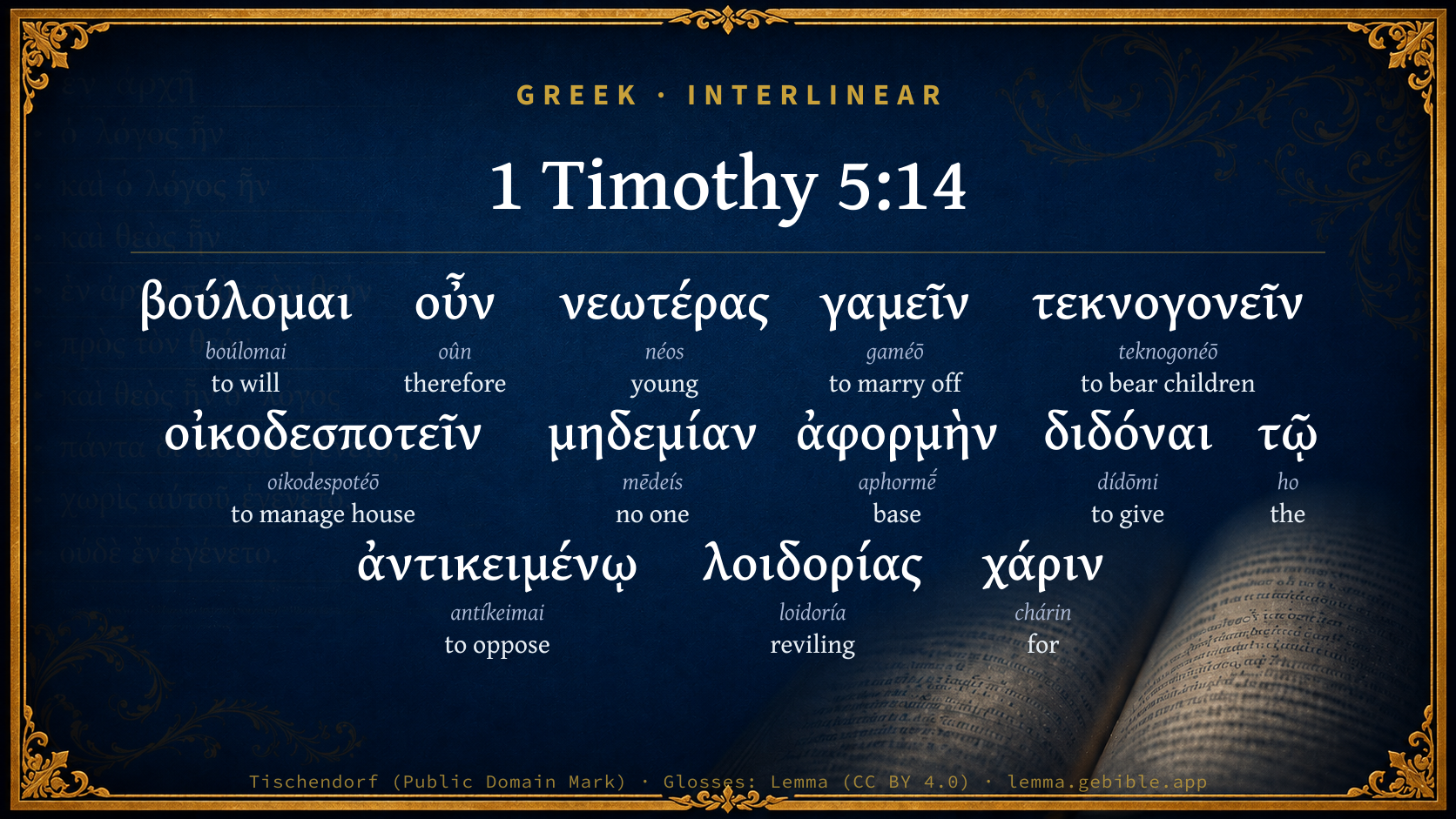
I desire therefore that the younger widows marry, bear children, rule the household, and give no occasion to the adversary for reviling.
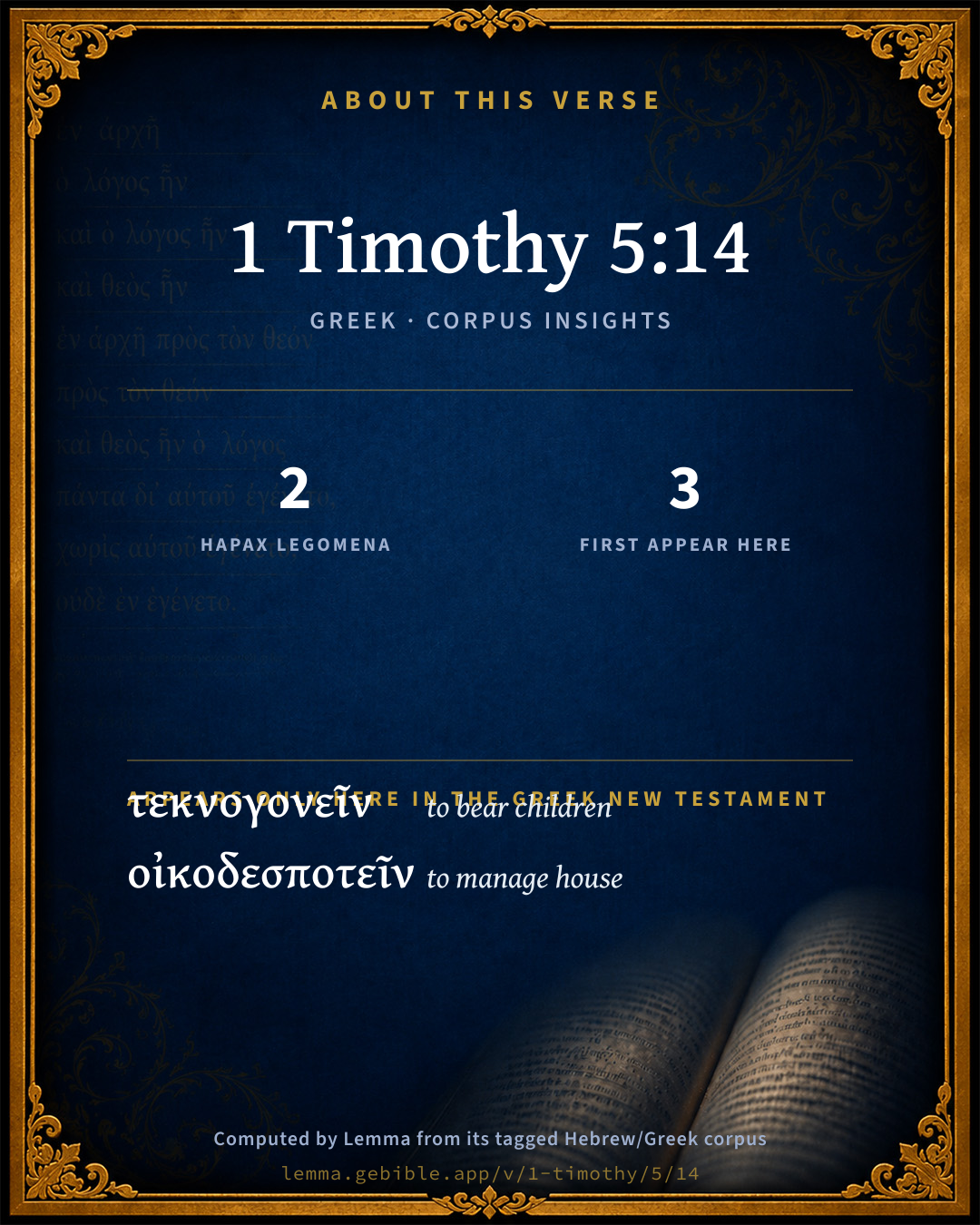
- 2 hapax legomena — only here in the Greek New Testament
- 3 first appearances in the Greek New Testament
Download a study sheet
One document with this verse’s original text, its word-by-word gloss line, the meaning frame, cross-references with their text, attributed commentary, and full source and license credits — printable, and it pastes into notes with its structure intact.
This verse Autodidact and up
A passage Seminary Student
Up to 50 verses in one chapter. A passage sheet keeps up to 6 commentary sources and 12 cross-references per verse, in the order this page ranks them, and says so on the sheet whenever that leaves anything out. Ask for a single verse and you get the Autodidact verse sheet above.
Everything on this page stays free to read, with no account — the sheet is a download of what is already on screen, not access to it.
Compare translations 3
The same verse in 3 English versions, stacked beneath the original-language interlinear above. Click any original word for its lexicon entry.
Each is an independent rendering of the whole verse — the interlinear is not word-aligned to these translations.
Highlighted words mark where these versions differ — a whole-verse word diff, not a word-by-word alignment.
-
World English Bible Public Domain
I desire therefore that the younger widows marry, bear children, rule the household, and give no occasion to the adversary for reviling.
-
King James Version Public Domain
I will therefore that the younger women marry, bear children, guide the house, give none occasion to the adversary to speak reproachfully.
-
unfoldingWord Literal Text CC BY-SA 4.0
Therefore, I want younger ones to marry, to bear children, to manage a household, to give no opportunity for reviling to the one opposing.
unfoldingWord Literal Text — © unfoldingWord, licensed CC BY-SA 4.0. Word-aligned USFM3 via Door43 (git.door43.org/unfoldingWord/en_ult).
Show all 19 translations
Every available English version of this verse, each an independent rendering of the whole verse.
-
World English Bible Public Domain
I desire therefore that the younger widows marry, bear children, rule the household, and give no occasion to the adversary for reviling.
-
Berean Standard Bible Public Domain
So I advise the younger widows to marry, have children, and manage their households, denying the adversary occasion for slander.
-
Majority Standard Bible Public Domain
So I advise the younger widows to marry, have children, and manage their households, denying the adversary occasion for slander.
-
King James Version Public Domain
I will therefore that the younger women marry, bear children, guide the house, give none occasion to the adversary to speak reproachfully.
-
American Standard Version (1901) Public Domain
I desire therefore that the younger `widows' marry, bear children, rule the household, give no occasion to the adversary for reviling:
-
Revised Version (1885) Public Domain
I desire therefore that the younger widows marry, bear children, rule the household, give none occasion to the adversary for reviling:
-
Geneva Bible (1599) Public Domain
I will therefore that the yonger women marie, and beare children, and gouerne the house, and giue none occasion to the aduersary to speake euill.
-
Douay-Rheims (1899) Public Domain
I will therefore that the younger should marry, bear children, be mistresses of families, give no occasion to the adversary to speak evil.
-
Young's Literal Translation Public Domain
I wish, therefore, younger ones to marry, to bear children, to be mistress of the house, to give no occasion to the opposer to reviling;
-
Literal Standard Version CC BY-SA 4.0
I intend, therefore, younger ones to marry, to bear children, to be mistress of the house, to give no occasion to the opposer of reviling;
-
Unlocked Literal Bible CC BY-SA 4.0
I therefore want younger women to marry, to bear children, to manage the household, and to give no opportunity for the enemy to slander us.
-
unfoldingWord Literal Text CC BY-SA 4.0
Therefore, I want younger ones to marry, to bear children, to manage a household, to give no opportunity for reviling to the one opposing.
-
Darby Bible Public Domain
I will therefore that the younger marry, bear children, rule the house, give no occasion to the adversary in respect of reproach.
-
World Messianic Bible Public Domain
I desire therefore that the younger widows marry, bear children, rule the household, and give no occasion to the adversary for insulting.
-
Webster's Bible Public Domain
I will therefore that the younger women marry, bear children, guide the house, give no occasion to the adversary to speak reproachfully.
-
Free Bible Version CC BY-SA 4.0
So my best advice is that younger widows marry and have children and take care of the home. That way there's no opportunity for criticism from the Enemy.
-
Bible in Basic English Public Domain
So it is my desire that the younger widows may be married and have children, controlling their families, and giving the Evil One no chance to say anything against them,
-
Text-Critical English NT CC BY 4.0
So I advise the younger widows to marry, bear children, and manage their households, so as to give the adversary no opportunity to revile us.
-
Tyndale New Testament (1534) Public Domain
I will therfore that the yonger weme mary and beare childre and gyde the housse and geve none occasion to the adversary to speake evill
Literal Standard Version (2020), Covenant Press — licensed CC BY-SA 4.0. Text via the HelloAO Bible API (eBible.org). Unlocked Literal Bible (unfoldingWord) — licensed CC BY-SA 4.0. Text via the HelloAO Bible API (eBible.org). unfoldingWord Literal Text — © unfoldingWord, licensed CC BY-SA 4.0. Word-aligned USFM3 via Door43 (git.door43.org/unfoldingWord/en_ult). Free Bible Version, Dr. Jonathan Gallagher — licensed CC BY-SA 4.0. Text via the HelloAO Bible API (eBible.org).
Word by word
More ways to search: Search by grammar → Find every occurrence → Compare this word →
Practice this passage: Drill this verse → Learn its vocabulary →
- Appears 1× in the Greek New Testament
- First appears here
- Part of Speech
- Verb
- Tense
- Present
- Voice
- Active
- Mood
- Infinitive
Full Thayer's Definition
- βούλομαι boúlomai G1014 “to will” Verb, Present, Middle or Passive deponent, Indicative, 1st person, Singular
- οὖν oûn G3767 “therefore” Conjunction
- νεωτέρας néos G3501 “young” Adjective, Accusative, Plural, Feminine, Comparative
- γαμεῖν gaméō G1060 “to marry off” Verb, Present, Active, Infinitive
- τεκνογονεῖν teknogonéō G5041 “to bear children” Verb, Present, Active, Infinitive
- οἰκοδεσποτεῖν oikodespotéō G3616 “to manage house” Verb, Present, Active, Infinitive
- μηδεμίαν mēdeís G3367 “no one” Adjective, Accusative, Singular, Feminine, Negative
- ἀφορμὴν aphormḗ G874 “base” Noun, Accusative, Singular, Feminine
- διδόναι dídōmi G1325 “to give” Verb, Present, Active, Infinitive
- τῷ ho G3588 “the” Article, Dative, Singular, Masculine
- ἀντικειμένῳ antíkeimai G480 “to oppose” Verb, Present, Middle or Passive deponent, Participle, Dative, Singular, Masculine
- λοιδορίας loidoría G3059 “reviling” Noun, Genitive, Singular, Feminine
- χάριν chárin G5484 “for” Adverb
About this verse
These counts appear in no published source. They are computed here, from the morphology-tagged text and Lemma’s own curated glosses. What Lemma adds →
- 13
- words
- 13
- distinct lemmas
- Pauline Epistles
- section
Notable vocabulary
2 hapax legomena — words that appear only here in the entire Greek New Testament:
First appearance in Scripture
These words make their first canonical appearance in the Greek New Testament here:
Shared distinctive vocabulary
λοιδορίας reviling G3059 occurs in 2 verses of the Greek New Testament. Also found in:
Cross-references
18Topical passages linked to 1 Timothy 5:14 in the Treasury of Scripture Knowledge — connected by theme and wording, ordered by reader-vote popularity; previews shown in the World English Bible.
- Titus 2:5 to be sober-minded, chaste, workers at home, kind, being in subjection to their own husbands, that God's word may not be blasphemed.
- 1 Timothy 6:1 Let as many as are bondservants under the yoke count their own masters worthy of all honor, that the name of God and the doctrine not be blasphemed.
- Proverbs 31:27–29 She looks well to the ways of her household, And doesn't eat the bread of idleness.
- 1 Corinthians 7:8–9 But I say to the unmarried and to widows, it is good for them if they remain even as I am.
- Titus 2:8 and soundness of speech that can't be condemned; that he who opposes you may be ashamed, having no evil thing to say about us.
- Proverbs 14:1 Every wise woman builds her house, But the foolish one tears it down with her own hands.
- Daniel 6:4 Then the presidents and the satraps sought to find occasion against Daniel as touching the kingdom; but they could find no occasion nor fault, because he was faithful, neither was there any error or fault found in him.
- 1 Timothy 4:3 forbidding marriage and commanding to abstain from foods which God created to be received with thanksgiving by those who believe and know the truth.
- Hebrews 13:4 Let marriage be held in honor among all, and let the bed be undefiled: but God will judge the sexually immoral and adulterers.
- Genesis 18:6 Abraham hurried into the tent to Sarah, and said, "Quickly make ready three measures of fine meal, knead it, and make cakes."
- Genesis 18:9 They said to him, "Where is Sarah, your wife? He said, "See, in the tent."
- 2 Samuel 12:14 However, because by this deed you have given great occasion to Yahweh's enemies to blaspheme, the child also who is born to you shall surely die."
- Luke 23:35–41 The people stood watching. The rulers with them also scoffed at him, saying, "He saved others. Let him save himself, if this is the Christ of God, his chosen one!"
- Romans 14:13 Therefore let's not judge one another any more, but judge this rather, that no man put a stumbling block in his brother's way, or an occasion for falling.
- 2 Corinthians 11:12 But what I do, that I will do, that I may cut off occasion from them that desire an occasion, that in which they boast, they may be found even as we.
- 1 Timothy 2:8 I desire therefore that the men in every place pray, lifting up holy hands without wrath and doubting.
- 1 Timothy 5:11 But refuse younger widows, for when they have grown wanton against Christ, they desire to marry;
- 1 Peter 4:14–15 If you are insulted for the name of Christ, blessed are you; because the Spirit of glory and of God rests on you. On their part he is blasphemed, but on your part he is glorified.
Cross-references courtesy of OpenBible.info (CC BY 4.0).
Lesson kit
Teaching starters — assembled from the data on this page, not authored interpretation. Every prompt links to the verse data it draws on. Edit before teaching.
1 Timothy, in the Pauline Epistles, opens this verse with 13 words (13 distinct Greek lemmas). Its most distinctive word is teknogonéō (“to bear children”). A historical commentator’s framing appears above. Read the whole chapter for the surrounding context.
Discussion questions
- The word teknogonéō carries the sense “to bear children.” How does it shape the verse?
- 2 words here appear nowhere else in the Greek New Testament. Why might the author reach for such rare wording?
- 3 words make their first appearance in Scripture here. What does this debut establish?
- How does 1 Peter 3:9, which shares the word «reviling», read alongside this verse?
- These translations render this verse differently. What is at stake in choosing one wording over another?
- Compare how The Biblical Illustrator and Joseph Benson's Commentary read this verse. Where do they agree or differ?
Things to notice
- 2 words in this verse appear nowhere else in the Greek New Testament.
- 3 words make their first canonical appearance in Scripture here.
- These translations choose different wording for 20 words in this verse.
- 13 distinct Greek lemmas span 13 words in this verse.
Commentary
Notes on 1 Timothy 5:14 from classic Christian and Jewish commentators (each source and its license shown beneath its notes). The classic Christian expositions comment on the surrounding passage and are grouped to its opening verse, so a note may address several verses; the Jewish commentaries on the Tanakh (Rashi and others) are per-verse, so they appear only where the commentator wrote on this verse.
Lemma curates 59 commentaries, every one of them public domain or Creative Commons licensed, each selected and text-cleaned for this edition rather than reprinted as found. About our sources →
The Biblical Illustrator
Joseph S. Exell
The Biblical Illustrator, edited by Joseph S. Exell (c. 1880s–1900s) — public domain. Text from a community e-Sword module.
Joseph Benson's Commentary
Joseph Benson's Commentary on the Old and New Testaments (1811–1818) — public domain. Text from a community e-Sword module.
Tyndale Open Study Notes
Tyndale Open Resources
Tyndale Open Study Notes — © Tyndale Open Resources, licensed CC BY-SA 4.0. Text via the HelloAO Bible API.
Bengel's Gnomon
Johann Albrecht Bengel
Bengel's Gnomon of the New Testament — English translation (T&T Clark, Edinburgh, 1860) — public domain. Text from a community e-Sword module.
Meyer's Critical & Exegetical Commentary
Heinrich August Wilhelm Meyer
Meyer — Critical and Exegetical Commentary on the New Testament — English translation by Peter Christie, edited by Frederick Crombie (T&T Clark, 1880) — public domain. Text from a community e-Sword module.
Expositor's Greek Testament
ed. W. Robertson Nicoll
The Expositor's Greek Testament, edited by W. Robertson Nicoll (1897–1910) — public domain. Text from a community e-Sword module.
Geneva Bible (1599)
Geneva Bible translators
Geneva Bible (1599) marginal notes — public domain. Text via Bolls.life.
Jamieson, Fausset & Brown
Robert Jamieson, A. R. Fausset & David Brown
Jamieson, Fausset & Brown — Commentary Critical and Explanatory on the Whole Bible (1871) — public domain (CC PDM 1.0). Text via the HelloAO Bible API.
Adam Clarke's Commentary
Adam Clarke's Commentary on the Bible (1810–1826) — public domain. Text from a community e-Sword/MySword module.
John Calvin's Commentaries
John Calvin's Commentaries (1540-1563) — public domain. Text from the Calvin Translation Society English edition (1840s-50s) via the Christian Classics Ethereal Library (ccel.org). Calvin's coverage is partial (roughly two-thirds of the Bible); uncommented books and verses are honest gaps, never fabricated. The 19th-century editor's footnotes and remarks are omitted so the notes are faithfully Calvin's own voice.
Ellicott's Commentary for English Readers
A Bible Commentary for English Readers, edited by Charles John Ellicott (1878–1897) — public domain. Text from a community e-Sword module.
The Cambridge Bible for Schools and Colleges
gen. ed. J. J. S. Perowne
The Cambridge Bible for Schools and Colleges (gen. ed. J. J. S. Perowne; Cambridge University Press, 1878–1918) — public domain. Text from a community e-Sword module.
John Gill's Exposition
John Gill's Exposition of the Whole Bible (1746–1763) — public domain (CC PDM 1.0). Text via the HelloAO Bible API.
Trapp's Complete Commentary
John Trapp
John Trapp, A Commentary or Exposition upon All the Books of the Old and New Testament (1647–1656) — public domain. Text from a community e-Sword module.
Albert Barnes' Notes on the Bible
Albert Barnes' Notes on the Bible (1834–1885) — public domain. Text from a community e-Sword/MySword module.
Haydock's Catholic Bible Commentary
George Leo Haydock (1774–1849), Haydock's Catholic Family Bible and Commentary, 1859 edition — public domain. Excludes Psalms (Douay-Rheims chapter numbering differs from Protestant) and Deuterocanonical books (Catholic canon only).
Matthew Poole's English Annotations
Matthew Poole's English Annotations on the Holy Bible (1683–1685) — public domain. Text from a community e-Sword/MySword module.
Whedon's Commentary on the Bible
Daniel D. Whedon
Daniel D. Whedon (gen. ed.), Commentary on the Old and New Testaments (1874–1909) — public domain. Text from a community e-Sword module.
The Pulpit Commentary
The Pulpit Commentary (1880–1919), ed. H.D.M. Spence-Jones & Joseph S. Exell — public domain. Text from a community e-Sword module.
John Wesley's Explanatory Notes
John Wesley, Explanatory Notes Upon the Whole Bible (1754–1765) — public domain. Text via the GEBible commentary corpus.
Fairbairn on Ezekiel, Jonah & the Pastoral Epistles
Patrick Fairbairn
Patrick Fairbairn — An Exposition of Ezekiel (1851), Jonah (1849), and The Pastoral Epistles (1874) — public domain. Text from a community e-Sword module.
The People's New Testament
B. W. Johnson
B. W. Johnson's The People's New Testament with Notes (1889–1891) — public domain. Electronic text from the Christian Classics Ethereal Library (CCEL) ThML edition.
unfoldingWord translationNotes
Door43 World Missions Community
unfoldingWord translationNotes — © Distant Shores Media and the Door43 World Missions Community, licensed CC BY-SA 4.0. Source: git.door43.org/Door43/en_tn.
Cambridge Greek Testament for Schools and Colleges
Cambridge Greek Testament for Schools and Colleges (Cambridge University Press, 1896; 21 vols, various authors incl. Carr, Maclear, Plummer, Farrar, Lumby, Moule, M. R. James, Simcox) — public domain. Text from a community e-Sword module.
International Critical Commentary
International Critical Commentary — older volumes (1896–1929), various authors — public domain. Text from a community e-Sword module.
Vincent's Word Studies in the New Testament
Marvin R. Vincent
Marvin R. Vincent, Word Studies in the New Testament (1887–1900) — public domain. Text from a community e-Sword/MySword module.