Galatians 6:3

Greek (Tischendorf 8th ed.) Galatians 6:3 appears in the Greek New Testament. The text above is from the Tischendorf 8th edition. Each word links to its Strong’s number and a concise gloss. Click any word for its full Thayer’s Greek Lexicon entry.
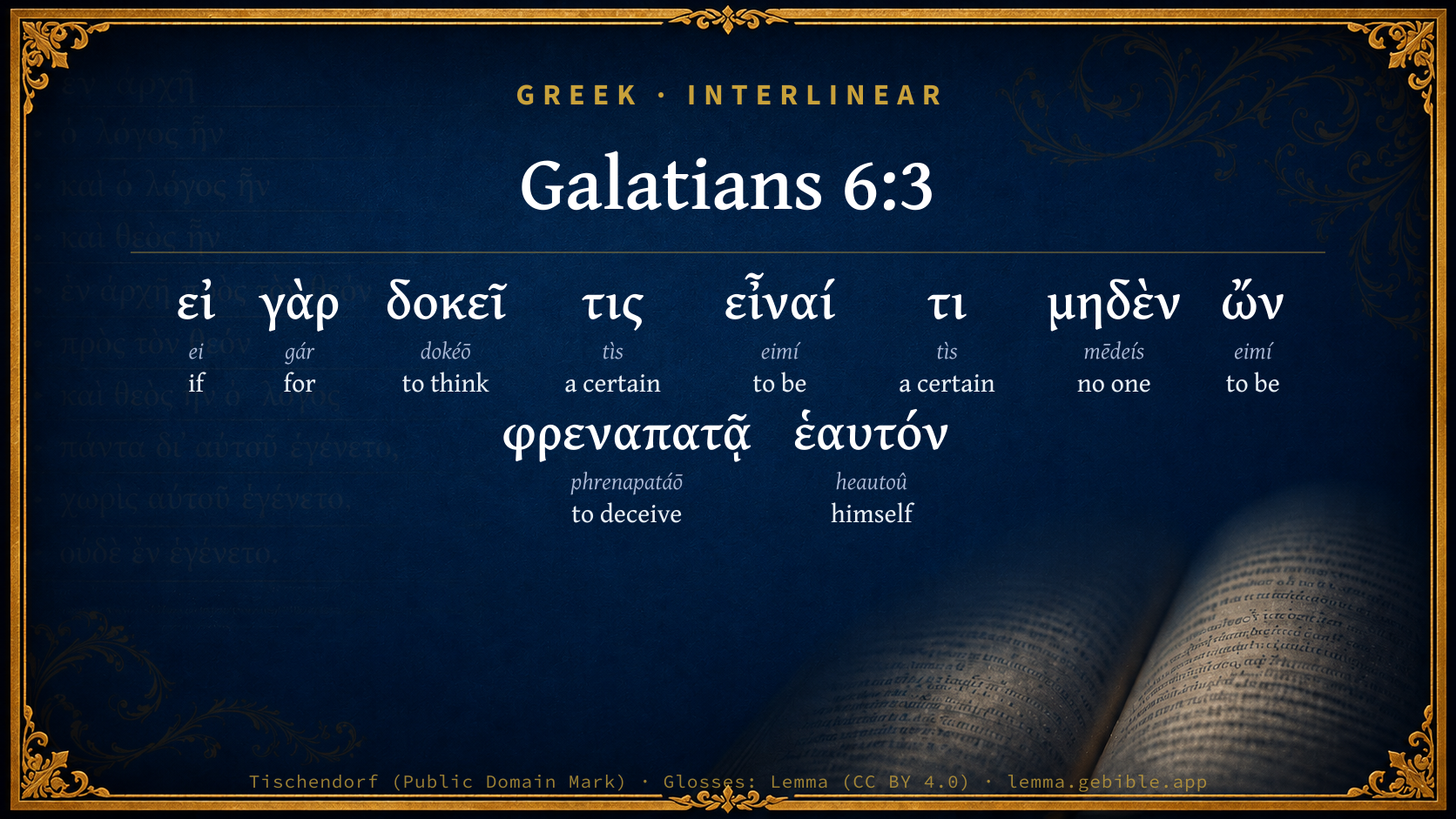
Download image
Cite this verse

Galatians 6:3 (World English Bible). Public Domain. Lemma interlinear Bible study tool, https://lemma.gebible.app/v/galatians/6/3.

Show BibTeX & RIS
BibTeX
RIS
English Translation
For if a man thinks himself to be something when he is nothing, he deceives himself.
World English Bible · Public Domain
Highlights
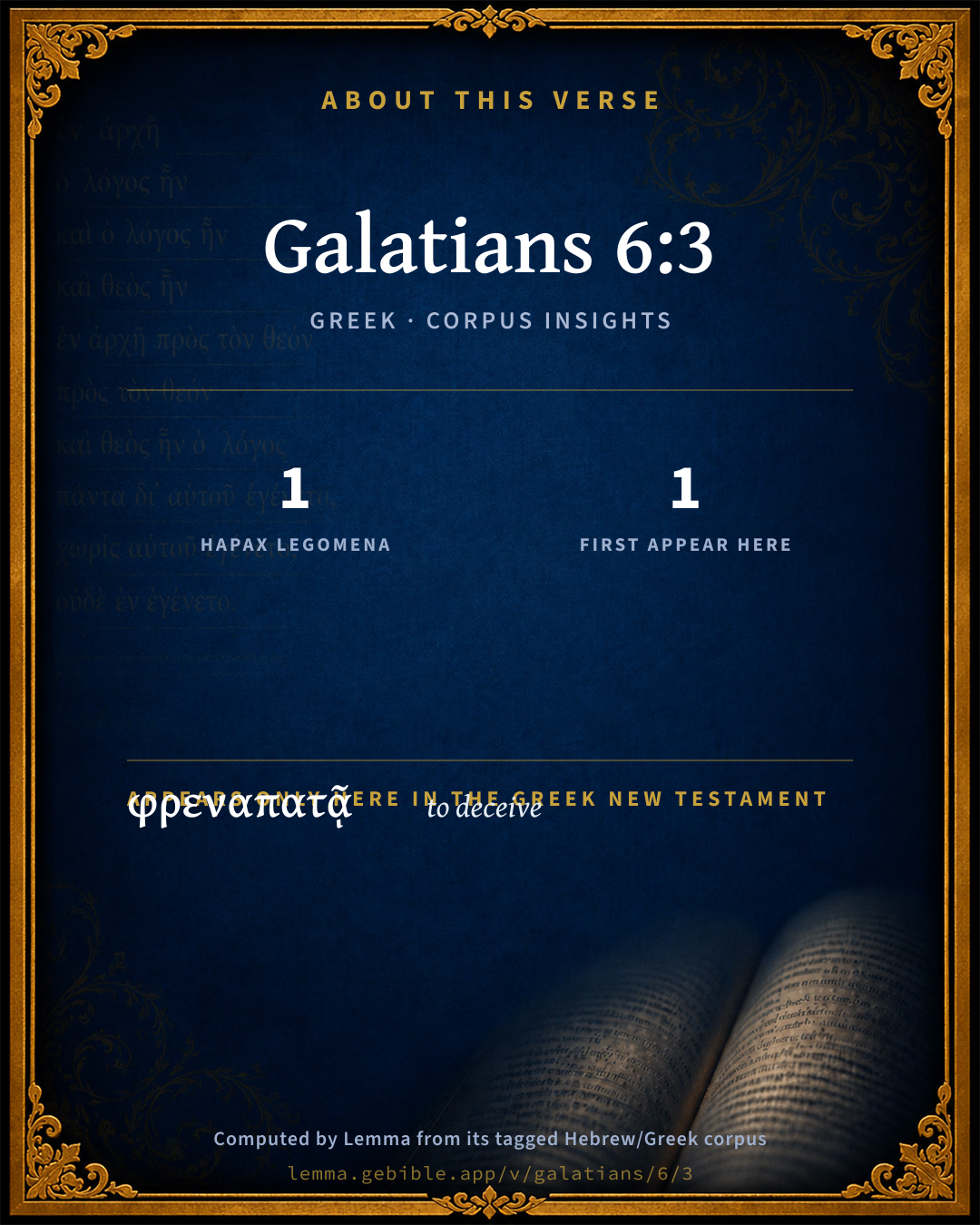
  • 1 hapax legomenon — only here in the Greek New Testament
  • 1 first appearance in the Greek New Testament
Full analysis ↓
Download a study sheet

One document with this verse’s original text, its word-by-word gloss line, the meaning frame, cross-references with their text, attributed commentary, and full source and license credits — printable, and it pastes into notes with its structure intact.

This verse Autodidact and up

Study sheet (.html) Plain text (.txt)

A passage Seminary Student

Up to 50 verses in one chapter. A passage sheet keeps up to 6 commentary sources and 12 cross-references per verse, in the order this page ranks them, and says so on the sheet whenever that leaves anything out. Ask for a single verse and you get the Autodidact verse sheet above.

Everything on this page stays free to read, with no account — the sheet is a download of what is already on screen, not access to it.

Want to remove ads? Support Godless Engineer
Compare translations 3

The same verse in 3 English versions, stacked beneath the original-language interlinear above. Click any original word for its lexicon entry.

Each is an independent rendering of the whole verse — the interlinear is not word-aligned to these translations.

Highlighted words mark where these versions differ — a whole-verse word diff, not a word-by-word alignment.

  • World English Bible Public Domain
    For if a man thinks himself to be something when he is nothing, he deceives himself.
  • King James Version Public Domain
    For if a man think himself to be something, when he is nothing, he deceiveth himself.
  • unfoldingWord Literal Text CC BY-SA 4.0
    For if anyone thinks to be something, being nothing, he deceives himself.

unfoldingWord Literal Text — © unfoldingWord, licensed CC BY-SA 4.0. Word-aligned USFM3 via Door43 (git.door43.org/unfoldingWord/en_ult).

Versions to compare (up to 4)

3 of 4 selected

Show all 19 translations

Every available English version of this verse, each an independent rendering of the whole verse.

  • World English Bible Public Domain
    For if a man thinks himself to be something when he is nothing, he deceives himself.
  • Berean Standard Bible Public Domain
    If anyone thinks he is something when he is nothing, he deceives himself.
  • Majority Standard Bible Public Domain
    If anyone thinks he is something when he is nothing, he deceives himself.
  • King James Version Public Domain
    For if a man think himself to be something, when he is nothing, he deceiveth himself.
  • American Standard Version (1901) Public Domain
    For if a man thinketh himself to be something when he is nothing, he deceiveth himself.
  • Revised Version (1885) Public Domain
    For if a man thinketh himself to be something, when he is nothing, he deceiveth himself.
  • Geneva Bible (1599) Public Domain
    For if any man seeme to himselfe, that he is somewhat, when he is nothing, hee deceiueth himselfe in his imagination.
  • Douay-Rheims (1899) Public Domain
    For if any man think himself to be some thing, whereas he is nothing, he deceiveth himself.
  • Young's Literal Translation Public Domain
    for if any one doth think `himself' to be something -- being nothing -- himself he doth deceive;
  • Literal Standard Version CC BY-SA 4.0
    for if anyone thinks [himself] to be something—being nothing—he deceives himself;
  • Unlocked Literal Bible CC BY-SA 4.0
    For if anyone thinks he is something when he is nothing, he deceives himself.
  • unfoldingWord Literal Text CC BY-SA 4.0
    For if anyone thinks to be something, being nothing, he deceives himself.
  • Darby Bible Public Domain
    For if any man reputes himself to be something, being nothing, he deceives himself;
  • World Messianic Bible Public Domain
    For if a man thinks himself to be something when he is nothing, he deceives himself.
  • Webster's Bible Public Domain
    For if a man thinketh himself to be something, when he is nothing, he deceiveth himself.
  • Free Bible Version CC BY-SA 4.0
    Those who think they're really something—when they're actually nothing—only fool themselves.
  • Bible in Basic English Public Domain
    For if a man has an idea that he is something when he is nothing, he is tricked by himself.
  • Text-Critical English NT CC BY 4.0
    For if anyone thinks that he is something, when he is nothing, he deceives himself.
  • Tyndale New Testament (1534) Public Domain
    If eny man seme to him silfe that he is somwhat when in dede he is nothynge the same deceaveth hym silfe in his ymaginacion.

Literal Standard Version (2020), Covenant Press — licensed CC BY-SA 4.0. Text via the HelloAO Bible API (eBible.org). Unlocked Literal Bible (unfoldingWord) — licensed CC BY-SA 4.0. Text via the HelloAO Bible API (eBible.org). unfoldingWord Literal Text — © unfoldingWord, licensed CC BY-SA 4.0. Word-aligned USFM3 via Door43 (git.door43.org/unfoldingWord/en_ult). Free Bible Version, Dr. Jonathan Gallagher — licensed CC BY-SA 4.0. Text via the HelloAO Bible API (eBible.org).

Word by word

More ways to search: Search by grammar → Find every occurrence → Compare this word →

Practice this passage: Drill this verse → Learn its vocabulary →

About this verse

These counts appear in no published source. They are computed here, from the morphology-tagged text and Lemma’s own curated glosses. What Lemma adds →

10
words
8
distinct lemmas
Pauline Epistles
section

Notable vocabulary

1 hapax legomenon — a word that appears only here in the entire Greek New Testament:

  • φρεναπατᾷ to deceive G5422

First appearance in Scripture

This word makes its first canonical appearance in the Greek New Testament here:

  • φρεναπατᾷ to deceive G5422

Repetition

Words recur within this verse:

  • τις a certain G5100 ×2
  • εἶναί to be G1510 ×2

Cross-references

15

Topical passages linked to Galatians 6:3 in the Treasury of Scripture Knowledge — connected by theme and wording, ordered by reader-vote popularity; previews shown in the World English Bible.

  • Proverbs 26:12 Do you see a man wise in his own eyes? There is more hope for a fool than for him.
  • 1 Corinthians 3:18 Let no one deceive himself. If anyone thinks that he is wise among you in this world, let him become a fool, that he may become wise.
  • 1 Corinthians 8:2 But if anyone thinks that he knows anything, he doesn't yet know as he ought to know.
  • Romans 12:3 For I say, through the grace that was given me, to every man who is among you, not to think of himself more highly than he ought to think; but to think reasonably, as God has apportioned to each person a measure of faith.
  • 2 Corinthians 3:5 not that we are sufficient of ourselves, to account anything as from ourselves; but our sufficiency is from God;
  • Luke 18:11 The Pharisee stood and prayed to himself like this: 'God, I thank you, that I am not like the rest of men, extortioners, unrighteous, adulterers, or even like this tax collector.
  • 1 Corinthians 13:2 If I have the gift of prophecy, and know all mysteries and all knowledge; and if I have all faith, so as to remove mountains, but don't have love, I am nothing.
  • Romans 12:16 Be of the same mind one toward another. Don't set your mind on high things, but associate with the humble. Don't be wise in your own conceits.
  • James 1:22 But be doers of the word, and not only hearers, deluding your own selves.
  • 1 John 1:8 If we say that we have no sin, we deceive ourselves, and the truth is not in us.
  • Proverbs 25:14 As clouds and wind without rain, So is he who boasts of gifts deceptively.
  • James 1:26 If anyone among you thinks himself to be religious while he doesn't bridle his tongue, but deceives his heart, this man's religion is worthless.
  • 2 Corinthians 12:11 I have become foolish in boasting. You compelled me, for I ought to have been commended by you, for in nothing was I inferior to the very best apostles, though I am nothing.
  • 2 Timothy 3:13 But evil men and impostors will grow worse and worse, deceiving and being deceived.
  • Galatians 2:6 But from those who were reputed to be important (whatever they were, it makes no difference to me; God doesn't show partiality to man)--they, I say, who were respected imparted nothing to me,

Cross-references courtesy of OpenBible.info (CC BY 4.0).

Commentary

Notes on Galatians 6:3 from classic Christian and Jewish commentators (each source and its license shown beneath its notes). The classic Christian expositions comment on the surrounding passage and are grouped to its opening verse, so a note may address several verses; the Jewish commentaries on the Tanakh (Rashi and others) are per-verse, so they appear only where the commentator wrote on this verse.

Lemma curates 59 commentaries, every one of them public domain or Creative Commons licensed, each selected and text-cleaned for this edition rather than reprinted as found. About our sources →

The Biblical Illustrator

Joseph S. Exell

Gal_6:3

For if a man think himself to be something, when he Is nothing, he deceiveth himself.

Caution against over self-estimation

These words admit of two different interpretations, according as you connect the middle with the first or with the last clause.

1. If we connect the middle clause with the first one, as our translators have done, the meaning is, If a man think himself to be a Christian of a high order, while he either is not a Christian at all, or, at any rate, a Christian of a very inferior order, he commits an important mistake and falls into a hazardous error. The man who supposes himself arrived at the measure of the stature of the fulness of Christ, when in reality only a babe in Christ, deceives himself, and throws important obstacles in the way of his own improvement. In their own estimation they have little to learn, while the truth is, they have learned but little. But the mistake is much more deplorable when a man flatters himself into the belief that he is a Christian, perhaps a Christian of the first order, while in reality he is not a Christian at all. The thing is quite possible--I fear not uncommon. We pity the poor maniac mendicant who thinks himself a king; we pity the man who has persuaded himself he is a man of wealth, while in reality he is in immediate hazard of bankruptcy; we pity the man who is assuring himself of long life, when he is tottering on the brink of the grave; but how much more to be pitied is the man who thinks himself secure of the favour of God, and of eternal happiness, while in reality the wrath of God is abiding on him, and a miserable eternity lies before him! No kinder office can be done to such a person than to arouse him from his state of carnal security, to undeceive him, to convince him of his wants while they may be supplied, of his danger while it may be averted. A woe is denounced against such as are thus at ease in Zion.

2. Perhaps, however, the apostles meaning is, If any man think he is something, he deceiveth himself, for he is nothing. The apostle is cautioning the Galatians against a vainglorious disposition; and in this verse I apprehend he means that the habitual indulgence of vainglory is utterly inconsistent with the possession of genuine Christianity. Humility is a leading trait in the character of every genuine Christian. He knows and believes that he is guilty before the God of heaven exceedingly, and he feels that he is an ignorant, foolish, depraved creature, that of himself he is nothing, less than nothing, and vanity. Feeling thus his insignificance as a creature, and his demerit and depravity as a sinner, he is not--he cannot be--vainglorlous. Whatever he is that is good, he knows God has made him to be. Whatever he has that is good, he knows God has given him. The falls of others excite in him not self-glorification, but gratitude. (John Brown, D. D.)

Self-magnifiers

A friend had fitted two glasses into a little ivory tube in such a way that any small object, like a midge or other insect, when put into it, and viewed through the smaller and upper glass, seemed of enormous magnitude, with all its parts, however diminutive, distinctly visible. If, however, the tube was reversed, and the objects contemplated through the larger glass, they then appeared to shrink below the usual size. Gotthold looked upon the contrivance with no ordinary pleasure, and said: I know not what better name to give this instrument than the magnifier. In my opinion, however, the hearts of the proud and of the hypocritical are of the same construction. When they contemplate what is their own--their virtues and talents--they see through a glass which self-love has so artfully prepared that all seems of vast dimensions, and they imagine that they have good reason to boast and congratulate themselves upon their gifts. If, however, they have occasion to look at their neighbour and his good points, they turn the instrument upside down, and then all seems small and commonplace. In like manner, their own faults and vices they observe through the diminishing glass, and reckon them very inconsiderable; while they contemplate their neighbours from the opposite side, and so convert a midge into an elephant: The greatest of all delusions in the world is that which man voluntarily practises upon himself, and which betrays him, with his eyes open, into pride, self-esteem, and contempt of others. You will own that the heart of the Pharisee, who looked upon himself as a mighty saint, and upon the publican as a brand fit for the burning, was of this description. That Pharisee, however, has left behind him a numerous breed, and spread his line over the whole earth. In fact, I do not believe there exists a man who has not sometimes used such an instrument in the way we have described. (Scriver.)

Self-deception

Boswell relates that Dr. Johnson told him that when his fathers workshop, which was a detached building, had partly fallen down for want of being repaired, he was no less diligent to lock the door every night, though he saw that anybody might walk in at the back. Even so do many persons, guarding themselves against one approach of sin only, while they are exposed to danger from some other point, vainly suppose themselves safe from their spiritual foes. (R. Brewin.)

I. Men are nothing of themselves.

1. The gifts of God, whether of nature or grace, are not ours, but Gods.

2. In the use of these gifts the best fall far short of what they ought to be (1Co_15:10; 1Co_8:2).

II. Though men are nothing, yet they seem to be something, and that of themselves. This arises from--

(1) Pride;

(2) the excessive consideration of our good things;

(3) the comparing of ourselves with the infirmities of others;

(4) the flattery of men.

III. In so doing, men deceive themselves. Self-deception is

(1) The worst deception (Jam_1:22; Jam_1:26);

(2) the most dangerous deception;

(3) self-degradation;

(4) spiritual impotence. Conceit is fatal to the duty of burdenbearing, for it is the death of love.

IV. The remedies against the overweening of ourselves.

1. To look ourselves in the glass of the law (1Co_3:18).

2. To remember that the gifts on which we pride ourselves are ours only for a time (Luk_16:2), and for the use of them we shall be held responsible.

3. To compare ourselves with Gods majesty (Psa_8:4). (R. Cudworth.)

Self-complacency

One day Narcissus, who had resisted all the charms of others, came to an open fountain of silvery clearness. He stooped down to drink, and saw his own image, and thought it some beautiful water-spirit living in the fountain. He gazed, and admired the eyes, the neck, the hair, the lips. He fell in love with himself. In vain he sought a kiss and an embrace. He talked to the charmer, but received no response. He could not break the fascination, and so he pined away and died. The moral is, Think not too much nor too highly of yourself.

A mans talk better than himself

A hungry man once caught and killed a nightingale that filled a grove with its song. A bird that makes so much noise, thought he, must be something. So he plucked it. And lo! it was no bigger than a sparrow. Ah! said the man, I see what you are. You are voice and nothing else. So it is with not a few. They are full of vauntings, they talk of their goodness, their liberality the whole parish rings with the praises of themselves, which they warble so well. But pluck them, strip them of all appearances, and you will find them voice and nothing else. A great deal of talk, and very little action. (S. Baring-Gould, M. A.)

The Biblical Illustrator, edited by Joseph S. Exell (c. 1880s–1900s) — public domain. Text from a community e-Sword module.

Tyndale Open Study Notes

Tyndale Open Resources

6:3 Those with a proud attitude wrongly assume they are too important to help the weak (see study note on 6:1).

Tyndale Open Study Notes — © Tyndale Open Resources, licensed CC BY-SA 4.0. Text via the HelloAO Bible API.

Bengel's Gnomon

Johann Albrecht Bengel

Gal 6:3. Δοκεῖ εἶναί τι, seems to be something) in the Spirit. Whoever does not think himself to be something, he and he alone bears the burdens of others.

Bengel's Gnomon of the New Testament — English translation (T&T Clark, Edinburgh, 1860) — public domain. Text from a community e-Sword module.

Meyer's Critical & Exegetical Commentary

Heinrich August Wilhelm Meyer

Gal_6:3. Argumentum e contrario for the preceding καὶ οὕτως ἀναπληρ. τ. ν. τ. Χρ.; in so far as the fulfilment to be given in such measure to this law is impossible to moral conceit.

For if any one thinks himself to be something, imagines himself possessed of peculiar moral worth, so that he conceives himself exalted above such a mutual bearing of burdens, while he is nothing, although he is in reality of no moral importance, he is, so far from fulfilling the law of Christ, involved in self-deception.

On εἶναί τι, and the opposite μηδὲν εἶναι, nullius momenti esse (comp. Arrian. Epict. ii. 24: δοκῶν μέν τι εἶναι, ὢ δʼ οὐδείς), comp. Gal_2:6, and see on Act_5:36; 2Co_12:11; Locella, ad Xen. Eph. p. 143. As to μή with the participle, see Buttmann, neut. Gr. p. 301. If μηδὲν ὤν be attached to the apodosis (Michaelis, Baumgarten, Morus, Jatho, Hofmann), the effect is only to weaken the judgment which is expressed in it, because it would contain the fundamental statement (since he is nothing), in which the ἑαυτ. φρεναπ. is already obviously involved, and consequently, as the first portion of the affirmation in the apodosis, would anticipate the latter portion of it and take away its energetic emphasis. This is not the case, if the being nothing belongs to the antithetical delineation of conceited pretension in the protasis, where it is appropriate for the completeness of the case supposed. Moreover, μηδὲν ὤν is really applicable in the case of every one, Luk_17:10; Rom_3:23; 1Co_4:7, et al.

φρεναπατᾷ] denotes deception in the judgment, here in the moral judgment; the word is not preserved in any other Greek author. But comp. φρεναπάτης, Tit_1:10; Ignat. Trall. interpol. 6; Etym. M. 811. 3.

Meyer — Critical and Exegetical Commentary on the New Testament — English translation by Peter Christie, edited by Frederick Crombie (T&T Clark, 1880) — public domain. Text from a community e-Sword module.

Expositor's Greek Testament

ed. W. Robertson Nicoll

Gal 6:3-5 . Any conceit of our own strength or goodness is a vain delusion, for we are nothing. Let no man compare his own with others’ work: this will only feed his vanity; but let each scrutinise his own work. Then, if he find there ground for rejoicing, it will be in the ability that has been given by God’s grace to such a one as he is: for each will have his own burden to bear of conscious guilt and shame.

The Expositor's Greek Testament, edited by W. Robertson Nicoll (1897–1910) — public domain. Text from a community e-Sword module.

Jamieson, Fausset & Brown

Robert Jamieson, A. R. Fausset & David Brown

Self-conceit, the chief hindrance to forbearance and sympathy towards our fellow men, must be laid aside.

something--possessed of some spiritual pre-eminence, so as to be exempt from the frailty of other men.

when he is nothing--The Greek is subjective: "Being, if he would come to himself, and look on the real fact, nothing" [ALFORD] (Gal 6:2, Gal 6:6; Rom 12:3; Co1 8:2).

deceiveth himself--literally, "he mentally deceives himself." Compare Jam 1:26, "deceiveth his own heart."

Jamieson, Fausset & Brown — Commentary Critical and Explanatory on the Whole Bible (1871) — public domain (CC PDM 1.0). Text via the HelloAO Bible API.

Adam Clarke's Commentary

Verse 3. If a man think himself to be something] i.e. To be a proper Christian man; when he is nothing; being destitute of that charity which beareth, hopeth, and endureth all things. See 1Co 13:1, c. Those who suppose themselves to excel all others in piety, understanding, c., while they are harsh, censorious, and overbearing, prove that they have not the charity that thinketh no evil and in the sight of God are only as sounding brass and a tinkling cymbal. There are no people more censorious or uncharitable than those among some religious people who pretend to more light and a deeper communion with God. They are generally carried away with a sort of sublime, high sounding phraseology, which seems to argue a wonderfully deep acquaintance with Divine things stripped of this, many of them are like Samson without his hair.

Adam Clarke's Commentary on the Bible (1810–1826) — public domain. Text from a community e-Sword/MySword module.

John Calvin's Commentaries

3. For if a man think himself. There is an ambiguity in the construction, but Paul’s meaning is clear. The phrase, When he is nothing, appears at first view to mean, “if any person, who is in reality nothing, claims to be something;” as there are many men of no real worth who are elated by a foolish admiration of themselves. But the meaning is more general, and may be thus expressed: “Since all men are nothing, he who wishes to appear something, and persuades himself that he is somebody, deceives himself.” First, then, he declares that we are nothing, by which he means, that we have nothing of our own of which we have a right to boast, but are destitute of every thing good: so that all our glorying is mere vanity. Secondly, he infers that they who claim something as their own deceive themselves. Now, since nothing excites our indignation more than that others should impose upon us, it argues the height of folly that we should willingly impose upon ourselves. This consideration will render us much more candid to others. Whence proceeds fierce insult or haughty sternness, but from this, that every one exalts himself in his own estimation, and proudly despises others? Let arrogance be removed, and we shall all discover the greatest modesty in our conduct towards each other.

John Calvin's Commentaries (1540-1563) — public domain. Text from the Calvin Translation Society English edition (1840s-50s) via the Christian Classics Ethereal Library (ccel.org). Calvin's coverage is partial (roughly two-thirds of the Bible); uncommented books and verses are honest gaps, never fabricated. The 19th-century editor's footnotes and remarks are omitted so the notes are faithfully Calvin's own voice.

Ellicott's Commentary for English Readers

(3) He deceiveth himself.—A peculiar word, perhaps coined by St. Paul: puts himself under an hallucination; persuades himself of the existence of that which has no reality.

A Bible Commentary for English Readers, edited by Charles John Ellicott (1878–1897) — public domain. Text from a community e-Sword module.

The Cambridge Bible for Schools and Colleges

gen. ed. J. J. S. Perowne

3. The connexion seems to be: Christ by precept and by example bade you bear one another’s burdens. To neglect this duty is to set up yourselves above Christ. He ‘humbled Himself’ for us. You will not stoop to comfort and help your brethren. This must arise from pride—from a fancy that you are something exceptionally exalted, whereas such notions arise from self-deception—a phantom which represents nothingness.

The Cambridge Bible for Schools and Colleges (gen. ed. J. J. S. Perowne; Cambridge University Press, 1878–1918) — public domain. Text from a community e-Sword module.

John Gill's Exposition

For if a man think himself to be something,.... Of himself; to have anything of himself, to do anything of himself, and of himself to attain to life and salvation:

when he is nothing: of himself; not even as a creature, but owes his being and preservation, and all the mercies of life, to another, even to God; has no grace nor gifts of himself, but what he has received, and can do no good thing, not think a good thought, or perform a good action, of himself, and much less of himself procure eternal life and salvation:

he deceiveth himself: and will find himself sadly mistaken, and wretchedly disappointed another day; or whoever thinks himself to be some famous and excellent person, to be something more, and better than others, of a more excellent nature, and of greater abilities, that he is free from sin, or at least holier than others, and not liable to fall as others, whom he looks upon with disdain and contempt, wanting that charity which the law, and new commandment of Christ, requires, when he is nothing but sin and vanity, he is destitute of the grace of God, he deceives himself and the truth is not in him. This the apostle says to depress pride, and a swelling conceit of themselves, and all uncharitable, rough, and severe usages of others. A saying like this the Jews have (y);

"whoever he is that is something, or thinks in himself that he is "something", it would be better for him if he had never been created.''

(y) Midrash Kohelet, fol. 79. 1.

John Gill's Exposition of the Whole Bible (1746–1763) — public domain (CC PDM 1.0). Text via the HelloAO Bible API.

Trapp's Complete Commentary

John Trapp

3 For if a man think himself to be something, when he is nothing, he deceiveth himself.

Ver. 3. Think himself to be something] The self-deceiver takes his counter, and sets it up for a thousand pound, as the Pharisees and Laodiceans. Of such it may be said, as Quintilian somewhere of some overweeners of themselves, that they might have proved excellent scholars if they had not been so persuaded already.

John Trapp, A Commentary or Exposition upon All the Books of the Old and New Testament (1647–1656) — public domain. Text from a community e-Sword module.

Albert Barnes' Notes on the Bible

For if a man think himself to be something ... - see Gal 5:26. This is designed, evidently, to be another reason why we should be kind and tender to those who have erred. It is, that even those who are most confident may fall. They who feel secure, and think it impossible that they should sin, are not safe. They may be wholly deceived, and may be nothing, when they have the highest estimate of themselves. They may themselves fall into sin, and have need of all the sympathy and kindness of their brethren.

When he is nothing - When he has no strength, and no moral worth. When he is not such as he apprehends, but is lifted up with vain self-conceit.

He deceiveth himself - He understands not his own character. “The worst part of the fraud falls on his own head” - Doddridge. He does not accomplish what he expected to do; and instead of acquiring reputation from others, as he expected, he renders himself contemptible in their sight.

Albert Barnes' Notes on the Bible (1834–1885) — public domain. Text from a community e-Sword/MySword module.

Matthew Poole's English Annotations

It is a general maxim, and the truth of it is obvious to every one that readeth it, for supposing a man to be

nothing of what he thinks himself to be, he must needs

deceive himself in nourishing and entertaining such an opinion of himself. For the dependence of it upon what the apostle had said before, it is obvious. Pride, and men’s high opinions of themselves above what they ought, are the cause of their censoriousness and morosity in dealing with other offenders; which modesty would not suffer in them, if they apprehended themselves to be as weak, and as much exposed to temptations, as others are. It is pride and overweening opinions of ourselves, that make us despise or neglect others under their burdens, and so forget the law of Christ; the apostle therefore properly addeth this precept for humility and modesty to those former precepts.

Matthew Poole's English Annotations on the Holy Bible (1683–1685) — public domain. Text from a community e-Sword/MySword module.

Whedon's Commentary on the Bible

Daniel D. Whedon

3. For if, in the spirit of the above vainglory, forgetting the spirit of meekness, with which we should bear.

A man… something—A proper corrector and restorer of others. The maxim is, indeed, general, but Paul uses it now in special reference here to the spiritual reprover.

Nothing— As he truly would be, if, while correcting his neighbour’s fault, he is falling into vainglory.

Deceiveth himself—A very expressive single Greek word, not found in any previous author, perhaps invented by St. Paul, and used by himself again in Tit_1:10, and may be rendered cheats-his-own-brain.

Daniel D. Whedon (gen. ed.), Commentary on the Old and New Testaments (1874–1909) — public domain. Text from a community e-Sword module.

The Pulpit Commentary

For if a man think himself to be something, when he is nothing, he deceiveth himself (eij ga ti mhden Receptus, eJauton frenapata); for if a man is nothing and thinketh himself to be something, he is deceiving his own soul. The conjunction "for" points back to the practical direction just given to the "spiritual;" meaning that for those who wished to be, and also perhaps to be thought to be, fulfilling Christ"s law, this was the behaviour which they were to carry out, and without which their claim was mere self-delusion. The phrase, dokei einai ti mhden wn, is well illustrated by the passage cited by critics from Plato"s "Apologia," p. 41, E: jEa ti ei+nai mhdezete aujtoiv... oti, oiontai ti ei+nai ontev oujdenov axioi "Something" is, by a common meiosis, put for "something considerable" (cf. Gal_2:6) The especial form of eminence, the claim to which is here referred to, is eminence in spirituality and consistency as a servant of Christ. Possibly the apostle has in his eye certain individuals among the Galatians that he had heard of, who, professing much, were, however, self-complacently bitter and contemptuous towards brethren who had gone wrong in moral conduct or who differed from themselves in the disputes then rife in those Churches. The phrase, mhden wn, "being nothing," is a part of the hypothesis relative to the individual case spoken of, not a statement putting forth the aphorism that no one is really anything. The passage quoted above from Plato shows, that in the latter case we should have had oujden and not mhden. Some men, by the grace of God, are "something;" but these persons only fancy themselves to be so. Whether any man is really "something" or not is determined by his practical conduct his "work" as the apostle expresses it in the next verse. The verb frenapatan occurs in the New Testament only here, though we have the substantive frenapathv, deceivers, in Tit_1:10. St. James. (Jam_1:26) speaks of a man "deceiving his heart" in seemingly just the same sense. In both passages it appears to be meant that a man palms off upon his own mind fancies as if they were just apprehensions of real facts; in both also these fancies are but illusive notions of one"s own religious character here, as being "spiritual;" in James, as being "religious" or "devout" (qrhskov) the activity of practical benevolence being in both cases wanting; for the bridling not his tongue" in ver. 26 is proved by the contrasted behaviour spoken of in the next verse to refer to those sins of the tongue which are implicitly condemned in vers. 19-21.

A warning against self-deceit.

The high but false estimate that men may form of themselves is the great hindrance to this mutual burden-bearing. Consider

I THE STRANGENESS OF SELF-DECEPTION. It is not remarkable that a man should be the dupe of others, but strange that he should be the dupe of himself. Yet there are many who think themselves to be something when they are nothing partly from the want of self-knowledge; partly from the deceitfulness and pride of the human heart; partly from the fallacious habit of measuring themselves by the attainments of others; partly, too, from the influence of false teachings.

II ITS EVIL EFFECTS UPON THE MAN HIMSELF. He deceives himself, but he cannot deceive either God or man. It is a fatal delusion while it lasts, for it stands in the way of all improvement. He lives in a fool"s paradise. If he had once discovered that he was nothing he would be put in the way of getting the foundation rightly laid, and he would be the more likely to have points of sympathy with the outcast and fallen. The sense of our own weakness is the best motive to an indulgent consideration for others.

III ITS EVIL EFFECTS AS REGARDS OTHERS. This is the crowning idea of the passage. The self-deceived man is incapable of bearing others" burdens, in fact, the imagination of superior piety leads him to be harsh and censorious and overbearing to others. There are sects in our day which pretend to a deeper communion with God than other Christians, and they are only remarkable for a censorious pride which kills love. The self-deceived man thinks meanly of others" attainments, in opposition to the gospel temper, which counsels Christians "in lowliness of mind to think others better than themselves;" while he takes no delight in their graces or gifts, and will accept neither instruction nor correction from others. He seems self-supporting and self-contained, exempt from frailty, sin, and sorrow, and therefore cares nothing for the sins or the sorrows of others. It is only the disposition that can say, "Not I, but the grace of God in me," that will be ready for that mutual burden-bearing which conduces so much to the comfort and cohesion of Christian society.

The self-deception of self-conceit.

A truism, yet such that, while everybody is ready to apply it to his neighbour, few are wise enough to take it home to themselves. By the very nature of the case it is always ignored where it fits most aptly. Hence the need of insisting upon it.

I THERE ARE STRONG INDUCEMENTS FOR FORMING AN UNDULY FAVOURABLE OPINION OF ONE"S SELF. Self-knowledge is a difficult acquisition. We cannot get the right perspective. The effort of turning the mind in upon itself is arduous. Then we are inclined to take imagination and desire for direct perception, i.e. to think we possess qualities which we only picture in thought; or to measure our faculties by our inclinations, to suppose that the wish to do certain things carries with it the power. E.g. an enthusiast for the violin is likely to suppose he can handle the instrument musically before other people are of that opinion. The very habit of thinking about ourselves causes a growing sense of self-importance. Moreover, by an unconscious selection we are led to dwell on the favourable features of our own characters, and leave out of account the unfavourable.

II A HIGH OPINION OF ONE"S SELF IS COMMONLY FOUND TO BE ASSOCIATED WITH A LOW CONDITION OF REAL WORTH. Not invariably, for we sometimes find men of high endowments painfully self-assertive, either because they know that their merits have not been duly recognized, or because their vanity has been excited by the applause of their friends. Such cases reveal a weakness, and strike us as peculiarly unfortunate, for the men of worth would be wiser to wait for the acknowledgment which their merits by themselves will ultimately command had they but patience enough, or at the worst should be above caring overmuch for any such acknowledgment. Still, the merit may be real. In most cases, however, it is those who are least who boast the loudest. The man of little knowledge thinks he knows everything; wide knowledge reveals the awful vastness of the unknown, and impresses profound humility. So the holiest man is most conscious of his own sinfulness. At best, too, what right have we to think much of ourselves when all we have comes from God-our natural abilities as gifts of Providence, our spiritual attainments as graces of the Spirit?

III AN UNDUE OPINION OF ONE"S SELF IS NOTHING BUT SELF-DECEPTION. It cannot long impose upon others. The world is not inclined to attach much weight to a man"s own evidence in favour of himself. (Hypocrisy, or the deliberate effort to deceive others, is out of the question here, as that implies a knowledge of the falseness of our pretensions, while we are now considering the honest belief in them.) Such self-deception is unfortunate,

(1) because it will put us in a false position, incline us to make wrong claims, and to attempt the unattainable, and so result in disastrous failure;

(2) because it precludes the endeavour to improve ourselves;

(3) because it destroys the Christ-like grace of humility;

(4) because it provokes the ridicule, scorn, or even enmity of others. W.F.A.

The Pulpit Commentary (1880–1919), ed. H.D.M. Spence-Jones & Joseph S. Exell — public domain. Text from a community e-Sword module.

John Wesley's Explanatory Notes

If any one think himself to be something - Above his brethren, or by any strength of his own. When he is nothing, he deceiveth himself - He alone will bear their burdens, who knows himself to be nothing.

John Wesley, Explanatory Notes Upon the Whole Bible (1754–1765) — public domain. Text via the GEBible commentary corpus.

Luther on Galatians

Martin Luther

VERSE 3. For if a man think himself to be something, when he is nothing, he deceiveth himself.

Again the Apostle takes the authors of sects to task for being hard-hearted tyrants. They despise the weak and demand that everything be just so. Nothing suits them except what they do. Unless you eulogize whatever they say or do, unless you adapt yourself to their slightest whim, they become angry with you. They are that way because, as St. Paul says, they "think themselves to be something," they think they know all about the Scriptures.

Paul has their number when he calls them zeros. They deceive themselves with their self-suggested wisdom and holiness. They have no understanding of Christ or the law of Christ. By insisting that everything be perfect they not only fail to bear the burdens of the weak, they actually offend the weak by their severity. People begin to hate and shun them and refuse to accept counsel or comfort from them.

Paul describes these stiff and ungracious saints accurately when he says of them, "They think themselves to be something." Bloated by their own silly ideas and schemes they entertain a pretty fair opinion of themselves, when in reality they amount to nothing.

Martin Luther — Commentary on the Epistle to the Galatians (1535), English translation by Theodore Graebner (Zondervan, 1939) — public domain (U.S. copyright not renewed). Text from a community e-Sword module.

Burkitt's Expository Notes on the New Testament

William Burkitt

The apostle is still directing the Galatians, and enforcing them to express great lenity and tenderness towards such of their brethren as had fallen into sin and error, and particularly cautions them,

1. To beware of the sin of pride and self-conceit, and to abound in the grace of humility and modesty; intimating to us, that pride, and an high opinion of ourselves, are the certain cause of censoriousness and rash judging of others, and the true reason why we despise and glory over an offending brother, instead of pitying of him, sympathizing with him, and endeavouring to restore him.

He that thinks himself to be something here, is the man that hath proud thoughts of himself, who thinks himself more righteous and holy, more steady and steadfast, than his fallen brother; and conceits he has more power to preserve himself than others: such an one thinks himself to be some great thing; when, alas! every man is nothing; and the best of men having nothing but what the grace of God confers upon them, 2Co 12:11

Observe, 2. How the apostle strikes at the root of the fore-mentioned sin of pride and self-conceit; namely, the comparing of themselves with those who are worse than themselves, which is very apt to stir up pride and arrogancy: to cure which, he directs them to compare themselves with those who are better than themselves, and to try and prove their own works by the rule of the word of God, and not by the example and practice of others; and so shall they find matter of rejoicing in themselves, in the testimony of God, and the silent applause of their own consciences, without borrowing matter of rejoicing from the failings and infirmities of other persons.

Observe, 3. The argument or motive used by the apostle to enforce upon every man the duty of trying his own work, rather than to be prying into the infirmities of others; because when he cometh to judgment, every man must bear his own burden, or give an account of himself and his own actions to God; who will then absolve or condemn men, not as they have done better or worse than others, but as they shall be then found in themselves, absolutely considered. It is a great error for any man to measure himself by the measure of other men, either by their perfections, or by their imperfections.

To conclude our estate safe, because we are not so bad as others, or unsafe, because we have not attained to the perfections of others, is alike dangerous: God will not proceed by this rule, no more should we; every man that appears before him, shall bear his own burden, and answer for his own sins.

Here note, 1. That how light soever men make of sin in the commission of it, it will be found heavy and burdensome when they come before God to account for it; He shall bear his own burden.

Note, 2. That the righteous God, in the great judgment, will call no man to account for the sins of others, unless he has some ways been accessary to them; but every man shall bear his own burden both of guilt and punishment.

William Burkitt's Expository Notes on the New Testament (1700–1703) — public domain. Text from a community e-Sword module.

McGarvey & Pendleton's Commentaries

J. W. McGarvey

For if a man thinketh himself to be something when he is nothing, he deceiveth himself.

J. W. McGarvey (with Philip Y. Pendleton), Commentaries on the New Testament (The Fourfold Gospel, 1914; Acts; and the epistles) — public domain. Text from a community e-Sword/MySword module.

The People's New Testament

B. W. Johnson

3–6. If a man think, etc. If he thinks he is strong, needs no help, will never need sympathy, etc., he deceiveth himself.

B. W. Johnson's The People's New Testament with Notes (1889–1891) — public domain. Electronic text from the Christian Classics Ethereal Library (CCEL) ThML edition.

unfoldingWord translationNotes

Door43 World Missions Community

For if

"Because if." The words that follow tell why the Galatians should 1) "carry one other's burdens" (Galatians 6:2) or 2) be careful that they themselves are not tempted (Galatians 6:1) or 3) "not become conceited" (Galatians 5:26).

he is something

"he is someone important" or "he is better than others"

he is nothing

"he is not important" or "he is not better than others"

Each one should

"Each person must"

each one will carry his own load

"each person will be judged by his own work only" or "each person will be responsible for his own work only"

each one will

"each person will"

translationWords

deceive

works

proud

burden

unfoldingWord translationNotes — © Distant Shores Media and the Door43 World Missions Community, licensed CC BY-SA 4.0. Source: git.door43.org/Door43/en_tn.

Cambridge Greek Testament for Schools and Colleges

3. εἰ γὰρ. To be joined closely with Gal 6:2, not Gal 6:1. “For that opinion of self which will not suffer a man to stoop to this [i.e. bearing another’s burdens], is mere self-deception” (Jowett). Cf. Php 2:3-4, where also κενοδοξία is contrasted with helping others; cf. Gal 5:26.

δοκεῖ τις εἶναί τι: “thinks,” not “seems” as in Gal 2:2; cf. 1Co 8:2.

μηδὲν ὤν: “though he is nothing.” Probably to be taken with the preceding words, although οὐδέν would be more natural. If with the following it must be translated “because he is nothing.”

φρεναπατᾳ[160] ἑαυτόν. He deceives even his own mind; he becomes conceited without any cause. See Blass, Gram. § 28. 5 note. Cf. φρεναπάτης, Tit 1:10[161].

[160] Is affixed it means that all the passages are mentioned where the word occurs in the Greek Bible.

[161] Is affixed it means that all the passages are mentioned where the word occurs in the Greek Bible.

Cambridge Greek Testament for Schools and Colleges (Cambridge University Press, 1896; 21 vols, various authors incl. Carr, Maclear, Plummer, Farrar, Lumby, Moule, M. R. James, Simcox) — public domain. Text from a community e-Sword module.

Alford’s Greek Testament

Henry Alford

3.] The chief hindrance to sympathy with the burdens of others, is self-conceit: that must be got rid of.

εἶναι τί, see reff.

μηδὲν ὤν] there is (perhaps: but this must not be over-pressed, see Ellic.) a fine irony in the subjective μηδέν—‘being, if he would come to himself, and look on the real fact, nothing:’—whereas οὐδὲν ὤν expresses more the objective fact,—his real absolute worthlessness. See examples of both expressions in Wetst. h. l.

φρεναπατᾷ] not found elsewhere: see ref. and Jas 1:26. The word seems to mean just as ἀπατῶν καρδίαν αὐτοῦ there: I should hardly hold Ellic.’s distinction: both are subjective deceits, and only to be got rid of by testing them with plain matter of fact.

Henry Alford, The Greek Testament (1849–1861) — public domain. Text from a community e-Sword module.

International Critical Commentary

3. εἰ γὰρ δοκεῖ τις εἶναί τι μηδὲν ὤν, φρεναπατᾷ ἑαυτόν· “For if any one thinketh himself to be something, when he is nothing, he deceiveth himself.” Introduced by γάρ this sentence gives a reason for the injunction of v. 2b, ἀλλήλων τὰ βάρη βαστάζετε, and implies that conceit, thinking one’s self to be something more than one really is, tends to make one unwilling to share another’s burden. Conceiving ourselves to have no faults, we have no sympathy with those who have faults and refuse to make their shortcomings any concern of ours.

On the expression δοκεῖν εἶναί τι, cf. on 2:2, 6. Of the two meanings with which usage shows the expression to have been used, the context makes it evident that it bears one in 2:6 and the other here, meaning there “to be esteemed of importance (by others),” here “to esteem one’s self to be of importance.” Note the bearing of φρεναπατᾷ ἑαυτόν.

On the use of μηδὲν ὤν with δοκεῖν εἶναί τι, cf. Plato, Rev_41E, ἐὰν δοκῶσί τι εἶναι, μηδὲν ὂντες. The participle ὤν is concessive, expressing a condition which is adverse to δοκεῖ, etc., equivalent to εἰ μηδέν ἐστι. Otherwise stated, the conditional clause and the participial phrase together are equivalent to εἰ δοκεῖ τις εἶναί τι καὶ μηδέν ἐστι, in which the combination of the two elements is causal-conditional. On the combination of causal and concessive conditional elements, see comment on 1:3. In such cases μή is the regular negative, both in classical and later Greek. BMT 485. Against the connection of ὤν, as a causal participle, with the apodosis φρεναπατᾷ (Zahn) the negative μή is not decisive, but the implied affirmation that no man is anything and that any man who thinks himself to be something deceives himself, imports into the sentence a harshness of judgment that is not warranted by the context or the apostle’s other utterances. Cf. esp. Rom 12:3ff. Php 2:3ff.

Φρεναπατάω appears here for the first time in extant Greek literature and here only in N. T. It is not found in the Lxx, Apocr. or Patr. Ap., but first after Paul, so far as noted, in Galen, Hesych. (L.&S.) and eccles. and Byzant. writers (Th.). φρεναπάτης is found in Tit 1:10, ματαιολόγοι καὶ φρεναπάται, “vain talkers and deceivers,” which is quoted in the longer recension of Ign. Trall. 6. This noun appears also in a papyrus (Grenfell, An Alexandrian Erotic Fragment, Oxford, 1896, p. 2) said by Grenfell to be not later than 100 a. d. The Greek of the passage is obscure,* but the word φρεναπάτης applied by a woman to her former lover seems clearly to mean “deceiver,” not as Blass affirms (Bl.-D.. 119. 2), “one who deceives his own mind,” “conceited.” The noun is not found in the Lxx, Apocr. or Patr. Ap. On the meaning of the verb, cf. Jas 1:26, ἀπατῶν καρδίαν ἑαυτοῦ and such compounds as φρενοθελγής (heart-charming). φρενοκλόπος† (heart-stealing, deceiving), νομοδιδάσκαλος, ἑτεροδιδασκαλεῖν, εἰδωλολατρία εἰδωλολατρεῖν (Hermas, cited by Bl.-D. 119. 2), which indicate that it means to deceive the mind, and that it differs from ἀπατάω in that it is more intensive, as ἀπατᾷν καρδίαν ἑαυτοῦ is a stronger expression for self-deception than ἀπατῶν ἑαυτόν. There is the less reason for taking the verb as itself reflexive in that it is here accompanied by ἑαυτόν.

3. Final benedictions (6:18)

International Critical Commentary — older volumes (1896–1929), various authors — public domain. Text from a community e-Sword module.

Vincent's Word Studies in the New Testament

Marvin R. Vincent

Think [δοκει] . Sometimes rendered seems, 1Co 12:22; 2Co 10:9; Gal 2:9; but think is Paul 's usual meaning. Comp. Mt 3:9; 1Co 11:16; Phi 3:4.

To be something [ειναι τι] . For the phrase see Act 5:36; Act 8:9; 1Co 3:7; 1Co 10:19; Gal 2:6; Gal 6:15.

Deceiveth [φρεναπατα] . N. T. o. o LXX, o Class. See the noun fenapathv deceiver, Tit 1:10. Denoting subjective deception; deception of the judgment. The simple ajpatan to deceive, Eph 5:6; 1Ti 2:14; Jas 1:26, and often in LXX Lightfoot thinks the compound verb may possibly have been coined by Paul. 88

Marvin R. Vincent, Word Studies in the New Testament (1887–1900) — public domain. Text from a community e-Sword/MySword module.

Lesson kit

Teaching starters — assembled from the data on this page, not authored interpretation. Every prompt links to the verse data it draws on. Edit before teaching.

Galatians, in the Pauline Epistles, opens this verse with 10 words (8 distinct Greek lemmas). Its most distinctive word is phrenapatáō (“to deceive”). A historical commentator’s framing appears above. Read the whole chapter for the surrounding context.

Discussion questions

  1. What does “to deceive” (phrenapatáō) contribute to the verse as a whole?
  2. 1 word here appears nowhere else in the Greek New Testament. Why might the author reach for such rare wording?
  3. This is the first place “to deceive” appears in Scripture (first appears here). What does its debut here establish?
  4. How does Proverbs 26:12, which shares this passage’s theme, read alongside this verse?
  5. What does the repetition of “a certain” (2× in this one verse) do in this verse?
  6. These translations render this verse differently. What is at stake in choosing one wording over another?
  7. Compare how The Biblical Illustrator and Tyndale Open Study Notes read this verse. Where do they agree or differ?

Things to notice

  • 1 word in this verse appears nowhere else in the Greek New Testament.
  • 1 word makes its first canonical appearance in Scripture here.
  • These translations choose different wording for 8 words in this verse.
  • “a certain” occurs 2× in this single verse.
  • 8 distinct Greek lemmas span 10 words in this verse.

Reading settings

Reading text

Shown beneath each verse's original-language words.

Old Testament
Old Testament edition

Read the OT as the Masoretic Hebrew (MT) or the Greek Septuagint (LXX).

English shown for the Greek Septuagint (in the Hebrew ↔ Greek comparison).

Comparing translations? Open the Compare panel on any verse page to stack up to four side by side.