
Titus 2:8

Greek (Tischendorf 8th ed.) Titus 2:8 appears in the Greek New Testament. The text above is from the Tischendorf 8th edition. Each word links to its Strong’s number and a concise gloss. Click any word for its full Thayer’s Greek Lexicon entry.
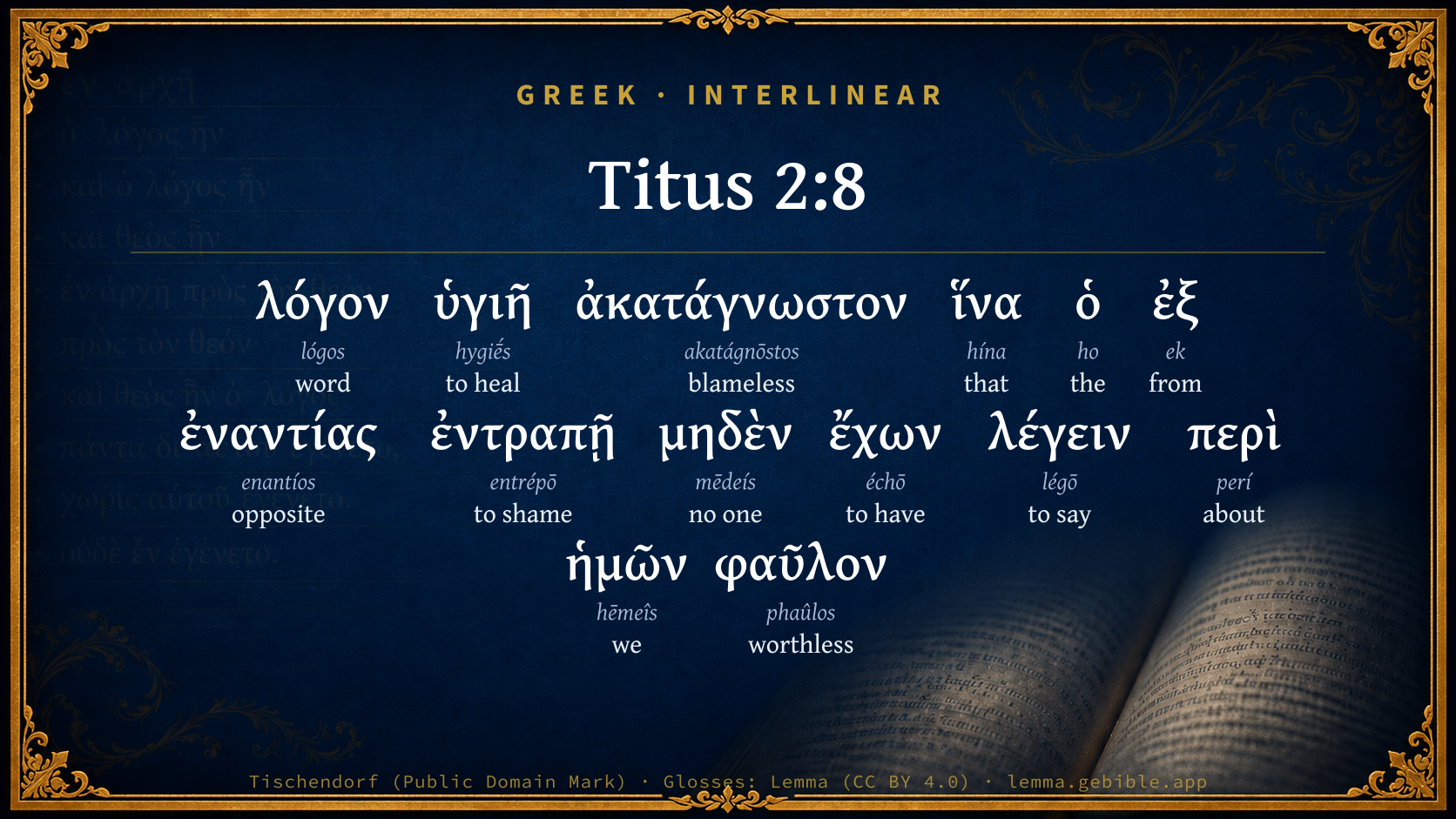
Download image
Cite this verse

Titus 2:8 (World English Bible). Public Domain. Lemma interlinear Bible study tool, https://lemma.gebible.app/v/titus/2/8.

Show BibTeX & RIS
BibTeX
RIS
English Translation
and soundness of speech that can't be condemned; that he who opposes you may be ashamed, having no evil thing to say about us.
World English Bible · Public Domain
Highlights
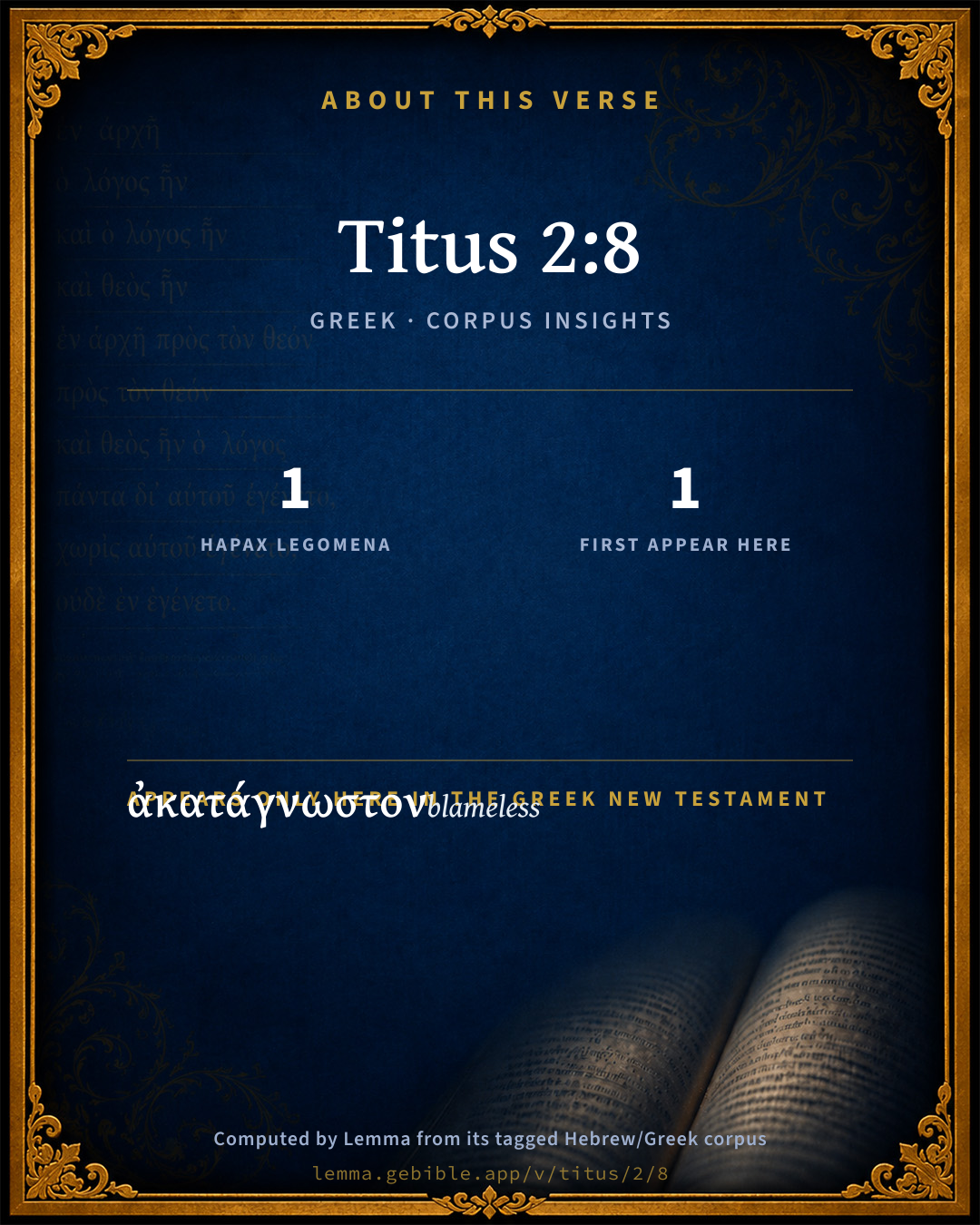
  • 1 hapax legomenon — only here in the Greek New Testament
  • 1 first appearance in the Greek New Testament
Full analysis ↓
Download a study sheet

One document with this verse’s original text, its word-by-word gloss line, the meaning frame, cross-references with their text, attributed commentary, and full source and license credits — printable, and it pastes into notes with its structure intact.

This verse Autodidact and up

Study sheet (.html) Plain text (.txt)

A passage Seminary Student

Up to 50 verses in one chapter. A passage sheet keeps up to 6 commentary sources and 12 cross-references per verse, in the order this page ranks them, and says so on the sheet whenever that leaves anything out. Ask for a single verse and you get the Autodidact verse sheet above.

Everything on this page stays free to read, with no account — the sheet is a download of what is already on screen, not access to it.

Want to remove ads? Support Godless Engineer
Compare translations 3

The same verse in 3 English versions, stacked beneath the original-language interlinear above. Click any original word for its lexicon entry.

Each is an independent rendering of the whole verse — the interlinear is not word-aligned to these translations.

Highlighted words mark where these versions differ — a whole-verse word diff, not a word-by-word alignment.

  • World English Bible Public Domain
    and soundness of speech that can't be condemned; that he who opposes you may be ashamed, having no evil thing to say about us.
  • King James Version Public Domain
    Sound speech, that cannot be condemned; that he that is of the contrary part may be ashamed, having no evil thing to say of you.
  • unfoldingWord Literal Text CC BY-SA 4.0
    a sound message above criticism, so that the opponent may be ashamed, having nothing bad to say about us.

unfoldingWord Literal Text — © unfoldingWord, licensed CC BY-SA 4.0. Word-aligned USFM3 via Door43 (git.door43.org/unfoldingWord/en_ult).

Versions to compare (up to 4)

3 of 4 selected

Show all 19 translations

Every available English version of this verse, each an independent rendering of the whole verse.

  • World English Bible Public Domain
    and soundness of speech that can't be condemned; that he who opposes you may be ashamed, having no evil thing to say about us.
  • Berean Standard Bible Public Domain
    and wholesome speech that is above reproach, so that anyone who opposes us will be ashamed, having nothing bad to say about us.
  • Majority Standard Bible Public Domain
    and wholesome speech that is above reproach, so that anyone who opposes us will be ashamed, having nothing bad to say about us.
  • King James Version Public Domain
    Sound speech, that cannot be condemned; that he that is of the contrary part may be ashamed, having no evil thing to say of you.
  • American Standard Version (1901) Public Domain
    sound speech, that cannot be condemned; that he that is of the contrary part may be ashamed, having no evil thing to say of us.
  • Revised Version (1885) Public Domain
    sound speech, that cannot be condemned; that he that is of the contrary part may be ashamed, having no evil thing to say of us.
  • Geneva Bible (1599) Public Domain
    And with the wholesome woorde, which can not be condemned, that hee which withstandeth, may be ashamed, hauing nothing concerning you to speake euill of.
  • Douay-Rheims (1899) Public Domain
    The sound word that can not be blamed: that he, who is on the contrary part, may be afraid, having no evil to say of us.
  • Young's Literal Translation Public Domain
    discourse sound, irreprehensible, that he who is of the contrary part may be ashamed, having nothing evil to say concerning you.
  • Literal Standard Version CC BY-SA 4.0
    sound discourse [that is] blameless, so that he who is of the contrary may be ashamed, having nothing evil to say concerning you.
  • Unlocked Literal Bible CC BY-SA 4.0
    and a correct message, so that anyone who opposes you may be ashamed because they have nothing bad to say about us.
  • unfoldingWord Literal Text CC BY-SA 4.0
    a sound message above criticism, so that the opponent may be ashamed, having nothing bad to say about us.
  • Darby Bible Public Domain
    a sound word, not to be condemned; that he who is opposed may be ashamed, having no evil thing to say about us:
  • World Messianic Bible Public Domain
    and soundness of speech that can’t be condemned, that he who opposes you may be ashamed, having no evil thing to say about us.
  • Webster's Bible Public Domain
    Sound speech that cannot be condemned; that he that is of the contrary part may be ashamed, having no evil thing to say concerning you.
  • Free Bible Version CC BY-SA 4.0
    sharing healthy beliefs that can't be criticized. In this way those who are opposed will be ashamed of themselves and won't have anything bad to say about us.
  • Bible in Basic English Public Domain
    Saying true and right words, against which no protest may be made, so that he who is not on our side may be put to shame, unable to say any evil of us.
  • Text-Critical English NT CC BY 4.0
    and sound speech that is above reproach, so that any opponent may be put to shame because he has nothing bad to say about us.
  • Tyndale New Testament (1534) Public Domain
    and with the wholsome worde which cannot be rebuked that he which withstondeth maye be a shamed havynge no thinge in you that he maye disprayse.

Literal Standard Version (2020), Covenant Press — licensed CC BY-SA 4.0. Text via the HelloAO Bible API (eBible.org). Unlocked Literal Bible (unfoldingWord) — licensed CC BY-SA 4.0. Text via the HelloAO Bible API (eBible.org). unfoldingWord Literal Text — © unfoldingWord, licensed CC BY-SA 4.0. Word-aligned USFM3 via Door43 (git.door43.org/unfoldingWord/en_ult). Free Bible Version, Dr. Jonathan Gallagher — licensed CC BY-SA 4.0. Text via the HelloAO Bible API (eBible.org).

Word by word

More ways to search: Search by grammar → Find every occurrence → Compare this word →

Practice this passage: Drill this verse → Learn its vocabulary →

ἀκατάγνωστον
akatágnōstos
G176
“blameless”
Adjective, Accusative, Singular, Masculine
Part of Speech
Adjective
Case
Accusative
Number
Singular
Gender
Masculine
Full Thayer's Definition

Origin: from G1 (as a negative particle) and a derivative of G2607

TDNT: 12:54,1

1. that cannot be condemned, not to be censored
  1. λόγον lógos G3056 “word” Noun, Accusative, Singular, Masculine
  2. ὑγιῆ hygiḗs G5199 “to heal” Adjective, Accusative, Singular, Masculine
  3. ἵνα hína G2443 “that” Conjunction
  4. ὁ ho G3588 “the” Article, Nominative, Singular, Masculine
  5. ἐξ ek G1537 “from” Preposition
  6. ἐναντίας enantíos G1727 “opposite” Adjective, Genitive, Singular, Feminine
  7. ἐντραπῇ entrépō G1788 “to shame” Verb, Aorist, Passive, Subjunctive, 3rd person, Singular
  8. μηδὲν mēdeís G3367 “no one” Adjective, Accusative, Singular, Neuter, Negative
  9. ἔχων échō G2192 “to have” Verb, Present, Active, Participle, Nominative, Singular, Masculine
  10. λέγειν légō G3004 “to say” Verb, Present, Active, Infinitive
  11. περὶ perí G4012 “about” Preposition
  12. ἡμῶν hēmeîs G2249 “we” Personal pronoun, 1st person, Genitive, Plural
  13. φαῦλον phaûlos G5337 “worthless” Adjective, Accusative, Singular, Neuter

About this verse

These counts appear in no published source. They are computed here, from the morphology-tagged text and Lemma’s own curated glosses. What Lemma adds →

14
words
14
distinct lemmas
Pauline Epistles
section

Notable vocabulary

1 hapax legomenon — a word that appears only here in the entire Greek New Testament:

  • ἀκατάγνωστον blameless G176

First appearance in Scripture

This word makes its first canonical appearance in the Greek New Testament here:

  • ἀκατάγνωστον blameless G176

Shared distinctive vocabulary

φαῦλον worthless G5337 occurs in 6 verses of the Greek New Testament. Also found in:
Cross-references

13

Topical passages linked to Titus 2:8 in the Treasury of Scripture Knowledge — connected by theme and wording, ordered by reader-vote popularity; previews shown in the World English Bible.

  • 1 Peter 2:12 having good behavior among the nations, so in that which they speak against you as evil-doers, they may by your good works, which they see, glorify God in the day of visitation.
  • 1 Peter 2:15 For this is the will of God, that by well-doing you should put to silence the ignorance of foolish men:
  • 1 Timothy 6:3 If anyone teaches a different doctrine, and doesn't consent to sound words, the words of our Lord Jesus Christ, and to the doctrine which is according to godliness,
  • 1 Peter 3:16 having a good conscience; that, while you are spoken against as evildoers, they may be disappointed who curse your good manner of life in Christ.
  • Philippians 2:14–16 Do all things without murmurings and disputes,
  • Nehemiah 5:9 Also I said, The thing that you do is not good: ought you not to walk in the fear of our God, because of the reproach of the nations our enemies?
  • 2 Thessalonians 3:14 If any man doesn't obey our word in this letter, note that man, that you have no company with him, to the end that he may be ashamed.
  • Isaiah 66:5 Hear the word of Yahweh, you who tremble at his word: Your brothers who hate you, who cast you out for my name's sake, have said, Let Yahweh be glorified, that we may see your joy; but it is those who shall be disappointed.
  • Mark 12:28 One of the scribes came, and heard them questioning together. Knowing that he had answered them well, asked him, "Which commandment is the greatest of all?"
  • Mark 12:32 The scribe said to him, "Truly, teacher, you have said well that he is one, and there is none other but he,
  • Mark 12:34 When Jesus saw that he answered wisely, he said to him, "You are not far from the Kingdom of God." No one dared ask him any question after that.
  • Luke 13:17 As he said these things, all his adversaries were disappointed, and all the multitude rejoiced for all the glorious things that were done by him.
  • 1 Timothy 5:14 I desire therefore that the younger widows marry, bear children, rule the household, and give no occasion to the adversary for reviling.

Cross-references courtesy of OpenBible.info (CC BY 4.0).

Where the printed editions differ

1 variant

Places in this verse where the major printed Greek editions disagree on the wording in a way that affects the translation — a comparison of editions, not a manuscript-by-manuscript collation. The editions are the modern critical texts (Nestlé-Aland 28/27, SBL, Westcott-Hort, Tregelles, Tyndale House) and the traditional texts behind the KJV (the Textus Receptus and the Byzantine/Majority text). It is not a claim about which reading is original.

  1. Different wording
    ἡμῶν

    “us”

    In NA28NA27TynSBLWHTregByz Not in TR

    ὑμῶν (humōn) 'you' occurs in traditional manuscripts (TR) instead of ἡμῶν (hēmōn) 'us' in older manuscripts (NA28+NA27+Tyn+SBL+WH+Treg+Byz)

Textual data: Translators Amalgamated Greek New Testament (STEPBible TAGNT) · CC BY 4.0.

Commentary

Notes on Titus 2:8 from classic Christian and Jewish commentators (each source and its license shown beneath its notes). The classic Christian expositions comment on the surrounding passage and are grouped to its opening verse, so a note may address several verses; the Jewish commentaries on the Tanakh (Rashi and others) are per-verse, so they appear only where the commentator wrote on this verse.

Lemma curates 59 commentaries, every one of them public domain or Creative Commons licensed, each selected and text-cleaned for this edition rather than reprinted as found. About our sources →

Albert Barnes' Notes on the Bible

Sound speech - Notes, 1Ti 1:10. He was to use language that would be spiritually “healthful” (ὑγιῆ hugiē); that is, true, pure, uncorrupted. - This word, and its correlatives, is used in this sense, in the New Testament, only by the apostle Paul. It is commonly applied to the body, meaning that which is healthful, or whole; see Luk 5:31; Luk 6:10; Luk 7:10; Luk 15:27; Mat 12:13; Mat 15:31; Mar 3:5; Mar 5:34; Joh 5:4, Joh 5:6,Joh 5:9, Joh 5:11, Joh 5:14-15; Joh 7:23; Act 4:10; 3Jo 1:2. For Paul’s use of the word see 1Ti 1:10; 1Ti 6:3; 2Ti 1:13;2Ti 4:3; Tit 1:9, Tit 1:13; Tit 2:1-2, Tit 2:8. It does not elsewhere occur.

That cannot be condemned - Such as cannot be shown to be weak, or unsound; such that no one could find fault with it, or such as an adversary could not take hold of and blame. This direction would imply purity and seriousness of language, solidity of argument, and truth in the doctrines which he maintained.

That he that is of the contrary part may be ashamed ... - Ashamed that he has opposed such views.

Albert Barnes' Notes on the Bible (1834–1885) — public domain. Text from a community e-Sword/MySword module.

Bengel's Gnomon

Johann Albrecht Bengel

Tit 2:8. Ἐντραπῇ, may be confounded) The great force of truth and innocence.

Bengel's Gnomon of the New Testament — English translation (T&T Clark, Edinburgh, 1860) — public domain. Text from a community e-Sword module.

Expositor's Greek Testament

ed. W. Robertson Nicoll

Tit 2:8 . ἀκατάγνωστον : to which no exception can be taken . See Deissmann, Bible Studies , Trans. p. 200. ὑγιῆ implies the conformity of the doctrine taught with the Church’s standard (see note on 1Ti 1:10 ), while ἀκατάγνωστον has reference to the manner of its presentation to the hearer.

ὁ ἐξ ἐναντίας : The heathen opponent, official or unofficial, ὁ ἀντικείμενος (1Ti 5:14 ), οἱ ἀντιδιατιθέμενοι (2Ti 2:25 ), not the Devil himself (Chrys.).

ἐντραπῇ : vercatur (Vulg.); but confundatur , as in 2Th 3:14 , would be a better rendering here. An antagonist who finds that he has no case “looks foolish,” as we say.

φαῦλον : usually applied to actions. See reff. The clause means having nothing evil to report concerning us : not, as the English versions, having no evil thing to say , which might be explained as, “being unable to abuse us”.

The Expositor's Greek Testament, edited by W. Robertson Nicoll (1897–1910) — public domain. Text from a community e-Sword module.

Jamieson, Fausset & Brown

Robert Jamieson, A. R. Fausset & David Brown

speech--discourse in public and private ministrations.

he that is of the contrary part--the adversary (Tit 1:9; Ti2 2:25), whether he be heathen or Jew.

may be ashamed--put to confusion by the power of truth and innocence (compare Tit 2:5, Tit 2:10; Ti1 5:14; Ti1 6:1).

no evil thing--in our acts, or demeanor.

of you--So one of the oldest manuscripts. Other very old manuscripts read, "of US," Christians.

Jamieson, Fausset & Brown — Commentary Critical and Explanatory on the Whole Bible (1871) — public domain (CC PDM 1.0). Text via the HelloAO Bible API.

Adam Clarke's Commentary

Verse 8. Sound speech] λογον υγιη. Sound or healing doctrine. Human nature is in a state of disease; and the doctrine of the Gospel is calculated to remove the disease, and restore all to perfect health and soundness. All false doctrines leave men under the influence of this spiritual disease; the unadulterated doctrine of the Gospel alone can heal men.

He that is of the contrary part] Whether this may refer to the Judaizing teachers in general, or to some one who might, by his false doctrine, have been disturbing the peace of the Churches in Crete, we cannot tell.

Having no evil thing to say of you.] Against a person who is sound in his doctrine, and holy in his life, no evil can be justly alleged. He who reports evil of such a person must be confounded when brought to the test. Instead of περι υμων, of YOU, περι ημων, of US, is the reading of CDEFG, and about forty others; with both the Syriac, all the Arabic, Slavonic, Vulgate, Itala, and several of the primitive fathers. This reading makes a better sense, and is undoubtedly genuine.

Adam Clarke's Commentary on the Bible (1810–1826) — public domain. Text from a community e-Sword/MySword module.

John Calvin's Commentaries

8. Sound speech, unblamable “Sound speech” relates (in my opinion) to ordinary life and familiar conversation; for it would be absurd to interpret it as relating to public instruction, since he only wishes that Titus, both in his actions and in his words, shall lead a life that agrees with his preaching. He therefore enjoins that his words shall be pure and free from all corruption.

Unblamable may apply either to the words or the person of Titus. I prefer the latter view, that the other nouns in the accusative case (which the Greek syntax easily allows) may depend upon it in this sense — “that thou mayest shew thyself unblamable in gravity, in integrity, and in sound words.”

That the adversary may be ashamed. Although a Christian man ought to look at other objects, yet this must not be neglected, to shut the mouth of wicked men, as we are everywhere taught that we should give no occasion for slander. Everything that they can seize on as improper in our conduct is maliciously turned against Christ and his doctrine. The consequence is, that, through our fault, the sacred name of God is exposed to insult. Accordingly, the more we perceive that we are keenly observed by enemies, let us be the more attentive to guard against their calumnies, and thus let their malignity strengthen in us the desire of doing well.

John Calvin's Commentaries (1540-1563) — public domain. Text from the Calvin Translation Society English edition (1840s-50s) via the Christian Classics Ethereal Library (ccel.org). Calvin's coverage is partial (roughly two-thirds of the Bible); uncommented books and verses are honest gaps, never fabricated. The 19th-century editor's footnotes and remarks are omitted so the notes are faithfully Calvin's own voice.

Ellicott's Commentary for English Readers

(8) Sound speech, that cannot be condemned.—The substance of Titus’ teaching, whether in the more private intercourse with individuals or in his preaching in the Christian gatherings, must be healthy, practical, manly, in contrast to the sickly, morbid, fanciful instruction the false teachers of Crete were in the habit of giving. His words, too, must be well weighed and thoughtful, as well as earnest and impassioned; they must be such as would expose him neither to contempt nor to the charge of presumption. Between the lines of the exhortation of the 7th and 8th verses we can read the anxiety of the Apostle that his representative in Crete should take all possible care that the matter of his teaching and preaching was studied and prepared with all the attention and thought so important a duty demanded. He should remember, too, that the words as well as the works of the Christian teacher will be subject to a sharp and often hostile criticism. These warnings and reminders of St. Paul, it should be borne in mind, belong to all ages of the faith.

That he that is of the contrary part may be ashamed, having no evil thing to say of you.—The older authorities, with one exception, read “of us,” instead of “of you.” If Titus fairly carries out the exhortation of the last two verses, then the enemy, either the false teacher or the Pagan opponent of Christianity, confounded by the pure, self-sacrificing, earnest life, overcome by the well-weighed, thoughtful utterance of great truths, by the impassioned exhortation to men and women to lead noble, honest lives, will surely be ashamed of his bitter opposition, when he finds neither in the life nor in the teaching anything which he can fairly criticise as “bad.” As the better supported reading, “of us,” associates St. Paul and others with Titus, the evil thing which might have been said of Titus in reality would be spoken against St. Paul and the elder Apostles.

A Bible Commentary for English Readers, edited by Charles John Ellicott (1878–1897) — public domain. Text from a community e-Sword module.

The Cambridge Bible for Schools and Colleges

gen. ed. J. J. S. Perowne

8. sound speech] For the ‘Pastoral’ word ‘sound’ cf. 1Ti_1:10; 1Ti_6:3; 1Ti_1:13. From the union in this counsel of ‘speech’ and ‘doctrine’ we must understand ‘sound speech’ to be part of the public teaching function of Titus. ‘That cannot be condemned,’ Vulg. ‘irreprehensibile’; cf. 1Ti_6:14 for the similar formation and sense ‘that cannot be laid hold of.’

may be ashamed] The active is ‘to shame,’ 1Co_4:14 (present). Cf. the subst. ‘to your shame,’ 1Co_6:5. The middle pres. and imperf. with 2 fut. pass, are ‘to shame myself at,’ ‘to take shame at’; Luk_18:4, ‘regard not man;’ Heb_12:9, ‘gave them reverence’; Mat_21:37, ‘they will reverence my son.’ The 2 aor. pass., which occurs here and 2Th_3:14 without an object, should be classed with these, rather than be regarded (as by Bp Ellicott) as a passive ‘be shamed.’ His quotation from Psa_35:26 is quite inconclusive; for the aor. pass, of the verb, with which our tense is there coupled, has clearly a middle sense in 1Jn_2:28, where Bp Westcott renders ‘that we may not shrink with shame.’ Be ashamed is therefore correct, as A.V. and R.V.

having no evil thing to say of you] i.e. ‘since he has, and finds that he has.’ The reading ‘us’ for ‘you’ should be adopted with the best mss. St Paul identifies himself with Titus and all Church teachers and workers. So St John with his ‘children’ 1Jn_2:1, ‘we have an advocate’; 1Jn_2:28, ‘that we may have boldness.’ The word for ‘evil’ is not common in N.T.; twice in St John’s Gospel, R.V. ‘doeth ill,’ ‘they that have done ill’; twice in St Paul besides, R.V. ‘good or bad’; once in St James, R.V. ‘confusion and every vile deed.’ ‘Worthlessness is the central notion,’ Trench, N.T. Syn. § 84, ‘nequam,’ ‘naughty,’ originally ‘light’ and ‘slight.’ Contrasted is the ‘positively evil’ or ‘mischief working,’ ‘deliver us from the evil,’ Mat_6:13. The point of the word is here then ‘he should have nothing mean, contemptible, good for nothing, to taunt us with.’ The ‘good’ above and the ‘evil’ here find (as does the thought) apt illustration in Shakespeare’s

‘So shines a good deed in a naughty world.’

The Cambridge Bible for Schools and Colleges (gen. ed. J. J. S. Perowne; Cambridge University Press, 1878–1918) — public domain. Text from a community e-Sword module.

John Gill's Exposition

Not purloining..... Or stealing, embezzling their master's substance, taking away, and making use of what is their property, keeping back part of money or goods committed to their trust: the word is used in the case of Ananias and Sapphira. Act 5:2,

but showing all good fidelity; approving themselves to be faithful servants in everything they are intrusted with:

that they may adorn the doctrine of God our Saviour in all things; Christ is our alone Saviour, and he is truly and properly God, and so fit and able to be a Saviour; and the Gospel is his doctrine, not only what he himself preached, when on earth, but it is a doctrine concerning him; concerning his deity, and the dignity of his person, and concerning his office as Mediator, and the great salvation by him; and which are so many reasons why it should be adorned by a suitable life and conversation; for this is what becomes the Gospel of Christ, throws a beauty upon it, and is ornamental to it; and in this way the doctrine of Christ may be, and ought to be, adorned by servants, as well as others: to adorn the Gospel, is first to believe and receive it, then to profess it, and hold fast that profession, and walk worthy of it. Two of Stephens's copies read, "in", or "among all men".

John Gill's Exposition of the Whole Bible (1746–1763) — public domain (CC PDM 1.0). Text via the HelloAO Bible API.

Trapp's Complete Commentary

John Trapp

8 Sound speech, that cannot be condemned; that he that is of the contrary part may be ashamed, having no evil thing to say of you.

Ver. 8. May be ashamed, having, &c.] Oh, it is a brave thing to stop an open mouth, to throttle envy, to cut off all occasion of evil speaking.

John Trapp, A Commentary or Exposition upon All the Books of the Old and New Testament (1647–1656) — public domain. Text from a community e-Sword module.

Matthew Poole's English Annotations

Sound speech, that cannot be condemned: Paul (as yet) seemeth to be directing Titus as a minister, and the rest of the ministers in Crete, how to behave themselves in the ministry, for the last word being plural, you, signifieth either the ministry, or else is put for thee; he would have Titus not only preach sound doctrine, not corrupt, and do it gravely, but also preach profitable doctrine, tending to make the souls of others sound and healthy; unless perhaps by λογον be here meant his style and phrase, which he would have such as none could justly condemn. What was said of Caesar’s wife, that she ought not only to be chaste, but so to behave herself as not to be suspected otherwise, is applicable to ministers; their doctrine, and phrase used in their ministry, ought not only to be sound and grave, but such as none should judge or censure for other.

That he that is of the contrary part may be ashamed; that the adversaries of the truth may be ashamed of their aspersing them or it.

Having no evil thing to say of you; and may have no evil thing to charge them with.

Matthew Poole's English Annotations on the Holy Bible (1683–1685) — public domain. Text from a community e-Sword/MySword module.

Whedon's Commentary on the Bible

Daniel D. Whedon

8. Sound speech—Both in the pulpit and in daily converse with men.

Cannot be condemned—That defies the censure of the most adverse listener.

Contrary part—The gainsayers of Tit_1:9, who are Titus’ immediate rivals and opposers.

No evil thing—There is an immense conquering power in this negative innocence, that allows no hold to the slanderer.

Daniel D. Whedon (gen. ed.), Commentary on the Old and New Testaments (1874–1909) — public domain. Text from a community e-Sword module.

The Pulpit Commentary

Us for you, A.V and T.R. Sound speech (logon ugih); still depending upon parecumenov . Besides his personal qualities as a teacher, his speech, or doctrine, must be sound. The word, common of bodily health, is only here applied to speech or doctrine; the common phrase in the pastoral Epistles is ugiasinoush didaskalia, ugiainousi logoiv , and the like. That cannot be condemned (akatagnwston ); only here in the New Testament, once in RAPC 2Ma 4:27. This marks the care that the Christian teacher must take not to say anything in his teaching rash, or reprehensible, or that can give offence or cause the ministry to be blamed. (1Ti_5:14) May be ashamed (entraph). In the active voice entrepein is "to put to shame", (1Co_4:14) and in classical Greek. In the middle voice entrepomai , followed by a genitive of the person, or an accusative in later Greek, means to "respect, reverence". (Mat_21:37 Luk_18:2, etc.) In the passive, as here and 2Th_3:14, it means "to be put to shame," "to be ashamed". (comp. Psa_34:4 Psa_35:4) (Compare, for the sentiment, 1Pe_2:15 1Pe_3:16; and note the frequent resemblances between the pastoral Epistles and those of St. Peter.) The shame of the detractors consists in their being put to silence, having nothing to say, being proved to be slanderers. No evil thing (mhde); as Jam_3:16 Joh_3:20 Joh_5:29. The word means mean, worthless, paltry," and is hence synonymous with

The Pulpit Commentary (1880–1919), ed. H.D.M. Spence-Jones & Joseph S. Exell — public domain. Text from a community e-Sword module.

John Wesley's Explanatory Notes

Wholesome speech - In private conversation.

John Wesley, Explanatory Notes Upon the Whole Bible (1754–1765) — public domain. Text via the GEBible commentary corpus.

Fairbairn on Ezekiel, Jonah & the Pastoral Epistles

Patrick Fairbairn

Ver. 8. And now comes the character of the instruction itself: sound discourse that cannot be condemned, in order that he who is of the contrary part may be ashamed, having no evil thing to say of us. (ἡμῶν is the reading of א, C, D, E, F, G, K, L, Ital., Vulg., Syr., by much the best supported.) The same peculiar aspect is here given to true evangelical teaching, which is of such frequent occurrence in these Pastoral epistles; it was to be sound (ὑγιῆ), or healthy, as opposed to everything fitted to nourish a sickly and distempered pietism. Being such, it could not, of course, be condemned by any competent judge; and, what was more, those who had the will would find they lacked any proper ground to speak reproachfully against the doctrine taught, and for shame sake might be reduced to silence. Although the party contemplated as ready to assume a hostile position is spoken of in the singular, “he who is of the contrary part,” yet this is plainly but an individualizing mode of representing a class, and both the connection and the form of expression employed forbid us to suppose any other than human adversaries, heathen or Jewish, to have been in view. May have nothing bad or foul to say— μηδὲν, having reference to the subjective condition of the adversary: however desirous, he could get hold of no ground of blame.

Patrick Fairbairn — An Exposition of Ezekiel (1851), Jonah (1849), and The Pastoral Epistles (1874) — public domain. Text from a community e-Sword module.

The People's New Testament

B. W. Johnson

8. Sound speech. Speech of a healthy, moral effect. He that is of the contrary part. Opposers, whether heathen, Jews, or false teachers.

B. W. Johnson's The People's New Testament with Notes (1889–1891) — public domain. Electronic text from the Christian Classics Ethereal Library (CCEL) ThML edition.

Cambridge Greek Testament for Schools and Colleges

8. λέγειν περὶ ἡμῶν φαῦλον. The rec. text has ὑμῶν for ἡμῶν (with A and the Bohairic version), and also places λέγειν directly before φαῦλον (with KL and a considerable number of authorities). But the mass of uncial evidence is overwhelmingly in favour of the text as printed.

8. λόγον ὑγιῆ ἀκατάγνωστον, sound discourse that cannot be condemned. The two qualities which the λόγος or ‘discourse’ of one in the position of Titus should have are (1) that it be ὑγιής (see the note on 1Ti 1:10), and (2) that it be ἀκατάγνωστος or irreprehensible. The word ἀκατάγνωστος occurs again in the Greek Bible only once, at 2Ma 4:47 where it means ‘uncondemned’; here it means rather ‘not open to just rebuke.’ In fact, every faithful teacher has frequently to declare ‘doctrine’ against which some of his hearers rebel and which they are only too ready to ‘condemn.’ But the true standard of ὑγιεία or soundness is not derived from a comparison of the opinions of the taught, but is the Apostolic deposit of faith, as officially and authoritatively interpreted by the Church.

ἵνα ὁ ἐξ ἐναντίας ἐντραπῇ, in order that he of the contrary part, sc. the ματαιολόγος, may be put to shame, and so his vain talk be silenced. The positive presentation of truth, of the ‘sound doctrine,’ is the best means of combating error; falsehood dreads the light and is—generally—discredited as soon as the light of truth is allowed to play on it, without any direct controversial attack. Chrysostom interprets ὁ ἐξ ἐναντίας of the devil, but this is to introduce an idea quite foreign to the context, as indeed the next clause sufficiently shews.

μηδὲν ἔχων λέγειν περὶ ἡμῶν φαῦλον, having no evil thing to say of us. φαῦλος is in the N.T. always applied to evil deeds rather than evil words; and so the point of this clause is that the opponents of St Paul’s ‘sound doctrine’ have nothing scandalous to report of his conduct or of that of Titus.

v. Slaves

Cambridge Greek Testament for Schools and Colleges (Cambridge University Press, 1896; 21 vols, various authors incl. Carr, Maclear, Plummer, Farrar, Lumby, Moule, M. R. James, Simcox) — public domain. Text from a community e-Sword module.

International Critical Commentary

8. ὁ ἐξ ἐναντίας] “he that is of the contrary part”—doubtless the main thought is of pagan criticism; cf. 5, 10, 1 P 2:12-15, 1Ti 5:14 ὁ ἀντικείμενος: but as there is a direct reference to Titus, it may include “the contrary part” within the Church; cf. τοὺς ἀντιλέγοντας, 1:9, 3:15 note, 2Ti 2:25.

International Critical Commentary — older volumes (1896–1929), various authors — public domain. Text from a community e-Sword module.

Vincent's Word Studies in the New Testament

Marvin R. Vincent

Sound speech [λογον υγιη] . Ugihv sound, only here in Pastorals. The usual form is the participle, as uJgiainontwn logwn, 2Ti 1:13; uJgiainousi logoiv, 1Ti 6:3.

That cannot, be condemned [ακαταγνωστον] . N. T. o. o Class. See 2 Macc. 4 47.

He that is of the contrary part [ο εξ εναντιας] . The phrase N. T. o. See Mr 14:39. The heathen opposer is meant. Comp. blasphemed, verse 5, and 1Ti 6:1. Enantiov contrary, in Paul only 1Th 2:15.

May be ashamed [εντραπη] . Only here in Pastorals. In Paul, 1Co 4:14; 2Th 3:14, see notes on both, and on Mt 21:37.

Evil thing [φαυλον] . Only here in Pastorals. In Paul, Rom 9:11; 2Co 5:10. See on Joh 3:20.

Marvin R. Vincent, Word Studies in the New Testament (1887–1900) — public domain. Text from a community e-Sword/MySword module.

Lesson kit

Teaching starters — assembled from the data on this page, not authored interpretation. Every prompt links to the verse data it draws on. Edit before teaching.

Titus, in the Pauline Epistles, opens this verse with 14 words (14 distinct Greek lemmas). Its most distinctive word is akatágnōstos (“blameless”). A historical commentator’s framing appears above. Read the whole chapter for the surrounding context.

Discussion questions

  1. The word akatágnōstos carries the sense “blameless.” How does it shape the verse?
  2. 1 word here appears nowhere else in the Greek New Testament. Why might the author reach for such rare wording?
  3. This is the first place “blameless” appears in Scripture (first appears here). What does its debut here establish?
  4. How does John 3:20, which shares the word «worthless», read alongside this verse?
  5. These translations render this verse differently. What is at stake in choosing one wording over another?
  6. Compare how Albert Barnes' Notes on the Bible and Bengel's Gnomon read this verse. Where do they agree or differ?

Things to notice

  • 1 word in this verse appears nowhere else in the Greek New Testament.
  • 1 word makes its first canonical appearance in Scripture here.
  • These translations choose different wording for 21 words in this verse.
  • 14 distinct Greek lemmas span 14 words in this verse.

Reading settings

Reading text

Shown beneath each verse's original-language words.

Old Testament
Old Testament edition

Read the OT as the Masoretic Hebrew (MT) or the Greek Septuagint (LXX).

English shown for the Greek Septuagint (in the Hebrew ↔ Greek comparison).

Comparing translations? Open the Compare panel on any verse page to stack up to four side by side.