2 Corinthians 11:5

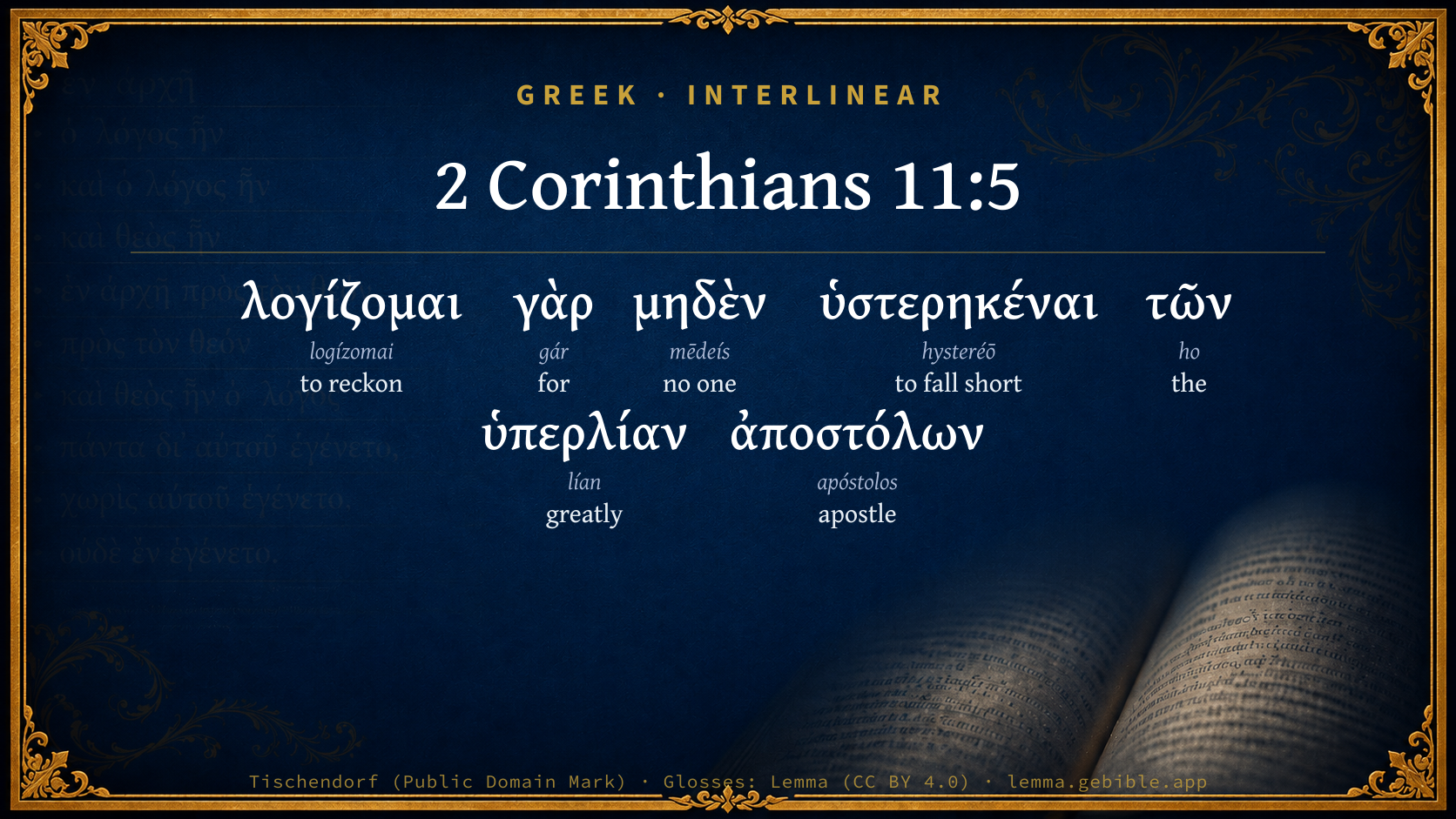
Greek (Tischendorf 8th ed.) 2 Corinthians 11:5 appears in the Greek New Testament. The text above is from the Tischendorf 8th edition. Each word links to its Strong’s number and a concise gloss. Click any word for its full Thayer’s Greek Lexicon entry.
Download image
Cite this verse

2 Corinthians 11:5 (World English Bible). Public Domain. Lemma interlinear Bible study tool, https://lemma.gebible.app/v/2-corinthians/11/5.

Show BibTeX & RIS
BibTeX
RIS
English Translation
For I reckon that I am not at all behind the very best apostles.
World English Bible · Public Domain
Download a study sheet

One document with this verse’s original text, its word-by-word gloss line, the meaning frame, cross-references with their text, attributed commentary, and full source and license credits — printable, and it pastes into notes with its structure intact.

This verse Autodidact and up

Study sheet (.html) Plain text (.txt)

A passage Seminary Student

Up to 50 verses in one chapter. A passage sheet keeps up to 6 commentary sources and 12 cross-references per verse, in the order this page ranks them, and says so on the sheet whenever that leaves anything out. Ask for a single verse and you get the Autodidact verse sheet above.

Everything on this page stays free to read, with no account — the sheet is a download of what is already on screen, not access to it.

Want to remove ads? Support Godless Engineer
Compare translations 3

The same verse in 3 English versions, stacked beneath the original-language interlinear above. Click any original word for its lexicon entry.

Each is an independent rendering of the whole verse — the interlinear is not word-aligned to these translations.

Highlighted words mark where these versions differ — a whole-verse word diff, not a word-by-word alignment.

  • World English Bible Public Domain
    For I reckon that I am not at all behind the very best apostles.
  • King James Version Public Domain
    For I suppose I was not a whit behind the very chiefest apostles.
  • unfoldingWord Literal Text CC BY-SA 4.0
    For I consider not to fall short of the “super-apostles.”

unfoldingWord Literal Text — © unfoldingWord, licensed CC BY-SA 4.0. Word-aligned USFM3 via Door43 (git.door43.org/unfoldingWord/en_ult).

Versions to compare (up to 4)

3 of 4 selected

Show all 19 translations

Every available English version of this verse, each an independent rendering of the whole verse.

  • World English Bible Public Domain
    For I reckon that I am not at all behind the very best apostles.
  • Berean Standard Bible Public Domain
    I consider myself in no way inferior to those “super-apostles.”
  • Majority Standard Bible Public Domain
    I consider myself in no way inferior to those “super-apostles.”
  • King James Version Public Domain
    For I suppose I was not a whit behind the very chiefest apostles.
  • American Standard Version (1901) Public Domain
    For I reckon that I am not a whit behind the very chiefest apostles.
  • Revised Version (1885) Public Domain
    For I reckon that I am not a whit behind the very chiefest apostles.
  • Geneva Bible (1599) Public Domain
    Verely I suppose that I was not inferior to the very chiefe Apostles.
  • Douay-Rheims (1899) Public Domain
    For I suppose that I have done nothing less than the great apostles.
  • Young's Literal Translation Public Domain
    for I reckon that I have been nothing behind the very chiefest apostles,
  • Literal Standard Version CC BY-SA 4.0
    for I reckon that I have been nothing behind the very chiefest apostles,
  • Unlocked Literal Bible CC BY-SA 4.0
    For I think that I am not in the least inferior to those so-called super-apostles.
  • unfoldingWord Literal Text CC BY-SA 4.0
    For I consider not to fall short of the “super-apostles.”
  • Darby Bible Public Domain
    For I reckon that in nothing I am behind those who are in surpassing degree apostles.
  • World Messianic Bible Public Domain
    For I reckon that I am not at all behind the very best emissaries.
  • Webster's Bible Public Domain
    For I suppose I was not a whit behind the very greatest apostles.
  • Free Bible Version CC BY-SA 4.0
    I don't believe I'm inferior to these “super-apostles.”
  • Bible in Basic English Public Domain
    For in my opinion, I am in no way less than the most important of the Apostles.
  • Text-Critical English NT CC BY 4.0
    For I consider myself to be in no way inferior to these “super-apostles.”
  • Tyndale New Testament (1534) Public Domain
    I suppose that I was not behynde the chefe apostles.

Literal Standard Version (2020), Covenant Press — licensed CC BY-SA 4.0. Text via the HelloAO Bible API (eBible.org). Unlocked Literal Bible (unfoldingWord) — licensed CC BY-SA 4.0. Text via the HelloAO Bible API (eBible.org). unfoldingWord Literal Text — © unfoldingWord, licensed CC BY-SA 4.0. Word-aligned USFM3 via Door43 (git.door43.org/unfoldingWord/en_ult). Free Bible Version, Dr. Jonathan Gallagher — licensed CC BY-SA 4.0. Text via the HelloAO Bible API (eBible.org).

Word by word

More ways to search: Search by grammar → Find every occurrence → Compare this word →

Practice this passage: Drill this verse → Learn its vocabulary →

About this verse

These counts appear in no published source. They are computed here, from the morphology-tagged text and Lemma’s own curated glosses. What Lemma adds →

7
words
7
distinct lemmas
Pauline Epistles
section

Notable vocabulary

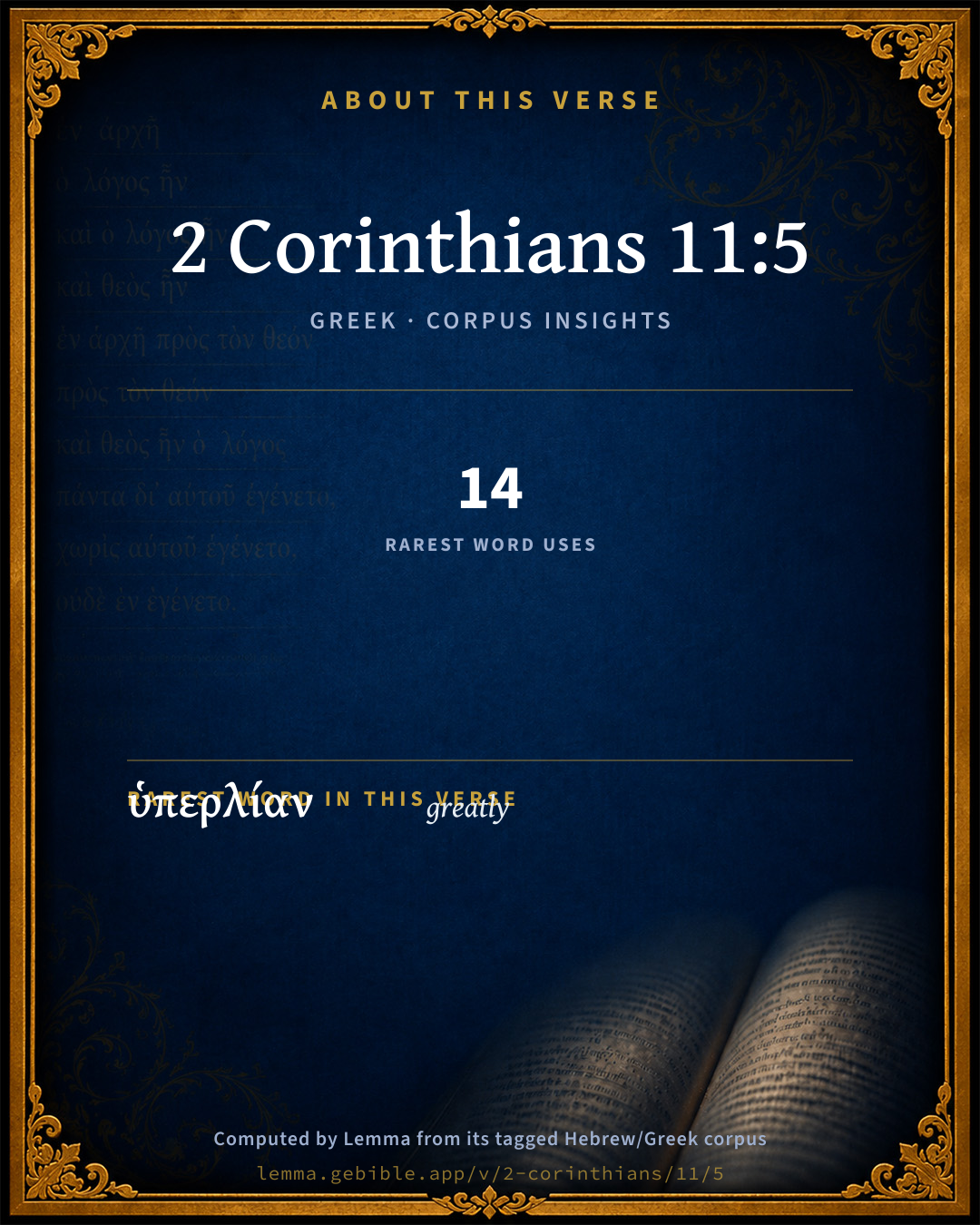
The rarest word here is ὑπερλίαν greatly G3029 — appearing just 14 times in the whole Greek New Testament.

Shared distinctive vocabulary

ὑπερλίαν greatly G3029 occurs in 14 verses of the Greek New Testament. Also found in:

Cross-references

3

Topical passages linked to 2 Corinthians 11:5 in the Treasury of Scripture Knowledge — connected by theme and wording, ordered by reader-vote popularity; previews shown in the World English Bible.

  • 1 Corinthians 15:10 But by the grace of God I am what I am. His grace which was bestowed on me was not futile, but I worked more than all of them; yet not I, but the grace of God which was with me.
  • 2 Corinthians 12:11–12 I have become foolish in boasting. You compelled me, for I ought to have been commended by you, for in nothing was I inferior to the very best apostles, though I am nothing.
  • Galatians 2:6–9 But from those who were reputed to be important (whatever they were, it makes no difference to me; God doesn't show partiality to man)--they, I say, who were respected imparted nothing to me,

Cross-references courtesy of OpenBible.info (CC BY 4.0).

Commentary

Notes on 2 Corinthians 11:5 from classic Christian and Jewish commentators (each source and its license shown beneath its notes). The classic Christian expositions comment on the surrounding passage and are grouped to its opening verse, so a note may address several verses; the Jewish commentaries on the Tanakh (Rashi and others) are per-verse, so they appear only where the commentator wrote on this verse.

Lemma curates 59 commentaries, every one of them public domain or Creative Commons licensed, each selected and text-cleaned for this edition rather than reprinted as found. About our sources →

Matthew Henry's Commentary

After the foregoing preface to what he was about to say, the apostle in these verses mentions,

I. His equality with the other apostles - that he was not a whit behind the very chief of the apostles, Co2 11:5. This he expresses very modestly: I suppose so. He might have spoken very positively. The apostleship, as an office, was equal in all the apostles; but the apostles, like other Christians, differed one from another. These stars differed one from another in glory, and Paul was indeed of the first magnitude; yet he speaks modestly of himself, and humbly owns his personal infirmity, that he was rude in speech, had not such a graceful delivery as some others might have. Some think that he was a man of very low stature, and that his voice was proportionably small; others think that he may have had some impediment in his speech, perhaps a stammering tongue. However, he was not rude in knowledge; he was not unacquainted with the best rules of oratory and the art of persuasion, much less was he ignorant of the mysteries of the kingdom of heaven, as had been thoroughly manifested among them.

II. His equality with the false apostles in this particular - the preaching of the gospel unto them freely, without wages. This the apostle largely insists on, and shows that, as they could not but own him to be a minister of Christ, so they ought to acknowledge he had been a good friend to them. For, 1. He had preached the gospel to them freely, Co2 11:7-10. He had proved at large, in his former epistle to them, the lawfulness of ministers' receiving maintenance from the people, and the duty of the people to give them an honourable maintenance; and here he says he himself had taken wages of other churches (Co2 11:8), so that he had a right to have asked and received from them: yet he waived his right, and chose rather to abase himself, by working with his hands in the trade of tent-making to maintain himself, than be burdensome to them, that they might be exalted, or encouraged to receive the gospel, which they had so cheaply; yea, he chose rather to be supplied from Macedonia than to be chargeable unto them. 2. He informs them of the reason of this his conduct among them. It was not because he did not love them (Co2 11:11), or was unwilling to receive tokens of their love (for love and friendship are manifested by mutual giving and receiving), but it was to avoid offence, that he might cut off occasion from those that desired occasion. He would not give occasion for any to accuse him of worldly designs in preaching the gospel, or that he intended to make a trade of it, to enrich himself; and that others who opposed him at Corinth might not in this respect gain an advantage against him: that wherein they gloried, as to this matter, they might be found even as he, Co2 11:12. It is not improbable to suppose that the chief of the false teachers at Corinth, or some among them, were rich, and taught (or deceived) the people freely, and might accuse the apostle or his fellow-labourers as mercenary men, who received hire or wages, and therefore the apostle kept to his resolution not to be chargeable to any of the Corinthians.

III. The false apostles are charged as deceitful workers (Co2 11:13), and that upon this account, because they would transform themselves into the likeness of the apostles of Christ, and, though they were the ministers of Satan, would seem to be the ministers of righteousness. They would be as industrious and as generous in promoting error as the apostles were in preaching truth; they would endeavour as much to undermine the kingdom of Christ as the apostles did to establish it. There were counterfeit prophets under the Old Testament, who wore the garb and learned the language of the prophets of the Lord. So there were counterfeit apostles under the New Testament, who seemed in many respects like the true apostles of Christ. And no marvel (says the apostle); hypocrisy is a thing not to be much wondered at in this world, especially when we consider the great influence Satan has upon the minds of many, who rules in the hearts of the children of disobedience. As he can turn himself into any shape, and put on almost any form, and look sometimes like an angel of light, in order to promote his kingdom of darkness, so he will teach his ministers and instruments to do the same. But it follows, Their end is according to their works (Co2 11:15); the end will discover them to be deceitful workers, and their work will end in ruin and destruction.

Matthew Henry's Commentary on the Whole Bible (1708–1710) — public domain (CC PDM 1.0). Text via the HelloAO Bible API.

Tyndale Open Study Notes

Tyndale Open Resources

11:5-6 These false teachers claimed authority as “super apostles,” and they despised Paul’s lack of sophisticated eloquence (10:10).

Tyndale Open Study Notes — © Tyndale Open Resources, licensed CC BY-SA 4.0. Text via the HelloAO Bible API.

Bengel's Gnomon

Johann Albrecht Bengel

2Co 11:5. Γὰρ, for) The particle connecting the discussion with the proposition [the subject he proposed to discuss]. The sum of Paul’s boasting is here stated and repeated, ch. 2Co 12:11.—τῶν ὑπερλίαν, the very chiefest) such as James, Kephas, John [distinguished for their high privilege in being witnesses of the transfiguration of Jesus.—V. g.], or even the other survivors of the twelve, Gal 2:2, not merely such as those, who are called apostles in a wider sense, i.e. I am as much an apostle as he who is most so. Peter has no title to any preference. [Act 26:13; Act 26:16; Gal 1:16.]

Bengel's Gnomon of the New Testament — English translation (T&T Clark, Edinburgh, 1860) — public domain. Text from a community e-Sword module.

Meyer's Critical & Exegetical Commentary

Heinrich August Wilhelm Meyer

2Co_11:5. You might well tolerate it, Paul had just said; but every reader who knew the apostle could not but at once of himself feel that he did not mean it so, that the meaning at his heart was rather: then you would be very far wrong in tolerating such novelties; that he thus in the way of ironical censure makes it palpable to his readers that their complaisance towards the false apostles was the ground of his anxiety expressed in 2Co_11:3. Hence he now by γάρ[321] at once gives a reason for the censure of that complaisance so disparaging to his own position as an apostle, which is conveyed in the ironical καλῶς ἀνείχεσθε. This γάρ does not refer therefore to 2Co_11:1, but to what immediately precedes, in so far, namely, as it was not meant approvingly (Hofmann), but in exactly the opposite sense. Hofmann groundlessly and dogmatically replies that the reason assigned for an ironical praise must necessarily be itself ironical.[322]

λογίζομαι] censeo, I am of opinion. Rom_2:3; Rom_3:28; Rom_8:18, al.

μηδὲν ὑστερηκέναι] in no respect have I remained behind. Comp. on Mat_19:20. Rückert without reason adds: i.e. in my action. The μηδέν, in no respect a stronger negation than the simple μή (Kühner, ad Xen. Mem. iv. 4. 10), excludes any restriction to some mere partial aspect of his official character. The perfect exhibits the state of the case as at present continuing to subsist (Bernhardy, p. 378): to stand behind. In 2Co_12:11 the conception is differen.

τῶν ὑπερλίαν ἀποστόλων] The genitive with a verb of comparison. Comp. Plat. Pol. 7, p. 539 E. See Matthiae, p. 836. Comp. Kypke, II. p. 265. ὑπερλίαν, overmuch, supra quam valde, is not preserved elsewhere in old Greek, but is found again, nevertheless, in Eustath. Od. i. p. 27,35: ἐστι γάρ ποτε καὶ τῷ λίαν κατὰ τὴν τραγῳδίαν χρᾶσθαι καλῶς, καθʼ ὃ σημαινόμενον λέγομέν τινα ὑπερλίαν σόφον. Similarly we have ὑπεράγαν (2Ma_8:35; 2Ma_10:34; Strabo, iii. p. 147), ὑπέρευ (Kypke, Obss. II. p. 267), ὑπεράνω, etc., as well as generally Pauls frequent application of compounds with ὑπέρ (Fritzsche, ad Rom. I. p. 351). But whom does he mean by τῶν ὑπερλίαν ἀποστόλων? According to Chrysostom, Theodoret, Grotius, Bengel, and most of the older commentators, also Emmerling, Flatt, Schrader, Baur, Hilgenfeld, Holsten, Holtzmann (Judenth. und Christenth. p. 764), the actual summos apostolos, namely, Peter, James, and John (comp. Gal_2:9). But Paul is not contending against these, but against the false apostles (2Co_11:13); hence the expression: the over-great apostles, which is manifestly selected not μετʼ ἐγκωμίων (Chrysostom), but with a certain bitterness, would be very unsuitable here (comp. on the other hand, 1Co_15:9; 1Co_9:5) if the old apostles should be simply incidentally mentioned, because they were possibly placed high above Paul by his opponents.[323] Rightly, therefore, Richard Simon, Alethius, Heumann, Semler, Michaelis, Schulz, Stolz, Rosenmüller, Fritzsche, Billroth, Rückert, Olshausen, de Wette, Ewald, Osiander, Neander, Hofmann, Weiss, Beyschlag, and others have followed Bezas suggestion (comp. Erasmus in the Annot.), and understood the Judaistic anti-Pauline teachers to be the pseudo-apostles (2Co_11:13; 2Co_11:22), whose inflated arrogance in exalting themselves over Paul is caricatured. Nevertheless they are not to be considered as the heads of the Christ-party (comp. on 2Co_10:7).

[321] δέ, adopted by Lachm. on the testimony of B only, and approved by Rückert, appears after εἰ μέν in ver. 4 as an alteration, because no reference was seen for the γάρ. With δέ there would result the quite simple course of thought: If indeed … I mean, however, etc., not as Rückert would have it, that Paul passes from the justification of the intended self-praise given in vv. 24 to the self-praise itself.

[322] Without conceding this arbitrary assertion, observe, moreover, that ver. 5 also has a sufficiently ironic tinge. Comp. 2Co_4:8-9. See also Klöpper.

[323] The immediately following εἰ δὲ καὶ ἰδιώτης τῷ λόγῳ would also be quite unsuitable, since every other apostle, at least as much as Paul, was ἰδιώτης τῷ λόγῳ.

REMARK.

The reference of our passage to Peter, James, and John was supported among the earlier Protestants from polemical considerations, for the comparison in itself and the plural expression were urged against the primacy of Peter. See Calovius, Bibl. ill. p. 505. In defence of this primacy, it was maintained by the older Catholic writers that the equality referred to preaching and gifts, not to power and jurisdiction. See Cornelius a Lapide.

Meyer — Critical and Exegetical Commentary on the New Testament — English translation by Peter Christie, edited by Frederick Crombie (T&T Clark, 1880) — public domain. Text from a community e-Sword module.

Expositor's Greek Testament

ed. W. Robertson Nicoll

2Co 11:5-15 . HE IS NOT INFERIOR TO HIS ADVERSARIES ALTHOUGH ( a ) HE IS NOT A TRAINED ORATOR (2Co 11:6 ), AND ALTHOUGH ( b ) HE DID NOT CLAIM MAINTENANCE FROM THE CHURCH (2Co 11:7 ). THIS WAS NOT THROUGH WANT OF AFFECTION FOR THEM, BUT THAT THERE MIGHT BE NO ROOM FOR CAVIL.

2Co 11:5 . λογίζομαι γὰρ κ . τ . λ .: for I reckon that I am not a whit behind these superfine Apostles ; you receive them gladly; why not me? He then proceeds to refute the two reasons which were assigned for the disparagement of his apostolic authority, viz. , ( a ) he had none of the arts of a trained rhetorician, ( b ) he had not claimed maintenance from the Church of Corinth, which he had a right to do, if of genuine “apostolic” rank. οἱ ὑπερλίαν ἀπόστολοι , “these superfine Apostles” is thus, as at 2Co 12:11 , an ironical description of the ψευδαπόστολοι (2Co 11:13 ) against whom he is contending. The A.V. and R.V. render “the very chiefest Apostles,” i.e. , the original Twelve, who received their commission directly from Christ, and especially Peter, James and John; but to introduce any mention of them here would be irrelevant, and would interrupt the argument (they were ἰδιῶται ἐν λόγῳ ), not to speak of the fact that ὑπερλίαν seems always in Greek literature to be used in an ironical sense.

The Expositor's Greek Testament, edited by W. Robertson Nicoll (1897–1910) — public domain. Text from a community e-Sword module.

Jamieson, Fausset & Brown

Robert Jamieson, A. R. Fausset & David Brown

For--My claim is superior to that of the false teachers, "For," &c.

I suppose--I reckon [ALFORD].

I was not--Greek, "That I have not been, and am not."

the very chiefest apostles--James, Peter, and John, the witnesses of Christ's transfiguration and agony in Gethsemane. Rather, "those overmuch apostles," those surpassers of the apostles in their own esteem. This sense is proved by the fact that the context contains no comparison between him and the apostles, but only between him and the false teachers; Co2 11:6 also alludes to these, and not to the apostles; compare also the parallel phrase, "false apostles" (see on Co2 11:13 and Co2 12:11) [ALFORD].

Jamieson, Fausset & Brown — Commentary Critical and Explanatory on the Whole Bible (1871) — public domain (CC PDM 1.0). Text via the HelloAO Bible API.

Adam Clarke's Commentary

Verse 5. I was not - behind the very chiefest apostles.] That is: The most eminent of the apostles have not preached Christ, ministered the spirit, explained and enforced the doctrines of the Gospel in a more powerful and effectual manner than I have done.

Adam Clarke's Commentary on the Bible (1810–1826) — public domain. Text from a community e-Sword/MySword module.

John Calvin's Commentaries

5. For I reckon that I am. He now convicts them of ingratitude, by removing the only thing that could serve as an excuse for them, for he shows that he is on a level, even with the chief of the Apostles. The Corinthians, therefore, were ungrateful in not esteeming him more highly, after having found him, by experience, to be such; while, on the other hand, the authority that was justly due to him, they transferred to persons of no value. For the sake of modesty, however, he says that he reckons so, while the thing was known and manifest to all. His meaning, however, is, that God had honored his Apostleship with no less distinguished marks of favor, than that of John or Peter. Now the man that despises the gifts of God, which he himself recognizes, cannot clear himself from the charge of being spiteful and ungrateful. Hence, wherever you see the gifts of God, you must there reverence God himself: I mean, that every one is worthy of honor, in so far as he is distinguished by graces received from God, and especially if any advantage has redounded to thee from them.

John Calvin's Commentaries (1540-1563) — public domain. Text from the Calvin Translation Society English edition (1840s-50s) via the Christian Classics Ethereal Library (ccel.org). Calvin's coverage is partial (roughly two-thirds of the Bible); uncommented books and verses are honest gaps, never fabricated. The 19th-century editor's footnotes and remarks are omitted so the notes are faithfully Calvin's own voice.

Ellicott's Commentary for English Readers

(5) For I suppose I was not a whit behind the very chiefest apostles.—The verb with which the sentence opens is the same as the “I think,” “I reckon,” which characterises these chapters, and which, being characteristic, ought to be retained. I reckon I have not fallen short of those apostles-extraordinary. The whole tone of the passage ought to have made it impossible for any commentator to imagine that the words referred to Peter and James and John as the pillars of the Church of Jerusalem (Gal_2:9). Of them he speaks, even in his boldest moments, with respect, even where respect is mingled with reproof. He is glad to remember how they gave to him and Barnabas the right hand of fellowship. He presents himself at Jerusalem a few months after writing these words, and almost submissively follows the counsel which James gives him (Act_21:26). It is, accordingly, simply the insanity of controversy to imagine that these words have any bearing on the question of the primacy of St. Peter. Those whom he holds up to scorn with an almost withering irony, as “apostles-extraordinary” (he coins a word which literally means, “these extra-special or over-extra apostles”), are the false teachers, claiming to stand in a special relation to Christ, to be His Apostles—perhaps, also, to have a double title to the name, as delegates of the Church of Jerusalem. Of these he speaks more fully in 2Co_11:13.

A Bible Commentary for English Readers, edited by Charles John Ellicott (1878–1897) — public domain. Text from a community e-Sword module.

The Cambridge Bible for Schools and Colleges

gen. ed. J. J. S. Perowne

5. For I suppose] The connection of thought seems to be as above. If they had been preaching another Gospel, you might have borne with them, but when preaching the same Gospel they can arrogate no superiority over me, for I am on an equality with the very highest.

I was not a whit behind] Rather, I have not fallen short in any way, i.e. I neither have been, nor am now, in the least inferior.

the very chiefest apostles] Cf. ch. 2Co_12:11. Most modern editors render by “these surpassers of the Apostles” (Alford), “those Apostles extraordinary” (Plumptre) (literally, the overmuch Apostles), regarding the Greek as ironical and interpreting the passage as referring to the false teachers. Chrysostom and the ancient interpreters refer it to St Peter and the rest of the twelve. But possibly there is no personal reference at all. St Paul may mean that no Apostles existed anywhere, however great they might be, who could claim superiority over him. Cf. Gal_2:6; Gal_2:9. Robertson has some interesting remarks on the common interpretation: “Some cannot understand the feeling which prompts an expression like this. Shallow men would call it egotism, vanity, folly, as if egotism consisted only in speaking of oneself. True Christian modesty is not the being ignorant of what we are, neither does it consist in affecting ignorance. It consists in this—in having a high and sublime standard set before us, so that we feel how far we are from attaining to that.”

The Cambridge Bible for Schools and Colleges (gen. ed. J. J. S. Perowne; Cambridge University Press, 1878–1918) — public domain. Text from a community e-Sword module.

John Gill's Exposition

For I suppose I was not a whit behind,.... This is very modestly expressed by the apostle; for he does not assert, and in a haughty and confident way affirm, but only supposes, or thinks that this might be admitted, that he was not inferior to, or did not come short of, in gifts, grace, and usefulness,

the very chiefest of the apostles: such as Peter, James, and John; who seemed to be pillars, were eminent apostles, of great note among them, and such as Christ, in the days of his flesh, took particular notice of. This he says, not to exalt himself, but to show, how weakly and injudiciously the Corinthians acted in setting up the false apostle above him; or else these words are spoken ironically, and design the false teachers, who vaunted so much of their gifts, learning, eloquence, and usefulness; and extolled themselves at such a rate, as if they were , "greatly above the apostles"; and therefore he jeeringly calls them

the very chiefest of them; and yet thinks fit to put himself at least, upon an equality with them: one manuscript reads, "the chiefest of the apostles among you"; and the Ethiopic version seems to have read you.

John Gill's Exposition of the Whole Bible (1746–1763) — public domain (CC PDM 1.0). Text via the HelloAO Bible API.

Trapp's Complete Commentary

John Trapp

5 For I suppose I was not a whit behind the very chiefest apostles.

Ver. 5. The very chiefest apostles] Either he meaneth those pillars, Peter, James, John, &c., Gal 2:6; or the false apostles, whom he styleth chiefest by an irony, because they sought to bear away the bell, and be counted prime preachers.

John Trapp, A Commentary or Exposition upon All the Books of the Old and New Testament (1647–1656) — public domain. Text from a community e-Sword module.

Albert Barnes' Notes on the Bible

For I suppose ... - I think that I gave as good evidence that I was commissioned by God as the most eminent of the apostles. In the miracles which I performed; in the abundance of my labors, and in my success, I suppose that I did not fall behind any of them. If so, I ought to be regarded and treated as an apostle; and if so, then the false teachers should not be allowed to supplant me in your affections, or to seduce you from the doctrines which I have taught. On the evidence that Paul was equal to others in the proper proof of a commission from God; see notes on 2Co 11:21-30.

Albert Barnes' Notes on the Bible (1834–1885) — public domain. Text from a community e-Sword/MySword module.

Haydock's Catholic Bible Commentary

For I suppose. Many understand this as spoken ironically, and alluding to the false apostles, who called themselves great. But it ought rather to be understood in a literal sense, that God had performed as many and great miracles by his hands, as by any of the apostles. St. Paul here wished to refute those who called themselves the disciples of Peter, and other apostles. (Calmet)

George Leo Haydock (1774–1849), Haydock's Catholic Family Bible and Commentary, 1859 edition — public domain. Excludes Psalms (Douay-Rheims chapter numbering differs from Protestant) and Deuterocanonical books (Catholic canon only).

Matthew Poole's English Annotations

The apostle, doubtless, meaneth those that were the true apostles of our Lord. those who were immediately sent out by him to preach the gospel, behind whom the apostle was not, either in respect of ministerial gifts and graces, or in respect of labours, or in respect of success which God had given him in his work. One method that false teachers used to vilify Paul, was by magnifying some others of the apostles above him, and preferring them before him; which makes him, both here, and in Gal 2:1-21, and Rom 11:13, to magnify his office, by showing them, there was no reason why they should make a difference between him and other apostles; for he had the same immediate call, was intrusted with the same power, furnished and adorned with the same gifts, in labours (as he elsewhere saith) he had been more than they all; nor had God been wanting in giving him success in his labours, proportionable to the chiefest of them: so as he was not a whit behind them.

Matthew Poole's English Annotations on the Holy Bible (1683–1685) — public domain. Text from a community e-Sword/MySword module.

Whedon's Commentary on the Bible

Daniel D. Whedon

5. I am justly jealous at this for the following reason:

I suppose— Literally, I reckon myself not to have been at all inferior to these over-much apostles.

The allusion, as the best scholars now agree, is not to either of the twelve apostles, but to the pretended and pretentious apostles, whose preaching is characterized in the last verse. The over-much apostles is an epithet which characterizes the assumption of the party.

Daniel D. Whedon (gen. ed.), Commentary on the Old and New Testaments (1874–1909) — public domain. Text from a community e-Sword module.

The Pulpit Commentary

For. It cannot be that you received this rival teacher as being so much superior to me; for, etc. I suppose. Again, like the Latin censeo or opinor, with a touch of irony. I was not a whit behind; in no respect have I come short of. The very chiefest apostles. The word used by St. Paul for "very chiefest" is one which, in its strangeness, marks the vehemence of his emotion. It involves an indignant sense that he had been most disparagingly compared with other apostles, as though he were hardly a genuine apostle at all. Yet he reckons himself to have done as much as the "above exceedingly or, as it might be expressed, the "out and out," "extra-super," or "super-apostolic," apostles. There is here no reflection whatever on the twelve; he merely means that, even if any with whom he was uufavourably contrasted were "apostles ten times over," he can claim to be in the front rank with them. This is no more than he has said with the utmost earnestness in 1Co_15:10; Gal_2:6. There is no self-assertion here; but, in consequence of the evil done by his detractors, St. Paul, with an utter sense of distaste, is forced to say the simple truth.

Vers. 5-12.

The highest knowledge and the noblest generosity.

I suppose I was not a whit behind the very chiefest apostles. But though I be rude in speech, yet not in knowledge; but we have been thoroughly made manifest among you in all things. Have I committed an offence in abasing myself that ye might be exalted, because I have preached to you the gospel of God freely? I robbed other Churches, taking wages of them, to do you service. And when I was present with you, and wanted, I was chargeable to no man: for that which was lacking to me the brethren which came from Macedonia supplied: and in all things I have kept myself from being burdensome unto you, and so will I keep myself. As the truth of Christ is in me, no man shall stop me of this boasting in the regions of Achaia. Wherefore? because I love you not? God knoweth. But what I do, that I will do, that I may cut off occasion from them which desire occasion; that wherein they glory, they may be found even as we." Few things in human life are more distasteful than egotism or vanity. There are those in society whose chief delight is to parade their own imaginary merits and distinctions. We are wrong, however, if we regard the man who sometimes speaks about himself as an egotist. When a man is denied virtues which he knows he possesses, and charged with faults of which his conscience tells him he is not guilty, he is bound by the laws of his nature to stand up in self-defence. Every man is justified in fighting for his moral reputation, which is to him more precious than gold, and dear to him as life itself. This is just what Paul does here and in many other places in his letters to the Corinthians. He had slanderers at Corinth. Here he says, "For I suppose reckon I was not a whit behind the very chiefest apostles." Two facts are here indicated which warranted his boasting.

I He felt that, though he had not rhetorical accomplishments, HE HAD THE HIGHEST KNOWLEDGE. "Though I be rude in speech, yet not in knowledge." He was not trained in all the rhetorical parts of Grecian oratory, his periods were not polished, his sentences were not tuneful, and, perhaps, his utterances lacked flow and his voice music. This he seems to have felt; but what of that? He had the highest "knowledge." What is the grandest oratory without true knowledge? Clouds of golden splendour without water for the thirsty land. Paul"s knowledge was of the highest kind. He knew Christ; he knew what Christ was to him; what he had done for him, as well as what he was in himself and in his relation to the Father and the universe. This is the science of all sciences; the science of which all other sciences are to it the mere leaf, or stem, or branch, of which this is the root. "This is life eternal, to know thee the only true God, and Jesus Christ, whom thou hast sent." "I count all things but loss for the excellency of the knowledge of Christ Jesus my Lord.

II He felt that, though he consecrated himself to their highest interests, he RECEIVED FROM THEM NO REMUNERATION. What trials he endured for them! what perils he braved for them! what labours he prosecuted for them (see vers. 24-27)! All this was done and endured for what? Not for selfish ends, not for worldly gain. "Have I committed an offence in abasing myself that ye might be exalted, because I have preached to you the gospel of God freely?" Why did he not receive remuneration at their hands? Nay, why did he reject it?

(1) Not because he did not need such a recompense. "And when I was present with you, and wanted, I was chargeable to no man." He was dependent upon such contributions for his subsistence. He had received them at Thessalonica before his first visit to Corinth.

(2) Not because he did not love them. "Wherefore? because I love you not? God knoweth." It would have been a gratification to those whom he had spiritually saved, to have made some secular recompense for his labours, but he denied them this gratification, not because he did not love them. Why, then, did he reject their secular help?

1. To furnish in his own life a proof of the benevolent terms of the gospel. "I preach to you the gospel of God freely." The gospel is a free gift of God, and I present it to you as a tree gift. The gospel should never be preached as a means of livelihood or for filthy lucre.

1. To silence the tongue of his slanderers. No doubt his enemies at Corinth sought in every way to degrade the apostle. The false apostles, no doubt, boasted that they did their work there as benefactors disinterestedly and without pay. Had Paul taken payment he would have given them some ground for boasting of their generosity.

2. To compel his enemies by his example to act from generous impulses. "That they may be found as we are." "Notice," says Mr. Beet, "the bitter irony of these words. Paul"s opponents boasted their disinterestedness whilst making gain of the Corinthians, and eagerly watched him to detect self-enrichment, that they might boast of their own superiority. These have been the tactics of demagogues in all ages. But Paul resolved to refuse just recompense for real and great benefits, that thus by his example he may compel those who boasted their superiority to come up to his own level of working without pay, so that when his conduct and theirs are investigated, they may be found to be as disinterested as he was.

CONCLUSION. Truly that man might well exult who feels that, however deficient in mere verbal learning, he possesses the highest knowledge the knowledge of Christ; and who also feels that he is rendering to men the highest service from kindly generous impulses without a desire for fee or reward, giving freely to men what God has given freely to all the gospel of Jesus Christ.

The Pulpit Commentary (1880–1919), ed. H.D.M. Spence-Jones & Joseph S. Exell — public domain. Text from a community e-Sword module.

Kretzmann's Popular Commentary

Paul E. Kretzmann

Paul is not inferior to the "great apostles":

v. 5. For I suppose I was not a whit behind the very chiefest apostles.

v. 6. But though I be rude in speech, yet not in knowledge; but we have been thoroughly made manifest among you in all things.

v. 7. Have I committed an offense in abasing myself that ye might be exalted, because I have preached to you the Gospel of God freely?

v. 8. I robbed other churches, taking wages of them, to do you service.

v. 9. And when I was present with you and wanted, I was chargeable to no man; for that which was lacking to me the brethren which came from Macedonia supplied; and in all things I have kept myself from being burden so me unto you, and so will I keep myself.

The apostle here proceeds to take up the reasons why his apostolic authority was being questioned by the false teachers, namely, that he was not a trained orator, and that he had not claimed support from the congregation at Corinth. With biting sarcasm he writes: I think that in not one whit have I been behind the very superior, these superfine apostles. The false teachers not only claimed apostolic rank, but attached an extravagant importance to their persons and rights. The longer he considers the matter, Paul declares with another ironical thrust, the more he is convinced that his apostolic authority was fully on a level with that claimed by these false teachers.

Taking up, now, the first charge, that he is rude, bungling, uneducated, uneloquent in speech, that he lacks professional training, he lets that stand; it is true, he speaks in plain, unadorned phrase, he does not strive after polished elegance of expression, which appeals more by the sound than by reason of its content. But he maintains that he is not rude, unlearned, in his knowledge and understanding of divine things, of the sound truths of the Gospel. As a matter of fact, Paul was a forceful speaker, Act 19:12; Act 22:1; Act 24:10; Act 26:2; but he purposely avoided the glittering methods of the professional speakers. And this method of his had been effective, as is proved by the fact that in everything he has made the knowledge of God and spiritual things manifest among all men toward the Corinthians, or, by a slightly different construction: He and his fellow-workers have been everywhere made manifest as such that know the truth of God.

So far as the second charge was concerned, Paul asks: Or have I committed a sin in humiliating myself that you might be exalted, because without charge I preached to you the Gospel of God? Do they consider it such a grievous wrong that he waived his right to maintenance, that he humbled himself in their midst, making his living by his own hands, while at the same time exalting them in spiritual privileges by committing to them the glorious message of salvation? Will they insist upon deeming it a fault that he charged them nothing for his maintenance while he worked in their midst? Has he disgraced the apostolic office by descending to servile labor for his own support? Are they going to complain because they have been treated with such exceptional kindness? Surely they would not think of being so foolish! Note that in the expression "preaching the divine, precious Gospel without charge" there is a most effective contrast between that which is free and that which is of the highest price and value.

Paul frankly states: Other congregations I despoiled, accepting wages from them, that I might minister to you. He purposely uses the strong term "robbing" or "despoiling," in order to awaken shame in their hearts. From other congregations he accepted wages for services performed for a livelihood, and all the while he was doing service for the Corinthians. Other Christians contributed to his maintenance, in order that the believers of Corinth might make headway in spiritual welfare. How humiliating for them! And Paul further explains: And being with you and suffering want, I was a burden on no man; he did not bring his financial troubles to their attention, he did not rely upon any one in Corinth for his support. For his lack the brethren that came from Macedonia supplied, probably Silas and Timothy, Act 18:5; Php 4:15. Consequently in everything he kept himself from being burdensome to the Christians at Corinth, and this he intended to continue, as he shows in the nest paragraph. His argument here is: If it was right that he, in the midst of wealthy Achaia, gave a proof of his selflessness, although this redounded to the disgrace of his opponents, then his accepting of assistance from the Christians of Macedonia could not have been wrong, since the latter thereby brought a willing and cheerful sacrifice for the glory and praise of the Gospel.

Paul E. Kretzmann, Popular Commentary of the Bible (1921–1924) — public domain. Text from a community e-Sword module.

Burkitt's Expository Notes on the New Testament

William Burkitt

Observe here, 1. The great modesty of the apostle in this expression; I suppose I was not a wit behind the chiefest apostles. He might have said he was equal with them, and in some sense superior to them, even the most eminent of them, Peter, James, and John. Indeed the apostleship, as an office, was of equal honour in all the apostles; but even amongst them, some had more excellent gifts, and greater enlargements, and did more signal services than others. Thus one of those stars differed from another in brightness and glory.

But, observe, 2. Before whom it is that St. Paul thus compares himself with the chiefest apostles: it was not before the true, but the false apostles, that he makes this modest boast. He did not contend with any of the apostles of Christ for the upper hand, nor say, I am not behind any of you, or I am better than any of you; but he only gives check to those false apostles who undervalued him, and poured contempt upon him. He who said at another time, I am not worthy to be called an apostle, says here, I am not behind the chiefest apostle.

From whence we learn, That the ministers of Christ may stand upon terms of credit with those that vilify their persons, disparage their function, and discredit that honourable work which God hath called them unto. Though all ambitious contending with others is odious, yet no man ought to betray either the truth of God or his own integrity, lest he should be counted contentious. He purchases the opinion of an humble and peaceable minister too dear; who either pays the faith of God for it, or his own credit: something of reputation being absolutely necessary in a minister, to render his labours successful.

Observe, 3. The objection which the false apostles, those proud boasters of their eloquence, made against St. Paul, namely, that he was rude in speech. That the apostle had some imperfection in his speech or utterance, is the opinion of many. Others affirm, that he was an eloquent preacher, from Act 19:12 where he is compared to Mercurius for it; but he did not think fit, in his ministry, to use the Grecian flaunting way in ostentation thereof, that so the power of the gospel might not seem to be placed in human wisdom. "However, says the apostle, though I be rude in speech, yet not in knowledge; if my language has nothing extraordinary in it, yet sure nothing can be objected against my skill in the mysteries of salvation. But I need not tell you of this, who have had the proof of it in my ministry amongst yourselves."

Note, we hear, The manner and methods of St. Paul’s preaching; it was grave and serious, pious and ardent, plain and profitable. No doubt he could have acted the orator in the pulpit, as well as most: But he chose rather to speak close and home to the consciences of men, in a plain and familiar style, delivering all his evangelical and apostolical precepts so plainly, that the weakest capacities might understand and receive them. Plain truths, without any art or varnish, may be conveyed with more warmth and vigour to the conscience, than all the charms of human eloquence from the most fluent and popular tongue.

William Burkitt's Expository Notes on the New Testament (1700–1703) — public domain. Text from a community e-Sword module.

McGarvey & Pendleton's Commentaries

J. W. McGarvey

For I reckon that I am not a whit behind the very chiefest apostles . [I can not think that you receive these rival teachers and professed apostles as so much superior to me, for I am not behind these super-apostolic apostles. Paul is not here comparing himself with the twelve, but with these spurious apostles at Corinth. Paul reveals his emotion by the use of that strange word which is translated "very chiefest." It means "out-and-out," "extra-super," "overmuch," a term he would have never applied to the twelve. It is as though he said, Though these men claim to be apostles a hundred times over, yet I can certainly take my place in the front ranks with them.]

J. W. McGarvey (with Philip Y. Pendleton), Commentaries on the New Testament (The Fourfold Gospel, 1914; Acts; and the epistles) — public domain. Text from a community e-Sword/MySword module.

The People's New Testament

B. W. Johnson

5, 6. I suppose I am not a whit behind the very chiefest apostles. The Greek (see Revision in the margin) implies that these men claimed to be apostles. Paul says he is not behind these “pre-eminent apostles”—a stroke of sarcasm.

B. W. Johnson's The People's New Testament with Notes (1889–1891) — public domain. Electronic text from the Christian Classics Ethereal Library (CCEL) ThML edition.

unfoldingWord translationNotes

Door43 World Missions Community

those so-called super-apostles

Paul uses irony here to show that those teachers are less important then people say there are. AT: "those teachers whom some think are better than anyone else" (See: Irony)

I am not untrained in knowledge

This negative phrase emphasizes the positive truth that he is trained in knowledge. The abstract noun "knowledge" can be translated with a verbal phrase. AT: "I am certainly trained in knowledge" or "I am trained to know what they know" (See: Litotes and Abstract Nouns)

translationWords

apostle

know

unfoldingWord translationNotes — © Distant Shores Media and the Door43 World Missions Community, licensed CC BY-SA 4.0. Source: git.door43.org/Door43/en_tn.

Cambridge Greek Testament for Schools and Colleges

5, 6. These verses lead up to the περιαυτολογία and καύχησις which is coming. The γάρ connects them with what precedes: ‘Of course this is not acting καλῶς, for &c.’

5. λογίζομαι γὰρ μηδὲν ὑστερηκέναι τῶν ὑπερλίαν ἀποστόλων. For I count (2Co 10:7; 2Co 10:11) that I am not a whit behind those preeminent apostles. The rare compound ὑπερλίαν (here and 2Co 12:11 only) has been variously translated and explained; ‘overmuch,’ ‘superlative,’ ‘superfine,’ ‘extraordinary, ‘very chiefest.’ Almost certainly οἱ ὑπερλίαν ἀπόστολοι refers to the ψευδαπόστολοι (2Co 11:13), the seducing leaders who had been acting as if they had apostolic authority, if not something superior to that. The verse has been used as an argument against the supremacy of S. Peter, as if by ‘the preeminent Apostles’ S. Paul meant Peter, James, and John: and to this Roman commentators have replied that S. Paul claims to be equal to S. Peter in gifts, but says nothing about equality of jurisdiction. Both argument and reply are beside the mark. For S. Paul would hardly have used a word which implies excess or extravagance of any of the Twelve; Gal 2:6 is no proof that he would have done so. In both passages he is depreciating, not the Twelve, but those Judaizers who professed to have the authority of the Twelve for their bigotry. Here the Twelve are not in question. It is the contrast between S. Paul and the rival teachers that is pointed out. These rivals denied Paul’s authority, and themselves claimed to have the authority of the Twelve. It is more probable that he calls the rival teachers themselves ‘superextra-apostles’ than that he styles the Twelve such. S. Paul has coined the compound on the model of ὑπεράγαν (2Ma 8:35; 2Ma 10:34; 2Ma 13:25), ὑπέρευ (Plat., Xen., Dem.), ὑπέρφευ (Aesch., Eurip.), being fond of compounds of ὑπέρ. In this letter we have ὑπεραίρομαι, ὑπερβαλλόντως, ὑπερβάλλειν, ὑπερβολή, ὑπερέκεινα, ὑπερεκτείνω, ὑπερπερισσεύω, and there are ten or twelve more in his other letters: but this one is unique. But perhaps the possibility that S. Paul is here borrowing a phrase from his detractors at Corinth ought not to be excluded: οἱ ὑπερλίαν ἀπόστολοι may have been a cant expression there for the Jewish Apostles who had seen the Lord. Although he would never himself have invented such a designation of the Twelve, he might take it up when current. For ὑστερηκέναι see Hebrews 4. with Westcott’s note. The perfect marks not only a past (2Co 12:11, ὑστέρησα) or present inferiority (Rom 3:23, ὑστεροῦνται), but an abiding one. The gen., τῶν ἀποστόλων, comes from the idea of comparison involved in the verb: comp. ἵνα μηδʼ ἐμπειρίᾳ ὑστερῶσι τῶν ἄλλων (Plat. Rep. VII. 539 E).

Cambridge Greek Testament for Schools and Colleges (Cambridge University Press, 1896; 21 vols, various authors incl. Carr, Maclear, Plummer, Farrar, Lumby, Moule, M. R. James, Simcox) — public domain. Text from a community e-Sword module.

Alford’s Greek Testament

Henry Alford

5.] The thought here seems to be this:—‘If these new teachers had brought with them a new Gospel, superseding that which I preached, they might have some claim to your regard. But, since there is but one gospel, that which I preached to you, and which they pretend to preach also, I submit that in that one no claim to regard is prior to mine.’ Observe, that the whole hypothesis is ironical: it is fixed and clear that there can be no such new gospel: therefore the inference is the stronger. For (the whole sentence is steeped in irony:—‘the serpent deceived Eve by subtlety: I fear for you, but not because the new teachers use such subtlety—if they did, if the temptation were really formidable, there would be some excuse.’ All this lies in the γάρ) if indeed (εἰ μέν introduces a reality, and is full here of deep irony. Cf. Il. α. 135, ἀλλʼ εἰ μὲν δώσουσι γέρας μεγάθυμοι Ἀχαιοί: ‘if the Achæans shall really give me another gift;’ and μ. 138-142, εἰ μὲν δὴ Ἀντιμάχοιο δαΐφρονος υἱέες ἐστὸν … νῦν μὲν δὴ τοῦ πατρὸς ἀεικέα τίσετε λώβην …, ‘if ye really are, &c., … ye verily will’.… See Hartung, Partikellehre, ii. 414) he that cometh (viz. the false teachers generically thus designated: but here too perhaps there is irony: ὁ ἐρχόμενος was a ῥῆμα σεμνόν) is preaching (the indicative pres. carries on the ironical assumption, so λαμβ. below) another Jesus whom we preached not, or ye are receiving a different Spirit (ἄλλος, distinctive of individuality, ἕτερος of kind), which ye received not (from us), or another gospel which ye accepted not (ἐλάβ., ἐδέξ.,—‘verba diversa, rei apta. Non concurrit voluntas hominis in accipiendo Spiritu, ut in recipiendo evangelio.’ Bengel. But singularly enough, in English, usage has attached the voluntary act to the verb ‘accept’) ye with reason bear with him (irony again: for they not only bore with, but preferred them to their father in the faith. The sense is: “there seems to be some excuse in that case,—but even in that, really there is none,—for your tolerating him.” On the rec., Bengel remarks: ‘Ponit conditionem, ex parte rei, impossibilem: ideo dicit in imperfecto, toleraretis: sed pro conatu pseudapostolorum, non modo possibilem, sed plane præsentem: ideo dicit in præsenti, prædicat.’ Similarly Meyer. See Winer, edn. 6, § 42. 2. That the rendering above given is right, seems to me beyond question. It is the only one which reaches the depth of the exquisite irony of the sentence, at the same time that it satisfies all grammatical requirements.

5.] See above. ‘Seeing that there is but one gospel, and they and I profess to preach one Jesus and impart one Spirit, they have no such claim: mine is superior’): for I reckon that in no respect do I fall short of (the perf. sets forth the past and present truth of the fact) these overmuch Apostles.

τῶν ὑπερλίαν ἀποστ. has very commonly been taken to mean bona fide ‘the greatest Apostles,’ i.e. Peter, James, and John, or perhaps the Twelve: but (1) this hardly seems to suit the expression ὑπερλίαν, in which I cannot help seeing, with De W., some bitterness: (2) it would be alien from the spirit of the passage, in which he institutes no comparison whatever between himself and the other Apostles, but only between himself and the false teachers. (3) had any such comparison been here intended, the ‘punctum comparationis’ would not have been, personal eminence in fruits of apostolic work and sufferings, still less, seeing that the other Apostles were unlearned also, the distinction which immediately follows, between an ἰδιώτης, and one pretending to more skill,—but priority of arrival and teaching in Corinth. (4) the expression ψευδαπόστολος ver. 13, seems to me to refer to, and give the plain sense of, this ironical designation of ὑπερλίαν ἀπόστολοι. (5) the same expression ch. 12:11 appears even more plainly than here to require this explanation. The above explanation is that of Beza, Michaelis, Schulz, Fritzsche, Billroth, Rückert, Olsh., Meyer, De Wette.

ὑπερλίαν is not found in classic Greek: but Wetstein cites from Od. α. p. 27, 35: ἔστι γάρ ποτε καὶ τῷ λίαν κατὰ τὴν τραγῳδίαν χρᾶσθαι καλῶς, καθʼ ὃ σημαινόμενον λέγομέν τινα ὑπερλίαν σοφόν. Meyer instances as analogous, ὑπεράγαν (2 Macc. 10:34), ὑπέρευ (ὑπέρευ πεπολίτευμαι, Demosth. 228. 17), and the frequent use by Paul of compounds of ὑπέρ. It has been the practice of Protestant Commentators (e.g. Bengel, Macknight) to adduce this verse against the primacy of Peter, and of the Romanists (e.g. Corn.-a-Lapide) to evade the inference by supposing the pre-eminence to be only in gifts and preaching, not in power and jurisdiction. All this will fall to the ground with the supposed reference to the other Apostles.

Henry Alford, The Greek Testament (1849–1861) — public domain. Text from a community e-Sword module.

International Critical Commentary

5. λογίζομαι γὰρ μηδὲν ὑστερηκέναι τῶν ὑπερλίαν ἀποστόλων. ‘For I count (10:7, 11) that I am not a whit behind those preeminent apostles.’ The γάρ looks back to the appeal just made; ‘You tolerate these people; you surely can tolerate me; for I am at least as good as they are.’ The very unusual expression οἱ ὑπερλίαν ἀπόστολοι has been explained in two very different ways, and the rendering of the rate adv. ὑπερλίαν varies according to the interpretation of the whole phrase. Baur and many others have supposed that this is a hit at the leaders among the Twelve, that such as the ‘pillar-Apostles’ of Gal 2:9 are meant, and that we have here a powerful piece of evidence in support of the theory that in the Apostolic Age there was strong opposition between Petrine and Pauline influences. On this hypothesis such renderings as ‘pre-eminent,’ ‘very chiefest,’ ‘supreme,’ are preferred.* Protestant controversialists have used this interpretation as an argument against the supremacy of St Peter, to whom St Paul is supposed to claim to be in every point an equal; and Romanists, instead of showing that the interpretation is erroneous, have accepted it and argued that, although St Paul claims equality in gifts, yet he says nothing about jurisdiction.

It is improbable that St Paul would use such an expression as οἱ ὑπερλίαν ἀπόστολοι of any of the Twelve. Baur’s hypothesis about the conflict between Petrine and Pauline tendencies in the Apostolic Age is now almost everywhere abandoned, and there is little doubt that the phrase in question is a sarcastic description of the Judaizing leaders, who claimed to be acting with the authority of the Twelve against one who had no such authority. St Paul speaks of them as ‘superlative,’ ‘superfine,’ ‘superextra,’ ‘overmuch’ apostles. ‘These precious apostles of yours’ might represent the contemptuous tone of the words. It is possible that ὑπερλίαν was current in colloquial language, but the Apostle may have coined it for himself; cf. ὑπεράγαν (2 Macc. 8:35, 10:34, 13:25) and the classical ὑπεράνω (Arist., Polyb.) and ὑπέρευ (εὖ).* He is fond of compounds of ὑπέρ, as this letter shows; ὑπεραίρομαι, ὑπερβάλλω, ὑπερβαλλόντως, ὑπερέκεινα, ὑπερπερισσεύω. The suggestion that he is here using a phrase coined by his opponents, and turning it against them, is not wholly incredible; but it does not seem probable that they would employ such an expression to designate any of the Twelve, or that, if they did, he would borrow it.† That he should frame it as a mock-heroic description of his unscrupulous critics is more probable. Gal 2:6-9 is not parallel, and is not evidence that St Paul sometimes spoke disparagingly of the Twelve. ‘Preeminent.’ may serve as a neutral rendering, which does not at once commit one to either interpretation.

Vulg. renders ὑστερέω in a variety of ways; here minus facio, xii. II minus sum, elsewhere desum, egeo, deficio (Index IV.). The perf. here, as in Heb 4:1, indicates past and continuing inferiority. ‘Being inferior to’ and ‘coming short of’ must involve the idea of comparison, and hence the gen.; cf. Rom 3:23.

For γάρ B has δέ, perhaps to correspond with μέν in v. 4. D* E, d e r add ἐν ὑμῖν after ὑστερηκέναι.

International Critical Commentary — older volumes (1896–1929), various authors — public domain. Text from a community e-Sword module.

Vincent's Word Studies in the New Testament

Marvin R. Vincent

The very chiefest apostles [των υπερλιαν αποστολων] . Lit., those who are preeminently apostles. Not referring to the genuine apostles, but ironically to the false teachers, the false apostles of ver. 13. Compare ch. 12 11. Farrar renders the extra - super apostles.

Marvin R. Vincent, Word Studies in the New Testament (1887–1900) — public domain. Text from a community e-Sword/MySword module.

Lesson kit

Teaching starters — assembled from the data on this page, not authored interpretation. Every prompt links to the verse data it draws on. Edit before teaching.

2 Corinthians, in the Pauline Epistles, opens this verse with 7 words (7 distinct Greek lemmas). Its most distinctive word is lían (“greatly”). A historical commentator’s framing appears above. Read the whole chapter for the surrounding context.

Discussion questions

  1. What does “greatly” (lían) contribute to the verse as a whole?
  2. How does Matthew 2:16, which shares the word «greatly», read alongside this verse?
  3. These translations render this verse differently; the difference is in the English rendering, not the original. What questions does that raise?
  4. Compare how Matthew Henry's Commentary and Tyndale Open Study Notes read this verse. Where do they agree or differ?

Things to notice

Reading settings

Reading text

Shown beneath each verse's original-language words.

Old Testament
Old Testament edition

Read the OT as the Masoretic Hebrew (MT) or the Greek Septuagint (LXX).

English shown for the Greek Septuagint (in the Hebrew ↔ Greek comparison).

Comparing translations? Open the Compare panel on any verse page to stack up to four side by side.