
Titus 3:13

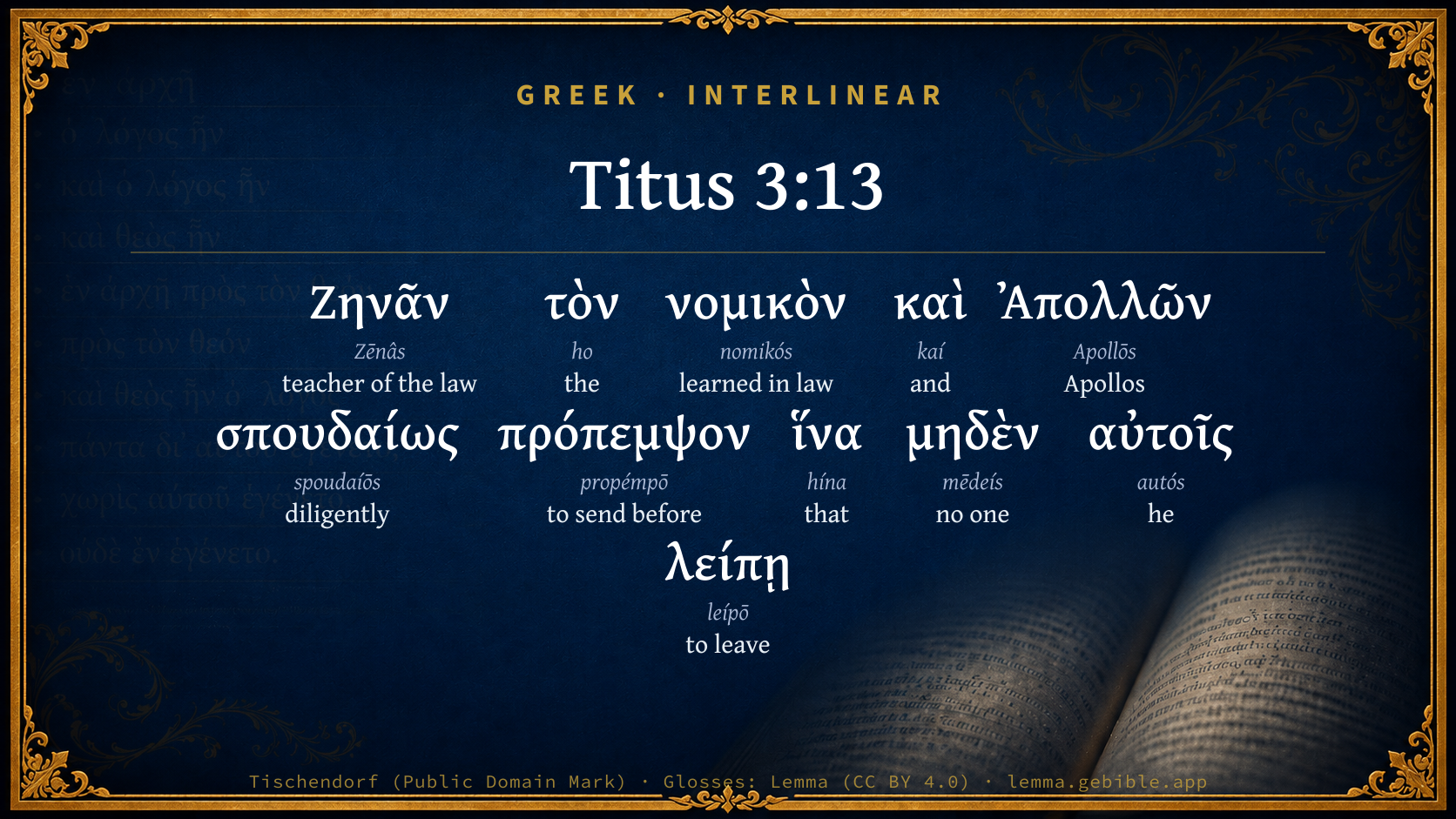
Greek (Tischendorf 8th ed.) Titus 3:13 appears in the Greek New Testament. The text above is from the Tischendorf 8th edition. Each word links to its Strong’s number and a concise gloss. Click any word for its full Thayer’s Greek Lexicon entry.
Download image
Cite this verse

Titus 3:13 (World English Bible). Public Domain. Lemma interlinear Bible study tool, https://lemma.gebible.app/v/titus/3/13.

Show BibTeX & RIS
BibTeX
RIS
English Translation
Send Zenas, the lawyer, and Apollos on their journey speedily, that nothing may be lacking for them.
World English Bible · Public Domain
Highlights
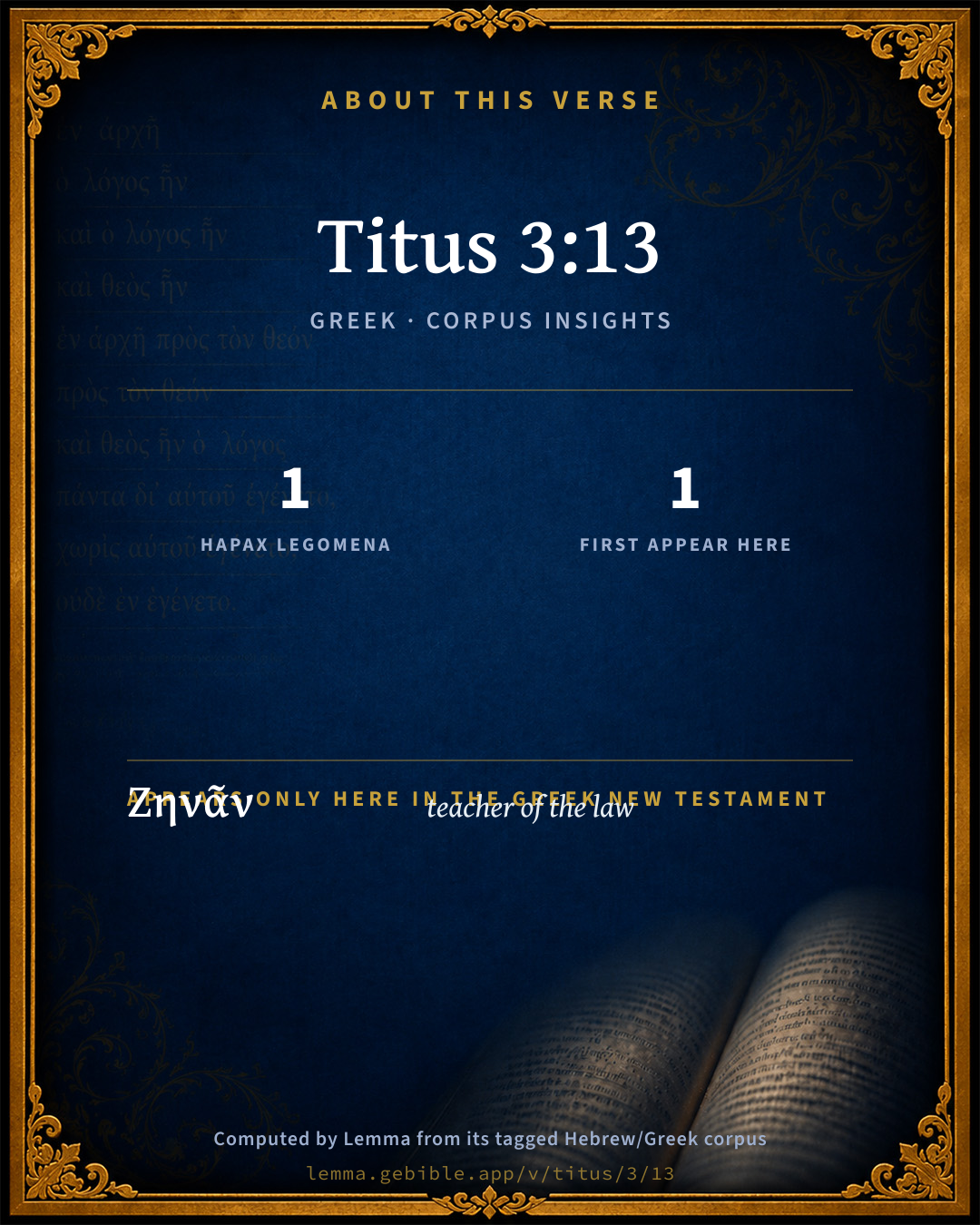
  • 1 hapax legomenon — only here in the Greek New Testament
  • 1 first appearance in the Greek New Testament
Full analysis ↓
Download a study sheet

One document with this verse’s original text, its word-by-word gloss line, the meaning frame, cross-references with their text, attributed commentary, and full source and license credits — printable, and it pastes into notes with its structure intact.

This verse Autodidact and up

Study sheet (.html) Plain text (.txt)

A passage Seminary Student

Up to 50 verses in one chapter. A passage sheet keeps up to 6 commentary sources and 12 cross-references per verse, in the order this page ranks them, and says so on the sheet whenever that leaves anything out. Ask for a single verse and you get the Autodidact verse sheet above.

Everything on this page stays free to read, with no account — the sheet is a download of what is already on screen, not access to it.

Want to remove ads? Support Godless Engineer
Compare translations 3

The same verse in 3 English versions, stacked beneath the original-language interlinear above. Click any original word for its lexicon entry.

Each is an independent rendering of the whole verse — the interlinear is not word-aligned to these translations.

Highlighted words mark where these versions differ — a whole-verse word diff, not a word-by-word alignment.

  • World English Bible Public Domain
    Send Zenas, the lawyer, and Apollos on their journey speedily, that nothing may be lacking for them.
  • King James Version Public Domain
    Bring Zenas the lawyer and Apollos on their journey diligently, that nothing be wanting unto them.
  • unfoldingWord Literal Text CC BY-SA 4.0
    Diligently send on their way Zenas the lawyer and Apollos so that they lack nothing.

unfoldingWord Literal Text — © unfoldingWord, licensed CC BY-SA 4.0. Word-aligned USFM3 via Door43 (git.door43.org/unfoldingWord/en_ult).

Versions to compare (up to 4)

3 of 4 selected

Show all 19 translations

Every available English version of this verse, each an independent rendering of the whole verse.

  • World English Bible Public Domain
    Send Zenas, the lawyer, and Apollos on their journey speedily, that nothing may be lacking for them.
  • Berean Standard Bible Public Domain
    Do your best to equip Zenas the lawyer and Apollos, so that they will have everything they need.
  • Majority Standard Bible Public Domain
    Do your best to equip Zenas the lawyer and Apollos, so that they will have everything they need.
  • King James Version Public Domain
    Bring Zenas the lawyer and Apollos on their journey diligently, that nothing be wanting unto them.
  • American Standard Version (1901) Public Domain
    Set forward Zenas the lawyer and Apollos on their journey diligently, that nothing be wanting unto them.
  • Revised Version (1885) Public Domain
    Set forward Zenas the lawyer and Apollos on their journey diligently, that nothing be wanting unto them.
  • Geneva Bible (1599) Public Domain
    Bring Zenas the expounder of the Lawe, and Apollos on their iourney diligently, that they lacke nothing.
  • Douay-Rheims (1899) Public Domain
    Send forward Zenas, the lawyer, and Apollo, with care, that nothing be wanting to them.
  • Young's Literal Translation Public Domain
    Zenas the lawyer and Apollos bring diligently on their way, that nothing to them may be lacking,
  • Literal Standard Version CC BY-SA 4.0
    Diligently send forth Zenas the lawyer and Apollos on their way, that nothing to them may be lacking,
  • Unlocked Literal Bible CC BY-SA 4.0
    Do everything you can to send on their way Zenas the lawyer and Apollos, so that they lack nothing.
  • unfoldingWord Literal Text CC BY-SA 4.0
    Diligently send on their way Zenas the lawyer and Apollos so that they lack nothing.
  • Darby Bible Public Domain
    Zenas the lawyer and Apollos set forward diligently on their way, that nothing may be lacking to them;
  • World Messianic Bible Public Domain
    Send Zenas the Torah scholar and Apollos on their journey speedily, that nothing may be lacking for them.
  • Webster's Bible Public Domain
    Bring Zenas the lawyer and Apollos on their journey diligently, that nothing may be wanting to them.
  • Free Bible Version CC BY-SA 4.0
    Do all you can to help Zenas the lawyer and Apollos on their way so that they have everything they need.
  • Bible in Basic English Public Domain
    Send Zenas, the man of law, and Apollos on their journey with all care, so that they may be in need of nothing.
  • Text-Critical English NT CC BY 4.0
    Do everything yoʋ can to help Zenas the lawyer and Apollos on their way, and make sure they lack nothing.
  • Tyndale New Testament (1534) Public Domain
    Brynge zenas the lawear and Apollos on their iorney diligently that nothynge be lackynge vnto them.

Literal Standard Version (2020), Covenant Press — licensed CC BY-SA 4.0. Text via the HelloAO Bible API (eBible.org). Unlocked Literal Bible (unfoldingWord) — licensed CC BY-SA 4.0. Text via the HelloAO Bible API (eBible.org). unfoldingWord Literal Text — © unfoldingWord, licensed CC BY-SA 4.0. Word-aligned USFM3 via Door43 (git.door43.org/unfoldingWord/en_ult). Free Bible Version, Dr. Jonathan Gallagher — licensed CC BY-SA 4.0. Text via the HelloAO Bible API (eBible.org).

Word by word

More ways to search: Search by grammar → Find every occurrence → Compare this word →

Practice this passage: Drill this verse → Learn its vocabulary →

About this verse

These counts appear in no published source. They are computed here, from the morphology-tagged text and Lemma’s own curated glosses. What Lemma adds →

11
words
11
distinct lemmas
Pauline Epistles
section

Notable vocabulary

1 hapax legomenon — a word that appears only here in the entire Greek New Testament:

  • Ζηνᾶν teacher of the law G2211

First appearance in Scripture

This word makes its first canonical appearance in the Greek New Testament here:

  • Ζηνᾶν teacher of the law G2211

Shared distinctive vocabulary

σπουδαίως diligently G4709 occurs in 3 verses of the Greek New Testament. Also found in:
Cross-references

12

Topical passages linked to Titus 3:13 in the Treasury of Scripture Knowledge — connected by theme and wording, ordered by reader-vote popularity; previews shown in the World English Bible.

  • Acts 18:24 Now a certain Jew named Apollos, an Alexandrian by race, an eloquent man, came to Ephesus. He was mighty in the Scriptures.
  • Matthew 22:35 One of them, a lawyer, asked him a question, testing him.
  • Acts 28:10 They also honored us with many honors, and when we sailed, they put on board the things that we needed.
  • 3 John 1:6–8 They have testified about your love before the assembly. You will do well to send them forward on their journey in a manner worthy of God,
  • Luke 7:30 But the Pharisees and the lawyers rejected the counsel of God, not being baptized by him themselves.
  • Luke 10:25 Behold, a certain lawyer stood up and tested him, saying, "Teacher, what shall I do to inherit eternal life?"
  • Luke 11:45 One of the lawyers answered him, "Teacher, in saying this you insult us also."
  • Luke 11:52 Woe to you lawyers! For you took away the key of knowledge. You didn't enter in yourselves, and those who were entering in, you hindered."
  • Luke 14:3 Jesus, answering, spoke to the lawyers and Pharisees, saying, "Is it lawful to heal on the Sabbath?"
  • Acts 21:5 When it happened that we had accomplished the days, we departed and went on our journey. They all, with wives and children, brought us on our way until we were out of the city. Kneeling down on the beach, we prayed.
  • Romans 15:24 whenever I journey to Spain, I will come to you. For I hope to see you on my journey, and to be helped on my way there by you, if first I may enjoy your company for a while.
  • 1 Corinthians 16:11 Therefore let no one despise him. But set him forward on his journey in peace, that he may come to me; for I expect him with the brothers.

Cross-references courtesy of OpenBible.info (CC BY 4.0).

Commentary

Notes on Titus 3:13 from classic Christian and Jewish commentators (each source and its license shown beneath its notes). The classic Christian expositions comment on the surrounding passage and are grouped to its opening verse, so a note may address several verses; the Jewish commentaries on the Tanakh (Rashi and others) are per-verse, so they appear only where the commentator wrote on this verse.

Lemma curates 59 commentaries, every one of them public domain or Creative Commons licensed, each selected and text-cleaned for this edition rather than reprinted as found. About our sources →

The Biblical Illustrator

Joseph S. Exell

Tit_3:13

Bring Zenas the lawyer

Sermon to the legal profession

This man of my text belonged to a profession which has often had ardent supporters of Christ and the gospel.

Among them, Blackstone, the great commentator on English law; and Wilberforce, the emancipator; and Chief Justices Marshall, and Tenterden, and Campbell, and Sir Thomas More, who died for the truth on the scaffold, saying to his aghast executioner: Pluck up courage, man, and do your duty: my neck is very short; be careful, therefore, and do not strike awry. Among the mightiest pleas that ever have been made by tongue of barrister, have been pleas in behalf of the Bible and Christianity--as when Daniel Webster stood in the Supreme Court at Washington, pleading in the famous Girard will case, denouncing any attempt to educate the people without giving them at the same time moral sentiment, as low, ribald, and vulgar deism and infidelity; as when Samuel L. Southard, of New Jersey, the leader of the forum in his day, stood on the platform at Princeton College commencement, advocating the literary excellency of the Scriptures; as when Edmund Burke, in the famous trial of Warren Hastings, not only in behalf of the English government, but in behalf of elevated morals, closed his speech in the midst of the most august assemblage ever gathered in Westminster Hall, by saying: I impeach Warren Hastings in the name of the House of Commons, whose national character he has dishonoured; I impeach him in the name of the people of India, whose rights and liberties he has subverted; I impeach him in the name of human nature, which he has disgraced; in the name of both sexes, and of every rank, and of every station, and of every situation in the world, I impeach Warren Hastings. Yet, notwithstanding all the pleas which that profession has made in behalf of God, and the Church, and the gospel, and the rights of man, there has come down through the generations a style of prejudice against it. So long ago as in the time of Oliver Cromwell, it was decided that lawyers might not enter the parliament house as members, and they were called sons of Zeruiah. The learned Doctor Johnson wrote an epitaph for one of them in these words:

God works wonders now and then,

Here lies a lawyer, an honest man!

There is no man who has more temptations, more trials, or graver responsibilities than the barrister, and he who attempts to discharge the duties of his position with only earthly resources, is making a very great mistake. Witness Lord Thurlow, announcing his loyalty to earthly government in the sentence: If I forget my earthly sovereign, may God forget me, and yet stooping to unaccountable meanness. Witness Lord Coke, the learned and the reckless. No other profession more needs the grace of God to deliver them in their temptations, to comfort them in their trials, to sustain them in the discharge of their duty. While I would have you bring the merchant to Christ, and while I would have you bring the farmer to Christ, and while I would have you bring the mechanic to Christ, I address you today in the words of Paul to Titus, Bring Zenas the lawyer. By so much as his duties are delicate and great, by so much does he need Christian stimulus and safeguard. God alone can direct him. To that chancery he must be appellant, and he will get an answer in an hour. Blessed is that attorney between whose office and the throne of God there is perpetual, reverential, and prayerful communication. That attorney will never make an irreparable mistake. True to the habits of your profession, you say, Cite us some authority on the subject. Well, I quote to you the decision of the Supreme Court of Heaven: If any lack wisdom, let him ask of God, who giveth to all men liberally, and upbraideth not, and it shall be given him. There are two or three forms of temptation to which the legal profession is especially subjected.

1. The first of all is scepticism. You get so used to pushing the sharp question why and making unaided reason superior to the emotions, that the religion of Jesus Christ, which is a simple matter of faith, and above human reason, has but little chance with some of you. Scepticism is the mightiest temptation of the legal profession, and that man who can stand in that profession, resisting all solicitations to infidelity, and can be as brave as George Briggs of Massachusetts, who stepped from the gubernatorial chair to the missionary convention, to plead the cause of a dying race: then on his way home from the convention, on a cold day, took off his warm cloak and threw it over the shoulders of a thinly-clad missionary, saying: Take that and wear it, it will do you more good than it will me; or, like John McLean, who can step from the Supreme Courtroom of the United States on to the anniversary platform of the American Sunday School Union--its most brilliant orator--deserves congratulation and encomium. O men of the legal profession, let me beg of you to quit asking questions in regard to religion, and begin believing. If you do not become a Christian, O man of the legal profession, until you can reason this whole thing out in regard to God, and Christ, and the immortality of the soul, you will never become a Christian at all. Only believe. Bring Zenas the lawyer.

2. Another mighty temptation for the legal profession is to Sabbath breaking. What you cannot do before twelve oclock Saturday night, or after twelve oclock Sunday night, God does not want you to do at all. Beside that, you want the twenty-four hours of Sabbath rest to give you that electrical and magnetic force which will be worth more to you before the jury than all the elaboration of your case on the sacred day. Every lawyer is entitled to one days rest out of seven. If he surrender that, he robs three--God, his own soul, and his client. Lord Castlereagh and Sir Thomas Romilly were the leaders of the bar in their day. They both died suicides. Wilberforce accounts for their aberration of intellect on the ground that they were unintermittent in their work, and they never rested on Sunday. Poor fellow! said Wilberforce, in regard to Castlereagh--Poor fellow! it was nonobservance of the Sabbath. Chief Justice Hale says, When I do not properly keep the Lords day, all the rest of the week is unhappy and unsuccessful in my worldly employment.

3. Another powerful temptation of the legal profession is to artificial stimulus. The flower of the American bar, ruined in reputation and ruined in estate, said in his last moments: This is the end. I am dying on a borrowed bed, covered with a borrowed sheet, in a house built by public charity. Bury me under that tree in the middle of the field, that I may not be crowded; I always have been crowded.

4. Another powerful temptation of the legal profession is to allow the absorbing duties of the profession to shut out thoughts of the great future. You know very well that you who have so often tried others, will after awhile be put on trial yourselves. Death will serve on you a writ of ejectment, and you will be put off these earthly premises. On that day all the affairs of your life will be presented in a bill of particulars. No certiorari from a higher court, for this is the highest court. The day when Lord Exeter was tried for high treason; the day when the House of Commons moved for the impeachment of Lord Lovatt; the day when Charles I and Queen Caroline were put upon trial; the day when Robert Emmet was arraigned as an insurgent; the day when Blennerhasset was brought into the courtroom because he had tried to overthrow the United States government, and all the other great trials of the world are nothing compared with the great trial in which you and I shall appear, summoned before the Judge of quick and dead. There will be no pleading there the statute of limitation; no turning States evidence, trying to get off ourselves, while others suffer; no moving for a non-suit. The case will come on inexorably, and we shall be tried. You, who have so often been advocate for others, will then need an advocate for yourself. Have you selected Him? The Lord Chancellor of the Universe. Lord Ashburton and Mr. Wallace were leading barristers in their day. They died about the same time. A few months before their decease they happened to be at the same hotel in a village, the one counsel going to Devonshire, the other going to London. They had both been seized upon by a disease which they knew would be fatal, and they requested that they be carried into the same room and laid down on sofas, side by side, that they might talk over old times and talk over the future. So they were carried in, and lying there on opposite sofas, they talked over their old contests at the bar, and then they talked of the future world upon which they must soon enter. It was said to have been a very affecting and solemn interview between Mr. Wallace and Lord Ashburton. My friends, my subject today puts you side by side with those men in your profession who have departed this life, some of them sceptical and rebellious, some of them penitent, childlike, and Christian. These were wandering stars for whom is reserved the blackness of darkness forever, while these others went up from the courtroom of earth to the throne of eternal dominion. Through Christ, the advocate, these got glorious acquittal. In the other case, it was a hopeless lawsuit. An unpardoned sinner versus the Lord God Almighty. O what disastrous litigation! (T. De Witt Talmage, D. D.)

That nothing be wanting unto them

Titus duty to his fellow ministers

Ministers ought to abound in the fruits of kindness to one another, and most to those whose circumstances render the expressions of brotherly kindness needful. Probably Titus could not, from his own purse, furnish everything that was needful to his brethren who were travelling in the service of the Churches. But he might, through his influence, do by the hands of others what was not in his own power. The apostle had already said that the doctrine of salvation by grace teaches and constrains men who believe it to maintain good works. And here he calls on the believers under the care of Titus to embrace the occasion that was presented to them, of testifying their faith by their works, and learning to practise the duties by which they were to approve themselves unto God as faithful Christians. There are too many who form good resolves, but when opportunities offer of putting them into practice, suffer them to pass unimproved. They intend to do what they know to be right, but are in no haste to perform it. But let ours, those who belong to our holy society, learn not only to do, but to stand foremost in doing, good works, on all necessary occasions. An opportunity for doing good ought to be as much valued by us as an opportunity for receiving it, for we are sure that it is more blessed to give than to receive. We know not what opportunities we may afterwards have to do good; but the present opportunity will not return; and we may feel the same disposition to neglect a second and a third as a first opportunity of usefulness. How then shall we approve ourselves fruit-bearing branches in the true vine, and not to be found among the barren branches against whom the terrible sentence is pronounced, that the great Husbandman will take them away, and they shall be gathered, and cast into the fire and burned? Bring Zenas the lawyer, and Apollos, diligently on their way, and in supplying their necessities let our people learn to excel, or go before others, in good works, that they be not unfruitful. Zenas had probably been a Jewish lawyer. And against that class of men awful things had been spoken by our Lord. Amongst others, it is said that they took away the key of knowledge from men. But the grace of God can make a most effectual change in those from whom least good and most evil is to be expected. He was now travelling with the key of knowledge to open the mysteries of the kingdom of heaven to Gentiles as well as Jews. Apollos was a well known and an eminent labourer in the gospel. And those who were not ready to afford encouragement and facilities to such labourers for Christ, and for the souls of men, gave too much reason to suspect that they were themselves barren and unfruitful in the knowledge of our Lord and Saviour. Let us be fellow helpers to the truth, that we may not incur the punishment of those who are lukewarm in the cause of Christ (Rev_3:1-22). (G. Lawson, D. D.)

Christianity enjoins courtesy

Christianity hindereth not, but commendeth and enjoineth civil courtesy and all kind of humanity. For

1. Whatsoever pertaineth to love and good report, that must believers think on and do (Php_4:1-23).

2. The wisdom which is from above is gentle, peaceable, full of mercy and good fruits (Jam_3:17).

3. Those many commandments, that Christians should salute and greet one another, and that with a holy kiss (1Th_5:26), called by Peter the kiss of love; usual in those East countries, by which outward testimony they declared mutual love and kindness.

4. Outward courtesy is a necessary virtue even for the maintaining of the bond of Christian peace; yea, availeth much for the nourishing and increasing the communion of saints, and society with Gods people.

5. How disgraceful a thing were it for the profession of Christ, that such as profess faith in the Lord Jesus should show themselves inhuman or hoggish, who should be as lambs and little children, for such are they who have entered into the kingdom of Christ, as the prophet witnesseth. Let this point, therefore, be well thought of, that as faith and love cannot be separate, so must good conscience and good manners go together. (T. Taylor, D. D.)

The Biblical Illustrator, edited by Joseph S. Exell (c. 1880s–1900s) — public domain. Text from a community e-Sword module.

Joseph Benson's Commentary

Tit 3:13-15. Bring — Or send forward; Zenas the lawyer — Zenas is mentioned in this passage only, and called νομικον, the lawyer, because, according to Jerome’s interpretation, which is also that of Dr. Benson, he had formerly been a teacher of the law among the Jews; see Mat 22:35, where the same appellation is given to one of that profession. He might possibly, however, as others think, be a Roman lawyer; and Apollos — It is probable that Zenas and Apollos were to pass through Crete, either in their way to the apostle, or to some place whither he had sent them. He therefore desired Titus to help them forward on their journey by supplying them with such necessaries as they were in want of, that they might not be retarded. And let ours also — All our brethren in Crete, whether ministers or private members of the church; learn — By thy admonition and example; to maintain good works — Works of charity and bounty; for necessary uses — For the relief of the poor brethren, that they may not want any necessary; that they — The Cretian believers; be not unfruitful — Unserviceable to those among whom they dwell. Perhaps, at some former period, they had not assisted Zenas and Apollos as they ought to have done. Greet them that love us in the faith — That is, for the faith’s sake, and with such a love as Christianity requires.

Joseph Benson's Commentary on the Old and New Testaments (1811–1818) — public domain. Text from a community e-Sword module.

Tyndale Open Study Notes

Tyndale Open Resources

3:13 Zenas and Apollos were involved in spreading the Good News, and they might have been the couriers of this letter to Titus. • Zenas was probably an expert in Roman law or a Roman jurist (the same word for lawyer is in Luke 7:30; 10:25); his pagan name (“gift of Zeus”) makes it unlikely that he was an expert in Jewish law. • Apollos is presumably the same man as in Acts 18:24; 19:1; 1 Cor 1:12; 3:4-6, 22; 4:6; 16:12. • everything they need: See 1 Tim 3:2; 3 Jn 1:5-8; cp. Rom 15:24; 1 Cor 16:6, 11; 2 Cor 1:16.

Tyndale Open Study Notes — © Tyndale Open Resources, licensed CC BY-SA 4.0. Text via the HelloAO Bible API.

Bengel's Gnomon

Johann Albrecht Bengel

Tit 3:13. Ἵνα μηδὲν, that nothing) Titus therefore had the means. They did not go empty.

Bengel's Gnomon of the New Testament — English translation (T&T Clark, Edinburgh, 1860) — public domain. Text from a community e-Sword module.

Meyer's Critical & Exegetical Commentary

Heinrich August Wilhelm Meyer

Tit_3:13. Ζηνᾶν τὸν νομικόν] Zenas is otherwise unknown. The epithet τὸν νομ. shows either that he had been formerly a Jew learned in the Scriptures, a γραμματεύς (Mat_22:35, and other passages), oras is more probablethat he was one skilled in law, a jurisconsultus (Strabo, 12, p. 539: ἐξηγητὴς τῶν νόμων, καθάπερ οἱ παρὰ Ῥωμαίοις νομικοί).

καὶ Ἀπολλώ] He is known from Acts and 1 Corinthians; but it is not known when he went to Crete.[21]

σπουδαίως πρόπεμψον] equip carefully for departure; on προπέμπειν, comp. 3Jn_1:6. Wiesinger translates σπουδαίως by hastily, unsuitably, as the words ἵνα κ.τ.λ. show. In σπουδαίως the prevailing conception is zeal; σπουδαίως ἔχειν is equivalent to be zealous for a thing. Luther: make ready with diligence.

ἵνα μηδὲν αὐτοῖς λείπῃ] Hofmanns opinion, that this is an imperative sentence in itself, is all the more arbitrary that ἵνα manifestly refers to σπουδαίως; comp. besides what was said on 1Ti_1:3.

[21] Hofmann suggests that Zenas and Apollo set out from the place where Paul was at the time of writing the epistle, in order to proceed by Crete to Alexandria, which was Apollos native place, and that Paul gave them this epistle to Titus to serve them also as a letter of recommendation. These are mere conjectures, for which there is no foundation.

Meyer — Critical and Exegetical Commentary on the New Testament — English translation by Peter Christie, edited by Frederick Crombie (T&T Clark, 1880) — public domain. Text from a community e-Sword module.

Expositor's Greek Testament

ed. W. Robertson Nicoll

Tit 3:13 . νομικόν : In the absence of any example of this word being used as the equivalent of legisperitus (Vulg.), jurisconsultus or jurisperitus , it seems best to assume that Zenas was a νομικός in the usual N.T. sense, an expert in the Mosaic Law.

Ἀπολλὼν : For Apollos, see article in Hastings’ D. B .

πρόπεμψον : set forward on their journey, praemitte ; but deduco is the rendering where the word occurs elsewhere. See reff.

The Expositor's Greek Testament, edited by W. Robertson Nicoll (1897–1910) — public domain. Text from a community e-Sword module.

Jamieson, Fausset & Brown

Robert Jamieson, A. R. Fausset & David Brown

Bring . . . on their journey--Enable them to proceed forward by supplying necessaries for their journey.

Zenas--the contracted form of Zenodorus.

lawyer--a Jewish "scribe," who, when converted, still retained the title from his former occupation. A civil lawyer.

Apollos--with Zenas, probably the bearers of this Epistle. In Co1 16:12, Apollos is mentioned as purposing to visit Corinth; his now being at Corinth (on the theory of Paul being at Corinth when he wrote) accords with this purpose. Crete would be on his way either to Palestine or his native place, Alexandria. Paul and Apollos thus appear in beautiful harmony in that very city where their names had been formerly the watchword of unchristian party work. It was to avoid this party rivalry that Apollos formerly was unwilling to visit Corinth though Paul desired him. HIPPOLYTUS mentions Zenas as one of the Seventy, and afterwards bishop of Diospolis.

Jamieson, Fausset & Brown — Commentary Critical and Explanatory on the Whole Bible (1871) — public domain (CC PDM 1.0). Text via the HelloAO Bible API.

Adam Clarke's Commentary

Verse 13. Bring Zenas the lawyer] This person is only mentioned in this place; whether he was a Jewish, Roman, or Greek lawyer, we cannot tell.

And Apollos] Of this person we have some valuable particulars in Ac 18:24; 1Co 1:12; 1Co 3:5-6; 1Co 4:6. Either St. Paul had left these at Crete when he visited that island, or he had heard that, in their evangelical itinerancy, they were about to pass through it.

On their journey diligently] Afford them the means to defray their expenses. The Churches through which these evangelists passed, bore their expenses from one to the other. See 3Jo 1:6.

Adam Clarke's Commentary on the Bible (1810–1826) — public domain. Text from a community e-Sword/MySword module.

John Calvin's Commentaries

13 Zenas a lawyer It is uncertain whether “Zenas”, was a Doctor of the Civil Law or of the Law of Moses; but as we may learn from Paul’s words that he was a poor man and needed the help of others, it is probable that he belonged to the same rank with Apollo, that is, an expounder of the Law of God among the Jews. It more frequently happens that such persons are in want of the necessaries of life than those who conduct causes in civil courts. I have said that Zenas’s poverty may be inferred from the words of Paul, because the expression, conduct him, means here to supply him with the means of accomplishing his journey, as is evident from what follows.

John Calvin's Commentaries (1540-1563) — public domain. Text from the Calvin Translation Society English edition (1840s-50s) via the Christian Classics Ethereal Library (ccel.org). Calvin's coverage is partial (roughly two-thirds of the Bible); uncommented books and verses are honest gaps, never fabricated. The 19th-century editor's footnotes and remarks are omitted so the notes are faithfully Calvin's own voice.

Ellicott's Commentary for English Readers

(13) Bring Zenas the lawyer.—A name contracted, as it seems, from Zenodorus. The term “lawyer” might possibly indicate that this friend of Paul’s was a Roman jurist, but it is more likely that the law in which he was an expert was that of Moses. Hippolytus numbers him among the seventy disciples, and relates how in after years he was Bishop of Diospolis. He is never mentioned by name in the New Testament, except in this place.

And Apollos.—This famous teacher appears often in the New Testament records, in the Acts and several of the Epistles. A distinguished Alexandrian scholar and a disciple of John the Baptist, he was converted to Christianity by the agency of the devoted Priscilla and Aquila, the tent-makers. He became the friend and intimate associate of St. Paul, and might, had he chosen, have rivalled or even superseded St. Paul in his supreme authority over the churches planted along the Mediterranean sea-board. But Apollos seems resolutely to have declined any such rivalry, and to have lived ever as the loyal and devoted friend of the great Apostle; who, however, always seems to have treated the learned and eloquent Alexandrian as an equal power in the Church of Christ, classing Apollos with St. Peter and himself. Luther’s well-known suggestion that Apollos was the unknown writer of the Epistle to the Hebrews—“auctor Epistolæ ad Hebros . . . ut ego arbritror Apollo”—the authorship (though not the canonicity) of which has been a disputed point as far back as the days of Origen, in the first half of the third century—has been adopted, though, of course, with much reserve, by many. Attention has been called to the somewhat remarkable fact that the names of these three friends of St. Paul, who were classed among his most faithful adherents in this almost the last Epistle he wrote, were derived from three of the most famous heathen deities—Zenas from Zeus; Artemas from Artemis, the famous tutelary goddess of Ephesus; Apollos from the well-known sun-god.

A Bible Commentary for English Readers, edited by Charles John Ellicott (1878–1897) — public domain. Text from a community e-Sword module.

The Cambridge Bible for Schools and Colleges

gen. ed. J. J. S. Perowne

13. Bring Zenas the lawyer and Apollos on their journey] The verb ‘bring on their journey’ is literally ‘send forward,’ and so Vulg. here ‘praemitte’; but in the other eight places of its use in N.T. ‘deduco’ is used, that is, ‘conduct,’ ‘take them a certain part of the way.’ So in old provincial English ‘I will send you a mile,’ meaning ‘accompany you.’ R.V. in four places has ‘bring on the way,’ in five, ‘set forward on the journey;’ but in only one, Act_21:5, does the context require that the ‘accompanying’ should be prominent, ‘they all with wives and children brought us on our way till we were out of the city.’ Here set forward with less thought of bringing (A.V.) seems sufficient.

Zenas the lawyer and Apollos] Zenas is the Greek form of Zenodorus, as Apollos of Apollodorus, Artemas of Artemidorus. Nothing is known of him, but the phrase itself suggests that he was one of the class of Jewish scribes or lawyers, i.e. experts in Jewish law who were especially numerous among the Pharisees. On his conversion he may have retained the name, as Simon the Zealot and Matthew the publican did theirs. As his class had for their fuller title ‘teachers of the law,’ ‘doctors,’ Luk_2:46; Luk_5:17, he would be especially fitted to become one of the order of the Christian ‘teachers’; cf. Eph_4:11, ‘some to be apostles, some prophets, some evangelists, some pastors and teachers.’ Apollos, on the other hand, was recognised as an apostle. He was an Alexandrian by race, a learned (or eloquent) man, mighty in the Scriptures, instructed in the way of the Lord, to whom Priscilla and Aquila ‘expounded the way of God more carefully’ (Act_18:26) at Ephesus. He became a most successful evangelist in Achaia and at Corinth, and was regarded by St Paul as a brother apostle, independent in will and action, 1Co_16:12, but preaching and serving an undivided Christ, 1Co_1:12; 1Co_3:22-23. From this passage we may infer, not that they had been resident in Crete, which introduces an unnecessary complication with the official authority of Titus, but that they had undertaken such a ‘pastoral mission’ there as St Paul had invited Apollos to undertake to Corinth, 1Co_16:12; perhaps, with Mr Lewin, that they were on the way from Corinth to Alexandria, and were the bearers of this letter to Titus.

This visit of ‘an apostle’ and ‘a teacher,’ and the hospitality to be exercised towards them by Titus, are to stimulate, St Paul adds, the zeal and liberality of the whole body of Christians, the Cretan Church.

diligently] Vulg. ‘sollicite’ Theod. Mops. Lat. ‘velociter’; but the following clause ‘that nothing be wanting unto them,’ favours ‘attention’ rather than ‘speed,’ and implies provision for the journey as part of the sympathetic attendance; so in 3Jn_1:6 ‘set forward on their journey worthily of God,’ i.e. with supplies worthy of their service to God, the following verses making this clear, ‘we therefore as fellow Christians ought to give them hospitable support.’

The Cambridge Bible for Schools and Colleges (gen. ed. J. J. S. Perowne; Cambridge University Press, 1878–1918) — public domain. Text from a community e-Sword module.

John Gill's Exposition

Bring Zenas the lawyer,.... Whether he was brought up to the civil law, either among the Greeks or Romans, is not certain; it may be he was a Jewish lawyer, or scribe, an interpreter of Moses's law among the Jews; for with them a lawyer and a scribe were one and the same, as appears from Mat 22:35 compared with Mar 12:28 and the Syriac version here calls him "a scribe", and the Ethiopic version "a scribe of the city"; which looks as if it was a civil office he bore; but however, be he what he will, he seems to have been now a preacher of the Gospel, being joined with Apollos, who certainly was one: he is said to have been one of the seventy disciples of Christ, and afterwards bishop of Diospolis; See Gill on Luk 10:1; his name is the contraction of Zenodorus: him the apostle would have Titus bring,

and Apollos, on their journey diligently; who was a Jew born at Alexandria, an eloquent man, and mighty in the Scriptures; who had preached at Corinth, but was now at Crete; and whom the apostle, with Zenas, would have provided with everything necessary for their journey:

that nothing be wanting unto them; which might be proper for them in their travels, to make them comfortable, and their journey pleasant and easy.

John Gill's Exposition of the Whole Bible (1746–1763) — public domain (CC PDM 1.0). Text via the HelloAO Bible API.

Trapp's Complete Commentary

John Trapp

13 Bring Zenas the lawyer and Apollos on their journey diligently, that nothing be wanting unto them.

Ver. 13. That nothing be wanting] Those that labour in the Lord’s work must have all necessary accommodations and encouragements. They must be set forth and brought forward on their journey and in their negotiations worthy of God, 3Jn 1:6. Deduetione honorifica, Act 15:3; Act 20:38; Act 21:5. A Balaam will not deal hardly with his ass, if once he perceive the Lord to be in him, and to speak by him; shall we deal unworthily with God’s ministers, in whom God is of a truth, 1Co 14:25, and hath given unto them the ministry of reconciliation? 2Co 5:8.

John Trapp, A Commentary or Exposition upon All the Books of the Old and New Testament (1647–1656) — public domain. Text from a community e-Sword module.

Albert Barnes' Notes on the Bible

Bring Zenas the lawyer - - This person is not elsewhere mentioned in the New Testament, and nothing more is known of him. He belonged doubtless to that class of persons so often mentioned in the New Testament as lawyers; that is, who were regarded as qualified to expound the Jewish laws; see the notes at Mat 22:35. It does not mean that he practiced law, in the modern sense of that phrase. He had doubtless been converted to the Christian faith, and it is not improbable that there were Jews at Nicopolis, and that Paul supposed he might be particularly useful among them.

And Apollos - Notes, Act 18:24. He was also well-skilled in the laws of Moses, being “mighty in the Scriptures” Act 18:24, and he and Zenas appear to have been traveling together. It would seem that they had been already on a journey, probably in preaching the gospel, and Paul supposed that they would be in Crete, and that Titus could aid them.

Diligently - 2Ti 4:9; Greek Speedily; i. e., facilitate their journey as much as possible.

That nothing be wanting unto them - Nothing necessary for their journey. Paul desired that they might meet with hospitable treatment from Christians in Crete, and might not be embarrassed for the want of that which was needful for their journey. It would seem most probable that they had been sent by Paul on a visit to the churches.

Albert Barnes' Notes on the Bible (1834–1885) — public domain. Text from a community e-Sword/MySword module.

Matthew Poole's English Annotations

Of this Zenas we read no more in holy writ, but of

Apollos we read both in the Acts, and 1Co 3:4,5,22; it seemeth they were about to go to Paul to Nicopolis.

That nothing be wanting unto them; the apostle would have Titus take care that they might want no necessaries that might accommodate them in their journey.

Matthew Poole's English Annotations on the Holy Bible (1683–1685) — public domain. Text from a community e-Sword/MySword module.

The Pulpit Commentary

Set forward for bring, A.V Set forward (propemqon); the technical expression both in the New Testament and the LXX, and also in classical Greek, for helping a person forward on their journey by supplying them with money food, letters of recommendation, escort, or whatever else they might require. (see Act_15:3 Act_20:38 Act_21:5 Rom_15:24 1Co_16:6 2Co_1:16 3Jn_1:6) Zenas the lawyer. He is utterly unknown. His name is short for Zenodorus, but whether he was "a Jewish scribe or Roman legist" can hardly be decided. But his companionship with Apollos, and the frequent application of the term nomikov in the New Testament to the Jewish scribes and lawyers, (Mat_22:35 Luk_7:30 Luk_10:25 Luk_11:45, Luk_11:48, 52 14:3) makes it most probable that he was a Jewish lawyer. Apollos; the well-known and eminent Alexandrian Jew, who was instructed in the gospel by Aquila and Priscilla at Ephesus, and became a favorite teacher at Corinth. (Act_18:24 Act_19:1 1Co_1:12, and the following chapters, and 1Co_16:12) It is a probable conjecture of Lewin"s that Apollos was the bearer of this letter, written at Corinth, and was on his way to Alexandria, his native place, taking Crete on the way.

The Pulpit Commentary (1880–1919), ed. H.D.M. Spence-Jones & Joseph S. Exell — public domain. Text from a community e-Sword module.

John Wesley's Explanatory Notes

Send forward Zenas the lawyer - Either a Roman lawyer or an expounder of the Jewish law.

John Wesley, Explanatory Notes Upon the Whole Bible (1754–1765) — public domain. Text via the GEBible commentary corpus.

Fairbairn on Ezekiel, Jonah & the Pastoral Epistles

Patrick Fairbairn

Ver. 13. Zealously forward on their journey Zenas the lawyer, and Apollos, that nothing may be wanting to them. The σπουδαίως πρόπεμψον evidently means that Titus should hasten the departure of the brethren mentioned, and do it, as the context shows, by furnishing them with things needful for their journey. This is the only passage in which the name of Zenas occurs; nor is it certain whether the designation lawyer is to be taken in the Jewish sense (one who had been skilled in Hebrew law, and from former times still retained the name), or with reference to the study and practice of law in a civil sense. The majority of commentators prefer the former view. But the mention of Apollos here along with Zenas, as one whom Paul wished to have beside him, so near the close of his earthly labours, is a clear proof of the good understanding which subsisted between these two eminent servants of God, and how little ground there is for the serious differences in respect to their doctrinal teaching which have sometimes been alleged by modern rationalists. As Apollos commenced preaching when still but imperfectly taught in the gospel, and then received fuller instruction from some of Paul’s most intimate friends (Act 18:26), the probability is, that whatever divergence might appear was confined to the earlier part of his labours: and even of that we know next to nothing.

Patrick Fairbairn — An Exposition of Ezekiel (1851), Jonah (1849), and The Pastoral Epistles (1874) — public domain. Text from a community e-Sword module.

Burkitt's Expository Notes on the New Testament

William Burkitt

Here we have a second private affair which is given in charge to Titus, namely, that he help forward on their journey Zenas and Apollos, both apostolic men, the former an expounder of the law of Moses, the other an eloquent man, and mighty in the scriptures; both these cleaved to St. Paul, and therefore were worthily to be respected by Titus, whom the apostle therefore bids him be kind and courteous to, and help them forward with their journey.

Learn thence, That Christianity is no enemy to, but a great promoter of, all offices of humanity and civil courtesy towards all persons, towards strangers particularly, towards good men especially.

Observe next, St. Paul desires Titus to take care that those servants of God be so supplied, that they lack nothing; such as are engaged in the Lord’s work must be carefully provided for, and care taken that they lack nothing.

William Burkitt's Expository Notes on the New Testament (1700–1703) — public domain. Text from a community e-Sword module.

The People's New Testament

B. W. Johnson

13. Bring Zenas the lawyer. Of him nothing more is known. And Apollos. See Acts 18:24–28. It was the custom of the churches to help the early evangelists forward on their journeys.

B. W. Johnson's The People's New Testament with Notes (1889–1891) — public domain. Electronic text from the Christian Classics Ethereal Library (CCEL) ThML edition.

Cambridge Greek Testament for Schools and Colleges

13. Ἀπολλώ. This, the rec. spelling, has the authority of CD2*cEH** KLP d e f, and is adopted by Tregelles and Lachmann; Tischendorf and WH print Ἀπολλών with אD2bH* (cp. 1Co 4:6).

λείπη. So ACD2cEGLP &c. (with the rec. text), followed by Tregelles, Lachmann and WH; Tischendorf prefers λίπη with אD2* and some cursives, and WH give a place to this reading in their margin. See on ch. Tit 1:5.

13. Ζηνᾶν τὸν νομικὸν καὶ Ἀπολλὰ σπουδαίως πρόπεμψον κ.τ.λ. With diligence (cp. 2Ti 1:17) set forward on their journey Zenas the lawyer and Apollos, that nothing may be wanting to them.

The duty of speeding fellow-Christians on their journeys, of giving them a good ‘send-off,’ as we say, is often mentioned by St Paul; cp. Rom 15:24; 1Co 16:6; 1Co 16:11; 2Co 1:16, and see also 3Jn 1:6. It is, in fact, a point of hospitality, on which so much stress is naturally laid in these early years of the Church’s life.

Of Zenas we know nothing further, not even whether the epithet ὁ νομικός is intended to describe him as skilled in Roman or Hebrew law. The Gospel use of the term (Luk 7:30) might seem to favour the latter interpretation, but there is no certainty. He was by late tradition counted the author of apocryphal Acts of Titus.

Of Apollos, on the other hand, we hear several times. He is the learned and eloquent Alexandrian whom we find (Act 18:24) at Ephesus receiving instruction from Priscilla and Aquila, and then proceeding to Corinth, where all too soon parties arose claiming respectively Apollos and Paul as their leaders (1Co 3:4 &c.). Jerome accounts for the presence of Apollos in Crete by supposing that he had retired thither until the unhappy controversies among the Corinthians should have died out. But this is not a probable account of the matter.

Cambridge Greek Testament for Schools and Colleges (Cambridge University Press, 1896; 21 vols, various authors incl. Carr, Maclear, Plummer, Farrar, Lumby, Moule, M. R. James, Simcox) — public domain. Text from a community e-Sword module.

International Critical Commentary

13. Ζηνᾶν (contracted from Ζηνόδωρος), according to tradition bishop of Diospolis and author of an apocryphal “Acts of Titus.” τὸν νομικόν, possibly a converted Jew, τὸν τῶν Ἰουδαικῶν νόμων ἔμπειρον, Chrys.; cf. μάχας νομικάς 9, and so always in the Gospels: or a Roman lawyer, “jurisconsultum.” His association with Apollos, a Jew, makes the former more probable.

Ἀπολλώ contracted from Ἀπολλώνιος (which D reads in Act 18:24) or from Ἀπολλόδωρος, a very common name (cf. M.M. s.v.), but here doubtless the same as in Act 18:24, 1Co 1:12ff.

ἵνα . . . λείπῃ] probably a new sentence, not dependent on προπέμψον (so Hofmann and apparently Oecum. Theophyl.). “See that nothing is wanting to them,” cf. Mar 5:23 ἵνα ἐλθὼν ἐπιθῇς αὐτῇ τὰς χεῖρας: 2Co 8:7, Eph 5:33. This use of ἵνα is fairly common in letters, cf. Cic. ad Att. vi. 5, ταῦτα οὖν πρῶτον μέν, ἵνα πάντα σῴζηται, δεύτερον δέ, ἵνα μηδὲ τῶν τόκων ὀλιγωρήσῃς. Tebt. Pap. 408, σὺ δὲ περὶ ὧν βούλει γράφε, τὰ δʼ ἄλλα ἵνα ὑγιαίνῃς (cf. Moulton, Gk. Gr., Proleg. p. 176; Blass, § 64. 4, M.M. s.v. ἴνα).

International Critical Commentary — older volumes (1896–1929), various authors — public domain. Text from a community e-Sword module.

Lesson kit

Teaching starters — assembled from the data on this page, not authored interpretation. Every prompt links to the verse data it draws on. Edit before teaching.

Titus, in the Pauline Epistles, opens this verse with 11 words (11 distinct Greek lemmas). Its most distinctive word is Zēnâs (“teacher of the law”). A historical commentator’s framing appears above. Read the whole chapter for the surrounding context.

Discussion questions

  1. How does “teacher of the law” (Zēnâs) shape what this verse is saying?
  2. This verse holds 1 word here found nowhere else in the Greek New Testament. What might the rare word draw attention to?
  3. The word “teacher of the law” first appears here in Scripture. What is being introduced at this debut?
  4. Luke 7:4 shares the word «diligently» with this verse. How do the two illuminate each other?
  5. These translations render this verse differently; the difference is in the English rendering, not the original. What questions does that raise?
  6. Reading how The Biblical Illustrator and Joseph Benson's Commentary read this verse, where do the two commentators agree and where do they part?

Things to notice

  • 1 word in this verse appears nowhere else in the Greek New Testament.
  • 1 word makes its first canonical appearance in Scripture here.
  • These translations choose different wording for 10 words in this verse.
  • 11 distinct Greek lemmas span 11 words in this verse.

Reading settings

Reading text

Shown beneath each verse's original-language words.

Old Testament
Old Testament edition

Read the OT as the Masoretic Hebrew (MT) or the Greek Septuagint (LXX).

English shown for the Greek Septuagint (in the Hebrew ↔ Greek comparison).

Comparing translations? Open the Compare panel on any verse page to stack up to four side by side.