1 Thessalonians 4:12

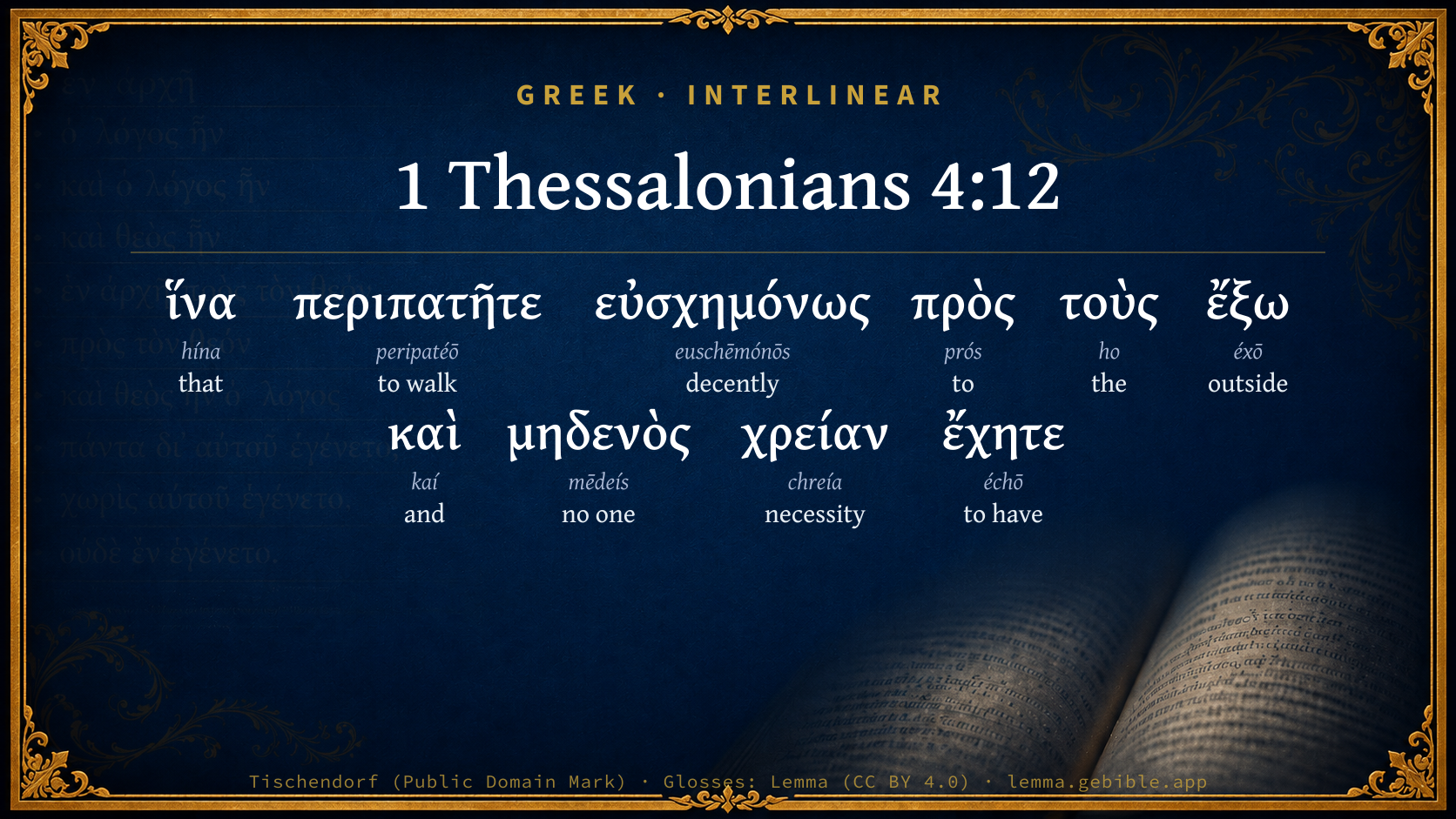
Greek (Tischendorf 8th ed.) 1 Thessalonians 4:12 appears in the Greek New Testament. The text above is from the Tischendorf 8th edition. Each word links to its Strong’s number and a concise gloss. Click any word for its full Thayer’s Greek Lexicon entry.
Download image
Cite this verse

1 Thessalonians 4:12 (World English Bible). Public Domain. Lemma interlinear Bible study tool, https://lemma.gebible.app/v/1-thessalonians/4/12.

Show BibTeX & RIS
BibTeX
RIS
English Translation
that you may walk properly toward those who are outside, and may have need of nothing.
World English Bible · Public Domain
Download a study sheet

One document with this verse’s original text, its word-by-word gloss line, the meaning frame, cross-references with their text, attributed commentary, and full source and license credits — printable, and it pastes into notes with its structure intact.

This verse Autodidact and up

Study sheet (.html) Plain text (.txt)

A passage Seminary Student

Up to 50 verses in one chapter. A passage sheet keeps up to 6 commentary sources and 12 cross-references per verse, in the order this page ranks them, and says so on the sheet whenever that leaves anything out. Ask for a single verse and you get the Autodidact verse sheet above.

Everything on this page stays free to read, with no account — the sheet is a download of what is already on screen, not access to it.

Want to remove ads? Support Godless Engineer
Compare translations 3

The same verse in 3 English versions, stacked beneath the original-language interlinear above. Click any original word for its lexicon entry.

Each is an independent rendering of the whole verse — the interlinear is not word-aligned to these translations.

Highlighted words mark where these versions differ — a whole-verse word diff, not a word-by-word alignment.

  • World English Bible Public Domain
    that you may walk properly toward those who are outside, and may have need of nothing.
  • King James Version Public Domain
    That ye may walk honestly toward them that are without, and that ye may have lack of nothing.
  • unfoldingWord Literal Text CC BY-SA 4.0
    so that you may walk properly before the ones outside and have need of nothing.

unfoldingWord Literal Text — © unfoldingWord, licensed CC BY-SA 4.0. Word-aligned USFM3 via Door43 (git.door43.org/unfoldingWord/en_ult).

Versions to compare (up to 4)

3 of 4 selected

Show all 19 translations

Every available English version of this verse, each an independent rendering of the whole verse.

  • World English Bible Public Domain
    that you may walk properly toward those who are outside, and may have need of nothing.
  • Berean Standard Bible Public Domain
    Then you will behave properly toward outsiders, without being dependent on anyone.
  • Majority Standard Bible Public Domain
    Then you will behave properly toward outsiders, without being dependent on anyone.
  • King James Version Public Domain
    That ye may walk honestly toward them that are without, and that ye may have lack of nothing.
  • American Standard Version (1901) Public Domain
    that ye may walk becomingly toward them that are without, and may have need of nothing.
  • Revised Version (1885) Public Domain
    that ye may walk honestly toward them that are without, and may have need of nothing.
  • Geneva Bible (1599) Public Domain
    That yee may behaue your selues honestly towarde them that are without, and that nothing be lacking vnto you.
  • Douay-Rheims (1899) Public Domain
    And we will not have you ignorant, brethren, concerning them that are asleep, that you be not sorrowful, even as others who have no hope.
  • Young's Literal Translation Public Domain
    that ye may walk becomingly unto those without, and may have lack of nothing.
  • Literal Standard Version CC BY-SA 4.0
    that you may walk properly to those outside, and may have lack of nothing.
  • Unlocked Literal Bible CC BY-SA 4.0
    so that you may walk properly before outsiders and not be in any need.
  • unfoldingWord Literal Text CC BY-SA 4.0
    so that you may walk properly before the ones outside and have need of nothing.
  • Darby Bible Public Domain
    that ye may walk reputably towards those without, and may have need of no one.
  • World Messianic Bible Public Domain
    that you may walk properly toward those who are outside, and may have need of nothing.
  • Webster's Bible Public Domain
    That ye may walk honestly towards them that are without, and that ye may have need of nothing.
  • Free Bible Version CC BY-SA 4.0
    so that your way of life may be respected by non-Christians and you won't have to rely on anyone to provide what you need.
  • Bible in Basic English Public Domain
    That you may be respected by those who are outside, and may have need of nothing.
  • Text-Critical English NT CC BY 4.0
    so that you may walk properly toward outsiders and not be in need of anything.
  • Tyndale New Testament (1534) Public Domain
    that ye maye behave youre selves honestly towarde them that are with out and that nothinge be lackynge vnto you.

Literal Standard Version (2020), Covenant Press — licensed CC BY-SA 4.0. Text via the HelloAO Bible API (eBible.org). Unlocked Literal Bible (unfoldingWord) — licensed CC BY-SA 4.0. Text via the HelloAO Bible API (eBible.org). unfoldingWord Literal Text — © unfoldingWord, licensed CC BY-SA 4.0. Word-aligned USFM3 via Door43 (git.door43.org/unfoldingWord/en_ult). Free Bible Version, Dr. Jonathan Gallagher — licensed CC BY-SA 4.0. Text via the HelloAO Bible API (eBible.org).

Word by word

More ways to search: Search by grammar → Find every occurrence → Compare this word →

Practice this passage: Drill this verse → Learn its vocabulary →

About this verse

These counts appear in no published source. They are computed here, from the morphology-tagged text and Lemma’s own curated glosses. What Lemma adds →

10
words
10
distinct lemmas
Pauline Epistles
section

Notable vocabulary

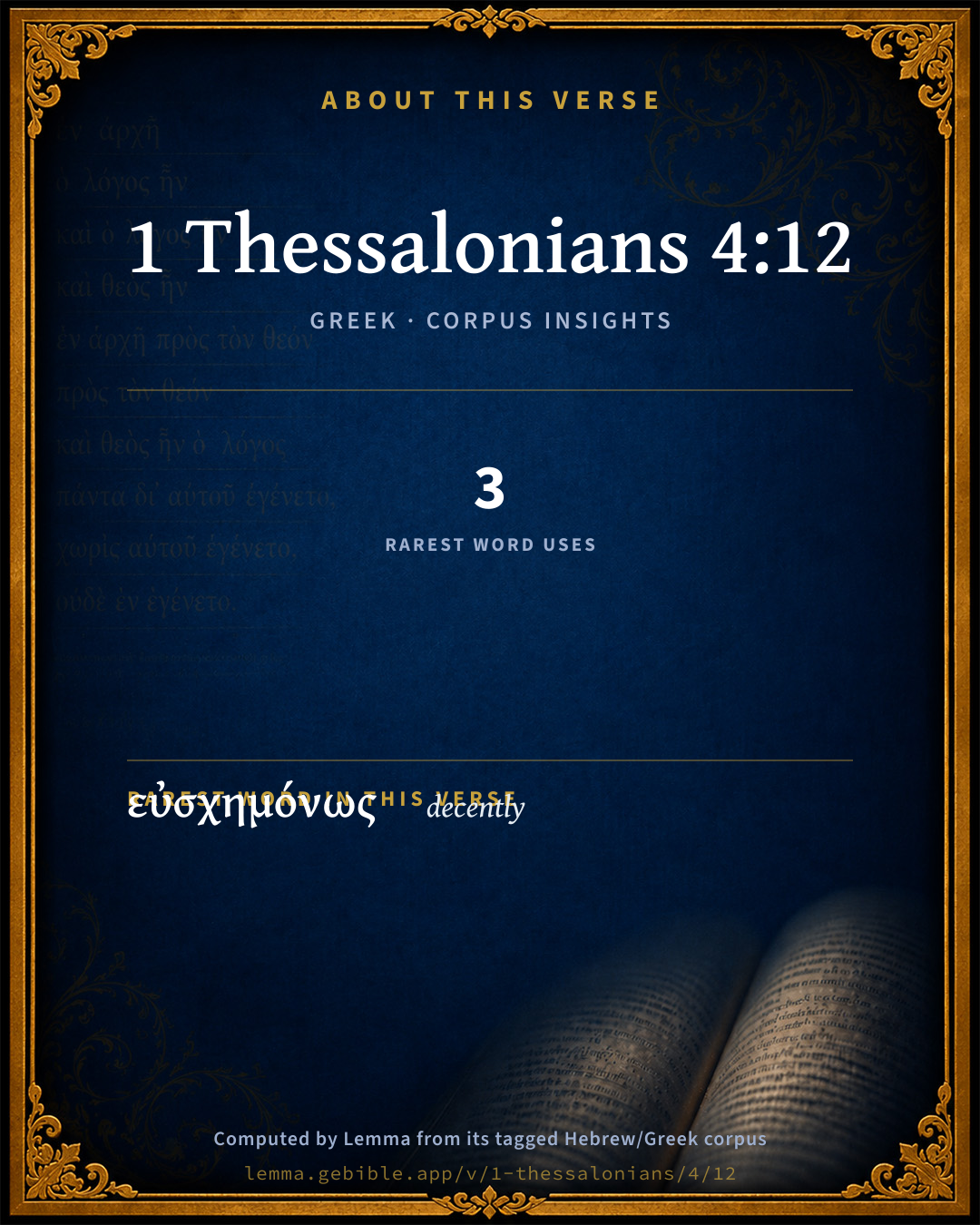
The rarest word here is εὐσχημόνως decently G2156 — appearing just 3 times in the whole Greek New Testament.

Shared distinctive vocabulary

εὐσχημόνως decently G2156 occurs in 3 verses of the Greek New Testament. Also found in:

Cross-references

13

Topical passages linked to 1 Thessalonians 4:12 in the Treasury of Scripture Knowledge — connected by theme and wording, ordered by reader-vote popularity; previews shown in the World English Bible.

  • Colossians 4:5 Walk in wisdom toward those who are outside, redeeming the time.
  • 1 Peter 2:12 having good behavior among the nations, so in that which they speak against you as evil-doers, they may by your good works, which they see, glorify God in the day of visitation.
  • Romans 12:17 Repay no one evil for evil. Respect what is honorable in the sight of all men.
  • Romans 13:13 Let us walk properly, as in the day; not in reveling and drunkenness, not in sexual promiscuity and lustful acts, and not in strife and jealousy.
  • 1 Timothy 3:7 Moreover he must have good testimony from those who are outside, to avoid falling into reproach and the snare of the devil.
  • Mark 4:11 He said to them, "To you is given the mystery of the Kingdom of God, but to those who are outside, all things are done in parables,
  • 1 Peter 3:16–17 having a good conscience; that, while you are spoken against as evildoers, they may be disappointed who curse your good manner of life in Christ.
  • 1 Thessalonians 5:22 Abstain from every form of evil.
  • Titus 2:8–10 and soundness of speech that can't be condemned; that he who opposes you may be ashamed, having no evil thing to say about us.
  • 2 Corinthians 8:20–21 We are avoiding this, that any man should blame us concerning this abundance which is administered by us.
  • 2 Corinthians 11:7–9 Or did I commit a sin in humbling myself that you might be exalted, because I preached to you God's Gospel free of charge?
  • Philippians 4:8 Finally, brothers, whatever things are true, whatever things are honorable, whatever things are just, whatever things are pure, whatever things are lovely, whatever things are of good report; if there is any virtue, and if there is any praise, think about these things.
  • 1 Peter 3:1 In like manner, wives, be in subjection to your own husbands; so that, even if any don't obey the Word, they may be won by the behavior of their wives without a word;

Cross-references courtesy of OpenBible.info (CC BY 4.0).

Commentary

Notes on 1 Thessalonians 4:12 from classic Christian and Jewish commentators (each source and its license shown beneath its notes). The classic Christian expositions comment on the surrounding passage and are grouped to its opening verse, so a note may address several verses; the Jewish commentaries on the Tanakh (Rashi and others) are per-verse, so they appear only where the commentator wrote on this verse.

Lemma curates 59 commentaries, every one of them public domain or Creative Commons licensed, each selected and text-cleaned for this edition rather than reprinted as found. About our sources →

The Biblical Illustrator

Joseph S. Exell

1Th_4:12

That ye may walk honestly toward them that are without, and that ye may have lack of nothing.

The disciplinary and educational function of business, and some of the dangers that assail those engaged in it

I. Whatever their motives may be, businessmen are actually practising daily and hourly the christian virtues of faith or foresight, prudence, self-control, self-denial, temperance, uprightness. The characteristic virtues of the business world are Christian virtues every one, and in adopting them men have acknowledged the excellence of Christianity. Self-indulgence is recognized as folly, as the foe to all happiness and manliness. Self-denial, self-control, is known in the practical affairs of life to be the condition of all success. Thus far, then, men have learned the great lesson of the Cross, and have taken its principles to be the rules of business life. Therefore it is that, if rightly and wisely conducted, there is no better discipline for the formation of character than business. It teaches in its own way the peculiar value of regard for others interests, of spotless integrity, of unimpeachable righteousness; and the busy activities of life, in themselves considered, are good and not evil. They are a part of Gods great work, and are as much His appointment as the services of praise and prayer.

II. Though beyond all question the business energies of the age have been reinforced and guided by the gospel, until discipline, temperance, and self-control have become their permanent characteristics, and though beyond all question the business pursuits of the age are recognized by Christian thinkers and economists as departments of human culture and as part of Gods administration of the world, yet businessmen, with all their earnestness and sagacity, are peculiarly liable to be blind to these high considerations and ignorant of this great economy. There are two dangers by which they are continually liable to be betrayed: one is selfishness, and the other is worldliness.

1. Profit, of course, is the very essence of success in business. Yet the making of profit is apt to become an absorbing passion with the eager businessman for its own sake. His ordinary relations with men are apt to be more or less controlled by it. He pretty soon begins to wish to make his association pay, and his friendships, and his politics, and everything that he is and has and does. And if he is successful, a certain selfish pride establishes itself in his heart. Then comes avarice, that amazing and monstrous passion of the soul which loves money for its own sake, which grows on what it feeds on, which never can be appeased, never has enough. Woe to the man who sinks into this slavery.

2. Men are simply absorbed and engrossed and satisfied with their business pursuits and interests, and so neglect and forget their religious and eternal interests. Man is more than a denizen of this world. There is a hunger of the heart which nothing but God can appease; a thirst of the soul which nothing but God can satisfy. That ye may walk honourably toward them that are without. What can give this, spite of poverty or wealth, but the Christian conscience which is void of offence toward man and God? That ye may have lack of nothing. What can assure this, but the Spirit of adoption, which bears witness with our spirit that we are children and heirs of God? (Bp. S. S. Harris.)

Motives to industry

I. It is right. That ye may walk honestly.

1. Idleness exposes men to three forms of dishonesty--

(1) Unlawful dependence on others. We have no right to ask or receive the produce of anothers labour when we are perfectly able to have produce of our own. This belongs to him and we filch it when we take it without value returned. It is taking the bread out of his mouth. All beggars, loungers, and loafers of all classes come under this category--labourers, genteel placemen, ministerial sinecurists.

(2) Thievery. The thief is not usually one who cant, but one who wont work. To rob requires abilities which if honestly employed would secure adequate remuneration. But the thief likes his calling because of the idle leisure it promises, and the love of display which its wicked gains may gratify.

(3) Gambling--the vice of which consists in getting that for which nothing, is given, involving the rightful owner in loss. That he might have been the garner is no justification, but a condemnation of both parties. This, too, springs from love of ease, from love of excitement, and from the feverish desire to be rich without the legitimate pains.

2. Honest industry avoids these temptations and secures--

(1) Independence, which is worth all that is requisite to secure it. The worker could not stoop to the base cringing necessary to reap the paltry gains of the parasite, and mercifully escapes the contempt to which the idle dependent is exposed.

(2) Nobility of soul which would scorn to take an undue advantage of another.

II. It is profitable. That ye may have lack of nothing. This is perfectly legitimate as a subordinate motive, and is one of the mainstays of civilization and philanthropy. The idea involves--

1. The economy of the results of labour. To gain a competence thrift, temperance, and forethought are necessary. How many men honest and industrious enough, and with every means of acquiring a competency from time to time lack everything from their thriftless ways. But while honest to others they are dishonest to themselves. Frugality must enter into any large meaning of honesty.

2. The use of the results of labour--

(1) In domestic requirements.

(2) For charitable purposes.

(3) For the promotion of religion. (J. W. Burn.)

Honesty

When James II, sent his Jacobite emissary to seduce the commanders of the British navy, he reported that Sir Cloudesley Shovel was in corruptible; He is a man not to be spoken to, was the emissarys tribute. (C. E. Little.)

Honesty rewarded

A farmer called on Earl Fitzwilliam to represent that his crop of wheat had been seriously injured in a field adjoining a certain wood where his lordships hounds had, during the winter, frequently met. He stated that the young wheat had been so cut up and destroyed that in some parts he could not hope for any produce. Well, my friend, said his lordship, if you can procure an estimate of the loss you have sustained I will repay you. The farmer replied that he had requested a friend to assist him in estimating the damage, and they thought that, as the crop seemed entirely destroyed, £50 would not more than repay him. The Earl immediately gave him the money. As the harvest approached, however, the wheat grew, and in those parts of the field which were the most trampled the corn was strongest and most luxuriant. The farmer went again to his lordship, and said, I am come, my lord, respecting the field of wheat adjoining such a wood. I find that I have sustained no loss at all; for where the horses had most cut up the land the crop is most promising, and therefore I brought the £50 back again. Ah, exclaimed the venerable Earl, this is what I like! this is as it should be between man and man! His lordship then went into another room, and on returning, presented the farmer with a cheque for £100, saying, Take care of this, and when your eldest son shall become of age present it to him, and tell him the occasion which produced it.

Honesty towards those without

Only a few weeks ago, a missionary in China took his gun to go up one of the rivers of the interior to shoot wild ducks; and, as he went along in the boat, he shot at some ducks, and down they fell; unfortunately they did not happen to be wild fowl, but tame ducks belonging to some neighbours. The owner was miles away, but the boat was drawn up to the side of the river, and the missionary went about carefully endeavouring to find out the owner of the ducks, for he could not rest until he had paid for the damage he had ignorantly done. The owner was much surprised, he had been so accustomed to have people shoot his ducks and never say a word about it, that he could not understand the honesty of the man of God, and he told others, until crowds of Chinese gathered round and stared at the missionary as if he had dropped from the moon; a man so extremely honest as not to be willing to take away ducks when he had killed them! They listened to the gospel with attention, and observed that the teaching must be good which made people so conscientious as the missionary had been. I should not wonder but what that little accident did more for the gospel than the preaching of twenty sermons might have done without it. So let it be with us; let us so act in every position that we shall adorn the gospel which is committed to our trust. (C. H. Spurgeon.)

Exemplary honesty

When this church was built, the President of the Board of Trustees called together every contractor and every mechanic that had worked upon it to ask if any of them had lost money by a too close contract in its construction; and the welcome reply came to us, on the part of every single man, We are content: we have made a reasonable profit on the work. And I think the blessing of God has rested on this Church from that day to this, in that it was honest. Nor do I know that this Church has ever committed an act, even through carelessness or forgetfulness, of dishonesty in the matter of the management of its fiscal affairs. (H. W. Beecher.)

The Biblical Illustrator, edited by Joseph S. Exell (c. 1880s–1900s) — public domain. Text from a community e-Sword module.

Tyndale Open Study Notes

Tyndale Open Resources

4:12 Self-sufficiency and decorum would win the recognition and respect of people who are not believers (see Rom 13:13; 1 Cor 5:12-13; Col 4:5).

Tyndale Open Study Notes — © Tyndale Open Resources, licensed CC BY-SA 4.0. Text via the HelloAO Bible API.

Bengel's Gnomon

Johann Albrecht Bengel

1Th 4:12. Εὐσχημόνως, becomingly) Lest men should be able to say that Christianity leads to sloth and poverty. The opposite is the disorderly (unruly), 1Th 5:14; 2Th 3:6.—μηδενὸς) of nothing, which you require to solicit from those without. This is the highest degree of εὑπορία, i.e. freedom from entanglement in matters of property, and is to be desired by a Christian, on account of the liberty which it bestows.

Bengel's Gnomon of the New Testament — English translation (T&T Clark, Edinburgh, 1860) — public domain. Text from a community e-Sword module.

Meyer's Critical & Exegetical Commentary

Heinrich August Wilhelm Meyer

is not the statement of an inference (Baumgarten-Crusius), but of a purpose: dependent, however, neither on παρηγγείλαμεν, nor on what has hitherto been said, including the precept to φιλαδελφία, 1Th_4:10 (Flatt), but on 1Th_4:11, and in such a manner that the first half of 1Th_4:12 refers to φιλοτιμεῖσθαι ἡσυχάζειν καὶ πράσσειν τὰ ἴδια, and the second half to ἐργάζεσθαι ταῖς χερσὶν ὑμῶν

1Th_4:12 is not the statement of an inference (Baumgarten-Crusius), but of a purpose: dependent, however, neither on παρηγγείλαμεν, nor on what has hitherto been said, including the precept to φιλαδελφία, 1Th_4:10 (Flatt), but on 1Th_4:11, and in such a manner that the first half of 1Th_4:12 refers to φιλοτιμεῖσθαι ἡσυχάζειν καὶ πράσσειν τὰ ἴδια, and the second half to ἐργάζεσθαι ταῖς χερσὶν ὑμῶν.

εὐσχημόνως] well-becoming, honourably, Rom_13:13; 1Co_7:35; 1Co_14:40. The opposite is ἀτάκτως, 2Th_3:6.

πρός] not coram (Flatt, Schott, Koch), but in relation to, or in reference to those who are ἔξω. Comp. Bernhardy, Syntax, p. 265.

οἱ ἔξω] those who are without (sc. the Christian community), those who are not Christians, whether Jews or Gentiles. Comp. Col_4:5; 1Co_5:12-13, 1Ti_3:7. Already among the Jews οἱ ἔξω (חיצונים) was the usual designation of Gentiles. See Meyer on 1Co_5:12.

μηδενός] is by most considered as masculine, being understood partly of Christians only (so Flatt), partly of unbelievers only (Luther, Camerarius, Ernest Schmid, Wolf, Moldenhauer, Pelt), partly both of Christians and unbelievers (Schott, de Wette,who, however, along with Koch, thinks that there is a chief reference to Christians,

Hofmann, Riggenbach). But to stand in need of no man, is for man an impossibility. It is better therefore, with Calvin, Estius, Grotius, Bengel, Baumgarten-Crusius, Alford, to take μηδενός as neuter, so that a further purpose is given, whose attainment is to be the motive for fulfilling the exhortations in 1Th_4:10 : to have need of nothing, inasmuch as labour leads to the possession of all that is necessary for life, whereas idleness has as its inevitable consequence, want and need.

Meyer — Critical and Exegetical Commentary on the New Testament — English translation by Peter Christie, edited by Frederick Crombie (T&T Clark, 1880) — public domain. Text from a community e-Sword module.

Jamieson, Fausset & Brown

Robert Jamieson, A. R. Fausset & David Brown

honestly--in the Old English sense, "becomingly," as becomes your Christian profession; not bringing discredit on it in the eyes of the outer world, as if Christianity led to sloth and poverty (Rom 13:13; Pe1 2:12).

them . . . without--outside the Christian Church (Mar 4:11).

have lack of nothing--not have to beg from others for the supply of your wants (compare Eph 4:28). So far from needing to beg from others, we ought to work and get the means of supplying the need of others. Freedom from pecuniary embarrassment is to be desired by the Christian on account of the liberty which it bestows.

Jamieson, Fausset & Brown — Commentary Critical and Explanatory on the Whole Bible (1871) — public domain (CC PDM 1.0). Text via the HelloAO Bible API.

Adam Clarke's Commentary

Verse 12. That ye may walk honestly] ευσχημονως. Becomingly, decently, respectably; as is consistent with the purity, holiness, gravity, and usefulness of your Christian calling.

Them that are without] The unconverted Gentiles and Jews. See this expression explained at large on Col 4:5.

That ye may have lack of nothing.] That ye may be able to get your bread by honest labour, which God will ever bless; and be chargeable to no man. He that is dependent on another is necessarily in bondage; and he who is able to get his own bread by the sweat of his brow, should not be under obligation even to a king.

I do not recollect whether, in any other part of this work, I have given the following story from the Hatem Tai Nameh. Hatem Tai was an Arabian nobleman, who flourished some time before the Mahommedan era; he was reputed the most generous and liberal man in all the east. One day he slew one hundred camels, and made a feast, to which all the Arabian lords and all the peasantry in the district were invited. About the time of the feast he took a walk towards a neighbouring wood, to see if he could find any person whom he might invite to partake of the entertainment which he had then provided. Walking along the skirt of the wood, he espied an old man coming out of it, laden with a burden of faggots; he accosted him and asked if he had not heard of the entertainment made that day by Hatem Tai. The old man answered in the affirmative. He asked him why he did not attend and partake with the rest. The old man answered: "He that is able to gain his bread even by collecting faggots in the wood, should not be beholden even to Hatem Tai." This is a noble saying, and has long been a rule of conduct to the writer of this note.

Adam Clarke's Commentary on the Bible (1810–1826) — public domain. Text from a community e-Sword/MySword module.

Ellicott's Commentary for English Readers

(12) Honestly.—Not in our modern sense of the word, but “honourably,” “creditably.”

Toward—i.e., ”in reference to,” “in your connection with.” The heathen were certain to be watching the conduct of the members of the new religion, and it would bring down political suspicion if they were seen to be acting more like agitators for a secret society than honest citizens who worked at their handicraft and calling.

Of nothing.—Right: the marginal version is hardly consistent with the Greek. Two purposes will be fulfilled by their industry: (1) to allay heathen suspicion; (2) to be well supplied themselves. It seems as if they had been reduced to begging of other Churches in return for their own expensive charities.

A Bible Commentary for English Readers, edited by Charles John Ellicott (1878–1897) — public domain. Text from a community e-Sword module.

The Cambridge Bible for Schools and Colleges

gen. ed. J. J. S. Perowne

12. that ye may walk honestly toward them that are without] Honestly is rather honourably, honestè (Vulgate)—in decent, comely fashion, in such manner as to “adorn the doctrine of God our Saviour” (Tit_2:10), and to win for Christian faith respect even from those who did not embrace it. in 1Ti_3:7 this is laid down as a condition specially important hi the case of men appointed to office in the Church, that they should “have a good testimony from them that are without.”

Those without—“outsiders,” as we say—is an established phrase, used by contrast with “those within” the fold of Christ, or the walls of the city of God; see 1Co_5:12-13; Col_4:5, “Walk in wisdom toward those outside;” also Mar_4:11. In a thriving commercial town like Thessalonica, indolence or unfitness for the common work of life would bring great discredit on the new society.

and that ye may have lack of nothing] Better, need of nothing (R. V.), or of no one (no man, A.V. margin). As much as to say: “That every one, inside or outside the Church, may respect you, and you may be no man’s dependents.”

The sense of honourable independence was strong in St Paul (see ch. 1Th_2:6; 1Th_2:9, and again 2Th_3:8): he desires to see it in all his people. The Church was already in danger of having its charities abused by the indolent, so as to foster a spirit of pauperism. In Eph_4:28 the Apostle enlists on the side of diligent secular work the spirit of charity, in addition to that of self-respect—“that he may have to give to him that needeth;” comp. Act_20:34-35, “It is more blessed to give than to receive.” And in 1Ti_5:8 he includes under the necessities to be met by honest labour those of the man’s household, condemning the neglecter of these claims as “denying the faith” and “worse than an unbeliever.”

The Cambridge Bible for Schools and Colleges (gen. ed. J. J. S. Perowne; Cambridge University Press, 1878–1918) — public domain. Text from a community e-Sword module.

John Gill's Exposition

That ye may walk honestly,.... Decently, in good credit and reputation, providing things honest in the sight of all men, for themselves and families, and honestly paying every man his own; on which account it became them to mind their own business, and work at their trades; otherwise their walk and conversation would be scandalous, and not honest and honourable:

toward them that are without: the men of the world, who were without the church; see Co1 5:12 profane sinners, unconverted Gentiles, that were without Christ and hope, and God in the world, and were aliens and strangers; and yet care should be taken that no occasion be given to such to reproach the name of God, the ways of Christ, and the doctrines of the Gospel:

and that ye may have lack of nothing; but have wherewith to supply the necessaries of life, and give to them also that stand in need, which is more blessed and honourable than to receive; or might not need any such instruction and exhortation, or any reproof for sloth and idleness; or not stand in need of "any man", as the Syriac version renders it; of the help and assistance of any, of any of those that are without, which would be dishonourable; or of them that are within, of the church, which might be burdensome. The Vulgate Latin version renders it, "that ye may not desire anything of anyone"; as the slothful man covets greedily all the day long what is another's, and this desire kills him, Pro 21:25 he covets an evil covetousness, and craves in a scandalous way the bread of others; when it would be more honourable for him to work with quietness, and eat his own bread got by honest labour, and not be beholden to another.

John Gill's Exposition of the Whole Bible (1746–1763) — public domain (CC PDM 1.0). Text via the HelloAO Bible API.

Trapp's Complete Commentary

John Trapp

12 That ye may walk honestly toward them that are without, and that ye may have lack of nothing.

Ver. 12. Lack of nothing] He becometh poor that dealeth with a slack hand, but the hand of the diligent maketh rich, Pro 10:4. Jabal that dwelt in tents and tended herds had Jubal to his brother, the father of music. Jabal and Jubal, industry and plenty, not without sweet content, dwell together.

John Trapp, A Commentary or Exposition upon All the Books of the Old and New Testament (1647–1656) — public domain. Text from a community e-Sword module.

Albert Barnes' Notes on the Bible

That ye may walk honestly toward them that are without - Out of the church; comp notes on Col 4:5. The word rendered honestly, means “becomingly, decorously, in a proper manner;” Rom 13:13; 1Co 14:40. It does not refer here to mere honesty in the transaction of business, but to their general treatment of those who were not professing Christians. They were to conduct themselves toward them in all respects in a becoming manner - to be honest with them; to be faithful to their engagements; to be kind and courteous in their conversation; to show respect where it was due, and to endeavor in every way to do them good. There are few precepts of religion more important than those which enjoin upon Christians the duty of a proper treatment of those who are not connected with the church.

And that ye may have lack of nothing - Margin, no man. The Greek will bear either construction, but the translation in the text is probably the correct one. The phrase is to be taken in connection not merely with that which immediately precedes it - as if “their walking honestly toward those who were without” would preserve them from want - but as meaning that their industrious and quiet habits; their patient attention to their own business, and upright dealing with every man, would do it. They would, in this way, have a competence, and would not be beholden to others. Learn hence, that it is the duty of a Christian so to live as not to be dependent on others, unless he is made so by events of divine Providence which he cannot foresee or control. No man should be dependent on others as the result of idle habits; of extravagance and improvidence; of the neglect of his own business, and of intermeddling with that of others. If by age, losses, infirmities, sickness, he is made dependent, he cannot be blamed, and he should not repine at his lot. One of the ways in which a Christian may always do good in society, and honor his religion, is by quiet and patient industry, and by showing that religion prompts to those habits of economy on which the happiness of society so much depends.

Albert Barnes' Notes on the Bible (1834–1885) — public domain. Text from a community e-Sword/MySword module.

Matthew Poole's English Annotations

He enforceth his commands by a twofold reason, the former is ab honesto, the other is ab utili. First:

That ye may walk honestly, or decently, as the word is rendered, 1Co 14:40.

Toward them that are without; that is, Gentiles, infidels, so they are described, 1Co 5:12; Col 4:5; as those that were received into the church of Christ are said to be within. The apostle would have them honour the gospel before the heathen in such moral actions which they did approve of, and were able to judge of, not understanding the higher mysteries of faith and gospel holiness; which he calls walking in wisdom totoards them that are without, Col 4:5. The other reason is ab utili:

That ye may have lack of nothing; or, of no man, have no need to beg of any man. It might offend and be a stumblingblock to the Gentiles, to see Christians to beg of any, and especially of themselves, for their necessary relief. Or, of nothing; that you may by your own labour be able to subsist, and not depend upon others, and so not be a burden to friends, or a scandal to strangers. For every man to subsist by his own labour, was the primitive law to Adam, Gen 3:19, commended often by Solomon in his Proverbs, and enjoined by the apostle to believing Christians, 2Th 3:10.

Matthew Poole's English Annotations on the Holy Bible (1683–1685) — public domain. Text from a community e-Sword/MySword module.

Whedon's Commentary on the Bible

Daniel D. Whedon

12. Honestly—Reputably; securing the respect of heathen that are without the Church. Even in his first preaching, irrespective of any special tendencies to idleness in the Church, St. Paul had made effort to form the new Christians into models of regular, conscientious industry, in the midst of Greek idleness, in order to impress and correct the outside world.

May have lack of nothing—So that there may be no Christian mendicants, and no pagans to taunt the Christians as loungers or vagrants.

Daniel D. Whedon (gen. ed.), Commentary on the Old and New Testaments (1874–1909) — public domain. Text from a community e-Sword module.

The Pulpit Commentary

That ye walk honestly; that is, honorably; seemly. Toward them that are without; without the pale of the Christian Church, toward those who are not Christians, whether Jews or Gentiles, the unbelieving world. So also, in another Epistle, the apostle says, "Walk in wisdom toward them that are without". (Col_4:5) That ye may have lack of nothing; either neuter, of no thing; or perhaps rather masculine, of no man; that ye be under no necessity of asking assistance either from heathens or from fellow-Christians; inasmuch as working with your hands will put you in possession of what is necessary for life; whereas idleness necessarily involves poverty and dependence on others. Honesty.

1. Its nature. We must guard against commercial dishonesty; all attempts to go beyond and defraud our brother; all overestimating what we sell, and underestimating what we buy; all shrinking from the payment of debts; all mean practices to gain customers.

2. Its importance. Temptations to dishonesty in this commercial age. Dishonesty combined with religious profession gives occasion to the enemies of God to blaspheme. We must walk honestly toward them that are without. The independence and loftiness of character which honesty imparts.

Christians before the world.

In the previous verse St. Paul has been urging upon his readers the duty of quiet industry. He now gives two reasons for this advice first, that they may walk honestly before the world; and secondly, that they may have need of nothing. The apostle turns to the same subject in his Second Epistle. "If any man will not work, neither let him eat," he says. (2Th_3:10) God only provides for us when we cannot provide for ourselves; or, rather, he provides for us by helping us to provide for ourselves. He feeds the ravens by giving them strong wings and claws and beaks, and by. providing them prey. But the birds must catch their quarry. We need not be anxious about the morrow if we are diligent in doing our own business. So much for the second reason for diligence. The first demands more extended inquiry, and may be taken by itself as a fertile subject for meditation. We are to be diligent in our secular business in order that we may "walk honestly towards them that are without.

I CHRISTIANS OWE DUTIES TO THE WORLD, Christians have no right to treat "them that are without" as outlaws. If we should pray for those who despitefully use us, much more should we treat them honestly. And if we are to be kind to our enemies, certainly we are required to be just to those who are not inimical to us. The Christian must pay his debts to an infidel. The temperate man must fulfill his obligations to the drunkard. The spiritually minded man must be just to the worldly minded man. Christians should respect the rights of the heathen in foreign countries.

II THE WORLD JUDGES CHRISTIANS ACCORDING TO THEIR DISCHARGE OF THESE DUTIES. These it can appreciate. It knows nothing of the behavior of Christians in the Church. It cares nothing for orthodox creeds or devout psalm-singing. But it can estimate the value of a thorough piece of work, and it can see the merit of a prompt payment. If we are wanting in these things, the world will only regard us as hypocrites when we make much of our religion in spiritual matters and rightly, for if we arc not honest men we cannot be saints.

III THE WORLD JUDGES OF CHRISTIANITY ACCORDING TO THE EXTERNAL CONDUCT OF CHRISTIANS IN THIS RESPECT. Here is a graver consideration. The honor of Christ is concerned. The defaulting Christian gives a shock to Christian evidences. One glaring instance of misconduct in secular affairs does more to hinder the progress of true religion than volumes of sermons can do to advance it. Even the negligent and idle Christian brings discredit on his Master. The Christian artisan should be known from the secularist by the greater diligence and thoroughness of his work.

IV CHRISTIANS HAVE NO RIGHT TO EXPECT GOOD TREATMENT FROM THE WORLD UNLESS THEY BEHAVE HONESTLY TOWARDS IT. The Church at Thessalonica lived in constant danger of an assault from the hostile heathen population of the city. It was most desirable that no shadow of an excuse should be given for an attack. Idleness, noisy restlessness, interference with other people, would provoke opposition. Quiet industry was most safe. When a master found that the Christians were his best hands he would not be inclined to molest them. We shall best conciliate opponents and silence enmity and at last win respect by a quiet, unassuming, diligent discharge of our daily duty. W.F.A.

The Pulpit Commentary (1880–1919), ed. H.D.M. Spence-Jones & Joseph S. Exell — public domain. Text from a community e-Sword module.

John Wesley's Explanatory Notes

Decently - That they may have no pretense to say, (but they will say it still,) "This religion makes men idle, and brings them to beggary." And may want nothing - Needful for life and godliness. What Christian desires more?

John Wesley, Explanatory Notes Upon the Whole Bible (1754–1765) — public domain. Text via the GEBible commentary corpus.

Burkitt's Expository Notes on the New Testament

William Burkitt

Our apostle having exhorted the Thessalonians to industry and diligence in the foregoing verse, he presses it with a double argument in this verse.

1. Hereby they should walk honestly towards them that are without, that is, in a decent and seemly manner in the eyes of unconverted Pagans, who are said to be without, because without the pale of the visible church; and,

2. Because, by God’s blessing upon their industry, they would attain to such a competency of the things of this life, as to lack nothing which the wisdom of God saw fit and convenient for them; so that by industrious diligence we please God, we profit ourselves, are serviceable to the public, we silence and stop the mouths of the enemies of religion, and beautify our profession with a becoming conversation.

William Burkitt's Expository Notes on the New Testament (1700–1703) — public domain. Text from a community e-Sword module.

McGarvey & Pendleton's Commentaries

J. W. McGarvey

that ye may walk becomingly toward them that are without, and may have need of nothing . [Instead of spending their time in restless gadding about or idle meddling with other people's affairs, Paul expected them to heed his warning, and earn their own living. These Thessalonians were mostly of the laboring class. If they were idle, they would quickly be reduced to dependence or beggary, and the unbelieving world without ( Col_4:5 ) would quickly say of the new religion that it made men idle and worthless. Paul therefore counsels them to that industry that would make them independent, self-respecting and respected.]

J. W. McGarvey (with Philip Y. Pendleton), Commentaries on the New Testament (The Fourfold Gospel, 1914; Acts; and the epistles) — public domain. Text from a community e-Sword/MySword module.

The People's New Testament

B. W. Johnson

12. That ye may walk honestly. Becomingly in the sight of those without. It would be a reproach if the heathen could say, “This new religion makes men idle and brings them to beggary.” Lack of nothing. The necessaries supplied by labor are especially meant.

B. W. Johnson's The People's New Testament with Notes (1889–1891) — public domain. Electronic text from the Christian Classics Ethereal Library (CCEL) ThML edition.

Cambridge Greek Testament for Schools and Colleges

12. It is especially to the last particular of the lengthened παραγγελία that the final clause, ἵνα περιπατῆτε εὐσχημόνως κ.τ.λ., applies: that you may walk honourably (honeste, Vulg.; Old Eng. honestly) toward those without, and have need of nothing. Εὐσχημόνως (cf. Rom 13:13; 1Co 7:35) means in decent, comely fashion, in such manner as to “adorn the doctrine of our Saviour God” (Tit 2:10) and to win respect for the faith from those who had not embraced it. For such regard shown by St Paul to οἱ ἔξω (Heb. הַחִיצוֹנִים), “the outsiders,” cf. Col 4:5 (identical with this, except that ἐν σοφίᾳ replaces εὐσχημόνως), 1Ti 3:7, Tit 2:8; and for the phrase οἱ ἔξω elsewhere, 1Co 5:12 f., Mar 4:11. On its distinction from οἱ λοιποί, see note to 1Th 4:13 below. For περιπατεῖν, see note on 1Th 2:12. Πρός, “in your attitude towards, converse with the outsiders”; cf. note on πρὸς ὑμᾶς ἦμεν, 1Th 3:3. In a thriving commercial city like Thessalonica, indolence or pauperism, and unfitness for the common work of life, would bring peculiar disgrace on the new society.

μηδενός is ambiguous in gender; some interpreters render it, “may have need of no one”: the fact that χρείαν ἔχειν is frequently used with a genitive of the thing (e.g. in Mat 6:8, Luk 10:42, Heb 5:12; 1Co 12:21 is not really different) “turns the scale in favour of the neuter” (Lightfoot); the context (ἐργάζεσθαι κ.τ.λ.) suggests “need” of sustenance,—ἄρτος (2Th 3:8; 2Th 3:12; cf. 1Jn 3:17; Jas 2:15). The repetition of χρείαν ἔχειν (1Th 4:9) is accidental. The sense of honourable independence, which was so strong in the Apostle (see 1Th 2:6; 1Th 2:9, &c.), he desires his converts to cultivate. The Church was from the first in danger of having its charities abused by the idle.

Cambridge Greek Testament for Schools and Colleges (Cambridge University Press, 1896; 21 vols, various authors incl. Carr, Maclear, Plummer, Farrar, Lumby, Moule, M. R. James, Simcox) — public domain. Text from a community e-Sword module.

Alford’s Greek Testament

Henry Alford

12.] Purpose of ver. 11.

εὐσχημόνως] honourably: ἀτάκτως, 2Th 3:6, 2Th 3:11, is the opposite.

πρός, with regard to: as in the proverb οὐδὲν πρὸς Διόνυσον,—πρὸς Τιμόθεον πρᾶξαι, Demosth., p. 1185. See Bernhardy, p. 265.

τοὺς ἔξω] the unbelieving world (reff.).

μηδενός (subjective, as ruled by the χρείαν ἔχητε) is much better taken neuter than masculine; for as Lün. observes, to stand in need of no man, is for man an impossibility.

13-Ch.

Henry Alford, The Greek Testament (1849–1861) — public domain. Text from a community e-Sword module.

International Critical Commentary

12. ἵνα περιπατῆτε κτλ. The purpose of παρακαλοῦμε is twofold, (1) that the converts may behave themselves becomingly with a view to the opinion of non-Christians (τοὺς ἔξ) the point being that the idleness of some of the Christians tended to bring Christianity into discredit with the unbelievers; and (2) that they may have need of no one to support them, the point being that they should support themselves instead of trespassing on the hospitality of the church.

Ell. thinks that ἵνα περιπατῆτε εὐσχημόνω refers mainly to ἡσυχάζει and πράσσει, and μηδενὸς χρείαν ἔχητ refers to ἐργάζεσθα This reference is due to the fact that ἡσυχάζει is interpreted as leading a quiet life after a bustling interest in public affairs. Ewald and Dob. take the clause with ἵν as the object of παρηγγείλαμε; but the change from the infinitives to ἵν after παρακαλοῦμε strongly intimates that Paul is passing from the object to the purpose of the exhortation cf. 1Co 10:32 f.: γίνεσθ … καθὼ … ἵν). εὐσχημόνω, which is used elsewhere in the Gk. Bib. only Rom 13:13 (περιπατεῖ) and 1Co 14:40 (parallel to κατὰ τάξι), denotes “becomingly,” “honestly” in the sense of honeste, so that no exception can be taken; cf. Epictetus, Diss. II, 5:23 εὐσχημόνως ἀνεστράφη οἱ ἔξ in Paul (1Co 5:12 f. Col 4:5) indicates non-Christians, irrespective of race (contrast οἱ ἔς, 1Co 5:12). The Jews had a similar designation for non-Jews; cf. οἱ ἔξωθε (Josephus, Ant. 15:316; also 1Ti 3:7) and οἱ ἐκτό (Sir. prol.); and see Schöttgen on 1Co 5:12 and Levy, Neuhebr. u. Chald. Wörterbuch on חיצון. πρό = “with an eye to,” as in Col 4:5; not coram, “in the eyes of.” On the gender of μηδενό, Vorstius (apud Poole) remarks: “perinde est sive μηδενό in neut. gen. sive in masc. accipias.” Nor does it matter logically, for in either case the reference is to dependence upon the brotherhood for support. Grammatically, the usage of χρείαν ἔχει is inconclusive; contextually, the masculine is probable (τοὺς ἔξ) Vulg has nullius aliquid.

(5) The Dead in Christ (4:13-18)

This section is separated from the previous paragraphs “concerning brotherly love” (vv. 9-12) but is closely related to the following question “concerning times and seasons” (5:1-11), as the repetition of ἅμα σύ (v. 17) in 5:10 intimates. The faint-hearted (οἱ ὀλιγόψυχο 5:14) are anxious both about their dead (4:13-18) and about their own salvation (5:1-11).

Since Paul’s departure, one or more of the Thessalonian Christians had died. The brethren were in grief not because they did not believe in the resurrection of the saints, but because they feared that their dead would not have the same advantages as the survivors when the Lord came. Their perplexity was due not simply to the Gentile difficulty of apprehending the meaning of resurrection, but also to the fact that Paul had not when he was with them discussed explicitly the problem of the relation of survivors to dead at the Parousia. Since they had received no instruction on this point (contrast vv. 1-2, 6, 9, 11, 5:2), they write to Paul for advice “concerning the dead.”

That the question is not: Will the Christians who die before the Parousia be raised from the dead? but: Will the Christians who die before the Parousia be at the Parousia on a level of advantage with the survivors? is made plain by the consideration that in v. 14 Paul says not ἐγερει but ἄξει σὺν αὐτῷ (which presupposes resurrection); and that he singles out for emphasis not only in v. 14 but also in the summarised agraphon (v. 15), in the explanation of v. 15 given in vv. 16-17 (as far as ἀέρ), and in the consequence drawn in v. 17 (καὶ οὕτως πάντοτε σὺν κυρίῳ ἐσόμεθ), not ἀναστήσοντα but σὺν αὐτῷ (v. 14), ἅμα σύ (v. 17; cf. 5:10), and σὺν κυρίῳ (v. 17). It may well be that during the previous seventeen or more years of Paul’s Christian career relatively few Christians had died (cf. Act 12:2; also the death of Stephen when Paul was yet a Pharisee); but it is improbable that, because this passage is perhaps the first extant reference in Paul to the resurrection of believers, it is also the first time Paul had expressed himself, let alone reflected, on the subject; but see Lake, Exp 1907, 494-507. In fact, if v. 15 is to be accepted, Jesus himself had given his disciples to understand that the survivors would not anticipate the dead at his coming, thus intimating that some might die before he came (cf. Mar 9:1).

Similar but not identical questions bothered the writers of the Apocalypse of Baruch and Fourth Ezra; but their answers differ from that of Paul. Baruch says (11:6 f.): “Announce in Sheol and say to the dead: Blessed are ye more than we who are living.” Ezra writes (13:16 ff.) that the seer first pronounces woe unto the survivors and more woe unto the dead, but concludes that it is better or happier for the survivors, a conclusion confirmed from on high with the words (13:24): “magis beatifici sunt qui derelicti super eos qui mortui sunt.” Paul’s encouraging word is that living and dead are at the Parousia on a level of advantage, ἅμα σύ (v. 17, 5:10), simul cum.

In replying to the request for information, Paul states that his purpose in relieving their ignorance is that they, unlike the non-Christians who sorrow because they have no hope of being with Christ, should not sorrow at all. The reason for this striking utterance, already tacit in ἔχοντες ἐλπίδ (v. 13), is first expressed in v. 14 where from a subjective conviction, drawn from Christian experience and hypothetically put: “if we believe, as of course we do, that Jesus died and rose again,” he draws directly an objective inference: “so also God will lead on with Jesus those who died through him.” This internal argument from the believers’ mystic experience in Christ, the main purpose of which is to prove that the saints will be σὺν αὐτῷ, is further strengthened by an appeal to the external authority of an unwritten word of the Lord, summarised in Paul’s language, to the effect that the surviving saints will not anticipate the dead at the Parousia (v. 15). Then in apocalyptic language, drawn from tradition but coloured with his own phraseology, Paul explains the word of the Lord by singling out such details in the procedure at the Parousia as bring to the forefront the point to be proved, ἅμα σὺν αὐτοῖ (vv. 16-17 as far as ἀέρ); and draws the conclusion, anticipated in v. 14, “and so we shall always be with the Lord.” Finally (v. 18), uniting conclusion with exhortation, he bids them not to be encouraged but to encourage one another with the very words he himself has used.

13Now as to those who sleep, brothers, we do not wish you to be in ignorance, that you may not grieve, as do the rest who have not hope. 14For if we believe that Jesus died and rose, so also God will lead on those who fell asleep through Jesus along with him. 15For this that follows, we, the writers, tell you, not on our own authority but in a word of the Lord, namely, that we, the writers and our Christian contemporaries, who live, that is, who survive until the coming of the Lord, shall by no means anticipate the dead; 16because the Lord himself at a command, namely, at an archangel’s voice and a divine trumpet, will come down from heaven, and the dead who are in Christ will arise first of all; 17then we the living, the survivors, will with them at the same time be caught and carried by means of clouds to meet the Lord in the air. And so, we shall be always with the Lord. 18So then encourage one another with these words.

International Critical Commentary — older volumes (1896–1929), various authors — public domain. Text from a community e-Sword module.

Vincent's Word Studies in the New Testament

Marvin R. Vincent

Honestly [ευσχημονως] . P o. Better, seemly. From euj well and schma figure or fashion. The literal sense is suggested by the familiar phrase in good form. The contrast appears in ajtaktwv disorderly, 2Th 3:6. Paul has in view the impression to be made by his readers on those outside of the church. See on Rom 13:13, and comp. 1Co 14:40.

Of nothing [μηδενος] . Either neuter, of nothing, or masculine, of no man. In the latter case it would refer to depending upon others for their support, which some, in view of the immediately expected parousia, were disposed to do, neglecting their own business.

Marvin R. Vincent, Word Studies in the New Testament (1887–1900) — public domain. Text from a community e-Sword/MySword module.

Lesson kit

Teaching starters — assembled from the data on this page, not authored interpretation. Every prompt links to the verse data it draws on. Edit before teaching.

1 Thessalonians, in the Pauline Epistles, opens this verse with 10 words (10 distinct Greek lemmas). Its most distinctive word is euschēmónōs (“decently”). A historical commentator’s framing appears above. Read the whole chapter for the surrounding context.

Discussion questions

  1. The word euschēmónōs carries the sense “decently.” How does it shape the verse?
  2. Romans 13:13 shares the word «decently» with this verse. How do the two illuminate each other?
  3. The translations on this page render this verse differently — a whole-verse word diff, not a word-by-word alignment. What might account for the different wordings?
  4. Reading how The Biblical Illustrator and Tyndale Open Study Notes read this verse, where do the two commentators agree and where do they part?

Things to notice

Reading settings

Reading text

Shown beneath each verse's original-language words.

Old Testament
Old Testament edition

Read the OT as the Masoretic Hebrew (MT) or the Greek Septuagint (LXX).

English shown for the Greek Septuagint (in the Hebrew ↔ Greek comparison).

Comparing translations? Open the Compare panel on any verse page to stack up to four side by side.