

Ephesians 5:6
Greek (Tischendorf 8th ed.) Ephesians 5:6 appears in the Greek New Testament. The text above is from the Tischendorf 8th edition. Each word links to its Strong’s number and a concise gloss. Click any word for its full Thayer’s Greek Lexicon entry.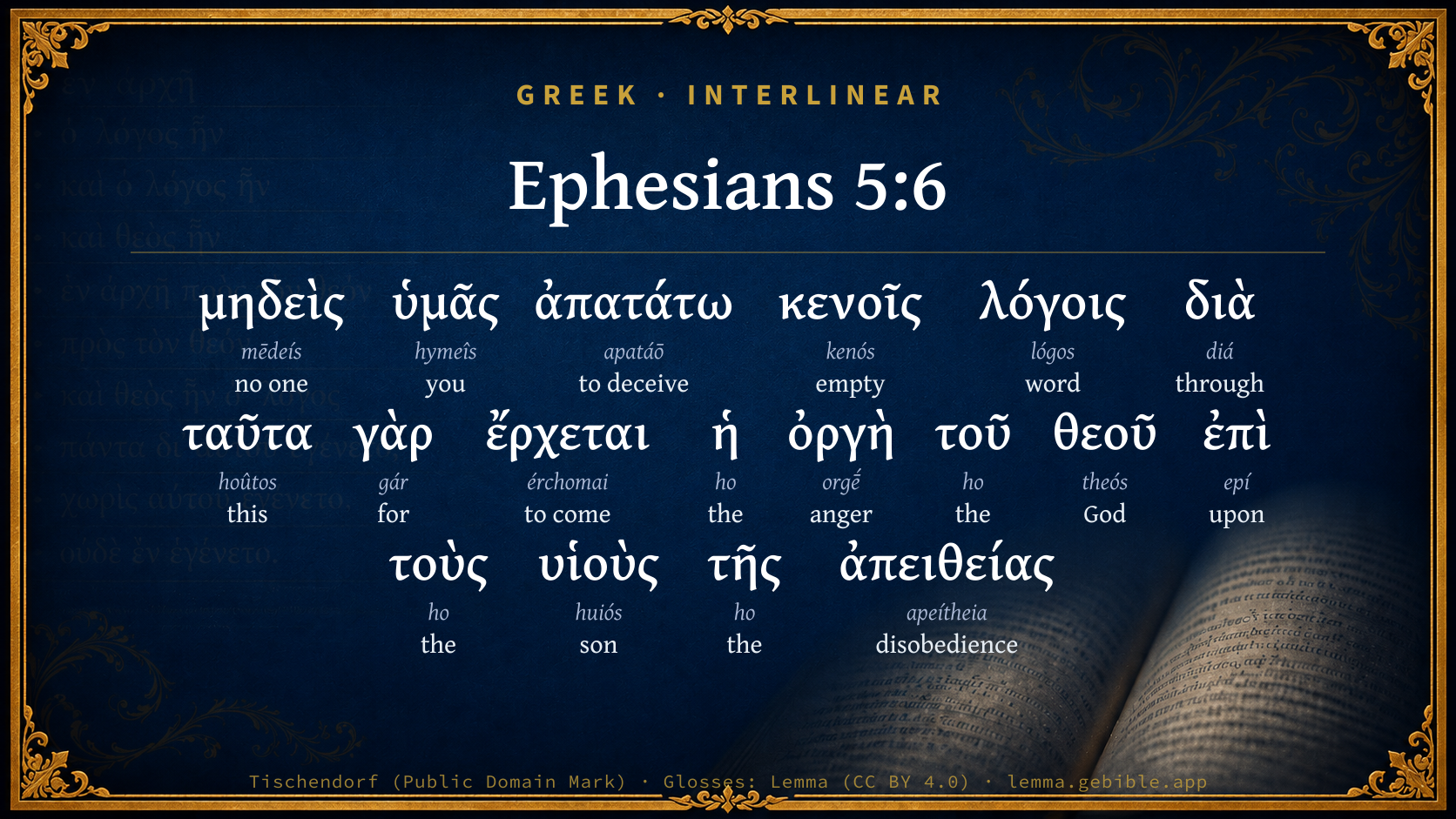
Let no one deceive you with empty words. For because of these things, the wrath of God comes on the children of disobedience.
Download a study sheet
One document with this verse’s original text, its word-by-word gloss line, the meaning frame, cross-references with their text, attributed commentary, and full source and license credits — printable, and it pastes into notes with its structure intact.
This verse Autodidact and up
A passage Seminary Student
Up to 50 verses in one chapter. A passage sheet keeps up to 6 commentary sources and 12 cross-references per verse, in the order this page ranks them, and says so on the sheet whenever that leaves anything out. Ask for a single verse and you get the Autodidact verse sheet above.
Everything on this page stays free to read, with no account — the sheet is a download of what is already on screen, not access to it.
Compare translations 3
The same verse in 3 English versions, stacked beneath the original-language interlinear above. Click any original word for its lexicon entry.
Each is an independent rendering of the whole verse — the interlinear is not word-aligned to these translations.
Highlighted words mark where these versions differ — a whole-verse word diff, not a word-by-word alignment.
-
World English Bible Public Domain
Let no one deceive you with empty words. For because of these things, the wrath of God comes on the children of disobedience.
-
King James Version Public Domain
Let no man deceive you with vain words: for because of these things cometh the wrath of God upon the children of disobedience.
-
unfoldingWord Literal Text CC BY-SA 4.0
Let no one deceive you with empty words, for because of these things the wrath of God is coming upon the sons of disobedience.
unfoldingWord Literal Text — © unfoldingWord, licensed CC BY-SA 4.0. Word-aligned USFM3 via Door43 (git.door43.org/unfoldingWord/en_ult).
Show all 19 translations
Every available English version of this verse, each an independent rendering of the whole verse.
-
World English Bible Public Domain
Let no one deceive you with empty words. For because of these things, the wrath of God comes on the children of disobedience.
-
Berean Standard Bible Public Domain
Let no one deceive you with empty words, for because of such things the wrath of God is coming on the sons of disobedience.
-
Majority Standard Bible Public Domain
Let no one deceive you with empty words, for because of such things the wrath of God is coming on the sons of disobedience.
-
King James Version Public Domain
Let no man deceive you with vain words: for because of these things cometh the wrath of God upon the children of disobedience.
-
American Standard Version (1901) Public Domain
Let no man deceive you with empty words: for because of these things cometh the wrath of God upon the sons of disobedience.
-
Revised Version (1885) Public Domain
Let no man deceive you with empty words: for because of these things cometh the wrath of God upon the sons of disobedience.
-
Geneva Bible (1599) Public Domain
Let no man deceiue you with vaine wordes: for, for such thinges commeth the wrath of God vpon the children of disobedience.
-
Douay-Rheims (1899) Public Domain
Let no man deceive you with vain words. For because of these things cometh the anger of God upon the children of unbelief.
-
Young's Literal Translation Public Domain
Let no one deceive you with vain words, for because of these things cometh the anger of God upon the sons of the disobedience,
-
Literal Standard Version CC BY-SA 4.0
Let no one deceive you with vain words, for because of these things comes the anger of God on the sons of the disobedience;
-
Unlocked Literal Bible CC BY-SA 4.0
Let no one deceive you with empty words, for because of these things the anger of God is coming upon the sons of disobedience.
-
unfoldingWord Literal Text CC BY-SA 4.0
Let no one deceive you with empty words, for because of these things the wrath of God is coming upon the sons of disobedience.
-
Darby Bible Public Domain
Let no one deceive you with vain words, for on account of these things the wrath of God comes upon the sons of disobedience.
-
World Messianic Bible Public Domain
Let no one deceive you with empty words, for because of these things the wrath of God comes on the children of disobedience.
-
Webster's Bible Public Domain
Let no man deceive you with vain words: for because of these things cometh the wrath of God upon the children of disobedience.
-
Free Bible Version CC BY-SA 4.0
Don't let anyone fool you with lying words, for it's because of such things that God's judgment comes upon the children of disobedience.
-
Bible in Basic English Public Domain
Do not be turned from the right way by foolish words; for because of these things the punishment of God comes on those who do not put themselves under him.
-
Text-Critical English NT CC BY 4.0
Let no one deceive you with empty words, for because of these things the wrath of God is coming upon the sons of disobedience.
-
Tyndale New Testament (1534) Public Domain
Let no man deceave you with vayne wordes. For thorow soche thinges cometh the wrath of God vpon the chyldre of vnbelefe.
Literal Standard Version (2020), Covenant Press — licensed CC BY-SA 4.0. Text via the HelloAO Bible API (eBible.org). Unlocked Literal Bible (unfoldingWord) — licensed CC BY-SA 4.0. Text via the HelloAO Bible API (eBible.org). unfoldingWord Literal Text — © unfoldingWord, licensed CC BY-SA 4.0. Word-aligned USFM3 via Door43 (git.door43.org/unfoldingWord/en_ult). Free Bible Version, Dr. Jonathan Gallagher — licensed CC BY-SA 4.0. Text via the HelloAO Bible API (eBible.org).
Word by word
More ways to search: Search by grammar → Find every occurrence → Compare this word →
Practice this passage: Drill this verse → Learn its vocabulary →
- Appears 3× in the Greek New Testament
- First appears here
- Part of Speech
- Verb
- Tense
- Present
- Voice
- Active
- Mood
- Imperative
- Person
- 3rd person
- Number
- Singular
Full Thayer's Definition
- μηδεὶς mēdeís G3367 “no one” Adjective, Nominative, Singular, Masculine, Negative
- ὑμᾶς hymeîs G5210 “you” Personal pronoun, 2nd person, Accusative, Plural
- ἀπατάτω apatáō G538 “to deceive” Verb, Present, Active, Imperative, 3rd person, Singular
- κενοῖς kenós G2756 “empty” Adjective, Dative, Plural, Masculine
- λόγοις lógos G3056 “word” Noun, Dative, Plural, Masculine
- διὰ diá G1223 “through” Preposition
- ταῦτα hoûtos G3778 “this” Demonstrative pronoun, Accusative, Plural, Neuter
- γὰρ gár G1063 “for” Conjunction
- ἔρχεται érchomai G2064 “to come” Verb, Present, Middle or Passive deponent, Indicative, 3rd person, Singular
- ἡ ho G3588 “the” Article, Nominative, Singular, Feminine
- ὀργὴ orgḗ G3709 “anger” Noun, Nominative, Singular, Feminine
- τοῦ ho G3588 “the” Article, Genitive, Singular, Masculine
- θεοῦ theós G2316 “God” Noun, Genitive, Singular, Masculine
- ἐπὶ epí G1909 “upon” Preposition
- τοὺς ho G3588 “the” Article, Accusative, Plural, Masculine
- υἱοὺς huiós G5207 “son” Noun, Accusative, Plural, Masculine
- τῆς ho G3588 “the” Article, Genitive, Singular, Feminine
- ἀπειθείας apeítheia G543 “disobedience” Noun, Genitive, Singular, Feminine
About this verse
These counts appear in no published source. They are computed here, from the morphology-tagged text and Lemma’s own curated glosses. What Lemma adds →
- 18
- words
- 15
- distinct lemmas
- Pauline Epistles
- section
Notable vocabulary
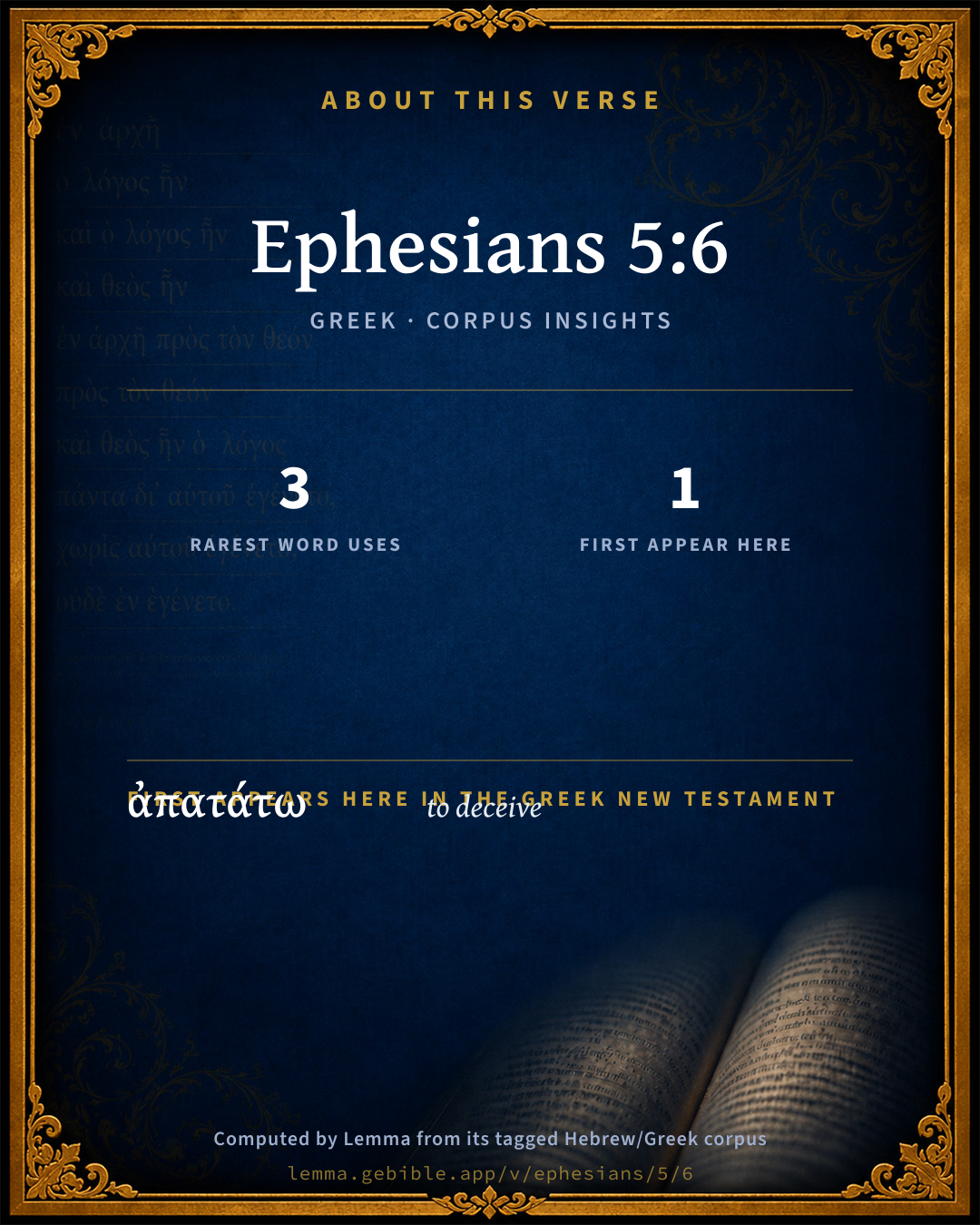
The rarest word here is ἀπατάτω to deceive G538 — appearing just 3 times in the whole Greek New Testament.
First appearance in Scripture
This word makes its first canonical appearance in the Greek New Testament here:
- ἀπατάτω to deceive G538
Shared distinctive vocabulary
ἀπατάτω to deceive G538 occurs in 3 verses of the Greek New Testament. Also found in:
Repetition
A word recurs within this verse:
- ἡ the G3588 ×4
Cross-references
25Topical passages linked to Ephesians 5:6 in the Treasury of Scripture Knowledge — connected by theme and wording, ordered by reader-vote popularity; previews shown in the World English Bible.
- Romans 1:18 For the wrath of God is revealed from heaven against all ungodliness and unrighteousness of men, who suppress the truth in unrighteousness,
- Matthew 24:4 Jesus answered them, "Be careful that no one leads you astray.
- Colossians 2:8 Be careful that you don't let anyone rob you through his philosophy and vain deceit, after the tradition of men, after the elements of the world, and not after Christ.
- 1 John 4:1 Beloved, don't believe every spirit, but test the spirits, whether they are of God, because many false prophets have gone out into the world.
- 2 Thessalonians 2:10–12 and with all deception of wickedness for those who are being lost, because they didn't receive the love of the truth, that they might be saved.
- Colossians 3:6 for which things' sake the wrath of God comes on the children of disobedience.
- Matthew 24:24 For there will arise false christs, and false prophets, and they will show great signs and wonders, so as to lead astray, if possible, even the chosen ones.
- Mark 13:5 Jesus, answering, began to tell them, "Be careful that no one leads you astray.
- Galatians 6:7–8 Don't be deceived. God is not mocked, for whatever a man sows, that will he also reap.
- Jeremiah 29:8–9 For thus says Yahweh of hosts, the God of Israel: Don't let your prophets who are in the midst of you, and your diviners, deceive you; neither listen you to your dreams which you cause to be dreamed.
- Ephesians 2:2–3 in which you once walked according to the course of this world, according to the prince of the powers of the air, the spirit who now works in the children of disobedience;
- Joshua 22:17–18 Is the iniquity of Peor too little for us, from which we have not cleansed ourselves to this day, although there came a plague on the congregation of Yahweh,
- Ezekiel 13:10–16 Because, even because they have seduced my people, saying, Peace; and there is no peace; and when one builds up a wall, behold, they daub it with whitewash:
- Mark 13:22 For there will arise false christs and false prophets, and will show signs and wonders, that they may lead astray, if possible, even the chosen ones.
- Numbers 32:13–14 Yahweh's anger was kindled against Israel, and he made them wander back and forth in the wilderness forty years, until all the generation, who had done evil in the sight of Yahweh, was consumed.
- 2 Kings 18:20 You say (but they are but vain words), [There is] counsel and strength for the war. Now on whom do you trust, that you have rebelled against me?
- Jeremiah 23:14–16 In the prophets of Jerusalem also I have seen a horrible thing: they commit adultery, and walk in lies; and they strengthen the hands of evil-doers, so that none does return from his wickedness: they are all of them become to me as Sodom, and the inhabitants of it as Gomorrah.
- Jeremiah 29:31 Send to all them of the captivity, saying, Thus says Yahweh concerning Shemaiah the Nehelamite: Because Shemaiah has prophesied to you, and I didn't send him, and he has caused you to trust in a lie;
- Micah 3:5 Thus says Yahweh concerning the prophets who lead my people astray; for those who feed their teeth, they proclaim, "Peace!" and whoever doesn't provide for their mouths, they prepare war against him:
- Hebrews 3:19 We see that they were not able to enter in because of unbelief.
- 1 Peter 2:8 and, "A stone of stumbling, and a rock of offense." For they stumble at the word, being disobedient, whereunto also they were appointed.
- Psalms 78:31 When the anger of God went up against them, Killed some of the fattest of them, And struck down the young men of Israel.
- Colossians 2:4 Now this I say that no one may delude you with persuasiveness of speech.
- Colossians 2:18 Let no one rob you of your prize by a voluntary humility and worshipping of the angels, dwelling in the things which he has not seen, vainly puffed up by his fleshly mind,
- 2 Thessalonians 2:3 Let no one deceive you in any way. For it will not be, unless the departure comes first, and the man of sin is revealed, the son of destruction,
Cross-references courtesy of OpenBible.info (CC BY 4.0).
Lesson kit
Teaching starters — assembled from the data on this page, not authored interpretation. Every prompt links to the verse data it draws on. Edit before teaching.
Ephesians, in the Pauline Epistles, opens this verse with 18 words (15 distinct Greek lemmas). Its most distinctive word is apatáō (“to deceive”). A historical commentator’s framing appears above. Read the whole chapter for the surrounding context.
Discussion questions
- What does “to deceive” (apatáō) contribute to the verse as a whole?
- This is the first place “to deceive” appears in Scripture (first appears here). What does its debut here establish?
- How does 1 Timothy 2:14, which shares the word «to deceive», read alongside this verse?
- What does the repetition of “the” (4× in this one verse) do in this verse?
- These translations render this verse differently; the difference is in the English rendering, not the original. What questions does that raise?
- Compare how The Biblical Illustrator and Lange's Commentary on the Holy Scriptures read this verse. Where do they agree or differ?
Things to notice
- 1 word makes its first canonical appearance in Scripture here.
- These translations choose different wording for 10 words in this verse.
- “the” occurs 4× in this single verse.
- 15 distinct Greek lemmas span 18 words in this verse.
Commentary
Notes on Ephesians 5:6 from classic Christian and Jewish commentators (each source and its license shown beneath its notes). The classic Christian expositions comment on the surrounding passage and are grouped to its opening verse, so a note may address several verses; the Jewish commentaries on the Tanakh (Rashi and others) are per-verse, so they appear only where the commentator wrote on this verse.
Lemma curates 59 commentaries, every one of them public domain or Creative Commons licensed, each selected and text-cleaned for this edition rather than reprinted as found. About our sources →
The Biblical Illustrator
Joseph S. Exell
The Biblical Illustrator, edited by Joseph S. Exell (c. 1880s–1900s) — public domain. Text from a community e-Sword module.
Lange's Commentary on the Holy Scriptures
Lange's Commentary on the Holy Scriptures (Critical, Doctrinal, and Homiletical), ed. John Peter Lange, English translation edited by Philip Schaff (1864–1880) — public domain. Text from a community e-Sword module.
Tyndale Open Study Notes
Tyndale Open Resources
Tyndale Open Study Notes — © Tyndale Open Resources, licensed CC BY-SA 4.0. Text via the HelloAO Bible API.
Bengel's Gnomon
Johann Albrecht Bengel
Bengel's Gnomon of the New Testament — English translation (T&T Clark, Edinburgh, 1860) — public domain. Text from a community e-Sword module.
Meyer's Critical & Exegetical Commentary
Heinrich August Wilhelm Meyer
Meyer — Critical and Exegetical Commentary on the New Testament — English translation by Peter Christie, edited by Frederick Crombie (T&T Clark, 1880) — public domain. Text from a community e-Sword module.
Expositor's Greek Testament
ed. W. Robertson Nicoll
The Expositor's Greek Testament, edited by W. Robertson Nicoll (1897–1910) — public domain. Text from a community e-Sword module.
Hodge's Commentary on Romans, Ephesians & First Corinthians
Charles Hodge
Charles Hodge — Commentary on Romans (1835), First Corinthians (1857), and Ephesians (1856) — public domain. Text from a community e-Sword module.
Jamieson, Fausset & Brown
Robert Jamieson, A. R. Fausset & David Brown
Jamieson, Fausset & Brown — Commentary Critical and Explanatory on the Whole Bible (1871) — public domain (CC PDM 1.0). Text via the HelloAO Bible API.
Adam Clarke's Commentary
Adam Clarke's Commentary on the Bible (1810–1826) — public domain. Text from a community e-Sword/MySword module.
John Calvin's Commentaries
John Calvin's Commentaries (1540-1563) — public domain. Text from the Calvin Translation Society English edition (1840s-50s) via the Christian Classics Ethereal Library (ccel.org). Calvin's coverage is partial (roughly two-thirds of the Bible); uncommented books and verses are honest gaps, never fabricated. The 19th-century editor's footnotes and remarks are omitted so the notes are faithfully Calvin's own voice.
Ellicott's Commentary for English Readers
A Bible Commentary for English Readers, edited by Charles John Ellicott (1878–1897) — public domain. Text from a community e-Sword module.
The Cambridge Bible for Schools and Colleges
gen. ed. J. J. S. Perowne
The Cambridge Bible for Schools and Colleges (gen. ed. J. J. S. Perowne; Cambridge University Press, 1878–1918) — public domain. Text from a community e-Sword module.
John Gill's Exposition
John Gill's Exposition of the Whole Bible (1746–1763) — public domain (CC PDM 1.0). Text via the HelloAO Bible API.
Trapp's Complete Commentary
John Trapp
John Trapp, A Commentary or Exposition upon All the Books of the Old and New Testament (1647–1656) — public domain. Text from a community e-Sword module.
Albert Barnes' Notes on the Bible
Albert Barnes' Notes on the Bible (1834–1885) — public domain. Text from a community e-Sword/MySword module.
Haydock's Catholic Bible Commentary
George Leo Haydock (1774–1849), Haydock's Catholic Family Bible and Commentary, 1859 edition — public domain. Excludes Psalms (Douay-Rheims chapter numbering differs from Protestant) and Deuterocanonical books (Catholic canon only).
Matthew Poole's English Annotations
Matthew Poole's English Annotations on the Holy Bible (1683–1685) — public domain. Text from a community e-Sword/MySword module.
Whedon's Commentary on the Bible
Daniel D. Whedon
Daniel D. Whedon (gen. ed.), Commentary on the Old and New Testaments (1874–1909) — public domain. Text from a community e-Sword module.
The Pulpit Commentary
The Pulpit Commentary (1880–1919), ed. H.D.M. Spence-Jones & Joseph S. Exell — public domain. Text from a community e-Sword module.
John Wesley's Explanatory Notes
John Wesley, Explanatory Notes Upon the Whole Bible (1754–1765) — public domain. Text via the GEBible commentary corpus.
Kretzmann's Popular Commentary
Paul E. Kretzmann
Paul E. Kretzmann, Popular Commentary of the Bible (1921–1924) — public domain. Text from a community e-Sword module.
The People's New Testament
B. W. Johnson
B. W. Johnson's The People's New Testament with Notes (1889–1891) — public domain. Electronic text from the Christian Classics Ethereal Library (CCEL) ThML edition.
Cambridge Greek Testament for Schools and Colleges
Cambridge Greek Testament for Schools and Colleges (Cambridge University Press, 1896; 21 vols, various authors incl. Carr, Maclear, Plummer, Farrar, Lumby, Moule, M. R. James, Simcox) — public domain. Text from a community e-Sword module.
Alford’s Greek Testament
Henry Alford
Henry Alford, The Greek Testament (1849–1861) — public domain. Text from a community e-Sword module.
International Critical Commentary
International Critical Commentary — older volumes (1896–1929), various authors — public domain. Text from a community e-Sword module.
Vincent's Word Studies in the New Testament
Marvin R. Vincent
Marvin R. Vincent, Word Studies in the New Testament (1887–1900) — public domain. Text from a community e-Sword/MySword module.