
Psalms 80:15

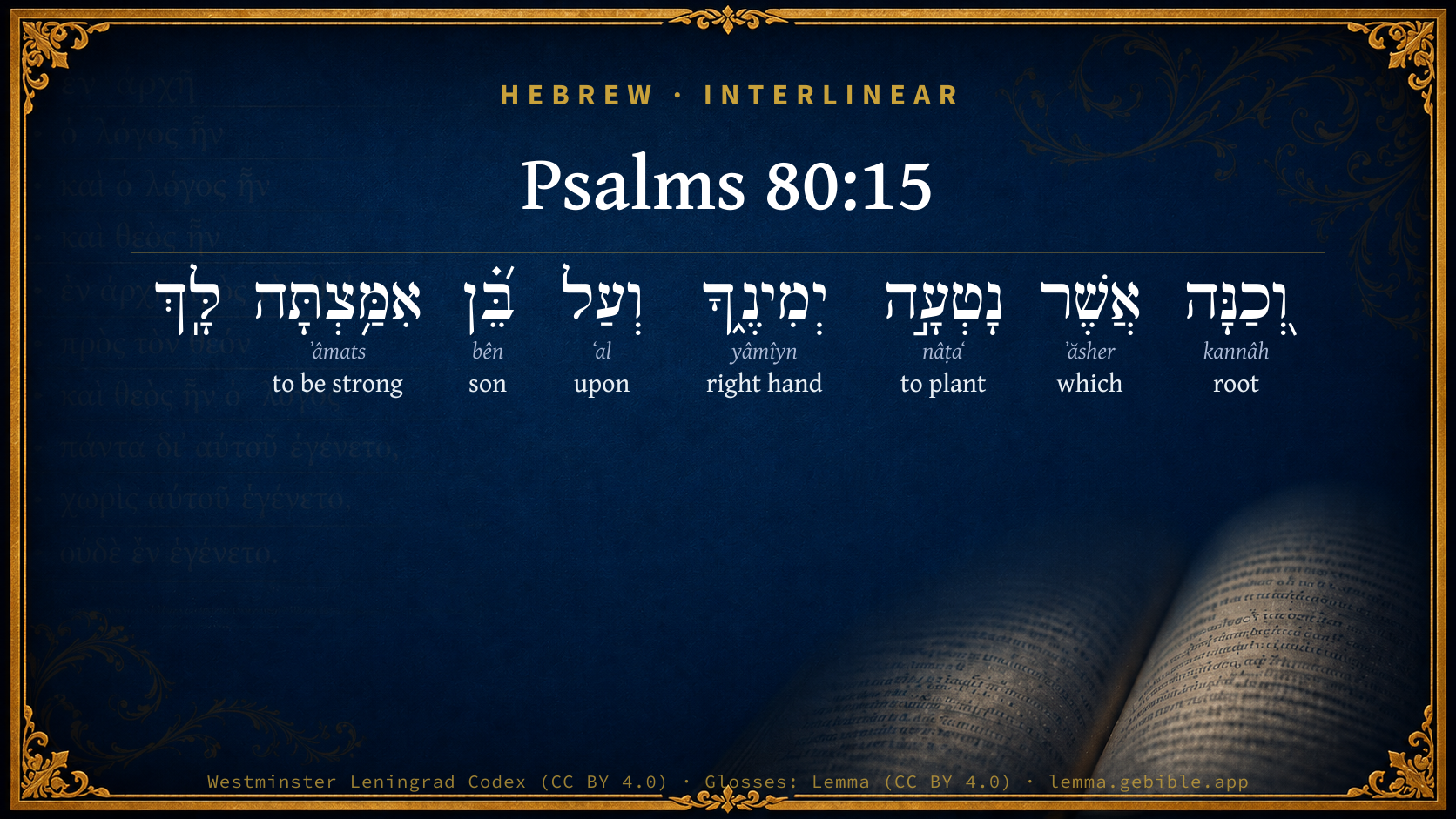
Hebrew (Westminster Leningrad Codex) Psalms 80:15 appears in the Hebrew Old Testament. The text above is from the Westminster Leningrad Codex. Each word links to its Strong’s number, a concise gloss, and parsing drawn from the Open Scriptures Hebrew Bible morphology. Click any word for its full Brown-Driver-Briggs (BDB) entry.
Download image
Cite this verse

Psalms 80:15 (World English Bible). Public Domain. Lemma interlinear Bible study tool, https://lemma.gebible.app/v/psalms/80/15.

Show BibTeX & RIS
BibTeX
RIS
English Translation
The stock which your right hand planted, The branch that you made strong for yourself.
World English Bible · Public Domain
Highlights
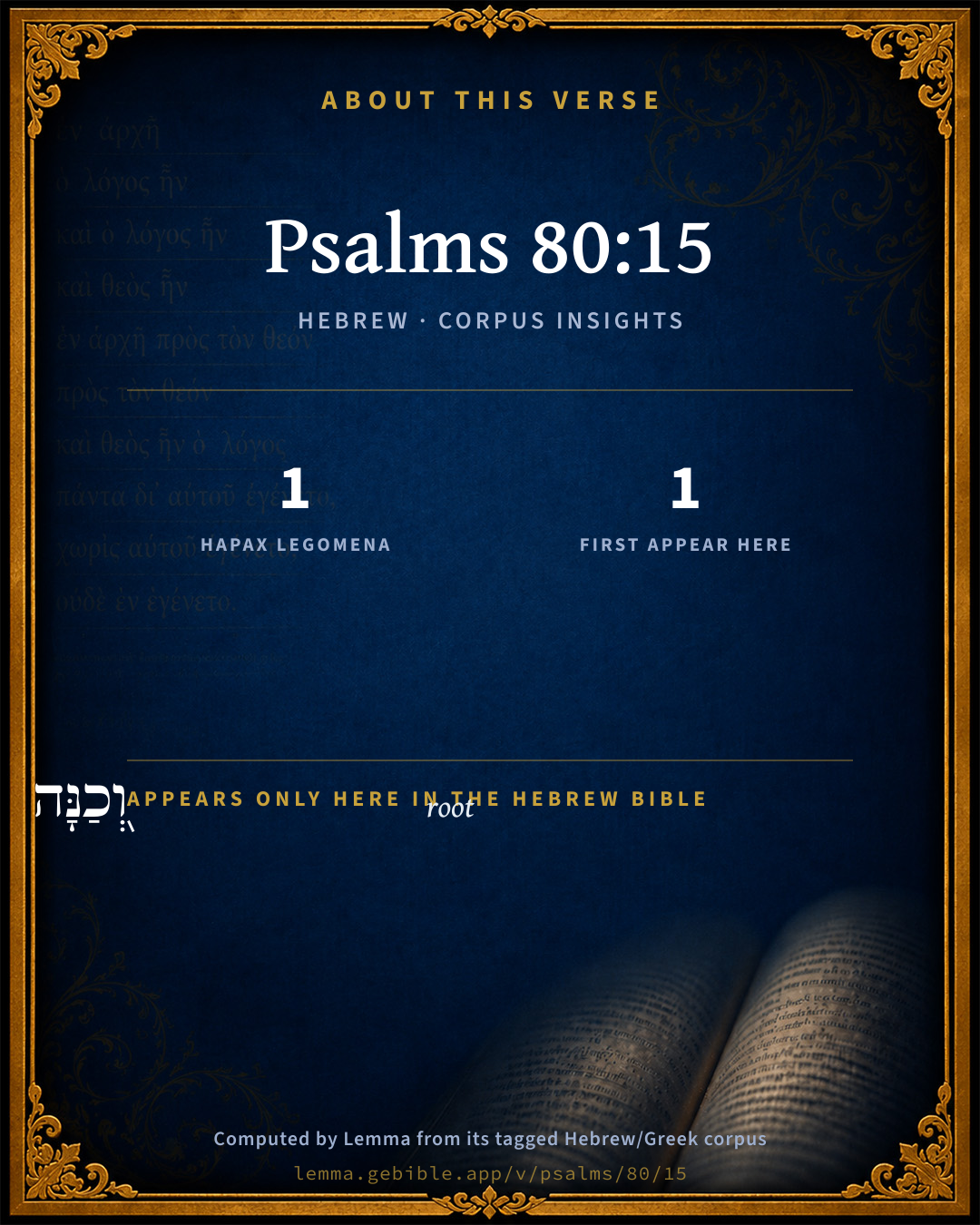
  • 1 hapax legomenon — only here in the Hebrew Bible
  • 1 first appearance in the Hebrew Bible
Full analysis ↓
Download a study sheet

One document with this verse’s original text, its word-by-word gloss line, the meaning frame, cross-references with their text, attributed commentary, and full source and license credits — printable, and it pastes into notes with its structure intact.

This verse Autodidact and up

Study sheet (.html) Plain text (.txt)

A passage Seminary Student

Up to 50 verses in one chapter. A passage sheet keeps up to 6 commentary sources and 12 cross-references per verse, in the order this page ranks them, and says so on the sheet whenever that leaves anything out. Ask for a single verse and you get the Autodidact verse sheet above.

Everything on this page stays free to read, with no account — the sheet is a download of what is already on screen, not access to it.

Want to remove ads? Support Godless Engineer
Compare translations 3

The same verse in 3 English versions, stacked beneath the original-language interlinear above. Click any original word for its lexicon entry.

Each is an independent rendering of the whole verse — the interlinear is not word-aligned to these translations.

Highlighted words mark where these versions differ — a whole-verse word diff, not a word-by-word alignment.

  • World English Bible Public Domain
    The stock which your right hand planted, The branch that you made strong for yourself.
  • King James Version Public Domain
    And the vineyard which thy right hand hath planted, and the branch that thou madest strong for thyself.
  • unfoldingWord Literal Text CC BY-SA 4.0
    even the stock that your right hand planted, and on the son you strengthened for yourself.

unfoldingWord Literal Text — © unfoldingWord, licensed CC BY-SA 4.0. Word-aligned USFM3 via Door43 (git.door43.org/unfoldingWord/en_ult).

Versions to compare (up to 4)

3 of 4 selected

Show all 18 translations

Every available English version of this verse, each an independent rendering of the whole verse.

  • World English Bible Public Domain
    The stock which your right hand planted, The branch that you made strong for yourself.
  • Berean Standard Bible Public Domain
    the root Your right hand has planted, the son You have raised up for Yourself.
  • Majority Standard Bible Public Domain
    the root Your right hand has planted, the son You have raised up for Yourself.
  • King James Version Public Domain
    And the vineyard which thy right hand hath planted, and the branch that thou madest strong for thyself.
  • American Standard Version (1901) Public Domain
    And the stock which thy right hand planted, And the branch that thou madest strong for thyself.
  • Revised Version (1885) Public Domain
    And the stock which thy right hand hath planted, and the branch that thou madest strong for thyself.
  • Geneva Bible (1599) Public Domain
    And the vineyard, that thy right hand hath planted, and the young vine, which thou madest strong for thy selfe.
  • Douay-Rheims (1899) Public Domain
    Turn again, O God of hosts, look down from heaven, and see, and visit this vineyard:
  • Young's Literal Translation Public Domain
    And the root that Thy right hand planted, And the branch Thou madest strong for Thee,
  • Literal Standard Version CC BY-SA 4.0
    And the root that Your right hand planted, || And the branch You made strong for Yourself,
  • Unlocked Literal Bible CC BY-SA 4.0
    This is the root that your right hand planted, the shoot that you made to grow.
  • unfoldingWord Literal Text CC BY-SA 4.0
    even the stock that your right hand planted, and on the son you strengthened for yourself.
  • Darby Bible Public Domain
    Even the stock which thy right hand hath planted, and the young plant thou madest strong for thyself.
  • World Messianic Bible Public Domain
    the stock which your right hand planted, the branch that you made strong for yourself.
  • Webster's Bible Public Domain
    \\80:14\\Return, we beseech thee, O God of hosts: look down from heaven, and behold, and visit this vine;
  • Free Bible Version CC BY-SA 4.0
    that you planted yourself, this son that you brought up yourself.
  • Bible in Basic English Public Domain
    Even to the tree which was planted by your right hand, and to the branch which you made strong for yourself.
  • JPS Tanakh (1917) Public Domain
    (80-16) And of the stock which Thy right hand hath planted, and the branch that Thou madest strong for Thyself.

Literal Standard Version (2020), Covenant Press — licensed CC BY-SA 4.0. Text via the HelloAO Bible API (eBible.org). Unlocked Literal Bible (unfoldingWord) — licensed CC BY-SA 4.0. Text via the HelloAO Bible API (eBible.org). unfoldingWord Literal Text — © unfoldingWord, licensed CC BY-SA 4.0. Word-aligned USFM3 via Door43 (git.door43.org/unfoldingWord/en_ult). Free Bible Version, Dr. Jonathan Gallagher — licensed CC BY-SA 4.0. Text via the HelloAO Bible API (eBible.org).

Word by word

More ways to search: Search by grammar → Find every occurrence → Compare this word →

Practice this passage: Drill this verse → Learn its vocabulary →

About this verse

These counts appear in no published source. They are computed here, from the morphology-tagged text and Lemma’s own curated glosses. What Lemma adds →

8
words
7
distinct lemmas
Wisdom
section

Notable vocabulary

1 hapax legomenon — a word that appears only here in the entire Hebrew Bible:

  • וְ֭כַנָּה root H3657

First appearance in Scripture

This word makes its first canonical appearance in the Hebrew Bible here:

  • וְ֭כַנָּה root H3657

Shared distinctive vocabulary

אִמַּ֥צְתָּה to be strong H553 occurs in 41 verses of the Hebrew Bible. Also found in:

Grammatical profile

  • 2 verbs
  • 3 nouns
  • 2 prepositions
  • 1 particle

Verb forms

  • נָטְעָ֣ה Qal · Perfect
  • אִמַּ֥צְתָּה Piel · Perfect

Hebrew & Septuagint length

In English translation the verse runs 15 words from the Hebrew and 22 from the Septuagint (LXX English) — closely comparable.

A rough comparison of the two English renderings, which tokenize alike — not a word-level alignment.

Word counts can differ between the Hebrew and the Greek without any difference in meaning — e.g. the Hebrew direct-object marker אֵת has no separate Greek word, and Greek often adds the article ὁ.

Cross-references

12

Topical passages linked to Psalms 80:15 in the Treasury of Scripture Knowledge — connected by theme and wording, ordered by reader-vote popularity; previews shown in the World English Bible.

  • John 15:1 "I am the true vine, and my Father is the farmer.
  • Psalms 80:8 You brought a vine out of Egypt. You drove out the nations, and planted it.
  • Zechariah 3:8 Hear now, Joshua the high priest, you and your fellows who sit before you; for they are men who are a sign: for, behold, I will bring forth my servant, the Branch.
  • Zechariah 6:12 and speak to him, saying, 'Thus says Yahweh of Hosts, "Behold, the man whose name is the Branch: and he shall grow up out of his place; and he shall build the temple of Yahweh;
  • Isaiah 11:1 There shall come forth a shoot out of the stock of Jesse, and a branch out of his roots shall bear fruit.
  • Jeremiah 2:21 Yet I had planted you a noble vine, wholly a right seed: how then are you turned into the degenerate branches of a foreign vine to me?
  • Jeremiah 23:5–6 Behold, the days come, says Yahweh, that I will raise to David a righteous Branch, and he shall reign as king and deal wisely, and shall execute justice and righteousness in the land.
  • Mark 12:1 He began to speak to them in parables. "A man planted a vineyard, put a hedge around it, dug a pit for the winepress, built a tower, rented it out to a farmer, and went into another country.
  • Psalms 89:21 With whom my hand shall be established. My arm will also strengthen him.
  • Isaiah 5:1–2 Let me sing for my well beloved a song of my beloved about his vineyard. My beloved had a vineyard on a very fruitful hill.
  • Isaiah 49:5 Now says Yahweh who formed me from the womb to be his servant, to bring Jacob again to him, and that Israel be gathered to him (for I am honorable in the eyes of Yahweh, and my God is become my strength);
  • Ezekiel 17:22–24 Thus says the Lord Yahweh: I will also take of the lofty top of the cedar, and will set it; I will crop off from the topmost of its young twigs a tender one, and I will plant it on a high and lofty mountain:

Cross-references courtesy of OpenBible.info (CC BY 4.0).

Hebrew and Greek witnesses Masoretic Hebrew ↔ Greek Septuagint

The same verse in the two great witnesses to the Old Testament, shown verse-for-verse.

You’re reading Greek Psalm 79 (Hebrew Psalm 80). The Septuagint counts the superscription, so verse numbers can differ from the Hebrew — chapter-level alignment, not verse-by-verse. Numbering follows Rahlfs.

These are two independent witnesses, not word-aligned to each other, and the Septuagint is shown in lemma (dictionary) form.

Hebrew Psalms 80:15 Masoretic · Westminster Leningrad Codex

וְ֭כַנָּה אֲשֶׁר נָטְעָ֣ה יְמִינֶ֑ךָ וְעַל בֵּ֝֗ן אִמַּ֥צְתָּה לָּֽךְ

The stock which your right hand planted, The branch that you made strong for yourself.

World English Bible · Public Domain

Greek LXX Greek Psalm 79:15 Septuagint · lemma form

ὁ θεός ὁ δύναμις ἐπιστρέφω δή ἐπιβλέπω ἐκ οὐρανός καί ὁράω καί ἐπισκέπτομαι ὁ ἄμπελος οὗτος

and restore that which your right hand has planted: and look on the son of man whom you did strengthen for yourself.

LXX2012 (modern English Septuagint) · Public Domain

On this verse, Joseph Benson's Commentary discusses the Septuagint’s reading. Read the note in Commentary ↓

Hebrew: Westminster Leningrad Codex (CC BY 4.0). Greek: Septuagint (public domain); English from LXX2012 (modern English Septuagint) (Public Domain). How the Septuagint differs from the Hebrew →

Commentary

Notes on Psalms 80:15 from classic Christian and Jewish commentators (each source and its license shown beneath its notes). The classic Christian expositions comment on the surrounding passage and are grouped to its opening verse, so a note may address several verses; the Jewish commentaries on the Tanakh (Rashi and others) are per-verse, so they appear only where the commentator wrote on this verse.

Lemma curates 59 commentaries, every one of them public domain or Creative Commons licensed, each selected and text-cleaned for this edition rather than reprinted as found. About our sources →

Trapp's Complete Commentary

John Trapp

Psa 80:15 And the vineyard which thy right hand hath planted, and the branch [that] thou madest strong for thyself.

Ver. 15. And the vineyard] Vitiarium, surculum, plantulam.

John Trapp, A Commentary or Exposition upon All the Books of the Old and New Testament (1647–1656) — public domain. Text from a community e-Sword module.

Joseph Benson's Commentary

Psa 80:15. And the vineyard — Hebrew, כנה, channah, which Buxtorf translates, surculus, planta, a branch, or plant, but which Dr. Hammond says “may be most fitly rendered a root, or stock, such as is wont to be planted. For this we know,” proceeds he, “that a branch of a vine, being laid in the ground, will take a root to it, and so be fit to be planted.” And after many critical remarks on the sense of the word, as used in other places, he adds, “by all this it appears that כנהhere, having in its original meaning somewhat of strength and stability, (being used for a foot, or basis,) and being by the context confined to vines, must signify such a slip, or young stock, or plant, as is fit to be set, or grow by itself. And being by the Masorites (Jewish rabbins) written with a large כ, (caph,) signifies this eminent plant, the whole people of the Jews whom God had chosen; and so his right hand is truly said to have planted it.” And the branch that thou madest strong for thyself — Hebrew, בן, ben, the son, namely, the son of the root or stock, according to the Hebrew phraseology, which terms any thing, that is produced by another, its son or daughter. Thus branches are called בנות, benoth, daughters, Gen 49:22. The royal family of David is evidently intended here, which God had raised and established for himself, to accomplish his eternal purpose of saving mankind by the Messiah, who was one day to spring from the root of Jesse. The Chaldee paraphrast expounds the branch of Messiah himself; “On King Messiah, whom thou hast established,” &c. So do the rabbins, Aben Ezra and Obadiah, cited by Dr. Hammond. And the LXX. have rendered the clause, επι υιον ανθρωπου, on the Son of man, an expression actually used by the psalmist, Psa 80:17. “To the advent of this Son of man.” says Dr. Horne, “Israel was ever accustomed to look forward, in time of affliction; on his second and glorious advent the Christian Church must fix her eye, in the day of her calamities.”

Joseph Benson's Commentary on the Old and New Testaments (1811–1818) — public domain. Text from a community e-Sword module.

J. A. Alexander on Psalms

Joseph Addison Alexander

16. (Psa 80:15) And sustain, what thy right hand has planted, and over the child thou hast reared for thyself (do thou watch, or extend thy protection). The common version of the first words (and the vineyard) is countenanced neither by the ancient versions nor by Hebrew etymology and usage. By giving it, as a verbal form, the sense of covering, protecting (which belongs to some kindred roots), the over in the last clause may depend upon it, and no verb need in that case be supplied. Thy right hand implies an exertion of strength, and at the same time involves an allusion to the name of Benjamin (Son of the Right Hand), here perhaps representing the whole race, on account of the connection of that tribe with both the rival kingdoms, its central position, its possession of the sanctuary, and its historical relation to the infant monarchy under Saul the Benjamite. To complete the allusion, the other element in the name (a son) is then introduced and metaphorically applied to the vine, which is still the Psalmist's theme, by an assimilation of animal and vegetable life common in all languages. Reared, literally strengthened, made strong, i.e. raised, brought up. See my note on Isa 44:14. For thyself, not for its own sake, but as a means of promoting the divine praise and glory.

Joseph Addison Alexander, The Psalms Translated and Explained (1850) — public domain. Text from a community e-Sword module.

Tyndale Open Study Notes

Tyndale Open Resources

80:15 Israel was the son that God had brought out of Egypt (see Hos 11:1) and planted in the Holy Land.

Tyndale Open Study Notes — © Tyndale Open Resources, licensed CC BY-SA 4.0. Text via the HelloAO Bible API.

Geneva Bible (1599)

Geneva Bible translators

So that no power can prevail against it, and which as a young bud thou raisest up again as out of the burnt ashes.

Geneva Bible (1599) marginal notes — public domain. Text via Bolls.life.

Adam Clarke's Commentary

Verse 15. The vineyard which thy right hand hath planted] Thy holy and pure worship, which thy Almighty power had established in this city.

And the branch - thou madest strong for thy self.] The original ועל בן veal ben, "and upon the SON whom thou hast strengthened for thyself." Many have thought that the Lord Jesus is meant. And so the Chaldee understood it, as it translates the passage thus: ועל מלכא משיחא veal MALCA MESHICHA, And upon the King Messiah, whom thou hast strengthened for thyself." The Syriac, Vulgate, Septuagint, AEthiopic, and Arabic, have, "the Son of man,' as in the seventeenth verse. Eighteen of Kennicott's and De Rossi's MSS. have בן אדם ben Adam, "Son of man," and as the Versions have all the same reading, it was probably that of the original copies. As Christ seems here to be intended, this is the first place in the Old Testament where the title Son of man is applied to him. The old Psalter understands this of setting Christ at the right hand of God.

Adam Clarke's Commentary on the Bible (1810–1826) — public domain. Text from a community e-Sword/MySword module.

John Calvin's Commentaries

As to the word כנה, cannah, in the beginning of the 15th verse, I readily acquiesce in the sense given of it by some who translate it, a place prepared; but as some think that there is a change in the Hebrew word of the letter ג, gimel, into כ, caph, so that the reading should be גנה, gannah, a garden or vineyard, we leave the reader to judge for himself. It is, however, certain that this is a metaphor akin to the former, by which is denoted the singular liberality of God in advancing this people, and causing them to prosper. The vine-branch which was planted by the hand of God is also called the Man of his right hand.

John Calvin's Commentaries (1540-1563) — public domain. Text from the Calvin Translation Society English edition (1840s-50s) via the Christian Classics Ethereal Library (ccel.org). Calvin's coverage is partial (roughly two-thirds of the Bible); uncommented books and verses are honest gaps, never fabricated. The 19th-century editor's footnotes and remarks are omitted so the notes are faithfully Calvin's own voice.

Ellicott's Commentary for English Readers

(15) And the vineyard which . . .—Most modern scholars follow the LXX. and Vulg. in making the word rendered vineyard an imperative of a verb, meaning protect: And protect what thy right hand hath planted. This makes a good parallelism.

A Bible Commentary for English Readers, edited by Charles John Ellicott (1878–1897) — public domain. Text from a community e-Sword module.

The Cambridge Bible for Schools and Colleges

gen. ed. J. J. S. Perowne

15. This verse presents serious ambiguities and difficulties. The first word may be rendered as a substantive, in close connexion with Psa_80:14, and the vineyard, or better as R.V. and the stock: or, as in R.V. marg., as a verb: and protect (or maintain) that which thy right hand hath planted. The second rendering is preferable, though not wholly free from difficulty.

the branch] Or, the son, which is the literal meaning of the word. Cp. Exo_4:22; Hos_11:1. Probably an allusion to Gen_49:22. The Targum interprets, “and upon Messiah the king, whom thou hast made strong for thyself.” But the primary reference is obviously to the nation.

madest strong] Tending it with loving care till it grew up: cp. Psa. 39:21; Isa_1:2.

The Cambridge Bible for Schools and Colleges (gen. ed. J. J. S. Perowne; Cambridge University Press, 1878–1918) — public domain. Text from a community e-Sword module.

John Gill's Exposition

It is burnt with fire, it is cut down,.... That is, the vine of Israel, and the branch before spoken of, alluding to a vine, and its branches; which, when become unprofitable, are cut down or cut off, and cast into the fire; see Joh 15:6, so Jerusalem and the temple were burnt with fire by Nebuchadnezzar, and afterwards by Vespasian:

they perish at the rebuke of thy countenance; that is, the Israelites, signified by the vine, whose destruction was owing to the wrath of God upon them for their sins; he frowned upon them, and rebuked them in his hot displeasure, and to that their ruin was owing; others were only instruments in his hands. Some understand this as a wish or imprecation, let them that cut down the vine, and burn it with fire, perish at the rebuke of thy countenance; see Psa 68:1, so the Targum.

John Gill's Exposition of the Whole Bible (1746–1763) — public domain (CC PDM 1.0). Text via the HelloAO Bible API.

Albert Barnes' Notes on the Bible

And the vineyard ... - Gesenius renders this as a verb: “Protect;” that is, “Protect or defend what thy right hand hath planted.” So the Septuagint renders it κατάρτισαι katartisai - and the Vulgate, perfice, fit, prepare, order. Prof. Alexander renders it sustain. DeWette, “Guard what thy right hand hath planted.” This is doubtless the true idea. It is a prayer that God would guard, sustain, defend what he had planted; to wit, the vine which he had brought out of Egypt, Psa 80:8.

And the branch - literally, the son; that is, the offspring or shoots of the vine. Not merely the original plant - the parent stock - but all the branches which had sprung from it and which had spread themselves over the land.

That thou madest strong for thyself - Thou didst cause it to grow so vigorously for thine own use or honor. On that account, we now call on thee to defend what is thine own.

Albert Barnes' Notes on the Bible (1834–1885) — public domain. Text from a community e-Sword/MySword module.

Matthew Poole's English Annotations

The vineyard; or, the root, or stock, or plant, as others render it. Thy right hand hath planted; which thou hast planted or fixed with thy might and power; whereof the right hand is both a sign or symbol and an instrument. The branch, Heb. the son, i.e. either,

1. The son of man, as it is more fully expressed, Psa 80:17. Or rather,

2. The branch; for as yet he continues the metaphor; which is called the son, to wit, of the root or stock mentioned in the former clause, as the branches are called daughters in the Hebrew text, Gen 49:22.

Thou madest strong; either,

1. By supporting it with stakes or walls, upon which the vine groweth up or rather,

2. By causing it to grow in bulk and thickness, and consequently in strength. For thyself; for thy own especial delight, and service, and honor.

Matthew Poole's English Annotations on the Holy Bible (1683–1685) — public domain. Text from a community e-Sword/MySword module.

The Treasury of David

Charles H. Spurgeon

Ver. 15. And the vineyard which thy right hand hath planted. Shall all thy care be lost? Thou has done so much, wilt thou lose thy labour? With thy power and wisdom thou didst great things for thy people, wilt thou now utterly give them up, and suffer thine enemies to exult in the evil which they delight in?

And the branch that thou madest strong for thyself. A prayer for the leader whom the Lord had raised up, or for the Messiah whom they expected. Though the vine had been left, yet one branch had been regarded of the Lord, as if to furnish a scion for another vine; therefore, is the prayer made in this form. Let us pray the Lord, if he will not in the first place look upon his church, to look upon the Lord Jesus, and then behold her in mercy for his sake. This is the true art of prayer, to put Christ forward and cry,

"Him and then the sinner see,

Look through Jesus' wounds on me."

Charles H. Spurgeon's The Treasury of David (1869–1885) — public domain. Psalms only. Text from a community e-Sword/MySword module.

Whedon's Commentary on the Bible

Daniel D. Whedon

15. And the vineyard which thy right hand hath planted—כנה, (kannah,) translated “vineyard,” signifies a layer-plant, or shoot. Its etymological sense, figuratively applied, takes us back to the germ life of the nation, when first planted in Canaan. Adopting the version of Gesenius we may read: “Behold and visit this vine; even the tender shoot which thy right hand hath planted.” The appeal is pathetic, like that of the infant child to the parent, and the successive pleas, “look down,” “behold,” “visit this vine,” indicate the earnestness of the prayer.

And the branch that thou madest strong for thyself—The Hebrew reads, The son that thou hast strengthened; but though the figure is changed the sense is “branch,” or vine.

Daniel D. Whedon (gen. ed.), Commentary on the Old and New Testaments (1874–1909) — public domain. Text from a community e-Sword module.

The Pulpit Commentary

And the vineyard which thy right hand hath planted; rather, the stock. (So Kay, Cheyne, and the Revised Version.) Some, however, regard hNk as a verb, and translate, "Establish that which thy right hand has planted" (see the LXX, Michaelis, Hupfeld, Canon Cook, and others). And the branch that thou madest strong for thyself; literally, the son, which may mean the offshoot. (comp. Gen_49:22) Is this offshoot Ephraim? or is the entire vine, all Israel, intended?

The Pulpit Commentary (1880–1919), ed. H.D.M. Spence-Jones & Joseph S. Exell — public domain. Text from a community e-Sword module.

Lesson kit

Teaching starters — assembled from the data on this page, not authored interpretation. Every prompt links to the verse data it draws on. Edit before teaching.

Psalms, in the Wisdom, opens this verse with 8 words (7 distinct Hebrew lemmas). Its most distinctive word is kannâh (“root”). A historical commentator’s framing appears above. Read the whole chapter for the surrounding context.

Discussion questions

  1. What does “root” (kannâh) contribute to the verse as a whole?
  2. This verse holds 1 word here found nowhere else in the Hebrew Bible. What might the rare word draw attention to?
  3. The word “root” first appears here in Scripture. What is being introduced at this debut?
  4. Genesis 25:23 shares the word «to be strong» with this verse. How do the two illuminate each other?
  5. These translations render this verse differently. What is at stake in choosing one wording over another?
  6. The verb «נָטְעָ֣ה» is Qal Perfect. How does its form color the action?
  7. Reading how Trapp's Complete Commentary and Joseph Benson's Commentary read this verse, where do the two commentators agree and where do they part?

Things to notice

  • 1 word in this verse appears nowhere else in the Hebrew Bible.
  • 1 word makes its first canonical appearance in Scripture here.
  • These translations choose different wording for 13 words in this verse.
  • 7 distinct Hebrew lemmas span 8 words in this verse.

Reading settings

Reading text

Shown beneath each verse's original-language words.

Old Testament
Old Testament edition

Read the OT as the Masoretic Hebrew (MT) or the Greek Septuagint (LXX).

English shown for the Greek Septuagint (in the Hebrew ↔ Greek comparison).

Comparing translations? Open the Compare panel on any verse page to stack up to four side by side.