Job 12:6

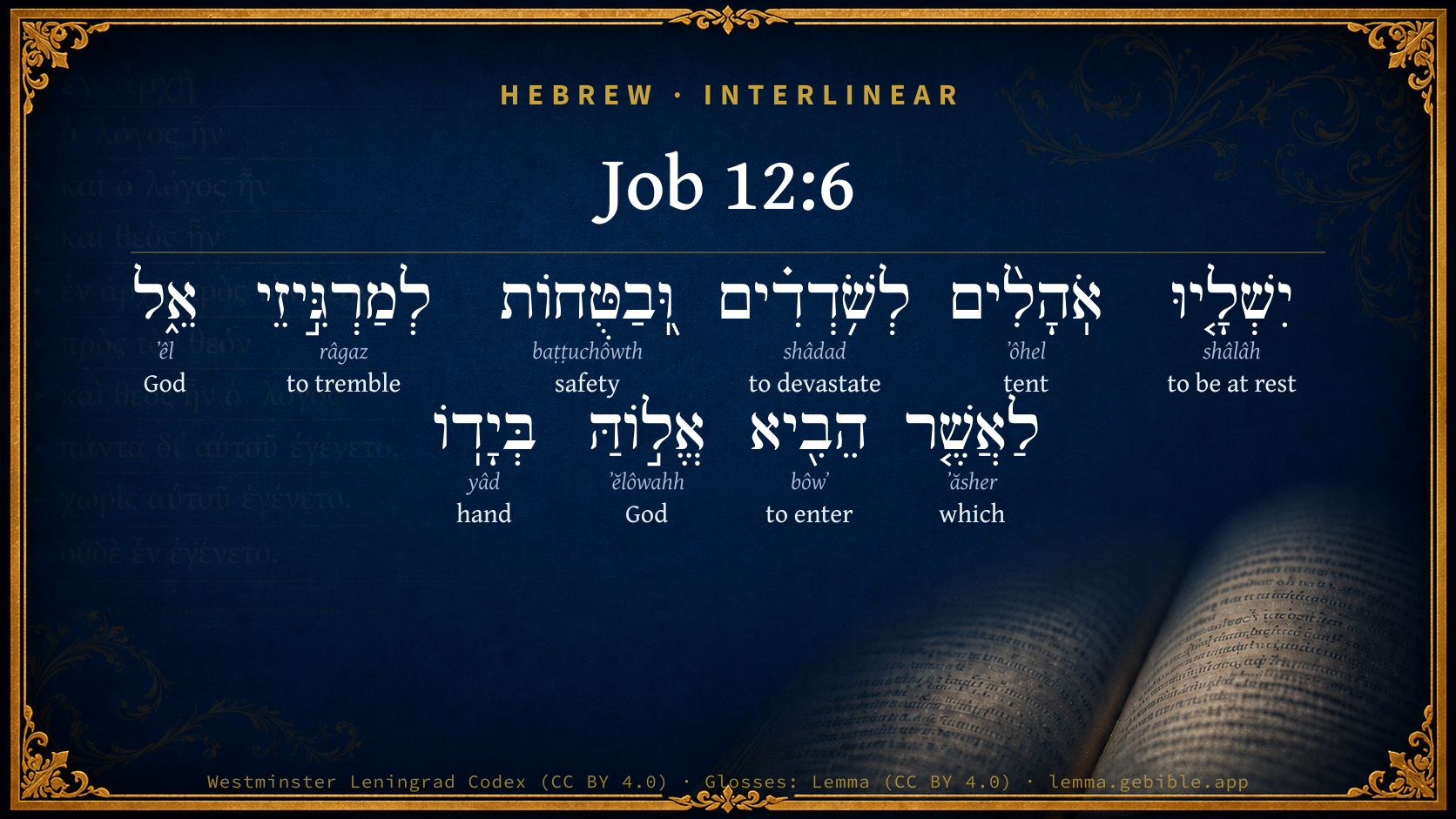
Hebrew (Westminster Leningrad Codex) Job 12:6 appears in the Hebrew Old Testament. The text above is from the Westminster Leningrad Codex. Each word links to its Strong’s number, a concise gloss, and parsing drawn from the Open Scriptures Hebrew Bible morphology. Click any word for its full Brown-Driver-Briggs (BDB) entry.
Download image
Cite this verse

Job 12:6 (World English Bible). Public Domain. Lemma interlinear Bible study tool, https://lemma.gebible.app/v/job/12/6.

Show BibTeX & RIS
BibTeX
RIS
English Translation
The tents of robbers prosper, Those who provoke God are secure; Who carry their God in their hands.
World English Bible · Public Domain
Highlights
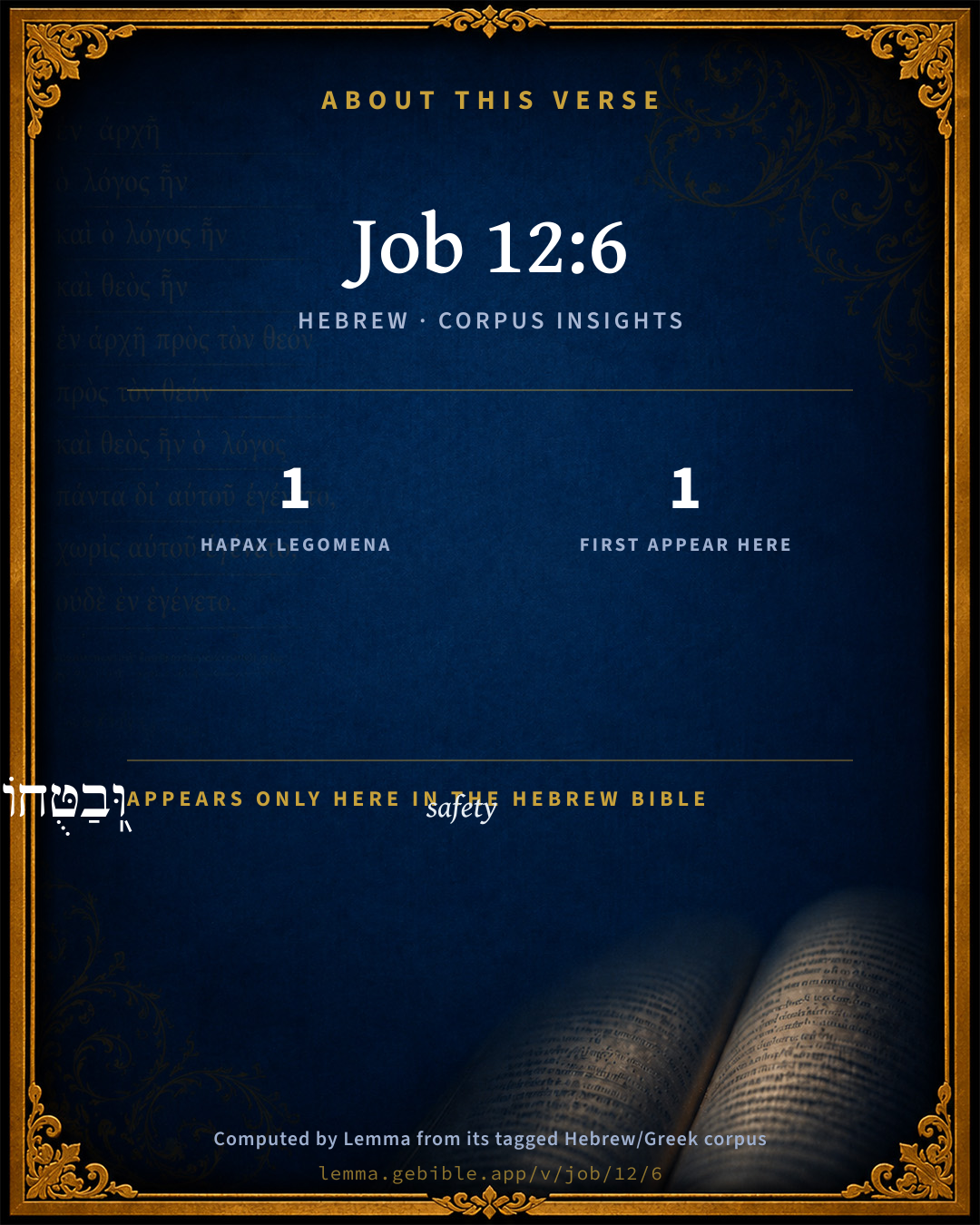
  • 1 hapax legomenon — only here in the Hebrew Bible
  • 1 first appearance in the Hebrew Bible
Full analysis ↓
Download a study sheet

One document with this verse’s original text, its word-by-word gloss line, the meaning frame, cross-references with their text, attributed commentary, and full source and license credits — printable, and it pastes into notes with its structure intact.

This verse Autodidact and up

Study sheet (.html) Plain text (.txt)

A passage Seminary Student

Up to 50 verses in one chapter. A passage sheet keeps up to 6 commentary sources and 12 cross-references per verse, in the order this page ranks them, and says so on the sheet whenever that leaves anything out. Ask for a single verse and you get the Autodidact verse sheet above.

Everything on this page stays free to read, with no account — the sheet is a download of what is already on screen, not access to it.

Want to remove ads? Support Godless Engineer
Compare translations 3

The same verse in 3 English versions, stacked beneath the original-language interlinear above. Click any original word for its lexicon entry.

Each is an independent rendering of the whole verse — the interlinear is not word-aligned to these translations.

Highlighted words mark where these versions differ — a whole-verse word diff, not a word-by-word alignment.

  • World English Bible Public Domain
    The tents of robbers prosper, Those who provoke God are secure; Who carry their God in their hands.
  • King James Version Public Domain
    The tabernacles of robbers prosper, and they that provoke God are secure; into whose hand God bringeth abundantly.
  • unfoldingWord Literal Text CC BY-SA 4.0
    The tents of robbers prosper, and securities to the provokers of God, to who carries God in his hand.

unfoldingWord Literal Text — © unfoldingWord, licensed CC BY-SA 4.0. Word-aligned USFM3 via Door43 (git.door43.org/unfoldingWord/en_ult).

Versions to compare (up to 4)

3 of 4 selected

Show all 18 translations

Every available English version of this verse, each an independent rendering of the whole verse.

  • World English Bible Public Domain
    The tents of robbers prosper, Those who provoke God are secure; Who carry their God in their hands.
  • Berean Standard Bible Public Domain
    The tents of robbers are safe, and those who provoke God are secure—those who carry their god in their hands.
  • Majority Standard Bible Public Domain
    The tents of robbers are safe, and those who provoke God are secure—those who carry their god in their hands.
  • King James Version Public Domain
    The tabernacles of robbers prosper, and they that provoke God are secure; into whose hand God bringeth abundantly.
  • American Standard Version (1901) Public Domain
    The tents of robbers prosper, And they that provoke God are secure; Into whose hand God bringeth `abundantly'.
  • Revised Version (1885) Public Domain
    The tents of robbers prosper, and they that provoke God are secure; into whose hand God bringeth abundantly.
  • Geneva Bible (1599) Public Domain
    The tabernacles of robbers doe prosper, and they are in safetie, that prouoke God, whome God hath enriched with his hand.
  • Douay-Rheims (1899) Public Domain
    The tabernacles of robbers abound, and they provoke God boldly; whereas it is he that hath given all into their hands:
  • Young's Literal Translation Public Domain
    At peace are the tents of spoilers, And those provoking God have confidence, He into whose hand God hath brought.
  • Literal Standard Version CC BY-SA 4.0
    The tents of spoilers are at peace, || And those provoking God have confidence, || Into whose hand God has brought.
  • Unlocked Literal Bible CC BY-SA 4.0
    The tents of robbers prosper, and those who provoke God feel secure; their own hands are their gods.
  • unfoldingWord Literal Text CC BY-SA 4.0
    The tents of robbers prosper, and securities to the provokers of God, to who carries God in his hand.
  • Darby Bible Public Domain
    The tents of desolators are in peace, and they that provoke ùGod are secure; into whose hand +God bringeth.
  • World Messianic Bible Public Domain
    The tents of robbers prosper. Those who provoke God are secure, who carry their god in their hands.
  • Webster's Bible Public Domain
    The tabernacles of robbers prosper, and they that provoke God are secure; into whose hand God bringeth abundantly.
  • Free Bible Version CC BY-SA 4.0
    Robbers live in peace, and those who make God angry live in safety, trusting their own strength as their ‘god.’
  • Bible in Basic English Public Domain
    There is wealth in the tents of those who make destruction, and those by whom God is moved to wrath are safe; even those whose god is their strength.
  • JPS Tanakh (1917) Public Domain
    The tents of robbers prosper, and they that provoke God are secure, in whatsoever God bringeth into their hand.

Literal Standard Version (2020), Covenant Press — licensed CC BY-SA 4.0. Text via the HelloAO Bible API (eBible.org). Unlocked Literal Bible (unfoldingWord) — licensed CC BY-SA 4.0. Text via the HelloAO Bible API (eBible.org). unfoldingWord Literal Text — © unfoldingWord, licensed CC BY-SA 4.0. Word-aligned USFM3 via Door43 (git.door43.org/unfoldingWord/en_ult). Free Bible Version, Dr. Jonathan Gallagher — licensed CC BY-SA 4.0. Text via the HelloAO Bible API (eBible.org).

Word by word

More ways to search: Search by grammar → Find every occurrence → Compare this word →

Practice this passage: Drill this verse → Learn its vocabulary →

וּֽ֭בַטֻּחוֹת
baṭṭuchôwth
H987
“and · safety”
Conjunction + Noun, Common, Feminine, Plural, Absolute
Part of Speech
Conjunction + Noun
Type
Common
Gender
Feminine
Number
Plural
State
Absolute
Full BDB Definition

Origin: from H982

TWOT: 233d

security, safety
  1. יִשְׁלָ֤יוּ shâlâh H7951 “to be at rest” Verb, Qal, Imperfect, 3rd Person, Masculine, Plural
  2. אֹֽהָלִ֨ים ʼôhel H168 “tents” Noun, Common, Masculine, Plural, Absolute
  3. לְשֹׁ֥דְדִ֗ים shâdad H7703 “to/for · devastating” Preposition + Verb, Qal, Participle Active, Masculine, Plural, Absolute
  4. לְמַרְגִּ֣יזֵי râgaz H7264 “to/for · trembling” Preposition + Verb, Hiphil, Participle Active, Masculine, Plural, Construct
  5. אֵ֑ל ʼêl H410 “God” Noun, Common, Masculine, Singular, Absolute
  6. לַאֲשֶׁ֤ר ʼăsher H834 “to/for · which” Preposition + Particle, Relative
  7. הֵבִ֖יא bôwʼ H935 “to enter” Verb, Hiphil, Perfect, 3rd Person, Masculine, Singular
  8. אֱל֣וֹהַּ ʼĕlôwahh H433 “God” Noun, Common, Masculine, Singular, Absolute
  9. בְּיָדֽוֹ yâd H3027 “in/at · hand · his” Preposition + Noun, Common, Both, Singular, Construct + Suffix, Personal, 3rd Person, Masculine, Singular

About this verse

These counts appear in no published source. They are computed here, from the morphology-tagged text and Lemma’s own curated glosses. What Lemma adds →

10
words
10
distinct lemmas
Wisdom
section

Notable vocabulary

1 hapax legomenon — a word that appears only here in the entire Hebrew Bible:

  • וּֽ֭בַטֻּחוֹת safety H987

First appearance in Scripture

This word makes its first canonical appearance in the Hebrew Bible here:

  • וּֽ֭בַטֻּחוֹת safety H987

Shared distinctive vocabulary

יִשְׁלָ֤יוּ to be at rest H7951 occurs in 5 verses of the Hebrew Bible. Also found in:

Grammatical profile

  • 4 verbs
  • 5 nouns
  • 1 particle

Verb forms

  • יִשְׁלָ֤יוּ Qal · Imperfect
  • לְשֹׁ֥דְדִ֗ים Qal · Participle Active
  • לְמַרְגִּ֣יזֵי Hiphil · Participle Active
  • הֵבִ֖יא Hiphil · Perfect

Hebrew & Septuagint length

In English translation the verse runs 18 words from the Hebrew and 19 from the Septuagint (LXX English) — closely comparable.

A rough comparison of the two English renderings, which tokenize alike — not a word-level alignment.

Word counts can differ between the Hebrew and the Greek without any difference in meaning — e.g. the Hebrew direct-object marker אֵת has no separate Greek word, and Greek often adds the article ὁ.

Cross-references

8

Topical passages linked to Job 12:6 in the Treasury of Scripture Knowledge — connected by theme and wording, ordered by reader-vote popularity; previews shown in the World English Bible.

  • Job 9:24 The earth is given into the hand of the wicked. He covers the faces of the judges of it. If not he, then who is it?
  • Psalms 73:11–12 They say, "How does God know? Is there knowledge in the Most High?"
  • Job 21:7–15 "Why do the wicked live, Become old, yes, and grow mighty in power?
  • Psalms 17:14 From men by your hand, Yahweh, From men of the world, whose portion is in this life. You fill the belly of your cherished ones. Your sons have plenty, And they store up wealth for their children.
  • Psalms 37:1 Don't fret because of evil-doers, Neither be envious against those who work unrighteousness.
  • Psalms 37:35 I have seen the wicked in great power, Spreading himself like a green tree in its native soil.
  • Job 22:18 Yet he filled their houses with good things, But the counsel of the wicked is far from me.
  • Jeremiah 5:27 As a cage is full of birds, so are their houses full of deceit: therefore they are become great, and grew rich.

Cross-references courtesy of OpenBible.info (CC BY 4.0).

Hebrew and Greek witnesses Masoretic Hebrew ↔ Greek Septuagint

The same verse in the two great witnesses to the Old Testament, shown verse-for-verse.

These are two independent witnesses, not word-aligned to each other, and the Septuagint is shown in lemma (dictionary) form.

Hebrew Job 12:6 Masoretic · Westminster Leningrad Codex

יִשְׁלָ֤יוּ אֹֽהָלִ֨ים לְשֹׁ֥דְדִ֗ים וּֽ֭בַטֻּחוֹת לְמַרְגִּ֣יזֵי אֵ֑ל לַאֲשֶׁ֤ר הֵבִ֖יא אֱל֣וֹהַּ בְּיָדֽוֹ

The tents of robbers prosper, Those who provoke God are secure; Who carry their God in their hands.

World English Bible · Public Domain

Greek LXX Job 12:6 Septuagint · lemma form

οὐ μήν δέ ἀλλά μηδείς πείθω πονηρός εἰμί ἀθῷος εἰμί ὅσος παραὀργίζω ὁ κύριος ὡς οὐ καί ἔτασις αὐτός εἰμί

even as many as provoke the Lord, as if there were indeed to be no inquisition made of them.

LXX2012 (modern English Septuagint) · Public Domain

On this verse, Albert Barnes' Notes on the Bible discusses the Septuagint’s reading. Read the note in Commentary ↓

Hebrew: Westminster Leningrad Codex (CC BY 4.0). Greek: Septuagint (public domain); English from LXX2012 (modern English Septuagint) (Public Domain). How the Septuagint differs from the Hebrew →

Commentary

Notes on Job 12:6 from classic Christian and Jewish commentators (each source and its license shown beneath its notes). The classic Christian expositions comment on the surrounding passage and are grouped to its opening verse, so a note may address several verses; the Jewish commentaries on the Tanakh (Rashi and others) are per-verse, so they appear only where the commentator wrote on this verse.

Lemma curates 59 commentaries, every one of them public domain or Creative Commons licensed, each selected and text-cleaned for this edition rather than reprinted as found. About our sources →

Matthew Henry's Commentary

Job's friends all of them went upon this principle, that wicked people cannot prosper long in this world, but some remarkable judgment or other will suddenly light on them: Zophar had concluded with it, that the eyes of the wicked shall fail, Job 11:20. This principle Job here opposes, and maintains that God, in disposing men's outward affairs, acts as a sovereign, reserving the exact distribution of rewards and punishments for the future state.

I. He asserts it as an undoubted truth that wicked people may, and often do, prosper long in this world, Job 12:6. Even great sinners may enjoy great prosperity. Observe, 1. How he describes the sinners. They are robbers, and such as provoke God, the worst kind of sinners, blasphemers and persecutors. Perhaps he refers to the Sabeans and Chaldeans, who had robbed him, and had always lived by spoil and rapine, and yet they prospered; all the world saw they did, and there is no disputing against sense; one observation built upon matter of fact is worth twenty notions framed by an hypothesis. Or more generally, All proud oppressors are robbers and pirates. It is supposed that what is injurious to men is provoking to God, the patron of right and the protector of mankind. It is not strange if those that violate the bonds of justice break through the obligations of all religion, bid defiance even to God himself, and make nothing of provoking him. 2. How he describes their prosperity. It is very great; for, (1.) Even their tabernacles prosper, those that live with them and those that come after them and descend from them. It seems as if a blessing were entailed upon their families; and that is sometimes preserved to succeeding generations which was got by fraud. (2.) They are secure, and not only feel no hurt, but fear none, are under no apprehensions of danger either from threatening providences or an awakened conscience. But those that provoke God are never the more safe for their being secure. (3.) Into their hand God brings abundantly. They have more than heart could wish (Psa 73:7), not for necessity only, but for delight - not for themselves only, but for others - not for the present only, but for hereafter; and this from the hand of Providence too. God brings plentifully to them. We cannot therefore judge of men's piety by their plenty, nor of what they have in their heart by what they have in their hand.

II. He appeals even to the inferior creatures for the proof of this - the beasts, and fowls, and trees, and even the earth itself; consult these, and they shall tell thee, Job 12:7, Job 12:8. Many a good lesson we may learn from them, but what are they here to teach us?

1. We may from them learn that the tabernacles of robbers prosper (so some); for, (1.) Even among the brute creatures the greater devour the less and the stronger prey upon the weaker, and men are as the fishes of the sea, Hab 1:14. If sin had not entered, we may suppose there would have been no such disorder among the creatures, but the wolf and the lamb would have lain down together. (2.) These creatures are serviceable to wicked men, and so they declare their prosperity. Ask the herds and the flocks to whom they belong, and they will tell you that such a robber, such an oppressor, is their owner: the fishes and fowls will tell you that they are served up to the tables, and feed the luxury, of proud sinners. The earth brings forth her fruits to them (Job 9:24), and the whole creation groans under the burden of their tyranny, Rom 8:20, Rom 8:22. Note, All the creatures which wicked men abuse, by making them the food and fuel of their lusts, will witness against them another day, Jam 5:3, Jam 5:4.

2. We may from them learn the wisdom, power, and goodness of God, and that sovereign dominion of his into which plain and self-evident truth all these difficult dispensations must be resolved. Zophar had made a vast mystery of it, Job 11:7. "So far from that," says Job, "that what we are concerned to know we may learn even from the inferior creatures; for who knows not from all these? Job 12:9. Any one may easily gather from the book of the creatures that the hand of the Lord has wrought this," that is, "that there is a wise Providence which guides and governs all these things by rules which we are neither acquainted with nor are competent judges of." Note, From God's sovereign dominion over the inferior creatures we should learn to acquiesce in all his disposals of the affairs of the children of men, though contrary to our measures.

III. He resolves all into the absolute propriety which God has in all the creatures (Job 12:10): In whose hand is the soul of every living thing. All the creatures, and mankind particularly, derive their being from him, owe their being to him, depend upon him for the support of it, lie at his mercy, are under his direction and dominion and entirely at his disposal, and at his summons must resign their lives. All souls are his; and may he not do what he will with his own? The name Jehovah is used here (Job 12:9), and it is the only time that we meet with it in all the discourses between Job and his friends; for God was, in that age, more known by the name of Shaddai - the Almighty.

IV. Those words - (Job 12:11), Doth not the ear try words, as the mouth tastes meat? may be taken either as the conclusion to the foregoing discourse or the preface to what follows. The mind of man has as good a faculty of discerning between truth and error, when duly stated, as the palate has of discerning between what is sweet and what is bitter. Job therefore demands from his friends a liberty to judge for himself of what they had said, and desires them to use the same liberty in judging of what he had said; nay, he seems to appeal to any man's impartial judgment in this controversy; let the ear try the words on both sides, and it would be found that he was in the right. Note, The ear must try words before it receives them so as to subscribe to them. As by the taste we judge what food is wholesome to the body and what not, so by the spirit of discerning we must judge what doctrine is sound, and savoury, and wholesome, and what not, Co1 10:15; Co1 11:13.

Matthew Henry's Commentary on the Whole Bible (1708–1710) — public domain (CC PDM 1.0). Text via the HelloAO Bible API.

Trapp's Complete Commentary

John Trapp

Job 12:6 The tabernacles of robbers prosper, and they that provoke God are secure; into whose hand God bringeth [abundantly].

Ver. 6. The tabernacles of robbers prosper] By robbers here understand all such as sin against the second table, but especially oppressors and wrong dealers, whether by force or fraud. As by those that provoke God ( qui res Dei interturbant, so the Tigurines translate), that irritate and disquiet him, attempting to put him out of temper, are meant sinners against the first table. See the like 1Ti 1:13 : I was against God a blasphemer, against man a persecutor, against both injurious; but I obtained mercy, special mercy. So do not these robbers and God-provokers in the text: thrive they may, and be in a peaceable condition; yea, they may be secure and confident of the continuance of their prosperity. Confidences are to them, saith the Hebrew, verity; for they trust in uncertain riches, while God bringeth into their hands, viz. whatsoever they wish, yet not as love tokens, but as wrath tokens; these fatting beasts are but fitting for the slaughter. God oft giveth in wrath to some which he withholdeth from others in great mercy. Meanwhile Zophar’s twofold assertion in the former chapter, Job 12:17; Job 12:20, that good men prosper here, and bad men suffer, falls to the ground, while Job disproves it, 1. By experience in this verse and the former. 2. By the testimony of the creatures, those catholic preachers, Job 12:7-25. By the testimony of the senses, and of ancient men, Job 12:11-12.

John Trapp, A Commentary or Exposition upon All the Books of the Old and New Testament (1647–1656) — public domain. Text from a community e-Sword module.

Joseph Benson's Commentary

Job 12:6. The tabernacles of robbers prosper — Job’s friends had all supposed that wicked men cannot prosper long in the world. This Job opposes, and maintains that God herein acts as sovereign, and reserves that exact distribution of rewards and punishments for the other world. As if he had said, Thy opinion, O Zophar, (see Job 11:14, &c.,) is confuted by daily experience; which shows that very wicked, injurious, and impudent oppressors, tyrants, and robbers, are so far from always meeting with those disappointments and miseries of which thou spakest as being their certain portion, that they frequently succeed in their iniquitous and daring enterprises, flourish in wealth and glory, and fill their houses with the goods of others, which they violently took away; of which the Chaldeans and Sabeans (Job 1:15; Job 1:17) are a present and striking evidence. And they that provoke God are secure — They, whose common practice it is to despise and provoke God, are confident and safe, apparently living without danger or fear. Into whose hands God bringeth abundantly — So far is God from crushing such persons, that he seems to favour them with wonderful success; by his providence, puts into their hands the opportunities which they seek, of enriching themselves by injustice and oppression, and the persons and goods of other more righteous men, for which they lie in wait.

Joseph Benson's Commentary on the Old and New Testaments (1811–1818) — public domain. Text from a community e-Sword module.

Geneva Bible (1599)

Geneva Bible translators

Hebrew, to whom God hath brought in with his hand.

Geneva Bible (1599) marginal notes — public domain. Text via Bolls.life.

Jamieson, Fausset & Brown

Robert Jamieson, A. R. Fausset & David Brown

Job shows that the matter of fact opposes Zophar's theory (Job 11:14, Job 11:19-20) that wickedness causes insecurity in men's "tabernacles." On the contrary, they who rob the "tabernacles" ("dwellings") of others "prosper securely" in their own.

into whose hand, &c.--rather, "who make a god of their own hand," that is, who regard their might as their only ruling principle [UMBREIT].

Jamieson, Fausset & Brown — Commentary Critical and Explanatory on the Whole Bible (1871) — public domain (CC PDM 1.0). Text via the HelloAO Bible API.

Adam Clarke's Commentary

Verse 6. The tabernacles of robbers prosper.] Those who live by the plunder of their neighbours are often found in great secular prosperity; and they that provoke God by impiety and blasphemy live in a state of security and affluence. These are administrations of Providence which cannot be accounted for; yet the Judge of all the earth does right. Therefore prosperity and adversity are no evidences of a man's spiritual state, nor of the place he holds in the approbation or disapprobation of God.

Adam Clarke's Commentary on the Bible (1810–1826) — public domain. Text from a community e-Sword/MySword module.

Ellicott's Commentary for English Readers

(6) Into whose hand God bringeth abundantly.—Some understand these words, to him that bringeth his god in his hand (comp. Hab_1:11; Hab_1:16); but the other seems more in accordance with the usage. (Comp., e.g., Pro_3:27, &c.)

A Bible Commentary for English Readers, edited by Charles John Ellicott (1878–1897) — public domain. Text from a community e-Sword module.

The Cambridge Bible for Schools and Colleges

gen. ed. J. J. S. Perowne

6. The other side of the picture, the peace of the wicked.

into whose hand God bringeth abundantly] The words might also mean: they who carry (their) god in their hand, the idea being that their god is their own strong hand or the weapon in it; cf. what the prophet says of the Chaldeans, This their power is their god, Hab_1:11 with Job_12:16. The commentators quote from Vergil the words of the contemptor deorum, dextra mihi deus, and Hitzig refers to Ammianus, 17. 12, who says of some Scythian tribes, mucrones pro numinibus colunt. In Job_12:5 Job said that the afflicted righteous were despised; the strict antithesis would have been that the prosperous wicked received respect; but Job, with the keen eye which he has at present for the anomalies of the Divine government, attributes the peace of the wicked to God, though they recognise no God but their own strong arm. Cf. ch. Job_5:24.

The Cambridge Bible for Schools and Colleges (gen. ed. J. J. S. Perowne; Cambridge University Press, 1878–1918) — public domain. Text from a community e-Sword module.

John Gill's Exposition

But ask now the beasts, and they shall teach thee,.... And so the fowls of the air, and the fishes of the sea, in this and Job 12:8; from those instructions may be learned, of instances taken, and examples given, which may illustrate and confirm the same things that had been treated of: either what had been just now confuted, that it is always well with good men, and ill with bad men; the reverse of which had been affirmed and proved, that good men are afflicted, and wicked men prosper; something like to which may be seen in the creatures, and learned of them; thus those creatures that are the most harmless and innocent, and most useful and beneficial, are a prey to others, as sheep and lambs to lions, wolves, and bears, while they range about forests, fields, and plains, fearless and unmolested; and doves and turtles to hawks and vultures; and the lesser fish to the greater, by whom they are devoured, see Hab 1:13; and moreover, these creatures which are most useful and profitable, or are for pleasure and delight, fall more to the share of wicked men than good men; when droves of cattle and flocks of sheep are observed, and the question is put, to whom do they belong? the answer for the most part must be given, to such and such wicked men; and if the gold and silver, and other valuable things the earth produces, should be inquired about whose they are, it must be said, that they are, generally speaking, the property of the men of the world, the profane part of it; or if the fowls of the air, and fishes of the sea, could speak, when asked the question, whose food they commonly were? the answer would be, of the carnal, sensual, and voluptuous men: or rather this may refer to what Job first takes notice of in this answer of his, that his friends represented what they said as uncommon things, deep mysteries, and out of the reach of the vulgar, and which did not fall under common observation; whereas Job suggests he was as well acquainted with them as they were, yea, they were such that almost everybody knew; nay, they might be learnt from the creatures, to which Job here sends them for instruction; the beasts, birds, and fishes, all proclaim that they did not make themselves, nor did their fellow creatures, but some first cause, who is God: that they are sustained, supported, and provided for by him, and are governed, directed, and disposed of as he pleases, and so furnishes out documents of his sovereignty, wisdom, power, and providence:

and the fowls of the air, and they will tell thee: the same things; that God made them, and that they are dependent on him, and are fed and cared for by him, see Mat 6:26.

John Gill's Exposition of the Whole Bible (1746–1763) — public domain (CC PDM 1.0). Text via the HelloAO Bible API.

Albert Barnes' Notes on the Bible

The tabernacles of robbers prosper - The tents or dwellings of robbers are safe and secure. This is Job’s original proposition, to which he all along adheres. It is, that God does not deal with people in this life according to their character; and in support of this he now appeals to the fact that the tents or dwellings of robbers are safe. Arabia would furnish many illustrations of this, which could not be unknown to the friends of Job. The Arabs dwelt in tents, and they were then, as now, wandering, predatory tribes. They lived, to a great extent, by plunder, and doubtless Job could appeal to the observation of his friends for the proof of this. He affirms that so far from dealing with people according to their character, God often seemed to protect the public robber, and the blasphemer of his name.

Prosper - They are secure, tranquil, at rest - for so the Hebrew word means. They are not disturbed and broken in upon.

And they that provoke God - Or rather, “the tents are secure to those who provoke God.” Dr. Good renders it, “and are fortresses to those who provoke God;” but the true idea is, that the tents of those who provoke God by their conduct are safe. God does not seem to notice them, or to come out in judgment against them.

Into whose hand God bringeth abundantly - Dr. Noyes renders this, “who carry their God in their hand;” but with much less accuracy, as it seems to me, than commonly characterizes his version. Eichhorn renders it in a sense somewhat similar:

Die ihre Faust fur ihre Gottheit achten -

“Who regard their fist as their God.”

And so Stuhlman renders it:

Und wem die Faust fur Gottheit gilt -

“And to whom the fist avails for their God;”

That is, says he, Job means that this is the course of the world. Dr. Good renders it, “of him who hath created all these things with his hand” - still less accurately. In order to this, he is obliged to suppose an error in the text, but without the slightest authority. Jerome renders it as in our version. The Septuagint, “who provoke the Lord as if there would be no trial to them - ἔτασις αὐτῶν etasis autōn - here-after;” which certainly makes sense, but it was never obtained from the Hebrew. Rosenmuller renders it, “who have their own hand, that is, power for God;” a description, says he, of a wicked and violent man who thinks it right for him to do as he pleases. It seems to me, however, that the common interpretation, which is the most simple, is most in accordance with the Hebrew, and with the drift of the passage. According to this it means, that there is security to the man who lives to provoke that God who is constantly bringing to him in abundance the tokens of kindness. This is the fact on which Job is insisting - that God does not treat people in this world according to their real character, but that the wicked are prospered and the righteous are afflicted.

Albert Barnes' Notes on the Bible (1834–1885) — public domain. Text from a community e-Sword/MySword module.

Haydock's Catholic Bible Commentary

Abound. Hebrew, "are at peace." (Calmet) --- The prosperity of the wicked is therefore no proof that they are pleasing to him. (Haydock) --- All nature testifies that God exercises a sovereign dominion over his works. He may therefore cause the just to suffer, though they be guiltless. This is one of Job’s grand maxims. (Calmet)

George Leo Haydock (1774–1849), Haydock's Catholic Family Bible and Commentary, 1859 edition — public domain. Excludes Psalms (Douay-Rheims chapter numbering differs from Protestant) and Deuterocanonical books (Catholic canon only).

Matthew Poole's English Annotations

The tabernacles of robbers prosper: thy opinion, delivered Job 11:14, &c, is confuted by daily experience; which shows that the most wicked, and injurious, and impudent oppressors, tyrants, and robbers, are so far from meeting with those disappointments and miseries wherewith thou didst threaten them, that they commonly succeed in their cursed enterprises, and flourish in wealth and glory, and fill their houses with the goods of others which they violently took away; whereof the Chaldeans and Sabeans, Job 1:15,17, are a present and pregnant evidence.

They that provoke God are secure; they whose common practice it is to despise and provoke God are confident and secure, live without danger or fear.

Into whose hand God bringeth abundantly; so far is God from crushing such persons, that he seems to favour them with wonderful success, and by his special and more than common providence puts into their hands the opportunities which they seek, and the persons and goods of other more righteous men, which they lie in wait for.

Matthew Poole's English Annotations on the Holy Bible (1683–1685) — public domain. Text from a community e-Sword/MySword module.

Whedon's Commentary on the Bible

Daniel D. Whedon

6. Tabernacles of robbers prosper — Literally, Are at peace. Zophar had spoken of the security of the tabernacle where virtue dwelt; (Job_11:14-19;) Job adduces other matters of fact — vice has also its security.

In ancient Egypt robbing was regarded as a necessity of its civilization, and was treated as a profession. Those who followed the craft “gave in their names to the chief of the robbers, and agreed that he should be informed of every thing that they should thence forward steal, the moment it was in their possession. In consequence of this the owner of the lost goods always applied by letter to the chief for their recovery.” — WILKINSON’S Anc. Egyptians, Pop. Acct., 2:216. Into whose hand God bringeth — Now generally rendered, he who brings God in his hand, (Ewald, etc.,) that is, who either deifies his hand, or, as some say, that which is taken into the hand. Thus Mezentius says, “Dextra mihi Deus — My right hand is God.” — AEneid, 10:773. Habakkuk speaks in like manner of the Chaldaean:

Literally, This its strength is its God. Job_1:11.

Daniel D. Whedon (gen. ed.), Commentary on the Old and New Testaments (1874–1909) — public domain. Text from a community e-Sword module.

The Pulpit Commentary

The tabernacles of robbers prosper. Having set at rest the personal question between himself and his friends, Job reverts to his main argument, and maintains that, the whole course of mundane events being under God"s governance, all the results are to be attributed to him, and among them both the prosperity of the wicked, and, by parity of reasoning, the sufferings of the righteous. And they that provoke God are secure. (Job_9:24 Job_10:3) Into whose hand God bringeth abundantly. So both the Authorized and the Revised Versions; but recent critics mostly render, "who bring their God in their hand," i.e. "who regard their own right hand as their God" (comp. Virgil, "Aen., 10:773, "Dextra mihi Dens")

The Pulpit Commentary (1880–1919), ed. H.D.M. Spence-Jones & Joseph S. Exell — public domain. Text from a community e-Sword module.

John Wesley's Explanatory Notes

Are secure - Job's friends had all supposed, that wicked men cannot prosper long in the world. This Job opposes, and maintains, that God herein acts as sovereign, and reserves that exact distribution of rewards and punishments for the other world.

John Wesley, Explanatory Notes Upon the Whole Bible (1754–1765) — public domain. Text via the GEBible commentary corpus.

Rashi

Rabbi Shlomo Yitzchaki (Rashi)

prosper I know that at times tents will prosper, namely those of the Kedarites who dwell in tents in the deserts, and who are robbers, as it is stated (Gen. 16:12): “a free man among men; his hand shall be against every man.”

are secure Those who provoke God have perfection, anyone to whom the Rock brought peace with His hand, whether he is good or bad.

Rashi on the Tanakh — English translations: “The Judaica Press complete Tanach with Rashi, translated by A. J. Rosenberg” (CC BY 4.0); “Pentateuch with Rashi's commentary by M. Rosenbaum and A.M. Silbermann, 1929-1934” (public domain); “The Metsudah Tanach series, Lakewood, N.J” (CC BY 4.0); and “The Book of Joshua, Metsudah Publications, 1997” (CC BY 4.0). Text via Sefaria.

Lesson kit

Teaching starters — assembled from the data on this page, not authored interpretation. Every prompt links to the verse data it draws on. Edit before teaching.

Job, in the Wisdom, opens this verse with 10 words (10 distinct Hebrew lemmas). Its most distinctive word is baṭṭuchôwth (“safety”). A historical commentator’s framing appears above. Read the whole chapter for the surrounding context.

Discussion questions

  1. How does “safety” (baṭṭuchôwth) shape what this verse is saying?
  2. This verse holds 1 word here found nowhere else in the Hebrew Bible. What might the rare word draw attention to?
  3. The word “safety” first appears here in Scripture. What is being introduced at this debut?
  4. Job 3:26 shares the word «to be at rest» with this verse. How do the two illuminate each other?
  5. The translations on this page render this verse differently — a whole-verse word diff, not a word-by-word alignment. What might account for the different wordings?
  6. The verb «יִשְׁלָ֤יוּ» is Qal Imperfect. How does its form color the action?
  7. Reading how Matthew Henry's Commentary and Trapp's Complete Commentary read this verse, where do the two commentators agree and where do they part?

Things to notice

  • 1 word in this verse appears nowhere else in the Hebrew Bible.
  • 1 word makes its first canonical appearance in Scripture here.
  • These translations choose different wording for 15 words in this verse.
  • 10 distinct Hebrew lemmas span 10 words in this verse.

Reading settings

Reading text

Shown beneath each verse's original-language words.

Old Testament
Old Testament edition

Read the OT as the Masoretic Hebrew (MT) or the Greek Septuagint (LXX).

English shown for the Greek Septuagint (in the Hebrew ↔ Greek comparison).

Comparing translations? Open the Compare panel on any verse page to stack up to four side by side.