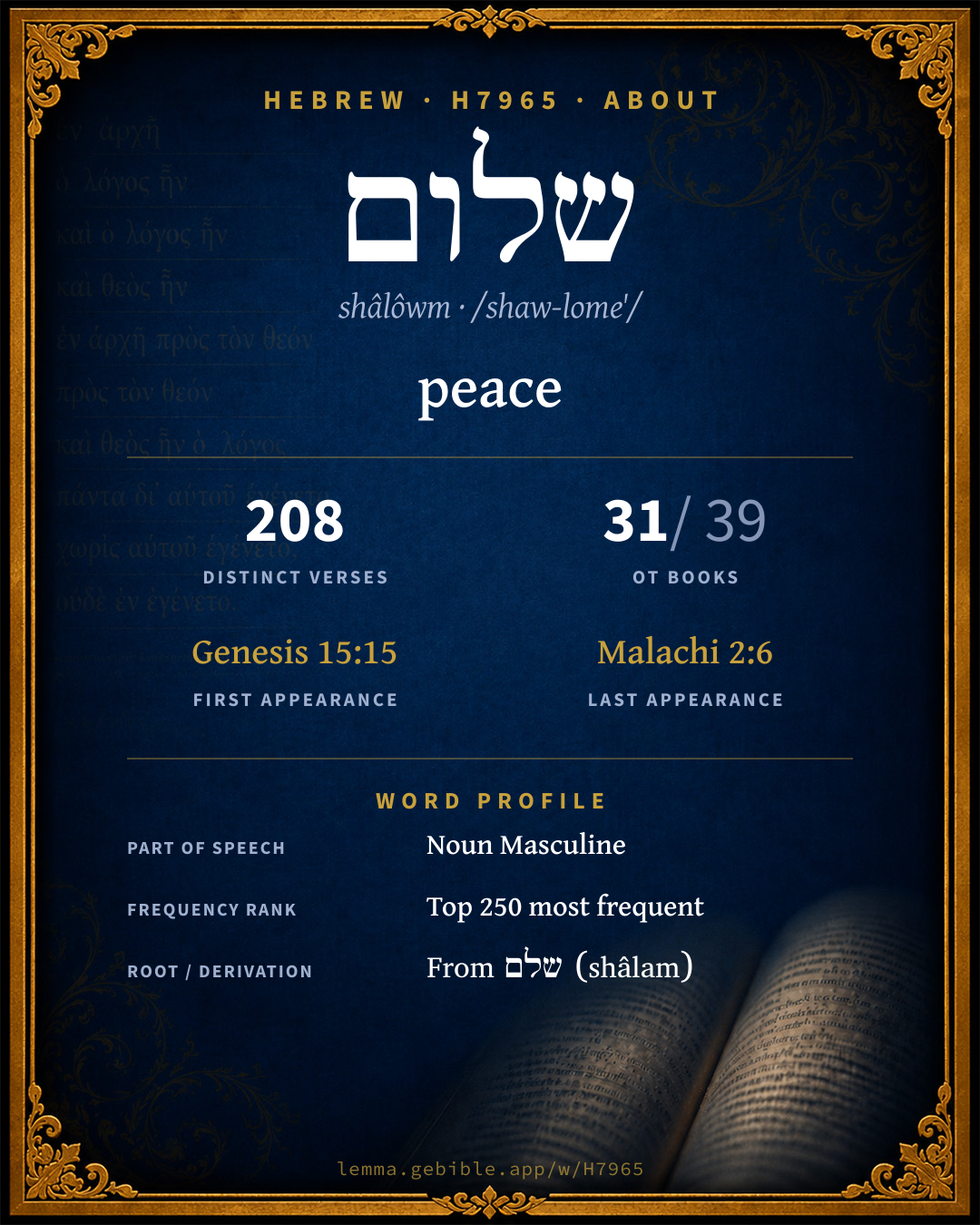
שָׁלוֹם
peace
also: completeness, soundness, welfare fuller range ↓
Full lexicon entry — Brown-Driver-Briggs (BDB)
From Brown-Driver-Briggs (BDB)
Where this word appears
See every Absolute-state word in the Hebrew Bible →
Grammar key — what these labels mean
Part of speech
- Noun
- A naming word — a person, place, thing, or idea.
Noun type
- Common
- A common noun — a general class of person, place, or thing (“king,” “city,” “water”), not a specific name.
State
- Absolute
- The independent form of a noun, not bound to a following word.
- Construct
- A noun bound to a following noun in a possessive / “of” relationship (the construct chain).
Gender
- Masculine
- Grammatically masculine.
Number
- Singular
- One.
- Plural
- More than one (in Hebrew, generally three or more).
13 verses where H7965 appears in the Absolute state in the Book of 2 Samuel. Filtered view — show all forms. Click any verse to open its interlinear word-by-word view. Verse text shown in the World English Bible for context — . Each verse’s Hebrew form is shown with its reference; the English is not keyword-highlighted, since the data carries no word-level English alignment. Use “Compare translations” on any verse to read it across multiple English versions. This concordance covers the Hebrew Bible; Septuagint (Greek Old Testament) occurrences are not indexed here.
2 Samuel
- 2 Samuel 3:21 בְּ/שָׁלֽוֹם prep + n c ms Abner said to David, I will arise and go, and will gather all Israel to my lord the king, that they may make a covenant with you, and that you may reign over all that your soul desires. David sent Abner away; and he went in peace.
- 2 Samuel 3:22 בְּ/שָׁלֽוֹם prep + n c ms Behold, the servants of David and Joab came from a foray, and brought in a great spoil with them: but Abner was not with David in Hebron; for he had sent him away, and he was gone in peace.
- 2 Samuel 3:23 בְּ/שָׁלֽוֹם prep + n c ms When Joab and all the host who was with him had come, they told Joab, saying, Abner the son of Ner came to the king, and he has sent him away, and he is gone in peace.
- 2 Samuel 8:10 לְ/שָׁל֜וֹם prep + n c ms then Toi sent Joram his son to king David, to Greet him, and to bless him, because he had fought against Hadadezer and struck him: for Hadadezer had wars with Toi. [Joram] brought with him vessels of silver, and vessels of gold, and vessels of brass:
- 2 Samuel 15:9 בְּ/שָׁל֑וֹם prep + n c ms The king said to him, Go in peace. So he arose, and went to Hebron.
- 2 Samuel 15:27 בְּ/שָׁל֑וֹם prep + n c ms The king said also to Zadok the priest, "Aren't you a seer? Return into the city in peace, and your two sons with you, Ahimaaz your son, and Jonathan the son of Abiathar.
- 2 Samuel 17:3 שָׁלֽוֹם n c ms and I will bring back all the people to you: the man whom you seek is as if all returned: [so] all the people shall be in peace.
- 2 Samuel 18:28 שָׁל֔וֹם n c ms Ahimaaz called, and said to the king, All is well. He bowed himself before the king with his face to the earth, and said, Blessed be Yahweh your God, who has delivered up the men who lifted up their hand against my lord the king.
- 2 Samuel 18:29 שָׁל֥וֹם n c ms The king said, Is it well with the young man Absalom? Ahimaaz answered, When Joab sent the king's servant, even me your servant, I saw a great tumult, but I don't know what it was.
- 2 Samuel 18:32 הֲ/שָׁל֥וֹם ptcl inter + n c ms The king said to the Cushite, Is it well with the young man Absalom? The Cushite answered, The enemies of my lord the king, and all who rise up against you to do you hurt, be as that young man is.
- 2 Samuel 19:24 בְ/שָׁלֽוֹם prep + n c ms Mephibosheth the son of Saul came down to meet the king; and he had neither dressed his feet, nor trimmed his beard, nor washed his clothes, from the day the king departed until the day he came home in peace.
- 2 Samuel 19:30 בְּ/שָׁל֖וֹם prep + n c ms Mephibosheth said to the king, yes, let him take all, because my lord the king is come in peace to his own house.
- 2 Samuel 20:9 הֲ/שָׁל֥וֹם ptcl inter + n c ms Joab said to Amasa, Is it well with you, my brother? Joab took Amasa by the beard with his right hand to kiss him.
About this entry
At a glance — auto-summarized from this page’s data, not written by a person. Every figure links to its source below. This summary describes the numbers; it doesn’t interpret them.
שלום — transliterated shâlôwm — is a Hebrew noun carrying the sense “peace.” Alongside “peace” the lexicon also lists “completeness”, “soundness”, and “welfare” — part of its full sense range. The Hebrew Bible uses it across 208 verses — common. Debuting at Genesis 15:15, it then recurs through the corpus. It shares a root with שלם, שלום and שלם. Each statement above links to its evidence; the full detail follows below.
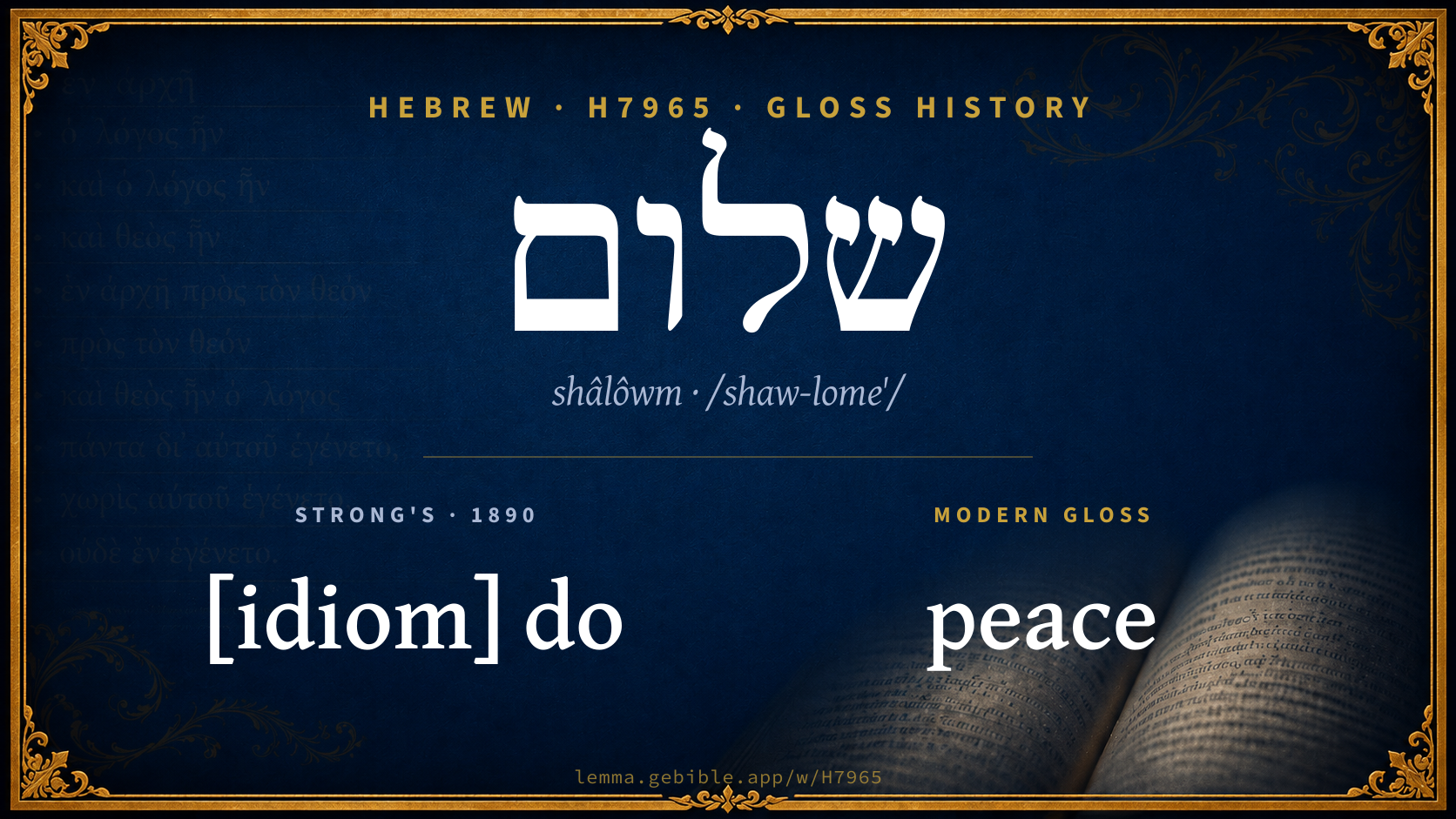
Gloss history
Strong's 1890 vs modern scholarship
About this word
Strong's H7965 catalogs a Hebrew word from the Hebrew Old Testament.
These counts are not copied from any lexicon or concordance. They are computed here, from the morphology-tagged Hebrew Old Testament. What Lemma adds →
- 208
- distinct verses
- The word appears in 208 distinct verses.
- 31 / 39
- OT books
- The word appears in 31 of 39 Old Testament books.
- #199
- by frequency
- Top 250 most frequent Hebrew words (rank 199 of 8,640 Hebrew words by occurrence).
View all 208 occurrences in the concordance →
By section of the Old Testament
By traditional corpus
Conventional, traditional groupings — biblical authorship is debated, so this is a traditional corpus grouping, not an authorship claim. Each share is this word’s portion of its verses in that division of the Hebrew canon. Each figure is a share of the word’s 208 distinct verses.
- Prophets (Nevi'im) 133 verses · 64%
- Writings (Ketuvim) 52 verses · 25%
- Torah (Pentateuch) 23 verses · 11%
How translations render this word
Counts come from each version’s own published word-to-Strong’s tagging or interlinear alignment — an approximate guide to how each version renders this word, not a word-level alignment the data otherwise carries. Because each total is that version’s own tagged count, the per-version totals vary from one another and need not match the appearance or distinct-verse counts above. These counts may also differ from a printed concordance because Lemma counts each distinctly tagged rendering and does not collapse phrase taggings into a single head-word total. This is a fixed set of word-tagged versions (KJV, ASV, BSB, ULT) and does not change with the reading translation you choose elsewhere. Each version’s license is shown beside its name below (and on Sources).
- King James Version: Peace 129×, Peaceably 7×, Is no peace 5×
- American Standard Version: Peace 111×, Is no peace 5×, Him 4×
- Berean Standard Bible: Peace 130×, Safely 9×, Prosperity 8×
- unfoldingWord Literal Text: Peace 181×, About peace 3×, About the welfare of 3×
King James Version Public Domain
Renders H7965 across 229 tagged occurrences — most commonly:
Plus other, less common renderings. Plus 45 renderings that appear only once — usually multi-word phrases or single function words the recovered tagging swept in, not distinct renderings. Not rendered by a distinct English word in 7 further occurrences.
American Standard Version Public Domain
Renders H7965 across 229 tagged occurrences — most commonly:
Plus other, less common renderings. Plus 64 renderings that appear only once — usually multi-word phrases or single function words the recovered tagging swept in, not distinct renderings.
Berean Standard Bible Public Domain
Renders H7965 across 222 tagged occurrences — most commonly:
Plus other, less common renderings. Plus 44 renderings that appear only once — usually multi-word phrases or single function words the recovered tagging swept in, not distinct renderings. Not rendered by a distinct English word in 12 further occurrences.
unfoldingWord Literal Text CC BY-SA 4.0
Renders H7965 across 237 tagged occurrences — most commonly:
Plus other, less common renderings. Plus 22 renderings that appear only once — usually multi-word phrases or single function words the recovered tagging swept in, not distinct renderings.
9 senses and sub-senses in the full BDB
What do BDB’s symbols mean?
BDB uses these scholarly abbreviations:
| Symbol | Meaning |
|---|---|
| 𝔊 | the Septuagint (the ancient Greek translation, LXX) |
| 𝔙 | the Vulgate (the Latin translation) |
| 𝔖 | the Syriac version (the Peshitta) |
| 𝔗 | the Targum (the Aramaic translation) |
| ψ | the Psalms |
| √ | root (the underlying root or stem) |
| ‖ | parallel passage (a synonymous or contrasted parallel) |
| † | the dagger: every passage where the word occurs is cited |
The 9 senses and sub-senses the full Brown-Driver-Briggs lexicon distinguishes for this word, in lexicon order (not ranked by frequency), with BDB’s own verbatim wording and sub-sense lettering. Shown in Hebrew script with BDB’s own scholarly abbreviations. The condensed entry is in the Lexicon Entry tab. See also the Forms in the corpus table below.
- 1. completeness in no., הָגְלָת שְׁלוֹמִים Je 13:19 Judah is wholly carried captive (but read גָּלוּת שְׁלֵמָה, cf. Am 1:6; so 𝔊 We Am SS Buhl). e.g. Jeremiah 13:19
- 2. safety, soundness, in body, אֵין שָׁלוֹם בַּעֲצָמַי ψ 38:4; לְשָׁלוֹם Is 38:17; שָׁלוֹם אָהֳלֶ֑ךָ (Ges§ 141 c) Jb 5:24 is safe, secure. e.g. Psalms 38:4
- 3. welfare, health, prosperity: †שָׁאַל לפ׳ לשׁ׳ ask one about welfare Gn 43:27 (J), Ex 18:7 (E), Ju 18:15 + 7 times, cf. 2 S 11:7(×3); pregn. ירד לשׁלום 2 K 10:13 descend (to ask) about welfare of, cf. 1 S 17:18 Je 38:4; הלך לשׁ׳ Ex 4:18 (E) + 5 times; עלה לשׁ׳ Gn 44:17 (J), 1 S 25:35; דבּר לשׁ׳ Gn 37:4 (JE); שָׁלוֹם ל׳ be well with Gn 29:6; 43:23, 28 (J), Ju 6:23; 19:20; 1 S 20:7, 21 + 10 times, 2 K 4:26(×3); שָׁלוֹם בְּ (יְהִי) ψ 122:7(8) be it well with; abs. as obj. of אָמַר well, be well, שׁ׳ Gn 29:6 (J), 2 S 18:28 2 K 9:11, 17, 18, 19, 22; Je 6:14(×2) + 10 times; הֲשָׁלוֹם אֲבִיכֶם Gn 43:27 (J) cp. 1 S 25:6; †שׁ׳ בּ(וֹ)אֶ֑ךָ 1 S 16:4 (v. Dr), 1 K 2:13; אֵין שׁ׳ Je 6:14 + 3 times; †אין שׁ׳ לרשׁעים Is 48:22; 57:21; but ראה שׁ׳ רשׁעים ψ 73:3; †רֹב שׁ׳ 37:11; 72:7; שׁאל שׁ׳ פ׳ 122:6; דרשׁ שׁ׳ (‖ טוב) Dt 23:7; Ezr 9:12; שׁ׳ יוֹסִיפוּ לָךְ Pr 3:2; בַּשּׁ׳ Jb 15:21 in time of prosperity. e.g. Genesis 43:27
- 4. peace, quiet, tranquillity, contentment, Is 32:17 (‖ הַשְׁקֵט וָבֶטַח); שָׁכַב בשׁ׳ ψ 4:9 (to sleep); depart life בְּשׁ׳ in tranquillity Gn 15:15 (Rje), 1 K 2:6 + 3 times, יָבוֹא Is 57:2; אַחֲרִית לְאִישׁ שׁ׳ ψ 37:37; בא בשׁ׳ Ex 18:23 (E) come in contentment; ארץ שׁ׳ Je 12:5; נְוֵה שׁ׳ (‖ מבטחים) Is 32:18, cf. Je 25:37; שׁ׳ מִפָּ֑חַד Jb 21:9, cf. Zc 8:10; ולשׁלומים לְמוֹקֵשׁ ψ 69:23 and let security become a trap (but 𝔊 Aq Sym Theod Jer וּלְמ׳ וּכְשִׁלּוּמִים, Du (cf. 𝔗) וּשְׁלָמִים peace-offerings, and שֻׁלְחָן va). e.g. Isaiah 32:17
- 5. peace, friendship:
- a. human relations: אֱנוֹשׁ שְׁלֹמִי Je 20:10 man of my friendship, cf. 38:22 Ob 7 ψ 41:10; עֲצַת שׁ׳ בין Zc 6:13; יֹעֲצֵי שׁ׳ Pr 12:20; (אֵת, עִם) דבּר שׁ׳ ψ 28:3; 35:20 Je 9:7; בקּשׁ שׁ׳ ψ 34:15; ידע שׁ׳ Is 59:8; דֶּרֶךְ שׁ׳ v 8; שׁלּח בשׁ׳ Gn 26:29 (J); הלך בשׁ׳ v 31 (J), 1 S 29:7 + 4 times; שׁוב בשׁ׳ 2 S 15:27; ‖ צדקה in Mess. reign ψ 72:3. e.g. Jeremiah 20:10
- b. peace with God, especially in covt. relation: Is 54:10 ברית covt. of my peace, cf. Nu 25:12 (P), Ez 34:25; 37:26, also Mal 2:5; י׳ שׁ׳ as name of altar Ju 6:24; י׳ subj. שָׂם שׁ׳ לְ Nu 6:26 (P); בֵּרַךְ בשׁ׳ ψ 29:11; חפץ שׁ׳ 35:27; עשׂה שׁ׳ לְ Je 33:9; אָסַף שׁ׳ מֵאֵת Je 16:5 (‖ חסד); דבּר שׁ׳ אֶל ψ 85:9; נתן שׁ׳ Hg 2:9; מחשׁבות שׁ׳ Je 29:11; man subj. עשׂה שׁ׳ ל׳ Is 27:5(×2); הלך בשׁ׳ Mal 2:6. In this sense ‖ צֶדֶק ψ 85:11, ‖ צְדָקָה Is 54:13; 60:17, ‖ שִׂמְחָה 55:12, is like a river 48:18; 66:12; שׁ׳ עַל־ישׂראל ψ 125:5; 128:6, שׁ׳ רָב לְאֹהֲבֵי תוֹרָתֶ֑ךָ 119:165; מוּסַר שׁ׳ Is 53:5 chastisement for our peace (but SS Buhl שִׁלֻּמֵינוּ). e.g. Isaiah 54:10
- 6. peace from war: (ל) עשׂה שׁ׳ make peace (with) Jos 9:15; Jb 25:2; נתן שׁ׳ בארץ Lv 26:6 (H); †שׁ׳ בין ובין Ju 4:17; 1 S 7:14; 1 K 5:26; †קרא (ל)שׁ׳ Dt 20:10; Ju 21:13; Mi 3:5; †שׁוב בשׁ׳ Jos 10:21; Ju 8:9; 11:31 (cf. v 13); בא בשׁ׳ 2 S 19:25, 31 + 7 times; †היה שׁ׳ לְ 1 K 5:4 + 3 times, cf. 2 S 17:3 (v. Dr); בקּשׁ שׁ׳ Ez 7:25; מלאכי שׁ׳ Is 33:7; נתן שׁ׳ וָשֶׁקֶט 1 Ch 22:9; מוֹצְאֵת שׁ׳ Ct 8:10; †שׁ׳(ו)אמת Is 39:8 = 2 K 20:19 + 3 times, cf. Zc 8:19; עֵת שׁ׳ Ec 3:8; בְּשׁ׳ 1 K 2:5 in time of peace; שַׂר שׁ׳ Is 9:5 (Mess. title), cf. זֶה שׁ׳ Mi 5:4. e.g. Joshua 9:15
- 7. as adj. שְׁלֹמָיו ψ 55:21 those at peace with him (read שֹֽׁלְמָיו Bae Buhl Du, or שְׁלֵמָיו SS; 𝔊 appar. שִׁלּוּמָיו). e.g. Psalms 55:21
Senses from the full Brown-Driver-Briggs lexicon (Brown, Driver, Briggs; Oxford 1906 — public domain), digitized via Sefaria, supplemented by the OpenScriptures HebrewLexicon (CC BY 4.0). Full attribution on Sources.
Word origin
n.m. Is 54:13 completeness, soundness, welfare, peace (LagBN 174);—שׁ׳ Gn 29:6 +; שָׁלֹם (rare) Ez 13:16 +; cstr. שְׁלוֹם Gn 37:14 +; sf. שְׁלוֹמִי ψ 41:10 +, etc.; pl. (all dub.) שְׁלוֹמִים Je 13:19 ψ 69:23; sf. שְׁלֹמָיו 55:21;—
— Brown-Driver-Briggs (Oxford 1906, public domain), digitized via Sefaria, supplemented by the OpenScriptures HebrewLexicon (CC BY 4.0). See Sources.
Derived from שלם (shâlam) (H7999) — to be at peace.
Jastrow Dictionary
A second Hebrew/Aramaic lexicon for comparison, covering Aramaic and post-biblical (Talmudic, Targumic, Midrashic) usage that the biblical-Hebrew BDB does not. Matched by lemma rather than by Strong’s number, so a lemma may carry more than one Jastrow headword (shown separately below), and the entries cover usage well beyond the Bible.
שָׁלוֹם I
- 1. peace, salvation; salutation. Lev. R. s. 9 גדול ש׳ … חותמין בש׳ peace is something great, for all benedictions, good tidings, and consolations … close with peace. Num. R. s. 21, beg. אין כלי … אלא ש׳ no vessel contains blessing but peace; Ukts. III, 12, a. e., v. חָזַק. Ber. 14ᵃ משיב ש׳ וכ׳ may return a salutation to any person. Ib. כל הנותן ש׳ וכ׳ he who offers salutation to his neighbor before prayer, is considered as if he made him a highplace (worshipping man before God). Shebi. IV, 3 ושואלין בשְׁלוֹמָן מפני דרכי ש׳ and you must salute them (gentiles in the field) &c., v. דֶּרֶךְ; Y. ib. 35ᵇ מהו שואלין בשלומן בשְׁלוֹם ישראל ש׳ עליכם how must we salute them? As we salute Israelites, ‘peace be upon you.’ Tam. I, 3 הגיעו … אמרו ש׳ הכל ש׳ when they (the two parties patrolling the Temple) met, they said, ‘peace?’ (answer) ‘all peace’ (everything is in good order); Lev. R. l. c. Sifra Vayikra, Par. 13, ch. XVI מי שהוא ש׳ וכ׳ he who is at peace offers peace-offerings, opp. אונן; v. שָׁלֵם. Ib. the peace-offerings are called sh’lamim, שהכל ש׳ בהן because everything in them is at peace (is turned to use; Yalk. Lev. 458 מְשׁוּלָּמִים). Ber. 39ᵇ (play on the name שלמן) ש׳ אתה וכ׳ thou art peace (perfection), and thy teaching is perfect (v. שָׁלֵם); a. v. fr.—חס וש׳, v. חַס.
- 2. (adv.) safely, unimpaired. T’bul Yom IV, 7, a. e. שתעלה ש׳ that it will be brought up safely, v. שֶׁבֶר I.—Pl. שְׁלוֹמוֹת. Num. R. s. 1316 עושה שני ש׳ וכ׳ produces two conditions of peace, peace above and peace below. Yalk. Is. 340 ארבעה רוב ש׳ וכ׳ (not שלומית) four times in the Scriptures ‘peace’ appears in connection with ‘abundance.’—Ch. v. שְׁלָמָא.
שָׁלוֹם II
- אִימָּא ש׳ Imma (Mother) Shalom, wife of R. Eliezer. Y. Shebi. VI, 36ᶜ top. Erub. 63ᵃ; a. fr.
שִׁלּוּם
- , v. שִׁילּוּם
שַׁלּוּם
- (b. h.) pr. n. m. Shallum,
- 1. husband of Huldah the prophetess. Meg. 14ᵇ (counted among the prophets). Yalk. Kings 233.
- 2. name of several Amoraim. Lev. R. s. 26 רב ש׳. Pesik. R. s. 3 יהודה הלוי ברבי ש׳; ib. s. 5; a. fr.
A Dictionary of the Targumim, the Talmud Babli and Yerushalmi, and the Midrashic Literature (Marcus Jastrow; London, Luzac, 1903) — Public Domain. Digitized via Sefaria. Digitized via Sefaria. Full attribution on Sources.
Forms in the corpus
The 86 distinct written forms H7965 takes in the Hebrew Bible, most frequent first — each parse links to that state’s occurrences in the concordance. Hebrew forms include their vowel points and cantillation, so a single lemma takes many written forms.
The 60 most common forms are shown; 26 rarer forms follow in the full concordance.
Same root — word family
Other BDB entries built from the same root as H7965, grouped by Strong’s listed origin. These share a root / origin per the lexicon — not necessarily a shared meaning. Each links to that word’s own entry.
Derives from
Shares the same root
- שלום shillûwm H7966 reward
- שלם shᵉlam H8000 to finish
- שלם shelem H8002 peace offering
- שלם shâlêm H8003 complete
- שלם shillêm H8005 recompense
- שלמן shalmôn H8021 reward
Derived from this word
Proper names from this root
People and places named from this root — a name, not an additional meaning of the word.
- משלם Mᵉshullâm H4918 Meshullam
- משלמות Mᵉshillêmôwth H4919 Meshillemoth
- משלמיה Mᵉshelemyâh H4920 Meshelemiah
- משלמית Mᵉshillêmîyth H4921 Meshillemith
- שולמית Shûwlammîyth H7759 Shulamite
- שלמה Shᵉlômôh H8010 Solomon
- שלמות Shᵉlômôwth H8013 Shelomoth
- שלמי Shᵉlômîy H8015 Shelomi
- שלמיאל Shᵉlumîyʼêl H8017 Shelumiel
- שלמית Shᵉlômîyth H8019 Shelomith
Compare all same-root words → Showing 4 of 19 — not the complete family. 10 of the same-root words are proper names (people or places). They share a root, not necessarily a meaning.
Septuagint verse parallels
This word appears in 191 verses that also exist in the Greek Old Testament (Septuagint), out of the 208 Hebrew verses it occurs in. You can read those verses in Greek by switching the Old Testament edition to the Septuagint.
Read these verses in the Septuagint
- Genesis 15:15
- Exodus 4:18
- Leviticus 26:6
- Numbers 6:26
- Deuteronomy 2:26
- Joshua 9:15
- Judges 4:17
- 1 Samuel 1:17
- 2 Samuel 3:21
- 1 Kings 2:5
- 2 Kings 4:23
- 1 Chronicles 12:17
This is a verse-level parallel only — the same verses exist in both the Hebrew and Greek Old Testaments. No word-level Hebrew↔Greek correspondence is claimed: the data carries no such alignment, so no Greek word is shown as this Hebrew word’s translation. Coverage is not total — the Septuagint omits the deuterocanon and renumbers the Psalms, so some Hebrew verses have no direct Greek parallel.