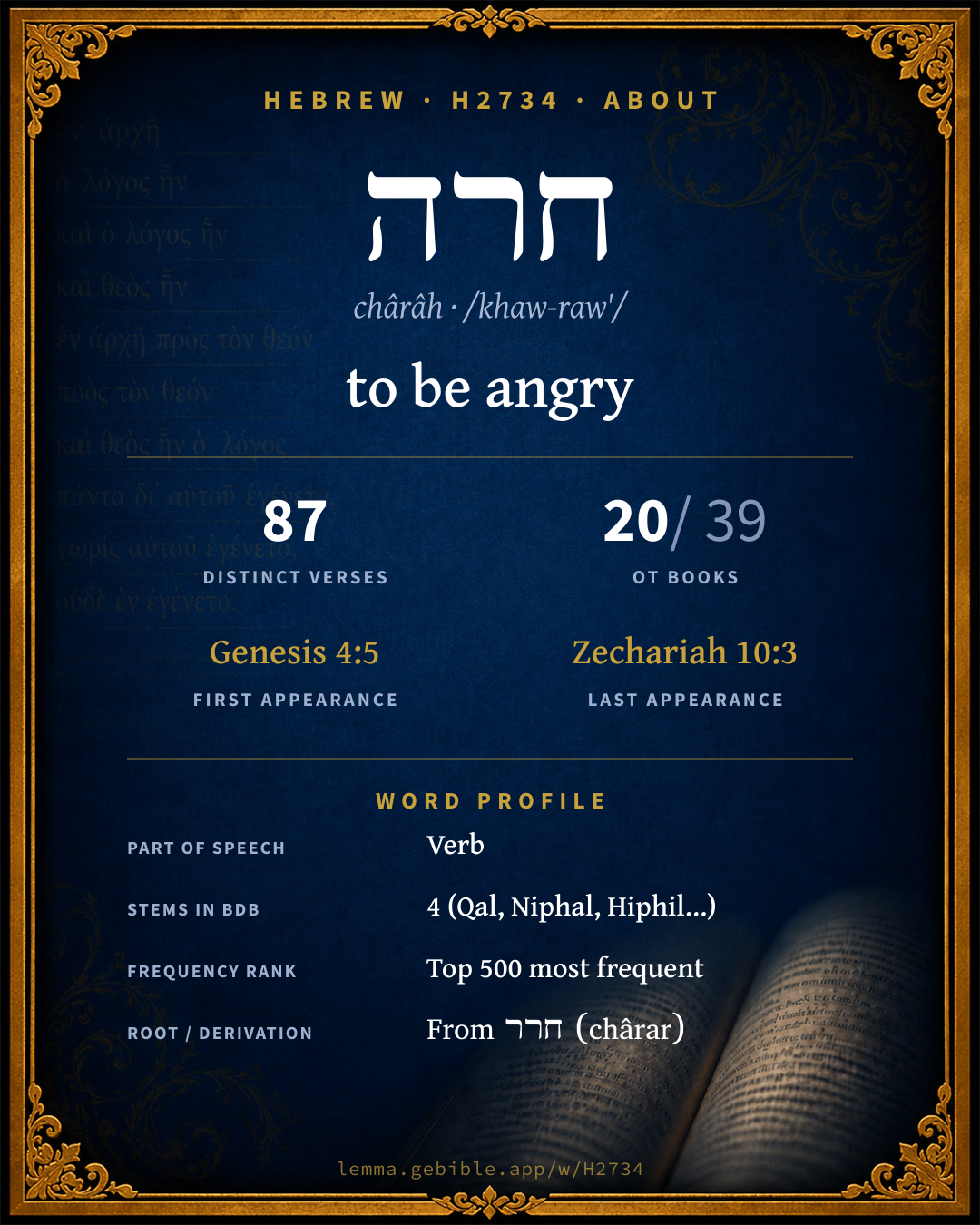
חָרָה
to be angry
‘to be angry’ is one of 5 main senses fuller range ↓
Full lexicon entry — Brown-Driver-Briggs (BDB)
From Brown-Driver-Briggs (BDB)
Where this word appears
See every Qal verb in the Hebrew Bible →
Grammar key — what these labels mean
Part of speech
- Verb
- An action or state-of-being word.
Stem
- Qal
- The basic, simple active stem — the plain form of the verb (“he wrote”). Here: ‘of man’
- Hithpael
- The reflexive or reciprocal stem (the subject acts on itself).
- Niphal
- Usually the simple passive or reflexive of the Qal (“he was written”).
- Hiphil
- The causative active stem (“he caused / brought about”).
Form
- Sequential Imperfect
- An imperfect with prefixed waw — the standard past-narrative form (waw-consecutive imperfect).
- Perfect
- A completed action or state — Hebrew marks aspect (completeness) more than strict tense (“he wrote”).
- Jussive
- A third- or second-person volitional form expressing wish or command (“let him write”).
- Sequential Perfect
- A perfect with prefixed waw continuing a preceding imperfect or command (waw-consecutive perfect).
- Imperfect
- An incomplete, ongoing, or future action (“he will / would write”).
- Infinitive Construct
- A bound verbal noun, frequently with prepositions (“to write / in writing”).
- Participle Active
- A verbal adjective expressing ongoing or characteristic action (“writing / one who writes”).
- Infinitive Absolute
- An unbound verbal noun, often intensifying or standing in for a finite verb.
State
- Absolute
- The independent form of a noun, not bound to a following word.
Person
- 3rd Person
- The one spoken about (“he / she / it / they”).
- 2nd Person
- The one addressed (“you”).
Gender
- Masculine
- Grammatically masculine.
Number
- Singular
- One.
- Plural
- More than one (in Hebrew, generally three or more).
Grammatical forms 11 distinct
- Verb, Qal, Sequential Imperfect, 3rd Person, Masculine, Singular 47 times (52%)
- Verb, Qal, Perfect, 3rd Person, Masculine, Singular 17 times (19%)
- Verb, Qal, Jussive, 3rd Person, Masculine, Singular 8 times (9%)
- Verb, Qal, Sequential Perfect, 3rd Person, Masculine, Singular 4 times (4%)
- Verb, Hithpael, Jussive, 2nd Person, Masculine, Singular 4 times (4%)
- Verb, Qal, Imperfect, 3rd Person, Masculine, Singular 3 times (3%)
- Verb, Qal, Infinitive Construct 2 times (2%)
- Verb, Niphal, Participle Active, Masculine, Plural, Absolute 2 times (2%)
+3 more forms (3 occurrences)
Parsed forms decoded from the imported morphology (morphhb / Westminster Leningrad Codex — WLC text public domain, morphhb tagging CC BY 4.0), counted across 90 parsed occurrences — not distinct verses.
Every verse where H2734 appears — 87 distinct verses across 20 books. Click any verse to open its interlinear word-by-word view. Verse text shown in the World English Bible for context — . Each verse’s Hebrew form is shown with its reference; the English is not keyword-highlighted, since the data carries no word-level English alignment. Use “Compare translations” on any verse to read it across multiple English versions. This concordance covers the Hebrew Bible; Septuagint (Greek Old Testament) occurrences are not indexed here.
Genesis 11 verses
- Genesis 4:5 וַ/יִּ֤חַר conj + Qal wimpf 3ms but he didn't respect Cain and his offering. Cain was very angry, and the expression on his face fell.
- Genesis 4:6 חָ֣רָה Qal pf 3ms Yahweh said to Cain, "Why are you angry? Why has the expression of your face fallen?
- Genesis 18:30 יִ֤חַר Qal juss 3ms He said, "Oh don't let the Lord be angry, and I will speak. What if there are thirty found there?" He said, "I will not do it, if I find thirty there."
- Genesis 18:32 יִ֤חַר Qal juss 3ms He said, "Oh don't let the Lord be angry, and I will speak yet but this once. What if ten are found there?" He said, "I will not destroy it for the ten's sake."
- Genesis 30:2 וַ/יִּֽחַר conj + Qal wimpf 3ms Jacob's anger was kindled against Rachel, and he said, "Am I in God's place, who has withheld from you the fruit of the womb?"
- Genesis 31:35 יִ֨חַר֙ Qal juss 3ms She said to her father, "Don't let my lord be angry that I can't rise up before you; for the manner of women is on me." He searched, but didn't find the teraphim.
- Genesis 31:36 וַ/יִּ֥חַר conj + Qal wimpf 3ms Jacob was angry, and argued with Laban. Jacob answered Laban, "What is my trespass? What is my sin, that you have hotly pursued after me?
- Genesis 34:7 וַ/יִּ֥חַר conj + Qal wimpf 3ms The sons of Jacob came in from the field when they heard it. The men were grieved, and they were very angry, because he had done folly in Israel in lying with Jacob's daughter; which thing ought not to be done.
- Genesis 39:19 וַ/יִּ֖חַר conj + Qal wimpf 3ms It happened, when his master heard the words of his wife, which she spoke to him, saying, "This is what your servant did to me," that his wrath was kindled.
- Genesis 44:18 יִ֥חַר Qal juss 3ms Then Judah came near to him, and said, "Oh, my lord, please let your servant speak a word in my lord's ears, and don't let your anger burn against your servant; for you are even as Pharaoh.
- Genesis 45:5 יִ֨חַר֙ Qal juss 3ms Now don't be grieved, nor angry with yourselves, that you sold me here, for God sent me before you to preserve life.
Exodus 6 verses
- Exodus 4:14 וַ/יִּֽחַר conj + Qal wimpf 3ms The anger of Yahweh was kindled against Moses, and he said, "What about Aaron, your brother, the Levite? I know that he can speak well. Also, behold, he comes forth to meet you. When he sees you, he will be glad in his heart.
- Exodus 22:24 וְ/חָרָ֣ה conj + Qal pf 3ms and my wrath will grow hot, and I will kill you with the sword; and your wives shall be widows, and your children fatherless.
- Exodus 32:10 וְ/יִֽחַר conj + Qal juss 3ms Now therefore leave me alone, that my wrath may burn hot against them, and that I may consume them; and I will make of you a great nation."
- Exodus 32:11 יֶחֱרֶ֤ה Qal impf 3ms Moses begged Yahweh his God, and said, "Yahweh, why does your wrath burn hot against your people, that you have brought forth out of the land of Egypt with great power and with a mighty hand?
- Exodus 32:19 וַ/יִּֽחַר conj + Qal wimpf 3ms It happened, as soon as he came near to the camp, that he saw the calf and the dancing: and Moses' anger grew hot, and he threw the tablets out of his hands, and broke them beneath the mountain.
- Exodus 32:22 יִ֥חַר Qal juss 3ms Aaron said, "Don't let the anger of my lord grow hot. You know the people, that they are set on evil.
Numbers 11 verses
- Numbers 11:1 וַ/יִּ֣חַר conj + Qal wimpf 3ms The people were as murmurers, [speaking] evil in the ears of Yahweh: and when Yahweh heard it, his anger was kindled; and the fire of Yahweh burnt among them, and devoured in the uttermost part of the camp.
- Numbers 11:10 וַ/יִּֽחַר conj + Qal wimpf 3ms Moses heard the people weeping throughout their families, every man at the door of his tent: and the anger of Yahweh was kindled greatly; and Moses was displeased.
- Numbers 11:33 חָרָ֣ה Qal pf 3ms While the flesh was yet between their teeth, before it was chewed, the anger of Yahweh was kindled against the people, and Yahweh struck the people with a very great plague.
- Numbers 12:9 וַ/יִּֽחַר conj + Qal wimpf 3ms The anger of Yahweh was kindled against them; and he departed.
- Numbers 16:15 וַ/יִּ֤חַר conj + Qal wimpf 3ms Moses was very angry, and said to Yahweh, "Don't respect their offering: I have not taken one donkey from them, neither have I hurt one of them."
- Numbers 22:22 וַ/יִּֽחַר conj + Qal wimpf 3ms God's anger was kindled because he went; and the angel of Yahweh placed himself in the way for an adversary against him. Now he was riding on his donkey, and his two servants were with him.
- Numbers 22:27 וַ/יִּֽחַר conj + Qal wimpf 3ms The donkey saw the angel of Yahweh, and she lay down under Balaam: and Balaam's anger was kindled, and he struck the donkey with his staff.
- Numbers 24:10 וַ/יִּֽחַר conj + Qal wimpf 3ms Balak's anger was kindled against Balaam, and he struck his hands together; and Balak said to Balaam, I called you to curse my enemies, and, behold, you have altogether blessed them these three times.
- Numbers 25:3 וַ/יִּֽחַר conj + Qal wimpf 3ms Israel joined himself to Baal Peor: and the anger of Yahweh was kindled against Israel.
- Numbers 32:10 וַ/יִּֽחַר conj + Qal wimpf 3ms Yahweh's anger was kindled in that day, and he swore, saying,
- Numbers 32:13 וַ/יִּֽחַר conj + Qal wimpf 3ms Yahweh's anger was kindled against Israel, and he made them wander back and forth in the wilderness forty years, until all the generation, who had done evil in the sight of Yahweh, was consumed.
Deuteronomy 5 verses
- Deuteronomy 6:15 יֶ֠חֱרֶה Qal impf 3ms for Yahweh your God in the midst of you is a jealous God; lest the anger of Yahweh your God be kindled against you, and he destroy you from off the face of the earth.
- Deuteronomy 7:4 וְ/חָרָ֤ה conj + Qal wpf 3ms For he will turn away your son from following me, that they may serve other gods: so will the anger of Yahweh be kindled against you, and he will destroy you quickly.
- Deuteronomy 11:17 וְ/חָרָ֨ה conj + Qal wpf 3ms and the anger of Yahweh be kindled against you, and he shut up the sky, so that there shall be no rain, and the land shall not yield its fruit; and you perish quickly from off the good land which Yahweh gives you.
- Deuteronomy 29:27 וַ/יִּֽחַר conj + Qal wimpf 3ms therefore the anger of Yahweh was kindled against this land, to bring on it all the curse that is written in this book;
- Deuteronomy 31:17 וְ/חָרָ֣ה conj + Qal wpf 3ms Then my anger shall be kindled against them in that day, and I will forsake them, and I will hide my face from them, and they shall be devoured, and many evils and troubles shall come on them; so that they will say in that day, Haven't these evils come on us because our God is not among us?
Joshua 2 verses
- Joshua 7:1 וַ/יִּֽחַר conj + Qal wimpf 3ms But the children of Israel committed a trespass in the devoted thing; for Achan, the son of Carmi, the son of Zabdi, the son of Zerah, of the tribe of Judah, took of the devoted thing: and the anger of Yahweh was kindled against the children of Israel.
- Joshua 23:16 וְ/חָרָ֤ה conj + Qal wpf 3ms When you disobey the covenant of Yahweh your God, which he commanded you, and go and serve other gods, and bow down yourselves to them; then will the anger of Yahweh be kindled against you, and you shall perish quickly from off the good land which he has given to you.
Judges 7 verses
- Judges 2:14 וַ/יִּֽחַר conj + Qal wimpf 3ms The anger of Yahweh was kindled against Israel, and he delivered them into the hands of spoilers who despoiled them; and he sold them into the hands of their enemies round about, so that they could not any longer stand before their enemies.
- Judges 2:20 וַ/יִּֽחַר conj + Qal wimpf 3ms The anger of Yahweh was kindled against Israel; and he said, Because this nation have transgressed my covenant which I commanded their fathers, and have not listened to my voice;
- Judges 3:8 וַ/יִּֽחַר conj + Qal wimpf 3ms Therefore the anger of Yahweh was kindled against Israel, and he sold them into the hand of Cushan Rishathaim king of Mesopotamia: and the children of Israel served Cushan Rishathaim eight years.
- Judges 6:39 יִ֤חַר Qal juss 3ms Gideon said to God, Don't let your anger be kindled against me, and I will speak but this once: Please let me make a trial just this once with the fleece; let it now be dry only on the fleece, and on all the ground let there be dew.
- Judges 9:30 וַ/יִּ֖חַר conj + Qal wimpf 3ms When Zebul the ruler of the city heard the words of Gaal the son of Ebed, his anger was kindled.
- Judges 10:7 וַ/יִּֽחַר conj + Qal wimpf 3ms The anger of Yahweh was kindled against Israel, and he sold them into the hand of the Philistines, and into the hand of the children of Ammon.
- Judges 14:19 וַ/יִּ֣חַר conj + Qal wimpf 3ms The Spirit of Yahweh came mightily on him, and he went down to Ashkelon, and struck thirty men of them, and took their spoil, and gave the changes [of clothing] to those who declared the riddle. His anger was kindled, and he went up to his father's house.
1 Samuel 6 verses
- 1 Samuel 11:6 וַ/יִּ֥חַר conj + Qal wimpf 3ms The Spirit of God came mightily on Saul when he heard those words, and his anger was kindled greatly.
- 1 Samuel 15:11 וַ/יִּ֨חַר֙ conj + Qal wimpf 3ms It repents me that I have set up Saul to be king; for he is turned back from following me, and has not performed my commandments. Samuel was angry; and he cried to Yahweh all night.
- 1 Samuel 17:28 וַ/יִּֽחַר conj + Qal wimpf 3ms Eliab his eldest brother heard when he spoke to the men; and Eliab's anger was kindled against David, and he said, Why are you come down? and with whom have you left those few sheep in the wilderness? I know your pride, and the naughtiness of your heart; for you have come down that you might see the battle.
- 1 Samuel 18:8 וַ/יִּ֨חַר conj + Qal wimpf 3ms Saul was very angry, and this saying displeased him; and he said, They have ascribed to David ten thousands, and to me they have ascribed but thousands: and what can he have more but the kingdom?
- 1 Samuel 20:7 חָרֹ֤ה יֶֽחֱרֶה֙ Qal inf.abs Qal impf 3ms If he says, 'It is well;' your servant shall have peace: but if he be angry, then know that evil is determined by him.
- 1 Samuel 20:30 וַ/יִּֽחַר conj + Qal wimpf 3ms Then Saul's anger was kindled against Jonathan, and he said to him, You son of a perverse rebellious woman, don't I know that you have chosen the son of Jesse to your own shame, and to the shame of your mother's nakedness?
2 Samuel 8 verses
- 2 Samuel 3:8 וַ/יִּחַר֩ conj + Qal wimpf 3ms Then was Abner very angry for the words of Ish-bosheth, and said, Am I a dog's head that belongs to Judah? This day do I show kindness to the house of Saul your father, to his brothers, and to his friends, and have not delivered you into the hand of David; and yet you charge me this day with a fault concerning this woman.
- 2 Samuel 6:7 וַ/יִּֽחַר conj + Qal wimpf 3ms The anger of Yahweh was kindled against Uzzah; and God struck him there for his error; and there he died by the ark of God.
- 2 Samuel 6:8 וַ/יִּ֣חַר conj + Qal wimpf 3ms David was displeased, because Yahweh had broken forth on Uzzah; and he called that place Perez Uzzah, to this day.
- 2 Samuel 12:5 וַ/יִּֽחַר conj + Qal wimpf 3ms David's anger was greatly kindled against the man, and he said to Nathan, "As Yahweh lives, the man who has done this is worthy to die!
- 2 Samuel 13:21 וַ/יִּ֥חַר conj + Qal wimpf 3ms But when king David heard of all these things, he was very angry.
- 2 Samuel 19:42 חָרָ֣ה Qal pf 3ms All the men of Judah answered the men of Israel, Because the king is a close relative to us: why then are you angry for this matter? have we eaten at all at the king's cost? or has he given us any gift?
- 2 Samuel 22:8 חָ֥רָה Qal pf 3ms Then the earth shook and trembled, The foundations of heaven quaked Were shaken, because he was angry.
- 2 Samuel 24:1 לַ/חֲר֖וֹת prep + Qal inf.cs Again the anger of Yahweh was kindled against Israel, and he moved David against them, saying, Go, number Israel and Judah.
2 Kings 2 verses
- 2 Kings 13:3 וַ/יִּֽחַר conj + Qal wimpf 3ms The anger of Yahweh was kindled against Israel, and he delivered them into the hand of Hazael king of Syria, and into the hand of Benhadad the son of Hazael, continually.
- 2 Kings 23:26 חָרָ֥ה Qal pf 3ms Notwithstanding, Yahweh didn't turn from the fierceness of his great wrath, with which his anger was kindled against Judah, because of all the provocation with which Manasseh had provoked him.
1 Chronicles 2 verses
- 1 Chronicles 13:10 וַ/יִּֽחַר conj + Qal wimpf 3ms The anger of Yahweh was kindled against Uzza, and he struck him, because he put forth his hand to the ark; and there he died before God.
- 1 Chronicles 13:11 וַ/יִּ֣חַר conj + Qal wimpf 3ms David was displeased, because Yahweh had broken forth on Uzza; and he called that place Perez Uzza, to this day.
2 Chronicles 2 verses
- 2 Chronicles 25:10 וַ/יִּ֨חַר conj + Qal wimpf 3ms Then Amaziah separated them, [to wit], the army that had come to him out of Ephraim, to go home again: therefore their anger was greatly kindled against Judah, and they returned home in fierce anger.
- 2 Chronicles 25:15 וַ/יִּֽחַר conj + Qal wimpf 3ms Therefore the anger of Yahweh was kindled against Amaziah, and he sent to him a prophet, who said to him, Why have you sought after the gods of the people, which have not delivered their own people out of your hand?
Nehemiah 4 verses
- Nehemiah 3:20 הֶחֱרָ֧ה Hiphil pf 3ms After him Baruch the son of Zabbai earnestly repaired another portion, from the turning [of the wall] to the door of the house of Eliashib the high priest.
- Nehemiah 4:1 וַ/יִּ֣חַר conj + Qal wimpf 3ms But it happened that when Sanballat heard that we were building the wall, he was angry, and took great indignation, and mocked the Jews.
- Nehemiah 4:7 וַ/יִּ֥חַר conj + Qal wimpf 3ms But it happened that when Sanballat, Tobiah, the Arabians, the Ammonites, and the Ashdodites heard that the repairing of the walls of Jerusalem went forward, [and] that the breaches began to be stopped, then they were very angry;
- Nehemiah 5:6 וַ/יִּ֥חַר conj + Qal wimpf 3ms I was very angry when I heard their cry and these words.
Job 5 verses
- Job 19:11 וַ/יַּ֣חַר conj + Hiphil wimpf 3ms He has also kindled his wrath against me. He counts me among his adversaries.
- Job 32:2 וַ/יִּ֤חַר חָרָ֣ה conj + Qal wimpf 3ms Qal pf 3ms Then the wrath of Elihu the son of Barachel, the Buzite, of the family of Ram, was kindled against Job. His wrath was kindled because he justified himself rather than God.
- Job 32:3 חָרָ֪ה Qal pf 3ms Also his wrath was kindled against his three friends, because they had found no answer, and yet had condemned Job.
- Job 32:5 וַ/יִּ֥חַר conj + Qal wimpf 3ms When Elihu saw that there was no answer in the mouth of these three men, his wrath was kindled.
- Job 42:7 חָרָ֨ה Qal pf 3ms It was so, that after Yahweh had spoken these words to Job, Yahweh said to Eliphaz the Temanite, "My wrath is kindled against you, and against your two friends; for you have not spoken of me the thing that is right, as my servant Job has.
Psalms 6 verses
- Psalms 18:7 חָ֥רָה Qal pf 3ms Then the earth shook and trembled. The foundations also of the mountains quaked and were shaken, Because he was angry.
- Psalms 37:1 תִּתְחַ֥ר Hithpael juss 2ms Don't fret because of evil-doers, Neither be envious against those who work unrighteousness.
- Psalms 37:7 תִּ֭תְחַר Hithpael juss 2ms Rest in Yahweh, and wait patiently for him. Don't fret because of him who prospers in his way, Because of the man who makes wicked plots happen.
- Psalms 37:8 תִּ֝תְחַ֗ר Hithpael juss 2ms Cease from anger, and forsake wrath. Don't fret, it leads only to evildoing.
- Psalms 106:40 וַ/יִּֽחַר conj + Qal wimpf 3ms Therefore Yahweh burned with anger against his people. He abhorred his inheritance.
- Psalms 124:3 בַּ/חֲר֖וֹת prep + Qal inf.cs Then they would have swallowed us up alive, When their wrath was kindled against us;
Proverbs 1 verse
Isaiah 3 verses
- Isaiah 5:25 חָרָה֩ Qal pf 3ms Therefore Yahweh's anger burns against his people, And he has stretched out his hand against them, and has struck them. The mountains tremble, And their dead bodies are as refuse in the midst of the streets. For all this, his anger is not turned away, But his hand is still stretched out.
- Isaiah 41:11 הַ/נֶּחֱרִ֣ים ptcl def.art + Niphal ptcp.act mp Behold, all those who are incensed against you shall be disappointed and confounded: those who strive with you shall be as nothing, and shall perish.
- Isaiah 45:24 הַ/נֶּחֱרִ֥ים ptcl def.art + Niphal ptcp.act mp Only in Yahweh, it is said of me, is righteousness and strength; even to him shall men come; and all those who were incensed against him shall be disappointed.
Hosea 1 verse
Jonah 3 verses
- Jonah 4:1 וַ/יִּ֖חַר conj + Qal wimpf 3ms But it displeased Jonah exceedingly, and he was angry.
- Jonah 4:4 חָ֥רָה Qal pf 3ms Yahweh said, "Is it right for you to be angry?"
- Jonah 4:9 חָרָֽה חָֽרָה Qal pf 3ms Qal pf 3ms God said to Jonah, "Is it right for you to be angry about the vine?" He said, "I am right to be angry, even to death."
Habakkuk 1 verse
Zechariah 1 verse
About this entry
At a glance — auto-summarized from this page’s data, not written by a person. Every figure links to its source below. This summary describes the numbers; it doesn’t interpret them.
חרה — transliterated chârâh — is a Hebrew verb carrying the sense “to be angry.” Its English rendering has broadened — “was kindled” classically, “burned” (Berean Standard Bible) in modern versions; see the renderings breakdown. Spanning 87 verses in 20 books, it ranks among the moderately common words of the Hebrew Bible. Its earliest occurrence is Genesis 4:5. As a verb its force shifts by stem, across 4 stems (Qal, Niphal, and more). See the sense tree, 87-verse concordance, and the renderings breakdown below.
Gloss history
Strong's 1890 vs modern scholarship
About this word
Strong's H2734 catalogs a Hebrew word from the Hebrew Old Testament.
These counts are not copied from any lexicon or concordance. They are computed here, from the morphology-tagged Hebrew Old Testament. What Lemma adds →
- 87
- distinct verses
- The word appears in 87 distinct verses.
- 20 / 39
- OT books
- The word appears in 20 of 39 Old Testament books.
- #462
- by frequency
- Top 500 most frequent Hebrew words (rank 462 of 8,640 Hebrew words by occurrence).
View all 87 occurrences in the concordance →
By section of the Old Testament
By traditional corpus
Conventional, traditional groupings — biblical authorship is debated, so this is a traditional corpus grouping, not an authorship claim. Each share is this word’s portion of its verses in that division of the Hebrew canon. Each figure is a share of the word’s 87 distinct verses.
- Prophets (Nevi'im) 34 verses · 39%
- Torah (Pentateuch) 33 verses · 38%
- Writings (Ketuvim) 20 verses · 23%
How translations render this word
Counts come from each version’s own published word-to-Strong’s tagging or interlinear alignment — an approximate guide to how each version renders this word, not a word-level alignment the data otherwise carries. Because each total is that version’s own tagged count, the per-version totals vary from one another and need not match the appearance or distinct-verse counts above. These counts may also differ from a printed concordance because Lemma counts each distinctly tagged rendering and does not collapse phrase taggings into a single head-word total. This is a fixed set of word-tagged versions (KJV, ASV, BSB, ULT) and does not change with the reading translation you choose elsewhere. Each version’s license is shown beside its name below (and on Sources).
- King James Version: Was kindled 30×, Wroth 8×, Kindled 6×
- American Standard Version: Was kindled 30×, Wroth 8×, Be angry 6×
- Berean Standard Bible: Burned 22×, Be angry 7×, Was kindled 6×
- unfoldingWord Literal Text: Burned 54×, And 29×, Do 10×
King James Version Public Domain
Renders H2734 across 90 tagged occurrences — most commonly:
Plus 18 renderings that appear only once — usually multi-word phrases or single function words the recovered tagging swept in, not distinct renderings.
American Standard Version Public Domain
Renders H2734 across 90 tagged occurrences — most commonly:
Plus 18 renderings that appear only once — usually multi-word phrases or single function words the recovered tagging swept in, not distinct renderings.
Berean Standard Bible Public Domain
Renders H2734 across 89 tagged occurrences — most commonly:
Plus other, less common renderings. Plus 21 renderings that appear only once — usually multi-word phrases or single function words the recovered tagging swept in, not distinct renderings. Not rendered by a distinct English word in 2 further occurrences.
unfoldingWord Literal Text CC BY-SA 4.0
Renders H2734 across 151 tagged occurrences — most commonly:
Plus other, less common renderings. Plus 12 renderings that appear only once — usually multi-word phrases or single function words the recovered tagging swept in, not distinct renderings.
11 senses and sub-senses in the full BDB
Hebrew verbs can shift meaning by stem (binyan): Qal is the basic action, Niphal is often passive or reflexive, Piel often intensifies or makes it factitive, and Hiphil is typically causative. The senses below are grouped under the stem BDB assigns to each. This entry also uses Hithpael (reflexive or reciprocal).
What do BDB’s symbols mean?
BDB uses these scholarly abbreviations:
| Symbol | Meaning |
|---|---|
| 𝔊 | the Septuagint (the ancient Greek translation, LXX) |
| 𝔙 | the Vulgate (the Latin translation) |
| 𝔖 | the Syriac version (the Peshitta) |
| 𝔗 | the Targum (the Aramaic translation) |
| ψ | the Psalms |
| √ | root (the underlying root or stem) |
| ‖ | parallel passage (a synonymous or contrasted parallel) |
| † | the dagger: every passage where the word occurs is cited |
The 11 senses and sub-senses the full Brown-Driver-Briggs lexicon distinguishes for this word, in lexicon order (not ranked by frequency), with BDB’s own verbatim wording and sub-sense lettering. Shown in Hebrew script with BDB’s own scholarly abbreviations. The condensed entry is in the Lexicon Entry tab. See also the Forms in the corpus table below.
Qal
- Pf. ח׳ Gn 4:6 + 20 times; Impf. יֶחֱרֶה Ex 32:11 + 2 times; יִ֫חַר Gn 18:30 + 7 times; וַיִּ֫חַר Gn 4:5 + 46 times; Inf. abs. חָרֹה 1 S 20:7; cstr. חֲרוֹת 2 S 24:1 ψ 124:3;— e.g. Genesis 4:6
- 1. of man:
- a. חרה אף (one’s) anger was kindled, burned Gn 39:19 Nu 22:27 (J), Ex 32:19, 22 (JE), Ju 9:30; 14:19 1 S 11:6 Jb 32:2, 5; c. בְּ against Gn 30:2 (E), 44:18 (J), 1 S 17:28; 20:30 2 S 12:5 2 Ch 25:10 ψ 124:3 Jb 32:2, 3; c. אֶל Nu 24:10 (E). e.g. Genesis 39:19
- b. impers., אף omitted; חרה לְ it was kindled for (him) he burned with anger Gn 31:36 (E), 4:5, 6; 34:7 Nu 16:15 (J), 1 S 15:11 (read perhaps וַיֵּצֶר, Weir in Dr), 18:8; 20:7(×2) 2 S 3:8; 6:8 = 1 Ch 13:11, 2 S 13:21; 19:43 Ne 3:33; 4:1; 5:6 Jon 4:1, 4, 9(×2); ins. ויחר לדוד 2 S 11:22 𝔊 We Dr; ח׳ בְּעֵינֵי Gn 31:35; 45:5 (E). e.g. Genesis 31:36
- 2. of God:
- a. ח׳ אף Ex 22:23 Nu 22:22 (E), Nu 11:1, 10; 32:10 (J); c. בְּ Ex 4:14; 32:10 Nu 12:9 Dt 31:17 (J), 6:15; 7:4; 11:17; 29:26 Jos 23:16 (D), Ju 6:39 2 S 6:7 = 1 Ch 13:10, Ho 8:5 2 K 23:26 2 Ch 25:15 Jb 42:7; בְּעַם Ex 32:11 Nu 11:33 (J), Is 5:25 ψ 106:40; בישׂראל Nu 25:3; 32:13 (JE); Ju 2:14, 20; 3:8; 10:7 2 S 24:1 2 K 13:3; בבני ישׂראל Jos 7:1 (R); בנהרים, אף omitted, Hb 3:8; c. עַל Zc 10:3. e.g. Exodus 22:23
- b. חרה לְ Gn 18:30, 32 (J) 2 S 22:8 = ψ 18:8.— e.g. Genesis 18:30
- חרה not in HP (who use קצף); nor in Je Ez Is 2 Pr or poetry of Jb.
Niphal
- Pf. נִחֲרוּ־ sq. בְּ Ct 1:6 (according to Bö ii. 379 De Köi. 551) be angry with; Pt. כֹּל הַנֶּחֱרִים בְּ׳ all that are incensed against (thee) Is 41:11, so 45:24. e.g. Song of Solomon 1:6
Hiphil
- Pf. הֶחֱרָה הֶחֱזִיק Ne 3:20 burned with zeal (?) in repairing, but 𝔊 om. החרה; prob. dittogr.; Impf. וַיַּחַר עָלַי אַפּוֹ Jb 19:11 and kindled his anger against me. e.g. Nehemiah 3:20
Hithpael
- Impf. אַל תִּתְחַר ψ 37:1, 7, 8 Pr 24:19 heat oneself in vexation.—The foll. forms are somewhat dub.: Impf. 2 ms. אֵיךְ תְּתַחֲרֶה אֶת־הַסּוּסִים Je 12:5 how canst thou hotly contend (in a race) with the horses? Pt. כִּי אַתָּה מְתַחֲרֶה בָאָ֑רֶז Je 22:15 because thou strivest eagerly (to excel) in cedar; expl. as Tiphʿēl by Thes Ges§ 55, 5 Ew§ 122 a Ol§ 255 a Sta§ 159 b Köi. p. 557 al., and regarded by most as a rare causative stem; but ag. existence of Tiphʿēl v. BaNB § 180 a; ZMG 1894, 20; Ba regards the form as denom. (from a noun formed by ת preform., cf. Aramaic ܬܰܚܪܘܽܬܳܐ contention); SS would point as Hithp. [cf. Syriac ܐܶܬܚܪܺܝ contend with, ܚܶܪܝܳܢ contention], although meaning of Hithp. is diff., v. supr. e.g. Psalms 37:1
Senses from the full Brown-Driver-Briggs lexicon (Brown, Driver, Briggs; Oxford 1906 — public domain), digitized via Sefaria, supplemented by the OpenScriptures HebrewLexicon (CC BY 4.0). Full attribution on Sources.
Word origin
vb. burn, be kindled, of anger (Aramaic חרי Pa. cause fire to burn (rare); Zinj. חרא anger, NöZMG 1893, 98. 103; Arabic حَرْوَةٌ burning sensation, in throat, etc., from rage and pain)—
— Brown-Driver-Briggs (Oxford 1906, public domain), digitized via Sefaria, supplemented by the OpenScriptures HebrewLexicon (CC BY 4.0). See Sources.
Derived from חרר (chârar) (H2787) — to burn.
Jastrow Dictionary
A second Hebrew/Aramaic lexicon for comparison, covering Aramaic and post-biblical (Talmudic, Targumic, Midrashic) usage that the biblical-Hebrew BDB does not. Matched by lemma rather than by Strong’s number, so a lemma may carry more than one Jastrow headword (shown separately below), and the entries cover usage well beyond the Bible.
חָרָה
- , v. חרי
חֲרַהּ
- , Pa. חָרֵהַּ, v. חֲרַח.
חרי
- (b. h.) to be hot, to glow. Yalk. Sam. 158 ח׳ אפו וכ׳ His anger is enkindled &c., v. אַפִּילוֹן.
- to ignite, stir. Midr. Till. to Ps. XVIII, 8 מְחָרֶה אפו He stirs up His anger.
A Dictionary of the Targumim, the Talmud Babli and Yerushalmi, and the Midrashic Literature (Marcus Jastrow; London, Luzac, 1903) — Public Domain. Digitized via Sefaria. Digitized via Sefaria. Full attribution on Sources.
Forms in the corpus
The 37 distinct written forms H2734 takes in the Hebrew Bible, most frequent first — each parse links to that stem’s occurrences in the concordance. Hebrew forms include their vowel points and cantillation, so a single lemma takes many written forms.
Same root — word family
Other BDB entries built from the same root as H2734, grouped by Strong’s listed origin. These share a root / origin per the lexicon — not necessarily a shared meaning. Each links to that word’s own entry.
Derives from
Shares the same root
- חר chôr H2715 noble
- חרחר charchur H2746 fever
- חרך chărak H2761 to singe
- חרר chârêr H2788 parched place
Derived from this word
- חרון chârôwn H2740 anger
- חרי chŏrîy H2750 heat of anger
- תחרא tachărâʼ H8473 corselet
- תחרה tachârâh H8474 to burn
Proper names from this root
People and places named from this root — a name, not an additional meaning of the word.
Compare all same-root words → Showing 4 of 12 — not the complete family. 2 of the same-root words are proper names (people or places). They share a root, not necessarily a meaning.
Septuagint verse parallels
This word appears in 83 verses that also exist in the Greek Old Testament (Septuagint), out of the 87 Hebrew verses it occurs in. You can read those verses in Greek by switching the Old Testament edition to the Septuagint.
Read these verses in the Septuagint
- Genesis 4:5
- Exodus 4:14
- Numbers 11:1
- Deuteronomy 6:15
- Joshua 7:1
- Judges 2:14
- 1 Samuel 11:6
- 2 Samuel 3:8
- 2 Kings 13:3
- 1 Chronicles 13:10
- 2 Chronicles 25:10
- Job 19:11
This is a verse-level parallel only — the same verses exist in both the Hebrew and Greek Old Testaments. No word-level Hebrew↔Greek correspondence is claimed: the data carries no such alignment, so no Greek word is shown as this Hebrew word’s translation. Coverage is not total — the Septuagint omits the deuterocanon and renumbers the Psalms, so some Hebrew verses have no direct Greek parallel.