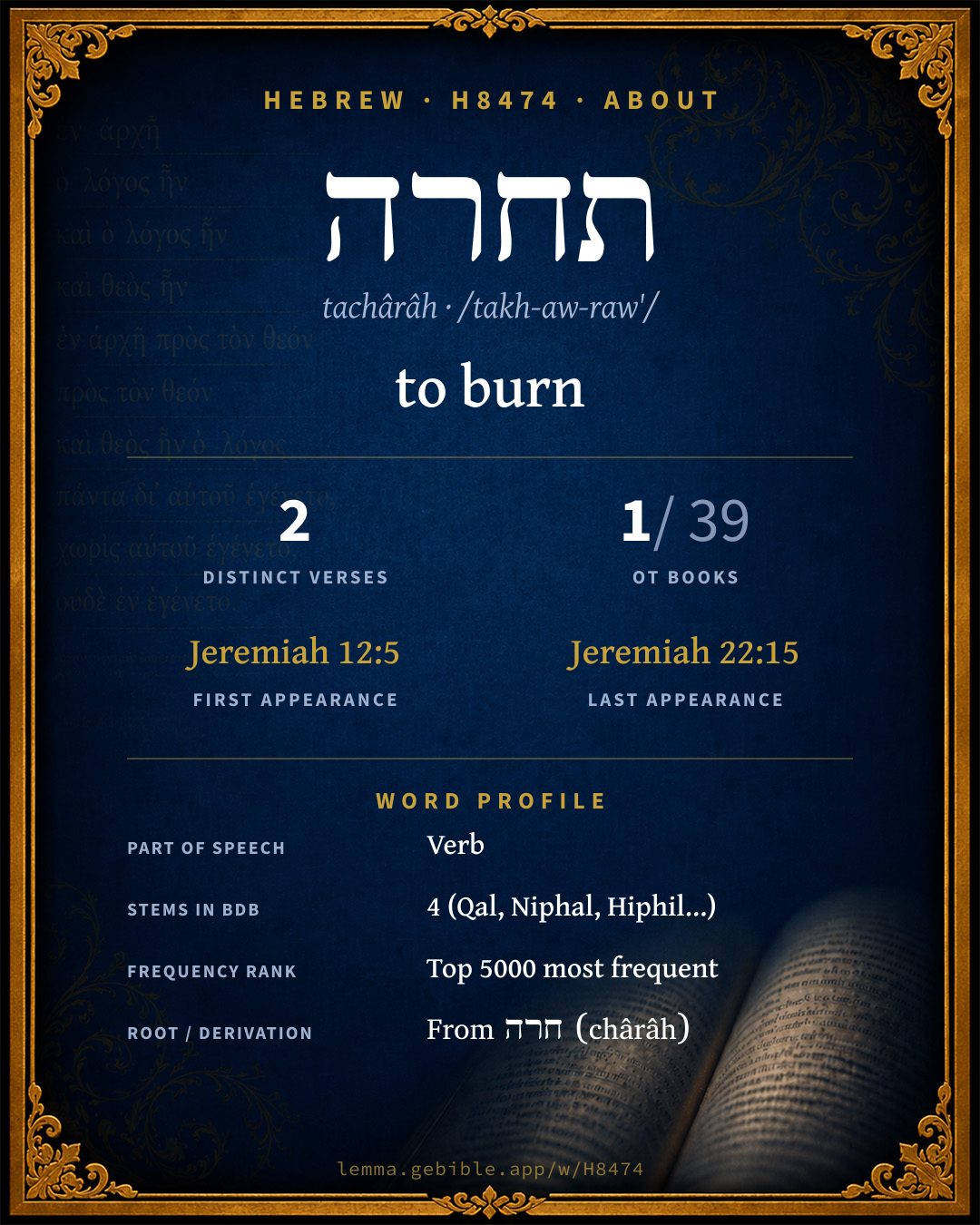
תַּחָרָה
to burn
‘to burn’ is one of 2 main senses fuller range ↓
Full lexicon entry — Brown-Driver-Briggs (BDB)
From Brown-Driver-Briggs (BDB)
Where this word appears
Grammar key — what these labels mean
Part of speech
- Verb
- An action or state-of-being word.
Form
- Imperfect
- An incomplete, ongoing, or future action (“he will / would write”).
- Participle Active
- A verbal adjective expressing ongoing or characteristic action (“writing / one who writes”).
State
- Absolute
- The independent form of a noun, not bound to a following word.
Person
- 2nd Person
- The one addressed (“you”).
Gender
- Masculine
- Grammatically masculine.
Number
- Singular
- One.
Grammatical forms
- Verb, Tiphil, Imperfect, 2nd Person, Masculine, Singular 1 time (50%)
- Verb, Tiphil, Participle Active, Masculine, Singular, Absolute 1 time (50%)
Parsed forms decoded from the imported morphology (morphhb / Westminster Leningrad Codex — WLC text public domain, morphhb tagging CC BY 4.0), counted across 2 parsed occurrences — not distinct verses.
Every verse where H8474 appears — 2 distinct verses across 1 book. Click any verse to open its interlinear word-by-word view. Verse text shown in the World English Bible for context — . Each verse’s Hebrew form is shown with its reference; the English is not keyword-highlighted, since the data carries no word-level English alignment. Use “Compare translations” on any verse to read it across multiple English versions. This concordance covers the Hebrew Bible; Septuagint (Greek Old Testament) occurrences are not indexed here.
Jeremiah 2 verses
- Jeremiah 12:5 תְּתַֽחֲרֶ֖ה Tiphil impf 2ms If you have run with the footmen, and they have wearied you, then how can you contend with horses? and though in a land of peace you are secure, yet how will you do in the pride of the Jordan?
- Jeremiah 22:15 מְתַחֲרֶ֣ה Tiphil ptcp.act ms Shall you reign, because you strive to excel in cedar? Didn't your father eat and drink, and do justice and righteousness? then it was well with him.
About this entry
At a glance — auto-summarized from this page’s data, not written by a person. Every figure links to its source below. This summary describes the numbers; it doesn’t interpret them.
The Hebrew verb תחרה centers on the idea of “to burn.” It is rare — just 2 verses in the entire Hebrew Bible. Jeremiah dominates its distribution — 2 of 2 verses. Its earliest occurrence is Jeremiah 12:5. Read the stem: it spans 4 stems, including Qal and Niphal. Dig into 2-verse concordance and the renderings breakdown below.
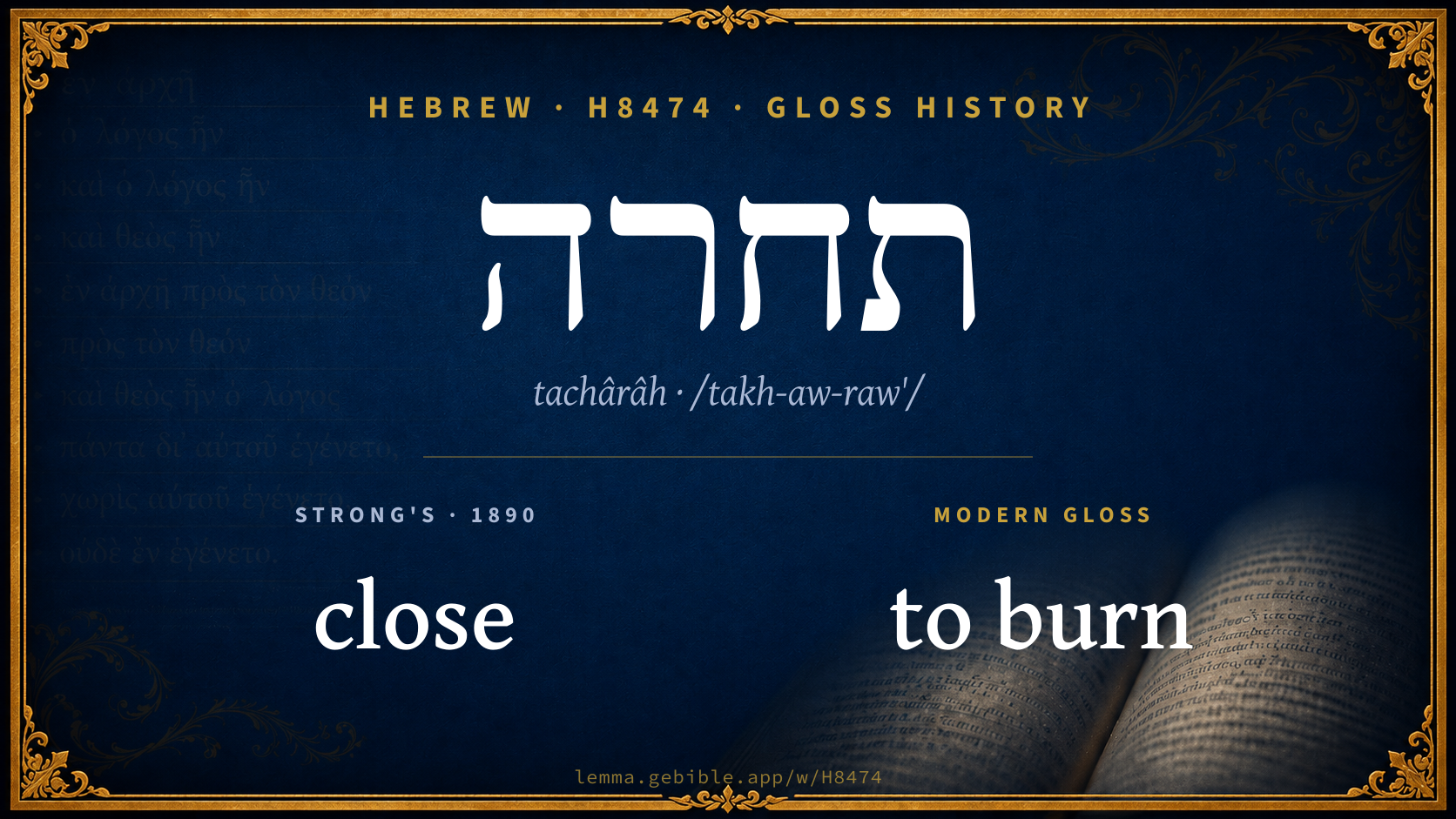
Gloss history
Strong's 1890 vs modern scholarship
About this word
Strong's H8474 catalogs a Hebrew word from the Hebrew Old Testament.
These counts are not copied from any lexicon or concordance. They are computed here, from the morphology-tagged Hebrew Old Testament. What Lemma adds →
- 2
- distinct verses
- The word appears in 2 distinct verses.
- 1 / 39
- OT books
- The word appears in 1 of 39 Old Testament books.
- #4,807
- by frequency
- Top 5000 most frequent Hebrew words (rank 4,807 of 8,640 Hebrew words by occurrence).
View all 2 occurrences in the concordance →
Most concentrated in
- Jeremiah 2 verses 100%
By section of the Old Testament
By traditional corpus
Conventional, traditional groupings — biblical authorship is debated, so this is a traditional corpus grouping, not an authorship claim. Each share is this word’s portion of its verses in that division of the Hebrew canon. Each figure is a share of the word’s 2 distinct verses.
- Prophets (Nevi'im) 2 verses · 100%
How translations render this word
Counts come from each version’s own published word-to-Strong’s tagging or interlinear alignment — an approximate guide to how each version renders this word, not a word-level alignment the data otherwise carries. Because each total is that version’s own tagged count, the per-version totals vary from one another and need not match the appearance or distinct-verse counts above. These counts may also differ from a printed concordance because Lemma counts each distinctly tagged rendering and does not collapse phrase taggings into a single head-word total. This is a fixed set of word-tagged versions (KJV, ASV, BSB, ULT) and does not change with the reading translation you choose elsewhere. Each version’s license is shown beside its name below (and on Sources).
- King James Version: Thee then how canst thou contend 1×, Thou closest 1×
- American Standard Version: Thee 1×, Thou strivest to excel 1×
- Berean Standard Bible: Can you compete 1×, Excel 1×
- unfoldingWord Literal Text: Are competing 1×, Will you compete 1×
King James Version Public Domain
Renders H8474 across 2 tagged occurrences — most commonly:
American Standard Version Public Domain
Renders H8474 across 2 tagged occurrences — most commonly:
Berean Standard Bible Public Domain
Renders H8474 across 2 tagged occurrences — most commonly:
unfoldingWord Literal Text CC BY-SA 4.0
Renders H8474 across 2 tagged occurrences — most commonly:
11 senses and sub-senses in the full BDB
Hebrew verbs can shift meaning by stem (binyan): Qal is the basic action, Niphal is often passive or reflexive, Piel often intensifies or makes it factitive, and Hiphil is typically causative. The senses below are grouped under the stem BDB assigns to each. This entry also uses Hithpael (reflexive or reciprocal).
What do BDB’s symbols mean?
BDB uses these scholarly abbreviations:
| Symbol | Meaning |
|---|---|
| 𝔊 | the Septuagint (the ancient Greek translation, LXX) |
| 𝔙 | the Vulgate (the Latin translation) |
| 𝔖 | the Syriac version (the Peshitta) |
| 𝔗 | the Targum (the Aramaic translation) |
| ψ | the Psalms |
| √ | root (the underlying root or stem) |
| ‖ | parallel passage (a synonymous or contrasted parallel) |
| † | the dagger: every passage where the word occurs is cited |
The 11 senses and sub-senses the full Brown-Driver-Briggs lexicon distinguishes for this word, in lexicon order (not ranked by frequency), with BDB’s own verbatim wording and sub-sense lettering. Shown in Hebrew script with BDB’s own scholarly abbreviations. The condensed entry is in the Lexicon Entry tab. See also the Forms in the corpus table below.
Qal
- Pf. ח׳ Gn 4:6 + 20 times; Impf. יֶחֱרֶה Ex 32:11 + 2 times; יִ֫חַר Gn 18:30 + 7 times; וַיִּ֫חַר Gn 4:5 + 46 times; Inf. abs. חָרֹה 1 S 20:7; cstr. חֲרוֹת 2 S 24:1 ψ 124:3;— e.g. Genesis 4:6
- 1. of man:
- a. חרה אף (one’s) anger was kindled, burned Gn 39:19 Nu 22:27 (J), Ex 32:19, 22 (JE), Ju 9:30; 14:19 1 S 11:6 Jb 32:2, 5; c. בְּ against Gn 30:2 (E), 44:18 (J), 1 S 17:28; 20:30 2 S 12:5 2 Ch 25:10 ψ 124:3 Jb 32:2, 3; c. אֶל Nu 24:10 (E). e.g. Genesis 39:19
- b. impers., אף omitted; חרה לְ it was kindled for (him) he burned with anger Gn 31:36 (E), 4:5, 6; 34:7 Nu 16:15 (J), 1 S 15:11 (read perhaps וַיֵּצֶר, Weir in Dr), 18:8; 20:7(×2) 2 S 3:8; 6:8 = 1 Ch 13:11, 2 S 13:21; 19:43 Ne 3:33; 4:1; 5:6 Jon 4:1, 4, 9(×2); ins. ויחר לדוד 2 S 11:22 𝔊 We Dr; ח׳ בְּעֵינֵי Gn 31:35; 45:5 (E). e.g. Genesis 31:36
- 2. of God:
- a. ח׳ אף Ex 22:23 Nu 22:22 (E), Nu 11:1, 10; 32:10 (J); c. בְּ Ex 4:14; 32:10 Nu 12:9 Dt 31:17 (J), 6:15; 7:4; 11:17; 29:26 Jos 23:16 (D), Ju 6:39 2 S 6:7 = 1 Ch 13:10, Ho 8:5 2 K 23:26 2 Ch 25:15 Jb 42:7; בְּעַם Ex 32:11 Nu 11:33 (J), Is 5:25 ψ 106:40; בישׂראל Nu 25:3; 32:13 (JE); Ju 2:14, 20; 3:8; 10:7 2 S 24:1 2 K 13:3; בבני ישׂראל Jos 7:1 (R); בנהרים, אף omitted, Hb 3:8; c. עַל Zc 10:3. e.g. Exodus 22:23
- b. חרה לְ Gn 18:30, 32 (J) 2 S 22:8 = ψ 18:8.— e.g. Genesis 18:30
- חרה not in HP (who use קצף); nor in Je Ez Is 2 Pr or poetry of Jb.
Niphal
- Pf. נִחֲרוּ־ sq. בְּ Ct 1:6 (according to Bö ii. 379 De Köi. 551) be angry with; Pt. כֹּל הַנֶּחֱרִים בְּ׳ all that are incensed against (thee) Is 41:11, so 45:24. e.g. Song of Solomon 1:6
Hiphil
- Pf. הֶחֱרָה הֶחֱזִיק Ne 3:20 burned with zeal (?) in repairing, but 𝔊 om. החרה; prob. dittogr.; Impf. וַיַּחַר עָלַי אַפּוֹ Jb 19:11 and kindled his anger against me. e.g. Nehemiah 3:20
Hithpael
- Impf. אַל תִּתְחַר ψ 37:1, 7, 8 Pr 24:19 heat oneself in vexation.—The foll. forms are somewhat dub.: Impf. 2 ms. אֵיךְ תְּתַחֲרֶה אֶת־הַסּוּסִים Je 12:5 how canst thou hotly contend (in a race) with the horses? Pt. כִּי אַתָּה מְתַחֲרֶה בָאָ֑רֶז Je 22:15 because thou strivest eagerly (to excel) in cedar; expl. as Tiphʿēl by Thes Ges§ 55, 5 Ew§ 122 a Ol§ 255 a Sta§ 159 b Köi. p. 557 al., and regarded by most as a rare causative stem; but ag. existence of Tiphʿēl v. BaNB § 180 a; ZMG 1894, 20; Ba regards the form as denom. (from a noun formed by ת preform., cf. Aramaic ܬܰܚܪܘܽܬܳܐ contention); SS would point as Hithp. [cf. Syriac ܐܶܬܚܪܺܝ contend with, ܚܶܪܝܳܢ contention], although meaning of Hithp. is diff., v. supr. e.g. Psalms 37:1
Senses from the full Brown-Driver-Briggs lexicon (Brown, Driver, Briggs; Oxford 1906 — public domain), digitized via Sefaria, supplemented by the OpenScriptures HebrewLexicon (CC BY 4.0). Full attribution on Sources.
Word origin
vb. burn, be kindled, of anger (Aramaic חרי Pa. cause fire to burn (rare); Zinj. חרא anger, NöZMG 1893, 98. 103; Arabic حَرْوَةٌ burning sensation, in throat, etc., from rage and pain)—
— Brown-Driver-Briggs (Oxford 1906, public domain), digitized via Sefaria, supplemented by the OpenScriptures HebrewLexicon (CC BY 4.0). See Sources.
Derived from חרה (chârâh) (H2734) — to be angry.
Forms in the corpus
The 2 distinct written forms H8474 takes in the Hebrew Bible, most frequent first — each parse links to that stem’s occurrences in the concordance. Hebrew forms include their vowel points and cantillation, so a single lemma takes many written forms.
| Form | Parsing | Example | Uses |
|---|---|---|---|
| מְתַחֲרֶ֣ה | Verb, Tiphil, Participle Active, Masculine, Singular, Absolute | Jeremiah 22:15 | 1 |
| תְּתַֽחֲרֶ֖ה | Verb, Tiphil, Imperfect, 2nd Person, Masculine, Singular | Jeremiah 12:5 | 1 |
Same root — word family
Other BDB entries built from the same root as H8474, grouped by Strong’s listed origin. These share a root / origin per the lexicon — not necessarily a shared meaning. Each links to that word’s own entry.
Derives from
Shares the same root
Proper names from this root
People and places named from this root — a name, not an additional meaning of the word.
Compare all same-root words → Showing 4 of 6 — not the complete family. 1 of the same-root words is a proper name (a person or place). They share a root, not necessarily a meaning.
Septuagint verse parallels
This word appears in 2 verses that also exist in the Greek Old Testament (Septuagint), out of the 2 Hebrew verses it occurs in. You can read those verses in Greek by switching the Old Testament edition to the Septuagint.
Read these verses in the Septuagint
This is a verse-level parallel only — the same verses exist in both the Hebrew and Greek Old Testaments. No word-level Hebrew↔Greek correspondence is claimed: the data carries no such alignment, so no Greek word is shown as this Hebrew word’s translation. Coverage is not total — the Septuagint omits the deuterocanon and renumbers the Psalms, so some Hebrew verses have no direct Greek parallel.