
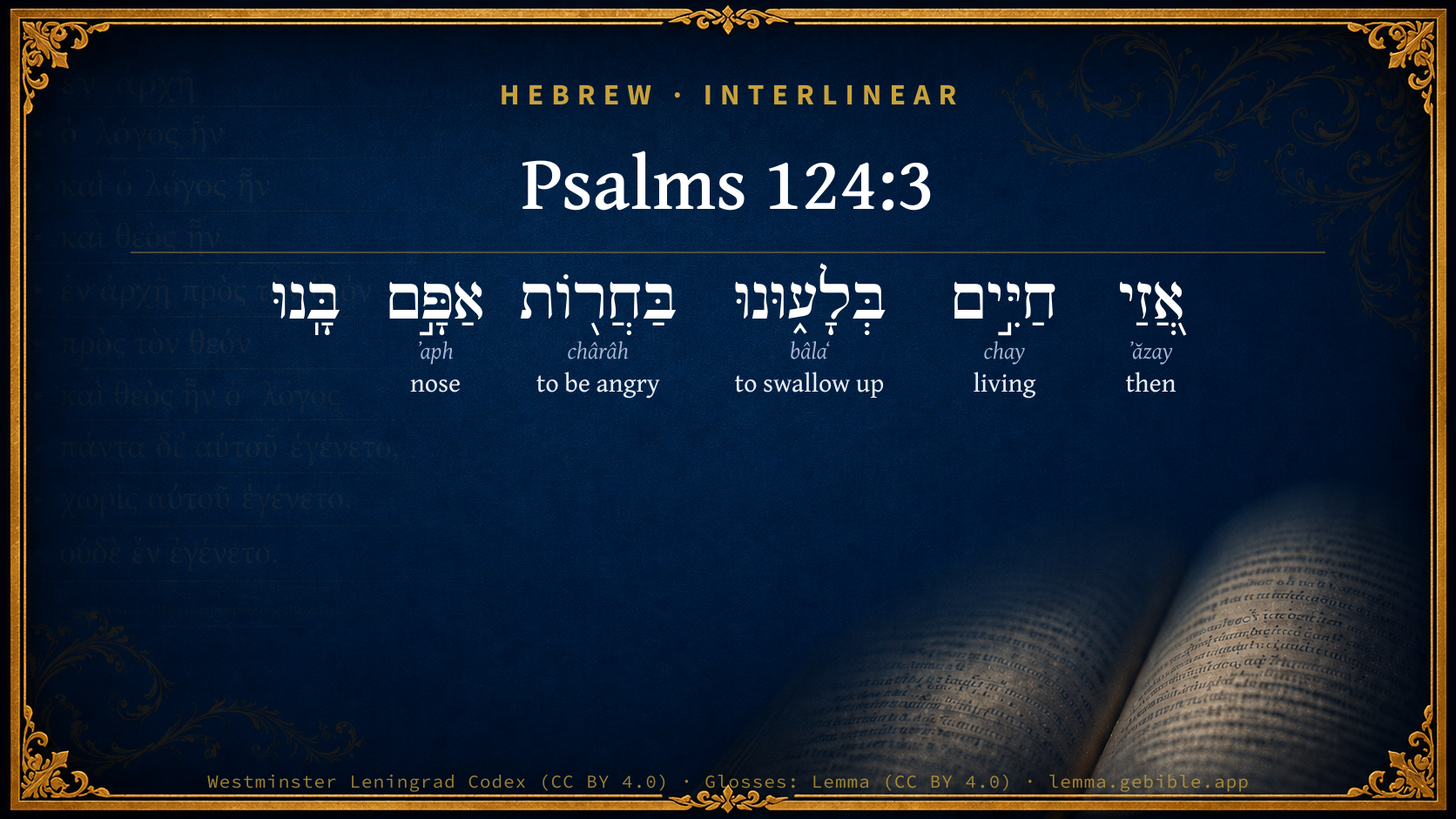
Psalms 124:3

Hebrew (Westminster Leningrad Codex) Psalms 124:3 appears in the Hebrew Old Testament. The text above is from the Westminster Leningrad Codex. Each word links to its Strong’s number, a concise gloss, and parsing drawn from the Open Scriptures Hebrew Bible morphology. Click any word for its full Brown-Driver-Briggs (BDB) entry.
Download image
Cite this verse

Psalms 124:3 (World English Bible). Public Domain. Lemma interlinear Bible study tool, https://lemma.gebible.app/v/psalms/124/3.

Show BibTeX & RIS
BibTeX
RIS
English Translation
Then they would have swallowed us up alive, When their wrath was kindled against us;
World English Bible · Public Domain
Highlights
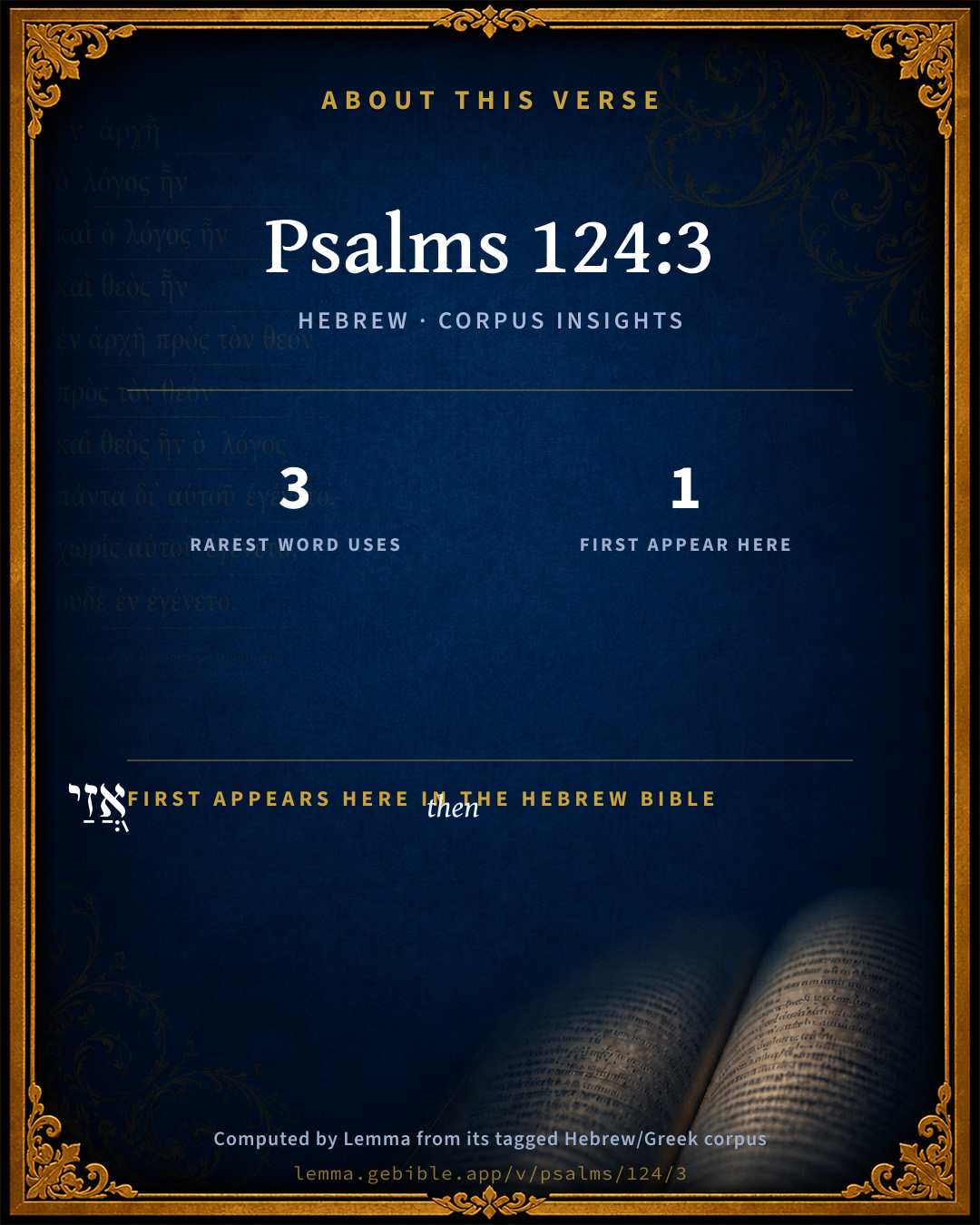
  • 1 first appearance in the Hebrew Bible
Full analysis ↓
Download a study sheet

One document with this verse’s original text, its word-by-word gloss line, the meaning frame, cross-references with their text, attributed commentary, and full source and license credits — printable, and it pastes into notes with its structure intact.

This verse Autodidact and up

Study sheet (.html) Plain text (.txt)

A passage Seminary Student

Up to 50 verses in one chapter. A passage sheet keeps up to 6 commentary sources and 12 cross-references per verse, in the order this page ranks them, and says so on the sheet whenever that leaves anything out. Ask for a single verse and you get the Autodidact verse sheet above.

Everything on this page stays free to read, with no account — the sheet is a download of what is already on screen, not access to it.

Want to remove ads? Support Godless Engineer
Compare translations 3

The same verse in 3 English versions, stacked beneath the original-language interlinear above. Click any original word for its lexicon entry.

Each is an independent rendering of the whole verse — the interlinear is not word-aligned to these translations.

Highlighted words mark where these versions differ — a whole-verse word diff, not a word-by-word alignment.

  • World English Bible Public Domain
    Then they would have swallowed us up alive, When their wrath was kindled against us;
  • King James Version Public Domain
    Then they had swallowed us up quick, when their wrath was kindled against us:
  • unfoldingWord Literal Text CC BY-SA 4.0
    then they would have swallowed us alive when their nose burned against us.

unfoldingWord Literal Text — © unfoldingWord, licensed CC BY-SA 4.0. Word-aligned USFM3 via Door43 (git.door43.org/unfoldingWord/en_ult).

Versions to compare (up to 4)

3 of 4 selected

Show all 18 translations

Every available English version of this verse, each an independent rendering of the whole verse.

  • World English Bible Public Domain
    Then they would have swallowed us up alive, When their wrath was kindled against us;
  • Berean Standard Bible Public Domain
    when their anger flared against us, then they would have swallowed us alive,
  • Majority Standard Bible Public Domain
    when their anger flared against us, then they would have swallowed us alive,
  • King James Version Public Domain
    Then they had swallowed us up quick, when their wrath was kindled against us:
  • American Standard Version (1901) Public Domain
    Then they had swallowed us up alive, When their wrath was kindled against us;
  • Revised Version (1885) Public Domain
    Then they had swallowed us up alive, when their wrath was kindled against us:
  • Geneva Bible (1599) Public Domain
    They had then swallowed vs vp quicke, when their wrath was kindled against vs.
  • Douay-Rheims (1899) Public Domain
    Have mercy on us, O Lord, have mercy on us: for we are greatly filled with contempt.
  • Young's Literal Translation Public Domain
    Then alive they had swallowed us up, In the burning of their anger against us,
  • Literal Standard Version CC BY-SA 4.0
    Then they had swallowed us alive, || In the burning of their anger against us,
  • Unlocked Literal Bible CC BY-SA 4.0
    then they would have swallowed us up alive when their anger raged against us.
  • unfoldingWord Literal Text CC BY-SA 4.0
    then they would have swallowed us alive when their nose burned against us.
  • Darby Bible Public Domain
    Then they had swallowed us up alive, when their anger was kindled against us;
  • World Messianic Bible Public Domain
    then they would have swallowed us up alive, when their wrath was kindled against us,
  • Webster's Bible Public Domain
    Then they had swallowed us up quick, when their wrath was kindled against us:
  • Free Bible Version CC BY-SA 4.0
    They would have swallowed us alive when their anger raged against us.
  • Bible in Basic English Public Domain
    They would have made a meal of us while still living, in the heat of their wrath against us:
  • JPS Tanakh (1917) Public Domain
    Then they had swallowed us up alive, when their wrath was kindled against us;

Literal Standard Version (2020), Covenant Press — licensed CC BY-SA 4.0. Text via the HelloAO Bible API (eBible.org). Unlocked Literal Bible (unfoldingWord) — licensed CC BY-SA 4.0. Text via the HelloAO Bible API (eBible.org). unfoldingWord Literal Text — © unfoldingWord, licensed CC BY-SA 4.0. Word-aligned USFM3 via Door43 (git.door43.org/unfoldingWord/en_ult). Free Bible Version, Dr. Jonathan Gallagher — licensed CC BY-SA 4.0. Text via the HelloAO Bible API (eBible.org).

Word by word

More ways to search: Search by grammar → Find every occurrence → Compare this word →

Practice this passage: Drill this verse → Learn its vocabulary →

About this verse

These counts appear in no published source. They are computed here, from the morphology-tagged text and Lemma’s own curated glosses. What Lemma adds →

6
words
5
distinct lemmas
Wisdom
section

Notable vocabulary

The rarest word here is אֲ֭זַי then H233 — appearing just 3 times in the whole Hebrew Bible.

First appearance in Scripture

This word makes its first canonical appearance in the Hebrew Bible here:

  • אֲ֭זַי then H233

Shared distinctive vocabulary

אֲ֭זַי then H233 occurs in 3 verses of the Hebrew Bible. Also found in:

Grammatical profile

  • 2 verbs
  • 1 noun
  • 1 adjective
  • 1 preposition
  • 1 adverb

Verb forms

  • בְּלָע֑וּנוּ Qal · Perfect
  • בַּחֲר֖וֹת Qal · Infinitive Construct

Hebrew & Septuagint length

In English translation the verse runs 15 words from the Hebrew and 15 from the Septuagint (LXX English) — the same length.

A rough comparison of the two English renderings, which tokenize alike — not a word-level alignment.

Word counts can differ between the Hebrew and the Greek without any difference in meaning — e.g. the Hebrew direct-object marker אֵת has no separate Greek word, and Greek often adds the article ὁ.

Cross-references

17

Topical passages linked to Psalms 124:3 in the Treasury of Scripture Knowledge — connected by theme and wording, ordered by reader-vote popularity; previews shown in the World English Bible.

  • Numbers 16:30–34 But if Yahweh make a new thing, and the ground open its mouth, and swallow them up, with all that appertain to them, and they go down alive into Sheol; then you shall understand that these men have despised Yahweh.
  • Esther 3:12–13 Then were the king's scribes called in the first month, on the thirteenth day of it; and there was written according to all that Haman commanded to the king's satraps, and to the governors who were over every province, and to the princes of every people, to every province according to the writing of it, and to every people after their language; in the name of king Ahasuerus was it written, and it was sealed with the king's ring.
  • Psalms 35:25 Don't let them say in their heart, "Aha! That's the way we want it!" Don't let them say, "We have swallowed him up!"
  • Psalms 57:3 He will send from heaven, and save me, He rebukes the one who is pursuing me. Selah. God will send out his loving kindness and his truth.
  • Matthew 2:16 Then Herod, when he saw that he was mocked by the wise men, was exceedingly angry, and sent out, and killed all the male children who were in Bethlehem and in all the surrounding countryside, from two years old and under, according to the exact time which he had learned from the wise men.
  • Acts 9:2 and asked for letters from him to the synagogues of Damascus, that if he found any who were of the Way, whether men or women, he might bring them bound to Jerusalem.
  • Psalms 27:2 When evil-doers came at me to eat up my flesh, Even my adversaries and my foes, they stumbled and fell.
  • Daniel 3:19 Then was Nebuchadnezzar full of fury, and the form of his visage was changed against Shadrach, Meshach, and Abednego: [therefore] he spoke, and commanded that they should heat the furnace seven times more than it was wont to be heated.
  • 1 Samuel 20:30–33 Then Saul's anger was kindled against Jonathan, and he said to him, You son of a perverse rebellious woman, don't I know that you have chosen the son of Jesse to your own shame, and to the shame of your mother's nakedness?
  • Esther 3:6 But he scorned the thought of laying hands on Mordecai alone; for they had made known to him the people of Mordecai: therefore Haman sought to destroy all the Jews who were throughout the whole kingdom of Ahasuerus, even the people of Mordecai.
  • Psalms 56:1–2 Be merciful to me, God, for man wants to swallow me up. All day long, he attacks and oppresses me.
  • Psalms 74:8 They said in their heart, "We will crush them completely." They have burned up all the places in the land where God was worshiped.
  • Psalms 76:10 Surely the wrath of man praises you. The survivors of your wrath are restrained.
  • Psalms 83:4 "Come," they say, "and let's destroy them as a nation, That the name of Israel may be remembered no more."
  • Proverbs 1:12 Let's swallow them up alive like Sheol, And whole, like those who go down into the pit.
  • Jeremiah 51:34 Nebuchadrezzar the king of Babylon has devoured me, he has crushed me, he has made me an empty vessel, he has, like a monster, swallowed me up, he has filled his maw with my delicacies; he has cast me out.
  • Jonah 1:17 Yahweh prepared a great fish to swallow up Jonah, and Jonah was in the belly of the fish three days and three nights.

Cross-references courtesy of OpenBible.info (CC BY 4.0).

Hebrew and Greek witnesses Masoretic Hebrew ↔ Greek Septuagint

The same verse in the two great witnesses to the Old Testament, shown verse-for-verse.

You’re reading Greek Psalm 123 (Hebrew Psalm 124). The Septuagint counts the superscription, so verse numbers can differ from the Hebrew — chapter-level alignment, not verse-by-verse. Numbering follows Rahlfs.

These are two independent witnesses, not word-aligned to each other, and the Septuagint is shown in lemma (dictionary) form.

Hebrew Psalms 124:3 Masoretic · Westminster Leningrad Codex

אֲ֭זַי חַיִּ֣ים בְּלָע֑וּנוּ בַּחֲר֖וֹת אַפָּ֣ם בָּֽנוּ

Then they would have swallowed us up alive, When their wrath was kindled against us;

World English Bible · Public Domain

Greek LXX Greek Psalm 123:3 Septuagint · lemma form

ἄρα ζάω ἄν καταπίνω ἐγώ ἐν ὁ ὀργίζω ὁ θυμός αὐτός ἐπί ἐγώ

verily they would have swallowed us up alive, when their wrath was kindled against us:

LXX2012 (modern English Septuagint) · Public Domain

Hebrew: Westminster Leningrad Codex (CC BY 4.0). Greek: Septuagint (public domain); English from LXX2012 (modern English Septuagint) (Public Domain). How the Septuagint differs from the Hebrew →

Commentary

Notes on Psalms 124:3 from classic Christian and Jewish commentators (each source and its license shown beneath its notes). The classic Christian expositions comment on the surrounding passage and are grouped to its opening verse, so a note may address several verses; the Jewish commentaries on the Tanakh (Rashi and others) are per-verse, so they appear only where the commentator wrote on this verse.

Lemma curates 59 commentaries, every one of them public domain or Creative Commons licensed, each selected and text-cleaned for this edition rather than reprinted as found. About our sources →

John Calvin's Commentaries

When he says, (Psalm 124:3,) They had swallowed us up alive, “The metaphor may be taken from famished wild beasts attacking and devouring men, (Comp. 5:5,) or the reference may ‘be to the case of a man shut up alive in a sepulcher, (Proverbs 1:12,) and left there to perish, or (Numbers 16:30) swallowed up by an earthquake ” — Cresswell. “A figurative expression to intimate the savageness of the adversaries, alluding to the practice of many predatory animals of swallowing their victims alive. Such is the well-known habit of many of the predatory kinds of fish.” — Phillips.

John Calvin's Commentaries (1540-1563) — public domain. Text from the Calvin Translation Society English edition (1840s-50s) via the Christian Classics Ethereal Library (ccel.org). Calvin's coverage is partial (roughly two-thirds of the Bible); uncommented books and verses are honest gaps, never fabricated. The 19th-century editor's footnotes and remarks are omitted so the notes are faithfully Calvin's own voice.

Trapp's Complete Commentary

John Trapp

Psa 124:3 Then they had swallowed us up quick, when their wrath was kindled against us:

Ver. 3. Then had they swallowed us up quick] As the great fish do the little ones, as hungry lions, or wolves, ravin up their prey. Ptolemy Lathurus, king of Egypt, slew thirty thousand Jews, and compelled the living to feed upon the dead. Adrian the emperor made a decree, that he who had not slain a Jew should himself be slain (Gualth Praef. in Marc. R. Obad. Gaon in Psa 124:1-8).

When their wrath was kindled against us] Heb. in the flagrancies or inflammations of their anger.

John Trapp, A Commentary or Exposition upon All the Books of the Old and New Testament (1647–1656) — public domain. Text from a community e-Sword module.

Joseph Benson's Commentary

Psa 124:3-6. They had swallowed us up quick — They had speedily and utterly destroyed us, as Korah and his company were, Numbers 16. The proud waters had gone over, &c. — Our enemies, compared to proud waters for their great multitude, swelling rage, and mighty force. The Lord hath not given us a prey to their teeth — A metaphor taken from wild beasts, which tear and devour their prey with their teeth. It is here intimated that the enemies of God’s people have no power whatever against them, but what is given them from above. God, however, sometimes suffers them to prevail very far against them, that his own power may appear the more illustrious in their deliverance.

Joseph Benson's Commentary on the Old and New Testaments (1811–1818) — public domain. Text from a community e-Sword module.

J. A. Alexander on Psalms

Joseph Addison Alexander

3. (Psa 124:3) Then alive would they have swallowed us, in the kindling of their wrath against us. With respect to the then at the beginning of this verse, there is danger of an error just the opposite of that already pointed out in reference to the now of Psa 124:1. As the English reader would be almost sure to take that for a particle of time, which it is not, he would be equally certain to mistake this for a term of logic, meaning in that case, upon that supposition, or the like; whereas it really means at that time, the well remembered time of our extremity, when God so wonderfully interposed for our deliverance. The Hebrew particle occurs in this form only here, and is consequently no more a proof of recent than of early date. Another word liable to misconstruction in the English versions of this clause is quick, here used in its primary sense of living or alive, from which may be easily deduced its secondary sense of swift, implying lively motion. The historical allusion, in this and other like passages, is no doubt to the fate of Korah and his company. Compare Num 16:32-33, where the same verb and adjective occur together. See above, on Psa 55:15. The plural pronoun their refers to the collective man in the preceding verse.

Joseph Addison Alexander, The Psalms Translated and Explained (1850) — public domain. Text from a community e-Sword module.

Geneva Bible (1599)

Geneva Bible translators

So unable were we to resist.

Geneva Bible (1599) marginal notes — public domain. Text via Bolls.life.

Ellicott's Commentary for English Readers

(3) Then.—Critics are at issue both as to the form and meaning of the word—whether it is an archaism or an aramaism, expressing time or logical sequence.

Swallowed . . . quick (alive).—No doubt an allusion to the fall of Korah (Num_16:32-33), where the same verb and adjective occur together. (See also Psa_55:15.)

A Bible Commentary for English Readers, edited by Charles John Ellicott (1878–1897) — public domain. Text from a community e-Sword module.

The Cambridge Bible for Schools and Colleges

gen. ed. J. J. S. Perowne

3. Then had they swallowed us up alive, as the earth swallowed Korah (Num_16:30); or as Sheol devours its victims (Pro_1:12), or a monster its prey (Jer_51:34). Cp. Psa_55:15; Lam_2:16.

when their wrath &c.] Cp. Neh_4:1 : Sanballat “was wroth and exceedingly vexed,” Psa_4:7 “they were exceedingly wroth.”

The Cambridge Bible for Schools and Colleges (gen. ed. J. J. S. Perowne; Cambridge University Press, 1878–1918) — public domain. Text from a community e-Sword module.

John Gill's Exposition

Then they had swallowed us up quick,.... Or "alive"; as the earth swallowed up Korah and his company; or as the fish swallowed up Jonah; or rather as ravenous beasts swallow their prey; to which the allusion is. The people of God are comparable to sheep and lambs, and such like innocent creatures: and the wicked to lions, tigers, wolves, bears, and such like beasts of prey that devour living creatures;

when their wrath was kindled against us; which is cruel and outrageous; there is no standing against it, nor before it; it is like a fierce flame of fire that burns furiously, and there is no stopping it; none but God can restrain it.

John Gill's Exposition of the Whole Bible (1746–1763) — public domain (CC PDM 1.0). Text via the HelloAO Bible API.

Albert Barnes' Notes on the Bible

Then they had swallowed us up quick - There was no other help, and ruin - utter ruin - would have soon come upon us. The word quick here means alive; and the idea is derived from persons swallowed up in an earthquake, or by the opening of the earth, as in the case of Korah, Dathan, and Abiram. Num 16:32-33. Compare Psa 106:17. The meaning here is, that they would have been destroyed as if they were swallowed up by the opening of the earth; that is, there would have been complete destruction.

When their wrath was kindled against us - Hebrew, In the kindling of their wrath against us. Wrath is often represented in the Scriptures as burning or heated - as that which consumes all before it.

Albert Barnes' Notes on the Bible (1834–1885) — public domain. Text from a community e-Sword/MySword module.

Matthew Poole's English Annotations

They had swallowed us up quick; they had speedily and utterly destroyed us, as Korah, &c. were, Num 16.

Matthew Poole's English Annotations on the Holy Bible (1683–1685) — public domain. Text from a community e-Sword/MySword module.

The Treasury of David

Charles H. Spurgeon

Ver. 3. Then they had swallowed us up quick, when their wrath was kindled against us. They were so eager for our destruction that they would have made only one morsel of us, and have swallowed us up alive and whole in a single instant. The fury of the enemies of the church is raised to the highest pitch, nothing will content them but the total annihilation of God's chosen. Their wrath is like a fire which is kindled, and has taken such firm hold upon the fuel that there is no quenching it. Anger is never more fiery than when the people of God are its objects. Sparks become flames, and the furnace is heated seven times hotter when God's elect are to be thrust into the blaze. The cruel world would make a full end of the godly seed were it not that Jehovah bars the way. When the Lord appears, the cruel throats cannot swallow, and the consuming fires cannot destroy. Ah, if it were not Jehovah, if our help came from all the creatures united, there would be no way of escape for us: it is only because the Lord liveth that his people are alive.

Ver. 3. Then they had swallowed us up quick. The metaphor may be taken from famished wild beasts attacking and devouring men (comp.

v. 5); or the reference may be to the case of a man shut up alive in a sepulchre (Pr 1:12) and left there to perish, or (Nu 16:80) swallowed up by an earthquake. Daniel Cresswell.

Ver. 3.Then they had swallowed us up. The word implies eating with insatiable appetite; every man that eateth must also swallow; but a glutton is rather a swallower than an eater. He throws his meat whole down his throat, and eats (as we may say) without chewing. The rod of Moses, turned into a serpent, "swallowed up" the rods of the Egyptian sorcerers. The word is often applied to express oppression (Ps 35:25): "Let them not say in their hearts, Ah, so would we have it: let them not say, We have swallowed him up": that is, we have made clear riddance of him; he is now a gone man for ever. The ravenous rage of the adversary is described in this language. Joseph Caryl.

Ver. 3. Quick. Not an adverb, "quickly, "but an adjective, alive. As greedy monsters, both of the land and of the deep, sometimes swallow their food before the life is out of it, so would the enemies of the Church have destroyed her as in a moment, but for divine interposition. William S. Plumer.

Ver. 3. Objection. But what may the reason thereof be? May a man say, that thus the godly shall always prevail and be never overthrown by their enemies, but overcome them rather? Experience doth teach us that they are fewer in number than the wicked are, that they are weaker for power and strength, that they are more simple for wit and policy, and that they are more careless for, diligence and watchfulness than their adversaries be: how, then, comes it to pass that they have the upper hand?

Answer. The Prophet Ezra doth declare it unto us in the 8th chapter of his prophecy, and the 10th verse thereof, it is in few words "because the Lord is with them and for them."

For, first, he is stronger than all, being able to resist all power that is devised against him and his, and to do whatsoever he will both in heaven and earth.

2. He is wiser than all, knowing how to prevent them in all their ways, and also how to bring matters to pass for the good of his people.

3. He is more diligent than all, to stand, as it were, upon the watch, and to take his advantage when it is offered him, for "He that keepeth Israel doth neither slumber nor sleep."

4. Lastly, he is happier then all to have good success in all his enterprises, for he doth prosper still in all things which he doth take in hand and none can resist a thought of his; yea, the very "word which goeth out of his mouth doth accomplish that which he wills, and prosper in the thing where unto he doth send it." In war, all these four things are respected in a captain that will still overcome: first, that he be strong; secondly, that he be wise; thirdly, that he be diligent; and, lastly, that he be fortunate; for the victory goeth not always with the strong, nor always with the wise, nor always with the diligent, nor always with the fortunate; but sometimes with the one of them, and sometimes with the other: Out look, where all four do concur together there is always the victory, and therefore seeing all of them are in God, it is no marvel though those whose battles he doth fight, do always overcome and get the victory. Thomas Stint, 1621.

Psalms 124:4*

Charles H. Spurgeon's The Treasury of David (1869–1885) — public domain. Psalms only. Text from a community e-Sword/MySword module.

Whedon's Commentary on the Bible

Daniel D. Whedon

3. Swallowed us up quick—Literally, Swallowed us up alive. The allusion seems to be to Korah and his company, (Num_16:30,) “If the Lord make a new thing, and the earth open her mouth and swallow them up… and they go down alive into the pit.” See also Psa_55:15; Psa_69:15

Daniel D. Whedon (gen. ed.), Commentary on the Old and New Testaments (1874–1909) — public domain. Text from a community e-Sword module.

The Pulpit Commentary

Then they had swallowed us up quick; or, "alive." A common expression for sudden and complete destruction. (comp. Psa_56:2 Psa_57:3 Pro_1:12 Lam_2:2, Lam_2:5, Lam_2:8, etc.) When their wrath was kindled against us ; or, "blazed out against us." The comparison of anger to fire is an almost universal commonplace.

The Pulpit Commentary (1880–1919), ed. H.D.M. Spence-Jones & Joseph S. Exell — public domain. Text from a community e-Sword module.

Rashi

Rabbi Shlomo Yitzchaki (Rashi)

when their anger was kindled against us Heb. בחרות, “when their anger was kindled against us,” is the same form as בעשות, “when he made.”

Rashi on the Tanakh — English translations: “The Judaica Press complete Tanach with Rashi, translated by A. J. Rosenberg” (CC BY 4.0); “Pentateuch with Rashi's commentary by M. Rosenbaum and A.M. Silbermann, 1929-1934” (public domain); “The Metsudah Tanach series, Lakewood, N.J” (CC BY 4.0); and “The Book of Joshua, Metsudah Publications, 1997” (CC BY 4.0). Text via Sefaria.

Lesson kit

Teaching starters — assembled from the data on this page, not authored interpretation. Every prompt links to the verse data it draws on. Edit before teaching.

Psalms, in the Wisdom, opens this verse with 6 words (5 distinct Hebrew lemmas). Its most distinctive word is ʼăzay (“then”). A historical commentator’s framing appears above. Read the whole chapter for the surrounding context.

Discussion questions

  1. The word ʼăzay carries the sense “then.” How does it shape the verse?
  2. The word “then” first appears here in Scripture. What is being introduced at this debut?
  3. Psalms 124:4 shares the word «then» with this verse. How do the two illuminate each other?
  4. The translations on this page render this verse differently — a whole-verse word diff, not a word-by-word alignment. What might account for the different wordings?
  5. The verb «בְּלָע֑וּנוּ» is Qal Perfect. How does its form color the action?
  6. Reading how John Calvin's Commentaries and Trapp's Complete Commentary read this verse, where do the two commentators agree and where do they part?

Things to notice

Reading settings

Reading text

Shown beneath each verse's original-language words.

Old Testament
Old Testament edition

Read the OT as the Masoretic Hebrew (MT) or the Greek Septuagint (LXX).

English shown for the Greek Septuagint (in the Hebrew ↔ Greek comparison).

Comparing translations? Open the Compare panel on any verse page to stack up to four side by side.