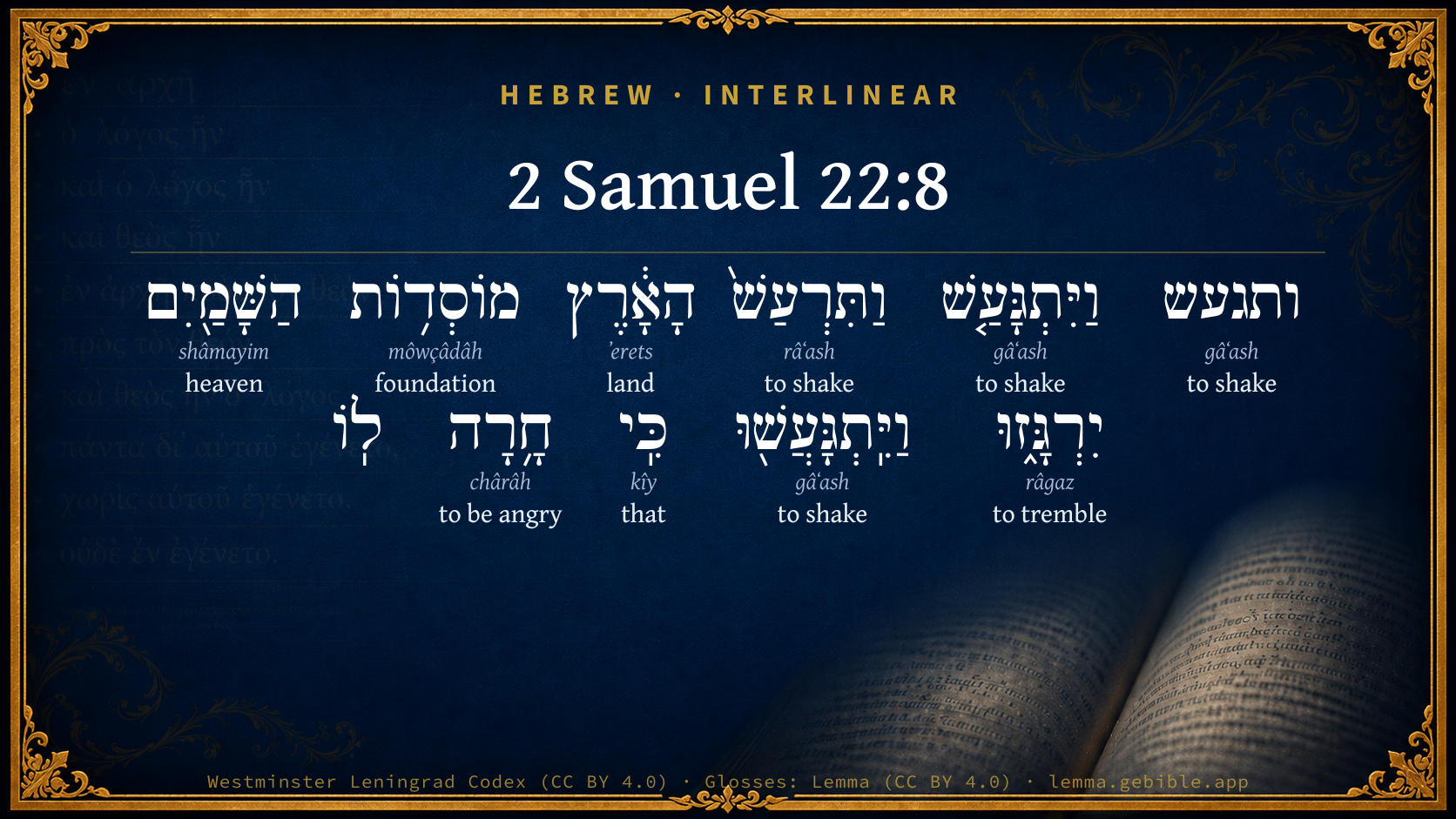
2 Samuel 22:8

Hebrew (Westminster Leningrad Codex) 2 Samuel 22:8 appears in the Hebrew Old Testament. The text above is from the Westminster Leningrad Codex. Each word links to its Strong’s number, a concise gloss, and parsing drawn from the Open Scriptures Hebrew Bible morphology. Click any word for its full Brown-Driver-Briggs (BDB) entry.
Download image
Cite this verse

2 Samuel 22:8 (World English Bible). Public Domain. Lemma interlinear Bible study tool, https://lemma.gebible.app/v/2-samuel/22/8.

Show BibTeX & RIS
BibTeX
RIS
English Translation
Then the earth shook and trembled, The foundations of heaven quaked Were shaken, because he was angry.
World English Bible · Public Domain
Highlights Full analysis ↓
Download a study sheet

One document with this verse’s original text, its word-by-word gloss line, the meaning frame, cross-references with their text, attributed commentary, and full source and license credits — printable, and it pastes into notes with its structure intact.

This verse Autodidact and up

Study sheet (.html) Plain text (.txt)

A passage Seminary Student

Up to 50 verses in one chapter. A passage sheet keeps up to 6 commentary sources and 12 cross-references per verse, in the order this page ranks them, and says so on the sheet whenever that leaves anything out. Ask for a single verse and you get the Autodidact verse sheet above.

Everything on this page stays free to read, with no account — the sheet is a download of what is already on screen, not access to it.

Want to remove ads? Support Godless Engineer
Compare translations 3

The same verse in 3 English versions, stacked beneath the original-language interlinear above. Click any original word for its lexicon entry.

Each is an independent rendering of the whole verse — the interlinear is not word-aligned to these translations.

Highlighted words mark where these versions differ — a whole-verse word diff, not a word-by-word alignment.

  • World English Bible Public Domain
    Then the earth shook and trembled, The foundations of heaven quaked Were shaken, because he was angry.
  • King James Version Public Domain
    Then the earth shook and trembled; the foundations of heaven moved and shook, because he was wroth.
  • unfoldingWord Literal Text CC BY-SA 4.0
    Then the earth shook and trembled. The foundations of the heavens quaked and shook themselves, because it burned to him.

unfoldingWord Literal Text — © unfoldingWord, licensed CC BY-SA 4.0. Word-aligned USFM3 via Door43 (git.door43.org/unfoldingWord/en_ult).

Versions to compare (up to 4)

3 of 4 selected

Show all 18 translations

Every available English version of this verse, each an independent rendering of the whole verse.

  • World English Bible Public Domain
    Then the earth shook and trembled, The foundations of heaven quaked Were shaken, because he was angry.
  • Berean Standard Bible Public Domain
    Then the earth shook and quaked; the foundations of the heavens trembled; they were shaken because He burned with anger.
  • Majority Standard Bible Public Domain
    Then the earth shook and quaked; the foundations of the heavens trembled; they were shaken because He burned with anger.
  • King James Version Public Domain
    Then the earth shook and trembled; the foundations of heaven moved and shook, because he was wroth.
  • American Standard Version (1901) Public Domain
    Then the earth shook and trembled, The foundations of heaven quaked And were shaken, because he was wroth.
  • Revised Version (1885) Public Domain
    Then the earth shook and trembled, the foundations of heaven moved and were shaken, because he was wroth.
  • Geneva Bible (1599) Public Domain
    Then the earth trembled and quaked: the foundations of the heauens mooued and shooke, because he was angrie.
  • Douay-Rheims (1899) Public Domain
    The earth shook and trembled, the foundations of the mountains were moved, and shaken, because he was angry with them.
  • Young's Literal Translation Public Domain
    And shake and tremble doth the earth, Foundations of the heavens are troubled, And are shaken, for He hath wrath!
  • Literal Standard Version CC BY-SA 4.0
    And the earth shakes and trembles, || Foundations of the heavens are troubled, || And are shaken, for He has wrath!
  • Unlocked Literal Bible CC BY-SA 4.0
    Then the earth shook and trembled. The foundations of the heavens trembled and were shaken, because God was angry.
  • unfoldingWord Literal Text CC BY-SA 4.0
    Then the earth shook and trembled. The foundations of the heavens quaked and shook themselves, because it burned to him.
  • Darby Bible Public Domain
    Then the earth shook, and quaked; The foundations of the heavens trembled And shook because he was wroth.
  • World Messianic Bible Public Domain
    Then the earth shook and trembled. The foundations of heaven quaked and were shaken, because he was angry.
  • Webster's Bible Public Domain
    Then the earth shook and trembled: the foundations of heaven moved and shook, because he was wroth.
  • Free Bible Version CC BY-SA 4.0
    The earth shook to and fro; the foundations of the heavens trembled, shaking because of his anger.
  • Bible in Basic English Public Domain
    Then the earth was moved with a violent shock; the bases of heaven were moved and shaking, because he was angry.
  • JPS Tanakh (1917) Public Domain
    Then the earth did shake and quake, the foundations of heaven did tremble; they were shaken, because He was wroth.

Literal Standard Version (2020), Covenant Press — licensed CC BY-SA 4.0. Text via the HelloAO Bible API (eBible.org). Unlocked Literal Bible (unfoldingWord) — licensed CC BY-SA 4.0. Text via the HelloAO Bible API (eBible.org). unfoldingWord Literal Text — © unfoldingWord, licensed CC BY-SA 4.0. Word-aligned USFM3 via Door43 (git.door43.org/unfoldingWord/en_ult). Free Bible Version, Dr. Jonathan Gallagher — licensed CC BY-SA 4.0. Text via the HelloAO Bible API (eBible.org).

Word by word

More ways to search: Search by grammar → Find every occurrence → Compare this word →

Practice this passage: Drill this verse → Learn its vocabulary →

ותגעש
gâʻash
H1607
“and · to shake”
Conjunction + Verb, Qal, Sequential Imperfect, 3rd Person, Feminine, Singular
Part of Speech
Conjunction + Verb
Stem
Qal
Form
Sequential Imperfect
Person
3rd Person
Gender
Feminine
Number
Singular
Full BDB Definition

Origin: a primitive root

TWOT: 371

to shake, quake - (Qal) to shake - (Pual) to be shaken up, convulsed - (Hithpael) to shake back and forth, toss or reel to and fro - (Hithpoel) to reel to and fro
  1. וַיִּתְגָּעַ֤שׁ gâʻash H1607 “and · to shake” Conjunction + Verb, Hithpael, Sequential Imperfect, 3rd Person, Masculine, Singular
  2. וַתִּרְעַשׁ֙ râʻash H7493 “and · to shake” Conjunction + Verb, Qal, Sequential Imperfect, 3rd Person, Feminine, Singular
  3. הָאָ֔רֶץ ʼerets H776 “the · land” Particle, Definite Article + Noun, Common, Both, Singular, Absolute
  4. מוֹסְד֥וֹת môwçâdâh H4146 “foundations of” Noun, Common, Both, Plural, Construct
  5. הַשָּׁמַ֖יִם shâmayim H8064 “the · heaven(s)” Particle, Definite Article + Noun, Common, Masculine, Plural, Absolute
  6. יִרְגָּ֑זוּ râgaz H7264 “to tremble” Verb, Qal, Imperfect, 3rd Person, Masculine, Plural
  7. וַיִּֽתְגָּעֲשׁ֖וּ gâʻash H1607 “and · to shake” Conjunction + Verb, Hithpael, Sequential Imperfect, 3rd Person, Masculine, Plural
  8. כִּֽי kîy H3588 “that” Conjunction
  9. חָ֥רָה chârâh H2734 “to be angry” Verb, Qal, Perfect, 3rd Person, Masculine, Singular

About this verse

These counts appear in no published source. They are computed here, from the morphology-tagged text and Lemma’s own curated glosses. What Lemma adds →

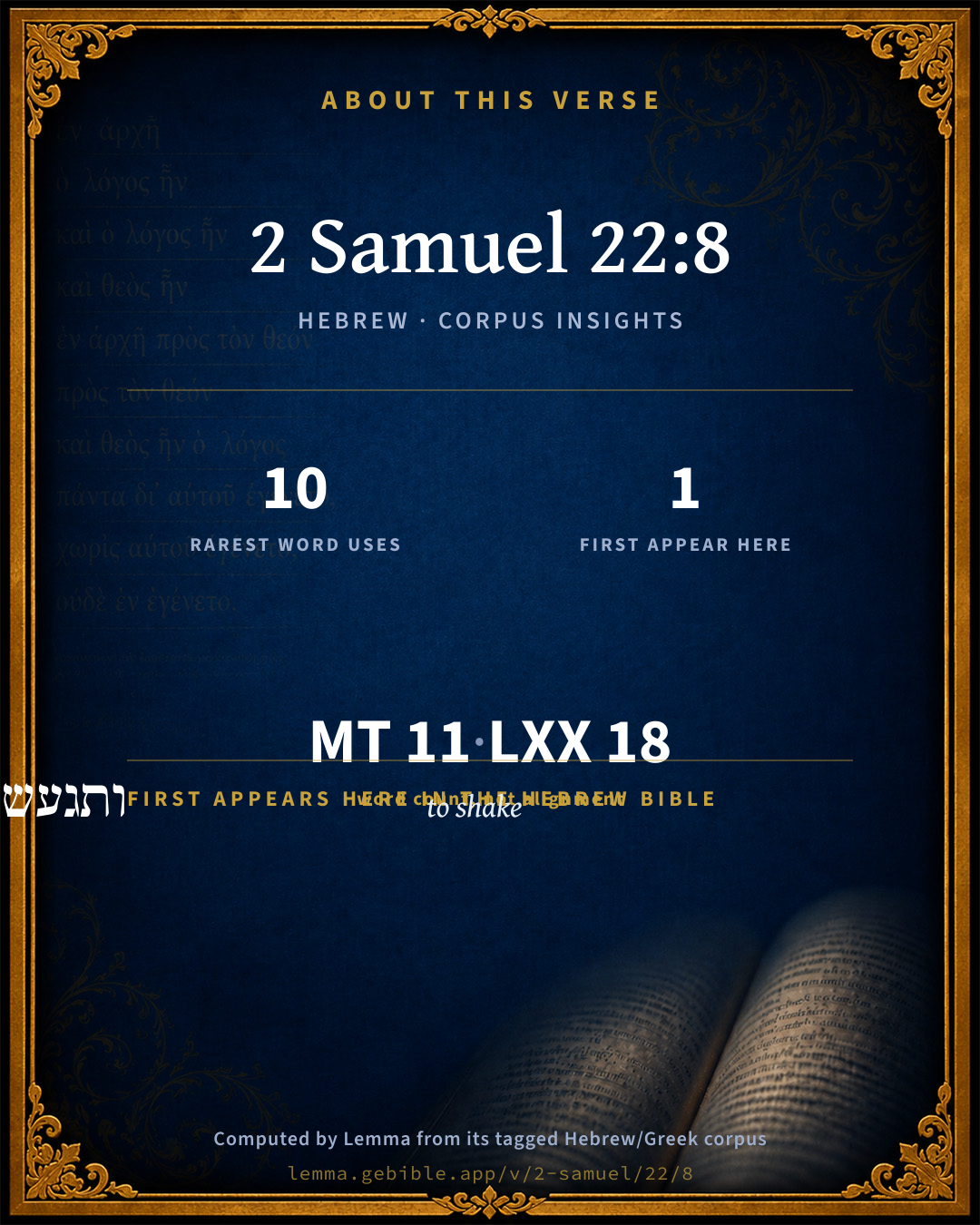
11
words
8
distinct lemmas
Historical
section

Notable vocabulary

The rarest word here is ותגעש to shake H1607 — appearing just 10 times in the whole Hebrew Bible.

First appearance in Scripture

This word makes its first canonical appearance in the Hebrew Bible here:

  • ותגעש to shake H1607

Shared distinctive vocabulary

ותגעש to shake H1607 occurs in 7 verses of the Hebrew Bible. Also found in:

Grammatical profile

  • 6 verbs
  • 3 nouns
  • 1 preposition
  • 1 conjunction

Verb forms

  • ותגעש Qal · Sequential Imperfect
  • וַיִּתְגָּעַ֤שׁ Hithpael · Sequential Imperfect
  • וַתִּרְעַשׁ֙ Qal · Sequential Imperfect
  • יִרְגָּ֑זוּ Qal · Imperfect
  • וַיִּֽתְגָּעֲשׁ֖וּ Hithpael · Sequential Imperfect
  • חָ֥רָה Qal · Perfect

Repetition

A word recurs within this verse — often emphatic in Hebrew:

  • ותגעש to shake H1607 ×3

Hebrew & Septuagint length

In English translation the verse runs 17 words from the Hebrew and 24 from the Septuagint (LXX English) — the Septuagint runs noticeably longer here. See the side-by-side →

A rough comparison of the two English renderings, which tokenize alike — not a word-level alignment.

Word counts can differ between the Hebrew and the Greek without any difference in meaning — e.g. the Hebrew direct-object marker אֵת has no separate Greek word, and Greek often adds the article ὁ.

In the original languages it is 11 Hebrew tokens and 18 Greek tokens — but the two are counted differently (Hebrew bundles its prefixes and suffixes into one token; the Greek is in lemma form), so that isn’t a like-for-like length.

Cross-references

10

Topical passages linked to 2 Samuel 22:8 in the Treasury of Scripture Knowledge — connected by theme and wording, ordered by reader-vote popularity; previews shown in the World English Bible.

  • Job 26:11 The pillars of heaven tremble And are astonished at his rebuke.
  • Psalms 97:4 His lightning lights up the world. The earth sees, and trembles.
  • Judges 5:4 Yahweh, when you went forth out of Seir, When you marched out of the field of Edom, The earth trembled, the sky also dropped, Yes, the clouds dropped water.
  • Psalms 77:18 The voice of your thunder was in the whirlwind. The lightnings lit up the world. The earth trembled and shook.
  • Psalms 18:7 Then the earth shook and trembled. The foundations also of the mountains quaked and were shaken, Because he was angry.
  • Matthew 28:2 Behold, there was a great earthquake, for an angel of the Lord descended from the sky, and came and rolled away the stone from the door, and sat on it.
  • Nahum 1:5 The mountains quake before him, and the hills melt away. The earth trembles at his presence, yes, the world, and all who dwell in it.
  • Acts 4:31 When they had prayed, the place was shaken where they were gathered together. They were all filled with the Holy Spirit, and they spoke the word of God with boldness.
  • Habakkuk 3:6–11 He stood, and shook the earth. He looked, and made the nations tremble. The ancient mountains were crumbled. The age-old hills collapsed. His ways are eternal.
  • Matthew 27:51 Behold, the veil of the temple was torn in two from the top to the bottom. The earth quaked and the rocks were split.

Cross-references courtesy of OpenBible.info (CC BY 4.0).

Hebrew and Greek witnesses Masoretic Hebrew ↔ Greek Septuagint

The same verse in the two great witnesses to the Old Testament, shown verse-for-verse.

Here the Septuagint runs noticeably longer than the Hebrew — LXX2012 (modern English Septuagint) 24 words vs World English Bible 17. A rough length comparison of the two English translations, not a word-level alignment — read both below.

These are two independent witnesses, not word-aligned to each other, and the Septuagint is shown in lemma (dictionary) form.

Hebrew 2 Samuel 22:8 Masoretic · Westminster Leningrad Codex

ותגעש וַיִּתְגָּעַ֤שׁ וַתִּרְעַשׁ֙ הָאָ֔רֶץ מוֹסְד֥וֹת הַשָּׁמַ֖יִם יִרְגָּ֑זוּ וַיִּֽתְגָּעֲשׁ֖וּ כִּֽי חָ֥רָה לֽוֹ

Then the earth shook and trembled, The foundations of heaven quaked Were shaken, because he was angry.

World English Bible · Public Domain

Greek LXX 2 Samuel 22:8 Septuagint · lemma form

καί ταράσσω καί σείω ὁ γῆ καί ὁ θεμέλιον ὁ οὐρανός συνταράσσω καί σπαράσσω ὅτι θυμόω κύριος αὐτός

And the earth was troubled and quaked, and the foundations of heaven were confounded and torn asunder, because the Lord was angry with them.

LXX2012 (modern English Septuagint) · Public Domain

Hebrew: Westminster Leningrad Codex (CC BY 4.0). Greek: Septuagint (public domain); English from LXX2012 (modern English Septuagint) (Public Domain). How the Septuagint differs from the Hebrew →

Targum (Aramaic paraphrase)

1

The Targum is the ancient Jewish Aramaic paraphrase of the Hebrew Scriptures — an interpretive translation, not the Hebrew text itself. Onkelos (literal) and Pseudo-Jonathan (expansive) render the Torah, and Jonathan the Prophets. Coverage is partial: where no permissively-licensed English translation exists for a verse, only the Aramaic is shown. This is verse-level text, not a word-by-word alignment to the Hebrew.

  1. Targum Jonathan Prophets (Joshua–Malachi)
    וְאִתְרְגִיפַת וְאִתְרְגִישַׁת אַרְעָא שַׁכְלוּלֵי שְׁמַיָא זָעוּ וְאִתְרְכִינוּ אֲרֵי תְקֵף רוּגְזֵיהּ:

    (no public-domain English translation for this verse)

    Targum Jonathan — Aramaic: “Mikraot Gedolot” (public domain). English: “Sefaria Community Translation” (CC0 1.0 (public-domain dedication)); “London "Chaldee Paraphrase," 1871” (public domain). Text via Sefaria.

Commentary

Notes on 2 Samuel 22:8 from classic Christian and Jewish commentators (each source and its license shown beneath its notes). The classic Christian expositions comment on the surrounding passage and are grouped to its opening verse, so a note may address several verses; the Jewish commentaries on the Tanakh (Rashi and others) are per-verse, so they appear only where the commentator wrote on this verse.

Lemma curates 59 commentaries, every one of them public domain or Creative Commons licensed, each selected and text-cleaned for this edition rather than reprinted as found. About our sources →

The Cambridge Bible for Schools and Colleges

gen. ed. J. J. S. Perowne

8. shook and trembled] The paronomasia of the original may be preserved by translating, and the earth did shake and quake.

the foundations of heaven] The mountains on which the vault of heaven seems to rest: cp. “the pillars of heaven” (Job_26:11): or perhaps the universe is regarded as a vast building, without any precise application of the details of the metaphor. See note on 1Sa_2:8. For heaven Psa_18:7 reads “the mountains.”

8–16. The manifestation of Jehovah for the discomfiture of David’s enemies

Earthquake and storm are regarded as the visible manifestations of Divine Power: and therefore God’s interposition for the deliverance of His servant from the perils that surrounded him is described as accompanied by terrible phenomena in nature. We have here an ideal description of a Theophany, based on the description of the Theophany at Sinai. See Exo_19:16-18; and cp. Psa_68:8; Psa_77:16-18; Jdg_5:4-5. It is not indeed impossible that David refers to some occasion when his enemies were scattered by the breaking of a terrible storm (cp. Jos_10:11; 1Sa_7:10): but we have no record of such an event having actually happened in his life; and in any case the picture is designed to serve as a description of God’s intervention for his deliverance in general, and not upon any single occasion. His power was exerted as really and truly as if all these extraordinary natural phenomena had visibly attested His Advent.

The earthquake (2Sa_22:8); the distant lightnings (2Sa_22:9); the gathering darkness of the storm (2Sa_22:10-12); the final outburst of its fury (2Sa_22:13-16); are pictured in regular succession.

Psalms 29 may be compared as illustrating David’s sense of the grandeur and significance of natural phenomena.

The Cambridge Bible for Schools and Colleges (gen. ed. J. J. S. Perowne; Cambridge University Press, 1878–1918) — public domain. Text from a community e-Sword module.

Tyndale Open Study Notes

Tyndale Open Resources

22:8-20 David vividly expands on how God heard him (22:7). David describes God’s rescue as a theophany (manifestation of God’s presence; see study notes on Exod 19:16-25; Deut 1:33) that recalls God’s manifestation at Sinai (Exod 19:16-20; cp. Judg 5:4-5).

Tyndale Open Study Notes — © Tyndale Open Resources, licensed CC BY-SA 4.0. Text via the HelloAO Bible API.

Ellicott's Commentary for English Readers

(8) Of heaven.—Psalms 18, “of the hills.” The thought is the same, but the strong poetic figure by which the mountains are spoken of as “the pillars of heaven” (comp. Job_26:11) is softened in the psalm.

A Bible Commentary for English Readers, edited by Charles John Ellicott (1878–1897) — public domain. Text from a community e-Sword module.

John Gill's Exposition

Through the brightness before him were coals of fire kindled. See Gill on Psa 18:12.

.

2 Samuel 22:14

sa2 22:14

sa2 22:14

sa2 22:14The Lord thundered from heaven, and the most High uttered his voice. See Gill on Psa 18:13.

John Gill's Exposition of the Whole Bible (1746–1763) — public domain (CC PDM 1.0). Text via the HelloAO Bible API.

Whedon's Commentary on the Bible

Daniel D. Whedon

8. Quakes and shakes — There is a similar play upon the words in the Hebrew — gaash and raash. From this verse on to 2Sa_22:17, the poet pictures his deliverance by the imagery of a sublime theophany drawn from the history of the scene at Sinai. Compare Exo_19:16-21. So overwhelming was David’s subjective view of the magnitude and grandeur of his deliverance from all his foes, that in his gratitude and glory he finds no ordinary language adequate to express his emotions of triumphant joy. We are not to understand that this sublime theophany was a literal historical fact in David’s life, but rather a highly-wrought poetical picture of his many and great deliverances as they were apprehended by his soul at a moment of great spiritual exultation.

Foundations of the heavens — A stronger expression than foundation of the hills, used in the corresponding passage in Psalms 18. The ideal pillars which support the skies are supposed to move and quake when God comes down in anger to smite David’s wicked enemies.

Daniel D. Whedon (gen. ed.), Commentary on the Old and New Testaments (1874–1909) — public domain. Text from a community e-Sword module.

The Pulpit Commentary

Vers. 8-10.

And the earth quaked and trembled; The foundations of the heavens shook, And quaked because he was wroth. A smoke went up in his nostril,

And fire out of his mouth devoured; Red hot cinders burned from him. And he bowed the heavens and came down, And darkness was under his feet.

In describing the manifestation of God for his deliverance, David bore in mind and repeated the description of God"s descent to earth given in Exo_19:16, Exo_19:18. But the poetic vigour of David"s imagination intensities the imagery, and makes it more grand and startling. Not merely is there the earthquake and the volcano and the storm cloud, but the dim form of the Almighty is present, with the smoke of just anger at unrighteousness ascending from his nostrils, and the lightnings flashing forth to execute his wrath. But David certainly intended that these metaphors should remain ideal; and it was quite unnecessary for the Targum carefully to eliminate all such expressions as seem to give the Almighty bureau shape. In so doing it merely changes poetry into prose. But even more dull and commonplace is the explanation given by some modern commentators, that all that is meant is that David was once saved by a thunderstorm from some danger or other. Really this glorious imagery, taken from all that is grandest on earth, is intended to magnify to us the spiritual conception of God"s justice coming forth to visit the earth and do right and equity. In ver. 8 for "the foundations of the heavens," we find in Psa_18:7 "the foundations of the hills." The former is the grander metaphor, and signifies the mighty mountain ranges, like those of Lebanon, on which the skies seem to rest. The smoke signifies hailstorms and, perhaps, also the rain driven in wreaths along the ground by the wind. Red hot cinders burned from him describes the flashing lightnings that were shot forth like the coals from the refiner"s furnace when heated to the full. It is to be regretted that the Revised Version retains the bathos of the old rendering, that God"s fiery breath set coals on fire.

The Pulpit Commentary (1880–1919), ed. H.D.M. Spence-Jones & Joseph S. Exell — public domain. Text from a community e-Sword module.

Keil & Delitzsch

C. F. Keil & F. Delitzsch

8 Then the earth swayed and trembled,

The foundations of the heavens shook

And swayed to and fro, because He was wroth.

9 Smoke ascended in His nose,

And fire out of His mouth devoured,

Red-hot coals burned out of Him.

10 And He bowed the heavens and came down,

And cloudy darkness under His feet.

Jehovah came down from heaven to save His servant, as He had formerly come down upon Sinai to conclude His covenant with Israel in the midst of terrible natural phenomena, which proclaimed the wrath of the Almighty. The theophany under which David depicts the deliverance he had experienced, had its type in the miraculous phenomenon which accompanied the descent of God upon Sinai, and which suggested, as in the song of Deborah (Jdg 5:4-5), the idea of a terrible storm. It is true that the deliverance of David was not actually attended by any such extraordinary natural phenomena; but the saving hand of God from heaven was so obviously manifested, that the deliverance experienced by him could be poetically described as a miraculous interposition on the part of God. When the Lord rises up from His heavenly temple to come down upon the earth to judgment, the whole world trembles at the fierceness of His wrath. Not only does the earth tremble, but the foundations of the heavens shake: the whole universe is moved. In the psalm we have "the foundations of the hills" instead of "the foundations of the heavens," - a weaker expression, signifying the earth to its deepest foundations. The Hithpael יתגּעשׁ, lit., to sway itself, expresses the idea of continuous swaying to and fro. לו חרה כּי, "for it (sc., wrath) burned to him," it flamed up like a fire; cf. Deu 32:22; Deu 29:19. "Smoke," the forerunner of fire, "ascended in His nose." The figurative idea is that of snorting or violent breathing, which indicates the rising of wrath. Smoke is followed by fire, which devours out of the mouth, i.e., bursts forth devouring or consuming all that opposes it. The expression is strengthened still further by the parallel: "red-hot coals come out of Him," i.e., the flame of red-hot coals pours out of Him as out of a glowing furnace (cf. Gen 15:17). This description is based entirely upon Exo 19:18, where the Lord comes down upon Sinai in smoke and fire. We are not to picture to ourselves flashes of lightning; for all these phenomena are merely the forerunners of the appearance of God in the clouds, which is described in Sa2 22:10, "He bowed the heavens" to come down. ערפל, which is frequently connected with ענן, signifies cloudy darkness, or dark clouds. The substratum of this description is the fact that in a severe storm the heavens seem to sink down upon the earth with their dark clouds. The Lord draws near riding upon black thunder-clouds, "that the wicked may not behold His serene countenance, but only the terrible signs of His fierce wrath and punishment" (J. H. Michaelis).

Keil & Delitzsch — Biblical Commentary on the Old Testament (1861–1891) — public domain (CC PDM 1.0). Text via the HelloAO Bible API. (Old Testament only.)

unfoldingWord translationNotes

Door43 World Missions Community

General Information:

David's song to Yahweh continues. He uses parallelism to emphasize what he is saying. (See: Parallelism)

Then the earth shook ... were ignited by it

This is Yahweh's response to David's cry for help from his enemies. David uses the imagery of the earth shaking and fire coming from Yahweh to emphasize Yahweh's terrible anger. (See: Metaphor)

earth shook ... heavens trembled

David speaks of the two extremes to include everything in creation. (See: Merism)

and were shaken, because God was angry

This can be stated in active form. AT: "because God's anger shook them" (See: Active or Passive)

his nostrils ... his mouth

David speaks of Yahweh as if he had these humans parts. (See: Personification)

Coals were ignited by it

Here Yahweh's anger is compared to fire, which causes coals to ignite and burn. AT: "The flame from his mouth set coals on fire" or "He also sent burning coals from his mouth" (See: Metaphor)

translationWords

earth

found

heaven

anger

fire

unfoldingWord translationNotes — © Distant Shores Media and the Door43 World Missions Community, licensed CC BY-SA 4.0. Source: git.door43.org/Door43/en_tn.

Rashi

Rabbi Shlomo Yitzchaki (Rashi)

Shook and shuddered. This is not referring to the miracles that happened to him but to the miracles that happened to Yisroel and the beginning of the verse is connected to the end.

When God became angry. The word כי is being used here to mean "when," and this is its interpretation, when God became angry on account of his antagonists the world shook and shuddered and the pillars of heaven trembled and shook.

Rashi on the Tanakh — English translations: “The Judaica Press complete Tanach with Rashi, translated by A. J. Rosenberg” (CC BY 4.0); “Pentateuch with Rashi's commentary by M. Rosenbaum and A.M. Silbermann, 1929-1934” (public domain); “The Metsudah Tanach series, Lakewood, N.J” (CC BY 4.0); and “The Book of Joshua, Metsudah Publications, 1997” (CC BY 4.0). Text via Sefaria.

Lesson kit

Teaching starters — assembled from the data on this page, not authored interpretation. Every prompt links to the verse data it draws on. Edit before teaching.

2 Samuel, in the Historical, opens this verse with 11 words (8 distinct Hebrew lemmas). Its most distinctive word is gâʻash (“to shake”). The Greek Septuagint runs longer here. A historical commentator’s framing appears above. Read the whole chapter for the surrounding context.

Discussion questions

  1. What does “to shake” (gâʻash) contribute to the verse as a whole?
  2. This is the first place “to shake” appears in Scripture (first appears here). What does its debut here establish?
  3. How does Job 34:20, which shares the word «to shake», read alongside this verse?
  4. What does the repetition of “to shake” (3× in this one verse) do in this verse?
  5. The Septuagint runs longer here than the Hebrew. What might account for the difference?
  6. These translations render this verse differently; the difference is in the English rendering, not the original. What questions does that raise?
  7. «ותגעש» is a Qal Sequential Imperfect verb. How does that grammatical form shape the action described?
  8. Compare how The Cambridge Bible for Schools and Colleges and Tyndale Open Study Notes read this verse. Where do they agree or differ?

Things to notice

Reading settings

Reading text

Shown beneath each verse's original-language words.

Old Testament
Old Testament edition

Read the OT as the Masoretic Hebrew (MT) or the Greek Septuagint (LXX).

English shown for the Greek Septuagint (in the Hebrew ↔ Greek comparison).

Comparing translations? Open the Compare panel on any verse page to stack up to four side by side.