
Psalms 106:40

Hebrew (Westminster Leningrad Codex) Psalms 106:40 appears in the Hebrew Old Testament. The text above is from the Westminster Leningrad Codex. Each word links to its Strong’s number, a concise gloss, and parsing drawn from the Open Scriptures Hebrew Bible morphology. Click any word for its full Brown-Driver-Briggs (BDB) entry.
Download image
Cite this verse

Psalms 106:40 (World English Bible). Public Domain. Lemma interlinear Bible study tool, https://lemma.gebible.app/v/psalms/106/40.

Show BibTeX & RIS
BibTeX
RIS
English Translation
Therefore Yahweh burned with anger against his people. He abhorred his inheritance.
World English Bible · Public Domain
Download a study sheet

One document with this verse’s original text, its word-by-word gloss line, the meaning frame, cross-references with their text, attributed commentary, and full source and license credits — printable, and it pastes into notes with its structure intact.

This verse Autodidact and up

Study sheet (.html) Plain text (.txt)

A passage Seminary Student

Up to 50 verses in one chapter. A passage sheet keeps up to 6 commentary sources and 12 cross-references per verse, in the order this page ranks them, and says so on the sheet whenever that leaves anything out. Ask for a single verse and you get the Autodidact verse sheet above.

Everything on this page stays free to read, with no account — the sheet is a download of what is already on screen, not access to it.

Want to remove ads? Support Godless Engineer
Compare translations 3

The same verse in 3 English versions, stacked beneath the original-language interlinear above. Click any original word for its lexicon entry.

Each is an independent rendering of the whole verse — the interlinear is not word-aligned to these translations.

Highlighted words mark where these versions differ — a whole-verse word diff, not a word-by-word alignment.

  • World English Bible Public Domain
    Therefore Yahweh burned with anger against his people. He abhorred his inheritance.
  • King James Version Public Domain
    Therefore was the wrath of the LORD kindled against his people, insomuch that he abhorred his own inheritance.
  • unfoldingWord Literal Text CC BY-SA 4.0
    So Yahweh’s nose burned with his people, and he despised his inheritance.

unfoldingWord Literal Text — © unfoldingWord, licensed CC BY-SA 4.0. Word-aligned USFM3 via Door43 (git.door43.org/unfoldingWord/en_ult).

Versions to compare (up to 4)

3 of 4 selected

Show all 18 translations

Every available English version of this verse, each an independent rendering of the whole verse.

  • World English Bible Public Domain
    Therefore Yahweh burned with anger against his people. He abhorred his inheritance.
  • Berean Standard Bible Public Domain
    So the anger of the LORD burned against His people, and He abhorred His own inheritance.
  • Majority Standard Bible Public Domain
    So the anger of the LORD burned against His people, and He abhorred His own inheritance.
  • King James Version Public Domain
    Therefore was the wrath of the LORD kindled against his people, insomuch that he abhorred his own inheritance.
  • American Standard Version (1901) Public Domain
    Therefore was the wrath of Jehovah kindled against his people, And he abhorred his inheritance.
  • Revised Version (1885) Public Domain
    Therefore was the wrath of the LORD kindled against his people, and he abhorred his inheritance.
  • Geneva Bible (1599) Public Domain
    Therefore was the wrath of the Lord kindled against his people, and he abhorred his owne inheritance.
  • Douay-Rheims (1899) Public Domain
    And the Lord was exceedingly angry with his people: and he abhorred his inheritance.
  • Young's Literal Translation Public Domain
    And the anger of Jehovah Is kindled against His people, And He doth abominate His inheritance.
  • Literal Standard Version CC BY-SA 4.0
    And the anger of YHWH || Is kindled against His people, || And He detests His inheritance.
  • Unlocked Literal Bible CC BY-SA 4.0
    So Yahweh was angry with his people, and he despised his own people.
  • unfoldingWord Literal Text CC BY-SA 4.0
    So Yahweh’s nose burned with his people, and he despised his inheritance.
  • Darby Bible Public Domain
    Then was the anger of Jehovah kindled against his people, and he abhorred his inheritance;
  • World Messianic Bible Public Domain
    Therefore the LORD burned with anger against his people. He abhorred his inheritance.
  • Webster's Bible Public Domain
    Therefore was the wrath of the LORD kindled against his people, insomuch that he abhorred his own inheritance.
  • Free Bible Version CC BY-SA 4.0
    So the Lord was angry with his people—he loathed those who belonged to him.
  • Bible in Basic English Public Domain
    Then the wrath of the Lord was burning against his people, and he was angry with his heritage.
  • JPS Tanakh (1917) Public Domain
    Therefore was the wrath of the LORD kindled against His people, and He abhorred His inheritance.

Literal Standard Version (2020), Covenant Press — licensed CC BY-SA 4.0. Text via the HelloAO Bible API (eBible.org). Unlocked Literal Bible (unfoldingWord) — licensed CC BY-SA 4.0. Text via the HelloAO Bible API (eBible.org). unfoldingWord Literal Text — © unfoldingWord, licensed CC BY-SA 4.0. Word-aligned USFM3 via Door43 (git.door43.org/unfoldingWord/en_ult). Free Bible Version, Dr. Jonathan Gallagher — licensed CC BY-SA 4.0. Text via the HelloAO Bible API (eBible.org).

Word by word

More ways to search: Search by grammar → Find every occurrence → Compare this word →

Practice this passage: Drill this verse → Learn its vocabulary →

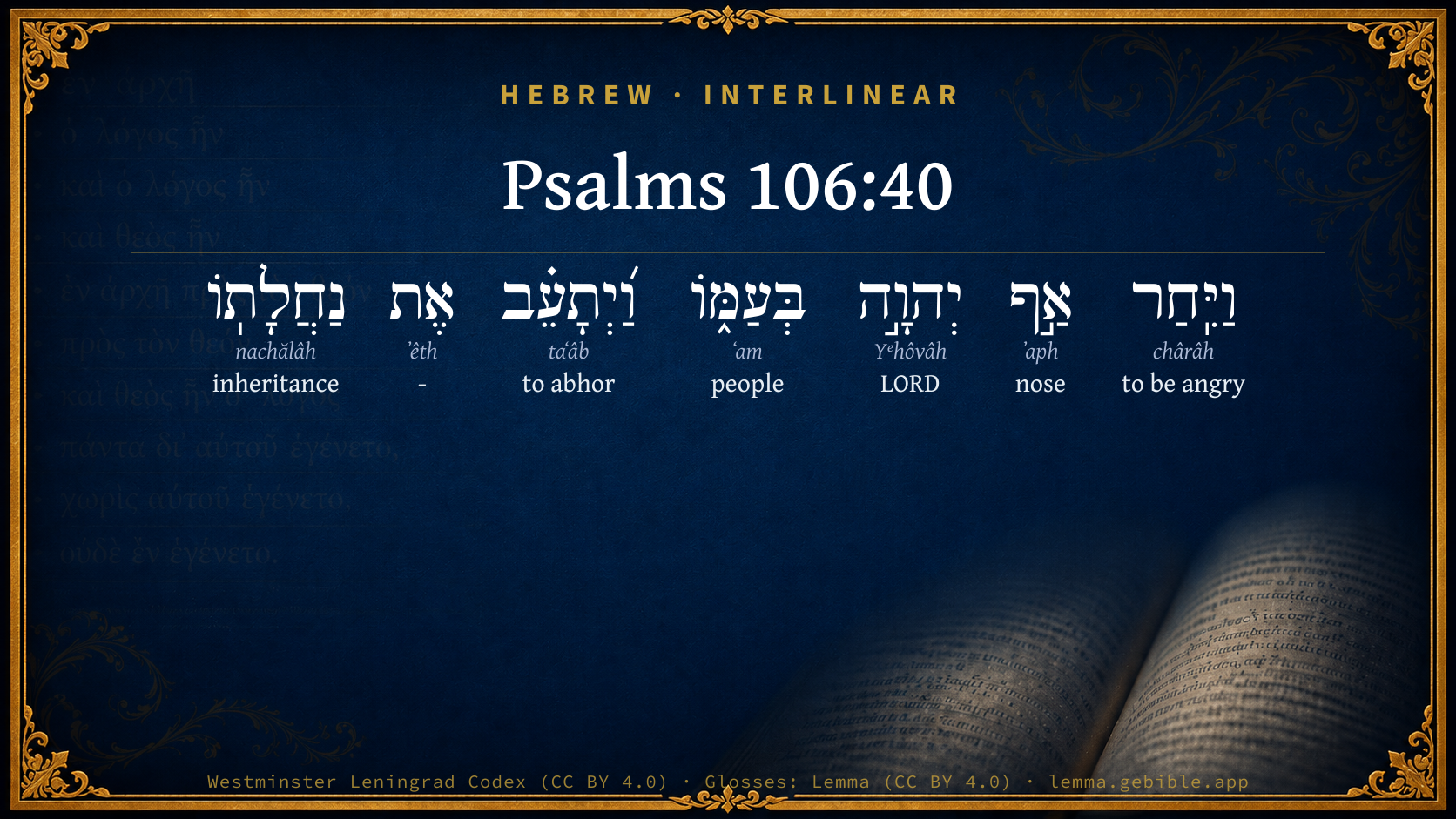
וַ֝יְתָעֵ֗ב
taʻâb
H8581
“and · to abhor”
Conjunction + Verb, Piel, Sequential Imperfect, 3rd Person, Masculine, Singular
Part of Speech
Conjunction + Verb
Stem
Piel
Form
Sequential Imperfect
Person
3rd Person
Gender
Masculine
Number
Singular
Full BDB Definition

Origin: a primitive root

TWOT: 2530

to abhor, be abominable, do abominably - (Niphal) to be abhorred, be detested - in the ritual sense - in the ethical sense - (Piel) - to loathe, abhor, regard as an abomination - in the ritual sense - in the ethical sense - to cause to be an abomination - (Hiphil) to make abominable, do abominably - in the ritual sense - in the ethical sense
  1. וַיִּֽחַר chârâh H2734 “and · to be angry” Conjunction + Verb, Qal, Sequential Imperfect, 3rd Person, Masculine, Singular
  2. אַ֣ף ʼaph H639 “nose” Particle, Accusative
  3. יְהוָ֣ה Yᵉhôvâh H3068 “LORD” Noun, Proper
  4. בְּעַמּ֑וֹ ʻam H5971 “in/at · people · his” Preposition + Noun, Common, Masculine, Singular, Construct + Suffix, Personal, 3rd Person, Masculine, Singular
  5. אֶת ʼêth H853 “-” Particle, Direct Object
  6. נַחֲלָתֽוֹ nachălâh H5159 “inheritance · his” Noun, Common, Feminine, Singular, Construct + Suffix, Personal, 3rd Person, Masculine, Singular

About this verse

These counts appear in no published source. They are computed here, from the morphology-tagged text and Lemma’s own curated glosses. What Lemma adds →

7
words
7
distinct lemmas
Wisdom
section

Notable vocabulary

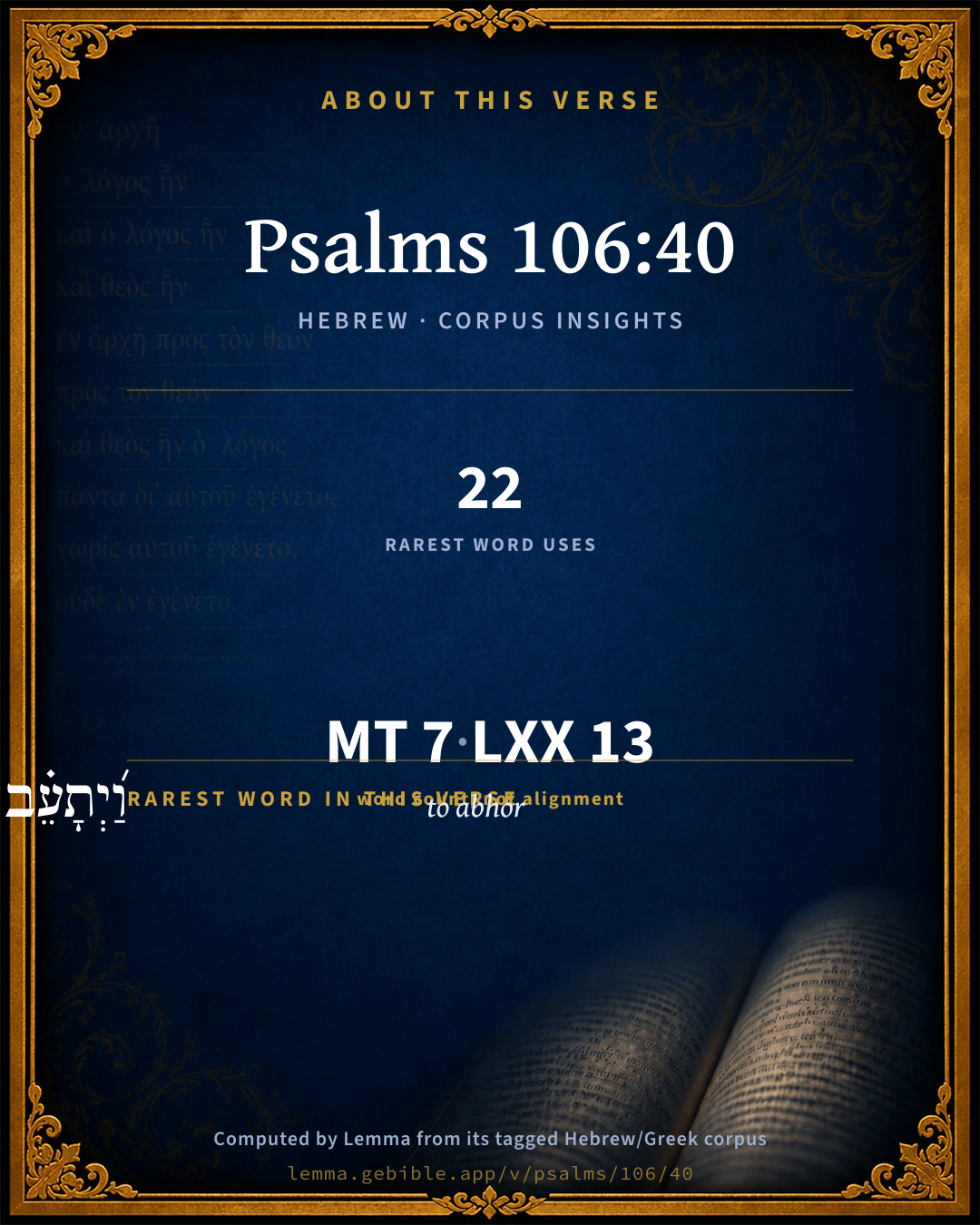
The rarest word here is וַ֝יְתָעֵ֗ב to abhor H8581 — appearing just 22 times in the whole Hebrew Bible.

Shared distinctive vocabulary

וַ֝יְתָעֵ֗ב to abhor H8581 occurs in 20 verses of the Hebrew Bible. Also found in:

Grammatical profile

  • 2 verbs
  • 3 nouns
  • 2 particles

Verb forms

  • וַיִּֽחַר Qal · Sequential Imperfect
  • וַ֝יְתָעֵ֗ב Piel · Sequential Imperfect

Hebrew & Septuagint length

In English translation the verse runs 12 words from the Hebrew and 14 from the Septuagint (LXX English) — closely comparable.

A rough comparison of the two English renderings, which tokenize alike — not a word-level alignment.

Word counts can differ between the Hebrew and the Greek without any difference in meaning — e.g. the Hebrew direct-object marker אֵת has no separate Greek word, and Greek often adds the article ὁ.

In the original languages it is 7 Hebrew tokens and 13 Greek tokens — but the two are counted differently (Hebrew bundles its prefixes and suffixes into one token; the Greek is in lemma form), so that isn’t a like-for-like length.

Cross-references

11

Topical passages linked to Psalms 106:40 in the Treasury of Scripture Knowledge — connected by theme and wording, ordered by reader-vote popularity; previews shown in the World English Bible.

  • Judges 2:14 The anger of Yahweh was kindled against Israel, and he delivered them into the hands of spoilers who despoiled them; and he sold them into the hands of their enemies round about, so that they could not any longer stand before their enemies.
  • Deuteronomy 9:29 Yet they are your people and your inheritance, which you brought out by your great power and by your outstretched arm.
  • Deuteronomy 32:19 Yahweh saw [it], and abhorred [them], Because of the provocation of his sons and his daughters.
  • Judges 2:20 The anger of Yahweh was kindled against Israel; and he said, Because this nation have transgressed my covenant which I commanded their fathers, and have not listened to my voice;
  • Judges 3:8 Therefore the anger of Yahweh was kindled against Israel, and he sold them into the hand of Cushan Rishathaim king of Mesopotamia: and the children of Israel served Cushan Rishathaim eight years.
  • Leviticus 20:23 You shall not walk in the customs of the nation, which I am casting out before you: for they did all these things, and therefore I abhorred them.
  • Nehemiah 9:27–38 Therefore you delivered them into the hand of their adversaries, who distressed them: and in the time of their trouble, when they cried to you, you heard from heaven; and according to your manifold mercies you gave them saviors who saved them out of the hand of their adversaries.
  • Psalms 74:1 God, why have you rejected us forever? Why does your anger smolder against the sheep of your pasture?
  • Lamentations 2:7 The Lord has cast off his altar, he has abhorred his sanctuary; He has given up into the hand of the enemy the walls of her palaces: They have made a noise in the house of Yahweh, as in the day of a solemn assembly.
  • Zechariah 11:8 I cut off the three shepherds in one month; for my soul was weary of them, and their soul also loathed me.
  • Psalms 78:59–62 When God heard this, he was angry, And greatly abhorred Israel;

Cross-references courtesy of OpenBible.info (CC BY 4.0).

Hebrew and Greek witnesses Masoretic Hebrew ↔ Greek Septuagint

The same verse in the two great witnesses to the Old Testament, shown verse-for-verse.

You’re reading Greek Psalm 105 (Hebrew Psalm 106). The Septuagint counts the superscription, so verse numbers can differ from the Hebrew — chapter-level alignment, not verse-by-verse. Numbering follows Rahlfs.

These are two independent witnesses, not word-aligned to each other, and the Septuagint is shown in lemma (dictionary) form.

Hebrew Psalms 106:40 Masoretic · Westminster Leningrad Codex

וַיִּֽחַר אַ֣ף יְהוָ֣ה בְּעַמּ֑וֹ וַ֝יְתָעֵ֗ב אֶת נַחֲלָתֽוֹ

Therefore Yahweh burned with anger against his people. He abhorred his inheritance.

World English Bible · Public Domain

Greek LXX Greek Psalm 105:40 Septuagint · lemma form

καί ὀργίζω θυμός κύριος ἐπί ὁ λαός αὐτός καί βδελύσσω ὁ κληρονομία αὐτός

So the Lord was very angry with his people, and he abhorred his inheritance.

LXX2012 (modern English Septuagint) · Public Domain

Hebrew: Westminster Leningrad Codex (CC BY 4.0). Greek: Septuagint (public domain); English from LXX2012 (modern English Septuagint) (Public Domain). How the Septuagint differs from the Hebrew →

Commentary

Notes on Psalms 106:40 from classic Christian and Jewish commentators (each source and its license shown beneath its notes). The classic Christian expositions comment on the surrounding passage and are grouped to its opening verse, so a note may address several verses; the Jewish commentaries on the Tanakh (Rashi and others) are per-verse, so they appear only where the commentator wrote on this verse.

Lemma curates 59 commentaries, every one of them public domain or Creative Commons licensed, each selected and text-cleaned for this edition rather than reprinted as found. About our sources →

Trapp's Complete Commentary

John Trapp

Psa 106:40 Therefore was the wrath of the LORD kindled against his people, insomuch that he abhorred his own inheritance.

Ver. 40. Therefore was the wrath of the Lord kindled] Sin doth as naturally draw and suck judgments to it as the loadstone doth iron, or turpentine fire.

Insomuch that he abhorred his own inheritance] This was the greatest of all miseries, and a piece of hell.

John Trapp, A Commentary or Exposition upon All the Books of the Old and New Testament (1647–1656) — public domain. Text from a community e-Sword module.

The Biblical Illustrator

Joseph S. Exell

Psa_106:40-46

Therefore was the wrath of the Lord kindled.

Four solemn thoughts concerning God

I. Gods abhorrence of mens sins (verse 40). Gods wrath or anger is not a malign passion, but a benevolent principle, antagonism to wrong. Do not blame the sun or the moon because of the shadows they throw upon the earth; rather blame the objects that obstruct their rays. Gods wrath is only the rays of His love obstructed by sin. Remove the obstruction, and all is genial and beaming.

II. Gods dominion over mens minds (verses 41, 42). As the billows of the ocean in furious battle serve the grand cause of nature as well as the placid river in its majestic flow, so does the rage of wicked spirits serve the Almighty plans as truly as the loyal services of the good. His purposes must stand.

III. Gods regard for mens penitence (verses 43, 44; 2Ch_15:4).

IV. Gods forbearance with mens wickedness (verses 45, 46). (Homilist.)

The Biblical Illustrator, edited by Joseph S. Exell (c. 1880s–1900s) — public domain. Text from a community e-Sword module.

J. A. Alexander on Psalms

Joseph Addison Alexander

40. (Psa 106:40) And the anger of Jehovah was enkindled at his people, and he abhorred his heritage. This is the strongest form in which his detestation of their sins could be expressed, but does not necessarily imply the abrogation of his covenant with them. The feeling described is like that of a parent towards his wicked children, or of husbands and wives, who do not cease to love each other, though grieved and indignant at each other's sins. The word heritage adds great point to the sentence. He abhorred the very people whom he had chosen to be his, not merely for a single generation, but for many. See above, on Psa 78:59; Psa 78:62.

Joseph Addison Alexander, The Psalms Translated and Explained (1850) — public domain. Text from a community e-Sword module.

Tyndale Open Study Notes

Tyndale Open Resources

106:40-46 The psalmist returns to the Babylonian exile (106:26-27). The Lord judged Israel severely, but he also restrained his wrath, remembering the covenant he had made with Abraham.

106:40 God abhorred Israel’s sin, as he does all sin.

Tyndale Open Study Notes — © Tyndale Open Resources, licensed CC BY-SA 4.0. Text via the HelloAO Bible API.

Adam Clarke's Commentary

Verse 40. Therefore was the wrath of the Lord kindled] God kindled a fire in his judgments for those who by their flagitious conduct had inflamed themselves with their idols, and the impure rites with which they were worshipped.

Adam Clarke's Commentary on the Bible (1810–1826) — public domain. Text from a community e-Sword/MySword module.

John Calvin's Commentaries

40. And the wrath of Jehovah waxed hot. The severity of the punishment inflicted upon the people confirms the truth of what we formerly said, that they had been guilty of no trivial offense, in presuming to corrupt the worship of God. And they themselves showed how hopeless their reformation was, in that all this as yet failed to bring them truly to repent of their sin. That the people, who were God’s sacred and chosen heritage, were delivered up to the abominations of the heathen, who themselves were the slaves of the devil, was an awful manifestation of his vindictive wrath. Then, at least, ought they to have held in abhorrence their own wickedness, by which they had been precipitated into such direful calamities. In saying, that they were subdued and afflicted by their enemies, the prophet points out, in a still more astonishing manner, the baseness of their conduct. Reduced to a state of bondage and oppression, their folly appears the more disgraceful, in that they were not truly and heartily humbled under God’s almighty hand. For prior to this, they had been warned by Moses, that they had not casually fallen into that bondage so galling to them, neither had it happened by the valor of their enemies, but because they were given over, and, as it were, sold to it by God himself. That those who had refused to bear his yoke, should be delivered up to tyrants to harass and oppress them, and that those who would not endure to be ruled by God’s paternal sway, should be subdued by their enemies, to be trodden under their feet, is a striking example of God’s retributive justice.

John Calvin's Commentaries (1540-1563) — public domain. Text from the Calvin Translation Society English edition (1840s-50s) via the Christian Classics Ethereal Library (ccel.org). Calvin's coverage is partial (roughly two-thirds of the Bible); uncommented books and verses are honest gaps, never fabricated. The 19th-century editor's footnotes and remarks are omitted so the notes are faithfully Calvin's own voice.

Ellicott's Commentary for English Readers

(40-43) Having made review of the sinful past, the poet briefly but impressively describes the punishment which once and again had fallen on the nation. But as his purpose is to make his generation look on the Captivity as a supreme instance of this punishment, and to seek for deliverance by repentance, he mentions only the judgments inflicted by foreign foes.

A Bible Commentary for English Readers, edited by Charles John Ellicott (1878–1897) — public domain. Text from a community e-Sword module.

The Cambridge Bible for Schools and Colleges

gen. ed. J. J. S. Perowne

40. So Jehovah’s anger was kindled against Israel, a standing formula in the Book of Judges (Jdg_2:14; Jdg_2:20, &c.; cp. Deu_7:4; &c.), and he abhorred his inheritance.

40–46. The alternations of chastisement, pardon, restoration, and relapse in the course of Israel’s history. As in Neh_9:26 ff., the primary reference is to the period of the judges; but doubtless the verses are intended to be a summary survey of the characteristics of the whole course of Israel’s history, leading up to the prayer for restoration in Psa_106:47.

The Cambridge Bible for Schools and Colleges (gen. ed. J. J. S. Perowne; Cambridge University Press, 1878–1918) — public domain. Text from a community e-Sword module.

John Gill's Exposition

And he gave them into the hand of the Heathen,.... In the times of the judges; as into the hands of the Mesopotamians, Moabites, Canaanites, Midianites, and Philistines, to whom they became tributaries; see the book of Judges.

And they that hated them ruled over them; as it was threatened and foretold they should, in case they did not observe the law of God, Lev 26:17.

John Gill's Exposition of the Whole Bible (1746–1763) — public domain (CC PDM 1.0). Text via the HelloAO Bible API.

Albert Barnes' Notes on the Bible

Therefore was the wrath of the Lord kindled against his people - Anger is often compared with a fire; as we say now, a man is “inflamed” with passion. See Est 1:12; Lam 2:3; Psa 79:5; Psa 89:46; Jer 4:4; Jdg 2:14. Of course, this must be taken in a manner appropriate to God. It means that his treatment of his offending people was as if he were burning with wrath against them.

Insomuch that he abhorred his own inheritance - He was offended with his people; he treated them “as if” they were an abomination to him. He punished them; he cast them off; he left them to the just results of their own conduct. Were ever any writers more candid and honest than the sacred penmen? There is no effort to vindicate the nation; there is no apology offered for them; there is no concealment of their guilt; there is no attempt to soften the statement in regard to the feelings of God toward them. Their conduct was abominable; they deserved the divine displeasure; they were ungrateful, evil, and rebellious; and the sacred writers do not hesitate to admit the truth of this to the fullest extent.

Albert Barnes' Notes on the Bible (1834–1885) — public domain. Text from a community e-Sword/MySword module.

The Treasury of David

Charles H. Spurgeon

Ver. 40. He abhorred his own inheritance. Whenever great love sinks into great hate it is termed abhorrence. Lorinus.

Psalms 106:41*

see Exposition of Verse 40

see Notes of Verse 40

see Hints of Verse 40

Psalms 106:42*

Charles H. Spurgeon's The Treasury of David (1869–1885) — public domain. Psalms only. Text from a community e-Sword/MySword module.

The Pulpit Commentary

Therefore was the wrath of the Lord kindled against his people. (comp. Psa_78:58, Psa_78:59) Insomuch that he abhorred his own inheritance. (see Psa_78:62) It justly increased God"s anger that the sinners were his own people, his own inheritance.

HOMILIES BY C. SHORT Vers. 40-46. Man"s misery and God"s compassion.

"The design of the whole psalm is to awaken the people to a lively consciousness of the truth, that though there is much of sin in us, there is much more of grace in God;" that "where sin abounded, grace did much more abound." Suggests

I GOD LOVES ALL HIS CREATURES, BUT HATES THEIR SINS. (Ver. 40) That is, he makes us feel sensible that he is forever opposed to our evil conduct, and creates in us a terror of the consequences of our sins the punishment they entail.

II PART OF THE PUNISHMENT OF SIN IS THAT WE ARE GIVEN OVER TO ITS TYRANNY. (Ver. 41) Give ourselves over. This is a natural consequence, a Divine law of our constitution, and is a galling and terrible penalty of the habit of transgression. Our passions come thus to rule over us, instead of our ruling over them.

III WHEN WE ATTEMPT TO RESIST THIS TYRANNY, WE FIND THAT OUR SLAVERY IS MORE OPPRESSIVE THAN WE THOUGHT. (Ver. 42). Men often may make some effort to break off from evil ways, but discover that they are under a heavier bondage to their sins than they had supposed. This, too, is a part of the punishment of sin its enfeebling, debilitating influence.

IV MEN WHOM GOD SEEMS TO HAVE DELIVERED FROM THEIR SINS, AFTER A TIME RETURN TO THEIR FORMER INIQUITY. (Ver. 43) They are then brought low, or impoverished, or weakened lower than they were before, because now they begin to lose all hope of recovery. House "swept and garnished" is prepared for the return of sevenfold powers of evil, that rule more absolutely than ever.

V SUCH HELPLESS MISERY EXCITES THE DIVINE COMPASSION. (Ver. 44) "Like as a father pitieth his children, so the Lord pitieth them that fear him." God pities those whom he cannot save because of their unwillingness. "How often would I have gathered thee as a hen doth gather her chickens under her wings, and ye would not!

VI GOD DOES NOT REPENT TILL MEN REPENT. (Ver. 45) God does not change his laws to relieve the disobedient from suffering; but when they change from disobedience to obedience, the result is so great that God seems to them to have changed. To row against the current and to row with the current seems like rowing upon a different river. S.

The Pulpit Commentary (1880–1919), ed. H.D.M. Spence-Jones & Joseph S. Exell — public domain. Text from a community e-Sword module.

unfoldingWord translationNotes

Door43 World Missions Community

So Yahweh was angry with his people ... he despised his own people

"So Yahweh was angry with his people and despised them"

He gave them into the hand of the nations

Here "hand" refers to power or control. AT: "God allowed the nations to take control of them" (See: Metonymy)

those who hated them

"people who hated them"

translationWords

people of God

hand

unfoldingWord translationNotes — © Distant Shores Media and the Door43 World Missions Community, licensed CC BY-SA 4.0. Source: git.door43.org/Door43/en_tn.

Lesson kit

Teaching starters — assembled from the data on this page, not authored interpretation. Every prompt links to the verse data it draws on. Edit before teaching.

Psalms, in the Wisdom, opens this verse with 7 words (7 distinct Hebrew lemmas). Its most distinctive word is taʻâb (“to abhor”). A historical commentator’s framing appears above. Read the whole chapter for the surrounding context.

Discussion questions

  1. How does “to abhor” (taʻâb) shape what this verse is saying?
  2. How does Deuteronomy 7:26, which shares the word «to abhor», read alongside this verse?
  3. The translations on this page render this verse differently — a whole-verse word diff, not a word-by-word alignment. What might account for the different wordings?
  4. «וַיִּֽחַר» is a Qal Sequential Imperfect verb. How does that grammatical form shape the action described?
  5. Compare how Trapp's Complete Commentary and The Biblical Illustrator read this verse. Where do they agree or differ?

Things to notice

Reading settings

Reading text

Shown beneath each verse's original-language words.

Old Testament
Old Testament edition

Read the OT as the Masoretic Hebrew (MT) or the Greek Septuagint (LXX).

English shown for the Greek Septuagint (in the Hebrew ↔ Greek comparison).

Comparing translations? Open the Compare panel on any verse page to stack up to four side by side.