
Numbers 25:3

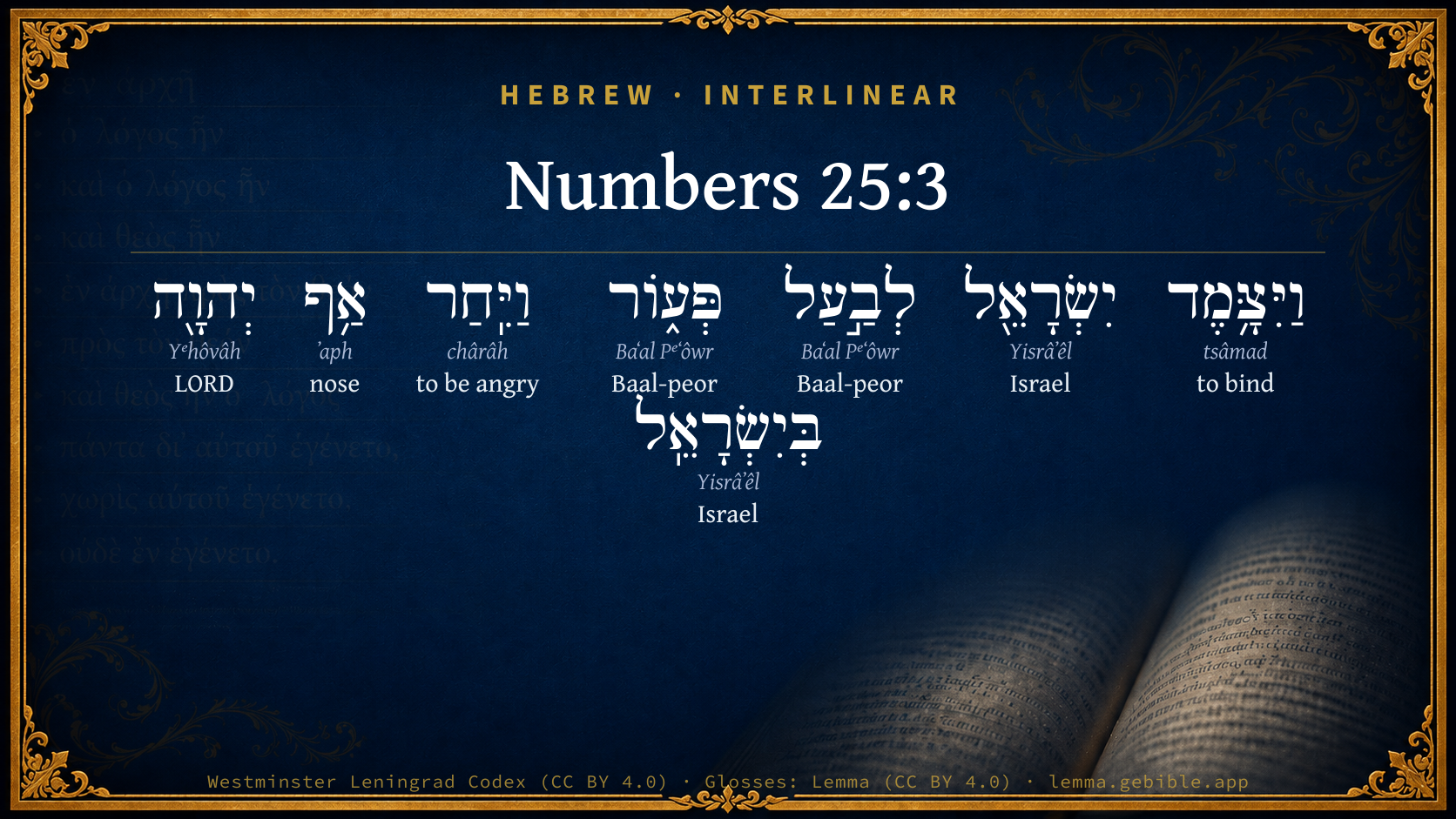
Hebrew (Westminster Leningrad Codex) Numbers 25:3 appears in the Hebrew Old Testament. The text above is from the Westminster Leningrad Codex. Each word links to its Strong’s number, a concise gloss, and parsing drawn from the Open Scriptures Hebrew Bible morphology. Click any word for its full Brown-Driver-Briggs (BDB) entry.
Download image
Cite this verse

Numbers 25:3 (World English Bible). Public Domain. Lemma interlinear Bible study tool, https://lemma.gebible.app/v/numbers/25/3.

Show BibTeX & RIS
BibTeX
RIS
English Translation
Israel joined himself to Baal Peor: and the anger of Yahweh was kindled against Israel.
World English Bible · Public Domain
Highlights
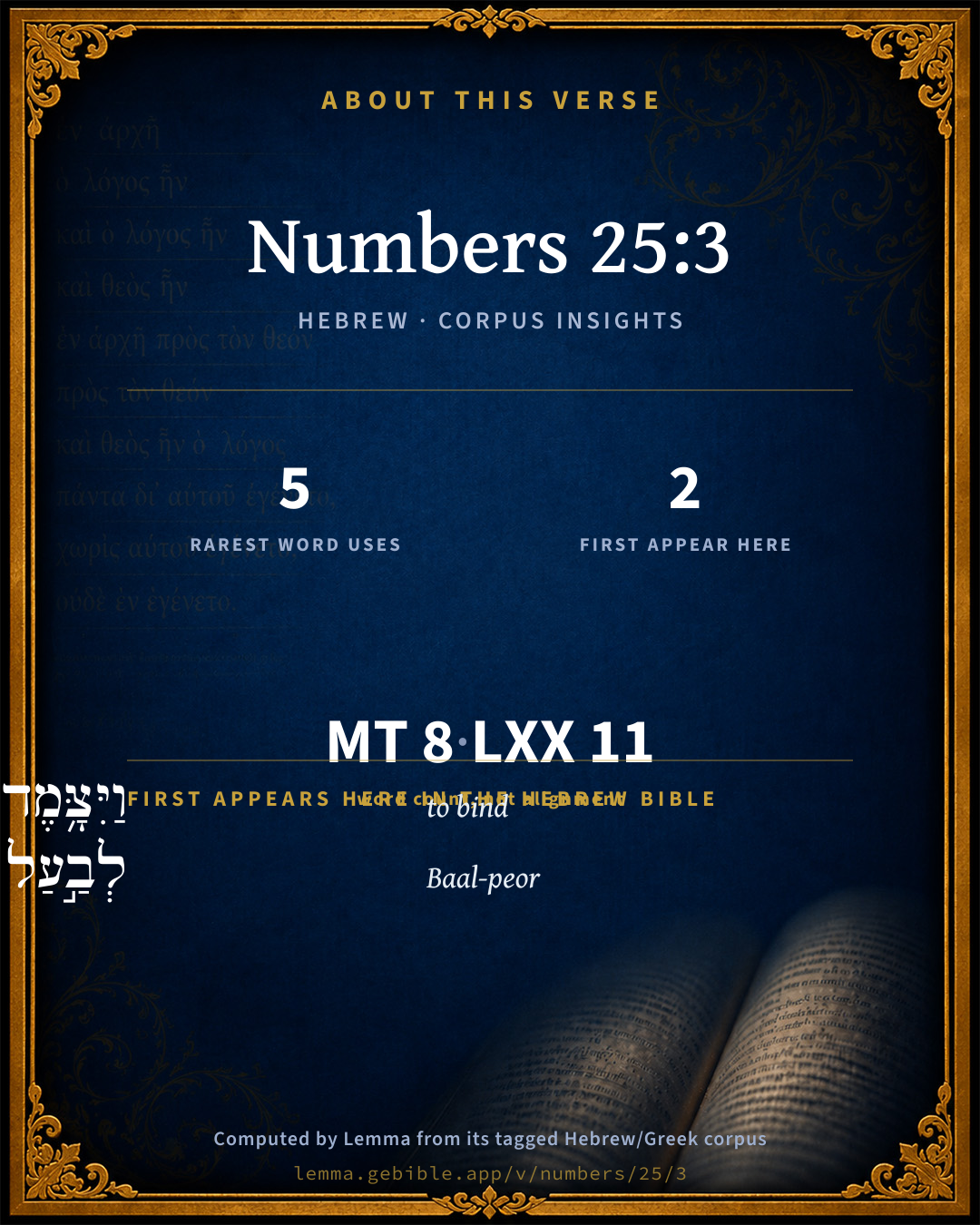
  • 2 first appearances in the Hebrew Bible
Full analysis ↓
Download a study sheet

One document with this verse’s original text, its word-by-word gloss line, the meaning frame, cross-references with their text, attributed commentary, and full source and license credits — printable, and it pastes into notes with its structure intact.

This verse Autodidact and up

Study sheet (.html) Plain text (.txt)

A passage Seminary Student

Up to 50 verses in one chapter. A passage sheet keeps up to 6 commentary sources and 12 cross-references per verse, in the order this page ranks them, and says so on the sheet whenever that leaves anything out. Ask for a single verse and you get the Autodidact verse sheet above.

Everything on this page stays free to read, with no account — the sheet is a download of what is already on screen, not access to it.

Want to remove ads? Support Godless Engineer
Compare translations 3

The same verse in 3 English versions, stacked beneath the original-language interlinear above. Click any original word for its lexicon entry.

Each is an independent rendering of the whole verse — the interlinear is not word-aligned to these translations.

Highlighted words mark where these versions differ — a whole-verse word diff, not a word-by-word alignment.

  • World English Bible Public Domain
    Israel joined himself to Baal Peor: and the anger of Yahweh was kindled against Israel.
  • King James Version Public Domain
    And Israel joined himself unto Baalpeor: and the anger of the LORD was kindled against Israel.
  • unfoldingWord Literal Text CC BY-SA 4.0
    And Israel bound himself to Baal of Peor. And the nose of Yahweh burned against Israel.

unfoldingWord Literal Text — © unfoldingWord, licensed CC BY-SA 4.0. Word-aligned USFM3 via Door43 (git.door43.org/unfoldingWord/en_ult).

Versions to compare (up to 4)

3 of 4 selected

Show all 18 translations

Every available English version of this verse, each an independent rendering of the whole verse.

  • World English Bible Public Domain
    Israel joined himself to Baal Peor: and the anger of Yahweh was kindled against Israel.
  • Berean Standard Bible Public Domain
    So Israel joined in worshiping Baal of Peor, and the anger of the LORD burned against them.
  • Majority Standard Bible Public Domain
    So Israel joined in worshiping Baal of Peor, and the anger of the LORD burned against them.
  • King James Version Public Domain
    And Israel joined himself unto Baalpeor: and the anger of the LORD was kindled against Israel.
  • American Standard Version (1901) Public Domain
    And Israel joined himself unto Baal-peor: and the anger of Jehovah was kindled against Israel.
  • Revised Version (1885) Public Domain
    And Israel joined himself unto Baal-peor: and the anger of the LORD was kindled against Israel.
  • Geneva Bible (1599) Public Domain
    And Israel coupled himselfe vnto Baal Peor: wherefore the wrath of the Lord was kindled against Israel:
  • Douay-Rheims (1899) Public Domain
    And Israel was initiated to Beelphegor: upon which the Lord being angry,
  • Young's Literal Translation Public Domain
    and Israel is joined to Baal-Peor, and the anger of Jehovah burneth against Israel.
  • Literal Standard Version CC BY-SA 4.0
    and Israel is joined to Ba‘al-Peor, and the anger of YHWH burns against Israel.
  • Unlocked Literal Bible CC BY-SA 4.0
    The men of Israel joined in worshiping Baal of Peor, and Yahweh's anger was kindled against Israel.
  • unfoldingWord Literal Text CC BY-SA 4.0
    And Israel bound himself to Baal of Peor. And the nose of Yahweh burned against Israel.
  • Darby Bible Public Domain
    And Israel joined himself to Baal-Peor; and the anger of Jehovah was kindled against Israel.
  • World Messianic Bible Public Domain
    Israel joined himself to Baal Peor, and the LORD’s anger burned against Israel.
  • Webster's Bible Public Domain
    And Israel joined himself to Baal-peor: and the anger of the LORD was kindled against Israel.
  • Free Bible Version CC BY-SA 4.0
    In this way the Israelites devoted themselves in worship to Baal of Peor, and the Lord was angry with them.
  • Bible in Basic English Public Domain
    So Israel had relations with the women of Moab in honour of the Baal of Peor: and the Lord was moved to wrath against Israel.
  • JPS Tanakh (1917) Public Domain
    And Israel joined himself unto the Baal of Peor; and the anger of the LORD was kindled against Israel.

Literal Standard Version (2020), Covenant Press — licensed CC BY-SA 4.0. Text via the HelloAO Bible API (eBible.org). Unlocked Literal Bible (unfoldingWord) — licensed CC BY-SA 4.0. Text via the HelloAO Bible API (eBible.org). unfoldingWord Literal Text — © unfoldingWord, licensed CC BY-SA 4.0. Word-aligned USFM3 via Door43 (git.door43.org/unfoldingWord/en_ult). Free Bible Version, Dr. Jonathan Gallagher — licensed CC BY-SA 4.0. Text via the HelloAO Bible API (eBible.org).

Word by word

More ways to search: Search by grammar → Find every occurrence → Compare this word →

Practice this passage: Drill this verse → Learn its vocabulary →

About this verse

These counts appear in no published source. They are computed here, from the morphology-tagged text and Lemma’s own curated glosses. What Lemma adds →

8
words
6
distinct lemmas
Pentateuch
section

Notable vocabulary

The rarest word here is וַיִּצָּ֥מֶד to bind H6775 — appearing just 5 times in the whole Hebrew Bible.

First appearance in Scripture

These words make their first canonical appearance in the Hebrew Bible here:

  • וַיִּצָּ֥מֶד to bind H6775
  • לְבַ֣עַל Baal-peor H1187

Shared distinctive vocabulary

וַיִּצָּ֥מֶד to bind H6775 occurs in 5 verses of the Hebrew Bible. Also found in:

Grammatical profile

  • 2 verbs
  • 5 nouns
  • 1 particle

Verb forms

  • וַיִּצָּ֥מֶד Niphal · Sequential Imperfect
  • וַיִּֽחַר Qal · Sequential Imperfect

Repetition

Words recur within this verse — often emphatic in Hebrew:

  • יִשְׂרָאֵ֖ל Israel H3478 ×2
  • לְבַ֣עַל Baal-peor H1187 ×2

Hebrew & Septuagint length

In English translation the verse runs 15 words from the Hebrew and 14 from the Septuagint (LXX English) — closely comparable.

A rough comparison of the two English renderings, which tokenize alike — not a word-level alignment.

Word counts can differ between the Hebrew and the Greek without any difference in meaning — e.g. the Hebrew direct-object marker אֵת has no separate Greek word, and Greek often adds the article ὁ.

In the original languages it is 8 Hebrew tokens and 11 Greek tokens — but the two are counted differently (Hebrew bundles its prefixes and suffixes into one token; the Greek is in lemma form), so that isn’t a like-for-like length.

Cross-references

9

Topical passages linked to Numbers 25:3 in the Treasury of Scripture Knowledge — connected by theme and wording, ordered by reader-vote popularity; previews shown in the World English Bible.

  • Joshua 22:17 Is the iniquity of Peor too little for us, from which we have not cleansed ourselves to this day, although there came a plague on the congregation of Yahweh,
  • Psalms 106:28–29 They joined themselves also to Baal Peor, And ate the sacrifices of the dead.
  • Hosea 9:10 I found Israel like grapes in the wilderness. I saw your fathers as the first ripe in the fig tree at its first season; But they came to Baal Peor, and consecrated themselves to the shameful thing, And became abominable like that which they loved.
  • Numbers 25:5 Moses said to the judges of Israel, Kill you everyone his men who have joined themselves to Baal Peor.
  • Deuteronomy 4:3–4 Your eyes have seen what Yahweh did because of Baal Peor; for all the men who followed Baal Peor, Yahweh your God has destroyed them from the midst of you.
  • Judges 2:14 The anger of Yahweh was kindled against Israel, and he delivered them into the hands of spoilers who despoiled them; and he sold them into the hands of their enemies round about, so that they could not any longer stand before their enemies.
  • Judges 2:20 The anger of Yahweh was kindled against Israel; and he said, Because this nation have transgressed my covenant which I commanded their fathers, and have not listened to my voice;
  • Psalms 90:11 Who knows the power of your anger, Your wrath according to the fear that is due to you?
  • Jeremiah 17:4 You, even of yourself, shall discontinue from your heritage that I gave you; and I will cause you to serve your enemies in the land which you don't know: for you have kindled a fire in my anger which shall burn forever.

Cross-references courtesy of OpenBible.info (CC BY 4.0).

Hebrew and Greek witnesses Masoretic Hebrew ↔ Greek Septuagint

The same verse in the two great witnesses to the Old Testament, shown verse-for-verse.

These are two independent witnesses, not word-aligned to each other, and the Septuagint is shown in lemma (dictionary) form.

Hebrew Numbers 25:3 Masoretic · Westminster Leningrad Codex

וַיִּצָּ֥מֶד יִשְׂרָאֵ֖ל לְבַ֣עַל פְּע֑וֹר וַיִּֽחַר אַ֥ף יְהוָ֖ה בְּיִשְׂרָאֵֽל

Israel joined himself to Baal Peor: and the anger of Yahweh was kindled against Israel.

World English Bible · Public Domain

Greek LXX Numbers 25:3 Septuagint · lemma form

καί τελέω ἰσραήλ ὁ βεελφεγωρ καί ὀργίζω θυμός κύριος ὁ ἰσραήλ

And Israel consecrated themselves to Beel-phegor; and the Lord was very angry with Israel.

LXX2012 (modern English Septuagint) · Public Domain

On this verse, The Pulpit Commentary discusses the Septuagint’s reading. Read the note in Commentary ↓

Hebrew: Westminster Leningrad Codex (CC BY 4.0). Greek: Septuagint (public domain); English from LXX2012 (modern English Septuagint) (Public Domain). How the Septuagint differs from the Hebrew →

Targum (Aramaic paraphrase)

2

The Targum is the ancient Jewish Aramaic paraphrase of the Hebrew Scriptures — an interpretive translation, not the Hebrew text itself. Onkelos (literal) and Pseudo-Jonathan (expansive) render the Torah, and Jonathan the Prophets. Coverage is partial: where no permissively-licensed English translation exists for a verse, only the Aramaic is shown. This is verse-level text, not a word-by-word alignment to the Hebrew.

  1. Targum Onkelos Torah (Genesis–Deuteronomy)
    וְאִתְחַבַּר יִשְׂרָאֵל לְבַעֲלָא פְעוֹר וּתְקֵף רוּגְזָא דַיְיָ בְּיִשְׂרָאֵל

    (no public-domain English translation for this verse)

    Targum Onkelos — Aramaic: “Onkelos Genesis” (public domain); “Onkelos Exodus” (public domain); “Onkelos Leviticus” (public domain); “Onkelos Numbers” (public domain); “Onkelos Deuteronomy” (public domain). English: “Sefaria Community Translation” (CC0 1.0 (public-domain dedication)); “J.W. Etheridge. The Targums of Onkelos and Jonathan Ben Uzziel on the Pentateuch. London: Longmans, Green, 1862” (public domain). Text via Sefaria.

  2. Targum Pseudo-Jonathan Torah (Genesis–Deuteronomy)
    וְאִתְחַבָּרוּ עַמָא בֵּית יִשְרָאֵל בְּבַעֲלָא פְּעוֹר כְּמַסְמְרָא בְּקִיסָא דְלָא מִתְפְּרֵשׁ בְּלָא קִיסְמָא וּתְקֵיף רוּגְזָא דַיְיָ בְּיִשְרָאֵל

    And the people of the house of Israel joined themselves to Baala-Peor, like the nail in the wood, which is not separated but by breaking up the wood (or, with the splinters). And the anger of the Lord was kindled against Israel.

    Targum Pseudo-Jonathan — Aramaic: “Targum Jonathan on Genesis” (public domain); “Targum Jonathan on Exodus” (public domain); “Targum Jonathan on Leviticus” (public domain); “Targum Jonathan on Numbers” (public domain); “Targum Jonathan on Deuteronomy” (public domain). English: “The Targum of Jonathan ben Uzziel, trans. J. W. Etheridge, London, 1862” (public domain). Text via Sefaria.

Commentary

Notes on Numbers 25:3 from classic Christian and Jewish commentators (each source and its license shown beneath its notes). The classic Christian expositions comment on the surrounding passage and are grouped to its opening verse, so a note may address several verses; the Jewish commentaries on the Tanakh (Rashi and others) are per-verse, so they appear only where the commentator wrote on this verse.

Lemma curates 59 commentaries, every one of them public domain or Creative Commons licensed, each selected and text-cleaned for this edition rather than reprinted as found. About our sources →

Trapp's Complete Commentary

John Trapp

Num 25:3 And Israel joined himself unto Baalpeor: and the anger of the LORD was kindled against Israel.

Ver. 3. Joined himself to Baalpeor.] Separated himself to that shame, {Hos 9:10} that abominable and shameless service of Priapus, as Jerome and Isidore understand it, as Maachah the mother of Asa seems to have done, {1Ki 15:13} and other filthy persons, whose fashion was, as soon as their sacrifice was ended, to step aside into the grove of their god, and there, like brute beasts, promiscuously to satisfy their lusts, &c. Vah scelus infandum!

John Trapp, A Commentary or Exposition upon All the Books of the Old and New Testament (1647–1656) — public domain. Text from a community e-Sword module.

Joseph Benson's Commentary

Num 25:3. Joined himself — The word implies a forsaking God, to whom they were joined, and a turning to, and strict conjunction with, this false god. Baal-peor — Called Baal, by the name common to many false gods, and especially to those that represented any of the heavenly bodies; and Peor, either from the hill Peor, where he was worshipped, Num 23:28; or rather from a verb signifying to open and uncover, because of the obscene posture in which the idol was set, as Priapus was; or because of the filthiness which was exercised in his worship.

Joseph Benson's Commentary on the Old and New Testaments (1811–1818) — public domain. Text from a community e-Sword module.

Tyndale Open Study Notes

Tyndale Open Resources

25:3 Baal of Peor might refer to Chemosh (21:29) by a different name, but probably Baal (“lord”), the Canaanite god, was included on the list of deities honored by the Moabites. Numerous place-names were formed with this deity’s name (e.g., Baal-gad, Baal-hermon, Baal-meon, Baal-peor), representing shrines for local manifestations of Baal. Peor was a mountain from which Balaam could see the Israelite camp in the plains of Moab; the mountain and the related shrine of Beth-peor (23:28; 25:3, 5, 18; 31:16; Deut 3:29; 4:3, 46; 34:6; Josh 13:20; 22:17) were somewhere in the vicinity of Mount Nebo. • Israel’s idolatry caused the Lord’s anger to blaze against his people; this included a plague (Num 25:8-9; 26:1; cp. 11:1, 10; 12:9).

Tyndale Open Study Notes — © Tyndale Open Resources, licensed CC BY-SA 4.0. Text via the HelloAO Bible API.

Geneva Bible (1599)

Geneva Bible translators

Worshipped the idol of the Moabites, which was in the hill Peor.

Geneva Bible (1599) marginal notes — public domain. Text via Bolls.life.

Jamieson, Fausset & Brown

Robert Jamieson, A. R. Fausset & David Brown

Israel joined himself unto Baal-peor--Baal was a general name for "lord," and Peor for a "mount" in Moab. The real name of the idol was Chemosh, and his rites of worship were celebrated by the grossest obscenity. In participating in this festival, then, the Israelites committed the double offense of idolatry and licentiousness.

Jamieson, Fausset & Brown — Commentary Critical and Explanatory on the Whole Bible (1871) — public domain (CC PDM 1.0). Text via the HelloAO Bible API.

Adam Clarke's Commentary

Verse 3. Israel joined himself unto Baal-peor] The same as the Priapus of the Romans, and worshipped with the same obscene rites as we have frequently had occasion to remark.

The joining to Baal-peor, mentioned here, was probably what St. Paul had in view when he said, 2Co 6:14: Be ye not unequally yoked together with unbelievers. And this joining, though done even in a matrimonial way, was nevertheless fornication, (see Re 2:14), as no marriage between an Israelite and a Midianite could be legitimate, according to the law of God. See the propositions at the close of the preceding chapter.

Adam Clarke's Commentary on the Bible (1810–1826) — public domain. Text from a community e-Sword/MySword module.

The Cambridge Bible for Schools and Colleges

gen. ed. J. J. S. Perowne

3. Baal-peor] i.e. the deity who was considered the Lord of the place Peor. See on Num_23:28. Names of deities consisting of the name Baal with a local attribute are not uncommon in the O.T., and are found on Phoenician inscriptions. Thus there were many Baals (Baâlîm) in different parts of the country (cf. 1Sa_7:4, Hos_2:17).

The Cambridge Bible for Schools and Colleges (gen. ed. J. J. S. Perowne; Cambridge University Press, 1878–1918) — public domain. Text from a community e-Sword module.

John Gill's Exposition

And Israel joined himself unto Baalpeor,.... The name of an idol; one of the Baals, Baal being a general name for an idol; and, to distinguish this from other Baals or idols, it was called Peor, either from its opening its mouth in prophecy, as Ainsworth; or from some obscene posture and action used in the worship of it, being, as it is by many thought to be, the same with Priapus; or rather from the mountain Peor, where it was worshipped, as Jupiter is called Jupiter Olympius, Capitolinus, &c. from the mountains where he had a temple, or was worshipped; or from the name of some great personage, called Lord Peor, who was deified after his death; hence these Israelites are said to "eat the sacrifices of the dead", Psa 106:28. Mr. Bedford (t) takes him to be Mizraim the son of Ham, the Osiris of the Egyptians, and the Priapus of other Heathens: and Father Calmet (u) is of opinion that he is the same with Orus, Osiris, and Adonis; and that Pe is only a prepositive article, and that Or is the name, and no other than Orus; but such a criticism the word will not bear: this idol, the chief god of the Moabites, was, in all probability, the same with Chemosh, who is expressly called the abomination of Moab, Kg1 11:7 of whom See Gill on Jer 48:7 so Chemosh and Peor are thought to be the same by our English poet (w): to him the Israelites joined themselves, forsook the true God in a great measure, and were initiated into the rites of this deity, and constantly attended the worship of it, and cleaved unto it with their hearts and directions, and joined with their harlots in all parts of service performed unto it; See Gill on Hos 9:10,

and the anger of the Lord was kindled against Israel; for no sin is more provoking to God than idolatry, that being so directly opposite to his nature, honour, and glory, as well as to his will and worship; and hereby the end of Balaam and Balak was, in a great measure, answered, and Balaam obtained that by his evil counsel which he could not by all his conjuring; this was seen by the plague sent among them; See Gill on Num 24:14.

(t) Scripture Chronology, p. 267. (u) Dictionary, on word "Baal". (w) "Next Chemos, the obscene dread of Moab's sons, Peor his other name, -----" Milton, B. 1. l. 406, 412.

John Gill's Exposition of the Whole Bible (1746–1763) — public domain (CC PDM 1.0). Text via the HelloAO Bible API.

Albert Barnes' Notes on the Bible

Joined himself - i. e., by taking part in the sacrificial meals as described in the last verse. Compare Exo 34:15; 1Co 10:18. The worship of Baal was attended with the grossest impurity, and indeed partly consisted in it Hos 4:14; Hos 9:10.

Baal-peor - i. e., the Baal worshipped at Peer, the place mentioned in Num 23:28 (compare Baal-meon, Num 32:38). (The identification of this god with Chemosh in Num 21:29 is now given up.)

Albert Barnes' Notes on the Bible (1834–1885) — public domain. Text from a community e-Sword/MySword module.

Haydock's Catholic Bible Commentary

Initiated to Beelphegor. That is, they took to the worship of Beelphegor, an obscene idol of the Moabites, and were consecrated as it were to him. (Challoner) --- Hebrew, "Israel was attached, or married to Beelphegor," the sun, Adonis or Osiris, whom the psalmist (cv. 28,) styles, the dead, because the people were accustomed to bewail the death of Adonis every year, with great solemnity. (Calmet) --- St. Jerome supposes this god "of opening, or nakedness," Beelphegor, to be the obscene Priapus. (Menochius) --- The people fell by degrees into the depth of abomination. They first defiled their bodies with women, then their souls were contaminated by the sacrifices of their idols, till they began really to adore them, and even to consecrate themselves to their service, meaning to ratify their base apostacy from the true God. (Haydock) --- Yet it is probable all those who were cut off by pestilence, were not thus initiated: but only those who were the princes or ringleaders, and who are sentenced to be gibbeted. (Salien) --- The mother of Asa, king of Juda, was not ashamed to preside over the mysteries of this obscene idol, (3 Kings xv. 13,) which people worshipped by prostitution. (Villalpand) (St. Jerome in Osee iv. 9.) (Tirinus)

George Leo Haydock (1774–1849), Haydock's Catholic Family Bible and Commentary, 1859 edition — public domain. Excludes Psalms (Douay-Rheims chapter numbering differs from Protestant) and Deuterocanonical books (Catholic canon only).

Matthew Poole's English Annotations

Joined himself; the word implies a forsaking of God, to whom they were and should have been joined, and a turning to, embracing of, strict conjunction with, and fervent affection after, this false god. Compare Hos 9:10; 2Co 6:14. Baal-peor, called Baal, by the name common to many false gods, and especially to those that represented any of the heavenly bodies; and Peor, either from the hill Peor, where he was worshipped, Num 23:28, or rather from a verb signifying to open and uncover, either because of the obscene posture in which possibly the idol was set, as Priapus was, or because of the filthiness which was exercised in his worship.

Was kindled, i.e. discovered itself in a dreadful plague, Psa 106:29.

Matthew Poole's English Annotations on the Holy Bible (1683–1685) — public domain. Text from a community e-Sword/MySword module.

Whedon's Commentary on the Bible

Daniel D. Whedon

3. Baal-peor, to whom Israel (that is, multitudes of them) joined himself, literally, bound himself, was a Moabitish Priapus, whose image, shocking to modesty, was worshipped by women and virgins who prostituted themselves in his service.

Anger… kindled — Holiness must necessarily antagonize sin, and justice must punish the sinner in every case except where the ends of moral government are attained by the intervention of an atonement. Note, Jdg_2:14.

Daniel D. Whedon (gen. ed.), Commentary on the Old and New Testaments (1874–1909) — public domain. Text from a community e-Sword module.

The Pulpit Commentary

Israel joined himself unto Baal-Peor. This is a technical phrase, repeated in verse 5, and quoted in Psa_106:28, expressing the quasi-sacramental union into which they entered with the heathen deity by partaking of his sacrificial meats and by sharing in his impure rites. (cf. Hos_9:10 and the argument of St. Paul in 1Co 10) There can be little doubt that Peor (rwOP, from rp, to open) has the sense of aperiens, in usu obsceno, and that it was the distinguishing name of Baal or Chemosh when worshipped as the god of reproduction with the abominable rites proper to this cultus. For a notice of the same thing in the last days of Israel see Hos_4:14, and for the practice of Babylonian and (to some degree) Egyptian women, see Herodotus, 1:199; 2:60). The Septuagint has here etelesyh tw Beelfegwr , "was consecrated," or "initiated," unto Baal-Peor, which admirably expressed the sense.

The Pulpit Commentary (1880–1919), ed. H.D.M. Spence-Jones & Joseph S. Exell — public domain. Text from a community e-Sword module.

John Wesley's Explanatory Notes

Joined himself - The word implies a forsaking God to whom they were joined and a turning to, and strict conjunction with, this false God. Baal-peor - Called Baal, by the name common to many false Gods, and especially to those that represented any of the heavenly bodies, and Peor, either from the hill Peor, where he was worshipped, chap. xxiii, 28, rather from a verb signifying to open and uncover, because of the obscene posture in which the idol was set, as Priapus was: or because of the filthiness which was exercised in his worship.

John Wesley, Explanatory Notes Upon the Whole Bible (1754–1765) — public domain. Text via the GEBible commentary corpus.

Keil & Delitzsch

C. F. Keil & F. Delitzsch

And the anger of the Lord burned against the people, so that Jehovah commanded Moses to fetch the heads of the people, i.e., to assemble them together, and to "hang up" the men who had joined themselves to Baal-Peor "before the Lord against the sun," that the anger of God might turn away from Israel. The burning of the wrath of God, which was to be turned away from the people by the punishment of the guilty, as enjoined upon Moses, consisted, as we may see from Num 25:8, Num 25:9, in a plague inflicted upon the nation, which carried off a great number of the people, a sudden death, as in Num 14:37; Num 17:11. הוקיע, from יקע, to be torn apart or torn away (Ges., Winer), refers to the punishment of crucifixion, a mode of capital punishment which was adopted by most of the nations of antiquity (see Winer, bibl. R. W. i. p. 680), and was carried out sometimes by driving a stake into the body, and so impaling them (ἀνασκολοπίζειν), the mode practised by the Assyrians and Persians (Herod. iii. 159, and Layard's Nineveh and its Remains, vol. ii. p. 374, and plate on p. 369), at other times by fastening them to a stake or nailing them to a cross (ἀνασταυροῦν). In the instance before us, however, the idolaters were not impaled or crucified alive, but, as we may see from the word הרגּוּ in Num 25:5, and in accordance with the custom frequently adopted by other nations (see Herzog's Encyclopaedia), they were first of all put to death, and then impaled upon a stake or fastened upon a cross, so that the impaling or crucifixion was only an aggravation of the capital punishment, like the burning in Lev 20:14, and the hanging (תּלה) in Deu 21:22. The rendering adopted by the lxx and Vulgate is παραδειγματίζειν, suspendere, in this passage, and in Sa2 21:6, Sa2 21:9, ἐξηλιάζειν (to expose to the sun), and crucifigere. ליהוה, for Jehovah, as satisfaction for Him, i.e., to appease His wrath. אותם (them) does not refer to the heads of the nation, but to the guilty persons, upon whom the heads of the nation were to pronounce sentence.

Keil & Delitzsch — Biblical Commentary on the Old Testament (1861–1891) — public domain (CC PDM 1.0). Text via the HelloAO Bible API. (Old Testament only.)

Scofield Reference Notes

C. I. Scofield

Baal-peor

Or, Baal of Peor. See Num 23:28.

The Scofield Reference Bible (1917 edition), notes by C. I. Scofield — public domain. Text from a community e-Sword module.

Rashi

Rabbi Shlomo Yitzchaki (Rashi)

פעור — It was so named because they bared (פער) their anus and relieved themselves before it: this was its ceremonial rite (Sanhedrin 60b).

ויחר אף ה' בישראל AND THE ANGER OF THE LORD WAS KINDLED AGAINST ISRAEL — he sent a plague among them (cf. v. 8).

Rashi on the Tanakh — English translations: “The Judaica Press complete Tanach with Rashi, translated by A. J. Rosenberg” (CC BY 4.0); “Pentateuch with Rashi's commentary by M. Rosenbaum and A.M. Silbermann, 1929-1934” (public domain); “The Metsudah Tanach series, Lakewood, N.J” (CC BY 4.0); and “The Book of Joshua, Metsudah Publications, 1997” (CC BY 4.0). Text via Sefaria.

Lesson kit

Teaching starters — assembled from the data on this page, not authored interpretation. Every prompt links to the verse data it draws on. Edit before teaching.

Numbers, in the Pentateuch, opens this verse with 8 words (6 distinct Hebrew lemmas). Its most distinctive word is tsâmad (“to bind”). A historical commentator’s framing appears above. Read the whole chapter for the surrounding context.

Discussion questions

  1. What does “to bind” (tsâmad) contribute to the verse as a whole?
  2. 2 words here appear for the first time in Scripture. What is being introduced at this debut?
  3. Numbers 25:5 shares the word «to bind» with this verse. How do the two illuminate each other?
  4. “Israel” occurs 2× in this one verse. What is the effect of the repetition?
  5. The translations on this page render this verse differently — a whole-verse word diff, not a word-by-word alignment. What might account for the different wordings?
  6. The verb «וַיִּצָּ֥מֶד» is Niphal Sequential Imperfect. How does its form color the action?
  7. Reading how Trapp's Complete Commentary and Joseph Benson's Commentary read this verse, where do the two commentators agree and where do they part?

Things to notice

Reading settings

Reading text

Shown beneath each verse's original-language words.

Old Testament
Old Testament edition

Read the OT as the Masoretic Hebrew (MT) or the Greek Septuagint (LXX).

English shown for the Greek Septuagint (in the Hebrew ↔ Greek comparison).

Comparing translations? Open the Compare panel on any verse page to stack up to four side by side.