
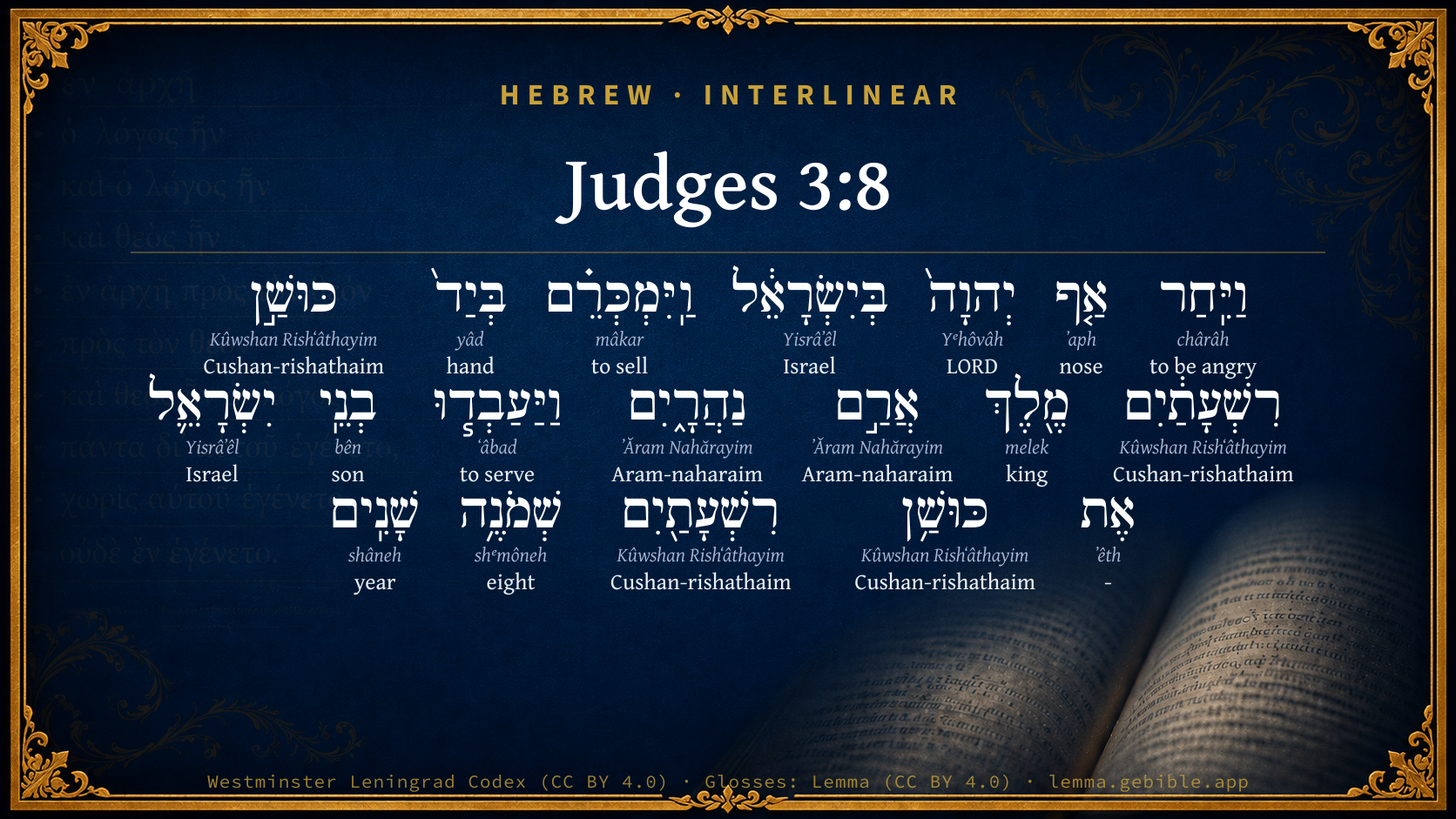
Judges 3:8

Hebrew (Westminster Leningrad Codex) Judges 3:8 appears in the Hebrew Old Testament. The text above is from the Westminster Leningrad Codex. Each word links to its Strong’s number, a concise gloss, and parsing drawn from the Open Scriptures Hebrew Bible morphology. Click any word for its full Brown-Driver-Briggs (BDB) entry.
Download image
Cite this verse

Judges 3:8 (World English Bible). Public Domain. Lemma interlinear Bible study tool, https://lemma.gebible.app/v/judges/3/8.

Show BibTeX & RIS
BibTeX
RIS
English Translation
Therefore the anger of Yahweh was kindled against Israel, and he sold them into the hand of Cushan Rishathaim king of Mesopotamia: and the children of Israel served Cushan Rishathaim eight years.
World English Bible · Public Domain
Highlights
  • 1 first appearance in the Hebrew Bible
Full analysis ↓
Download a study sheet

One document with this verse’s original text, its word-by-word gloss line, the meaning frame, cross-references with their text, attributed commentary, and full source and license credits — printable, and it pastes into notes with its structure intact.

This verse Autodidact and up

Study sheet (.html) Plain text (.txt)

A passage Seminary Student

Up to 50 verses in one chapter. A passage sheet keeps up to 6 commentary sources and 12 cross-references per verse, in the order this page ranks them, and says so on the sheet whenever that leaves anything out. Ask for a single verse and you get the Autodidact verse sheet above.

Everything on this page stays free to read, with no account — the sheet is a download of what is already on screen, not access to it.

Want to remove ads? Support Godless Engineer
Compare translations 3

The same verse in 3 English versions, stacked beneath the original-language interlinear above. Click any original word for its lexicon entry.

Each is an independent rendering of the whole verse — the interlinear is not word-aligned to these translations.

Highlighted words mark where these versions differ — a whole-verse word diff, not a word-by-word alignment.

  • World English Bible Public Domain
    Therefore the anger of Yahweh was kindled against Israel, and he sold them into the hand of Cushan Rishathaim king of Mesopotamia: and the children of Israel served Cushan Rishathaim eight years.
  • King James Version Public Domain
    Therefore the anger of the LORD was hot against Israel, and he sold them into the hand of Chushanrishathaim king of Mesopotamia: and the children of Israel served Chushanrishathaim eight years.
  • unfoldingWord Literal Text CC BY-SA 4.0
    Then the nose of Yahweh burned against Israel and he sold them into the hand of Cushan-Rishathaim, the king of Aram Naharaim. And the sons of Israel served Cushan-Rishathaim eight years.

unfoldingWord Literal Text — © unfoldingWord, licensed CC BY-SA 4.0. Word-aligned USFM3 via Door43 (git.door43.org/unfoldingWord/en_ult).

Versions to compare (up to 4)

3 of 4 selected

Show all 18 translations

Every available English version of this verse, each an independent rendering of the whole verse.

  • World English Bible Public Domain
    Therefore the anger of Yahweh was kindled against Israel, and he sold them into the hand of Cushan Rishathaim king of Mesopotamia: and the children of Israel served Cushan Rishathaim eight years.
  • Berean Standard Bible Public Domain
    Then the anger of the LORD burned against Israel, and He sold them into the hand of Cushan-rishathaim king of Aram-naharaim, and the Israelites served him eight years.
  • Majority Standard Bible Public Domain
    Then the anger of the LORD burned against Israel, and He sold them into the hand of Cushan-rishathaim king of Aram-naharaim, and the Israelites served him eight years.
  • King James Version Public Domain
    Therefore the anger of the LORD was hot against Israel, and he sold them into the hand of Chushanrishathaim king of Mesopotamia: and the children of Israel served Chushanrishathaim eight years.
  • American Standard Version (1901) Public Domain
    Therefore the anger of Jehovah was kindled against Israel, and he sold them into the hand of Cushan-rishathaim king of Mesopotamia: and the children of Israel served Cushan-rishathaim eight years.
  • Revised Version (1885) Public Domain
    Therefore the anger of the LORD was kindled against Israel, and he sold them into the hand of Cushan-rishathaim king of Mesopotamia: and the children of Israel served Cushan-rishathaim eight years.
  • Geneva Bible (1599) Public Domain
    Therefore the wrath of the Lord was kindled against Israel, and he solde them into the hand of Chushan rishathaim King of Aram-naharaim, and the children of Israel serued Chushan rishathaim eyght yeeres.
  • Douay-Rheims (1899) Public Domain
    And the Lord being angry with Israel, delivered them into the hands of Chusan Rasathaim king of Mesopotamia, and they served him eight years.
  • Young's Literal Translation Public Domain
    And the anger of Jehovah burneth against Israel, and He selleth them into the hand of Chushan-Rishathaim king of Aram-Naharaim, and the sons of Israel serve Chushan-Rishathaim eight years;
  • Literal Standard Version CC BY-SA 4.0
    And the anger of YHWH burns against Israel, and He sells them into the hand of Chushan-Rishathaim king of Aram-Naharaim, and the sons of Israel serve Chushan-Rishathaim eight years;
  • Unlocked Literal Bible CC BY-SA 4.0
    Therefore, the anger of Yahweh was set on fire against Israel, and he sold them into the hand of Cushan-Rishathaim king of Aram Naharaim. The people of Israel served Cushan-Rishathaim for eight years.
  • unfoldingWord Literal Text CC BY-SA 4.0
    Then the nose of Yahweh burned against Israel and he sold them into the hand of Cushan-Rishathaim, the king of Aram Naharaim. And the sons of Israel served Cushan-Rishathaim eight years.
  • Darby Bible Public Domain
    Therefore the anger of the LORD was kindled against Israel, and he sold them into the hand of Cu'shan-rishatha'im king of Mesopota'mia; and the people of Israel served Cu'shan-rishatha'im eight years.
  • World Messianic Bible Public Domain
    Therefore the LORD’s anger burned against Israel, and he sold them into the hand of Cushan Rishathaim king of Mesopotamia; and the children of Israel served Cushan Rishathaim eight years.
  • Webster's Bible Public Domain
    Therefore the anger of the LORD was hot against Israel, and he sold them into the hand of Chushan-rishathaim king of Mesopotamia: and the children of Israel served Chushan-rishathaim eight years.
  • Free Bible Version CC BY-SA 4.0
    The Lord became angry with Israel, so he sold them to Cushan-Rishathaim, king of Aram Naharaim. The Israelites were subject to Cushan-Rishathaim for eight years.
  • Bible in Basic English Public Domain
    So the wrath of the Lord was burning against Israel, and he gave them up into the hands of Cushan-rishathaim, king of Mesopotamia; and the children of Israel were his servants for eight years.
  • JPS Tanakh (1917) Public Domain
    Therefore the anger of the LORD was kindled against Israel, and He gave them over into the hand of Cushan-rishathaim king of Aram-naharaim; and the children of Israel served Cushan-rishathaim eight years.

Literal Standard Version (2020), Covenant Press — licensed CC BY-SA 4.0. Text via the HelloAO Bible API (eBible.org). Unlocked Literal Bible (unfoldingWord) — licensed CC BY-SA 4.0. Text via the HelloAO Bible API (eBible.org). unfoldingWord Literal Text — © unfoldingWord, licensed CC BY-SA 4.0. Word-aligned USFM3 via Door43 (git.door43.org/unfoldingWord/en_ult). Free Bible Version, Dr. Jonathan Gallagher — licensed CC BY-SA 4.0. Text via the HelloAO Bible API (eBible.org).

Word by word

More ways to search: Search by grammar → Find every occurrence → Compare this word →

Practice this passage: Drill this verse → Learn its vocabulary →

כּוּשַׁ֣ן
Kûwshan Rishʻâthayim
H3573
“Cushan-rishathaim”
Noun, Proper
Part of Speech
Noun
Type
Proper
Full BDB Definition

Origin: apparently from H3572 and the dual of H7564

TWOT: None

Chushan-rishathaim = "twice-wicked Cushan" - a king of Mesopotamia defeated by the judge Othniel the son-in-law of Caleb
  1. וַיִּֽחַר chârâh H2734 “and · to be angry” Conjunction + Verb, Qal, Sequential Imperfect, 3rd Person, Masculine, Singular
  2. אַ֤ף ʼaph H639 “nose” Particle, Accusative
  3. יְהוָה֙ Yᵉhôvâh H3068 “LORD” Noun, Proper
  4. בְּיִשְׂרָאֵ֔ל Yisrâʼêl H3478 “in/at · Israel” Preposition + Noun, Proper
  5. וַֽיִּמְכְּרֵ֗ם mâkar H4376 “and · to sell · them” Conjunction + Verb, Qal, Sequential Imperfect, 3rd Person, Masculine, Singular + Suffix, Personal, 3rd Person, Masculine, Plural
  6. בְּיַד֙ yâd H3027 “in/at · hand of” Preposition + Noun, Common, Both, Singular, Construct
  7. רִשְׁעָתַ֔יִם Kûwshan Rishʻâthayim H3573 “Cushan-rishathaim” Noun, Proper
  8. מֶ֖לֶךְ melek H4428 “king of” Noun, Common, Masculine, Singular, Construct
  9. אֲרַ֣ם ʼĂram Nahărayim H763 “Aram-naharaim” Noun, Proper
  10. נַהֲרָ֑יִם ʼĂram Nahărayim H763 “Aram-naharaim” Noun, Proper
  11. וַיַּעַבְד֧וּ ʻâbad H5647 “and · to serve” Conjunction + Verb, Qal, Sequential Imperfect, 3rd Person, Masculine, Plural
  12. בְנֵֽי bên H1121 “sons of” Noun, Common, Masculine, Plural, Construct
  13. יִשְׂרָאֵ֛ל Yisrâʼêl H3478 “Israel” Noun, Proper
  14. אֶת ʼêth H853 “-” Particle, Direct Object
  15. כּוּשַׁ֥ן Kûwshan Rishʻâthayim H3573 “Cushan-rishathaim” Noun, Proper
  16. רִשְׁעָתַ֖יִם Kûwshan Rishʻâthayim H3573 “Cushan-rishathaim” Noun, Proper
  17. שְׁמֹנֶ֥ה shᵉmôneh H8083 “eight” Adjective, Cardinal number, Feminine, Singular, Absolute
  18. שָׁנִֽים shâneh H8141 “years” Noun, Common, Feminine, Plural, Absolute

About this verse

These counts appear in no published source. They are computed here, from the morphology-tagged text and Lemma’s own curated glosses. What Lemma adds →

19
words
14
distinct lemmas
Historical
section

Notable vocabulary

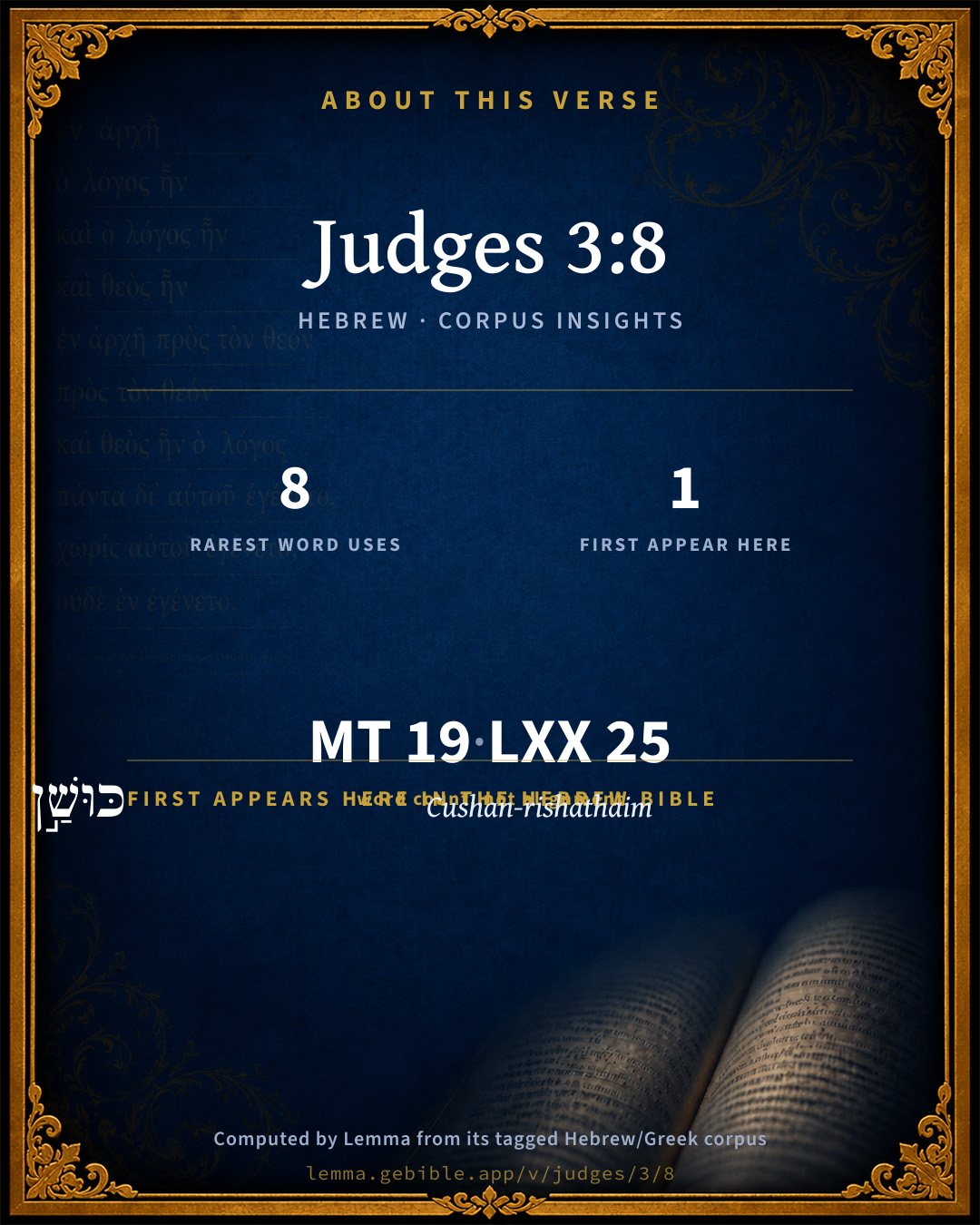
The rarest word here is כּוּשַׁ֣ן Cushan-rishathaim H3573 — appearing just 8 times in the whole Hebrew Bible.

First appearance in Scripture

This word makes its first canonical appearance in the Hebrew Bible here:

  • כּוּשַׁ֣ן Cushan-rishathaim H3573

Shared distinctive vocabulary

כּוּשַׁ֣ן Cushan-rishathaim H3573 occurs in 2 verses of the Hebrew Bible. Also found in:

Grammatical profile

  • 3 verbs
  • 13 nouns
  • 1 adjective
  • 2 particles

Verb forms

  • וַיִּֽחַר Qal · Sequential Imperfect
  • וַֽיִּמְכְּרֵ֗ם Qal · Sequential Imperfect
  • וַיַּעַבְד֧וּ Qal · Sequential Imperfect

Repetition

Words recur within this verse — often emphatic in Hebrew:

  • כּוּשַׁ֣ן Cushan-rishathaim H3573 ×4
  • בְּיִשְׂרָאֵ֔ל Israel H3478 ×2
  • אֲרַ֣ם Aram-naharaim H763 ×2

Hebrew & Septuagint length

In English translation the verse runs 32 words from the Hebrew and 31 from the Septuagint (LXX English) — closely comparable.

A rough comparison of the two English renderings, which tokenize alike — not a word-level alignment.

Word counts can differ between the Hebrew and the Greek without any difference in meaning — e.g. the Hebrew direct-object marker אֵת has no separate Greek word, and Greek often adds the article ὁ.

In the original languages it is 19 Hebrew tokens and 25 Greek tokens — but the two are counted differently (Hebrew bundles its prefixes and suffixes into one token; the Greek is in lemma form), so that isn’t a like-for-like length.

Cross-references

12

Topical passages linked to Judges 3:8 in the Treasury of Scripture Knowledge — connected by theme and wording, ordered by reader-vote popularity; previews shown in the World English Bible.

  • Judges 2:14 The anger of Yahweh was kindled against Israel, and he delivered them into the hands of spoilers who despoiled them; and he sold them into the hands of their enemies round about, so that they could not any longer stand before their enemies.
  • Judges 4:9 She said, I will surely go with you: notwithstanding, the journey that you take shall not be for your honor; for Yahweh will sell Sisera into the hand of a woman. Deborah arose, and went with Barak to Kedesh.
  • Psalms 85:3 You have taken away all your wrath. You have turned from the fierceness of your anger.
  • Habakkuk 3:7 I saw the tents of Cushan in affliction. The dwellings of the land of Midian trembled.
  • Exodus 22:24 and my wrath will grow hot, and I will kill you with the sword; and your wives shall be widows, and your children fatherless.
  • Deuteronomy 29:20 Yahweh will not pardon him, but then the anger of Yahweh and his jealousy will smoke against that man, and all the curse that is written in this book shall lie on him, and Yahweh will blot out his name from under the sky.
  • Deuteronomy 32:30 How should one chase a thousand, Two put ten thousand to flight, Except their Rock had sold them, Yahweh had delivered them up?
  • Judges 2:20 The anger of Yahweh was kindled against Israel; and he said, Because this nation have transgressed my covenant which I commanded their fathers, and have not listened to my voice;
  • 1 Samuel 12:9 But they forgot Yahweh their God; and he sold them into the hand of Sisera, captain of the host of Hazor, and into the hand of the Philistines, and into the hand of the king of Moab; and they fought against them.
  • Psalms 6:1 Yahweh, don't rebuke me in your anger, Neither discipline me in your wrath.
  • Isaiah 50:1 Thus says Yahweh, Where is the bill of your mother's divorce, with which I have put her away? or which of my creditors is it to whom I have sold you? Behold, for your iniquities were you sold, and for your transgressions was your mother put away.
  • Romans 7:14 For we know that the law is spiritual, but I am fleshly, sold under sin.

Cross-references courtesy of OpenBible.info (CC BY 4.0).

Hebrew and Greek witnesses Masoretic Hebrew ↔ Greek Septuagint

The same verse in the two great witnesses to the Old Testament, shown verse-for-verse.

These are two independent witnesses, not word-aligned to each other, and the Septuagint is shown in lemma (dictionary) form.

Hebrew Judges 3:8 Masoretic · Westminster Leningrad Codex

וַיִּֽחַר אַ֤ף יְהוָה֙ בְּיִשְׂרָאֵ֔ל וַֽיִּמְכְּרֵ֗ם בְּיַד֙ כּוּשַׁ֣ן רִשְׁעָתַ֔יִם מֶ֖לֶךְ אֲרַ֣ם נַהֲרָ֑יִם וַיַּעַבְד֧וּ בְנֵֽי יִשְׂרָאֵ֛ל אֶת כּוּשַׁ֥ן רִשְׁעָתַ֖יִם שְׁמֹנֶ֥ה שָׁנִֽים

Therefore the anger of Yahweh was kindled against Israel, and he sold them into the hand of Cushan Rishathaim king of Mesopotamia: and the children of Israel served Cushan Rishathaim eight years.

World English Bible · Public Domain

Greek LXX Judges 3:8 Septuagint · lemma form

καί ὀργίζω θυμός κύριος ἐν ὁ ἰσραήλ καί ἀποδίδωμι αὐτός ἐν χείρ χουσαρσαθαιμ βασιλεύς συρία ποταμός καί δουλεύω ὁ υἱός ἰσραήλ ὁ χουσαρσαθαιμ ἔτος ὀκτώ

And the Lord was very angry with Israel, and sold them into the hand of Chusarsathaim king of Syria of the rivers: and the children of Israel served Chusarsathaim eight years.

LXX2012 (modern English Septuagint) · Public Domain

On this verse, Adam Clarke's Commentary discusses the Septuagint’s reading. Read the note in Commentary ↓

Hebrew: Westminster Leningrad Codex (CC BY 4.0). Greek: Septuagint (public domain); English from LXX2012 (modern English Septuagint) (Public Domain). How the Septuagint differs from the Hebrew →

Targum (Aramaic paraphrase)

1

The Targum is the ancient Jewish Aramaic paraphrase of the Hebrew Scriptures — an interpretive translation, not the Hebrew text itself. Onkelos (literal) and Pseudo-Jonathan (expansive) render the Torah, and Jonathan the Prophets. Coverage is partial: where no permissively-licensed English translation exists for a verse, only the Aramaic is shown. This is verse-level text, not a word-by-word alignment to the Hebrew.

  1. Targum Jonathan Prophets (Joshua–Malachi)
    וּתְקֵיף רוּגְזָא דַייָ בְּיִשְׂרָאֵל וּמַסְרִינוּן בְּיַד כּוּשַׁן חַיָבָא מַלְכָּא דַאֲרָם דִי עַל פְּרָת וּפְלַחוּ בְּנֵי יִשְׂרָאֵל יַת כּוּשַׁן חַיָבָא תְּמָנֵי שְׁנִין:

    (no public-domain English translation for this verse)

    Targum Jonathan — Aramaic: “Mikraot Gedolot” (public domain). English: “Sefaria Community Translation” (CC0 1.0 (public-domain dedication)); “London "Chaldee Paraphrase," 1871” (public domain). Text via Sefaria.

Commentary

Notes on Judges 3:8 from classic Christian and Jewish commentators (each source and its license shown beneath its notes). The classic Christian expositions comment on the surrounding passage and are grouped to its opening verse, so a note may address several verses; the Jewish commentaries on the Tanakh (Rashi and others) are per-verse, so they appear only where the commentator wrote on this verse.

Lemma curates 59 commentaries, every one of them public domain or Creative Commons licensed, each selected and text-cleaned for this edition rather than reprinted as found. About our sources →

Matthew Henry's Commentary

We now come to the records of the government of the particular judges, the first of which was Othniel, in whom the story of this book is knit to that of Joshua, for even in Joshua's time Othniel began to be famous, by which it appears that it was not long after Israel's settlement in Canaan before their purity began to be corrupted and their peace (by consequence) disturbed. And those who have taken pains to enquire into the sacred chronology are generally agreed that the Danites' idolatry, and the war with the Benjamites for abusing the Levite's concubine, though related in the latter end of this book, happened about this time, under or before the government of Othniel, who, though a judge, was not such a king in Israel as would keep men from doing what was right in their own eyes. In this short narrative of Othniel's government we have,

I. The distress that Israel was brought into for their sin, Jdg 3:8. God being justly displeased with them for plucking up the hedge of their peculiarity, and laying themselves in common with the nations, plucked up the hedge of their protection and laid them open to the nations, set them to sale as goods he would part with, and the first that laid hands on them was Chushan-rishathaim, king of that Syria which lay between the two great rivers of Tigris and Euphrates, thence called Mesopotamia, which signifies in the midst of rivers. It is probable that this was a warlike prince, and, aiming to enlarge his dominions, he invaded the two tribes first on the other side Jordan that lay next him, and afterwards, perhaps by degrees, penetrated into the heart of the country, and as far as he went put them under contribution, exacting it with rigour, and perhaps quartering soldiers upon them. Laban, who oppressed Jacob with a hard service, was of this country; but it lay at such a distance that one could not have thought Israel's trouble would come from such a far country, which shows so much the more of the hand of God in it.

II. Their return to God in this distress: When he slew them, then they sought him whom before they had slighted. The children of Israel, even the generality of them, cried unto the Lord, Jdg 3:9. At first they made light of their trouble, and thought they could easily shake off the yoke of a prince at such a distance; but, when it continued eight years, they began to feel the smart of it, and then those cried under it who before had laughed at it. Those who in the day of their mirth had cried to Baalim and Ashtaroth now that they are in trouble cry to the Lord from whom they had revolted, whose justice brought them into this trouble, and whose power and favour could alone help them out of it. Affliction makes those cry to God with importunity who before would scarcely speak to him.

III. God's return in mercy to them for their deliverance. Though need drove them to him, he did not therefore reject their prayers, but graciously raised up a deliverer, or saviour, as the word is. Observe, 1. Who the deliverer was. It was Othniel, who married Caleb's daughter, one of the old stock that had seen the works of the Lord, and had himself, no question, kept his integrity, and secretly lamented the apostasy of his people, but waited for a divine call to appear publicly for the redress of their grievances. He was now, we may suppose, far advanced in years, when God raised him up to this honour, but the decays of age were no hindrance to his usefulness when God had work for him to do. 2. Whence he had his commission, not of man, nor by man; but the Spirit of the Lord came upon him (Jdg 3:10), the spirit of wisdom and courage to qualify him for the service, and a spirit of power to excite him to it, so as to give him and others full satisfaction that it was the will of God he should engage in it. The Chaldee says, The spirit of prophecy remained on him. 3. What method he took. He first judged Israel, reproved them, called them to account for their sins, and reformed them, and then went out to war. This was the right method. Let sin at home be conquered, that worst of enemies, and then enemies abroad will be the more easily dealt with. Thus let Christ be our Judge and Law-giver, and then he will save us, and on no other terms, Isa 33:22. 4. What good success he had. He prevailed to break the yoke of the oppression, and, as it should seem, to break the neck of the oppressor; for it is said, The Lord delivered Chushan-rishathaim into his hand. Now was Judah, of which tribe Othniel was, as a lion's whelp gone up from the prey. 5. The happy consequence of Othniel's good services. The land, though not getting ground, yet had rest, and some fruits of the reformation, forty years; and the benefit would have been perpetual if they had kept close to God and their duty.

Matthew Henry's Commentary on the Whole Bible (1708–1710) — public domain (CC PDM 1.0). Text via the HelloAO Bible API.

Jamieson, Fausset & Brown

Robert Jamieson, A. R. Fausset & David Brown

OTHNIEL DELIVERS ISRAEL. (Jdg 3:8-11)

sold them--that is, "delivered them"

into the hand of Chushan-rishathaim--or, Chushan, "the wicked." This name had been probably given him from his cruel and impious character.

served Chushan-rishathaim eight years--by the payment of a stipulated tribute yearly, the raising of which must have caused a great amount of labor and privation.

Jamieson, Fausset & Brown — Commentary Critical and Explanatory on the Whole Bible (1871) — public domain (CC PDM 1.0). Text via the HelloAO Bible API.

Trapp's Complete Commentary

John Trapp

Jdg 3:8 Therefore the anger of the LORD was hot against Israel, and he sold them into the hand of Chushanrishathaim king of Mesopotamia: and the children of Israel served Chushanrishathaim eight years.

Ver. 8. Into the hand of Chusanrishathaim.] Chusan impii, the Chaldee rendereth it; that is, Chusan the wicked. Gaudent tyranni horrendis nominibus, saith Lavater here, quae vel ipso sono homines terrere possint. Tyrants delight in terrible names and titles, as Attila, the Hun, who would needs be styled Ira Dei et orbis vastitas, the wrath of God, and waster of the world.

Eight years.] According to the time, saith Hugo and Lyra, that they had served idols.

John Trapp, A Commentary or Exposition upon All the Books of the Old and New Testament (1647–1656) — public domain. Text from a community e-Sword module.

Albert Barnes' Notes on the Bible

Here we hold again the thread of the proper narrative, which seems as if it ought to have run thus Jdg 1:1 : Now, etc. Jdg 3:8, therefore (or “and”) etc.

Served Chushan-Rishathaim - This is the same phrase as in Jdg 3:14. From it is derived the expression, “the times of servitude,” as distinguished from “the times of rest,” in speaking of the times of the Judges. Mesopotamia, or Aram-naharaim, was the seat of Nimrod’s kingdom, and Nimrod was the son of Cush Gen 10:8-12. Rishathaim is perhaps the name of a city, or a foreign word altered to a Hebrew form. Nothing is known from history, or the cuneiform inscriptions, of the political condition of Mesopotamia at this time, though Thotmes I and III in the 18th Egyptian dynasty are known to have invaded Mesopotamia. It is, however, in accordance with such an aggressive Aramean movement toward Palestine, that as early as the time of Abraham we find the kings of Shinar and of Elam invading the south of Palestine. There is also distinct evidence in the names of the Edomite kings Gen 36:32, Gen 36:35, Gen 36:37 of an Aramean dynasty in Edom about the time of the early Judges. Compare, too, Job 1:17.

Albert Barnes' Notes on the Bible (1834–1885) — public domain. Text from a community e-Sword/MySword module.

The Biblical Illustrator

Joseph S. Exell

Jdg_3:8

Sold them into the hand of Chushan-rishathaim king of Mesopotamia.

Israel in servitude

1. This was the first servitude of the Israelites ever since they came out of their house of bondage in Egypt; for now such detestable apostasy was found in Israel as heaven and earth had caused to be ashamed of (Jer_2:12-13); therefore is he made a slave and servant (Jdg_3:14). They that would not serve the Lord in the abundance of all things with gladness shall serve their enemies in the want of all things with sadness (Deu_28:47-48); therefore God forsook them, that they might know the worth of His service by the want of it under woful miseries (2Ch_12:8).

2. As this was the first oppression that Israel met with after their coming out of Egypt, so this king of Syria was their oppressor. This king had Gods commission to oppress Israel, for God sold them into this kings hands, and yet was he but a lessee; his possession was by virtue of a lease, and that only a lease limited to eight years. It surely seemed very long for those children of light to walk in such a place of darkness for eight years together; if so, the time of their suffering bears a due proportion to the time of their sinning.

3. The marvellous proportion God observed in proportioning Israels suffering to the proportion of their sinning. As Israels sinning increased in magnitude so their suffering increased in multitude, every term of their slavery rising higher and higher. They served this Chushan eight years, and, because not bettered thereby, they served Eglon eighteen years (Jdg_3:14) and afterwards Jabin twenty years (Jdg_4:3, etc.). With the froward God will deal frowardly (Psa_18:26). When lesser corrections could not restrain them from sin, God laid heavier punishments upon them, and punishes them seven times more; yea, and seven times more, and yet seven times more to that, as He had threatened (Lev_26:18; Lev_26:21; Lev_26:24; Lev_26:28). God will not give over punishing until men give over sinning.

4. The redeemer that the Lord raised up to redeem Israel out of their first slavery was Othniel (Jdg_3:9), which God would not yet do for them until they humbled themselves, when God, they saw, would get the better of them. And this deliverer, whom God sent to redeem Israel, when sold into the hands of this terrible tyrant, was a type of our Redeemer the Lord Jesus, who was sent of God to redeem us, and thus all the other judges be types of Christ, though some more eminently than others. Here the Spirit of the Lord came upon Othniel, gave him prudence, prowess, and magnanimity to make war against this tyrannical oppressor, and having vanquished him in battle, he restored rest to Gods Israel, governing his people in peace and in the profession and practice of Gods true religion according to His law. (C. Ness.)

The Biblical Illustrator, edited by Joseph S. Exell (c. 1880s–1900s) — public domain. Text from a community e-Sword module.

Joseph Benson's Commentary

Jdg 3:8. He sold them into the hand of Chushan-rishathaim — So that the first enemies that oppressed the Israelites were the Syrians; who, either out of hatred, or a desire to enlarge their dominions, came over the Euphrates, and invaded them, and kept them in subjection eight years. King of Mesopotamia — Which was that part of Syria which lay between the two great rivers Tigris and Euphrates. This lay at such a distance, that one would not have thought Israel’s trouble should have come from such a far country; but this shows so much the more that the hand of God was in it.

Joseph Benson's Commentary on the Old and New Testaments (1811–1818) — public domain. Text from a community e-Sword module.

Geneva Bible (1599)

Geneva Bible translators

Or, Mesopotamia.

Geneva Bible (1599) marginal notes — public domain. Text via Bolls.life.

Adam Clarke's Commentary

Verse 8. Chushan-rishathaim] Kushan, the wicked or impious; and so the word is rendered by the Chaldee Targum, the Syriac, and the Arabic, wherever it occurs in this chapter.

King of Mesopotamia] King of ארם נהרים Aram naharayim, "Syria of the two rivers; " translated Mesopotamia by the Septuagint and Vulgate.

It was the district situated between the Tigris and Euphrates, called by the Arabian geographers Maverannaher, "the country beyond the river," it is now called Diarbek. See Clarke on Ac 2:9.

Served Chushan - eight years.] He overran their country, and forced them to pay a very heavy tribute.

Adam Clarke's Commentary on the Bible (1810–1826) — public domain. Text from a community e-Sword/MySword module.

Ellicott's Commentary for English Readers

(8) Into the hand of Chushan-rishathaim.—If the reading of all the MSS. be correct, this must be a term of hatred rather than a name, for it means “Cushan of the double wickedness.” Some MSS. of the LXX. have Chousarsathaim. Josephus (Antt. v. 3, § 3) shortens it into Chousarthes; and St. Clemens of Alexandria (Strom. i. 21) into Chousachar. Syncellus (Chronogr. i. 58) says that Paphos was founded by those who fled from this Mesopotamian conqueror (Ewald). Cushan only occurs elsewhere in Hab_3:7, “I saw the tents of Cushan in affliction.” Cush was a son of Nimrod (Gen_10:8), and our translators, in the margin of Hab_3:11, render Cushan by Ethiopia. It is quite possible that Rishathaim may be the distorted form of the name of some town. It is always the tendency of a people to re-stamp a word which they receive into their current phraseology, because no nations like to use a term which they do not understand. Thus in our London streets, “Hangman’s Gains” is a corruption of Hammes et Guynes, and Blind Chapel Court, of Blanch Appleton.

The Jews were not only accustomed thus to re-stamp (sur-frapper) the names of foreign kings, peoples, and idols, but they especially rejoiced in using terms of hatred. Thus the Romans in the Talmud are called Idumeans; Beelzebul was changed into Beelzebub; Bethel into Bethaven; Ptolemy into Talmai; Ir-Cheres into Ir-Heres (see Note on Jdg_1:33), &c. In an ancient Rabbinic commentary the “two wickednesses” are supposed to be those of Balaam and Cushan, or that of Laban repeating itself in his descendants. The Targum and Syriac render it “the criminal Cushan.”

King of Mesopotamia.—In the original Aram-naharian, “the highland of the two rivers” (Euphratesand Tigris), or, as the LXX. render it, “Syria of the rivers.” His invasion, like that of Chedorlaomer, king of Elam, and Amraphel, king of Shinar, was from the south. Hence it is repelled by Othniel, whose inheritance was in the tribe of Judah. We find no other invaders from the far east till the close of the monarchy.

A Bible Commentary for English Readers, edited by Charles John Ellicott (1878–1897) — public domain. Text from a community e-Sword module.

The Cambridge Bible for Schools and Colleges

gen. ed. J. J. S. Perowne

8. sold them] See Jdg_2:14 n.

Cushan-rishathaim king of Mesopotamia] The rendering Mesopotamia, i.e. the vast region between the Euphrates and Tigris, comes from the LXX; the Hebr. is Aram-naharaim ‘Syria of the two rivers,’ usually held to designate the country between the Euphrates and the Ḥabor (2Ki_17:6) or Chabôras, now Khâbûr, because in the O.T. two towns are said to belong to it, Haran (Gen_24:10) and Pethor (Deu_23:5), the latter, however, situated on the western side of the Euphrates. But the form naharaim with the dual ending (-aim) may be due merely to the scribes who vocalized the Hebr. text; the original pronunciation was probably Aram-nahârim (plur.) ‘Syria of Nahârim,’ i.e. the rivers (cf. Riviera), which will then be the Hebr. equivalent of Naharin in Egyptian inscrr., the land of Nahrima or Narima in the Amarna tablets, the ancient name of the country which stretched from the Orontes across the Euphrates, and indefinitely eastwards. The subjugation of the Israelite tribes by the king of this remote region is as surprising as his overthrow by the small clan of Othniel in the S. of Judah. Yet a faint recollection of some actual event may be detected in the narrative, which is most improbable as it stands. The name Cushan-rishathaim (‘Cushan of double wickedness,’ a contemptuous sobriquet) suggests a connexion with Cushan, a Midianite tribe (Hab_3:7; cf. Num_12:1); nothing is more likely than that these Bedouin from Midian made an incursion into the S. of Judah, and were at last repulsed by the Kenizzites of Debir (Jdg_1:11 ff.). Perhaps the original tradition was perverted by the very natural confusion between Aram and Edom, which are barely distinguishable in the ancient writing (cf. 2Ki_16:6 RVm.); Aram once in the text, Naharaim would readily be added.

The Cambridge Bible for Schools and Colleges (gen. ed. J. J. S. Perowne; Cambridge University Press, 1878–1918) — public domain. Text from a community e-Sword module.

John Gill's Exposition

Therefore the anger of the Lord was hot against Israel,.... Because of their idolatry; see Jdg 2:14,

and he sold them into the hand of Chushanrishathaim, king of Mesopotamia; or Aramnaharaim; that is, Syria, between the two rivers, which were Tigris and Euphrates; hence the Greek name of this place is as here called Mesopotamia. Josephus (l) calls him king of Assyria, and gives him the name of Chusarthus; and indeed Chushanrishathaim seems to be his whole name, though the Targum makes Rishathaim to be an epithet, and calls him Cushan, the wicked king of Syria; the word is of the dual number, and signifies two wickednesses; which, according to the mystical exposition of the Jews (m), refers to two wicked things Syria did to Israel, one by Balaam the Syrian, and the other by this Cushan. Mr. Bedford (n) thinks it may be rendered,"Cushan, king of the two wicked kingdoms;''the Assyrian monarchy being at this time like two kingdoms, Babylon being the metropolis of the one, and Nineveh of the other; but it is question whether the monarchy was as yet in being. Hillerus (o) makes Cushan to be an Arab Scenite, from Hab 3:7; and Rishathaim to denote disquietudes; and it represents him as a man very turbulent, never quiet and easy, and so it seems he was; for not content with his kingdom on the other side Euphrates, he passed over that, and came into Canaan, to subject that to him, and add it to his dominions. Kimchi says that Rishathaim may be the name of a place, and some conjecture it to be the same with the Rhisina of Ptolemy (p); but it seems rather a part of this king's name, who came and fought against Israel, and the Lord delivered them into his hands:

and the children of Israel served Chushanrishathaim eight years; became tributaries to him during that space of time, but when that began is not easy to say. Bishop Usher (q) places it in A. M. 2591, and before Christ 1413.

(l) Antiqu. l. 5. c. 3. sect. 2. (m) T. Bab. Sanhedrin, fol. 105. I. (n) Scripture Chronology, p. 507. (o) Onomastic. p. 154, 155. (p) Geograph. l. 5. c. 18. (q) Annal. Vet. Test. p. 42.

John Gill's Exposition of the Whole Bible (1746–1763) — public domain (CC PDM 1.0). Text via the HelloAO Bible API.

Haydock's Catholic Bible Commentary

Chusan. This name leads us to conclude that this prince was of Scythian extraction, a descendant of Chus: (Calmet) it signifies "black," or an Ethiopian." (Menochius) --- Rasathaim was perhaps the place of his nativity. As it means "of two sorts of malice," Arias thinks that the Syrian kings took this title to shew that they would punish or repress all crimes against the civil or criminal law, (Menochius) those which affected the property as well as the lives of their subjects. (Haydock) --- Mesopotamia. In Hebrew Aram naharayim. Syria of the two rivers; so called because it lies between the Euphrates and the Tigris. It is absolutely called Syria, ver. 10. (Challoner) --- Eight years, by manual labour and presents, testifying their submission to their oppressor, who might not perhaps live among them. (Calmet) --- Moir’s edition, by mistake, reads eighty years. The Hebrews were equally fallible, chap. iii. 30. (Haydock)

George Leo Haydock (1774–1849), Haydock's Catholic Family Bible and Commentary, 1859 edition — public domain. Excludes Psalms (Douay-Rheims chapter numbering differs from Protestant) and Deuterocanonical books (Catholic canon only).

Matthew Poole's English Annotations

i.e. Were made subject and tributary to him.

Matthew Poole's English Annotations on the Holy Bible (1683–1685) — public domain. Text from a community e-Sword/MySword module.

Whedon's Commentary on the Bible

Daniel D. Whedon

8. Anger… sold — See on Jdg_2:14.

Chushan-rishathaim — The last word is a Hebrew dual signifying of double wickedness — Chushan, the moral monster. Of this Eastern king we have no other Scripture notice. “It is quite a gratuitous supposition of Bunsen’s that he was ‘a Mesopotamian satrap’ — ’the Assyrian satrap of Mesopotamia.’ Scripture calls him king, and besides, the cuneiform monuments make it perfectly clear that Assyria did not extend her dominion to Mesopotamia till the middle of the twelfth century B.C. If the Assyrian and Babylonian kingdoms of the early period be rightly apprehended, there is no more difficulty in supposing a powerful Aramaean state in western Mesopotamia, than in imagining the country divided up, as we must otherwise regard it, among a number of petty principalities. Chushan-rishathaim reigned, probably, before the Assyrian independence was established.” — Rawlinson’s Hist. Evidences, p. 300. Mesopotamia, signifying between the rivers, was that part of Syria which lies between the Euphrates and the Tigris. It is for the most part a vast plain seven hundred miles long and from twenty to two hundred and fifty broad. It is first mentioned in the Bible as the land where Nahor and his family settled after quitting Ur of the Chaldees. Gen_24:10.

Served — Not as slaves: the servitude was not personal, but political, and consisted in the loss of national independence, and the payment of onerous tributes to this tyrant. This remark applies to the state of servitude to which the Hebrews often were reduced in the days of the Judges.

Daniel D. Whedon (gen. ed.), Commentary on the Old and New Testaments (1874–1909) — public domain. Text from a community e-Sword module.

The Pulpit Commentary

Chushan-rishathaim, i.e. , as usually explained, Chushan the victorious, or the wicked. His name, Chushan, or Cushan, points to Cush, the father of Nimrod, (Gen_10:6-8) and the seat of his kingdom in Aram-naharaim, or Mesopotamia, agrees with Nimrod"s kingdom in "Babel... in the land of Shinar" (ibid. ver. 10). An earlier invasion of Palestine by conquerors from Mesopotamia is mentioned Gen_14:2, where Amraphel, king of Shinar, is one of the five kings who invaded Sodom. Bela, son of Beer, king of Edom, seems by his name to have been clearly from Mesopotamia, as Balaam the son of Beer was; (Num_22:5 Num_23:7) and in the time of Job we read of bands of Chaldeans looting in the land of Uz. (Job_1:17) Chushan, as the name of a people, is coupled with Midian in Hab_3:7; but we have no accounts of the state of Mesopotamia at the time of Chushan-rishathaim.

HOMILIES BY A.F. MUIR. Ver. 8. Idolatry and its Nemesis.

The effects of this communion with idolatrous peoples speedily appear. It was no accident that Israel became the subject of a heathen power, nor are we to suppose it an arbitrary exercise of the right of Divine providence.

I AS FAITH STRENGTHENS, SUPERSTITION DESTROYS, MORAL POWER. In all these punishments the external and physical disadvantage appears to be the first perceived. But the real loss was sustained beforehand, when faith in the one God was lost. The whole moral life which this dogma encouraged and sustained was thereby undermined. Monotheism was the foundation of the moral life, correcting and purifying it; idolatry pandered to the worst passions, and chained the spirit of man to the outward and sensuous.

II MORAL ENTHUSIASM IS THE ESSENCE AND INSPIRATION OF HEROISM AND THE RULING QUALITIES. The reverence of Israel in the worship of Jehovah was called forth towards qualities that were truly noble and admirable. The sustaining force of an Israelite"s piety was absolutely righteous and super-sensuous; and it had appeared superior to all that the arm of flesh could bring against it. The Israelite was taught, therefore, to despise the material, the outward, and the merely human. His faith, therefore, became heroic. And as the influence of the Divine Being repressed the passions and developed the spiritual power, it enabled him to restrain himself, to pursue after distant and vast aims; and, in making him heedless of the attractions of sense and penalties which only affected the outward man, it made him influential over others. Hence the religion of Israel marked it out for political superiority and power.

III THE "SERVICE" THAT IS WASTED ON WORTHLESS OBJECTS IS AVENGED BY A "SERVICE" THAT IS SEVERE AND INVOLUNTARY. This was the result of a special appointment, and also of a Divine law. The people that had become effeminate by idolatrous indulgence were an easy prey to any military and ambitious power; and so that which had been a weak yielding, or a choice, became binding and imperative. National liberty was lost; the purest and noblest traits of national character were repressed. What a special political power did in this instance evil habit itself may do; and there are other influences whose yoke waits upon the loss of moral power. M.

The Pulpit Commentary (1880–1919), ed. H.D.M. Spence-Jones & Joseph S. Exell — public domain. Text from a community e-Sword module.

John Wesley's Explanatory Notes

Served - That is, were made subject to him. Mesopotamia was that part of Syria which lay between the two great rivers, Tigris and Euphrates. This lay at such a distance, that one would not have thought Israel's trouble should have come from such a far country: which shews so much the more of the hand of God in it.

John Wesley, Explanatory Notes Upon the Whole Bible (1754–1765) — public domain. Text via the GEBible commentary corpus.

Lesson kit

Teaching starters — assembled from the data on this page, not authored interpretation. Every prompt links to the verse data it draws on. Edit before teaching.

Judges, in the Historical, opens this verse with 19 words (14 distinct Hebrew lemmas). Its most distinctive word is Kûwshan Rishʻâthayim (“Cushan-rishathaim”). A historical commentator’s framing appears above. Read the whole chapter for the surrounding context.

Discussion questions

  1. What does “Cushan-rishathaim” (Kûwshan Rishʻâthayim) contribute to the verse as a whole?
  2. This is the first place “Cushan-rishathaim” appears in Scripture (first appears here). What does its debut here establish?
  3. How does Judges 3:10, which shares the word «Cushan-rishathaim», read alongside this verse?
  4. What does the repetition of “Cushan-rishathaim” (4× in this one verse) do in this verse?
  5. These translations render this verse differently. What is at stake in choosing one wording over another?
  6. «וַיִּֽחַר» is a Qal Sequential Imperfect verb. How does that grammatical form shape the action described?
  7. Compare how Matthew Henry's Commentary and Jamieson, Fausset & Brown read this verse. Where do they agree or differ?

Things to notice

Reading settings

Reading text

Shown beneath each verse's original-language words.

Old Testament
Old Testament edition

Read the OT as the Masoretic Hebrew (MT) or the Greek Septuagint (LXX).

English shown for the Greek Septuagint (in the Hebrew ↔ Greek comparison).

Comparing translations? Open the Compare panel on any verse page to stack up to four side by side.