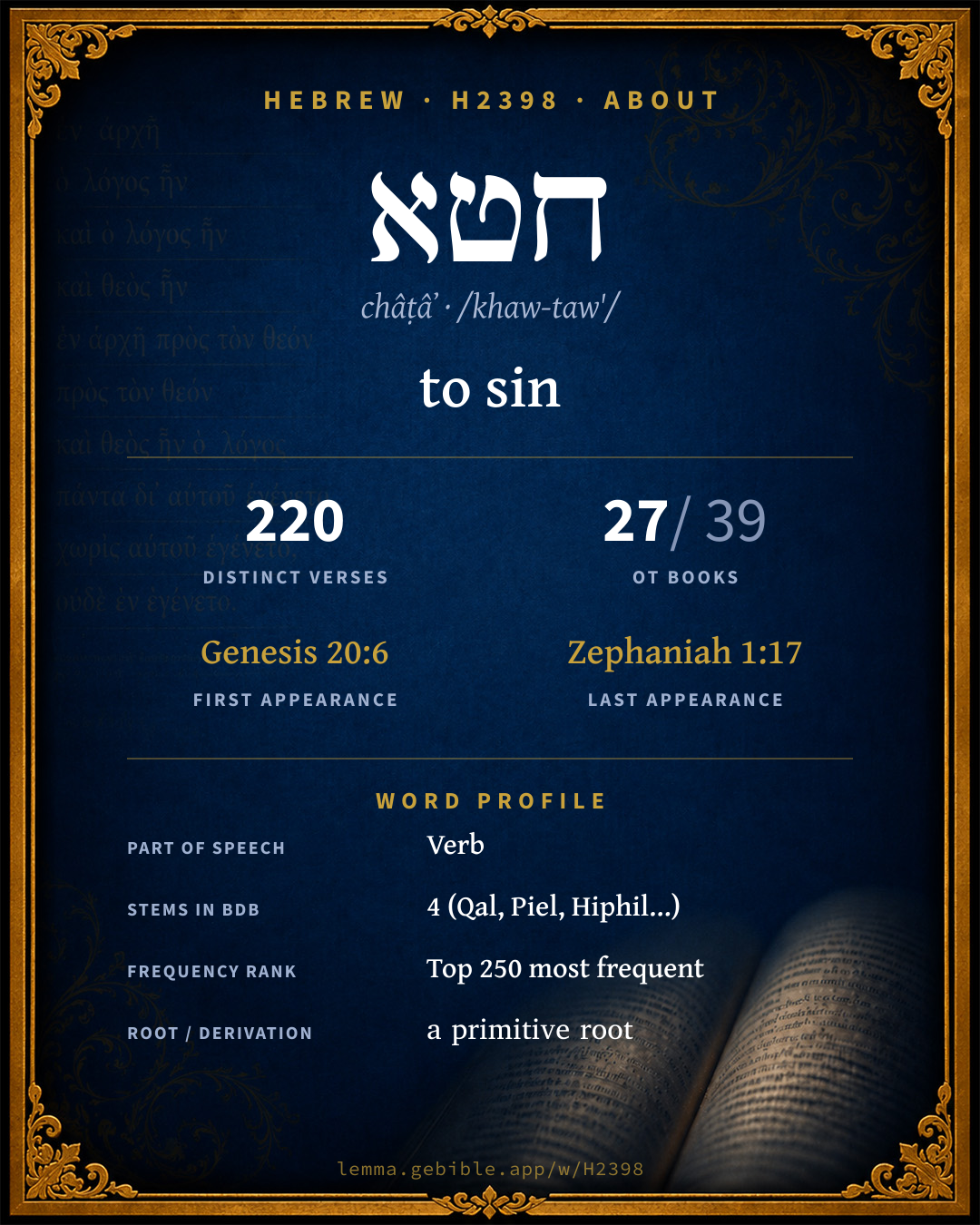
חָטָא
to sin
also: miss, miss the way, go wrong, incur guilt fuller range ↓
Full lexicon entry — Brown-Driver-Briggs (BDB)
From Brown-Driver-Briggs (BDB)
Where this word appears
See every Qal verb in the Hebrew Bible →
Grammar key — what these labels mean
Part of speech
- Verb
- An action or state-of-being word.
Noun type
- Common
- A common noun — a general class of person, place, or thing (“king,” “city,” “water”), not a specific name.
Stem
- Qal
- The basic, simple active stem — the plain form of the verb (“he wrote”). Here: ‘miss’
- Hiphil
- The causative active stem (“he caused / brought about”). Here: ‘miss the mark’
- Hithpael
- The reflexive or reciprocal stem (the subject acts on itself). Here: ‘miss oneself’
- Piel
- An intensive or resultative active stem. Here: ‘bear loss’
Form
- Perfect
- A completed action or state — Hebrew marks aspect (completeness) more than strict tense (“he wrote”).
- Imperfect
- An incomplete, ongoing, or future action (“he will / would write”).
- Infinitive Construct
- A bound verbal noun, frequently with prepositions (“to write / in writing”).
- Participle Active
- A verbal adjective expressing ongoing or characteristic action (“writing / one who writes”).
- Sequential Perfect
- A perfect with prefixed waw continuing a preceding imperfect or command (waw-consecutive perfect).
- Sequential Imperfect
- An imperfect with prefixed waw — the standard past-narrative form (waw-consecutive imperfect).
- Jussive
- A third- or second-person volitional form expressing wish or command (“let him write”).
State
- Absolute
- The independent form of a noun, not bound to a following word.
- Construct
- A noun bound to a following noun in a possessive / “of” relationship (the construct chain).
Person
- 3rd Person
- The one spoken about (“he / she / it / they”).
- 1st Person
- The speaker (“I / we”).
- 2nd Person
- The one addressed (“you”).
Gender
- Masculine
- Grammatically masculine.
- Common
- Either gender — not distinguished for this form.
- Feminine
- Grammatically feminine.
Number
- Singular
- One.
- Plural
- More than one (in Hebrew, generally three or more).
10 verses where H2398 appears in the Qal stem in the Book of Ezekiel. Filtered view — show all forms. Click any verse to open its interlinear word-by-word view. Verse text shown in the World English Bible for context — . Each verse’s Hebrew form is shown with its reference; the English is not keyword-highlighted, since the data carries no word-level English alignment. Use “Compare translations” on any verse to read it across multiple English versions. This concordance covers the Hebrew Bible; Septuagint (Greek Old Testament) occurrences are not indexed here.
Ezekiel
- Ezekiel 3:21 חֲטֹ֛א חָטָ֑א Qal inf.cs Qal pf 3ms Nevertheless if you warn the righteous man, that the righteous not sin, and he does not sin, he shall surely live, because he took warning; and you have delivered your soul.
- Ezekiel 14:13 תֶחֱטָא Qal impf 3fs Son of man, when a land sins against me by committing a trespass, and I stretch out my hand on it, and break the staff of the bread of it, and send famine on it, and cut off from it man and animal;
- Ezekiel 16:51 חָטָ֑אָה Qal pf 3fs Neither has Samaria committed half of your sins; but you have multiplied your abominations more than they, and have justified your sisters by all your abominations which you have done.
- Ezekiel 18:4 הַ/חֹטֵ֖את ptcl def.art + Qal ptcp.act fs Behold, all souls are mine; as the soul of the father, so also the soul of the son is mine: the soul who sins, he shall die.
- Ezekiel 18:20 הַ/חֹטֵ֖את ptcl def.art + Qal ptcp.act fs The soul who sins, he shall die: the son shall not bear the iniquity of the father, neither shall the father bear the iniquity of the son; the righteousness of the righteous shall be on him, and the wickedness of the wicked shall be on him.
- Ezekiel 18:24 חָטָ֖א Qal pf 3ms But when the righteous turns away from his righteousness, and commits iniquity, and does according to all the abominations that the wicked man does, shall he live? None of his righteous deeds that he has done shall be remembered: in his trespass that he has trespassed, and in his sin that he has sinned, in them shall he die.
- Ezekiel 28:16 וַֽ/תֶּחֱטָ֑א conj + Qal wimpf 2ms By the abundance of your traffic they filled the midst of you with violence, and you have sinned: therefore I have cast you as profane out of the mountain of God; and I have destroyed you, covering cherub, from the midst of the stones of fire.
- Ezekiel 33:12 חֲטֹאתֽ/וֹ Qal inf.cs + sfx pers 3ms You, son of man, tell the children of your people, The righteousness of the righteous shall not deliver him in the day of his disobedience; and as for the wickedness of the wicked, he shall not fall thereby in the day that he turns from his wickedness; neither shall he who is righteous be able to live thereby in the day that he sins.
- Ezekiel 33:16 חָטָ֔א Qal pf 3ms None of his sins that he has committed shall be remembered against him: he has done that which is lawful and right; he shall surely live.
- Ezekiel 37:23 חָטְא֣וּ Qal pf 3cp neither shall they defile themselves any more with their idols, nor with their detestable things, nor with any of their transgressions; but I will save them out of all their dwelling-places, in which they have sinned, and will cleanse them: so shall they be my people, and I will be their God.
About this entry
At a glance — auto-summarized from this page’s data, not written by a person. Every figure links to its source below. This summary describes the numbers; it doesn’t interpret them.
חטא — transliterated châṭâʼ — is a Hebrew verb carrying the sense “to sin.” The verb spans 4 stems, from Qal to Piel. It appears 220 verses across 27 books of the Hebrew Bible, among its common vocabulary. Its earliest occurrence is Genesis 20:6. It shares a root with חטא, חטא and חטאה. Each statement above links to its evidence; the full detail follows below.
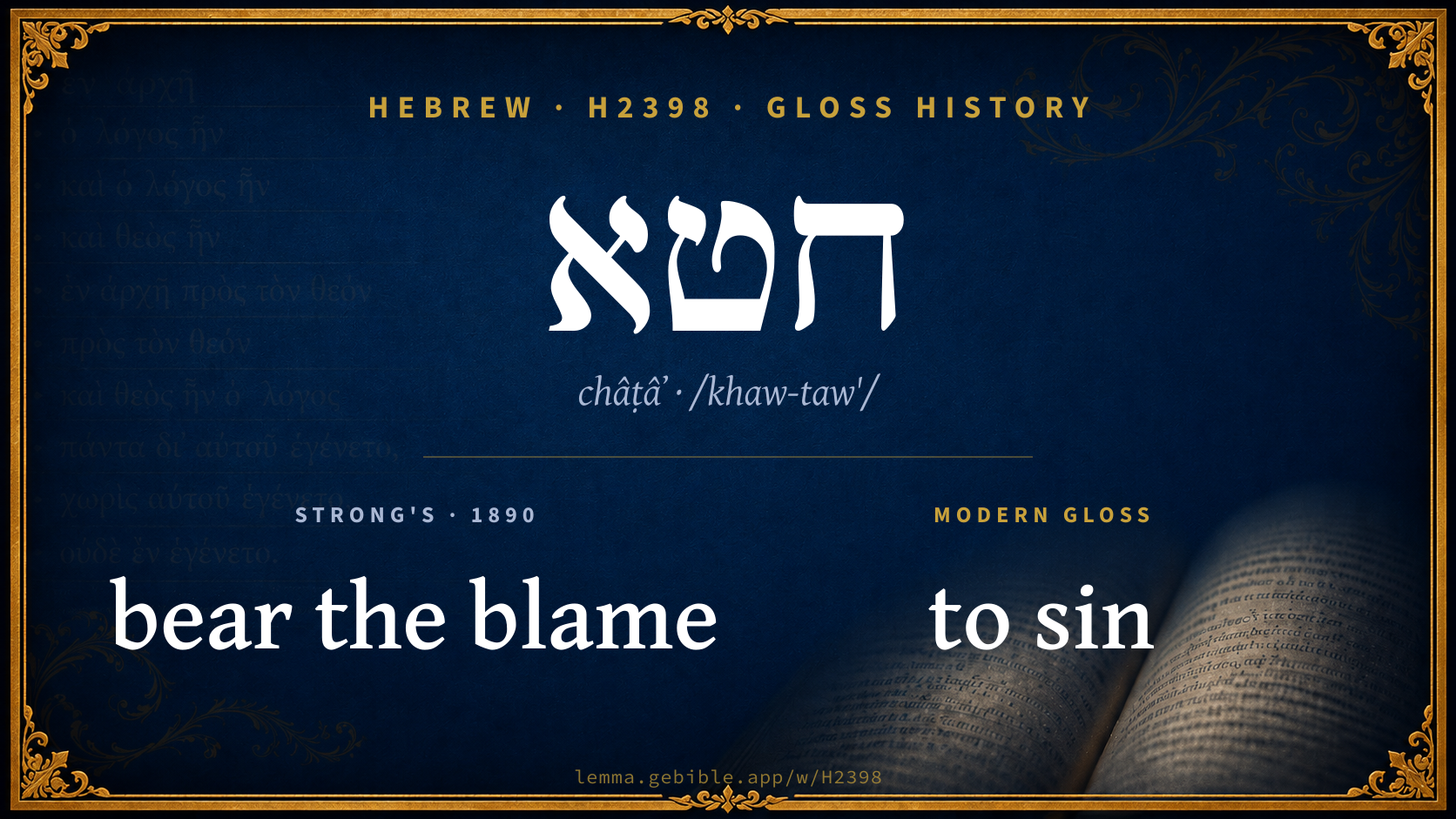
Gloss history
Strong's 1890 vs modern scholarship
About this word
Strong's H2398 catalogs a Hebrew word from the Hebrew Old Testament.
These counts are not copied from any lexicon or concordance. They are computed here, from the morphology-tagged Hebrew Old Testament. What Lemma adds →
- 220
- distinct verses
- The word appears in 220 distinct verses.
- 27 / 39
- OT books
- The word appears in 27 of 39 Old Testament books.
- #197
- by frequency
- Top 250 most frequent Hebrew words (rank 197 of 8,640 Hebrew words by occurrence).
View all 220 occurrences in the concordance →
By section of the Old Testament
By traditional corpus
Conventional, traditional groupings — biblical authorship is debated, so this is a traditional corpus grouping, not an authorship claim. Each share is this word’s portion of its verses in that division of the Hebrew canon. Each figure is a share of the word’s 220 distinct verses.
- Prophets (Nevi'im) 98 verses · 45%
- Torah (Pentateuch) 68 verses · 31%
- Writings (Ketuvim) 54 verses · 25%
How translations render this word
Counts come from each version’s own published word-to-Strong’s tagging or interlinear alignment — an approximate guide to how each version renders this word, not a word-level alignment the data otherwise carries. Because each total is that version’s own tagged count, the per-version totals vary from one another and need not match the appearance or distinct-verse counts above. These counts may also differ from a printed concordance because Lemma counts each distinctly tagged rendering and does not collapse phrase taggings into a single head-word total. This is a fixed set of word-tagged versions (KJV, ASV, BSB, ULT) and does not change with the reading translation you choose elsewhere. Each version’s license is shown beside its name below (and on Sources).
- King James Version: Sin 48×, We have sinned 22×, I have sinned 15×
- American Standard Version: Sin 43×, I have sinned 13×, We have sinned 13×
- Berean Standard Bible: Sin 24×, Commit 20×, Sins 20×
- unfoldingWord Literal Text: Sin 51×, We have sinned 21×, He sinned 19×
King James Version Public Domain
Renders H2398 across 238 tagged occurrences — most commonly:
Plus other, less common renderings. Plus 70 renderings that appear only once — usually multi-word phrases or single function words the recovered tagging swept in, not distinct renderings.
American Standard Version Public Domain
Renders H2398 across 238 tagged occurrences — most commonly:
Plus other, less common renderings. Plus 78 renderings that appear only once — usually multi-word phrases or single function words the recovered tagging swept in, not distinct renderings.
Berean Standard Bible Public Domain
Renders H2398 across 233 tagged occurrences — most commonly:
Plus other, less common renderings. Plus 70 renderings that appear only once — usually multi-word phrases or single function words the recovered tagging swept in, not distinct renderings. Not rendered by a distinct English word in 5 further occurrences.
unfoldingWord Literal Text CC BY-SA 4.0
Renders H2398 across 284 tagged occurrences — most commonly:
Plus other, less common renderings. Plus 62 renderings that appear only once — usually multi-word phrases or single function words the recovered tagging swept in, not distinct renderings.
20 senses and sub-senses in the full BDB
Hebrew verbs can shift meaning by stem (binyan): Qal is the basic action, Niphal is often passive or reflexive, Piel often intensifies or makes it factitive, and Hiphil is typically causative. The senses below are grouped under the stem BDB assigns to each. This entry also uses Hithpael (reflexive or reciprocal).
What do BDB’s symbols mean?
BDB uses these scholarly abbreviations:
| Symbol | Meaning |
|---|---|
| 𝔊 | the Septuagint (the ancient Greek translation, LXX) |
| 𝔙 | the Vulgate (the Latin translation) |
| 𝔖 | the Syriac version (the Peshitta) |
| 𝔗 | the Targum (the Aramaic translation) |
| ψ | the Psalms |
| √ | root (the underlying root or stem) |
| ‖ | parallel passage (a synonymous or contrasted parallel) |
| † | the dagger: every passage where the word occurs is cited |
The 20 senses and sub-senses the full Brown-Driver-Briggs lexicon distinguishes for this word, in lexicon order (not ranked by frequency), with BDB’s own verbatim wording and sub-sense lettering. Shown in Hebrew script with BDB’s own scholarly abbreviations. The condensed entry is in the Lexicon Entry tab. See also the Forms in the corpus table below.
Qal
- Pf. ח׳ Ex 32:31 + 29 times, 3 fs. חָֽטְאָה Lv 5:15 La 1:8, חָטָ֑אָה Je 50:14 Ez 16:15, חָטָאת Ex 5:16, etc., + 82 times Pf.; Impf. יֶחֱטָא Lv 4:3 + 12 times, תֶּחֱטָ֫אוּ Ex 20:20 ψ 4:5, etc. + 20 times Impf.; Inf. חֲטֹא Ez 3:21 + 8 times, מֵחֲטוֹא ψ 39:2, מֵחֲטוֹ (textual error for מחטא) Gn 20:6, בְּחֶטְאָה Nu 15:28, חֲטֹאתוֹ Ez 33:12 (del. Co); Pt. חוֹטֵא Pr 13:22 + 6 times, חֹטֵא Is 1:4 Ec 9:2, חוֹטֶא Is 65:20 + 2 times, חֹטֶא Ec 8:12, sf. חֹטְאִי Pr 8:36, pl. חֹטִ֯אֿים 1 S 14:33, sf. חֹטֵאת Ez 18:4, 20;— e.g. Exodus 32:31
- 1. miss: לא תחטא thou shalt not miss anything Jb 5:24, אָץ בְּרַגְלַיִם חוֹטֵא Pr 19:2 one hastening with his feet misseth (the way or the goal); חֹטְאִי חֹמֵס נַפְשׁוֹ Pr 8:36 the one missing me (Wisdom) is one wronging himself (opp. מֹצְאִי); miss, i.e. endanger, one’s life Pr 20:2 Hb 2:10 according to De VB (others sub 3 q.v.) e.g. Job 5:24
- 2. sin, miss the goal or path of right and duty:
- a. against man, abs. Ex 5:16 (E), 1 S 26:21 2 S 19:21 1 K 18:9 2 K 18:14; with לְ of the person against whom or towards whom one sins, Gn 40:1 (E), Ju 11:27 1 S 2:25; 19:4; 24:12, 1 K 8:31 = 2 Ch 6:22; מה חטאתי לך wherein have I sinned against thee? Gn 20:9 (E) Je 37:18; with בְּ, אל תחטאו בילד Gn 42:22 (E) do not sin against the lad, against David 1 S 19:4, 5. e.g. Exodus 5:16
- b. elsewhere always against God, abs. Ex 20:20 (E), 9:34 (J) Jos 7:11 (D) Lv 4:3; 5:1, 11, 17, 21, 23 Nu 16:22 (P), Ne 6:13 Jb 1:5, 22; 7:20; 10:14; 24:19; 35:6 ψ 4:5; 78:32 Is 43:27; 64:4 Je 2:35 La 5:7 Ez 3:21(×2); 16:51; 28:16; 33:12 Ho 8:11 (del. We Kl. Proph.), v 11 10:9; 13:2; לא נתתי לחטא חכי I have not permitted my palate to sin Jb 31:30; Pt. חֹטֵא, used as adj., sinful nation Is 1:4, sinful person Ez 18:4, 20; but usually as noun, sinner Pr 11:31; 13:22; 14:21 Ec 2:26; 7:26; 8:12; 9:2, 18 Is 65:20. Sin is confessed: חָטָאנוּ we have sinned Nu 14:40; 21:7 (E) Ju 10:15 1 S 12:10, 1 K 8:47 = 2 Ch 6:37, Ne 1:6 ψ 106:6 La 5:16 Dn 9:5, 15; חטאתי I have sinned Ex 9:27 Nu 22:34 (J) 1 S 15:24, 30 2 S 24:10, 17 1 Ch 21:8, 17 Jb 33:27. Sin is universal: אין אדם אשׁר לא יחטא there is no man who sinneth not 1 K 8:46 = 2 Ch 6:36, כי אדם אין צדיק בארץ אשׁר יעשׂה טוב ולא יחטא Ec 7:20 for man there is none righteous in the earth who doeth good and sinneth not; with לְ, against God Gn 20:6 (E), 39:9 (J), Ex 32:33 Nu 32:33 (both JE), Dt 9:16; 20:18 1 S 2:25; 12:23; 14:33, 34, 1 K 8:33, 35, 46, 50 = 2 Ch 6:24, 26, 36, 39, 2 K 17:7 Ho 4:7 Mi 7:9 Zp 1:17 Je 40:3; 44:23; 50:7, 14 Ez 14:13 Is 42:24 Jb 8:4 ψ 78:17; 119:11 Ne 1:6; in confession חטאתי ל Ex 10:16 Jos 7:20 (J), 2 S 12:13 ψ 41:5; 51:6; חטאנו ל Dt 1:41 Ju 10:10 1 S 7:6 Je 3:25; 8:14; 14:7, 20 Dn 9:8, 11; with בְּ of instr., lips Jb 2:10, tongue ψ 39:2; wherein Ez 37:23 Lv 4:23 (P), therein Lv 5:22 (P); ellipsis of בְּ in phrase עונם אשׁר ח׳ לי (their) iniquity wherein they sinned against me Je 33:8(×2); בשׁגגה by error, unwittingly Lv 4:2, 22, 27; 5:15 Nu 15:27, 28 (all P); against thy judgments Ne 9:29; with עַל, with regard to Lv 5:5 Nu 6:11 (P) Ne 13:26; with cognate acc. ח׳ חֲטָאָה Ex 32:30, 31 (JE); חַטָּאת אשׁר ח׳ Nu 12:11 (J) Lv 4:3, 28(×2), 35; 5:6, 10, 13 (all P) 19:22(×2) (H), Dt 9:18 1 K 14:16, 22; 15:30; 16:13, 19 2 K 21:17 Ez 18:24; 33:16; חטאת אשׁר ח׳ ל Je 16:10 Ne 1:6; חטאת אשׁר ח׳ על Lv 4:14 (P); חֵטְא ח׳ La 1:8; חֵטְא אשׁר ח׳ Dt 19:15. e.g. Exodus 20:17
- 3. incur guilt, penalty by sin, forfeit: וחטאתי לך כל הימים Gn 43:9 I shall incur the blame of sinning against thee all my days, cf. 44:32 (J); c. acc. חוֹטֵא נפשׁ for feiting one-self, one’s life Pr 20:2 Hb 2:10 according to most, yet v. sub 1.—והביא אשׁמו אשׁר ח׳ Lv 5:7, he shall bring his trespass-offering which he has incurred by sin; קרבנו אשׁר ח׳ Lv 5:11; את אשׁר ח׳ מן־הקדשׁ ישׁלּם v 16 what he hath incurred by taking of the holy thing he shall pay. e.g. Genesis 43:9
Piel
- Pf. חִטֵּא Lv 14:52; sf. חִטְּאוֹ Nu 19:19, חִטֵּאתָ Ex 29:36 + 2 times; 3 pl. חִטְּאוּ Ez 43:22(×2); Impf. וַיְחַטֵּא Lv 8:15; sf. וַיְחַטְּאֵהוּ Lv 9:15, תְּחַטְּאֵנִי ψ 51:9, אֲחַטֶּנָּה Gn 31:39, וַיְחַטְּאוּ 2 Ch 29:24; Inf. חַטֵּא Lv 14:49 Ez 43:23; Pt. הַמְחַטֵּא Lv 6:19;— e.g. Leviticus 14:52
- 1. bear loss: אָנֹכִי אֲחַטֶּנָּה I bare the loss of it Gn 31:39 (E; lit. I counted it missing? poss. read אֲחֻטּנה I was made to miss it?). e.g. Genesis 31:39
- 2. make a sin-offering: c. sf. referring to שׂעיר Lv 9:15 (P); to sin-offering Lv 6:19 (P); על המזבח upon the altar Ex 29:36 (P; not cleanse the altar RV); ח׳ את דמם המזבחה 2 Ch 29:24 made a sin-offering with their blood on the altar. e.g. Leviticus 9:15
- 3. purify from sin: the altar, by putting the blood of the sin-offering on its horns, Lv 8:15 (P), Ez 43:20, 22(×2), 23; the sanctuary, by applying to it the blood of the sin-offering Ez 45:18. e.g. Leviticus 8:15
- 4. purify from uncleanness: the house of the leper by application of the mixture of living water and blood of the bird Lv 14:49, 52 (P); a person, by application of the mixture of living water and ashes of the red heifer Nu 19:19 (P), by sprinkling with a hyssop sprig ψ 51:9. e.g. Leviticus 14:49
Hiphil
- Pf. הֶחֱטִיא 1 K 14:16 + 17 times, הֶחֶטִי֯ (Kt error for החטִיא) 2 K 13:6; sf. הֶחֱטִיאָם 2 K 17:21; pl. הֶחֱטִיאוּ 1 K 16:13 Ne 13:26; Impf. יַחֲטִא Ju 20:16 2 K 21:11; תַּחֲטִיא Dt 24:4; וַתַּחֲטִא 1 K 16:2; 21:22; pl. יַחֲטִיאוּ Ex 23:33; Inf. הַחֲטִיא Ec 5:5 1 K 16:19 Je 32:35 (Qr), הַחֲ֯טִי Je 32:35 (Kt error); Pt. pl. cstr. מַחֲטִיאֵי Is 29:21;— e.g. 1 Kings 14:16
- 1. miss the mark: קֹלֵעַ בָּאֶבֶן אֶל־הַשַּׂעְרָה וְלֹא יַחֲטִא Ju 20:16 slinging with stones at an hair and would not miss. e.g. Judges 20:16
- 2. induce or cause to sin: with acc. Ex 23:33 (JE), Ne 13:26; elsewhere in the phrase החטיא את ישׂראל (he) caused Israel to sin 1 K 14:16; 15:26, 30, 34; 16:2, 13, 19, 26; 21:22; 22:53; 2 K 3:3; 10:29, 31; 13:2, 6, 11; 14:24; 15:9, 18, 24, 28; 23:15; c. sf. ref. to Isr. 2 K 17:21; את יהודה 2 K 21:11, 16 Je 32:35 (sometimes c. 2nd acc.—חטאת, or אשׁר ref. to חטאת:—1 K 15:26, 34; 16:26 2 K 17:21; 21:16; prob. also 1 K 14:16; 15:30; 16:13; no 2nd acc. 1 K 16:2, 19; 21:22; 22:53 2 K 21:11; 23:15 Je 32:35; the rest are ambiguous). e.g. Exodus 23:33
- 3. bring into guilt, condemnation, punishment: מחטיאי אדם Is 29:21 who bring a man into condemnation; לא תחטיא את הארץ Dt 24:4 thou shalt not bring the land into guilt; אל תתן את־פיך לחטיא את־בשׂרך Ec 5:5 do not permit thy mouth to bring thy flesh into punishment. e.g. Isaiah 29:21
Hithpael
- Impf. יִתְחַטָּא Nu 19:12 + 4 times, יִתְחַטְּאוּ Nu 8:21, יִתְחַטָּ֑אוּ Jb 41:17, תִּתְחַטְּאוּ Nu 31:19, תִּתְחַטָּ֑אוּ Nu 31:20;— e.g. Numbers 19:12
- 1. miss oneself, lose oneself, fig. for be bewildered, beside oneself, מִשְּׁבָרִים יִתְחַטָּאוּ Jb 41:17 by reason of consternation they are beside themselves (‖ יגורו are afraid). e.g. Job 41:17
- 2. purify oneself from uncleanness, only in P:
- a. Levites Nu 8:21. e.g. Numbers 8:21
- b. those in contact with the dead Nu 19:12, 13, 20; 31:19, 20; with בְּ, בְּמֵי נִדָּה Nu 31:23; by a mixture of ashes of the red heifer with fresh water Nu 19:12. e.g. Numbers 19:12
Senses from the full Brown-Driver-Briggs lexicon (Brown, Driver, Briggs; Oxford 1906 — public domain), digitized via Sefaria, supplemented by the OpenScriptures HebrewLexicon (CC BY 4.0). Full attribution on Sources.
Word origin
vb. miss (a goal or way), go wrong, sin (NH id.; Aramaic חֲטָא, ܚܛܳܐ; Assyrian ḫaṭû, ZimBP 46; Sab. חֿטא, החֿטא, id., DHM in MV; Arabic خَطِىَٔ do wrong, commit a mistake or an error; ii. make to miss the mark; iv. miss the mark, miss the way; Ethiopic ኀጥአ fail to find or have; sometimes sin, especially in deriv.)—
— Brown-Driver-Briggs (Oxford 1906, public domain), digitized via Sefaria, supplemented by the OpenScriptures HebrewLexicon (CC BY 4.0). See Sources.
Origin: a primitive root
Jastrow Dictionary
A second Hebrew/Aramaic lexicon for comparison, covering Aramaic and post-biblical (Talmudic, Targumic, Midrashic) usage that the biblical-Hebrew BDB does not. Matched by lemma rather than by Strong’s number, so a lemma may carry more than one Jastrow headword (shown separately below), and the entries cover usage well beyond the Bible.
חָטָא
- , v. חטי
חֵטְא
- preced.) failure, sin. Ber. 4ᵃ שמא יגרום הח׳ perhaps sin is the cause (preventing the fulfillment of divine promise). Ib. אלא שגרם הח׳ but for sin that prevented it. Sabb. 119ᵇ, v. הֶבֶל; a. fr.—יְרֵא ח׳, יִרְאַת ח׳, v. יָרֵא a. יִרְאָה.—In Talm. Y. also חֵט. Y. Sabb. I, 3ᶜ top; a. fr.—Pl. חֲטָאִים. Ber. 10ᵃ (ref. to חַטָּאִים, Ps. CIV, 35) מי כתיב חוֹטְאִים ח׳ כתיב does the text read ḥot’im (sinners), it may be read ḥătaim (sins). Ib. כיון דְיִתַּמּוּ ח׳ וכ׳ when sins shall cease, the wicked shall be no more. Yoma IV, 2; a. fr. e.g. Psalms 104:35
חֵטא
- ch., v. חֶטְאָה
חִטָּא I
- (חטט), line drawn with a stylus.—Pl. חִטֵּי. Keth. 69ᵃ top ביני ח׳ between the lines, v. תְּלֵי.
חִטָּא II
- , wheat, v. חִיטָּא.
חַטָּא
- , v. next w.
חטי
- [to stroll idly, saunter (v. Fl. to Levy Targ. Dict. I, 4242),] to live in luxury, to be like a nobleman, to be well-dressed, clean &c. (cmp. פנק, פרנק).
- to make look well, polish, dress, cleanse, prepare. Ḥull. 27ᵃ (play on וש̇ח̇ט̇, Lev. I, 5) ממקום שש̇ח̇ חַטֵֹּהוּ from the place where the animal bends (its head, the front of the neck), cleanse it (let its blood run out). Ib. ממאי דהאי חטהו לישנא דדכויי הוא how can you prove that this ḥattehu has the meaning of cleansing?—Ib. ממקום שס̇ח̇ ח̇ט̇הו from where it utters sound, cleanse it. [Cant. R. to VII, 2, v. infra.] e.g. Leviticus 1:5
- 1. to enjoy, to be gratified. Cant. R. to VII, 2 [read:] כל חִיטּוּיִין … שישראל מִתְחַטִּין וכ׳ all luxuries and enjoyments which Israel indulge in and enjoy. Men. 66ᵇ (play on נ̇ת̇ע̇ל̇ס̇ה̇, Prov. VII, 18) נ̇שא ונת̇ן ונע̇לה ונ̇שמח ונִתְחַטֵּא באהבים let us have a conversation, then let us go up and rejoice and delight ourselves with dalliances; Sifra Vayikra, N’dabah, ch. XIV, Par. 13. Men. l. c. (play on נ̇ע̇ל̇ס̇ה̇ Job XXXIX, 13) נ̇וש̇א עול̇ה ונתח̇טא; Sifra l. c. נושא ועולה ומִתְחַטֵּא he (the bird) raises (his wings) and rises and enjoys himself (differ. interpret. in Rashi). e.g. Proverbs 7:18
- 2. to show one’s self a nobleman, to be generous, proud. Cant. R. to VII, 7 שהיה מתחטא על וכ׳ he was generous towards &c. (ref. to Gen. XIV, 23, Dan. V, 17). e.g. Genesis 14:23
- 3. to be imperious, to lord it, to ask petulantly. Taan. III, 8 אתה מתח׳ לפני thou comest petulantly before the Lord כבן שהוא מתח׳ על וכ׳ like a son that lords it over his father &c. Cant. R. to V, 6 (explain. חמק, ib.) נתח׳ וכ׳ he became petulant, he got angry with me.
חֲטִי
- ; part. חַטְיָא used to comfort, tender, delicate. Targ. Y. Gen. XXXIII, 13 טליא חַטְיָין (h. text רכים).
- to cause to be generous, to persuade to leniency. Koh. R. to IX, 18 אנא אזלא ומְחַטָּא ליה I will go to appeal to his generosity (Midr. Sam. ch. XXXII ומפייסה).
- to be raised in luxury. Part. pass. מִחְטֵי, fem. מֶחְטָיָא, מֶחְטַיְיתָא delicate. Targ. Y. I Deut. XXVIII, 54, Targ. Y. II, Deut. XXVIII, 54; 56.
חטי ²
- (b. h.) [to miss,] to fail, err, sin. Yoma IV, 2, sq. Ber. 17ᵃ; a. fr. R. Hash. 26ᵃ חוֹטֵא בל יקריב he that sinned (with gold by making the golden calf) shall not bring nigh (the gold, enter with gold garments); ח׳ בל יתגאה he that sinned (with gold) shall not parade himself (with it).—Keth. 11ᵃ שלא יהא חוטא נשכר that the sinner may not profit by his sin; Yeb. 92ᵇ; a. e.
- to expiate (cleanse from sin, v. חָטָא I). Yoma V, 5 (58ᵇ) מְחַטֵּא ויורד he expiates (sprinkles) and goes down (sprinkling downward; Rashi: moves his arm downward). Ib. במקומו היה עומד ומח׳ he remained in his place and sprinkled. Zeb. 53ᵃ
- to cause to sin. Midr. Till. to Ps. IV, 5; Pesik. Shubah, p. 158ᵃ. Ab. V, 18; a. fr.
חֲטִי ²
- Targ. Y. Gen. XLIX, 3. Targ. Josh. VII, 11; a. fr.—Sabb. 56ᵃ מֶהְטָא נמי לא חטאו but at all events they did not sin; ib. 56ᵇ ומיחטא וכ׳.—Pes. 113ᵇ; Macc. 11ᵃ, v. זִיגּוֹד; a. fr.
- to cause to sin. Targ. Y. Num. XXVII, 3; a. e.
- same. Targ. Y. II, Num. XXIV, 14 חַטֵּי יתהון (ed. Ven. חָטֵי) seduce them (to immorality).
- to be tempted. Y. Taan. I, 64ᵇ bot. תִיחְטְיִי that thou be not tempted to sin (through thy husband’s absence).
A Dictionary of the Targumim, the Talmud Babli and Yerushalmi, and the Midrashic Literature (Marcus Jastrow; London, Luzac, 1903) — Public Domain. Digitized via Sefaria. Digitized via Sefaria. Full attribution on Sources.
Forms in the corpus
The 156 distinct written forms H2398 takes in the Hebrew Bible, most frequent first — each parse links to that stem’s occurrences in the concordance. Hebrew forms include their vowel points and cantillation, so a single lemma takes many written forms.
The 60 most common forms are shown; 96 rarer forms follow in the full concordance.
Same root — word family
Other BDB entries built from the same root as H2398, grouped by Strong’s listed origin. These share a root / origin per the lexicon — not necessarily a shared meaning. Each links to that word’s own entry.
Derived from this word
- חטא chêṭᵉʼ H2399 sin
- חטא chaṭṭâʼ H2400 sinner
- חטאה chaṭṭâʼâh H2403 sin offering
- חטי chăṭîy H2408 sin
Compare all same-root words → Showing 4 of 5 — not the complete family. They share a root, not necessarily a meaning.
Septuagint verse parallels
This word appears in 206 verses that also exist in the Greek Old Testament (Septuagint), out of the 220 Hebrew verses it occurs in. You can read those verses in Greek by switching the Old Testament edition to the Septuagint.
Read these verses in the Septuagint
- Genesis 20:6
- Exodus 5:16
- Leviticus 4:2
- Numbers 6:11
- Deuteronomy 1:41
- Joshua 7:11
- Judges 10:10
- 1 Samuel 2:25
- 2 Samuel 12:13
- 1 Kings 8:31
- 2 Kings 3:3
- 1 Chronicles 21:8
This is a verse-level parallel only — the same verses exist in both the Hebrew and Greek Old Testaments. No word-level Hebrew↔Greek correspondence is claimed: the data carries no such alignment, so no Greek word is shown as this Hebrew word’s translation. Coverage is not total — the Septuagint omits the deuterocanon and renumbers the Psalms, so some Hebrew verses have no direct Greek parallel.