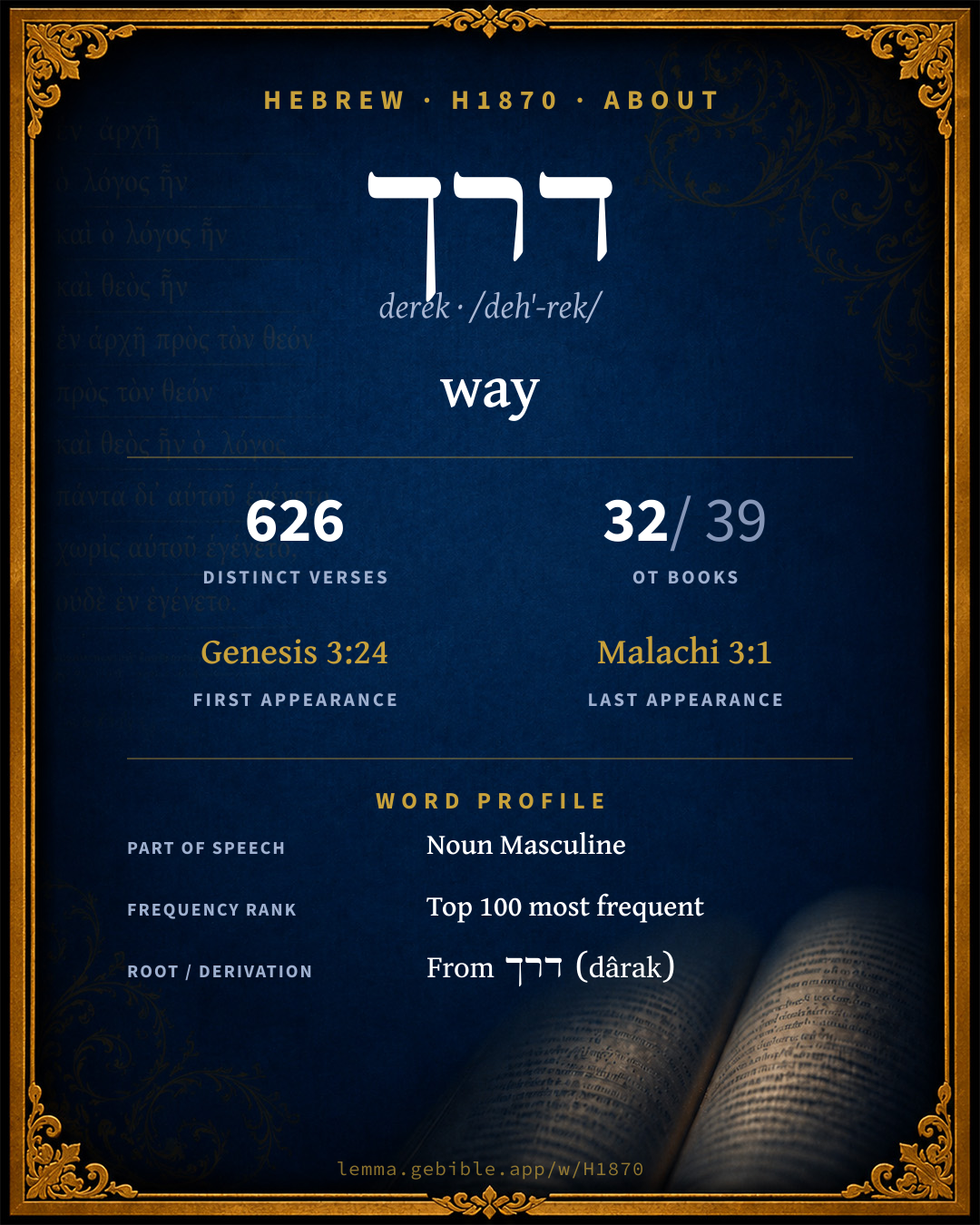
דֶּ֫רֶךְ
way
also: road, distance, journey, manner fuller range ↓
Full lexicon entry — Brown-Driver-Briggs (BDB)
From Brown-Driver-Briggs (BDB)
Where this word appears
See every Construct-state word in the Hebrew Bible →
Grammar key — what these labels mean
Part of speech
- Noun
- A naming word — a person, place, thing, or idea.
Noun type
- Common
- A common noun — a general class of person, place, or thing (“king,” “city,” “water”), not a specific name.
State
- Construct
- A noun bound to a following noun in a possessive / “of” relationship (the construct chain).
- Absolute
- The independent form of a noun, not bound to a following word.
Gender
- Both
- Attested as both masculine and feminine.
Number
- Singular
- One.
- Plural
- More than one (in Hebrew, generally three or more).
- Dual
- Exactly two — for natural pairs and some measures of time.
11 verses where H1870 appears in the Absolute state in the Book of Ezekiel. Filtered view — show all forms. Click any verse to open its interlinear word-by-word view. Verse text shown in the World English Bible for context — . Each verse’s Hebrew form is shown with its reference; the English is not keyword-highlighted, since the data carries no word-level English alignment. Use “Compare translations” on any verse to read it across multiple English versions. This concordance covers the Hebrew Bible; Septuagint (Greek Old Testament) occurrences are not indexed here.
Ezekiel
- Ezekiel 16:25 דֶּ֗רֶךְ n c bs You have built your lofty place at the head of every way, and have made your beauty an abomination, and have opened your feet to everyone who passed by, and multiplied your prostitution.
- Ezekiel 16:31 דֶּ֔רֶךְ n c bs in that you build your vaulted place at the head of every way, and make your lofty place in every street, and have not been as a prostitute, in that you scorn pay.
- Ezekiel 21:19 דְּרָכִ֗ים דֶּֽרֶךְ n c bp n c bs cs Also, you son of man, appoint two ways, that the sword of the king of Babylon may come; they both shall come forth out of one land: and mark out a place, mark it out at the head of the way to the city.
- Ezekiel 21:20 דֶּ֣רֶךְ n c bs You shall appoint a way for the sword to come to Rabbah of the children of Ammon, and to Judah in Jerusalem the fortified.
- Ezekiel 21:21 הַ/דֶּ֗רֶךְ הַ/דְּרָכִ֖ים ptcl def.art + n c bs ptcl def.art + n c bp For the king of Babylon stood at the parting of the way, at the head of the two ways, to use divination: he shook the arrows back and forth, he consulted the teraphim, he looked in the liver.
- Ezekiel 23:13 דֶּ֥רֶךְ n c bs I saw that she was defiled; they both took one way.
- Ezekiel 42:1 הַ/דֶּ֖רֶךְ דֶּ֣רֶךְ ptcl def.art + n c bs n c bs cs Then he brought me forth into the outer court, the way toward the north: and he brought me into the chamber that was over against the separate place, and which was over against the building toward the north.
- Ezekiel 42:11 וְ/דֶ֨רֶךְ֙ דֶּ֣רֶךְ conj + n c bs n c bs cs The way before them was like the appearance of [the way of] the chambers which were toward the north; according to their length so was their breadth: and all their exits were both according to their fashions, and according to their doors.
- Ezekiel 42:12 דֶּ֣רֶךְ דָּ֑רֶךְ דֶּ֗רֶךְ דֶּ֥רֶךְ n c bs cs n c bs n c bs n c bs cs According to the doors of the chambers that were toward the south was a door at the head of the way, even the way directly before the wall toward the east, as one enters into them.
- Ezekiel 47:2 דֶּֽרֶךְ דֶּ֣רֶךְ דֶּ֖רֶךְ n c bs cs n c bs cs n c bs Then he brought me out by the way of the gate northward, and led me round by the way outside to the outer gate, by the way of [the gate] that looks toward the east; and, behold, there ran out waters on the right side.
- Ezekiel 47:15 הַ/דֶּ֥רֶךְ ptcl def.art + n c bs This shall be the border of the land: On the north side, from the great sea, by the way of Hethlon, to the entrance of Zedad;
About this entry
At a glance — auto-summarized from this page’s data, not written by a person. Every figure links to its source below. This summary describes the numbers; it doesn’t interpret them.
“way” is the headline sense of the Hebrew noun דרך (derek). Beyond “way” it also covers “road”, “distance”, and “journey” — see its full sense range. With 626 verses in 32 books, it is one of the most common word in the Hebrew Bible. First canonically at Genesis 3:24, it enters the text early. It clusters with דרך and מדרך under a shared root. See the sense tree, 626-verse concordance, and the renderings breakdown below.
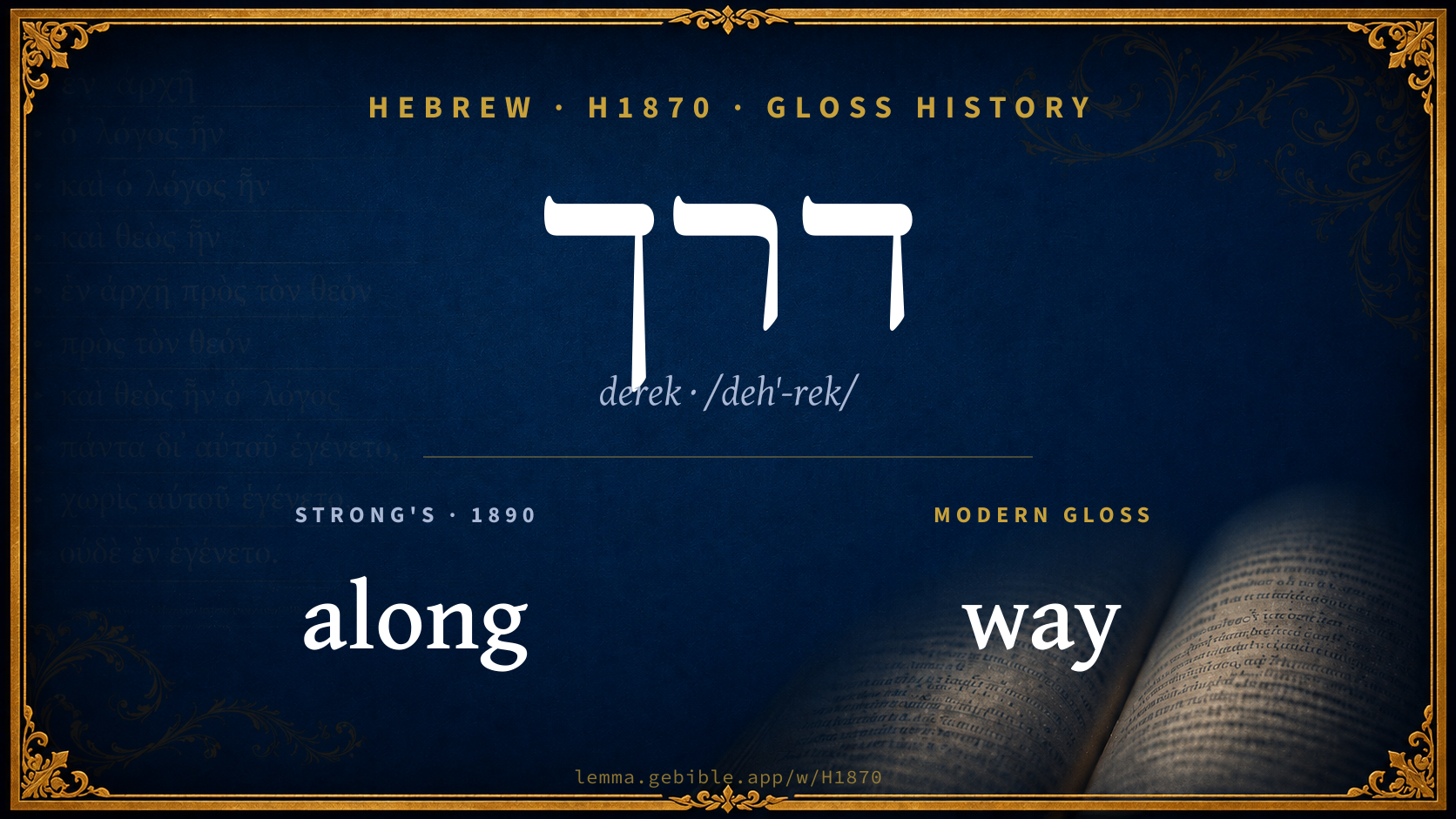
Gloss history
Strong's 1890 vs modern scholarship
About this word
Strong's H1870 catalogs a Hebrew word from the Hebrew Old Testament.
These counts are not copied from any lexicon or concordance. They are computed here, from the morphology-tagged Hebrew Old Testament. What Lemma adds →
- 626
- distinct verses
- The word appears in 626 distinct verses.
- 32 / 39
- OT books
- The word appears in 32 of 39 Old Testament books.
- #72
- by frequency
- Top 100 most frequent Hebrew words (rank 72 of 8,640 Hebrew words by occurrence).
View all 626 occurrences in the concordance →
By section of the Old Testament
By traditional corpus
Conventional, traditional groupings — biblical authorship is debated, so this is a traditional corpus grouping, not an authorship claim. Each share is this word’s portion of its verses in that division of the Hebrew canon. Each figure is a share of the word’s 626 distinct verses.
- Prophets (Nevi'im) 317 verses · 51%
- Writings (Ketuvim) 204 verses · 33%
- Torah (Pentateuch) 105 verses · 17%
How translations render this word
Counts come from each version’s own published word-to-Strong’s tagging or interlinear alignment — an approximate guide to how each version renders this word, not a word-level alignment the data otherwise carries. Because each total is that version’s own tagged count, the per-version totals vary from one another and need not match the appearance or distinct-verse counts above. These counts may also differ from a printed concordance because Lemma counts each distinctly tagged rendering and does not collapse phrase taggings into a single head-word total. This is a fixed set of word-tagged versions (KJV, ASV, BSB, ULT) and does not change with the reading translation you choose elsewhere. Each version’s license is shown beside its name below (and on Sources).
- King James Version: Way 377×, Ways 106×, Toward 21×
- American Standard Version: Way 354×, Ways 97×, Toward 15×
- Berean Standard Bible: Way 182×, Ways 160×, Road 47×
- unfoldingWord Literal Text: Way 199×, Ways 128×, Way of 112×
King James Version Public Domain
Renders H1870 across 701 tagged occurrences — most commonly:
Plus other, less common renderings. Plus 93 renderings that appear only once — usually multi-word phrases or single function words the recovered tagging swept in, not distinct renderings. Not rendered by a distinct English word in 4 further occurrences.
American Standard Version Public Domain
Renders H1870 across 697 tagged occurrences — most commonly:
Plus other, less common renderings. Plus 137 renderings that appear only once — usually multi-word phrases or single function words the recovered tagging swept in, not distinct renderings.
Berean Standard Bible Public Domain
Renders H1870 across 652 tagged occurrences — most commonly:
Plus other, less common renderings. Plus 81 renderings that appear only once — usually multi-word phrases or single function words the recovered tagging swept in, not distinct renderings. Not rendered by a distinct English word in 52 further occurrences.
unfoldingWord Literal Text CC BY-SA 4.0
Renders H1870 across 737 tagged occurrences — most commonly:
Plus other, less common renderings. Plus 67 renderings that appear only once — usually multi-word phrases or single function words the recovered tagging swept in, not distinct renderings.
14 senses and sub-senses in the full BDB
What do BDB’s symbols mean?
BDB uses these scholarly abbreviations:
| Symbol | Meaning |
|---|---|
| 𝔊 | the Septuagint (the ancient Greek translation, LXX) |
| 𝔙 | the Vulgate (the Latin translation) |
| 𝔖 | the Syriac version (the Peshitta) |
| 𝔗 | the Targum (the Aramaic translation) |
| ψ | the Psalms |
| √ | root (the underlying root or stem) |
| ‖ | parallel passage (a synonymous or contrasted parallel) |
| † | the dagger: every passage where the word occurs is cited |
The 14 senses and sub-senses the full Brown-Driver-Briggs lexicon distinguishes for this word, in lexicon order (not ranked by frequency), with BDB’s own verbatim wording and sub-sense lettering. Shown in Hebrew script with BDB’s own scholarly abbreviations. The condensed entry is in the Lexicon Entry tab. See also the Forms in the corpus table below.
- 1. way, road, path Gn 35:3 (E) 38:16, 21 (both J) 48:7 (P), 49:17 (J; poem) Lv 26:22 (H, only here in Lv) Nu 22:22, 23(×3), 31, 34 (all JE) Dt 6:7; 22:4, 6; 23:5; 24:9; 25:17, 18 Jos 3:4 (D) Ru 1:7 1 S 4:13 (on text cf. Dr) 15:2; 24;4 2 S 16:13 1 K 13:9, 10(×2), 12, 17, 24(×2), 25, 26, 28; 18:6(×2), 7; 20:38 2 K 2:23; 3:8; 6:19; 7:15, 19:28, 33 = Is 37:29, 34, Ho 6:9; 13:7 Is 43:16, 19; 49:9, 11; 51:10; 57:14(×2) Je 6:25 La 1:5 Ez 21:24, 25; 42:11, 12 Jo 2:7, Ezr 8:22, 31 Jb 12:24 ψ 107:40; 110:7 Pr 7:8; 8:2; 26:13 Ec 10:3; 12:5; cstr. way of (often = to, toward) ד׳ עֵץ הַחַיִּים Gn 3:24 (J) ד׳ שׁוּר 16:7 (J) ד׳ אֶרֶץ פְּלִשְׁתִּים Ex 13:7 (E) ד׳ הַבָּשָׁן Nu 21:33 (JE); cf. Dt 1:2, 19; 3:1 Jos 2:7 (JE) 12:3 1 S 6:9, 12; 13:17, 18(×2); 17:52 2 K 3:20 Is 15:5 Je 2:18(×2); 50:5 Ez 47:15; 48:1; ד׳ הַמִּדְבָּר (of different ways) Ex 13:18 (E) Jos 8:15 (JE) Ju 20:42, cf. Dt 2:8 2 S 2:24 2 K 3:8; ד׳ אֶת־הַמִּדְבָּר 2 S 15:23 is corrupt; read ד׳ הַזַּיִת אֲשֶׁר בַּמִּדְבָּר 𝔊L Dr cf. We: the way of the olive-tree which, etc.; ד׳ הָעֲרָבָה Dt 2:8 and (with diff. reference) 2 S 4:7 2 K 25:4 = Je 52:7, Je 39:4; ד׳ הַכִּכָּר 2 S 18:23; ד׳ יַם־סוּף Nu 14:25; 21:4 (JE Dt 1:40; 2:1; often of gateway, as ד׳ הַשַּׁעַר 2 S 15:2 cf. 2 K 11:19; 25:4 = Je 52:7; Ez 9:2; 43:4; 44:1, 4; 46:9(×5); 47:2; ד׳ אוּלָם הַשַּׁעַר 44:3; 46:2, 8; ד׳ בֵּית הַגָּן 2 K 9:27, ד׳ גַּן־הַמֶּלֶךְ Je 39:4; ד׳ הַיָּם Is 8:23 (cf. Comm. & SchumacherJaulân 63 and PEF Apr. 1889, 78); ד׳ מְבוֹא הַסּוּסִים 2 K 11:16; sq. ָה loc. Gn 35:19 (E), 38:14 (J) 48:7 (P; read אפרתה Ol); ד׳ הַמֶּלֶךְ נֵלֵךְ †Nu 20:17; 21:22 (both JE; Arabic درب السلطان of diff. highroads, cf. Seetzeni. 61, 132, ii. 336 RobBR iii. 141 Di; = מְסִלָּה 20:19) i.e. the highway, used by king with his army; cf. ‖ בַּדֶּרֶךְ בַּדֶּרֶךְ Dt 2:27; i.e. straight (or steadily) along the way; in particular of path, way, in which God moves †בַּיָּם דַּרְכֶּ֑ךָ ψ 77:20 (‖ וּשְׁבִילְיךָ֯ בְּמַיִם רַבִּים); וּבִשְׂעָרָה דַּרְכּוֹ Na 1:3; cf. בַּמִּדְבָּר פַּנּוּ ד׳ י׳ Is 40:3 (‖ יַשְּׁרוּ בָּֽעֲרָבָה מְסִלָּה לאלהינו); also Mal 3:1, comp. Is 43:16, 19 (way made by י׳) & 51:10; path of lightning Jb 28:26; 38:25; of light 38:19, 24, of camel (בִּכְרָה) Je 2:33, of locusts Jo 2:7 (pl.); v. further the four wonderful things Pr 30:19 the way of an eagle in the air, the way of a serpent upon a rock, the way of a ship in the heart of the sea, and the way of a man with a damsel (i.e. no trace is left in any case); cf. also v 20 כֵּן דֶּרֶךְ אִשָּׁה מְנָאָ֑פֶת; figure of death אָנֹכִי הוֹלֵךְ הַיּוֹם בְּדֶרֶךְ כָּל־הָאָרֶץ Jos 23:14 I am going to-day in the way of all the earth (D); so also 1 K 2:2 (cf. Gn 19:31 4 a). e.g. Genesis 35:3
- 2. journey Gn 24:21, 40, 42, 56 (all J) Nu 9:10, 13 (P) Jos 9:11, 13 (both JE) 1 K 18:27, 19:7 רַב מִמְּךָ הַדּ׳; לַעֲשׂוֹת ד׳ Ju 17:8; ד׳ בְּאֵר שָׁ֑בַע Am 8:14 (journey of—to—Beersheba cf. Hi St; but text dub., 𝔊 ὁ θεός, cf. Gunning; HoffmZAW 1883, 123 proposes דֹּדְךָ, We בְּאֵרְךָ cf. BuThLz 1892, 62); דֶּרֶךְ חֹל 1 S 21:6 a common (not sacred) journey; especially c. temp. modif. ד׳ שְׁלֹשֶׁת יָמִים Gn 30:36 (J) Ex 3:18; 5:3; 8:23 Nu 10:33(×2) (all JE), 33:8 (P) cf. also Gn 31:23 (E) Nu 11:31(×2) (JE), 1 K 19:4, 2 K 3:9; go one’s way הָלַךְ לְדַרְכּוֹ †Gn 19:2 (J), 32:2 (E), 33:16 (J) Nu 24:25 Jos 2:16 (both JE), Ju 18:26; 19:27 1 S 1:18; 26:25; 30:2 1 K 1:49 Je 28:11, vid. הלך; also הָפַךְ לְד׳ †1 S 25:12, & (fig.) פָּנָה לְד׳ †Is 53:6 (so 56:11 5 infr.); of זוֹנָה, fig. of Israel, וַתְּפַזְּרִי אֶת־דְּרָכַיִךְ לַזָּרִים Je 3:13. e.g. Genesis 24:21
- 3. of direction, almost or quite = toward, 1 K 8:44, 48 = 2 Ch 6:34, 38 pray toward the city, etc.; 18:43 look toward the sea; especially in Ezek. of looking, going, etc. ד׳ צָפוֹנָה Ez 8:5, 5 cf. 21:2; 40:6; cstr. ד׳ הַקָּדִים Ez 40:10 (del. 𝔊 HiCo) v 22 43:1; ד׳ הַצָּפוֹן 40:20 cf. ד׳ הַדָּרוֹם v 24(×2), ד׳ הַיָּם 41:12, ד׳ הֶחָצֵר 42:7 etc. (c. 28 times Ez); (v. also מִדֶּרֶךְ Ez 9:2 cf. 43:2; 44:3; on ד׳ אַמָּה אֶחָת Ez 42:4 v. VB Co Da) cf. לֹא־יִפְנֶה דֶּרֶךְ בְּרָמִים Jb 24:18. e.g. 1 Kings 8:44
- 4. way, manner:
- a. usage ד׳ כָּל־הָאָרֶץ Gn 19:31 (J; cf. also Jos 23:14 1 K 2:2 supr.). e.g. Genesis 19:31
- b. = customary experience, or condition ד׳ נָשִׁים Gn 31:35 (E). e.g. Genesis 31:35
- c. ד׳ מִצְרַיִם Am 4:10 the manner of Egypt, i.e. as was done in Egypt; Is 10:24, 26 e.g. Amos 4:10
- d. habit of animals, ants Pr 6:6 (pl.) e.g. Proverbs 6:6
- 5. fig. of course of life, or action, undertakings, etc. לֹא תַצְלִיחַ אֶת־דְּרָכֶיךָ Dt 28:29 cf. Jos 1:8 (D) 1 S 18:14; 2 S 22:33; = ψ 18:33; Jb 3:23; 8:19; 17:9; 22:28; 24:23; 31:4; 34:21; ψ 10:5; 35:6; 37:5, 7, 23; 91:11; 102:24; 119:37; 128:1; 139:3; 146:9; Pr 2:8; 3:6, 23; 11:5; 20:24; 29:27; 31:3; Is 40:27; 45:13; 48:15; 55:8, 9; Je 2:36; 10:23; 12:1; 23:12; La 3:9, 11; Ho 2:8; 9:8; 10:13; Am 2:7 (ד׳ עְנָוִים); thrice (Ch) in summary of a king’s life, of Abijah וּדְרָכָיו וּדְבָרָיו 2 Ch 13:22; of Jotham וְכָל־מִלְחֲמֹתָיו וּדְרָכָיו 2 Ch 27:7; of Ahaz וְכָל־דְּרָכָיו הָרִאשֹׁנִים וְהָאַחֲרוֹנִים 2 Ch 28:26; ד׳ אֹרְחֹתֶיךָ Is 3:12 cf. also Is 30:11 and 57:18; = gain Is 56:11, pleasure, etc. Is 58:13. e.g. Deuteronomy 28:29
- 6.
- a. of moral action and character הִשְׁחִית כָּל־בָּשָׂר אֶת־דַּרְכּוֹ עַל־הָאָרֶץ Gn 6:12 (P); cf. Je 3:21; יִשְׁמְרוּ אֶת־דַּרְכָּם 1 K 2:4; 8:25 = 2 Ch 6:16; cf. v 39 = 2 Ch 6:30; הֵכִין דְּרָכָיו לִפְנֵי י׳ 2 Ch 27:6; ψ 5:9; 39:2; 49:14; 50:23; 119:5, 26, 59, 168 Pr 4:26; 5:8, 21; 10:9; 14:2, 8, 12; 16:2, 7, 9, 17, 25; 19:3, 16; 21:2, 29 Je 2:33; 6:27; 7:3, 5; 16:17; 17:10; 18:11, 15; 26:13; 32:19(×2) La 3:40 Ez 7:3, 8, 9, 27; 14:22, 23; 18:25, 29, 30; 24:14; 28:15; 33:17, 20; 36:19 Hg 1:5, 7 Zc 1:6; דַּרְכֵי לִבְּךָ Ec 11:9 cf. Is 57:17 (& Je 32:39c. infr.) e.g. Genesis 6:12
- b. of duty (commanded by י׳, etc.) הַדּ׳ יֵלְכוּ בָּהּ Ex 18:20 (E) cf. 32:8 (JE) Dt 9:12, 16; 13:6; 31:29 Ju 2:17 Jb 31:7 ψ 25:8, 12; 32:8; 119:1; 143:8 Pr 21:16; 22:6; 23:19 Is 30:21; 48:17 Je 7:23 Mal 2:8; so too, of wisdom דְּרָכֶיהָ דַרְכֵי־נֹעַם Pr 3:17, ד׳ חָכְמָה 4:11; 8:32; cf. 23:26; ד׳ בִּינָה 9:6 cf. Is 40:14. e.g. Exodus 18:20
- c. specif.: in good sense ד׳ הָטּוֹבָה וְהַיְשָׁרָה 1 S 12:23 1 K 8:36 = 2 Ch 6:27; cf. Pr 16:31 Je 6:16; תֹּם דְּרָכֶיךָ Jb 4:6 cf. 22:3 Pr 13:6; דְּרָכָיו (i.e. of light) Jb 24:13 (‖ נְתִיבֹתָיו); ד׳ צַדִּיקִים ψ 1:6, ד׳ טוֹבִים Pr 2:20, יִשְׁרֵי־דָ֑רֶךְ ψ 37:14, תְּמִימֵי דָ֑רֶךְ Pr 11:20 ψ 119:1; ד׳ תָּמִים ψ 101:2, 6, ד׳ אֱמוּנָה ψ 119:30, ד׳ שָׁלוֹם Is 59:8; ד׳ עוֹלָם ψ 139:24, ד׳ חַיִּים Pr 6:23, cf. 12:28 Je 21:8 (opp. ד׳ המות v. infr.); without modifier 1 S 8:3, 5 Jb 13:15; 23:10, לֵב אֶחָד וְד׳ אֶחָד Je 32:39; cf. also a. supr.; especially cstr. before names of good kings 1 K 22:43 2 K 22:2 2 Ch 11:17; 20:32; 21:12(×2) (pl.) so 34:2; cf. דַּרְכֵי דָּוִיד הָרִאשֹׁנִים 2 Ch 17:3 the first ways of David; also דַּרְכֵי עַמִּי Je 12:16. e.g. 1 Samuel 12:23
- d. oftener in bad sense דַּרְכָּם הַקָּשָׁה Ju 2:19, דַּרְכּוֹ הָרָעָה 1 K 13:33, ד׳ רַע Pr 2:12; 8:13; 28:10; cf. 2 K 17:13 2 Ch 7:14 Je 18:11; 23:22; 25:5; 26:3; 35:15; 36:2, 7 Ez 3:18, 19; 13:22; 20:44; 33:11 Jon 3:8, 10 Zc 1:4; ד׳לֹא טוֹב ψ 36:5 Pr 16:29 Is 65:2; דַּרְכֵּךְ זִמָּה Ez 16:27; cf. with completed metaph. ד׳ לֹא סְלוּלָה Je 18:15; further ד׳ שֶׁקֶר ψ 119:29, ד׳ עֹצֶב ψ 139:24, ד׳ פִּשְׁעָם ψ 107:17; דַּרְכֵי־חֹשֶׁךְ Pr 2:13; דַּרְכֵי מָוֶת Pr 14:12 = 16:25; דרך המות Je 21:8, cf. supr. c; ד׳ עָצֵל Pr 15:19 (cf. 6:6); ד׳ חַטָּאִים ψ 1:1 cf. v 6 Pr 1:15; 3:31; 4:19 (ד׳ רְשָׁעִים), 12:15 (ד׳ אֱוִיל), 13:15 (ד׳ בֹּגְדִים), also 15:9; 21:8 Is 55:7; ד׳ עִקֵּשׁ Pr 22:5, cf. עִקֵּשׁ דְּרָכַיִם Pr 28:6 cf. v 18; further, without modifier, Ho 4:9; 12:3 Pr 7:25; 14:14 Is 53:6; 66:3 Je 2:23 (of idolatry רְאִי דַרְכֵּךְ בַּגַּיְא) v 23 4:11 (cf. Hi Gf) v 18 15:7; 22:21 Ez 16:47(×2), 61; 18:23; 20:43; 23:13, 31; 33:8, 9(×2), 11; 36:17(×2), 31, 32 cf. also sub a. supr.; לָתֵת דַּרְכּוֹ בְּרֹאשׁוֹ 1 K 8:32 to place his way upon his head, i.e. requite it on him = 2 Ch 6:23, cf. Ez 7:4; 9:10; 11:21; 16:43; 22:31; פְּרִי דַּרְכָּם Pr 1:31; especially cstr. before names of bad kings ד׳ יָרָבְעָם 1 K 15:34 (cf. v 26) 16:2, 19, 26; 22:53 cf. v 53(×2); also ד׳ מַלְכֵי יִשְׂרָאֵל 2 K 8:18; 16:3 2 Ch 21:6, 13; 28:2 (pl.); דַּרְכֵי בֵּית אַחְאָב 2 K 8:27 = 2 Ch 22:3 (of Ahaziah, grandson of Ahab); ד׳ הָעָם הַזֶּה Is 8:11, ד׳ הַגּוֹיִם Je 10:2, ד׳ אֲבוֹתֵיכֶם Ez 20:30 cf. 2 K 21:21. e.g. Judges 2:19
- e. way of י׳: (a) = his creative activity Jb 26:14; applied in concrete sense to behemoth (hippopotamus) הוּא רֵאשִׁית דַּרְכֵי־אֵל Jb 40:19 (hyperb.); cf. of wisdom רֵאשִׁית דַּרְכּוֹ Pr 8:22; (b) = his moral administration, Ex 33:13 (pl.; JE); Dt 32:4 2 S 22:31 = ψ 18:31 Jb 21:31; 36:23; אלהים בַּקֹּדֶשׁ דַּרְכֶּ֑ךָ ψ 77:14 (‖ מִי אֵל גָּדוֹל כֵּאלֹהִים); ψ 85:14; 103:7; 138:5; 145:17; Pr 10:29 Is 55:8, 9 Je 5:4, 5 Ez 18:25(×2), 29(×2); 33:17, 20 Ho 14:10. (c.) = his commandments וְשָֽׁמְרוּ ד׳ י׳ לַעֲשׂוֹת צְדָקָה וּמִשְׁפָּ֑ט Gn 18:19 (J); כָּל־הַדֶּרֶךְ אֲשֶׁר צִוָּה י׳ Dt 5:30 cf. (pl.) 8:6; 10:12; 11:22, 28; 19:9; 26:17; 28:9; 30:16 Jos 22:5 (D) Ju 2:22 2 S 22:22 = ψ 18:22, 1 K 2:3; 3:14; 8:58; 11:33, 38 2 K 21:22 2 Ch 6:31 Jb 21:14; 23:11; 34:27; ψ 25:4, 9; 27:11; 37:34; 51:15; 67:3; 81:14; 86:11; 95:10; 119:3 Is 2:3 = Mi 4:2, Is 42:24; 58:2; 63:17; 64:4 Zc 3:7 Mal 2:9; cf. וַיִּגְבַּהּ לִבּוֹ בְּדַרְכֵי י׳ 2 Ch 17:6; v. also ד׳ עֵדְוֹתֶיךָ ψ 119:14; ד׳ פִּקּוּדֶיךָ v 27, ד׳ מִצְוֹתֶ֑יךָ v 32, ד׳ חֻקֶּיךָ v 33. e.g. Job 26:14
Senses from the full Brown-Driver-Briggs lexicon (Brown, Driver, Briggs; Oxford 1906 — public domain), digitized via Sefaria, supplemented by the OpenScriptures HebrewLexicon (CC BY 4.0). Full attribution on Sources.
Word origin
n.m. Dt 17:16 & (less often) f. Ex 18:20 way, road, distance, journey, manner—abs. ד׳ Gn 38:16 +; דָּ֑רֶךְ v 21 +; cstr. דֶּרֶךְ 3:24; sf. דַּרְכִּי 24:42 + 4 times + 2 S 22:33 דַּרְכִּ֯ו; דַּרְכְּךָ Ho 10:13 1 K 19:15; דַּרְכֶּ֑ךָ ψ 5:9 + 9 times; דַּרְכֵּךְ Je 2:23 + 8 times; דַּרְכּוֹ Gn 6:12 +; דַּרְכָּהּ 1 S 1:18 Jb 28:23; דַּרְכֵּנוּ Ju 18:5 + 2 times; דַּרְכְּכֶם Gn 19:2 + 3 times; דַּרְבָּם 1 K 2:4 +; du. דְּרָכַיִם Pr 28:6, 18; pl. דְּרָכִים Dt 28:7 + 6 times; cstr. דַּרְכֵי Pr 3:17 + 24 times; sf. דְּרָכַי Jb 13:15 + 17 times, דְּרָכָ֑י ψ 95:10 + 4 times; דְּרָכֶיךָ Dt 28:29 + 16 times; דְּרָכֶךָ Ex 33:13 + 2 times; דְּרָכַיִךְ Je 3:13 + 4 times; דְּרָכָ֑יִךְ Ez 7:3 + 3 times; דְּרָכָיו Dt 10:12 +; דְּרָכֶיהָ Pr 3:17 + 3 times; דְּרָכֵינוּ La 3:40 Zc 1:6; דַּרְכֵיכֶם Lv 26:22 + 17 times; דַּרְכֵיהֶם Je 16:17 + 5 times; דַּרְכֵיהֶן Ez 16:47;—
— Brown-Driver-Briggs (Oxford 1906, public domain), digitized via Sefaria, supplemented by the OpenScriptures HebrewLexicon (CC BY 4.0). See Sources.
Derived from דרך (dârak) (H1869) — to tread.
Jastrow Dictionary
A second Hebrew/Aramaic lexicon for comparison, covering Aramaic and post-biblical (Talmudic, Targumic, Midrashic) usage that the biblical-Hebrew BDB does not. Matched by lemma rather than by Strong’s number, so a lemma may carry more than one Jastrow headword (shown separately below), and the entries cover usage well beyond the Bible.
דָּרַךְ
- (b. h.) to tread, stamp, walk. Ter. I, 9 ונמלך לדוֹרְכָן and after consideration decided to use them for pressing. Ex. R. s. 15 עתיד לִדְרוֹךְ וכ׳ He will tread with His shoe upon &c.; a. fr.
- to be trodden, pressed. Ter. I, 8 ענבים הנִדְרָכוֹת (Mish. ed. הנִדְרָכִים) grapes in the press or intended for the press.
- to lead, rear, train. Snh. 76ᵇ; Yeb. 62ᵇ המַּדְרִיךְ בניו וכ׳ he who leads his sons … on the right path.
דְּרַךְ
- 1. same. Targ. O. Deut. I, 36. Targ. Is. LIX, 8; a. fr.—Keth. 60ᵇ bot. דדָרְכָא על וכ׳ who stepped upon &c. Sabb. 109ᵃ דדרכא ליה וכ׳ Ms. M. (ed. דדריכא) that an ass had stepped on his foot. [Y. Maas. Sh. IV, 55ᶜ top יתיב מדרך, read: מְרַמֵּךְ, v. דְּמַךְ.—Lev. R. s. 27 דרכת עד, read: אוֹרְכַת, v. אֲרִיךְ I.]
- 2. to overtake, v. infra.
- 1. to thresh. Targ. Is. XXVIII, 27 sq.; a. e.
- 2. to lead. Targ. Prov. XXII, 6, v. דְּכִי Af.—Targ. Ps. XXV, 9; a. e.
- 3. to trace, overtake. Targ. Prov. VI, 11; XXIV, 34 ותַדְרְכָיךְ (ed. Lag. ותִידְ׳, Var. ותדרוך, ותדכיך, ותרכיך, h. text כמהלך).—Keth. 60ᵇ; Ab. Zar. 15ᵇ ולא אַדְרְכֵיה and did not find him.
דֶּרֶךְ
- c. (b. h.; preced.) way, road; method, manner. Kidd. 2ᵇ ד׳ לשון וכ׳ derekh is feminine gender &c. Ib. דַרְכּוֹ של אישׁ וכ׳ it is man’s way to carry war, and not woman’s.—Y. Ned. I, beg. 36ᶜ, a. e. התורה דיברה כדַרְכָּהּ, v. לָשׁוֹן. Succ. II, 1 לפי דַרְכֵּינוּ by our way (incidentally). Ab. Zar. 15ᵇ כד׳ שאסור … כך וכ׳ Ms. M. (ed. כד׳ שאמרו אסור) on the same principle that &c.; a. v. fr.—דֶּ׳ אֶרֶץ (abbrev. ד׳'א) the way of the land, a) good manners; b) secular occupation, trade; c) (euphem.) sexual connection. Ab. II, 2 study עם ד׳'א combined with a trade. Tosef. Sot. VII, 20 לימדה … ד׳'א וכ׳ the Torah teaches incidentally the proper conduct that one must first build a house &c.—Gitt. 70ᵃ bot. ד׳ וד׳'א וכ׳ travelling, marital connection &c. Gen. R. s. 18, end. Gen. R. s. 22, beg.—Ib. s. 80 כדַרְכָּהּ natural gratification of sexual appetite, שלא כד׳ unnatural. Ib. s. 18, end; a. fr.—Snh. 31ᵇ העביר עלי את הד׳ mutilated me (oth. interpret.: wronged me in business).—Pl. דְּרָכִים. Kidd. I, 1. R. Hash. 17ᵃ פירשו מדַּרְכֵי ציבור they deviated from the ways of the community, became heretics.—דרכי אמורי, v. אֱמוֹרִי.—דרכי שלום ways of peace (ref. to Prov. III, 17); מפני ד׳ ש׳ because the ways of the Law are ways of peace (differ. fr. משים איבה, v. אֵיבָה), i.e. it is a demand of equity, good manners &c., though no special law can be quoted for it. Gitt. V, 8 sq.; a. fr.—(ד׳'א) דרך ארץ Derekh Erets (Manners), name of a treatise attached to Talmud editions, divided into Rabba (Large), and Zuta (Small). e.g. Proverbs 3:17
A Dictionary of the Targumim, the Talmud Babli and Yerushalmi, and the Midrashic Literature (Marcus Jastrow; London, Luzac, 1903) — Public Domain. Digitized via Sefaria. Digitized via Sefaria. Full attribution on Sources.
Forms in the corpus
The 283 distinct written forms H1870 takes in the Hebrew Bible, most frequent first — each parse links to that state’s occurrences in the concordance. Hebrew forms include their vowel points and cantillation, so a single lemma takes many written forms.
The 60 most common forms are shown; 223 rarer forms follow in the full concordance.
Same root — word family
Other BDB entries built from the same root as H1870, grouped by Strong’s listed origin. These share a root / origin per the lexicon — not necessarily a shared meaning. Each links to that word’s own entry.
Derives from
Shares the same root
Compare all same-root words → They share a root, not necessarily a meaning.
Septuagint verse parallels
This word appears in 591 verses that also exist in the Greek Old Testament (Septuagint), out of the 626 Hebrew verses it occurs in. You can read those verses in Greek by switching the Old Testament edition to the Septuagint.
Read these verses in the Septuagint
- Genesis 3:24
- Exodus 3:18
- Leviticus 26:22
- Numbers 9:10
- Deuteronomy 1:2
- Joshua 1:8
- Judges 2:17
- Ruth 1:7
- 1 Samuel 1:18
- 2 Samuel 2:24
- 1 Kings 1:49
- 2 Kings 2:23
This is a verse-level parallel only — the same verses exist in both the Hebrew and Greek Old Testaments. No word-level Hebrew↔Greek correspondence is claimed: the data carries no such alignment, so no Greek word is shown as this Hebrew word’s translation. Coverage is not total — the Septuagint omits the deuterocanon and renumbers the Psalms, so some Hebrew verses have no direct Greek parallel.