
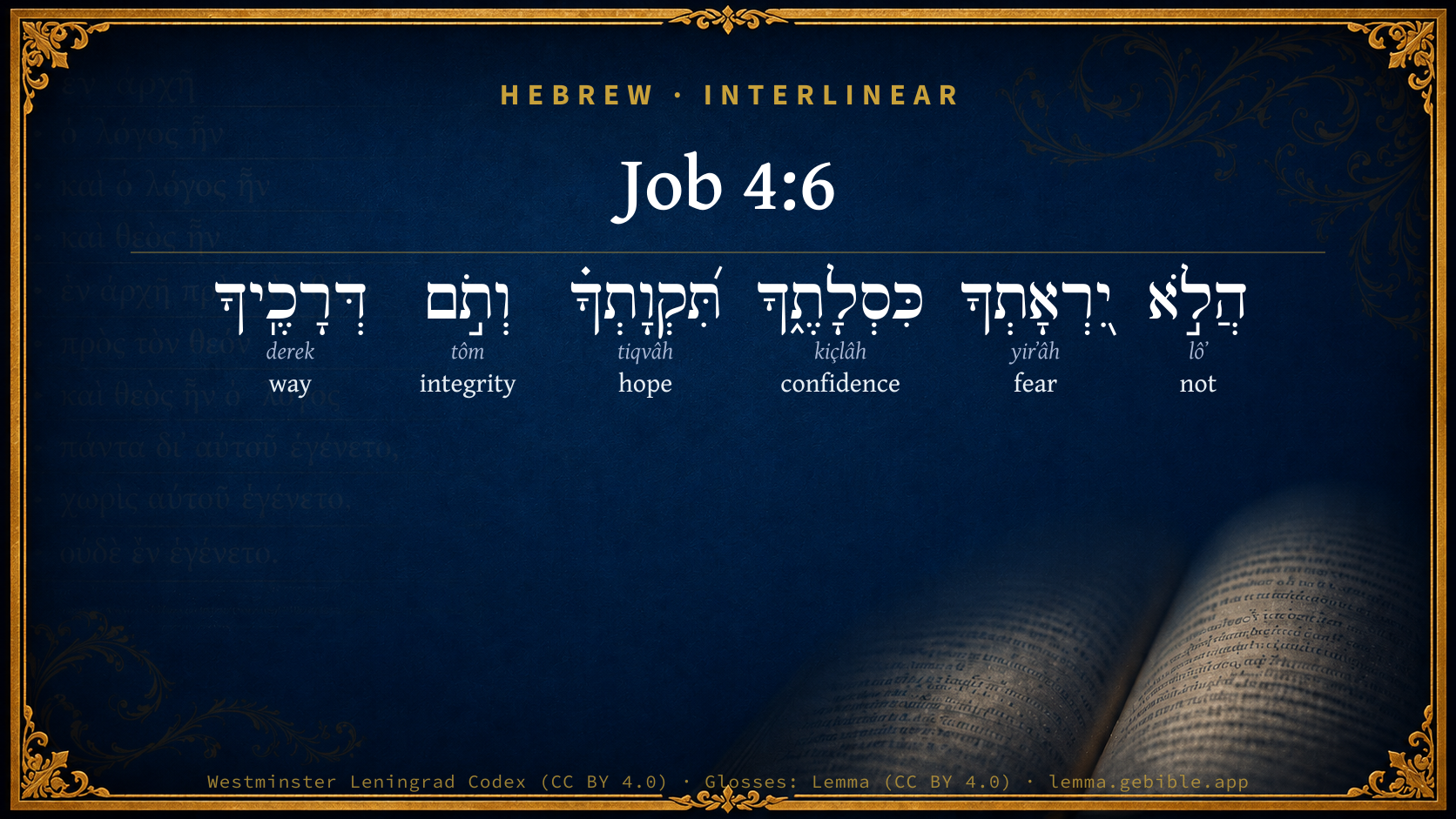
Job 4:6

Hebrew (Westminster Leningrad Codex) Job 4:6 appears in the Hebrew Old Testament. The text above is from the Westminster Leningrad Codex. Each word links to its Strong’s number, a concise gloss, and parsing drawn from the Open Scriptures Hebrew Bible morphology. Click any word for its full Brown-Driver-Briggs (BDB) entry.
Download image
Cite this verse

Job 4:6 (World English Bible). Public Domain. Lemma interlinear Bible study tool, https://lemma.gebible.app/v/job/4/6.

Show BibTeX & RIS
BibTeX
RIS
English Translation
Isn't your piety your confidence, The integrity of your ways your hope?
World English Bible · Public Domain
Highlights
  • 1 first appearance in the Hebrew Bible
Full analysis ↓
Download a study sheet

One document with this verse’s original text, its word-by-word gloss line, the meaning frame, cross-references with their text, attributed commentary, and full source and license credits — printable, and it pastes into notes with its structure intact.

This verse Autodidact and up

Study sheet (.html) Plain text (.txt)

A passage Seminary Student

Up to 50 verses in one chapter. A passage sheet keeps up to 6 commentary sources and 12 cross-references per verse, in the order this page ranks them, and says so on the sheet whenever that leaves anything out. Ask for a single verse and you get the Autodidact verse sheet above.

Everything on this page stays free to read, with no account — the sheet is a download of what is already on screen, not access to it.

Want to remove ads? Support Godless Engineer
Compare translations 3

The same verse in 3 English versions, stacked beneath the original-language interlinear above. Click any original word for its lexicon entry.

Each is an independent rendering of the whole verse — the interlinear is not word-aligned to these translations.

Highlighted words mark where these versions differ — a whole-verse word diff, not a word-by-word alignment.

  • World English Bible Public Domain
    Isn't your piety your confidence, The integrity of your ways your hope?
  • King James Version Public Domain
    Is not this thy fear, thy confidence, thy hope, and the uprightness of thy ways?
  • unfoldingWord Literal Text CC BY-SA 4.0
    not your fear your confidence, your hope, even the integrity of your ways?

unfoldingWord Literal Text — © unfoldingWord, licensed CC BY-SA 4.0. Word-aligned USFM3 via Door43 (git.door43.org/unfoldingWord/en_ult).

Versions to compare (up to 4)

3 of 4 selected

Show all 18 translations

Every available English version of this verse, each an independent rendering of the whole verse.

  • World English Bible Public Domain
    Isn't your piety your confidence, The integrity of your ways your hope?
  • Berean Standard Bible Public Domain
    Is your reverence not your confidence, and the uprightness of your ways your hope?
  • Majority Standard Bible Public Domain
    Is your reverence not your confidence, and the uprightness of your ways your hope?
  • King James Version Public Domain
    Is not this thy fear, thy confidence, thy hope, and the uprightness of thy ways?
  • American Standard Version (1901) Public Domain
    Is not thy fear `of God' thy confidence, `And' the integrity of thy ways thy hope?
  • Revised Version (1885) Public Domain
    Is not thy fear of God thy confidence, and thy hope the integrity of thy ways?
  • Geneva Bible (1599) Public Domain
    Is not this thy feare, thy confidence, thy pacience, and the vprightnesse of thy wayes?
  • Douay-Rheims (1899) Public Domain
    Where is thy fear, thy fortitude, thy patience, and the perfection of thy ways?
  • Young's Literal Translation Public Domain
    Is not thy reverence thy confidence? Thy hope -- the perfection of thy ways?
  • Literal Standard Version CC BY-SA 4.0
    Is your reverence not your confidence? Your hope—the perfection of your ways?
  • Unlocked Literal Bible CC BY-SA 4.0
    Is not your fear your confidence, and the integrity of your ways your hope?
  • unfoldingWord Literal Text CC BY-SA 4.0
    not your fear your confidence, your hope, even the integrity of your ways?
  • Darby Bible Public Domain
    Hath not thy piety been thy confidence, and the perfection of thy ways thy hope?
  • World Messianic Bible Public Domain
    Isn’t your piety your confidence? Isn’t the integrity of your ways your hope?
  • Webster's Bible Public Domain
    Is not this thy fear, thy confidence, thy hope, and the uprightness of thy ways?
  • Free Bible Version CC BY-SA 4.0
    Wasn't it your reverence for God that gave you confidence and your integrity that gave you hope?
  • Bible in Basic English Public Domain
    Is not your fear of God your support, and your upright way of life your hope?
  • JPS Tanakh (1917) Public Domain
    Is not thy fear of God thy confidence, and thy hope the integrity of thy ways?

Literal Standard Version (2020), Covenant Press — licensed CC BY-SA 4.0. Text via the HelloAO Bible API (eBible.org). Unlocked Literal Bible (unfoldingWord) — licensed CC BY-SA 4.0. Text via the HelloAO Bible API (eBible.org). unfoldingWord Literal Text — © unfoldingWord, licensed CC BY-SA 4.0. Word-aligned USFM3 via Door43 (git.door43.org/unfoldingWord/en_ult). Free Bible Version, Dr. Jonathan Gallagher — licensed CC BY-SA 4.0. Text via the HelloAO Bible API (eBible.org).

Word by word

More ways to search: Search by grammar → Find every occurrence → Compare this word →

Practice this passage: Drill this verse → Learn its vocabulary →

About this verse

These counts appear in no published source. They are computed here, from the morphology-tagged text and Lemma’s own curated glosses. What Lemma adds →

6
words
6
distinct lemmas
Wisdom
section

Notable vocabulary

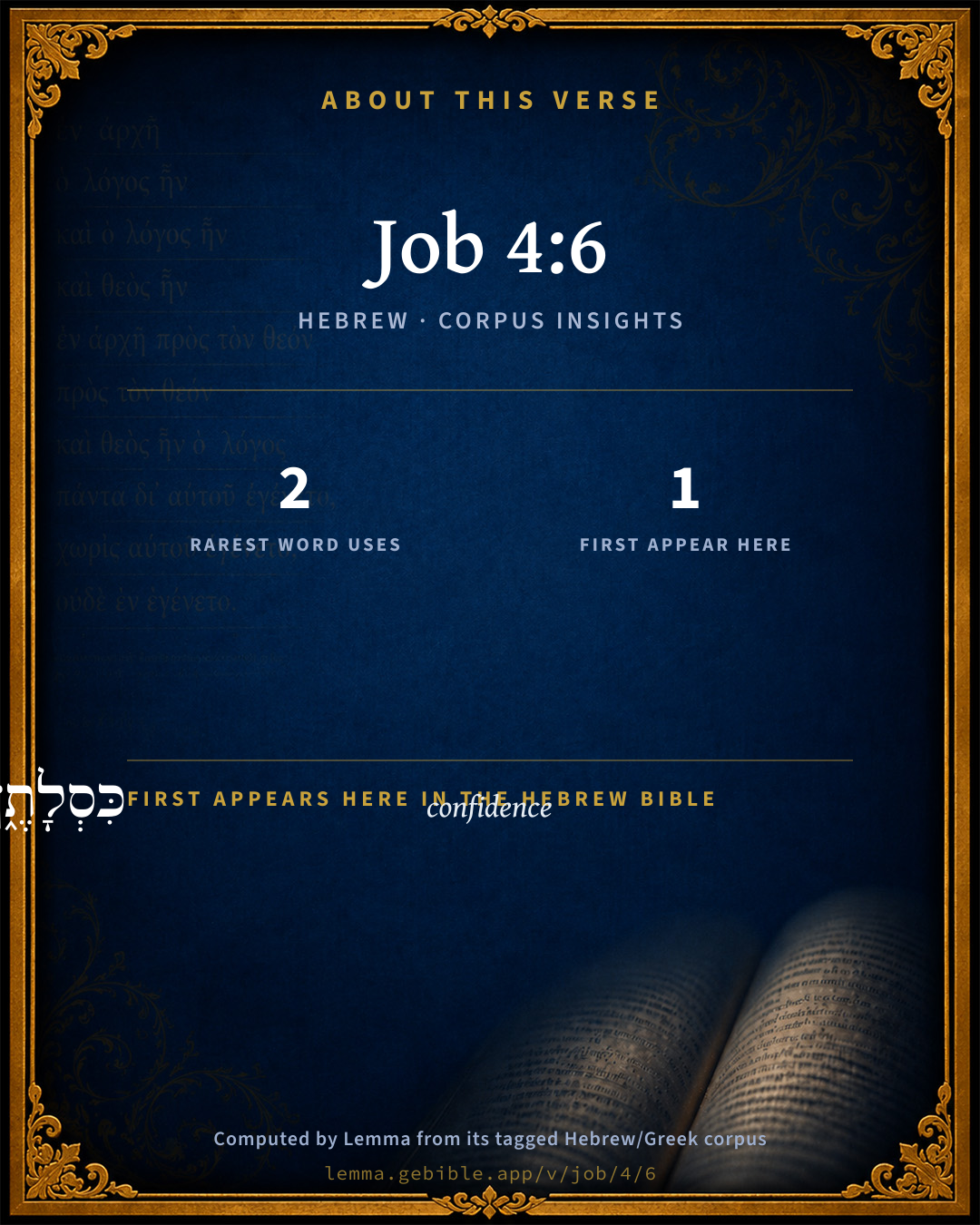
The rarest word here is כִּסְלָתֶ֑ךָ confidence H3690 — appearing just 2 times in the whole Hebrew Bible.

First appearance in Scripture

This word makes its first canonical appearance in the Hebrew Bible here:

  • כִּסְלָתֶ֑ךָ confidence H3690

Shared distinctive vocabulary

כִּסְלָתֶ֑ךָ confidence H3690 occurs in 2 verses of the Hebrew Bible. Also found in:

Grammatical profile

  • 5 nouns
  • 1 particle

Hebrew & Septuagint length

In English translation the verse runs 12 words from the Hebrew and 16 from the Septuagint (LXX English) — closely comparable.

A rough comparison of the two English renderings, which tokenize alike — not a word-level alignment.

Word counts can differ between the Hebrew and the Greek without any difference in meaning — e.g. the Hebrew direct-object marker אֵת has no separate Greek word, and Greek often adds the article ὁ.

Cross-references

14

Topical passages linked to Job 4:6 in the Treasury of Scripture Knowledge — connected by theme and wording, ordered by reader-vote popularity; previews shown in the World English Bible.

  • Proverbs 3:26 For Yahweh will be your confidence, And will keep your foot from being taken.
  • Proverbs 14:26 In the fear of Yahweh is a secure fortress, And he will be a refuge for his children.
  • Job 1:1 There was a man in the land of Uz, whose name was Job. That man was blameless and upright, and one who feared God, and turned away from evil.
  • Job 17:15 Where then is my hope? As for my hope, who shall see it?
  • Job 23:11–12 My foot has held fast to his steps. His way have I kept, and not turned aside.
  • Job 13:15 Behold, he will kill me; I have no hope. Nevertheless, I will maintain my ways before him.
  • Job 16:17 Although there is no violence in my hands, And my prayer is pure.
  • 2 Kings 20:3 Remember now, Yahweh, I beg you, how I have walked before you in truth and with a perfect heart, and have done that which is good in your sight. Hezekiah wept sore.
  • Job 29:12–17 Because I delivered the poor who cried, And the fatherless also, who had none to help him.
  • 1 Peter 1:13 Therefore, prepare your minds for action, be sober and set your hope fully on the grace that will be brought to you at the revelation of Jesus Christ--
  • Job 1:8–10 Yahweh said to Satan, "Have you considered my servant, Job? For there is none like him in the earth, a blameless and an upright man, one who fears God, and turns away from evil."
  • Job 27:5–6 Far be it from me that I should justify you. Until I die I will not put away my integrity from me.
  • 1 Peter 1:17 If you call on him as Father, who without respect of persons judges according to each man's work, pass the time of your living as strangers here in reverent fear:
  • Job 31:1–40 "I made a covenant with my eyes, How then should I look lustfully at a young woman?

Cross-references courtesy of OpenBible.info (CC BY 4.0).

Hebrew and Greek witnesses Masoretic Hebrew ↔ Greek Septuagint

The same verse in the two great witnesses to the Old Testament, shown verse-for-verse.

These are two independent witnesses, not word-aligned to each other, and the Septuagint is shown in lemma (dictionary) form.

Hebrew Job 4:6 Masoretic · Westminster Leningrad Codex

הֲלֹ֣א יִ֭רְאָתְךָ כִּסְלָתֶ֑ךָ תִּ֝קְוָתְךָ֗ וְתֹ֣ם דְּרָכֶֽיךָ

Isn't your piety your confidence, The integrity of your ways your hope?

World English Bible · Public Domain

Greek LXX Job 4:6 Septuagint · lemma form

πότερον οὐ ὁ φόβος σύ εἰμί ἐν ἀφροσύνη καί ὁ ἐλπίς σύ καί ὁ ἀκακία ὁ ὁδός σύ

Is not your fear founded in folly, your hope also, and the mischief of your way?

LXX2012 (modern English Septuagint) · Public Domain

On this verse, Albert Barnes' Notes on the Bible discusses the Septuagint’s reading. Read the note in Commentary ↓

Hebrew: Westminster Leningrad Codex (CC BY 4.0). Greek: Septuagint (public domain); English from LXX2012 (modern English Septuagint) (Public Domain). How the Septuagint differs from the Hebrew →

Commentary

Notes on Job 4:6 from classic Christian and Jewish commentators (each source and its license shown beneath its notes). The classic Christian expositions comment on the surrounding passage and are grouped to its opening verse, so a note may address several verses; the Jewish commentaries on the Tanakh (Rashi and others) are per-verse, so they appear only where the commentator wrote on this verse.

Lemma curates 59 commentaries, every one of them public domain or Creative Commons licensed, each selected and text-cleaned for this edition rather than reprinted as found. About our sources →

Trapp's Complete Commentary

John Trapp

Job 4:6 [Is] not [this] thy fear, thy confidence, thy hope, and the uprightness of thy ways?

Ver. 6. ls not this thy fear, thy confidence, &c.] Or thy folly: q.d. Is not thy religion a mere foolery? and hath not thou rather acted religion, played devotion and the fear of God, than been serious therein? This was a most bitter scoff, a cruel shake, and came near his heart. Like as nothing vexed David more than when they laid his religion in his dish, asking, Where is now thy God? So he. By this alteration that affliction hath wrought in thee, thou mayest easily see what thou art, viz. a very painted hypocrite: hard weather shows what health; empty vessels set near the fire, crack quickly. At the parting way every dog followeth his own master. Afflictio virum arguit, &c. Affliction shows a man, it turns the inside outward, the bottom of the bag upward; bringing that which was at the bottom to the top; as that stick cast into the water made the iron swim, 2Ki 6:6. Doth it not appear (saith Eliphaz here) that thou hast been merely mercenary, serving God while he prospered thee; and now kicking against him, because he affiicteth thee? See how near this man cometh, saith Mercer, to that first instigation of Satan, Job 1:9, in hoc Satanae factus minister, herein acting the devil’s part, though unwittingly, as Peter also did, Mat 16:22-23.

The uprightness of thy ways and thy hope?] q.d. Thou hast taken to thyself many fair titles, and made a great flaunt, as if there were none such; but what is it all come to? Is it any better than a flask, a foppery, a name, and not a thing? Or if it be a reality, make proof of it. True grace is operative, and will not lie dormant.

John Trapp, A Commentary or Exposition upon All the Books of the Old and New Testament (1647–1656) — public domain. Text from a community e-Sword module.

The Biblical Illustrator

Joseph S. Exell

Job_4:6

Is not this thy fear, thy confidence, thy hope?

The confidence of a godly fear

These words are understood by divers of the Hebrew writers for a direct and simple assertion, and they give it thus, Will not, or would not thy fear be thy confidence, and the uprightness of thy ways thy hope? As if Eliphaz had thus said unto him, Job, thou hast pretended much holiness and religion, fear and uprightness; why art thou so disquieted now that the hand of God is upon thee? Why art thou so amazed under these sufferings Would not that fear be thy confidence? And would not that uprightness of thy ways be thy hope? Surely it would, if thou hadst any such fear as thou pretendest; this fear would be thy confidence, and this uprightness thy hope; thou wouldst be very bold, and by hope cast anchor upon the goodness and faithfulness of God in the midst of all this storm: thy heart would be poised, settled, and established, notwithstanding all these shakings. Would not thy fear be thy confidence?

1. They who fear most in times of peace, have most reason to be confident in times of trouble.

2. The uprightness of a mans ways in good times, doth mightily strengthen his hope in evil times. (Joseph Caryl.)

Times of trouble are special times for the use of our graces

It is as if Eliphaz had said, Thou thyself, and all that knew thee, have spoken much of thy grace, but now is the time to use it; where is it? Show it me now. Where is thy fear and thy confidence? If a man have been reported very skilful at his weapon, when he comes into danger, then is the time to show his skill: and we may say to him, Where is thy skill now? Where is thy art now? So here. Now that thou hast most need of thy graces, where are they? Bring them forth. Are they to seek now? Is thy righteousness as the morning dew, and as a cloud vanished away? (Joseph Caryl.)

The Biblical Illustrator, edited by Joseph S. Exell (c. 1880s–1900s) — public domain. Text from a community e-Sword module.

Joseph Benson's Commentary

Job 4:6. Is not this thy fear? &c. — We now plainly see what was the nature of thy fear of God, thy confidence in him, the uprightness of thy ways, and thy hope in God’s mercy. Thy present conduct discovers that it was but mere talk and appearance. In thy prosperity it was easy for thee to make a splendid profession of religion; but men are best known by affliction, and this trial now shows what thou art. For now thou castest off thy fear of God, and thy confidence and hope in him, and hast relinquished the integrity of thy ways, which before thou didst seem to hold fast; whereas true piety is uniform and constant, and steadfast in all varieties of condition, and under all trials and temptations.

Joseph Benson's Commentary on the Old and New Testaments (1811–1818) — public domain. Text from a community e-Sword module.

Keil & Delitzsch

C. F. Keil & F. Delitzsch

6 Is not thy piety thy confidence,

Thy Hope? And the uprightness of thy ways?

7 Think now: who ever perished, being innocent?!

And where have the righteous been cut off?!

8 As often as I saw, those who ploughed evil

And sowed sorrow, - they reaped the same.

9 By the breath of Eloah they perished,

By the breath of His anger they vanished away.

10 The roaring of the lion, and the voice of the shachal,

And the teeth of the young lions, are rooted out.

11 The lion wanders about for want of prey,

And the lioness' whelps are scattered.

In Job 4:6 all recent expositors take the last waw as waw apodosis: And thy hope, is not even this the integrity of thy way? According to our punctuation, there is no occasion for supposing such an application of the waw apodosis, which is an error in a clause consisting only of substantives, and is not supported by the examples, Job 15:17; Job 23:12; Sa2 22:41.

(Note: We will not, however, dispute the possibility, for at least in Arabic one can say, zı̂d f-hkı̂m Zeid, he is wise. Grammarians remark that Arab. zı̂d in this instance is like a hypothetical sentence: If any one asks, etc. Sa2 15:34 is similar.)

תקותך is the permutative of the ambiguous כסלתך, which, from כּסל, to be fat, signifies both the awkwardness of stupidity and the boldness of confidence. The addition of הוּא to מי, Job 4:7, like Job 13:19; Job 17:3, makes the question more earnest: quis tandem, like זה מי, quisnam (Ges. 122, 2). In Job 4:8, כּאשׁר is not comparative, but temporal, and yet so that it unites, as usual, what stands in close connection with, and follows directly upon, the preceding: When, so as, as often as I had seen those who planned and worked out evil (comp. Pro 22:8), I also saw that they reaped it. That the ungodly, and they alone, perish, is shown in Job 4:10. under the simile of the lions. The Hebrew, like the oriental languages in general, is rich in names for lions; the reason of which is, that the lion-tribe, although now become rarer in Asia, and of which only a solitary one is found here and there in the valley of the Nile, was more numerous in the early times, and spread over a wider area.

(Note: Vid., Schmarda, Geographische Verbreitung der Thiere, i. 210, where, among other things, we read: The lion in Asia is driven back at almost all points, and also in Africa has been greatly diminished; for hundreds of lions and panthers were used in the Roman amphitheatres, whilst at the present time it would be impossible to procure so large a number.)

שׁחל, which the old expositors often understood as the panther, is perhaps the maneless lion, which is still found on the lower Euphrates and Tigris. נתע = נתץ, Psa 58:7, evellere, elidere, by zeugma, applies to the voice also. All recent expositors translate Job 4:11 init. wrongly: the lion perishes. The participle אבד is a stereotype expression for wandering about viewless and helpless (Deu 26:5; Isa 27:13; Psa 119:176, and freq.). The part., otherwise remarkable here, has its origin in this usage of the language. The parallelism is like Psa 92:10.

Keil & Delitzsch — Biblical Commentary on the Old Testament (1861–1891) — public domain (CC PDM 1.0). Text via the HelloAO Bible API. (Old Testament only.)

Geneva Bible (1599)

Geneva Bible translators

This he concludeth that Job was but an hypocrite, and had no true fear nor trust in God.

Geneva Bible (1599) marginal notes — public domain. Text via Bolls.life.

Jamieson, Fausset & Brown

Robert Jamieson, A. R. Fausset & David Brown

Is not this thy fear, thy confidence, &c.--Does thy fear, thy confidence, come to nothing? Does it come only to this, that thou faintest now? Rather, by transposition, "Is not thy fear (of God) thy hope? and the uprightness of thy ways thy confidence? If so, bethink thee, who ever perished being innocent?" [UMBREIT]. But Luk 13:2-3 shows that, though there is a retributive divine government even in this life, yet we cannot judge by the mere outward appearance. "One event is outwardly to the righteous and to the wicked" (Ecc 9:2); but yet we must take it on trust, that God deals righteously even now (Psa 37:25; Isa 33:16). Judge not by a part, but by the whole of a godly man's life, and by his end, even here (Jam 5:11). The one and the same outward event is altogether a different thing in its inward bearings on the godly and on the ungodly even here. Even prosperity, much more calamity, is a punishment to the wicked (Pro 1:32). Trials are chastisements for their good (to the righteous) (Psa 119:67, Psa 119:71, Psa 119:75). See Preface on the DESIGN of this book (see Introduction).

Jamieson, Fausset & Brown — Commentary Critical and Explanatory on the Whole Bible (1871) — public domain (CC PDM 1.0). Text via the HelloAO Bible API.

Adam Clarke's Commentary

Verse 6. Is not this thy fear] I think Coverdale hits the true meaning: Where is now thy feare of God, thy stedfastnesse, thy pacience, and the perfectnesse of thy life? If these be genuine, surely there is no cause for all this complaint, vexation, and despair. That this is the meaning, the next words show.

Adam Clarke's Commentary on the Bible (1810–1826) — public domain. Text from a community e-Sword/MySword module.

Ellicott's Commentary for English Readers

(6) Is not this thy fear, thy confidence . . .?—The meaning seems to be, “Should not thy fear or piety be thy confidence, and the uprightness of thy ways thy hope? Should not the piety thou wast so ready to commend to others supply a sufficient ground of hope for thyself?” Or we may understand, “Is not thy reverence, thy confidence, thy hope, and thy integrity shown to be worthless if thou faintest as soon as adversity toucheth thee?” The drift of the speaker is virtually the same in either case.

A Bible Commentary for English Readers, edited by Charles John Ellicott (1878–1897) — public domain. Text from a community e-Sword module.

The Cambridge Bible for Schools and Colleges

gen. ed. J. J. S. Perowne

6. Is not this thy fear?] This verse should read,

Is not thy fear of God thy confidence?

And thy hope, is it not the perfection of thy ways?

When Job comforted others he no doubt would refer to their god-fearing life as a ground of hope that God would give them a happy issue out of their afflictions. Eliphaz desires that Job should apply the same medicine to himself. He assumes that Job is a god-fearing man.

The Cambridge Bible for Schools and Colleges (gen. ed. J. J. S. Perowne; Cambridge University Press, 1878–1918) — public domain. Text from a community e-Sword module.

John Gill's Exposition

Remember, I pray thee, who ever perished, being innocent?.... Here Eliphaz appeals to Job himself, and desires him to recollect if ever anyone instance had fallen under his observation, in the whole course of his life, or it had ever been told him by credible persons, that an "innocent" man, by whom he means not one entirely free from sin original or actual, for he knew there was no such persons in the world, since the fall of Adam, but a truly good and gracious man, who was not guilty of any notorious and capital crime, or did not live a vicious course of life; if he ever knew or heard of any such persons that "perished", which cannot be understood of eternal ruin and destruction, which would be at once granted, that such as these described can never perish in such a sense, but have everlasting life; nor of a corporeal death, which is sometimes the sense of perishing, since it is notorious that innocent and righteous persons so perish or die, see Ecc 7:15 Isa 57:1; and could it be meant of a violent death, an answer might have been returned; and Eliphaz perhaps was not acquainted with it himself, that that innocent and righteous person Abel thus perished by the hands of his brother: but this is rather to be understood of perishing by afflictions, sore and heavy ones, not ordinary but extraordinary ones; and which are, or look like, the judgments of God on men, whereby they lose their all, their substance, their servants, their children, as well as their own health, which was Job's case; and therefore if no parallel instance of an innocent person ever being in the like case, it is insinuated that Job could not be an innocent man:

or where were the righteous cut off? such as are truly righteous in the sight of God, as well as before men, who have the gift of righteousness bestowed on them, and live soberly, righteously, and godly; in what age or country was it ever known that such persons, in their family and substance, were cut off by the hand and providence of God, and abandoned and forsaken by him, and reduced to such circumstances that there could be no hope of their ever being in prosperous ones again? and Job now being in such a forlorn and miserable case and condition, it is suggested, that he could not be a righteous man: but admitting that no such instance could be produced, Eliphaz was too hasty and premature in his conclusion; seeing, as it later appeared, Job was not so cut off, abandoned, and forsaken by God, as not to rise any more; for his latter end was greater than his beginning: and besides, innocent and righteous persons are often involved in the same calamities as wicked men are, and their afflictions are the same; only with this difference, to the one they are the proper punishment of sin, to the other they are fatherly chastisements and trials of their grace, and issue in their good; the Targum explains it of such persons, as Abraham, Isaac, and Jacob, none such as they perishing, or being cut off.

John Gill's Exposition of the Whole Bible (1746–1763) — public domain (CC PDM 1.0). Text via the HelloAO Bible API.

Albert Barnes' Notes on the Bible

Is not this thy fear, thy confidence? - There has been considerable variety in the interpretation of this verse. Dr. Good renders it,

Is thy piety then nothing? thy hope

Thy contidence? or the uprightness of thy ways?

Noyes renders it,

Is not thy fear of God thy hope,

And the uprightness of thy ways the confidence?

Rosenmuller translates it,

Is not in thy piety and integrity of life

Thy confidence and hope?

In the Vulgate it is translated, “Where is thy fear, thy fortitude, thy patience, and the integrity of thy ways?” In the Septuagint, “Is not thy fear founded on folly, and thy hope, and the evil of thy way?”

Castellio translates it,

Nimirum tanturn religionis, quantum expectationis;

Quantum spei, tanturn habebas integritatis morum;

And the idea according to his version is, that he had as much religion as was prompted by the hope of reward; that his piety and integrity were sustained only by his hope, and were not the result of principle; and that of course his religion was purely selfish. If this be the sense, it is designed to be a reproach, and accords with the charge in the question of Satan Job 1:9, “Doth Job fear God for naught?” Rosenmuller adopts the opinion of Ludovicus de Dieu, and explains it as meaning,” You seemed to be a man fearing God, and a man of integrity, and you were led hence to cherish high hopes and expectations; but now you perceive that you were deceived. Your piety was not sincere and genuine, for the truly pious do not thus suffer. Remember therefore that no one perishes being innocent.” Codurcus renders it, “All thy hope was placed in thy religion, and thy expectation in the rectitude of thy ways; consider now, who perishes being innocent?” The true sentiment of the passage has undoubtedly been expressed by Good, Noyes. and Codurcus. The Hebrew rendered thy fear יראתך yârê'tek means doubtless religious fear, veneration, or piety, and is a word synonymous with εὐλάβεια eulabeia, εὐσέβεια eusebeia, religion. The sentiment is, that his confidence or hope was placed in his religion - in his fear of God, his respect and veneration for him, and in reliance on the equity of his government. This had been his stay in times past; and this was the subject which was naturally brought before him then. Eliphaz asks whether he should not put his trust in that God still, and not reproach him as unequal and unjust in his administration.

The uprightness of thy ways - Hebrew, The perfection of thy ways. Note Job 1:1. The idea is, that his hope was founded on the integrity of his life, and on the belief that the upright would be rewarded. The passage may be rendered,

Is not thy confidence and thy expectation

Founded on thy religion,

And on the integrity of thy ways?

This is the general sentiment which Eliphaz proceeds to illustrate and apply. If this was a just principle, it was natural to ask whether the trials of Job did not prove that he had no well grounded reason for such confidence.

Albert Barnes' Notes on the Bible (1834–1885) — public domain. Text from a community e-Sword/MySword module.

Haydock's Catholic Bible Commentary

Where? Septuagint, "Rather is not thy fear foolishness as well as thy hope, and the innocence of thy path?" (Haydock) --- Is not all hypocrisy? (Menochius) (Calmet) --- Many of the assertions of Job’s friends are true, but their inferences are false. (Menochius)

George Leo Haydock (1774–1849), Haydock's Catholic Family Bible and Commentary, 1859 edition — public domain. Excludes Psalms (Douay-Rheims chapter numbering differs from Protestant) and Deuterocanonical books (Catholic canon only).

Matthew Poole's English Annotations

So the sense is, We now plainly see what was the nature and complexion of thy fear of God, thy confidence in him, the uprightness of thy ways, and thy hope in God’s mercy, which thou didst make show and boast of, and for which thou wast become so famous. Thy present carriage discovereth to thyself and others that it was but mere talk and appearance, and there was nothing sound and sincere in it. In thy prosperity it was easy to make a splendid profession of religion; but men are best known by affliction, and this now showeth of what metal thou art made; for now thou dost cast off thy fear of God, and all thy confidence and hope in him, and hast let go that integrity of thy ways which hitherto thou didst seem to hold fast; whereas true piety is uniform, and constant, and stedfast in all varieties of conditions, and under all trials and temptations. But this translation removes the and from its proper place, and changeth the order of the words, which is this in the Hebrew, thy hope, and the uprightness of thy ways, which words may be restored to their own order, and with that variation our translation may stand, and this seems to be the true sense. And so here are four distinct questions, Is not this thy fear? Is not this thy confidence? Is not this thy hope? Is not this the uprightness of thy ways? But others make only two questions, and render the words either thus, Is not (or rather, was not) thy fear (of God) thy confidence? and the uprightness of thy ways thy hope? i.e. Did not thy fear of God, and the integrity of thy life, of which thou didst make such eminent profession, proceed only from the love of thyself, and of this present world? and from thy confidence and hope that God would bless and prosper thee for it? For now when God withdraws his favour and blessings from thee, thy religion is vanished, and thou hast cast off all fear and reverence of God, as thy impious speeches show. Or thus, Would not thy fear be thy confidence, and the uprightness of thy ways thy hope? i.e. If thou hadst indeed that fear and integrity to which thou pretendest, it would give thee good ground of hope and confidence in the midst of all thy distresses, and thou wouldst not so faint and sink under thy calamities, as now thou dost, for want of a solid foundation of true piety. But both these translations, besides other inconveniences, stumble at the same stone, and pervert the order of the words in the Hebrew text, of which see before; which is not to be allowed without some kind of necessity, which is not in this case.

Matthew Poole's English Annotations on the Holy Bible (1683–1685) — public domain. Text from a community e-Sword/MySword module.

Whedon's Commentary on the Bible

Daniel D. Whedon

6. Is not this thy fear — More literally, Is not thy fear (of God) thy confidence? thy hope (is it not) the uprightness of thy ways? Eliphaz in all cases uses the word fear in the sense of the fear of God. “The word fear is the most comprehensive term for that mixed feeling called piety, the contradictory reverence and confidence, awe and familiarity, which, like the centripetal and centrifugal forces, keep man in his orbit around God.” — Davidson. This verse was meant in kindness, “but it is two-edged, for there is also implied, if thou despairest, thou hast no fear of God.” — Dillmann. The introduction is a masterpiece, judged by rhetorical rules. It has admirably paved the way for the fundamental thought of the next two verses. It has been simple, pertinent, conciliatory. It has treated, in the main, of the kind offices of Job to others. In the meantime, he is reminded that he has not been equal to the emergency, which is thus far the only sentiment to which exception could have been taken. Job, the well known consoler of the feeble, ought to have been strong to bear his own grievous trials.

Second strophe — The axiom Eliphaz proceeds to lay down (Job_4:8) involves an insinuation of wrong-doing on the part of Job , vv7-11.

The horns of the grand dilemma of the debate now begin to take shape, and for the first time protrude themselves. If Job’s case be a hopeless one, he must be a transgressor, for the testimony of experience everywhere is, that hopeless sufferers are not guiltless.

Daniel D. Whedon (gen. ed.), Commentary on the Old and New Testaments (1874–1909) — public domain. Text from a community e-Sword module.

The Pulpit Commentary

Is not this thy fear, thy confidence, thy hope, and the uprightness of thy ways? Translate, with the Revised Version, Is not thy fear of God thy confidenceand thy hope the integrity of thy ways? The verse is composed, as usual, of two clauses, balancing each other; and the meaning seems to be that, if Job is as convinced of his piety and uprightness as he professes to be, he ought still to maintain confidence in God, and a full expectation of deliverance from his troubles. If he does not, what is the natural inference? Surely, that he is not so confident of his innocence as he professes to be.

Vers. 6-8. Affliction.

I THE SOURCE OF IT.

1. Negatively.

(1) It comes not without a cause. "The curse causeless shall not come". (Pro_26:2)

(2) It comes not for any cause; i.e. by haphazard, by accident, since the whole universe is under the dominion of law. (Mat_10:29)

(3) It comes not from a material cause; it springs not from the ground; it is not the result of a man"s terrestrial environment

2. Positively.

(1) It comes from within man himself; it is the fruit of his own sin

(2) It comes in accordance with universal moral law, which connects sin and suffering together as cause and effect.

(3) It comes as an inseparable concomitant of man"s nature. Man, when he is born, finds himself introduced into a scene of trouble.

II THE CHARACTERISTICS OF IT.

1. Universal. It is the portion, not of one man, or a few, or even of many, but of the race. It forms a portion of the birthright of humanity.

2. Certain. It is absolutely unavoidable. As surely as the sparks ascend, so surely will those sinful passions rage that entail suffering and misery.

3. Perpetual. Meeting man upon the threshold of his birth, it accompanies him throughout life till its close.

III THE ESCAPE FROM IT.

1. Not by refractory rebellion. Not by behaving like the fool, or like Job, who cursed his day, and fumed and fretted against his misery.

2. But by patient submission. "Humble thyself beneath the hand of God, and he shall lift thee up."

The Pulpit Commentary (1880–1919), ed. H.D.M. Spence-Jones & Joseph S. Exell — public domain. Text from a community e-Sword module.

John Wesley's Explanatory Notes

Thy fear - We now plainly see what was the nature of thy fear of God, thy confidence in him, the uprightness of thy ways, and thy hope in God's mercy. Thy present carriage discovers that it was but mere talk and appearance.

John Wesley, Explanatory Notes Upon the Whole Bible (1754–1765) — public domain. Text via the GEBible commentary corpus.

Rashi

Rabbi Shlomo Yitzchaki (Rashi)

Surely now, your end reveals your beginning, that your fear, that you feared heaven...

your foolishness is due to foolishness and not to full understanding, and so are your hope and the sincerity of your ways all foolishness.

Rashi on the Tanakh — English translations: “The Judaica Press complete Tanach with Rashi, translated by A. J. Rosenberg” (CC BY 4.0); “Pentateuch with Rashi's commentary by M. Rosenbaum and A.M. Silbermann, 1929-1934” (public domain); “The Metsudah Tanach series, Lakewood, N.J” (CC BY 4.0); and “The Book of Joshua, Metsudah Publications, 1997” (CC BY 4.0). Text via Sefaria.

Lesson kit

Teaching starters — assembled from the data on this page, not authored interpretation. Every prompt links to the verse data it draws on. Edit before teaching.

Job, in the Wisdom, opens this verse with 6 words (6 distinct Hebrew lemmas). Its most distinctive word is kiçlâh (“confidence”). A historical commentator’s framing appears above. Read the whole chapter for the surrounding context.

Discussion questions

  1. The word kiçlâh carries the sense “confidence.” How does it shape the verse?
  2. This is the first place “confidence” appears in Scripture (first appears here). What does its debut here establish?
  3. How does Psalms 85:8, which shares the word «confidence», read alongside this verse?
  4. These translations render this verse differently; the difference is in the English rendering, not the original. What questions does that raise?
  5. Compare how Trapp's Complete Commentary and The Biblical Illustrator read this verse. Where do they agree or differ?

Things to notice

  • 1 word makes its first canonical appearance in Scripture here.
  • These translations choose different wording for 6 words in this verse.
  • 6 distinct Hebrew lemmas span 6 words in this verse.

Reading settings

Reading text

Shown beneath each verse's original-language words.

Old Testament
Old Testament edition

Read the OT as the Masoretic Hebrew (MT) or the Greek Septuagint (LXX).

English shown for the Greek Septuagint (in the Hebrew ↔ Greek comparison).

Comparing translations? Open the Compare panel on any verse page to stack up to four side by side.