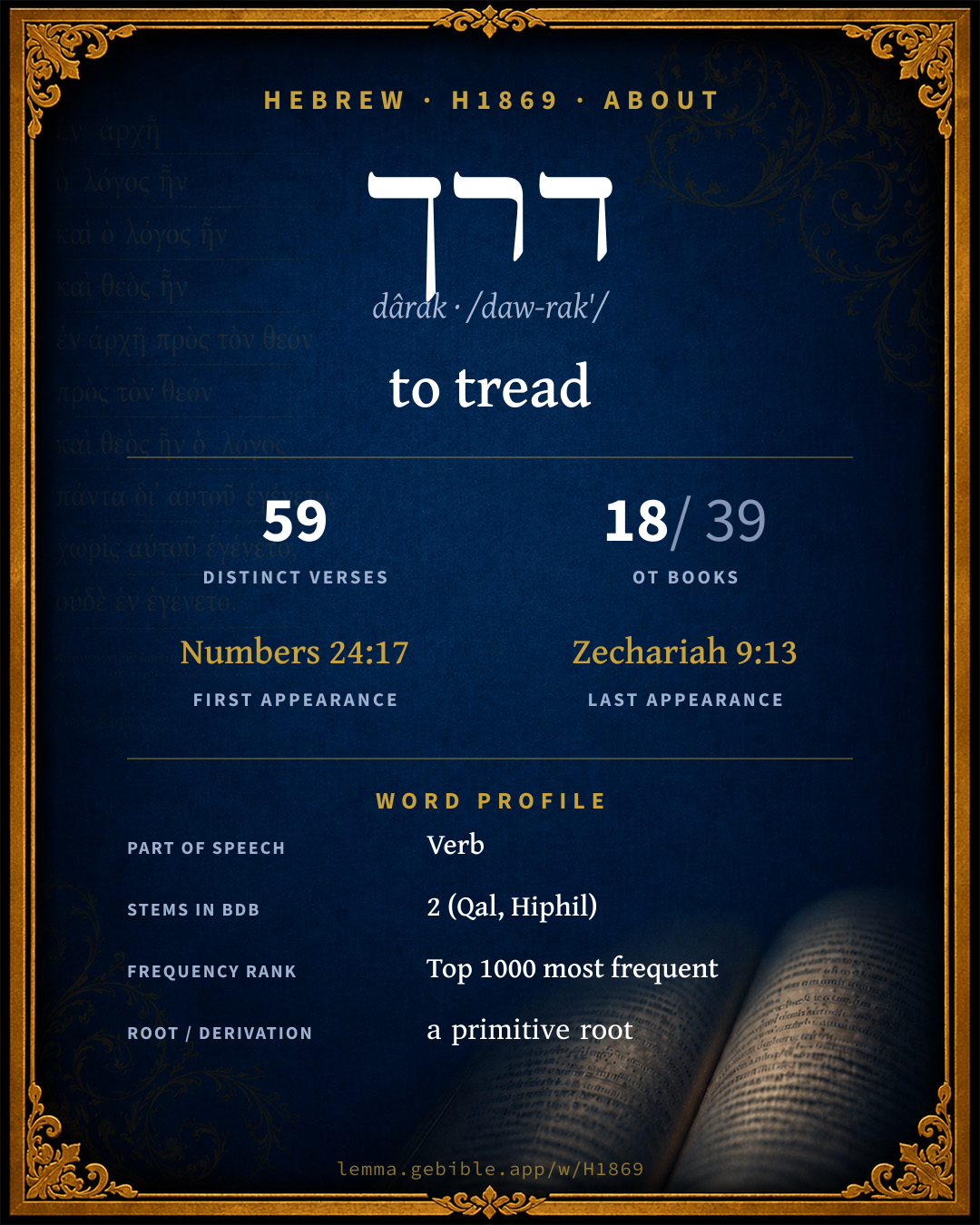
דָּרַךְ
to tread
also: bend, lead, march fuller range ↓
Full lexicon entry — Brown-Driver-Briggs (BDB)
From Brown-Driver-Briggs (BDB)
Where this word appears
See every Qal verb in the Hebrew Bible →
Grammar key — what these labels mean
Part of speech
- Verb
- An action or state-of-being word.
Stem
- Qal
- The basic, simple active stem — the plain form of the verb (“he wrote”). Here: ‘tread’
- Hiphil
- The causative active stem (“he caused / brought about”). Here: ‘tread’
Form
- Imperfect
- An incomplete, ongoing, or future action (“he will / would write”).
- Perfect
- A completed action or state — Hebrew marks aspect (completeness) more than strict tense (“he wrote”).
- Participle Active
- A verbal adjective expressing ongoing or characteristic action (“writing / one who writes”).
- Imperative
- A direct command (“write!”).
- Sequential Perfect
- A perfect with prefixed waw continuing a preceding imperfect or command (waw-consecutive perfect).
- Sequential Imperfect
- An imperfect with prefixed waw — the standard past-narrative form (waw-consecutive imperfect).
- Participle Passive
- A verbal adjective expressing action received (“written”).
State
- Construct
- A noun bound to a following noun in a possessive / “of” relationship (the construct chain).
- Absolute
- The independent form of a noun, not bound to a following word.
Person
- 3rd Person
- The one spoken about (“he / she / it / they”).
- 2nd Person
- The one addressed (“you”).
- 1st Person
- The speaker (“I / we”).
Gender
- Masculine
- Grammatically masculine.
- Common
- Either gender — not distinguished for this form.
- Feminine
- Grammatically feminine.
Number
- Singular
- One.
- Plural
- More than one (in Hebrew, generally three or more).
Grammatical forms 29 distinct
- Verb, Qal, Imperfect, 3rd Person, Masculine, Singular 7 times (11%)
- Verb, Qal, Perfect, 3rd Person, Masculine, Singular 7 times (11%)
- Verb, Qal, Participle Active, Masculine, Plural, Construct 6 times (10%)
- Verb, Qal, Participle Active, Masculine, Singular, Absolute 6 times (10%)
- Verb, Qal, Perfect, 3rd Person, Common, Plural 4 times (6%)
- Verb, Qal, Imperfect, 2nd Person, Masculine, Singular 3 times (5%)
- Verb, Hiphil, Perfect, 3rd Person, Common, Plural 2 times (3%)
- Verb, Hiphil, Imperative, 2nd Person, Masculine, Singular 2 times (3%)
+21 more forms (26 occurrences)
Parsed forms decoded from the imported morphology (morphhb / Westminster Leningrad Codex — WLC text public domain, morphhb tagging CC BY 4.0), counted across 63 parsed occurrences — not distinct verses.
Every verse where H1869 appears — 59 distinct verses across 18 books. Click any verse to open its interlinear word-by-word view. Verse text shown in the World English Bible for context — . Each verse’s Hebrew form is shown with its reference; the English is not keyword-highlighted, since the data carries no word-level English alignment. Use “Compare translations” on any verse to read it across multiple English versions. This concordance covers the Hebrew Bible; Septuagint (Greek Old Testament) occurrences are not indexed here.
Numbers 1 verse
Deuteronomy 4 verses
- Deuteronomy 1:36 דָּֽרַךְ Qal pf 3ms save Caleb the son of Jephunneh: he shall see it; and to him will I give the land that he has trodden on, and to his children, because he has wholly followed Yahweh.
- Deuteronomy 11:24 תִּדְרֹ֧ךְ Qal impf 3fs Every place whereon the sole of your foot shall tread shall be yours: from the wilderness, and Lebanon, from the river, the river Euphrates, even to the hinder sea shall be your border.
- Deuteronomy 11:25 תִּדְרְכוּ Qal impf 2mp There shall no man be able to stand before you: Yahweh your God shall lay the fear of you and the dread of you on all the land that you shall tread on, as he has spoken to you.
- Deuteronomy 33:29 תִדְרֹֽךְ Qal impf 2ms Happy are you, Israel: Who is like you, a people saved by Yahweh, The shield of your help, The sword of your excellency! Your enemies shall submit themselves to you; You shall tread on their high places.
Joshua 2 verses
- Joshua 1:3 תִּדְרֹ֧ךְ Qal impf 3fs Every place that the sole of your foot shall tread on, to you have I given it, as I spoke to Moses.
- Joshua 14:9 דָּרְכָ֤ה Qal pf 3fs Moses swore on that day, saying, Surely the land whereon your foot has trodden shall be an inheritance to you and to your children forever, because you have wholly followed Yahweh my God.
Judges 3 verses
- Judges 5:21 תִּדְרְכִ֥י Qal impf 2fs The river Kishon swept them away, That ancient river, the river Kishon. My soul, march on with strength.
- Judges 9:27 וַֽ/יִּדְרְכ֔וּ conj + Qal wimpf 3mp They went out into the field, and gathered their vineyards, and trod [the grapes], and held festival, and went into the house of their god, and did eat and drink, and cursed Abimelech.
- Judges 20:43 הִדְרִיכֻ֑/הוּ Hiphil pf 3cp + sfx pers 3ms They enclosed the Benjamites round about, [and] chased them, [and] trod them down at [their] resting-place, as far as over against Gibeah toward the sunrise.
1 Samuel 1 verse
1 Chronicles 2 verses
- 1 Chronicles 5:18 וְ/דֹ֣רְכֵי conj + Qal ptcp.act mp cs The sons of Reuben, and the Gadites, and the half-tribe of Manasseh, of valiant men, men able to bear buckler and sword, and to shoot with bow, and skillful in war, were forty-four thousand seven hundred and sixty, that were able to go forth to war.
- 1 Chronicles 8:40 דֹּ֣רְכֵי Qal ptcp.act mp cs The sons of Ulam were mighty men of valor, archers, and had many sons, and sons' sons, one hundred fifty. All these were of the sons of Benjamin.
2 Chronicles 1 verse
Nehemiah 1 verse
Job 4 verses
- Job 9:8 וְ֝/דוֹרֵ֗ךְ conj + Qal ptcp.act ms Who alone stretches out the heavens, Treads on the waves of the sea;
- Job 22:15 דָּרְכ֣וּ Qal pf 3cp Will you keep the old way Which wicked men have trodden,
- Job 24:11 דָּ֝רְכ֗וּ Qal pf 3cp They make oil within the walls of these men. They tread wine presses, and suffer thirst.
- Job 28:8 הִדְרִיכֻ֥/הוּ Hiphil pf 3cp + sfx pers 3ms The proud animals have not trodden it, Nor has the fierce lion passed by there.
Psalms 10 verses
- Psalms 7:12 דָ֝רַ֗ךְ Qal pf 3ms If a man doesn't relent, he will sharpen his sword; He has bent and strung his bow.
- Psalms 11:2 יִדְרְכ֬וּ/ן Qal impf 3mp + sfx n For, behold, the wicked bend their bows. They set their arrows on the strings, That they may shoot in darkness at the upright in heart.
- Psalms 25:5 הַדְרִ֘יכֵ֤/נִי Hiphil impv 2ms + sfx pers 1cs Guide me in your truth, and teach me, For you are the God of my salvation, I wait for you all day long.
- Psalms 25:9 יַדְרֵ֣ךְ Hiphil impf 3ms He will guide the humble in justice. He will teach the humble his way.
- Psalms 37:14 וְ/דָרְכ֪וּ conj + Qal pf 3cp The wicked have drawn out the sword, and have bent their bow, To cast down the poor and needy, To kill those who are upright in the way.
- Psalms 58:7 יִדְרֹ֥ךְ Qal impf 3ms Let them vanish as water that flows away. When they draw the bow, let their arrows be made blunt.
- Psalms 64:3 דָּרְכ֥וּ Qal pf 3cp Who sharpen their tongue like a sword, And aim their arrows, deadly words,
- Psalms 91:13 תִּדְרֹ֑ךְ Qal impf 2ms You will tread on the lion and cobra. You will trample the young lion and the serpent underfoot.
- Psalms 107:7 וַ֭/יַּֽדְרִיכֵ/ם conj + Hiphil wimpf 3ms + sfx pers 3mp He led them also by a straight way, That they might go to a city to live in.
- Psalms 119:35 הַ֭דְרִיכֵ/נִי Hiphil impv 2ms + sfx pers 1cs Direct me in the path of your commandments, For I delight in them.
Proverbs 1 verse
Isaiah 9 verses
- Isaiah 5:28 דְּרֻכ֑וֹת Qal ptcp.pass fp Whose arrows are sharp, And all their bows bent. Their horses' hoofs will be like flint, And their wheels like a whirlwind.
- Isaiah 11:15 וְ/הִדְרִ֖יךְ conj + Hiphil wpf 3ms Yahweh will utterly destroy the tongue of the Egyptian sea; and with his scorching wind will he wave his hand over the River, and will strike it into seven streams, and cause men to march over in sandals.
- Isaiah 16:10 יִדְרֹ֥ךְ הַ/דֹּרֵ֖ךְ Qal impf 3ms ptcl def.art + Qal ptcp.act ms Gladness is taken away, and joy out of the fruitful field; and in the vineyards there shall be no singing, neither joyful noise: nobody shall tread out wine in the presses; I have made the [vintage] shout to cease.
- Isaiah 21:15 דְּרוּכָ֔ה Qal ptcp.pass fs For they fled away from the swords, from the drawn sword, and from the bent bow, and from the heat of battle.
- Isaiah 42:16 אַדְרִיכֵ֑/ם Hiphil impf 1cs + sfx pers 3mp I will bring the blind by a way that they don't know; in paths that they don't know will I lead them; I will make darkness light before them, and crooked places straight. These things will I do, and I will not forsake them.
- Isaiah 48:17 מַדְרִֽיכֲ/ךָ֖ Hiphil ptcp.act ms cs + sfx pers 2ms Thus says Yahweh, your Redeemer, the Holy One of Israel: I am Yahweh your God, who teaches you to profit, who leads you by the way that you should go.
- Isaiah 59:8 דֹּרֵ֣ךְ Qal ptcp.act ms The way of peace they don't know; and there is no justice in their goings: they have made them crooked paths; whoever goes therein does not know peace.
- Isaiah 63:2 כְּ/דֹרֵ֥ךְ prep + Qal ptcp.act ms Why are you red in your clothing, and your garments like him who treads in the wine vat?
- Isaiah 63:3 דָּרַ֣כְתִּי וְ/אֶדְרְכֵ֣/ם Qal pf 1cs conj + Qal impf 1cs + sfx pers 3mp I have trodden the winepress alone; and of the peoples there was no man with me: yes, I trod them in my anger, and trampled them in my wrath; and their lifeblood is sprinkled on my garments, and I have stained all my clothing.
Jeremiah 8 verses
- Jeremiah 9:3 וַֽ/יַּדְרְכ֤וּ conj + Hiphil wimpf 3mp They bend their tongue, [as it were] their bow, for falsehood; and they are grown strong in the land, but not for truth: for they proceed from evil to evil, and they don't know me, says Yahweh.
- Jeremiah 25:30 כְּ/דֹרְכִ֣ים prep + Qal ptcp.act mp Therefore prophesy you against them all these words, and tell them, Yahweh will roar from on high, and utter his voice from his holy habitation; he will mightily roar against his fold; he will give a shout, as those who tread [the grapes], against all the inhabitants of the earth.
- Jeremiah 46:9 דֹּ֥רְכֵי Qal ptcp.act mp cs Go up, you horses; and rage, you chariots; and let the mighty men go forth: Cush and Put, who handle the shield; and the Ludim, who handle and bend the bow.
- Jeremiah 48:33 יִדְרֹ֣ךְ Qal impf 3ms Gladness and joy is taken away from the fruitful field and from the land of Moab; and I have caused wine to cease from the wine presses: none shall tread with shouting; the shouting shall be no shouting.
- Jeremiah 50:14 דֹּ֣רְכֵי Qal ptcp.act mp cs Set yourselves in array against Babylon round about, all you who bend the bow; shoot at her, spare no arrows: for she has sinned against Yahweh.
- Jeremiah 50:29 דֹּ֨רְכֵי Qal ptcp.act mp cs Call together the archers against Babylon, all those who bend the bow; encamp against her round about; let none of it escape: recompense her according to her work; according to all that she has done, do to her; for she has been proud against Yahweh, against the Holy One of Israel.
- Jeremiah 51:3 יִדְרֹ֤ךְ ידרך הַ/דֹּרֵךְ֙ Qal impf 3ms Qal impf 3ms ptcl def.art + Qal ptcp.act ms Against [him who] bends let the archer bend his bow, and against [him who] lifts himself up in his coat of mail: and don't you spare her young men; destroy you utterly all her host.
- Jeremiah 51:33 הִדְרִיכָ֑/הּ Hiphil pf 3ms + sfx pers 3fs For thus says Yahweh of hosts, the God of Israel: The daughter of Babylon is like a threshing floor at the time when it is trodden; yet a little while, and the time of harvest shall come for her.
Lamentations 3 verses
- Lamentations 1:15 דָּרַ֣ךְ Qal pf 3ms The Lord has set at nothing all my mighty men in the midst of me; He has called a solemn assembly against me to crush my young men: The Lord has trodden as in a winepress the virgin daughter of Judah.
- Lamentations 2:4 דָּרַ֨ךְ Qal pf 3ms He has bent his bow like an enemy, he has stood with his right hand as an adversary, Has killed all that were pleasant to the eye: In the tent of the daughter of Zion he has poured out his wrath like fire.
- Lamentations 3:12 דָּרַ֤ךְ Qal pf 3ms He has bent his bow, and set me as a mark for the arrow.
Amos 2 verses
- Amos 4:13 וְ/דֹרֵ֖ךְ conj + Qal ptcp.act ms For, behold, he who forms the mountains, And creates the wind, And declares to man what is his thought; Who makes the morning darkness, And treads on the high places of the Earth: Yahweh, the God of hosts, is his name."
- Amos 9:13 וְ/דֹרֵ֥ךְ conj + Qal ptcp.act ms cs "Behold, the days come," says Yahweh, "That the plowman shall overtake the reaper, And the one treading grapes him who sows seed; And sweet wine will drip from the mountains, And flow from the hills.
Micah 4 verses
- Micah 1:3 וְ/דָרַ֖ךְ conj + Qal pf 3ms For, behold, Yahweh comes forth out of his place, And will come down and tread on the high places of the earth.
- Micah 5:5 יִדְרֹךְ֙ Qal impf 3ms He will be our peace when Assyria invades our land, And when he marches through our fortresses, Then we will raise against him seven shepherds, And eight leaders of men.
- Micah 5:6 יִדְרֹ֖ךְ Qal impf 3ms They will rule the land of Assyria with the sword, And the land of Nimrod in its gates. He will deliver us from the Assyrian, When he invades our land, And when he marches within our border.
- Micah 6:15 תִדְרֹֽךְ Qal impf 2ms You will sow, but won't reap. You will tread the olives, but won't anoint yourself with oil; And crush grapes, but won't drink the wine.
Habakkuk 2 verses
- Habakkuk 3:15 דָּרַ֥כְתָּ Qal pf 2ms You trampled the sea with your horses, Churning mighty waters.
- Habakkuk 3:19 יַדְרִכֵ֑/נִי Hiphil impf 3ms + sfx pers 1cs Yahweh, the Lord, is my strength. He makes my feet like deer's feet, And enables me to go in high places. For the music director, on my stringed instruments.
Zechariah 1 verse
About this entry
At a glance — auto-summarized from this page’s data, not written by a person. Every figure links to its source below. This summary describes the numbers; it doesn’t interpret them.
“to tread” is the headline sense of the Hebrew verb דרך (dârak). First canonically at Numbers 24:17, it enters the text early. It appears 59 verses across 18 books of the Hebrew Bible, among its moderately common vocabulary. Read the stem: it spans 2 stems, including Qal and Hiphil. Related forms include דרך and מדרך. The sections below give every sense, occurrence, and version rendering.
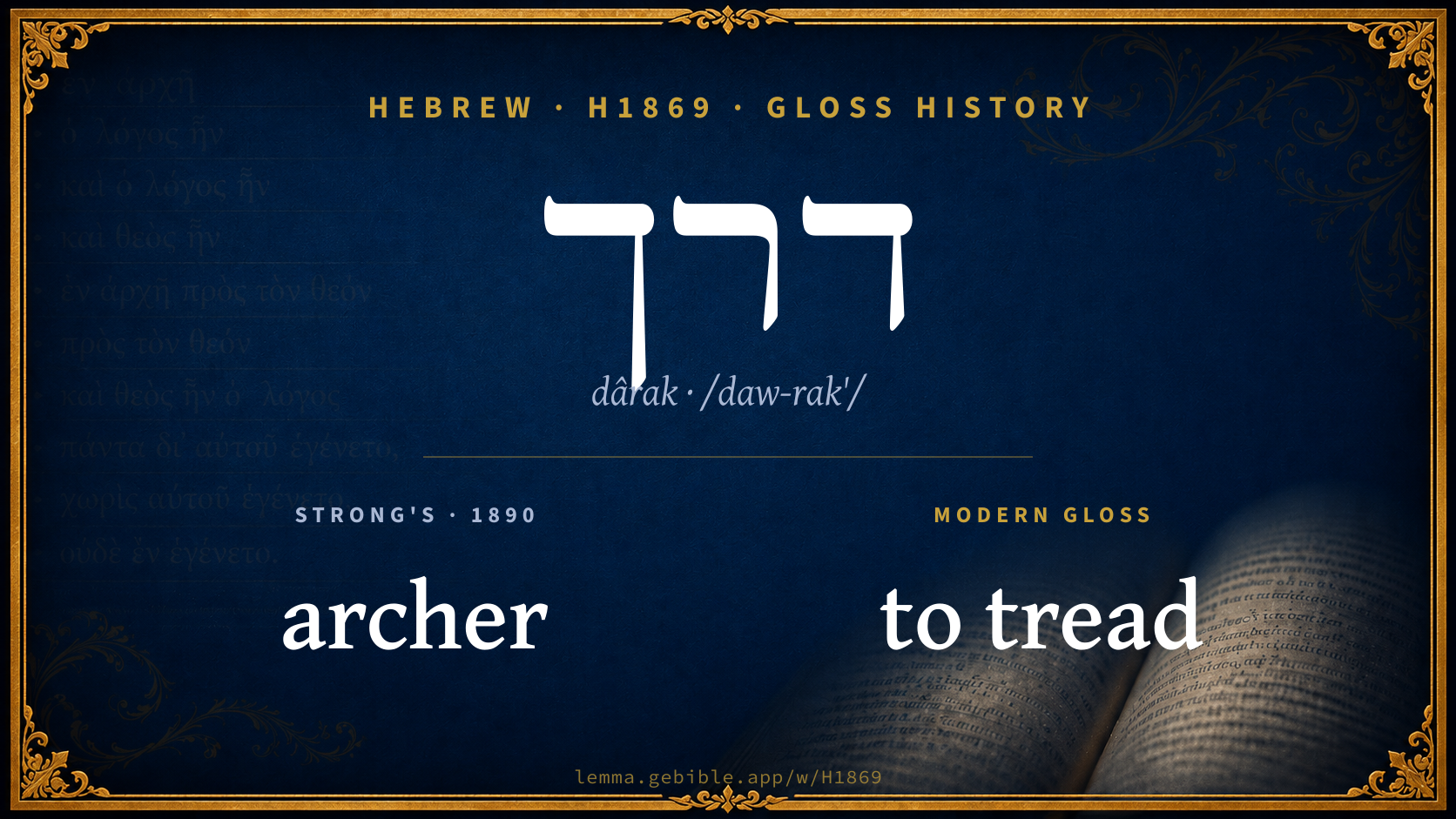
Gloss history
Strong's 1890 vs modern scholarship
About this word
Strong's H1869 catalogs a Hebrew word from the Hebrew Old Testament.
These counts are not copied from any lexicon or concordance. They are computed here, from the morphology-tagged Hebrew Old Testament. What Lemma adds →
- 59
- distinct verses
- The word appears in 59 distinct verses.
- 18 / 39
- OT books
- The word appears in 18 of 39 Old Testament books.
- #611
- by frequency
- Top 1000 most frequent Hebrew words (rank 611 of 8,640 Hebrew words by occurrence).
View all 59 occurrences in the concordance →
By section of the Old Testament
By traditional corpus
Conventional, traditional groupings — biblical authorship is debated, so this is a traditional corpus grouping, not an authorship claim. Each share is this word’s portion of its verses in that division of the Hebrew canon. Each figure is a share of the word’s 59 distinct verses.
- Prophets (Nevi'im) 32 verses · 54%
- Writings (Ketuvim) 22 verses · 37%
- Torah (Pentateuch) 5 verses · 8%
How translations render this word
Counts come from each version’s own published word-to-Strong’s tagging or interlinear alignment — an approximate guide to how each version renders this word, not a word-level alignment the data otherwise carries. Because each total is that version’s own tagged count, the per-version totals vary from one another and need not match the appearance or distinct-verse counts above. These counts may also differ from a printed concordance because Lemma counts each distinctly tagged rendering and does not collapse phrase taggings into a single head-word total. This is a fixed set of word-tagged versions (KJV, ASV, BSB, ULT) and does not change with the reading translation you choose elsewhere. Each version’s license is shown beside its name below (and on Sources).
- King James Version: Bend 4×, He hath bent 3×, Tread 3×
- American Standard Version: He hath bent 3×, Bend 2×, Bent 2×
- Berean Standard Bible: Treads 3×, Bend 2×, Drawing 2×
- unfoldingWord Literal Text: Tread 5×, He treads 3×, Will tread 3×
King James Version Public Domain
Renders H1869 across 63 tagged occurrences — most commonly:
Plus 43 renderings that appear only once — usually multi-word phrases or single function words the recovered tagging swept in, not distinct renderings.
American Standard Version Public Domain
Renders H1869 across 61 tagged occurrences — most commonly:
Plus 46 renderings that appear only once — usually multi-word phrases or single function words the recovered tagging swept in, not distinct renderings.
Berean Standard Bible Public Domain
Renders H1869 across 61 tagged occurrences — most commonly:
Plus 52 renderings that appear only once — usually multi-word phrases or single function words the recovered tagging swept in, not distinct renderings. Not rendered by a distinct English word in 1 further occurrence.
unfoldingWord Literal Text CC BY-SA 4.0
Renders H1869 across 65 tagged occurrences — most commonly:
Plus 42 renderings that appear only once — usually multi-word phrases or single function words the recovered tagging swept in, not distinct renderings.
9 senses and sub-senses in the full BDB
Hebrew verbs can shift meaning by stem (binyan): Qal is the basic action, Niphal is often passive or reflexive, Piel often intensifies or makes it factitive, and Hiphil is typically causative. The senses below are grouped under the stem BDB assigns to each.
What do BDB’s symbols mean?
BDB uses these scholarly abbreviations:
| Symbol | Meaning |
|---|---|
| 𝔊 | the Septuagint (the ancient Greek translation, LXX) |
| 𝔙 | the Vulgate (the Latin translation) |
| 𝔖 | the Syriac version (the Peshitta) |
| 𝔗 | the Targum (the Aramaic translation) |
| ψ | the Psalms |
| √ | root (the underlying root or stem) |
| ‖ | parallel passage (a synonymous or contrasted parallel) |
| † | the dagger: every passage where the word occurs is cited |
The 9 senses and sub-senses the full Brown-Driver-Briggs lexicon distinguishes for this word, in lexicon order (not ranked by frequency), with BDB’s own verbatim wording and sub-sense lettering. Shown in Hebrew script with BDB’s own scholarly abbreviations. The condensed entry is in the Lexicon Entry tab. See also the Forms in the corpus table below.
Qal
- Pf. 3 ms. דָּרַךְ Nu 24:17 + 6 times; 3 fs. דָּרְֽכָה Jos 14:9; 2 ms. דָּרַכְתָּ Hb 3:15; 1 s. דָּרַכְתִּי Is 63:3 Zc 9:13; pl. דָּֽרְכוּ Jb 22:15 + 3 times; Impf. 3 ms. יִדְרֹךְ Mi 5:4 + 6 times + ידרך Je 51:3 (כתיב ולא קוי); 3 fs. תִּדְרֹךְ Dt 11:24 Jos 1:3; 2 ms. תִּדְרֹךְ Dt 33:29 + 2 times; 2 fs. תִּדְרְכִי Ju 5:21; 1 s. sf. וְאֶדְרְכֵם Is 63:3; 3 mpl. יִדְרְכוּ 1 S 5:5, יִדְרְכוּן ψ 11:2, וַיִּדְרְכוּ Ju 9:27; 2 mpl. תִּדְרְכוּ Dt 11:25; Pt. act. דֹּרֵךְ Am 4:13 + 5 times; דּוֹרֵךְ Jb 9:8; דֹּרְכִים Je 25:30 Ne 13:15; דֹּרְכֵי Je 46:9 + 5 times; pass. f. דְּרוּכָה Is 21:15; דְּרֻכוֹת 5:28;— e.g. Numbers 24:17
- 1. tread, march, march forth, abs., תִּדְרְכִי נַפְשִׁי עֹז Ju 5:21; cf. דָּרַךְ כּוֹכָב מִיַּעֲקֹב Nu 24:17 (poem) a star hath marched forth from Jacob. e.g. Judges 5:21
- 2. tread upon (land), sq. בְּ Dt 1:36; 11:25 (subj. pers.), Jos 14:9 (subj. רֶגֶל) cf. Dt 11:24 = Jos 1:3 (subj. כַּף רַגְלְכֶם); tread in a path, sq. בְּ Is 59:8 (fig. of mode of life); tread in (on) the sea, sq. בְּ Hb 3:15 (but text dub. cf. VB); of an invader יִדְרֹךְ בְּאַרְמְנוֹתֵינוּ Mi 5:4 (‖ יָבוֹא בְּאַרְצֵנוּ); יִד׳ בִּגְבוּלֵינוּ v 5 (‖ id.); sq. עַל 1 S 5:5 (עַל־מִפְתַּן דָּגוֹן); ψ 91:13 (עַל־שַׁחַל וָפֶתֶן); especially (poet.) עַל־בָּמֳו֯תֵי אֶרֶץ Mi 1:3, of י׳, so Am 4:13, & (עַל־בָּמֳתֵי יָ֑ם) Jb 9:8; of Isr. treading on heights of enemies, i.e. subduing them Dt 33:29. Once sq. acc. (אֲשֶׁר ref. אֹרַח) Jb 22:15. In technical senses e.g. Deuteronomy 1:36
- 3. tread wine- (or oil-) press, sq. acc. יְקָבִים Jb 24:11 (‖ יַצְהִירוּ), גִּתּוֹת Ne 13:15; sq. acc. of thing pressed ד׳עֲנָבִים Am 9:13; also of product תִּדְרֹךְ־זַיִת … וְתִירוֹשׁ Mi 6:15; יַיִן בַּיְקָבִים לֹא יִדְרֹךְ הַדֹּרֵךְ Is 16:10; sq. בְּגַת Is 63:2 (in sim.); abs. Je 25:30 (sim.) 48:33; fig. of judgment Is 63:3 sq. acc. פּוּרָה winepress, subj. י׳, cf. v וְאֶדְרְכֵם בְּאַפִּי (‖ רמס) i.e. tread them down; so גַּת דָּרַךְ אֲדֹנָי לִבְתוּלַת בַּת־יְהוּדָה La 1:15. e.g. Job 24:11
- 4. tread (i.e. bend) the bow, sq. acc. קֶשֶׁת Je 51:3 (אֶל־יִדְרֹךְ יד֯רך הַדֹּרֵךְ קַשְׁתּוֹ); fig. of assaults of wicked ψ 11:2; 37:14, of judgments of י׳ ψ 7:13 La 2:4; 3:12; also fig. of Judah as bow in hand of י׳, כִּי דָרַכְתִּי לִי יְהוּדָה Zc 9:13 (‖ קֶשֶׁת מִלֵּאתִי אֶפְרַיִם); twice in like meaning c. obj. חֵץ arrow ψ 58:8 (but on text cf. Checrit. n.) 64:4; דֹּרְכֵי קֶשֶׁת = bow-benders, archers 46:9 Je 50:14, 29 1 Ch 5:18; 8:40 2 Ch 14:7; קֶשֶׁת דְּרוּכָה bent bow Is 21:15, קַשְׁתֹֿתָיו דְּרֻכוֹת 5:28. e.g. Jeremiah 51:3
Hiphil
- Pf. וְהִדְרִיךְ Is 11:15; sf. הִדְרִיכָהּ Je 51:33 (where many Inf. cstr.). cf. RSJ Ph. xvi. (1888) 72; 1 s. sf. הִדְרַכְתִּיךָ Pr 4:11; 3 pl. sf. הִדְרִיכֻ֑הוּ Ju 20:43, הִדְרִיכוּהוּ Jb 28:8; Impf. יַדְרֵךְ ψ 25:9; sf. יַדְרִכֵנִי Hb 3:19; וַיַּדְרִיכֵם ψ 107:7; 1 s. sf. אַדְרִיכֵם Is 42:16; וַיַּדְרְכוּ Je 9:2 (cf. Ges§ 53 n); Imv. ms. sf. הַדְרִיכֵנִי ψ 25:5; 119:35; Inf. cstr. v. supr.; Pt. sf. מַדְרִיכְךָ Is 48:17;— e.g. Isaiah 11:15
- 1. tread, tread down, of treading down enemy in battle Ju 20:43; of treading a path Jb 28:8; levelling threshing-floor Je 51:33 (all sq. sf.). e.g. Judges 20:43
- 2. tread (bend) the bow (= Qal 4), only fig. וַיַּדְרְכוּ אֶת־לְשׁוֹנָם קַשְׁתָּם שֶׁקֶר Je 9:2 and they have bent their tongue as their bow in falsehood. e.g. Jeremiah 9:2
- 3. causat. cause to tread or march, lead, returning exiles Is 11:15 (subj. י׳; no obj. expressed); cf. וַיַּדְרִיכֵם בְּדֶרֶךְ יְשָׁרָה ψ 107:7 and he led them in a straight way; v. also Is 42:16 (‖ הוֹלִיךְ); with a moral application הִדְרַכְתִּיךָ בְּמַעְגְּלֵי־ישֶׁר Pr 4:11; cf. ψ 119:35 הַדְרִיכֵנִי בִּנְתִיב מִצְוֹתֶיךָ lead me in the path of thy commandments; ψ 25:5 בַּאֲמִתֶּ֑ךָ (‖ לַמְּדֵנִי) cf. v 9 בַּמִּשְׁפָּט (‖ יְלַמֵּד דַּרְכּוֹ) Is 48:17 בְּדֶרֶךְ תֵּלֵךְ (‖ מְלַמֶּדְךָ לְהוֹעִל); once of giving security & truimph עַל־בָּמוֹתַי יַדְרִכֵנִי Hb 3:19 upon mine heights he maketh me tread (cf. Qal 2). e.g. Isaiah 11:15
Senses from the full Brown-Driver-Briggs lexicon (Brown, Driver, Briggs; Oxford 1906 — public domain), digitized via Sefaria, supplemented by the OpenScriptures HebrewLexicon (CC BY 4.0). Full attribution on Sources.
Word origin
vb. tread, march (Aramaic דְּרַךְ, ܕܪܶܟ NH Hiph. lead, conduct; Arabic iv. ادرك reach, overtake; Ethiopic ደረከ be rough, severe (from calcavit, Di); መድረክ threshold, vestibule)—
— Brown-Driver-Briggs (Oxford 1906, public domain), digitized via Sefaria, supplemented by the OpenScriptures HebrewLexicon (CC BY 4.0). See Sources.
Origin: a primitive root
Jastrow Dictionary
A second Hebrew/Aramaic lexicon for comparison, covering Aramaic and post-biblical (Talmudic, Targumic, Midrashic) usage that the biblical-Hebrew BDB does not. Matched by lemma rather than by Strong’s number, so a lemma may carry more than one Jastrow headword (shown separately below), and the entries cover usage well beyond the Bible.
דָּרַךְ
- (b. h.) to tread, stamp, walk. Ter. I, 9 ונמלך לדוֹרְכָן and after consideration decided to use them for pressing. Ex. R. s. 15 עתיד לִדְרוֹךְ וכ׳ He will tread with His shoe upon &c.; a. fr.
- to be trodden, pressed. Ter. I, 8 ענבים הנִדְרָכוֹת (Mish. ed. הנִדְרָכִים) grapes in the press or intended for the press.
- to lead, rear, train. Snh. 76ᵇ; Yeb. 62ᵇ המַּדְרִיךְ בניו וכ׳ he who leads his sons … on the right path.
דְּרַךְ
- 1. same. Targ. O. Deut. I, 36. Targ. Is. LIX, 8; a. fr.—Keth. 60ᵇ bot. דדָרְכָא על וכ׳ who stepped upon &c. Sabb. 109ᵃ דדרכא ליה וכ׳ Ms. M. (ed. דדריכא) that an ass had stepped on his foot. [Y. Maas. Sh. IV, 55ᶜ top יתיב מדרך, read: מְרַמֵּךְ, v. דְּמַךְ.—Lev. R. s. 27 דרכת עד, read: אוֹרְכַת, v. אֲרִיךְ I.]
- 2. to overtake, v. infra.
- 1. to thresh. Targ. Is. XXVIII, 27 sq.; a. e.
- 2. to lead. Targ. Prov. XXII, 6, v. דְּכִי Af.—Targ. Ps. XXV, 9; a. e.
- 3. to trace, overtake. Targ. Prov. VI, 11; XXIV, 34 ותַדְרְכָיךְ (ed. Lag. ותִידְ׳, Var. ותדרוך, ותדכיך, ותרכיך, h. text כמהלך).—Keth. 60ᵇ; Ab. Zar. 15ᵇ ולא אַדְרְכֵיה and did not find him.
דֶּרֶךְ
- c. (b. h.; preced.) way, road; method, manner. Kidd. 2ᵇ ד׳ לשון וכ׳ derekh is feminine gender &c. Ib. דַרְכּוֹ של אישׁ וכ׳ it is man’s way to carry war, and not woman’s.—Y. Ned. I, beg. 36ᶜ, a. e. התורה דיברה כדַרְכָּהּ, v. לָשׁוֹן. Succ. II, 1 לפי דַרְכֵּינוּ by our way (incidentally). Ab. Zar. 15ᵇ כד׳ שאסור … כך וכ׳ Ms. M. (ed. כד׳ שאמרו אסור) on the same principle that &c.; a. v. fr.—דֶּ׳ אֶרֶץ (abbrev. ד׳'א) the way of the land, a) good manners; b) secular occupation, trade; c) (euphem.) sexual connection. Ab. II, 2 study עם ד׳'א combined with a trade. Tosef. Sot. VII, 20 לימדה … ד׳'א וכ׳ the Torah teaches incidentally the proper conduct that one must first build a house &c.—Gitt. 70ᵃ bot. ד׳ וד׳'א וכ׳ travelling, marital connection &c. Gen. R. s. 18, end. Gen. R. s. 22, beg.—Ib. s. 80 כדַרְכָּהּ natural gratification of sexual appetite, שלא כד׳ unnatural. Ib. s. 18, end; a. fr.—Snh. 31ᵇ העביר עלי את הד׳ mutilated me (oth. interpret.: wronged me in business).—Pl. דְּרָכִים. Kidd. I, 1. R. Hash. 17ᵃ פירשו מדַּרְכֵי ציבור they deviated from the ways of the community, became heretics.—דרכי אמורי, v. אֱמוֹרִי.—דרכי שלום ways of peace (ref. to Prov. III, 17); מפני ד׳ ש׳ because the ways of the Law are ways of peace (differ. fr. משים איבה, v. אֵיבָה), i.e. it is a demand of equity, good manners &c., though no special law can be quoted for it. Gitt. V, 8 sq.; a. fr.—(ד׳'א) דרך ארץ Derekh Erets (Manners), name of a treatise attached to Talmud editions, divided into Rabba (Large), and Zuta (Small). e.g. Proverbs 3:17
A Dictionary of the Targumim, the Talmud Babli and Yerushalmi, and the Midrashic Literature (Marcus Jastrow; London, Luzac, 1903) — Public Domain. Digitized via Sefaria. Digitized via Sefaria. Full attribution on Sources.
Forms in the corpus
The 57 distinct written forms H1869 takes in the Hebrew Bible, most frequent first — each parse links to that stem’s occurrences in the concordance. Hebrew forms include their vowel points and cantillation, so a single lemma takes many written forms.
Same root — word family
Other BDB entries built from the same root as H1869, grouped by Strong’s listed origin. These share a root / origin per the lexicon — not necessarily a shared meaning. Each links to that word’s own entry.
Derived from this word
Compare all same-root words → They share a root, not necessarily a meaning.
Septuagint verse parallels
This word appears in 52 verses that also exist in the Greek Old Testament (Septuagint), out of the 59 Hebrew verses it occurs in. You can read those verses in Greek by switching the Old Testament edition to the Septuagint.
Read these verses in the Septuagint
- Numbers 24:17
- Deuteronomy 1:36
- Joshua 1:3
- Judges 5:21
- 1 Samuel 5:5
- 1 Chronicles 5:18
- 2 Chronicles 14:8
- Job 9:8
- Psalms 7:12
- Proverbs 4:11
- Isaiah 5:28
- Jeremiah 9:3
This is a verse-level parallel only — the same verses exist in both the Hebrew and Greek Old Testaments. No word-level Hebrew↔Greek correspondence is claimed: the data carries no such alignment, so no Greek word is shown as this Hebrew word’s translation. Coverage is not total — the Septuagint omits the deuterocanon and renumbers the Psalms, so some Hebrew verses have no direct Greek parallel.