
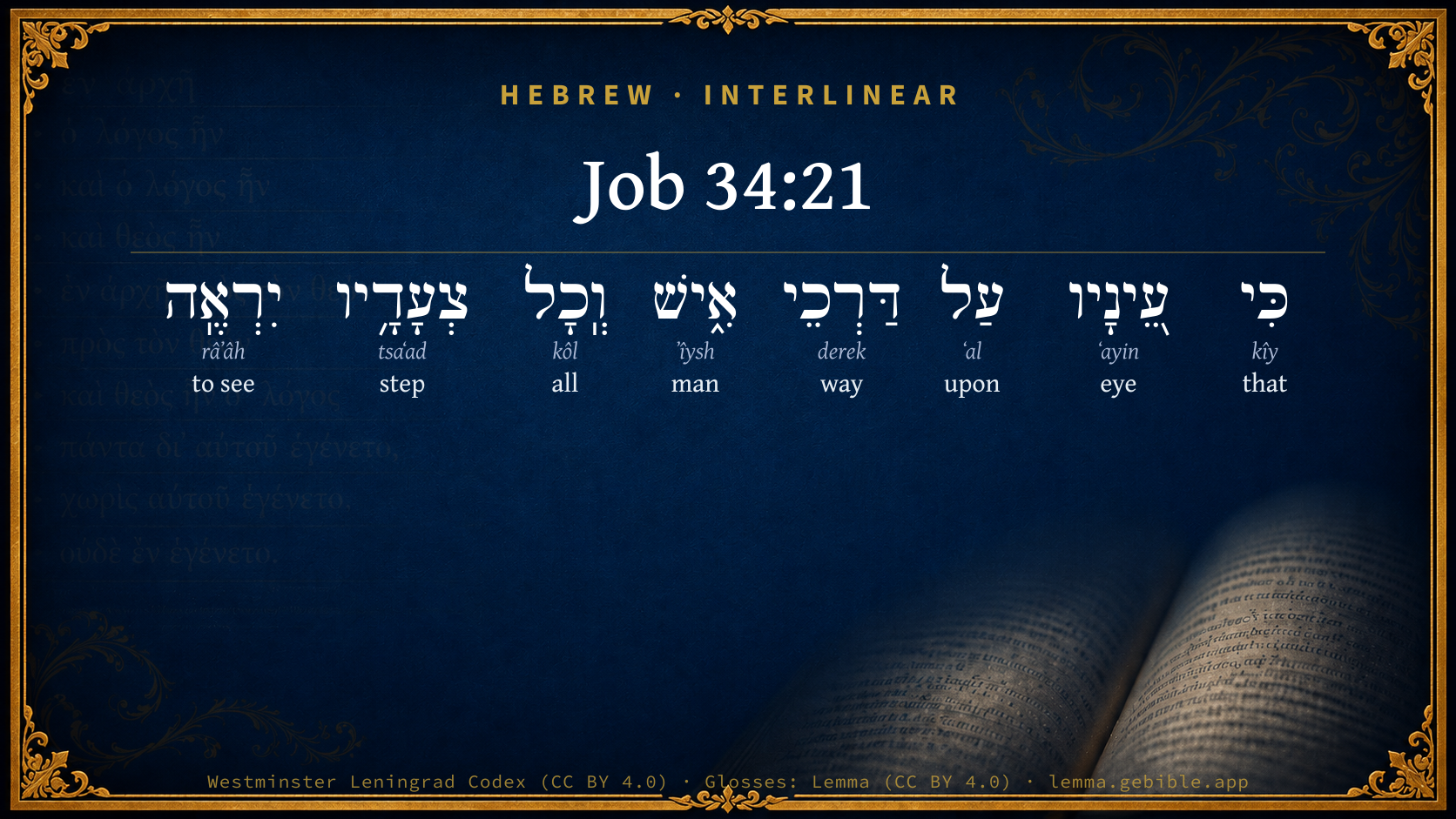
Job 34:21

Hebrew (Westminster Leningrad Codex) Job 34:21 appears in the Hebrew Old Testament. The text above is from the Westminster Leningrad Codex. Each word links to its Strong’s number, a concise gloss, and parsing drawn from the Open Scriptures Hebrew Bible morphology. Click any word for its full Brown-Driver-Briggs (BDB) entry.
Download image
Cite this verse

Job 34:21 (World English Bible). Public Domain. Lemma interlinear Bible study tool, https://lemma.gebible.app/v/job/34/21.

Show BibTeX & RIS
BibTeX
RIS
English Translation
"For his eyes are on the ways of a man, He sees all his goings.
World English Bible · Public Domain
Download a study sheet

One document with this verse’s original text, its word-by-word gloss line, the meaning frame, cross-references with their text, attributed commentary, and full source and license credits — printable, and it pastes into notes with its structure intact.

This verse Autodidact and up

Study sheet (.html) Plain text (.txt)

A passage Seminary Student

Up to 50 verses in one chapter. A passage sheet keeps up to 6 commentary sources and 12 cross-references per verse, in the order this page ranks them, and says so on the sheet whenever that leaves anything out. Ask for a single verse and you get the Autodidact verse sheet above.

Everything on this page stays free to read, with no account — the sheet is a download of what is already on screen, not access to it.

Want to remove ads? Support Godless Engineer
Compare translations 3

The same verse in 3 English versions, stacked beneath the original-language interlinear above. Click any original word for its lexicon entry.

Each is an independent rendering of the whole verse — the interlinear is not word-aligned to these translations.

Highlighted words mark where these versions differ — a whole-verse word diff, not a word-by-word alignment.

  • World English Bible Public Domain
    "For his eyes are on the ways of a man, He sees all his goings.
  • King James Version Public Domain
    For his eyes are upon the ways of man, and he seeth all his goings.
  • unfoldingWord Literal Text CC BY-SA 4.0
    For his eyes upon the ways of a man, and he sees all of his steps.

unfoldingWord Literal Text — © unfoldingWord, licensed CC BY-SA 4.0. Word-aligned USFM3 via Door43 (git.door43.org/unfoldingWord/en_ult).

Versions to compare (up to 4)

3 of 4 selected

Show all 18 translations

Every available English version of this verse, each an independent rendering of the whole verse.

  • World English Bible Public Domain
    "For his eyes are on the ways of a man, He sees all his goings.
  • Berean Standard Bible Public Domain
    For His eyes are on the ways of a man, and He sees his every step.
  • Majority Standard Bible Public Domain
    For His eyes are on the ways of a man, and He sees his every step.
  • King James Version Public Domain
    For his eyes are upon the ways of man, and he seeth all his goings.
  • American Standard Version (1901) Public Domain
    For his eyes are upon the ways of a man, And he seeth all his goings.
  • Revised Version (1885) Public Domain
    For his eyes are upon the ways of a man, and he seeth all his goings.
  • Geneva Bible (1599) Public Domain
    For his eyes are vpon the wayes of man, and he seeth all his goings.
  • Douay-Rheims (1899) Public Domain
    For his eyes are upon the ways of men, and he considereth all their steps.
  • Young's Literal Translation Public Domain
    For His eyes `are' on the ways of each, And all his steps He doth see.
  • Literal Standard Version CC BY-SA 4.0
    For His eyes [are] on the ways of each, || And He sees all his steps.
  • Unlocked Literal Bible CC BY-SA 4.0
    For God's eyes are upon a person's ways; he sees all his steps.
  • unfoldingWord Literal Text CC BY-SA 4.0
    For his eyes upon the ways of a man, and he sees all of his steps.
  • Darby Bible Public Domain
    For his eyes are upon the ways of man, and he seeth all his steps.
  • World Messianic Bible Public Domain
    “For his eyes are on the ways of a man. He sees all his goings.
  • Webster's Bible Public Domain
    For his eyes are upon the ways of man, and he seeth all his goings.
  • Free Bible Version CC BY-SA 4.0
    For he watches what they're doing and sees everywhere they go.
  • Bible in Basic English Public Domain
    For his eyes are on the ways of a man, and he sees all his steps.
  • JPS Tanakh (1917) Public Domain
    For His eyes are upon the ways of a man, and He seeth all his goings.

Literal Standard Version (2020), Covenant Press — licensed CC BY-SA 4.0. Text via the HelloAO Bible API (eBible.org). Unlocked Literal Bible (unfoldingWord) — licensed CC BY-SA 4.0. Text via the HelloAO Bible API (eBible.org). unfoldingWord Literal Text — © unfoldingWord, licensed CC BY-SA 4.0. Word-aligned USFM3 via Door43 (git.door43.org/unfoldingWord/en_ult). Free Bible Version, Dr. Jonathan Gallagher — licensed CC BY-SA 4.0. Text via the HelloAO Bible API (eBible.org).

Word by word

More ways to search: Search by grammar → Find every occurrence → Compare this word →

Practice this passage: Drill this verse → Learn its vocabulary →

About this verse

These counts appear in no published source. They are computed here, from the morphology-tagged text and Lemma’s own curated glosses. What Lemma adds →

8
words
8
distinct lemmas
Wisdom
section

Notable vocabulary

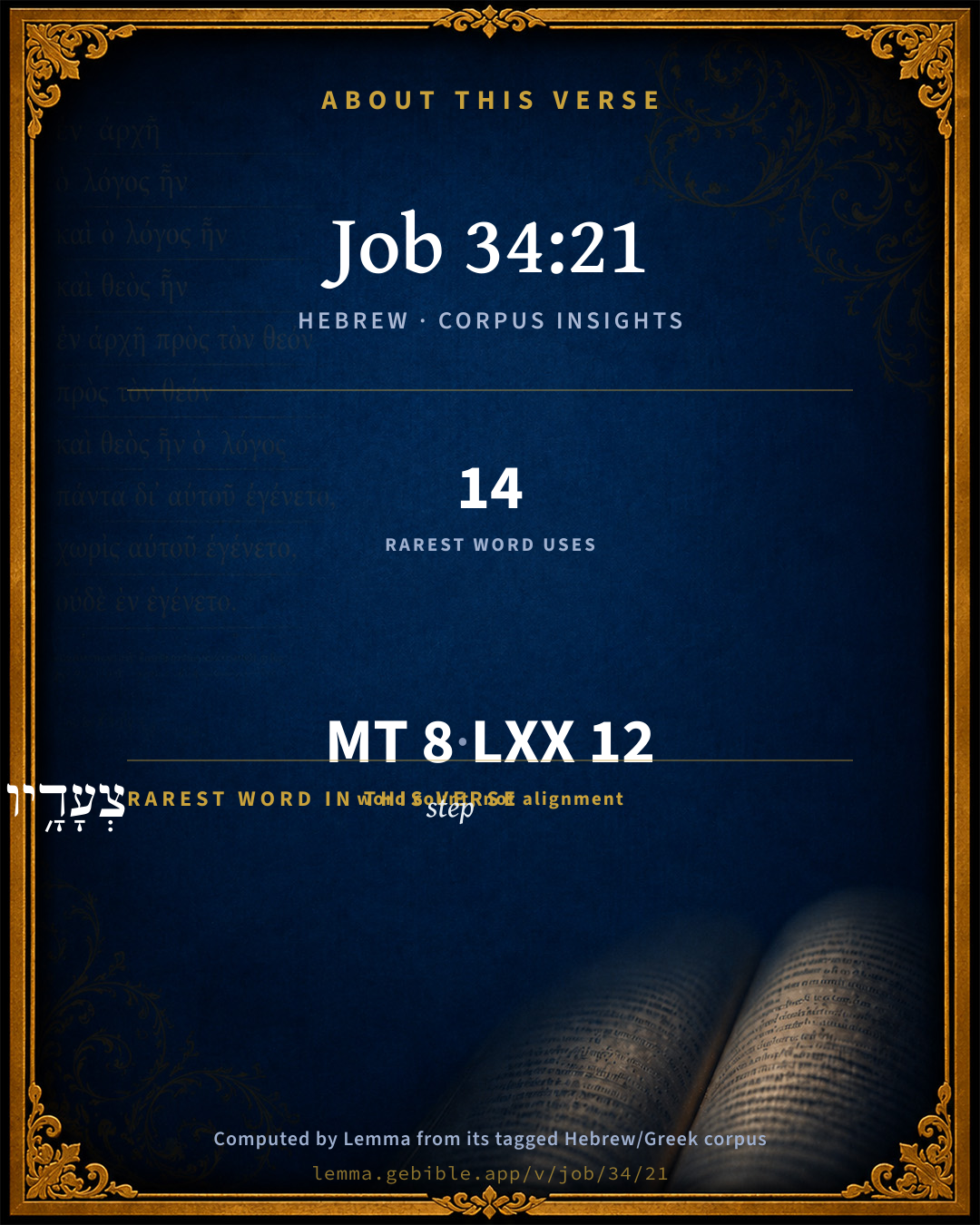
The rarest word here is צְעָדָ֥יו step H6806 — appearing just 14 times in the whole Hebrew Bible.

Shared distinctive vocabulary

צְעָדָ֥יו step H6806 occurs in 14 verses of the Hebrew Bible. Also found in:

Grammatical profile

  • 1 verb
  • 5 nouns
  • 1 preposition
  • 1 conjunction

Verb forms

  • יִרְאֶֽה Qal · Imperfect

Hebrew & Septuagint length

In English translation the verse runs 15 words from the Hebrew and 16 from the Septuagint (LXX English) — closely comparable.

A rough comparison of the two English renderings, which tokenize alike — not a word-level alignment.

Word counts can differ between the Hebrew and the Greek without any difference in meaning — e.g. the Hebrew direct-object marker אֵת has no separate Greek word, and Greek often adds the article ὁ.

In the original languages it is 8 Hebrew tokens and 12 Greek tokens — but the two are counted differently (Hebrew bundles its prefixes and suffixes into one token; the Greek is in lemma form), so that isn’t a like-for-like length.

Cross-references

11

Topical passages linked to Job 34:21 in the Treasury of Scripture Knowledge — connected by theme and wording, ordered by reader-vote popularity; previews shown in the World English Bible.

  • Proverbs 15:3 Yahweh's eyes are everywhere, Keeping watch on the evil and the good.
  • Job 31:4 Doesn't he see my ways, And number all my steps?
  • Proverbs 5:21 For the ways of man are before the eyes of Yahweh. He examines all his paths.
  • Jeremiah 16:17 For my eyes are on all their ways; they are not hidden from my face, neither is their iniquity concealed from my eyes.
  • Jeremiah 32:19 great in counsel, and mighty in work; whose eyes are open on all the ways of the sons of men, to give everyone according to his ways, and according to the fruit of his doings:
  • Psalms 139:23 Search me, God, and know my heart. Try me, and know my thoughts.
  • Genesis 16:13 She called the name of Yahweh who spoke to her, "You are a God who sees," for she said, "Have I even stayed alive after seeing him?"
  • Jeremiah 17:10 I, Yahweh, search the mind, I try the heart, even to give every man according to his ways, according to the fruit of his doings.
  • 2 Chronicles 16:9 For the eyes of Yahweh run back and forth throughout the whole earth, to show himself strong in the behalf of them whose heart is perfect toward him. Herein you have done foolishly; for from henceforth you shall have wars.
  • Psalms 34:15 Yahweh's eyes are toward the righteous. His ears listen to their cry.
  • Amos 9:8 Behold, the eyes of the Lord Yahweh are on the sinful kingdom, and I will destroy it from off the surface of the earth; except that I will not utterly destroy the house of Jacob," says Yahweh.

Cross-references courtesy of OpenBible.info (CC BY 4.0).

Hebrew and Greek witnesses Masoretic Hebrew ↔ Greek Septuagint

The same verse in the two great witnesses to the Old Testament, shown verse-for-verse.

These are two independent witnesses, not word-aligned to each other, and the Septuagint is shown in lemma (dictionary) form.

Hebrew Job 34:21 Masoretic · Westminster Leningrad Codex

כִּי עֵ֭ינָיו עַל דַּרְכֵי אִ֑ישׁ וְֽכָל צְעָדָ֥יו יִרְאֶֽה

"For his eyes are on the ways of a man, He sees all his goings.

World English Bible · Public Domain

Greek LXX Job 34:21 Septuagint · lemma form

αὐτός γάρ ὁρατής εἰμί ἔργον ἄνθρωπος λανθάνω δέ αὐτός οὐδείς ὅς πράσσω

For he surveys the works of men, and nothing of what they do has escaped him.

LXX2012 (modern English Septuagint) · Public Domain

Hebrew: Westminster Leningrad Codex (CC BY 4.0). Greek: Septuagint (public domain); English from LXX2012 (modern English Septuagint) (Public Domain). How the Septuagint differs from the Hebrew →

Commentary

Notes on Job 34:21 from classic Christian and Jewish commentators (each source and its license shown beneath its notes). The classic Christian expositions comment on the surrounding passage and are grouped to its opening verse, so a note may address several verses; the Jewish commentaries on the Tanakh (Rashi and others) are per-verse, so they appear only where the commentator wrote on this verse.

Lemma curates 59 commentaries, every one of them public domain or Creative Commons licensed, each selected and text-cleaned for this edition rather than reprinted as found. About our sources →

Trapp's Complete Commentary

John Trapp

Job 34:21 For his eyes [are] upon the ways of man, and he seeth all his goings.

Ver. 21. For his eyes are upon the ways of man] God’s providence (like a well drawn picture, that eyeth each one in the room) observeth all things; he seeth cause enough thus to proceed in judgment against a person or people, though we see it not. And although one man knoweth not another, nor doth any man well know himself; yet God, following, as it were, all men hard at the heels, doth with his eyes narrowly observe and mark what way every one walketh in, he seeth all his goings: let not men, therefore, please themselves in their sinful practices, as if God saw them not, because for a time they escape unpunished; Saeculi laetitia est impunita nequitia; but sin and punishment are tied together with chains of adamant, and cannot long be asunder.

John Trapp, A Commentary or Exposition upon All the Books of the Old and New Testament (1647–1656) — public domain. Text from a community e-Sword module.

Jamieson, Fausset & Brown

Robert Jamieson, A. R. Fausset & David Brown

God's omniscience and omnipotence enable Him to execute immediate justice. He needs not to be long on the "watch," as Job thought (Job 7:12; Ch2 16:9; Jer 32:19).

Jamieson, Fausset & Brown — Commentary Critical and Explanatory on the Whole Bible (1871) — public domain (CC PDM 1.0). Text via the HelloAO Bible API.

Ellicott's Commentary for English Readers

(21) His eyes are upon the ways of man.—He is not only just and mighty, but He is also all-wise; He cannot therefore err.

A Bible Commentary for English Readers, edited by Charles John Ellicott (1878–1897) — public domain. Text from a community e-Sword module.

The Cambridge Bible for Schools and Colleges

gen. ed. J. J. S. Perowne

21–24. This just rule of God operates unfailingly, being guided by infallible insight.

The Cambridge Bible for Schools and Colleges (gen. ed. J. J. S. Perowne; Cambridge University Press, 1878–1918) — public domain. Text from a community e-Sword module.

John Gill's Exposition

There is no darkness, nor shadow of death, where the workers of iniquity may hide themselves. By whom may be meant chiefly profane sinners that are abandoned to a vicious course of life, and make a trade of sin, or that the common course of their lives; though secret sinners, and even professors of religion, hypocrites, who in a more private manner live in sin, come under this name, Mat 7:23; such may endeavour to hide themselves through shame and fear, but all in vain and to no purpose; there is no screening themselves and their actions from the all-seeing eye of God, and from his wrath and vengeance. "No darkness" of any sort can hide them, not the thick clouds of the heavens, nor the darkness of the night; nor is there any darkness in God that can obstruct his sight of them; nor are they able to cast any mist before his eyes, or use any colourings, pretences, and excuses he cannot see through. "Nor shadow of death": the grossest and thickest darkness; nor is even the grave itself an hiding place for sinners, from whence they will be raised to receive the just deserts of their sins. See Job 10:21. Now from the omniscience of God, and his clear uninterrupted sight of all persons and their actions, inward and outward, Elihu argues to the justice of God, who therefore cannot do anything amiss through ignorance, error, or mistake.

. Now from the omniscience of God, and his clear uninterrupted sight of all persons and their actions, inward and outward, Elihu argues to the justice of God, who therefore cannot do anything amiss through ignorance, error, or mistake.

Job 34:23

job 34:23

job 34:23

job 34:23For he will not lay upon man more than right,.... Neither in a way of duty, his law being holy, just, and good, not any of his commandments grievous, but all his precepts concerning all things right, his yoke easy and his burden light; nor in a way of punishment, always punishing then less than their iniquities deserve; nor in a way of chastisement, suffering nothing to befall his people but what is common to men; and he is faithful to bear them up under it and through it, and to make a way to escape out of it: or the phrase, "than right", being a supplement, may be left out, and the words be connected with what follows,

that he should enter into judgment with God; and the sense is, either that God does not put it on man to go again into judgment with him; he does not suffer him to have a cause heard over again, to appeal from God or to him to have a second hearing; nor is anything to be got by it, he is in one mind, and none can turn him or reverse or get reversed any sentence of his; and therefore it was a piece of weakness in Job to insist so much as he did to have a hearing of his cause before him, since he could not expect there would be any alteration made in his favour: or, as Mr. Broughton reads it, "it is not for men to purpose to enter into judgment before the Omnipotent"; such a purpose is vain, he can never carry his cause against him; it is a piece of weakness to pretend to litigate a point with him: or the sense is, he puts no more on man than to come to him in judgment, so Schultens; he has appointed a person and time to judge the world in righteousness, and all must appear before his tribunal; and everything, thought, word and action, will then and there be brought into an account, and righteous judgment will pass; and therefore, since he has fixed such a method of proceeding, and requires no other, he can never be charged with injustice.

John Gill's Exposition of the Whole Bible (1746–1763) — public domain (CC PDM 1.0). Text via the HelloAO Bible API.

Albert Barnes' Notes on the Bible

For his eyes are upon the ways of man - None can escape from his notice; compare Psa 139:2-3.

Albert Barnes' Notes on the Bible (1834–1885) — public domain. Text from a community e-Sword/MySword module.

Matthew Poole's English Annotations

This is added as the reason of the judgments mentioned in the foregoing verse, God doth not afflict nor destroy either princes or people unjustly, no, nor out of his mere pleasure and absolute sovereignty, (to which Job seemed to impute his calamities,) but for their sins, which God sees exactly, although they use all possible arts and tricks to hide them from him. Therefore no man hath cause to complain of God, but of himself, for all that he may suffer in the world.

Matthew Poole's English Annotations on the Holy Bible (1683–1685) — public domain. Text from a community e-Sword/MySword module.

The Pulpit Commentary

-For his eyes are upon the ways of man, and he seeth all his goings. Elihu proceeds to a fresh argument. The omniscience of God is a security against his acting unjustly. He knows exactly each man"s powers, capacities, temperament, temptations, circumstances He can exactly me, sure each man"s due, and will assuredly mete it out to each without partiality or prejudice.

The Pulpit Commentary (1880–1919), ed. H.D.M. Spence-Jones & Joseph S. Exell — public domain. Text from a community e-Sword module.

John Wesley's Explanatory Notes

For - God doth not destroy either prince or people unjustly, no nor out of his mere pleasure, but for their sins, which he sees exactly, although they use all possible arts to hide them.

John Wesley, Explanatory Notes Upon the Whole Bible (1754–1765) — public domain. Text via the GEBible commentary corpus.

Keil & Delitzsch

C. F. Keil & F. Delitzsch

21 For His eyes are upon the ways of each one,

And He seeth all his steps.

22 There is no darkness nor shadow of death

Wherein the workers of iniquity might hide themselves.

23 For He needeth not long to regard a man

That he may enter into judgment with God.

As the preceding strophe showed that God's creative order excludes all partiality, so this strophe shows that His omniscience qualifies Him to be an impartial judge. He sees everything, nothing can escape His gaze; He sees through man without being obliged to wait for the result of a judicial investigation. שׂים with על does not here signify: to lay upon (Saad., Gecat.), but as Job 37:15, and as with אל (Job 34:14) or בּ (Job 23:6); to direct one's attention (supply לבּו, Job 1:8) towards anything; the fut. has here a modal signification; עוד is used as e.g., Gen 46:29 : again and again, continuously; and in the clause expressive of purpose it is אל־אל (instead of אליו, a very favourite combination used throughout the whole book, Job 5:8; Job 8:5; Job 13:3, and so on) from the human standpoint: He, the all-seeing One, needs not to observe him long that he should enter into judgment with God - He knows him thoroughly before any investigation takes place, which is not said without allusion to Job's vehement longing to be able to appear before God's tribunal.

Keil & Delitzsch — Biblical Commentary on the Old Testament (1861–1891) — public domain (CC PDM 1.0). Text via the HelloAO Bible API. (Old Testament only.)

unfoldingWord translationNotes

Door43 World Missions Community

For God's eyes are upon a person's ways

God's "eyes" represent his sight. The phrase "a person's ways" is an idiom for what he does and how he lives. AT: "For God watches everything a person does" (See: Metonymy and Idiom)

he sees all his steps

This means that he always knows where the person is and where he is going. AT: "he sees him wherever he goes" (See: Assumed Knowledge and Implicit Information)

no darkness, no thick gloom

The words "thick gloom" mean basically the same thing as, and intensify, the word "darkness." (See: Doublet)

in judgment

"so he may judge him" or "to be judged"

translationWords

darkness

iniquity

judge

unfoldingWord translationNotes — © Distant Shores Media and the Door43 World Missions Community, licensed CC BY-SA 4.0. Source: git.door43.org/Door43/en_tn.

Lesson kit

Teaching starters — assembled from the data on this page, not authored interpretation. Every prompt links to the verse data it draws on. Edit before teaching.

Job, in the Wisdom, opens this verse with 8 words (8 distinct Hebrew lemmas). Its most distinctive word is tsaʻad (“step”). A historical commentator’s framing appears above. Read the whole chapter for the surrounding context.

Discussion questions

  1. What does “step” (tsaʻad) contribute to the verse as a whole?
  2. How does 2 Samuel 6:13, which shares the word «step», read alongside this verse?
  3. These translations render this verse differently. What is at stake in choosing one wording over another?
  4. «יִרְאֶֽה» is a Qal Imperfect verb. How does that grammatical form shape the action described?
  5. Compare how Trapp's Complete Commentary and Jamieson, Fausset & Brown read this verse. Where do they agree or differ?

Things to notice

Reading settings

Reading text

Shown beneath each verse's original-language words.

Old Testament
Old Testament edition

Read the OT as the Masoretic Hebrew (MT) or the Greek Septuagint (LXX).

English shown for the Greek Septuagint (in the Hebrew ↔ Greek comparison).

Comparing translations? Open the Compare panel on any verse page to stack up to four side by side.