
Ezekiel 16:31

Hebrew (Westminster Leningrad Codex) Ezekiel 16:31 appears in the Hebrew Old Testament. The text above is from the Westminster Leningrad Codex. Each word links to its Strong’s number, a concise gloss, and parsing drawn from the Open Scriptures Hebrew Bible morphology. Click any word for its full Brown-Driver-Briggs (BDB) entry.
Download image
Cite this verse

Ezekiel 16:31 (World English Bible). Public Domain. Lemma interlinear Bible study tool, https://lemma.gebible.app/v/ezekiel/16/31.

Show BibTeX & RIS
BibTeX
RIS
English Translation
in that you build your vaulted place at the head of every way, and make your lofty place in every street, and have not been as a prostitute, in that you scorn pay.
World English Bible · Public Domain
Download a study sheet

One document with this verse’s original text, its word-by-word gloss line, the meaning frame, cross-references with their text, attributed commentary, and full source and license credits — printable, and it pastes into notes with its structure intact.

This verse Autodidact and up

Study sheet (.html) Plain text (.txt)

A passage Seminary Student

Up to 50 verses in one chapter. A passage sheet keeps up to 6 commentary sources and 12 cross-references per verse, in the order this page ranks them, and says so on the sheet whenever that leaves anything out. Ask for a single verse and you get the Autodidact verse sheet above.

Everything on this page stays free to read, with no account — the sheet is a download of what is already on screen, not access to it.

Want to remove ads? Support Godless Engineer
Compare translations 3

The same verse in 3 English versions, stacked beneath the original-language interlinear above. Click any original word for its lexicon entry.

Each is an independent rendering of the whole verse — the interlinear is not word-aligned to these translations.

Highlighted words mark where these versions differ — a whole-verse word diff, not a word-by-word alignment.

  • World English Bible Public Domain
    in that you build your vaulted place at the head of every way, and make your lofty place in every street, and have not been as a prostitute, in that you scorn pay.
  • King James Version Public Domain
    In that thou buildest thine eminent place in the head of every way, and makest thine high place in every street; and hast not been as an harlot, in that thou scornest hire;
  • unfoldingWord Literal Text CC BY-SA 4.0
    You have built your mounds at the head of every street and made your lofty shrines in every public square. Yet you were not like a prostitute because you scoffed at taking payment.

unfoldingWord Literal Text — © unfoldingWord, licensed CC BY-SA 4.0. Word-aligned USFM3 via Door43 (git.door43.org/unfoldingWord/en_ult).

Versions to compare (up to 4)

3 of 4 selected

Show all 18 translations

Every available English version of this verse, each an independent rendering of the whole verse.

  • World English Bible Public Domain
    in that you build your vaulted place at the head of every way, and make your lofty place in every street, and have not been as a prostitute, in that you scorn pay.
  • Berean Standard Bible Public Domain
    But when you built your mounds at the head of every street and made your lofty shrines in every public square, you were not even like a prostitute, because you scorned payment.
  • Majority Standard Bible Public Domain
    But when you built your mounds at the head of every street and made your lofty shrines in every public square, you were not even like a prostitute, because you scorned payment.
  • King James Version Public Domain
    In that thou buildest thine eminent place in the head of every way, and makest thine high place in every street; and hast not been as an harlot, in that thou scornest hire;
  • American Standard Version (1901) Public Domain
    in that thou buildest thy vaulted place at the head of every way, and makest thy lofty place in every street, and hast not been as a harlot, in that thou scornest hire.
  • Revised Version (1885) Public Domain
    in that thou buildest thine eminent place in the head of every way, and makest thy lofty place in every street; and hast not been as an harlot, in that thou scornest hire.
  • Geneva Bible (1599) Public Domain
    In that thou buildest thine hie place in the corner of euery way, and makest thine hie place in euery streete, and hast not bene as an harlot that despiseth a reward,
  • Douay-Rheims (1899) Public Domain
    Because thou hast built thy brothel house at the head of every way, and thou hast made thy high place in every street: and wast not as a harlot that by disdain enhanceth her price,
  • Young's Literal Translation Public Domain
    In thy building thine arch at the head of every way, Thy high place thou hast made in every broad place, And -- hast not been as a whore deriding a gift.
  • Literal Standard Version CC BY-SA 4.0
    In your building your arch at the head of every way, || You have made your high place in every broad place, || And have not been as a whore deriding a wage.
  • Unlocked Literal Bible CC BY-SA 4.0
    You have built your high places at the head of every street and made your vaulted chamber in every public place. Yet you were not like a prostitute because you refused to take payment.
  • unfoldingWord Literal Text CC BY-SA 4.0
    You have built your mounds at the head of every street and made your lofty shrines in every public square. Yet you were not like a prostitute because you scoffed at taking payment.
  • Darby Bible Public Domain
    in that thou buildest thy place of debauchery at the head of every way, and makest thy high place in every street! And thou hast not been as a harlot, in that thou scornest reward,
  • World Messianic Bible Public Domain
    in that you build your vaulted place at the head of every way, and make your lofty place in every street, and have not been as a prostitute, in that you scorn pay.
  • Webster's Bible Public Domain
    In that thou buildest thy eminent place in the head of every way, and makest thy high place in every street; and hast not been as a harlot, in that thou scornest hire;
  • Free Bible Version CC BY-SA 4.0
    Actually you weren't even a normal prostitute when you built yourselves pagan shrines at the top of every street and high places of idol worship on every public square—because you refused to be paid for your services!
  • Bible in Basic English Public Domain
    For you have made your arched room at the top of every street, and your high place in every open place; though you were not like a loose woman in getting together your payment.
  • JPS Tanakh (1917) Public Domain
    in that thou buildest thine eminent place in the head of every way, and makest thy lofty place in every street; and hast not been as a harlot that enhanceth her hire.

Literal Standard Version (2020), Covenant Press — licensed CC BY-SA 4.0. Text via the HelloAO Bible API (eBible.org). Unlocked Literal Bible (unfoldingWord) — licensed CC BY-SA 4.0. Text via the HelloAO Bible API (eBible.org). unfoldingWord Literal Text — © unfoldingWord, licensed CC BY-SA 4.0. Word-aligned USFM3 via Door43 (git.door43.org/unfoldingWord/en_ult). Free Bible Version, Dr. Jonathan Gallagher — licensed CC BY-SA 4.0. Text via the HelloAO Bible API (eBible.org).

Word by word

More ways to search: Search by grammar → Find every occurrence → Compare this word →

Practice this passage: Drill this verse → Learn its vocabulary →

לְקַלֵּ֥ס
qâlaç
H7046
“to mock”
Preposition + Verb, Piel, Infinitive Construct
Part of Speech
Preposition + Verb
Stem
Piel
Form
Infinitive Construct
Full BDB Definition

Origin: a primitive root

TWOT: 2029

to mock, scoff - (Piel) to scoff at - (Hithpael) to mock, deride, make fun of
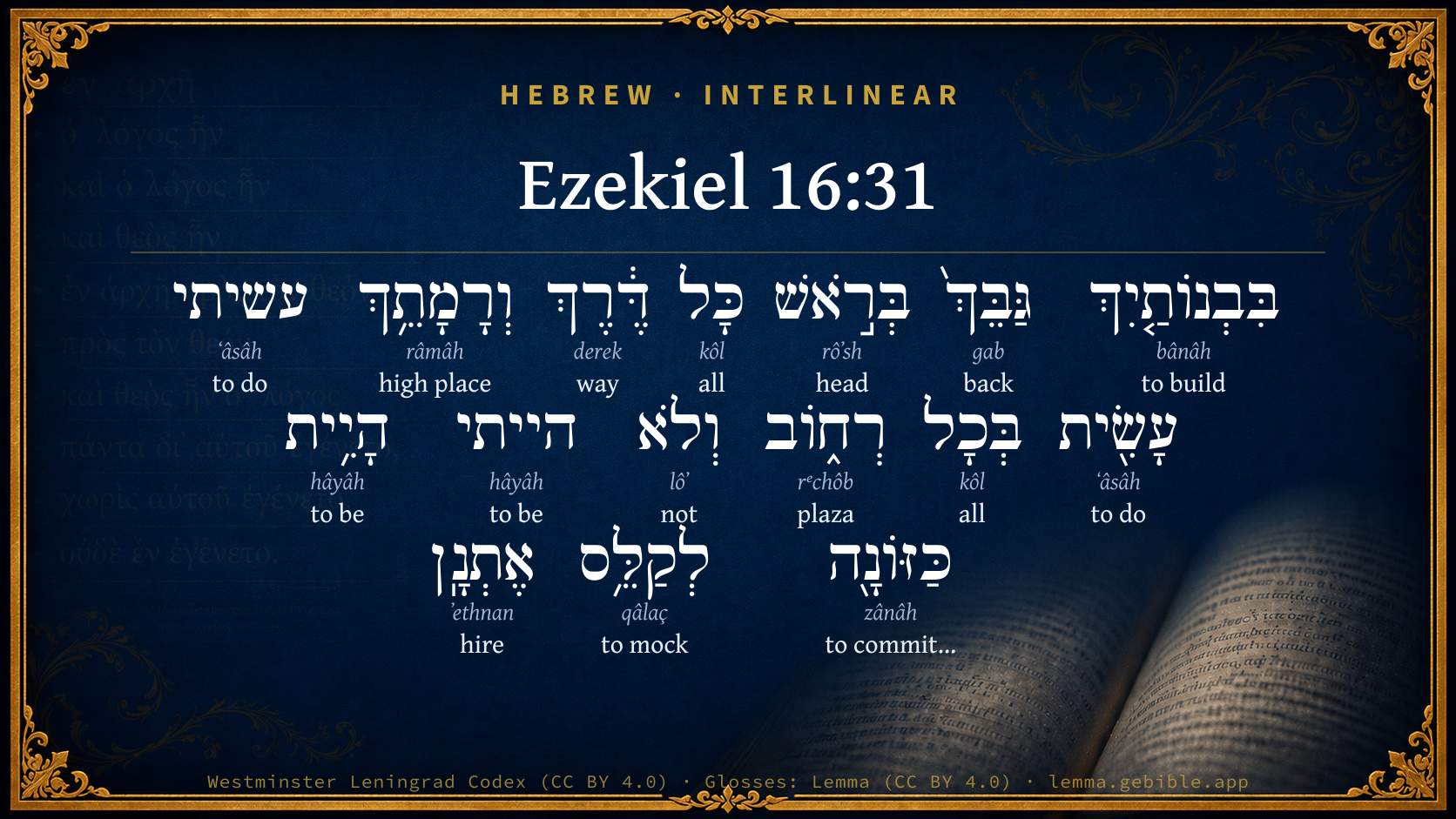
  1. בִּבְנוֹתַ֤יִךְ bânâh H1129 “in/at · to build · you” Preposition + Verb, Qal, Infinitive Construct + Suffix, Personal, 2nd Person, Feminine, Singular
  2. גַּבֵּךְ֙ gab H1354 “back · your” Noun, Common, Both, Singular, Construct + Suffix, Personal, 2nd Person, Feminine, Singular
  3. בְּרֹ֣אשׁ rôʼsh H7218 “in/at · head of” Preposition + Noun, Common, Masculine, Singular, Construct
  4. כָּל kôl H3605 “all of” Noun, Common, Masculine, Singular, Construct
  5. דֶּ֔רֶךְ derek H1870 “way” Noun, Common, Both, Singular, Absolute
  6. וְרָמָתֵ֥ךְ râmâh H7413 “and · high place · your” Conjunction + Noun, Common, Feminine, Singular, Construct + Suffix, Personal, 2nd Person, Feminine, Singular
  7. עשיתי ʻâsâh H6213 “to do” Verb, Qal, Perfect, 2nd Person, Feminine, Singular
  8. עָשִׂ֖ית ʻâsâh H6213 “to do” Verb, Qal, Perfect, 2nd Person, Feminine, Singular
  9. בְּכָל kôl H3605 “in/at · all of” Preposition + Noun, Common, Masculine, Singular, Construct
  10. רְח֑וֹב rᵉchôb H7339 “plaza” Noun, Common, Feminine, Singular, Absolute
  11. וְלֹא lôʼ H3808 “and · not” Conjunction + Particle, Negative
  12. הייתי hâyâh H1961 “to be” Verb, Qal, Perfect, 2nd Person, Feminine, Singular
  13. הָיִ֥ית hâyâh H1961 “to be” Verb, Qal, Perfect, 2nd Person, Feminine, Singular
  14. כַּזּוֹנָ֖ה zânâh H2181 “like/as the · committing fornication” Preposition, Determined + Verb, Qal, Participle Active, Feminine, Singular, Absolute
  15. אֶתְנָֽן ʼethnan H868 “hire” Noun, Common, Masculine, Singular, Absolute

About this verse

These counts appear in no published source. They are computed here, from the morphology-tagged text and Lemma’s own curated glosses. What Lemma adds →

16
words
13
distinct lemmas
Prophets
section

Notable vocabulary

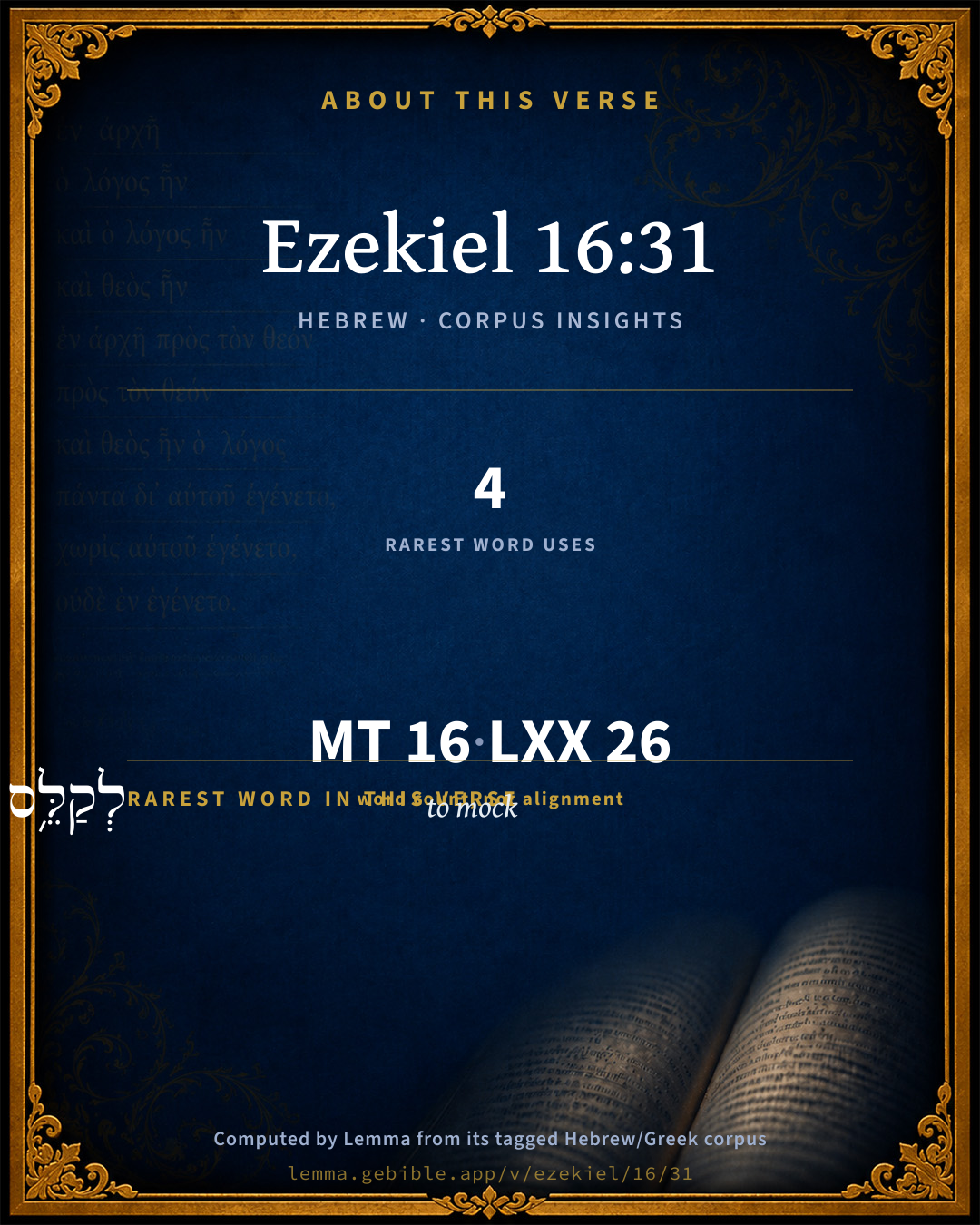
The rarest word here is לְקַלֵּ֥ס to mock H7046 — appearing just 4 times in the whole Hebrew Bible.

Shared distinctive vocabulary

לְקַלֵּ֥ס to mock H7046 occurs in 4 verses of the Hebrew Bible. Also found in:

Grammatical profile

  • 7 verbs
  • 8 nouns
  • 1 particle

Verb forms

  • בִּבְנוֹתַ֤יִךְ Qal · Infinitive Construct
  • עשיתי Qal · Perfect
  • עָשִׂ֖ית Qal · Perfect
  • הייתי Qal · Perfect
  • הָיִ֥ית Qal · Perfect
  • כַּזּוֹנָ֖ה Qal · Participle Active
  • לְקַלֵּ֥ס Piel · Infinitive Construct

Repetition

Words recur within this verse — often emphatic in Hebrew:

  • כָּל all H3605 ×2
  • עשיתי to do H6213 ×2
  • הייתי to be H1961 ×2

Hebrew & Septuagint length

In English translation the verse runs 33 words from the Hebrew and 32 from the Septuagint (LXX English) — closely comparable.

A rough comparison of the two English renderings, which tokenize alike — not a word-level alignment.

Word counts can differ between the Hebrew and the Greek without any difference in meaning — e.g. the Hebrew direct-object marker אֵת has no separate Greek word, and Greek often adds the article ὁ.

In the original languages it is 16 Hebrew tokens and 26 Greek tokens — but the two are counted differently (Hebrew bundles its prefixes and suffixes into one token; the Greek is in lemma form), so that isn’t a like-for-like length.

Cross-references

5

Topical passages linked to Ezekiel 16:31 in the Treasury of Scripture Knowledge — connected by theme and wording, ordered by reader-vote popularity; previews shown in the World English Bible.

  • Isaiah 52:3 For thus says Yahweh, You were sold for nothing; and you shall be redeemed without money.
  • Ezekiel 16:33–34 They give gifts to all prostitutes; but you give your gifts to all your lovers, and bribe them, that they may come to you on every side for your prostitution.
  • Ezekiel 16:24–25 that you have built to you a vaulted place, and have made you a lofty place in every street.
  • Ezekiel 16:39 I will also give you into their hand, and they shall throw down your vaulted place, and break down your lofty places; and they shall strip you of your clothes, and take your beautiful jewels; and they shall leave you naked and bare.
  • Hosea 12:11 If Gilead is wicked, Surely they are worthless. In Gilgal they sacrifice bulls. Indeed, their altars are like heaps in the furrows of the field.

Cross-references courtesy of OpenBible.info (CC BY 4.0).

Hebrew and Greek witnesses Masoretic Hebrew ↔ Greek Septuagint

The same verse in the two great witnesses to the Old Testament, shown verse-for-verse.

These are two independent witnesses, not word-aligned to each other, and the Septuagint is shown in lemma (dictionary) form.

Hebrew Ezekiel 16:31 Masoretic · Westminster Leningrad Codex

בִּבְנוֹתַ֤יִךְ גַּבֵּךְ֙ בְּרֹ֣אשׁ כָּל דֶּ֔רֶךְ וְרָמָתֵ֥ךְ עשיתי עָשִׂ֖ית בְּכָל רְח֑וֹב וְלֹא הייתי הָיִ֥ית כַּזּוֹנָ֖ה לְקַלֵּ֥ס אֶתְנָֽן

in that you build your vaulted place at the head of every way, and make your lofty place in every street, and have not been as a prostitute, in that you scorn pay.

World English Bible · Public Domain

Greek LXX Ezekiel 16:31 Septuagint · lemma form

ἐν ὁ θυγάτηρ σύ ὁ πορνεῖον σύ οἰκοδομέω ἐπί πᾶς ἀρχή ὁδός καί ὁ βάσις σύ ποιέω ἐν πᾶς πλατύς καί γίγνομαι ὡς πόρνη συνἄγω μίσθωμα

You have built a house of harlotry in every top of a way, and have set up your high place in every street; and you did become as a harlot gathering hires.

LXX2012 (modern English Septuagint) · Public Domain

On this verse, Haydock's Catholic Bible Commentary discusses the Septuagint’s reading. Read the note in Commentary ↓

Hebrew: Westminster Leningrad Codex (CC BY 4.0). Greek: Septuagint (public domain); English from LXX2012 (modern English Septuagint) (Public Domain). How the Septuagint differs from the Hebrew →

Targum (Aramaic paraphrase)

1

The Targum is the ancient Jewish Aramaic paraphrase of the Hebrew Scriptures — an interpretive translation, not the Hebrew text itself. Onkelos (literal) and Pseudo-Jonathan (expansive) render the Torah, and Jonathan the Prophets. Coverage is partial: where no permissively-licensed English translation exists for a verse, only the Aramaic is shown. This is verse-level text, not a word-by-word alignment to the Hebrew.

  1. Targum Jonathan Prophets (Joshua–Malachi)
    בְמִבְנָךְ אֱגוֹרָךְ בְּרֵישׁ כָּל פָּרָשׁוּת אוֹרַח וְרָמָתֵךְ עֲבַדְתְּ בְּכָל רְחוֹב וְלָא הֲוֵית כְּנַפְקַת בָּרָא דְמִתְהַנְיָא בְּאַגְרָא:

    (no public-domain English translation for this verse)

    Targum Jonathan — Aramaic: “Mikraot Gedolot” (public domain). English: “Sefaria Community Translation” (CC0 1.0 (public-domain dedication)); “London "Chaldee Paraphrase," 1871” (public domain). Text via Sefaria.

Commentary

Notes on Ezekiel 16:31 from classic Christian and Jewish commentators (each source and its license shown beneath its notes). The classic Christian expositions comment on the surrounding passage and are grouped to its opening verse, so a note may address several verses; the Jewish commentaries on the Tanakh (Rashi and others) are per-verse, so they appear only where the commentator wrote on this verse.

Lemma curates 59 commentaries, every one of them public domain or Creative Commons licensed, each selected and text-cleaned for this edition rather than reprinted as found. About our sources →

Trapp's Complete Commentary

John Trapp

Eze 16:31 In that thou buildest thine eminent place in the head of every way, and makest thine high place in every street; and hast not been as an harlot, in that thou scornest hire;

Ver. 31. And hast not been as an harlot, in that thou scornsst hire.] Whore should be written hore, as coming from the word hire; as the Latin meretrix a merendo. Harlot is said to come of Arlet, mother to our William the Conqueror; in spite to whom, and disgrace to his mother, the English called all whores harlots, adding an aspiration to her name, according to their manner of pronouncing.

John Trapp, A Commentary or Exposition upon All the Books of the Old and New Testament (1647–1656) — public domain. Text from a community e-Sword module.

Geneva Bible (1599)

Geneva Bible translators

Meaning, that some harlots contemn small rewards, but no lovers gave a reward to Israel, but they gave to all others: signifying that the idolaters bestow all their substance, which they receive of God for his glory, to serve their vile abominations.

Geneva Bible (1599) marginal notes — public domain. Text via Bolls.life.

Jamieson, Fausset & Brown

Robert Jamieson, A. R. Fausset & David Brown

Repetition of Eze 16:24.

not . . . as . . . harlot . . . thou scornest hire--Unlike an ordinary harlot thou dost prostitute thy person gratis, merely to satisfy thy lust. JEROME translates, "Thou hast not been as a harlot in scorning (that is, who ordinarily scorns) a hire offered," in order to get a larger one: nay, thou hast offered hire thyself to thy lovers (Eze 16:33-34). But these verses show English Version to be preferable, for they state that Israel prostituted herself, not merely for any small reward without demanding more, but for "no reward."

Jamieson, Fausset & Brown — Commentary Critical and Explanatory on the Whole Bible (1871) — public domain (CC PDM 1.0). Text via the HelloAO Bible API.

John Calvin's Commentaries

Here the Prophet again reproves the superstitions to which the Jews had devoted themselves: but yet he speaks figuratively, because by high places he does not simply mean altars, but tents by which the Jews had attempted to entice their neighbors: just as if an immodest female should choose a high place, and build her couch there conspicuously to attract her followers. Although therefore he inveighs against superstitions, the language is not simple, but retains the same simile as had been previously used. He says that the Jews were so prone to lust, that they were ostentatious and thought followers from a distance, and erected their tents or couches in high places. Since this has been treated before, I now pass it over slightly. But we may remark that a thing which seems of slight importance is here seriously condemned by the Prophet, whence we may learn that the worship of God is not to be estimated by our natural perception. For who would think it so great a crime to build an altar on a high place to God’s honor? but we see that the Prophet abhors that superstition. Since therefore God wishes nothing to be changed in his worship, as the principal part of his worship is obedience, which he prefers to all sacrifices, (1 Samuel 15:22,) let us learn that things which we might tolerate ought to be detested by us, because God condemns them so severely.

Since therefore you have erected and made for thyself a high place at the head of all streets and paths, that is in every celebrated place. Here we see how ardently they were enflamed by idolatry so as to provoke the anger of God, and this seemed unworthy of them, as the papists at this day, who are bent upon idol worship, and under the title of “devotion,” think that any vice both can and ought to be excused before God. But, on the other side, the Holy Spirit says that idolaters sin the more grievously in being so eager for those impure rites. He says, thou wast not like a harlot in despising hire Some explain this coldly, that harlots mentally despise the folly of those who reward them, but this comment is incorrect: the other view is more probable, namely, that the Jews were not like a harlot who despises the bribe by which she is deceived: for by this craftiness they gain most influence when they contemptuously despise what is offered them, and scarcely deign to touch it: they do this that the wretched lover may not think himself sufficiently liberal, and so may double his gift and squander away all his goods. This passage then may mean that the people were not like a harlot who despises her reward that the wretched lover may feel ashamed and increase his offer. But the Prophet’s sense seems to me different, though I do not altogether reject this. I interpret it thus: the Jews were not like a harlot, since they despised any reward for their sin, and harlots do not: they make a gain of their lusts, whence the name they bear. Since then such persons sell themselves for reward, the Prophet say’s that the Jews were not like them: how so? because they despised reward, and through the mere desire of gratifying their appetites, they neither asked nor expected any reward. Afterwards it follows —

John Calvin's Commentaries (1540-1563) — public domain. Text from the Calvin Translation Society English edition (1840s-50s) via the Christian Classics Ethereal Library (ccel.org). Calvin's coverage is partial (roughly two-thirds of the Bible); uncommented books and verses are honest gaps, never fabricated. The 19th-century editor's footnotes and remarks are omitted so the notes are faithfully Calvin's own voice.

Ellicott's Commentary for English Readers

(31) Eminent place.—See note on Eze_16:24.

In that thou scornest him.—It was characteristic of both the kingdoms of Israel after the division, that the interference of foreign nations in their affairs was generally sought first by Israel itself and purchased at a heavy price. The people were so situated on the great highway between the rival nations of Egypt and Assyria, that their friendship ought to have been of value to either of them, and to have been sought with great inducements. But Israel, in its weakness and wickedness, more than threw itself away and purchased its own ruin. The particulars mentioned in this verse belong to the past rather than to the present, and all the tenses should be so translated.

A Bible Commentary for English Readers, edited by Charles John Ellicott (1878–1897) — public domain. Text from a community e-Sword module.

The Cambridge Bible for Schools and Colleges

gen. ed. J. J. S. Perowne

31. Recapitulation of the acts done in her unbridled licentiousness, with the addition of a trait shewing that her dissoluteness was without parallel—other harlots take hire, she gives it.

in that thou scornest hire] Rather: hast not been as an harlot, that scoffeth at her hire (R.V. marg.), lit. in scoffing at hire. The words describe a characteristic of harlots, not one of Jerusalem in which she is unlike them. On scoff or “mock at,” cf. ch. Eze_22:5; 2Ki_2:23; Hab_1:10; Psa_44:14; Jer_20:8, &c. The harlot mocks at her hire in order to augment it; Jerusalem does not desire hire, she rather offers it (Eze_16:33).

The Cambridge Bible for Schools and Colleges (gen. ed. J. J. S. Perowne; Cambridge University Press, 1878–1918) — public domain. Text from a community e-Sword module.

John Gill's Exposition

But as a wife that committeth adultery,.... Who has a husband, and is provided for with all the necessaries of life, with food and clothing; and so has no need to prostitute herself for a livelihood, as common strumpets do; but does it purely for the satiating of her lust: and such were the people of the Jews, they were married to the Lord, who took care of them, and provided everything for them, and acted the part of a husband to them; so that it was the weakness of their hearts, and the strength of their corruptions, which led them to depart from him, and commit idolatry; which in them was adultery, while the sin of the Gentiles was as simple fornication:

which taketh strangers instead of her husband; that takes other men into her bed instead of her husband, not for the sake of gain, but lust; and this was the case of the Jews, who were a wicked people, an idolatrous generation; who took strange gods to worship instead of the true God, who had been a husband to them, Jer 31:32.

John Gill's Exposition of the Whole Bible (1746–1763) — public domain (CC PDM 1.0). Text via the HelloAO Bible API.

Albert Barnes' Notes on the Bible

Rather, didst build - didst make - wast not - scornest. In the marginal rendering, “thy daughters” must mean “thy smaller cities or villages.”

Albert Barnes' Notes on the Bible (1834–1885) — public domain. Text from a community e-Sword/MySword module.

Haydock's Catholic Bible Commentary

Price, before she will yield, (Haydock) or who follow such practices for a livelihood. (Calmet) --- Hebrew, "in that thou scornest hire." (Protestants) Septuagint, "gathering rewards." The difference consisted in Jerusalem’s sinning through mere wantonness, and even to her loss.

George Leo Haydock (1774–1849), Haydock's Catholic Family Bible and Commentary, 1859 edition — public domain. Excludes Psalms (Douay-Rheims chapter numbering differs from Protestant) and Deuterocanonical books (Catholic canon only).

Matthew Poole's English Annotations

Thou buildest; see Eze 16:24; whereas the paramours of other lewd women build for them, as it is reported of Solomon, 1Ki 11:7,8. Here, on the contrary, this unfaithful nation forsake their God, commit fornication with strange gods, and bear the charges both of building their temples, and furnishing them with sacrifices, and maintaining the priests.

Thine eminent place: see Eze 16:24.

Every way: see Eze 16:25.

In every street: see Eze 16:24. Hast not been as an harlot; common harlots make gain of their looseness, and live by that gain, they make a prey of the men that come in to them; thou doest worse, thou lavishest out thy credit, wealth, and all, to maintain and please thine adulterers. Scornest; the Hebrew word is of two significations, and opposite to each other, for it bears, as our translation renders it, contempt, slighting, or disregarding; and so it suiteth with what follows, Eze 16:32-34. It signifieth also to praise, value, and regard, as Buxtorf observes; and it will as well, if not better, be so rendered here, and be the character of a common harlot, which wandereth after her lovers with a design of receiving the rewards of her lewdness; and thus the Chaldee paraphrase reads it; so we shall need no parenthesis, nor begin the antithesis till the 32nd verse.

Matthew Poole's English Annotations on the Holy Bible (1683–1685) — public domain. Text from a community e-Sword/MySword module.

Whedon's Commentary on the Bible

Daniel D. Whedon

31. In that thou scornest hire — Literally, in scoffing at [her] hire. The ordinary prostitute scoffs at the first sum offered her and waits for a larger inducement, but this insatiable woman actually pays hire instead of receiving it (Eze_16:33-34; see also 2Ki_16:8). The meaning is that she prizes foreign alliances and religions far more than these foreigners prize hers.

Daniel D. Whedon (gen. ed.), Commentary on the Old and New Testaments (1874–1909) — public domain. Text from a community e-Sword module.

The Pulpit Commentary

In that, etc. It is better to take the words as beginning a fresh sentence: "when thou didst build," etc. The historical survey of the harlot"s progress is brought to a close, and the prophet points with bitter scorn to what aggravated its degradation. Other nations, like Tyre and Zidon, had risen to prosperity and eminence through their intercourse with foreigners. To Judah it had brought only subjection and the payment of tribute. She had given gifts to all her lovers, instead of receiving from them the rewards of her shame. She was as the adulterous wife who forsakes her husband, and gives what belonged to him to strangers. The conduct of Ahaz in stripping the Temple of its gold and silver to pay tribute to Assyria, (2Ki_16:8) gives an apt illustration of what the prophet means. (comp. Hos_12:1; Isa_30:6)

The Pulpit Commentary (1880–1919), ed. H.D.M. Spence-Jones & Joseph S. Exell — public domain. Text from a community e-Sword module.

John Wesley's Explanatory Notes

Not as an harlot - Common harlots make gain of their looseness, and live by that gain; thou dost worse, thou lavishest out thy credit, wealth, and all, to maintain thine adulterers.

John Wesley, Explanatory Notes Upon the Whole Bible (1754–1765) — public domain. Text via the GEBible commentary corpus.

Rashi

Rabbi Shlomo Yitzchaki (Rashi)

When you build your eminent place Heb. בִּבְנוֹתַיִךּ, like בִּבְנוֹתֵךּ, from the word for building.

to boast of a hire Heb. לְּקַלֵס, to speak and to boast of the fine hire that they give her. Similarly, every form of קֶלֶס is an expression of speech, parliz in Old French, boastful, empty talk.

hire Heb. אֶתְנַן, an expression for hire, loyez in old French.

Rashi on the Tanakh — English translations: “The Judaica Press complete Tanach with Rashi, translated by A. J. Rosenberg” (CC BY 4.0); “Pentateuch with Rashi's commentary by M. Rosenbaum and A.M. Silbermann, 1929-1934” (public domain); “The Metsudah Tanach series, Lakewood, N.J” (CC BY 4.0); and “The Book of Joshua, Metsudah Publications, 1997” (CC BY 4.0). Text via Sefaria.

Lesson kit

Teaching starters — assembled from the data on this page, not authored interpretation. Every prompt links to the verse data it draws on. Edit before teaching.

Ezekiel, in the Prophets, opens this verse with 16 words (13 distinct Hebrew lemmas). Its most distinctive word is qâlaç (“to mock”). A historical commentator’s framing appears above. Read the whole chapter for the surrounding context.

Discussion questions

  1. How does “to mock” (qâlaç) shape what this verse is saying?
  2. 2 Kings 2:23 shares the word «to mock» with this verse. How do the two illuminate each other?
  3. “all” occurs 2× in this one verse. What is the effect of the repetition?
  4. The translations on this page render this verse differently — a whole-verse word diff, not a word-by-word alignment. What might account for the different wordings?
  5. The verb «בִּבְנוֹתַ֤יִךְ» is Qal Infinitive Construct. How does its form color the action?
  6. Reading how Trapp's Complete Commentary and Geneva Bible (1599) read this verse, where do the two commentators agree and where do they part?

Things to notice

Reading settings

Reading text

Shown beneath each verse's original-language words.

Old Testament
Old Testament edition

Read the OT as the Masoretic Hebrew (MT) or the Greek Septuagint (LXX).

English shown for the Greek Septuagint (in the Hebrew ↔ Greek comparison).

Comparing translations? Open the Compare panel on any verse page to stack up to four side by side.