Ezekiel 18:25

Hebrew (Westminster Leningrad Codex) Ezekiel 18:25 appears in the Hebrew Old Testament. The text above is from the Westminster Leningrad Codex. Each word links to its Strong’s number, a concise gloss, and parsing drawn from the Open Scriptures Hebrew Bible morphology. Click any word for its full Brown-Driver-Briggs (BDB) entry.
Download image
Cite this verse

Ezekiel 18:25 (World English Bible). Public Domain. Lemma interlinear Bible study tool, https://lemma.gebible.app/v/ezekiel/18/25.

Show BibTeX & RIS
BibTeX
RIS
English Translation
Yet you say, The way of the Lord is not equal. Hear now, house of Israel: Is my way not equal? Aren't your ways unequal?
World English Bible · Public Domain
Download a study sheet

One document with this verse’s original text, its word-by-word gloss line, the meaning frame, cross-references with their text, attributed commentary, and full source and license credits — printable, and it pastes into notes with its structure intact.

This verse Autodidact and up

Study sheet (.html) Plain text (.txt)

A passage Seminary Student

Up to 50 verses in one chapter. A passage sheet keeps up to 6 commentary sources and 12 cross-references per verse, in the order this page ranks them, and says so on the sheet whenever that leaves anything out. Ask for a single verse and you get the Autodidact verse sheet above.

Everything on this page stays free to read, with no account — the sheet is a download of what is already on screen, not access to it.

Want to remove ads? Support Godless Engineer
Compare translations 3

The same verse in 3 English versions, stacked beneath the original-language interlinear above. Click any original word for its lexicon entry.

Each is an independent rendering of the whole verse — the interlinear is not word-aligned to these translations.

Highlighted words mark where these versions differ — a whole-verse word diff, not a word-by-word alignment.

  • World English Bible Public Domain
    Yet you say, The way of the Lord is not equal. Hear now, house of Israel: Is my way not equal? Aren't your ways unequal?
  • King James Version Public Domain
    Yet ye say, The way of the LORD is not equal. Hear now, O house of Israel; Is not my way equal? are not your ways unequal?
  • unfoldingWord Literal Text CC BY-SA 4.0
    But you say, ‘The way of the Lord is not fair!’ Listen, house of Israel! Are my ways unfair? Is it not your ways that are unfair?

unfoldingWord Literal Text — © unfoldingWord, licensed CC BY-SA 4.0. Word-aligned USFM3 via Door43 (git.door43.org/unfoldingWord/en_ult).

Versions to compare (up to 4)

3 of 4 selected

Show all 18 translations

Every available English version of this verse, each an independent rendering of the whole verse.

  • World English Bible Public Domain
    Yet you say, The way of the Lord is not equal. Hear now, house of Israel: Is my way not equal? Aren't your ways unequal?
  • Berean Standard Bible Public Domain
    Yet you say, ‘The way of the Lord is not just.’ Hear now, O house of Israel: Is it My way that is unjust? Is it not your ways that are unjust?
  • Majority Standard Bible Public Domain
    Yet you say, ‘The way of the Lord is not just.’ Hear now, O house of Israel: Is it My way that is unjust? Is it not your ways that are unjust?
  • King James Version Public Domain
    Yet ye say, The way of the LORD is not equal. Hear now, O house of Israel; Is not my way equal? are not your ways unequal?
  • American Standard Version (1901) Public Domain
    Yet ye say, The way of the Lord is not equal. Hear now, O house of Israel: Is not my way equal? are not your ways unequal?
  • Revised Version (1885) Public Domain
    Yet ye say, The way of the Lord is not equal. Hear now, O house of Israel: Is not my way equal? are not your ways unequal?
  • Geneva Bible (1599) Public Domain
    Yet ye say, The way of the Lord is not equall: heare now, O house of Israel. Is not my way equall? or are not your wayes vnequall?
  • Douay-Rheims (1899) Public Domain
    And you have said: The way of the Lord is not right. Hear ye, therefore, O house of Israel: Is it my way that is not right, and are not rather your ways perverse?
  • Young's Literal Translation Public Domain
    And ye have said, Not pondered is the way of the Lord. Hear, I pray you, O house of Israel, My way -- is it not pondered? Are not your ways unpondered?
  • Literal Standard Version CC BY-SA 4.0
    And you have said, The way of the Lord is not pondered. Now hear, O house of Israel, || My way—is it not pondered? Are not your ways unpondered?
  • Unlocked Literal Bible CC BY-SA 4.0
    But you say, 'The way of the Lord is not fair!' Listen, house of Israel! Are my ways unfair? Is it not your ways that are unfair?
  • unfoldingWord Literal Text CC BY-SA 4.0
    But you say, ‘The way of the Lord is not fair!’ Listen, house of Israel! Are my ways unfair? Is it not your ways that are unfair?
  • Darby Bible Public Domain
    And ye say, The way of the Lord is not equal. Hear then, house of Israel. Is not my way equal? are not your ways unequal?
  • World Messianic Bible Public Domain
    “Yet you say, ‘The way of the Lord is not equal.’ Hear now, house of Israel: Is my way not equal? Aren’t your ways unequal?
  • Webster's Bible Public Domain
    Yet ye say, The way of the Lord is not equal. Hear now, O house of Israel; Is not my way equal? are not your ways unequal?
  • Free Bible Version CC BY-SA 4.0
    Even so you say, ‘What the Lord does isn't right.’ People of Israel, listen to me! Is it what I'm doing that isn't right? Isn't it what you're doing that isn't right?
  • Bible in Basic English Public Domain
    But you say, The way of the Lord is not equal. Give ear, now, O children of Israel; is my way not equal? are not your ways unequal?
  • JPS Tanakh (1917) Public Domain
    Yet ye say: The way of the Lord is not equal. Hear now, O house of Israel: Is it My way that is not equal? is it not your ways that are unequal?

Literal Standard Version (2020), Covenant Press — licensed CC BY-SA 4.0. Text via the HelloAO Bible API (eBible.org). Unlocked Literal Bible (unfoldingWord) — licensed CC BY-SA 4.0. Text via the HelloAO Bible API (eBible.org). unfoldingWord Literal Text — © unfoldingWord, licensed CC BY-SA 4.0. Word-aligned USFM3 via Door43 (git.door43.org/unfoldingWord/en_ult). Free Bible Version, Dr. Jonathan Gallagher — licensed CC BY-SA 4.0. Text via the HelloAO Bible API (eBible.org).

Word by word

More ways to search: Search by grammar → Find every occurrence → Compare this word →

Practice this passage: Drill this verse → Learn its vocabulary →

יִתָּכֵ֖ן
tâkan
H8505
“to measure”
Verb, Niphal, Imperfect, 3rd Person, Masculine, Singular
Part of Speech
Verb
Stem
Niphal
Form
Imperfect
Person
3rd Person
Gender
Masculine
Number
Singular
Full BDB Definition

Origin: a primitive root

TWOT: 2511

to regulate, measure, estimate, ponder, balance, make even, level, weigh, be equal, be weighed out, test, prove - (Qal) estimate (participle) - (Niphal) - to be estimated - to be made even or right, be adjusted to the standard - (Piel) to weigh out, mete out - (Pual) - to be weighed out, be measured out - measured out (participle)
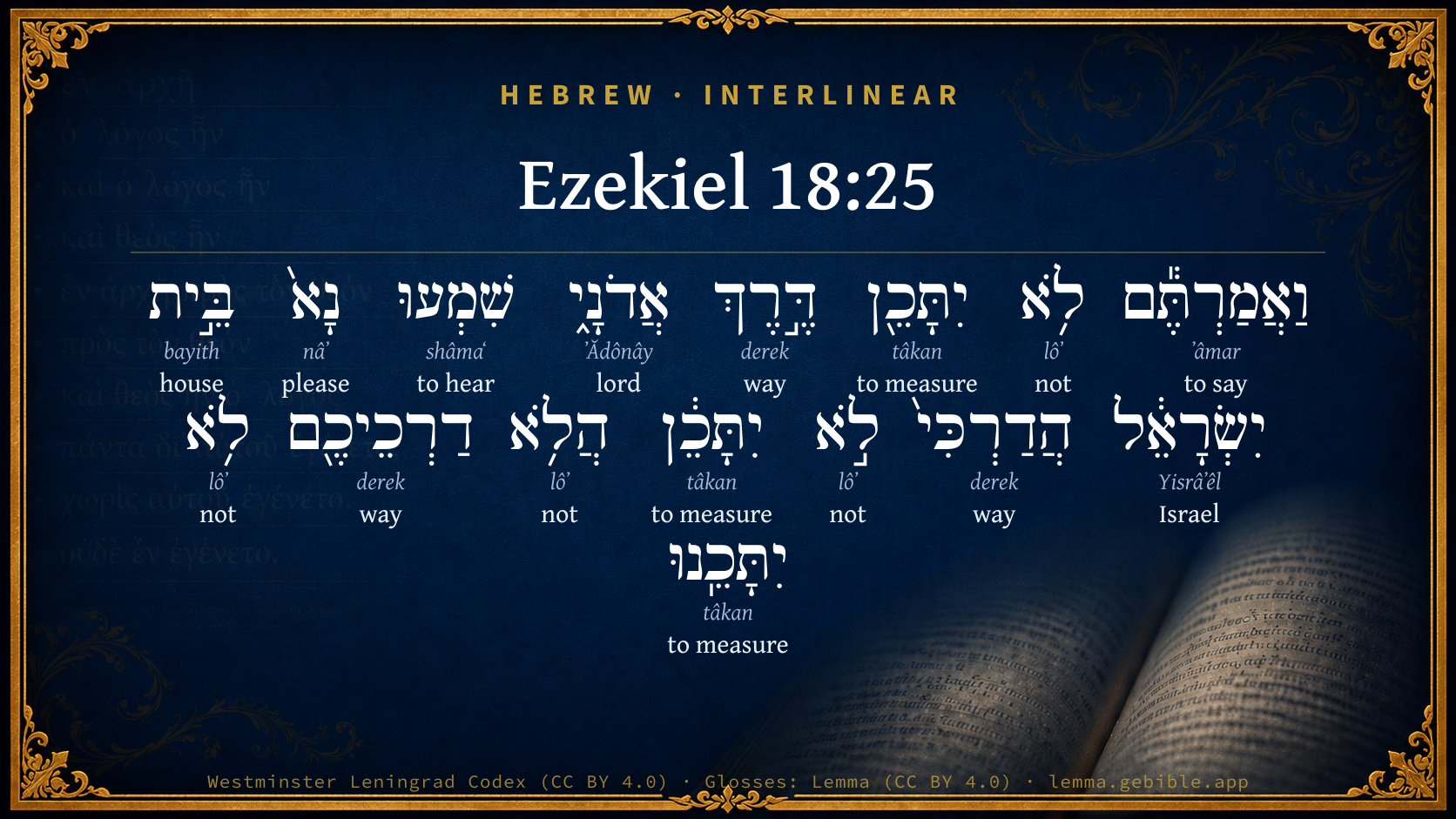
  1. וַאֲמַרְתֶּ֕ם ʼâmar H559 “and · to say” Conjunction + Verb, Qal, Sequential Perfect, 2nd Person, Masculine, Plural
  2. לֹ֥א lôʼ H3808 “not” Particle, Negative
  3. דֶּ֣רֶךְ derek H1870 “way of” Noun, Common, Both, Singular, Construct
  4. אֲדֹנָ֑י ʼĂdônây H136 “Lord · my” Noun, Common, Masculine, Plural, Construct + Suffix, Personal, 1st Person, Common, Singular
  5. שִׁמְעוּ shâmaʻ H8085 “hear” Verb, Qal, Imperative, 2nd Person, Masculine, Plural
  6. נָא֙ nâʼ H4994 “please” Particle, Exhortation
  7. בֵּ֣ית bayith H1004 “house of” Noun, Common, Masculine, Singular, Construct
  8. יִשְׂרָאֵ֔ל Yisrâʼêl H3478 “Israel” Noun, Proper
  9. הֲדַרְכִּי֙ derek H1870 “way · my” Particle, Interrogative + Noun, Common, Both, Singular, Construct + Suffix, Personal, 1st Person, Common, Singular
  10. לֹ֣א lôʼ H3808 “not” Particle, Negative
  11. יִתָּכֵ֔ן tâkan H8505 “to measure” Verb, Niphal, Imperfect, 3rd Person, Masculine, Singular
  12. הֲלֹ֥א lôʼ H3808 “not” Particle, Interrogative + Particle, Negative
  13. דַרְכֵיכֶ֖ם derek H1870 “ways · your” Noun, Common, Both, Plural, Construct + Suffix, Personal, 2nd Person, Masculine, Plural
  14. לֹ֥א lôʼ H3808 “not” Particle, Negative
  15. יִתָּכֵֽנוּ tâkan H8505 “to measure” Verb, Niphal, Imperfect, 3rd Person, Masculine, Plural

About this verse

These counts appear in no published source. They are computed here, from the morphology-tagged text and Lemma’s own curated glosses. What Lemma adds →

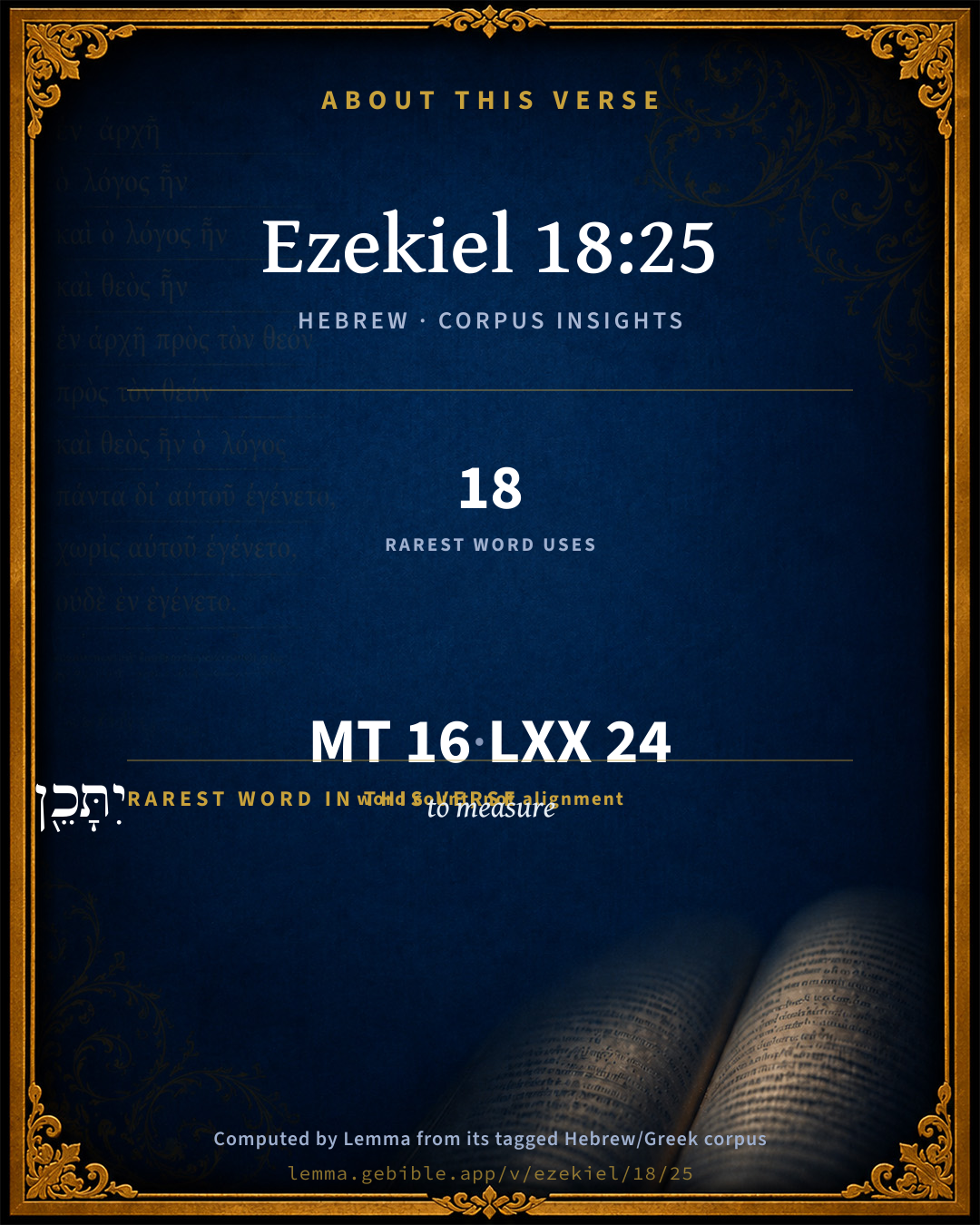
16
words
9
distinct lemmas
Prophets
section

Notable vocabulary

The rarest word here is יִתָּכֵ֖ן to measure H8505 — appearing just 18 times in the whole Hebrew Bible.

Shared distinctive vocabulary

יִתָּכֵ֖ן to measure H8505 occurs in 13 verses of the Hebrew Bible. Also found in:

Grammatical profile

  • 5 verbs
  • 6 nouns
  • 5 particles

Verb forms

  • וַאֲמַרְתֶּ֕ם Qal · Sequential Perfect
  • יִתָּכֵ֖ן Niphal · Imperfect
  • שִׁמְעוּ Qal · Imperative
  • יִתָּכֵ֔ן Niphal · Imperfect
  • יִתָּכֵֽנוּ Niphal · Imperfect

Repetition

Words recur within this verse — often emphatic in Hebrew:

  • יִתָּכֵ֖ן to measure H8505 ×3
  • דֶּ֣רֶךְ way H1870 ×3
  • לֹ֥א not H3808 ×4

Hebrew & Septuagint length

In English translation the verse runs 25 words from the Hebrew and 29 from the Septuagint (LXX English) — closely comparable.

A rough comparison of the two English renderings, which tokenize alike — not a word-level alignment.

Word counts can differ between the Hebrew and the Greek without any difference in meaning — e.g. the Hebrew direct-object marker אֵת has no separate Greek word, and Greek often adds the article ὁ.

In the original languages it is 16 Hebrew tokens and 24 Greek tokens — but the two are counted differently (Hebrew bundles its prefixes and suffixes into one token; the Greek is in lemma form), so that isn’t a like-for-like length.

Cross-references

26

Topical passages linked to Ezekiel 18:25 in the Treasury of Scripture Knowledge — connected by theme and wording, ordered by reader-vote popularity; previews shown in the World English Bible.

  • Ezekiel 33:17 Yet the children of your people say, The way of the Lord is not equal: but as for them, their way is not equal.
  • Malachi 3:13–15 "Your words have been stout against me," says Yahweh. "Yet you say, 'What have we spoken against you?'
  • Genesis 18:25 Be it far from you to do things like that, to kill the righteous with the wicked, that so the righteous should be as the wicked. May that be far from you. Shouldn't the Judge of all the earth do right?"
  • Jeremiah 12:1 Righteous are you, Yahweh, when I contend with you; yet would I reason the cause with you: why does the way of the wicked prosper? why are all they at ease who deal very treacherously?
  • Ezekiel 33:20 Yet you say, The way of the Lord is not equal. House of Israel, I will judge you everyone after his ways.
  • Zephaniah 3:5 Yahweh, in the midst of her, is righteous. He will do no wrong. Every morning he brings his justice to light. He doesn't fail, but the unjust know no shame.
  • Malachi 2:17 You have wearied Yahweh with your words. Yet you say, 'How have we wearied him?' In that you say, 'Everyone who does evil is good in the sight of Yahweh, and he delights in them;' or 'Where is the God of justice?'
  • Ezekiel 18:29 Yet says the house of Israel, The way of the Lord is not equal. house of Israel, are not my ways equal? are not your ways unequal?
  • Deuteronomy 32:4 The Rock, his work is perfect; For all his ways are justice: A God of faithfulness and without iniquity, Just and right is he.
  • Job 32:2 Then the wrath of Elihu the son of Barachel, the Buzite, of the family of Ram, was kindled against Job. His wrath was kindled because he justified himself rather than God.
  • Job 34:5–10 For Job has said, 'I am righteous, God has taken away my right:
  • Job 35:2 "Do you think this to be your right, Or do you say, 'My righteousness is more than God's,'
  • Job 40:8 Will you even annul my judgment? Will you condemn me, that you may be justified?
  • Job 42:4–6 You said, 'Listen, now, and I will speak; I will question you, and you will answer me.'
  • Psalms 50:6 The heavens shall declare his righteousness, For God himself is judge. Selah.
  • Psalms 50:21 You have done these things, and I kept silent. You thought that the "I AM" was just like you. I will rebuke you, and accuse you in front of your eyes.
  • Psalms 145:17 Yahweh is righteous in all his ways, And gracious in all his works.
  • Jeremiah 2:17–23 Haven't you procured this to yourself, in that you have forsaken Yahweh your God, when he led you by the way?
  • Jeremiah 2:29–37 Why will you contend with me? you all have transgressed against me, says Yahweh.
  • Jeremiah 16:10–13 It shall happen, when you shall show this people all these words, and they shall tell you, Why has Yahweh pronounced all this great evil against us? or what is our iniquity? or what is our sin that we have committed against Yahweh our God?
  • Matthew 20:11–15 When they received it, they murmured against the master of the household,
  • Romans 2:5–6 But according to your hardness and unrepentant heart you are treasuring up for yourself wrath in the day of wrath, revelation, and of the righteous judgment of God;
  • Romans 3:5 But if our unrighteousness commends the righteousness of God, what will we say? Is God unrighteous who inflicts wrath? I speak like men do.
  • Romans 3:20 Because by the works of the law, no flesh will be justified in his sight. For through the law comes the knowledge of sin.
  • Romans 9:20 But indeed, O man, who are you to reply against God? Will the thing formed ask him who formed it, "Why did you make me like this?"
  • Romans 10:3 For being ignorant of God's righteousness, and seeking to establish their own righteousness, they didn't subject themselves to the righteousness of God.

Cross-references courtesy of OpenBible.info (CC BY 4.0).

Hebrew and Greek witnesses Masoretic Hebrew ↔ Greek Septuagint

The same verse in the two great witnesses to the Old Testament, shown verse-for-verse.

These are two independent witnesses, not word-aligned to each other, and the Septuagint is shown in lemma (dictionary) form.

Hebrew Ezekiel 18:25 Masoretic · Westminster Leningrad Codex

וַאֲמַרְתֶּ֕ם לֹ֥א יִתָּכֵ֖ן דֶּ֣רֶךְ אֲדֹנָ֑י שִׁמְעוּ נָא֙ בֵּ֣ית יִשְׂרָאֵ֔ל הֲדַרְכִּי֙ לֹ֣א יִתָּכֵ֔ן הֲלֹ֥א דַרְכֵיכֶ֖ם לֹ֥א יִתָּכֵֽנוּ

Yet you say, The way of the Lord is not equal. Hear now, house of Israel: Is my way not equal? Aren't your ways unequal?

World English Bible · Public Domain

Greek LXX Ezekiel 18:25 Septuagint · lemma form

καί εἶπον οὐ καταεὐθύνω ὁ ὁδός κύριος ἀκούω δή πᾶς οἶκος ἰσραήλ μή ὁ ὁδός ἐγώ οὐ καταεὐθύνω οὐ ὁ ὁδός σύ οὐ καταεὐθύνω

Yet you⌃ have said, The way of the Lord is not straight. Hear now, all the house of Israel; will not my way be straight? Is your way straight?

LXX2012 (modern English Septuagint) · Public Domain

Hebrew: Westminster Leningrad Codex (CC BY 4.0). Greek: Septuagint (public domain); English from LXX2012 (modern English Septuagint) (Public Domain). How the Septuagint differs from the Hebrew →

Targum (Aramaic paraphrase)

1

The Targum is the ancient Jewish Aramaic paraphrase of the Hebrew Scriptures — an interpretive translation, not the Hebrew text itself. Onkelos (literal) and Pseudo-Jonathan (expansive) render the Torah, and Jonathan the Prophets. Coverage is partial: where no permissively-licensed English translation exists for a verse, only the Aramaic is shown. This is verse-level text, not a word-by-word alignment to the Hebrew.

  1. Targum Jonathan Prophets (Joshua–Malachi)
    וַאֲמַרְתּוּן לָא מַפְרְשַׁן לָנָא אוֹרְחַת טוּבָא דַייָ שְׁמָעוּ כְעַן בֵּית יִשְׂרָאֵל הֲאוֹרְחַת טוּבִי לָא מַפְרְשַׁן לְכוֹן הֲלָא אוֹרְחָתְכוֹן דִילְכוֹן לָא תַקְנָן:

    (no public-domain English translation for this verse)

    Targum Jonathan — Aramaic: “Mikraot Gedolot” (public domain). English: “Sefaria Community Translation” (CC0 1.0 (public-domain dedication)); “London "Chaldee Paraphrase," 1871” (public domain). Text via Sefaria.

Commentary

Notes on Ezekiel 18:25 from classic Christian and Jewish commentators (each source and its license shown beneath its notes). The classic Christian expositions comment on the surrounding passage and are grouped to its opening verse, so a note may address several verses; the Jewish commentaries on the Tanakh (Rashi and others) are per-verse, so they appear only where the commentator wrote on this verse.

Lemma curates 59 commentaries, every one of them public domain or Creative Commons licensed, each selected and text-cleaned for this edition rather than reprinted as found. About our sources →

Trapp's Complete Commentary

John Trapp

Eze 18:25 Yet ye say, The way of the Lord is not equal. Hear now, O house of Israel; Is not my way equal? are not your ways unequal?

Ver. 25. Yet ye say.] Ye will still hold your own, and no reason shall persuade you. A stubborn man standeth as a stake in a stream, lets all pass by him, but he standeth still where he was.

Is not my way equal?] This he had said before but he saith it again, Dις και τρις τα καλα. Cicero, aggravating the fact of a parricide, useth these words, Matrem tuam occidisti: quid dicam amplius? Matrem tuam occidisti - Thou hast killed thy mother, man: what should I say more? then hast killed thy mother, I tell thee.

Are not your ways unequal?] They are so, and that apparently: but that your mouth is out of taste, and ye cannot relish truth; your eyes are sore, and ye cannot behold the sunbeams; you are prejudiced, biased, perverted.

John Trapp, A Commentary or Exposition upon All the Books of the Old and New Testament (1647–1656) — public domain. Text from a community e-Sword module.

The Biblical Illustrator

Joseph S. Exell

Eze_18:25

Yet ye say, The way of the Lord is not equal.

Hear now, O house of Israel; Is not My way equal? Are not your ways unequal?

On the unequal distribution of happiness and misery

Let us suppose an attentive observer to take a general view of the situation in which mankind is placed. The first thing that would strike him would probably be the variety of conveniences and comforts distributed around him, which are neither earned by his own merit nor produced by his own care. This would lead him to a second observation, that many, and the most essential, of these conveniences and comforts are bestowed promiscuously, and without exception, on the whole race of mankind: the sun rises on the evil and on the good, and the rain descends on the just and on the unjust. What other conclusion could he draw from these two observations than that the Power above us is friendly to mankind? From this pleasing prospect the observer might turn his attention to the evils and miseries which attend on human life. What are we to infer from hence? Is it that God is a capricious Being, or that He has pleasure in the misery, as well as in the happiness, of His creatures? To solve this question, we may observe a remarkable difference between the two cases: the benefits, which are common to all mankind, are numerous and important, and are enjoyed, without intermission, every day and every hour. On the contrary, the evils common to all mankind, if any there be, are much fewer than is usually supposed, and only occur on particular emergencies. How far even death, which is the only universal lot, is really in itself an evil, distinct from the pain which is supposed to attend it, has never yet been ascertained; and the pains of death are by no means common to the whole human race: many die instantaneously without any pain, and many in lingering diseases without a pang or a groan. It is not certain, therefore, that there is any one evil existing which affects, necessarily and inevitably, the whole race of mankind. I might add, in this place, that the evils complained of serve to answer many wise purposes of discipline and probation. Hitherto we have considered those benefits and those evils which arise from Gods own appointment, without any merit or demerit of our own. Let us next consider those which are the consequences of our own conduct. In this view the first thing that would strike an attentive observer would probably be that many vicious actions are attended with regular and constant effects, and carry a sort of punishment along with them. It would next be observed, that there are virtues also which bring their own benefits along with them: temperance and regularity lead to health and long life; industry and diligence to affluence and plenty; good faith and sincerity promote esteem and regard; and patience, equanimity, and command of temper lay the foundation for happiness, and form a constituent part of it. Yet still an observer might take notice, that the good effects of virtue are not in any degree so certain or constant as the ill effects of vice. This fact is remarkable, and deserves to be seriously considered. It seems to prove, that the distribution of good and evil, of happiness and misery, which arises from our own actions, our own virtues and vices, is regulated by a different and even opposite law, from that distribution of happiness and misery which comes immediately and gratuitously, from the hand of God. In the latter, the benefits and favours which we receive from God are more numerous, as we have seen, are more extensive, more constant, and more certain than the evils which we suffer. In the former, where our own actions, our virtues and vices are concerned, the evils and punishments of vice are more numerous, more constant, and more certain than the benefits or rewards of virtue. Shall we say, then, in this case, that God is inconsistent, or that He is less a friend to virtue than an enemy to vice? Not so, says the text.

1. In the first place, you will readily allow it to be highly conducive to our piety and devotion that the dispensations of Almighty God Himself, which are unconnected with any human virtues or vices, should be, as becomes him, everywhere distinguished by marks of kindness, beneficence, and bounty.

2. In the next place, it is highly conducive to our religious and moral improvement, that virtue should not, in this life, be attended with its distinct and immediate reward. The magnificent idea held forth by Christianity, of the value in which virtue ought to be held, would be totally done away; it would be to appreciate that which is beyond all price; to demand prematurely a momentary reward here, for that which, in the sight of God, and through faith in the merits of Christ, no earthly enjoyment and immortal happiness alone can repay.

3. In the last place, it is highly conducive to our moral improvement that vice, on the contrary, should in many cases be attended with immediate punishment. It is evident that this is not an instance of Gods severity, but rather of His clemency and mercy. It restrains the sinner, in kindness, before it is too late, from treasuring up wrath, etc. It tends to check no one virtue which we have, and is the school in which we are best taught the virtues which we have not. (W. Pearce, D. D.)

The inequalities of life

I. If we had to find an immediate and direct answer to this question, Is not My way equal? we should be disposed to say, Decidedly not. From the beginning to the end of life there seems to be inequality, not equality. Consider, first of all, how men are born. Birth is something so entirely removed from the region of personal responsibility that no one of us is to be held accountable for anything belonging to it. Yet how much depends on being well born! Some thinking men have said that half the battle of life is won or lost according as an individual is well or ill born. Now, when we examine into the facts of life, how very many people seem to be anything but well born! Gods ways do not seem equal in this respect. Certainly not on the surface. There are thousands of children born from vicious parents. Very little chance do these seem to have to be good men and women. Compare their heredity with that which belongs to some of our friends here present, in whose ancestry has been no known criminal of any kind, no unvirtuous man, no impious woman. When we make such comparison, it does not seem as if Gods ways are equal. Take a step forward, and again ask the question when nurture begins to tell. The word education covers a very much larger area of life than we ordinarily assign it. The home in which we live, the company we keep, the books we read for fun and not as tasks, all are contributory to education. The word environment comes in here. In regard to that, Gods ways do not seem equal. The opportunities of a pure and wise education which come to some, contrasted with the vicious ignorance and coarse immoralities by which others are surrounded, do not enable us easily to find an affirmative answer to this question, Are not My ways equal? saith the Lord. Once more, the child is born and schooled; educated, as we say, by all through which he has passed in these impressionable years of youth. And now the time comes for sailing out on the ocean of enterprise. One young man finds his boat ready built and ready manned and abundantly victualled, and he has only to step aboard and sail off. A second casts about hither and thither, applying to one and another to take him aboard, and let him scrub decks or do anything, and almost loses heart before he can get any kind of start in life. Things do not seem equal here, any more than in the other stages of life.

II. Yet the more carefully we look into these facts, and the longer we dwell upon them, the more copiously will they supply us with something suggestive of the necessity of caution in dealing with them. We begin to think in this way: Let me not be too rash in lay affirmatives. This is not Gods perfect world. This is very far from an ideal condition of society. It is a society disturbed by sin. I cannot judge of the kingdom of God from what I see in society, every member of which is under condemnation as belonging to a sinful race. So I must be careful in forming my judgments. There are modifications and compensations discernible even now. First of all, it does not do to assume that happiness and unhappiness are in the ratio of external possession or non-possession. The man who has enough for all the legitimate uses of life is not at a disadvantage. He has no real wants. The artificial wants of society have nothing to do with the physical and mental necessities of life. Health, intelligence, aspiration, all that is wholesome and good, do not depend upon anything artificial. The disposition in our day, even among Christianised people, to make too much of externals needs to be studiously guarded against when we are speaking of equality and inequality. Has it not come to be one of the commonplaces of existence that poverty is not always a curse, and wealth is not always a blessing? When a child is born into the midst of the surroundings supplied by a luxurious home, he is at a considerable disadvantage in seam ways. You say he need not trouble about his future, so far as it consists in the providing for the necessaries and the comforts of life. Now, if some of these comfortable conditions are not as favourable to the putting forth of energy or the developing of strength of character as are the other less coveted conditions, immediately the question of equality becomes a little harder to answer. I say the more we investigate the facts of life the less disposed are we to say that all inequalities are of the nature of injustice. Often and often the rich mans son becomes indolent and ineffective, a mere lazy loafer on lifes highway, through want of that stimulus which comes naturally to the son of the poor man. It would be interesting to investigate that region more thoroughly. We must leave it for another remark bearing upon the answer we shall give to the question, Are not My ways equal? saith the Lord. The idea of responsibility comes in here. It becomes us ever to remember the words, To whom much is given, of him much will be required; and, To whom they commit much, of him will they ask the more. The Gospel of Jesus Christ is a gospel for all, but it is especially a gospel for the weary and heavy-laden, for the man who has been badly born, for the man who has been handicapped in the race of life, for the man whose chance has been of the poorest. There is a future, and it is not far off. There Lazarus gets his chance, and Dives learns the lesson he refused to learn here and now. (R. Thomas, D. D.)

The way of God and the ways of man

There is no foundation for an intelligent faith without the admission that Gods attributes are unchangeable and His will as inscrutable as His being; that He is and was and is to come, the same yesterday and today and forever. It is not mans mission to vindicate the way of God to understandings which will not receive the impressions of faith and the reasoning of love. He who undertakes by what he may call wise arguments to prove to the discontented heart that God is love will lose his labour, and may perhaps be himself made captive by the unbelief he rashly attacks. The same power which is to convince the world of sin must also convince it of righteousness. The answer to every cavil is the offer of eternal life, without money and without price, to all. They complain of their lost inheritance, and a nobler inheritance is offered in exchange; they resent the imputation of their fathers guilt, and they are called upon to turn from their own, and then for their punishment they shall receive a double reward in the life of their soul, which he who loses shall gain nothing if he gain the whole world, and he who gains may well afford to lose home and lands and all earthly possessions and advantages if it be Gods will to deprive him of them. It is in the simplicity and universal application of this invitation of mercy that the Lord is content to risk the vindication of His goodness. His purpose has been single and its scope universal, and its means undeviatingly the same, for there is none other name under heaven given among men whereby we must be saved. Away then with that delusion which holds that law has succeeded law, covenant superseded covenant, in such a sense that at one time salvation was by works, at another time by faith; once by the work of man, now by the work of Christ. He was the Lamb slain from the foundation of the world. The law was and is a schoolmaster to bring us to Christ; the law and the prophets testified of Him. Men may find fault with the ways of God, because He does not by large miracles pour out the flood of His Spirit upon the heathen; but the Lord replies, What have My people done to spread the knowledge I have given them? It is of the nature of light to expand its rays, and nothing but wilful obstructions can hinder it; why has the Church hidden her light? why have Christian nations neglected their mission? why have labourers been wanting when the field was ready for harvest? How shall they believe in Him of whom they have not heard? how shall they hear except the Word be sent unto them? That complaint which, if not loudest heard, is most widely spread and most deeply rankles in the heart of man, arises out of the inequalities of fortune, the manifold chances and changes of this mortal life, whereby the wicked prosper while the righteous struggle, fools are set in high places while pious wisdom dies in obscurity, rich men are clothed in purple and fine linen while Lazaruses are laid at their gate full of sores; indifference has peace while sensitive hearts yearning for holiness and rest are left melancholy and disconsolate, despairing of the peace that is theirs, and making themselves labour out of their earnest search for rest. Heed not the prosperity of the unrighteous; load not your souls with the burthen of envy, and murmur not at comparisons which a moment of Gods wrath may show to be vain; though you be poor and of sad spirit, lonely and uncheerful, afflicted with the ills of life and partaker of few of its blessings; though sin and its perplexities may harass you; though happiness be to you a thing of the past, wrapt up in fruitless memories and darkened by shadows from the grave; though trouble should come or has come upon you;--let not the petulance of sorrow charge its weariness upon the caprice of a Father, the faithfulness of whose mercy and the perfection of whose judgments and the consistency of whose way are in nothing more certainly manifested than in the troubles whereby out of the curse of sin He brings the grace of everlasting life. In conclusion; remember that the way of the Lord in His dealings with man is equal, impartial, consistent. The way of His providence is equal, for all things work together for good to them who love God; the way of His grace is equal, for it is and ever has been comprised in the person of Jesus Christ; His providence waits upon His grace, and the purpose of both is the salvation of our souls. (A. J. Macleane, M. A.)

The Biblical Illustrator, edited by Joseph S. Exell (c. 1880s–1900s) — public domain. Text from a community e-Sword module.

Joseph Benson's Commentary

Eze 18:25-29. Yet ye say, The way of the Lord is not equal, &c. — Yet ye allege that I do not act according to the strict rules of justice and equity: but “the declarations I have so often repeated concerning the eternal rewards and punishments allotted to the righteous and the wicked, are sufficient to vindicate the justice of my proceedings against all your objections.” When a righteous man turneth away from his righteousness, &c. — “It is an opinion that prevails among the Jews, even till this day, that at the day of judgment a considerable number of good actions shall overbalance men’s evil ones. See Eze 33:13. So they thought it a hard case for a man who had been righteous the far greater part of his life, if he did at last commit iniquity, that his former righteousness should avail him nothing. In opposition to this doctrine, God here declares that a righteous man sinning and not repenting, should die in his sins; and that a wicked man, upon his repentance, should save his soul alive.” — Lowth. Again, when the wicked man, &c. — These verses are, as it were, a repetition of what had been said before; or rather, the conclusion of the matter, or the whole of the chapter summed up and brought to a point; namely, that men suffer the divine punishments only on account of their sins; that they cannot enjoy the divine favour while they continue in sin; and that, in order to obtain it, it is indispensably necessary that they should turn from all their transgressions and become new creatures, and that even former righteousness cannot obtain for them, or preserve to them, the favour of God, while they relapse into and continue in subsequent iniquity. In a word, that sin and wickedness are the sole objects of God’s aversion and indignation, and holiness and righteousness of his favour and approbation.

Joseph Benson's Commentary on the Old and New Testaments (1811–1818) — public domain. Text from a community e-Sword module.

The Pulpit Commentary

Are not my ways equal? The. primary meaning of the Hebrew adjective is that of something ordered, symmetrically arranged. Men would find in the ways of God precisely that in which their own ways were wanting, and which they denied to him the workings of a considerate equity, adjusting all things according to their true weight and measure.

God accused of man"s injustice.

The Jews were asserting that the ways of God were not equal, when the fact was that their ways, not his, were unequal.

I GOD IS ACCUSED OF INJUSTICE. "Ye say, The way of the Lord is not equal." It is felt that the rule of the supreme God should be very different from that of earthly judges, some of whom take bribes, and all of whom are fallible. "Shall not the Judge of all the earth do right?" exclaims Abraham, when venturing to expostulate with God on what appears to him a threatened injustice. (Gen_18:25) Yet the facts of life are often discouraging, and suggest to doubting, impatient souls a notion that God is not acting justly. The wicked prosper, and the good meet with misfortune. Children suffer from the misdeeds of their parents. Persons equal in character are unequal in fortune. To one the way of life is far more smooth than to another, although we can detect no good reason for the distinction. At one time a wild and mindless Chance seems to play with the world, at another a blind, stern Fate appears to hold it in an iron grip. We cannot discover the hand of justice behind the drifting cloud of circumstances. But:

1. Justice does not involve equality, but treatment according to desert.

2. We only see a small part of Gods ways, and therefore cannot judge of the whole. The fly on the wheel cannot understand the machine. He might think the action of the "eccentric" deranged because it was unequal, and yet it is essential to the right working of the whole engine.

3. We are too limited in nature to judge, even if we saw all the facts.

II THIS ACCUSATION RESULTS FROM MAN"S INJUSTICE. We impute to God what is in ourselves. We judge him by our own hearts and conduct. We know what would be our motives if we did certain things which we discover in the Divine action, and therefore we ascribe those same motives to God. We colour what we see with the hues that are in our own eyes. To the railway traveller the hedgerows and trees appear to be turning about invisible pivots, now flying to him and then swiftly whirling away; yet the motion is with the observer.

1. We are unjust in attempting to judge God. Here on the threshold the fault is seen to be ours. Even if God were unjust, since we are not capable of understanding his actions, we should be unjust also in venturing to give a verdict on his deeds.

2. We are unjust in our general conduct. There is a lack of integrity of heart in us even when our external behaviour is straight. We walk in crooked paths, and our conscience itself is perverted, so that the very rule by which we measure is warped. It is not surprising that God seems to be unjust when our standard of measurement does not agree with his action; but then the fault is with the standard. Until our own hearts and lives are right, it is not possible for us to form right views of God.

3. We are unjust in ascribing our own injustice to God. The inequalities of society are charged against God. They come from "man"s inhumanity to man.

Vers. 25-32. The path to life.

Sin has a blinding effect upon man"s intellect and reason. It leads to most erroneous conclusions. It produces deep-seated and suicidal prejudice. It puts "darkness for light, and light for darkness." The most perfect equality it brands "inequality." It would make heaven into hell.

I THE FIRST STEP HEAVENWARD IS THOUGHTFUL CHOICE. The chief folly of men is their thoughtlessness. They sink into mental and moral indolence. They will not investigate truth, nor ponder the demands of duty, nor forecast the future. But when "he comes to himself," he begins to reflect. "Because he considereth" (ver. 28), he turns over a new leaf. The man allows intelligence add wisdom and reason to prevail. He resolves to seek his real good. He chooses the best course, and determines to pursue it.

II WISE DECISION LEADS TO NEW ACTION. Having made an intelligent resolve, the man "turns away from his transgressions." He begins with known sins. He abandons these. That is only a sham decision which does not lead to action. The will may be a slave to feeling and appetite; in that case no real decision has been made. The soul is divided. There is strife and war within! But if the man has decided upon a line of conduct, new action will at once follow.

III ACTIONS REACT UPON THE AFFECTIONS. It is a known fact that necessary work which was at first repulsive ceases to be repulsive. We grow to love actions which are oft repeated. Especially if such actions are right in themselves, if they have a moral loveliness, if others approve them, if they produce good effects, we learn to love them. Our actions develop and strengthen our affections. The heart is benefited. The tone and temper of our spirit are improved. True, it is God that renews and purifies the heart; but he works through our own activity. He gives Divine efficacy to the means employed.

IV THE AFFECTIONS OF A MAN FASHION HIS CHARACTER. As a man"s sentiments and affections are, so is he. "A new heart, and a right spirit" go together. The character follows the affections. The man that loves purity will become pure. The man that loves God will become Godlike. So long as man is on earth, he never is, he is always becoming, good or bad, great or mean. Character here is in a state of fusion.

V MAN"S SUPREME GOOD IS IDENTICAL WITH GOD"S PLEASURE. God has no pleasure in the death of a sinner; he has pleasure from his ransomed life. If my heart and life are right, I afford pleasure to God, I add to his joy. On the other hand, my sin diminishes his joy. For his own sake, therefore, he will hear my prayer; he will help me in my struggles against sin. Why, then, should we die? It is unreasonable. Every argument, every motive, is against it. To continue in sin is folly, madness, suicide. D.

The Pulpit Commentary (1880–1919), ed. H.D.M. Spence-Jones & Joseph S. Exell — public domain. Text from a community e-Sword module.

Tyndale Open Study Notes

Tyndale Open Resources

18:25-29 Israel’s problem was not that the Lord wasn’t doing what’s right but that they were persistently doing what was wrong. They thoroughly deserved God’s judgment.

Tyndale Open Study Notes — © Tyndale Open Resources, licensed CC BY-SA 4.0. Text via the HelloAO Bible API.

Geneva Bible (1599)

Geneva Bible translators

In punishing the father with the children.

Geneva Bible (1599) marginal notes — public domain. Text via Bolls.life.

Jamieson, Fausset & Brown

Robert Jamieson, A. R. Fausset & David Brown

Their plea for saying, "The way of the Lord is not equal," was that God treated different classes in a different way. But it was really their way that was unequal, since living in sin they expected to be dealt with as if they were righteous. God's way was invariably to deal with different men according to their deserts.

Jamieson, Fausset & Brown — Commentary Critical and Explanatory on the Whole Bible (1871) — public domain (CC PDM 1.0). Text via the HelloAO Bible API.

John Calvin's Commentaries

The Prophet here shows that those who used the vulgar taunt — that the children’s teeth were set on edge, because their fathers had eaten sour grapes — had broken away from all restraint; and nothing further remained to hinder them from uttering their blasphemies arrogantly against God: but their insolence and madness now increases when they say that God’s ways are not equal. And this is discerned in almost all hypocrites: at first they indirectly find fault with God, and yet pretend not to do so: while they endeavor to excuse themselves, they accuse him of injustice, and of too much rigor, yet they do not openly break out into such impiety as to dare to charge God with this crime: but after they profit nothing by their double dealing, the devil inflames them to such a pitch of boldness that they hesitate not openly to condemn God himself. The Prophet refers to this when he says that this disgraceful saying was bandied about among the Israelites, that the ways of the Lord are unequal. Lest, therefore, we should happen to resist God, and to contend with him, let us learn to restrain our rashness in good time before he becomes enraged against us. As soon as any thoughts spring up, tending to reflect upon the character of the Almighty, let us quickly restrain them; for if we do not, they will entangle us by degrees, and draw us into the extremity of folly, and then no sense of either religion or shame will deter us from open rebellion against God. But it is worth while noticing the source of this impiety: first of all, when we think of men’s relation to God, they should be ashamed to rise up against their Maker: for the clay does not cry out against the potter; and we are a hundredfold more insignificant than the clay, with reference to God. (Isaiah 45:9; Romans 9:20, 21.)

But let us come to another consideration. We know with how much greater clearness the angels are able reverently to adore God’s wisdom than the human race. What, therefore, must we do? Not only is God’s wisdom incomprehensible, but his justice is the most perfect rule of all justice. Now, if we desire to pass opinions upon God’s works according to our own perceptions, and to weigh them in our balance, what else are we doing but passing judgment upon him? But we must remember that passage of Isaiah, As I live, says Jehovah, every knee shall bend before me, and every tongue shall swear by me. (Isaiah 45:23.) Paul, too, is a faithful interpreter of this sentiment, when he forbids mortals to judge arrogantly, by saying, we shall all stand before the judgment-seat of Christ (Romans 14:10, 11.) Since, then, it will be necessary for us to render an account before Christ heavenly tribunal, we must now acquiesce in God’s judgments; because, when at length our license has entirely spent itself, and our petulance has had its full scope, God will be our judge. We see, therefore, that when men claim to themselves the right of daring to pronounce their own opinions on God’s work, they first subject his wisdom to their own fictions, and then feel too much hostility and contempt towards his justice. But this one thing ought to be sufficient, that men are too forgetful of their own condition when they dare to open their mouth against their Maker, not only to murmur, but openly to condemn him, as if they were his superiors. Let us then obey the contrary rule; let us with sobriety and modesty learn to look upon those works of God which are unknown to us, and to concede to him the praise of supreme wisdom, although his counsels seem at first sight contradictory. Hosea also briefly reminds us of this. For after God had promised that he would be merciful to the people, and when he had discoursed on the slaughter which he had inflicted, he says, that at length he would heal them: he adds, Who is wise, and he shall understand these things? (Hosea 14:9;) because many might have thought it inconsistent to remit so many sins for the abandoned people; and others might object that what they heard was utterly incredible and absurd, since God suffered the people to be utterly torn to pieces, so that no hope remained. For this reason, then, the Prophet exclaims, that we have need of rare and singular prudence to comprehend and embrace that teaching. When he says, “who is wise?” it signifies that the number is but small of those who will wait patiently till God really fulfills his promises. Yet he adds, because the ways of the Lord are right, and the just shall walk in them; but the impious shall stumble and perish. When he speaks here of the ways of the Lord, he does not mean only precepts, though the Scriptures often take the word in this sense; but he means the whole order of government which God upholds, and all the judgments which he exercises. He says, therefore, that all the ways of the Lord are right, and the just shall walk in them, since the just will give God the glory calmly, and with the proper docility; and when they are agitated by various doubts, and through their infirmity are ever in a ferment through the force of many temptations, yet they will always repose on the providence of God, and briefly determine, by cutting off every occasion for long and perplexing and thorny questions, that God is just. Thus the just walk in the ways of the Lord, because they submit to all his works.

He says also, that the impious stumble and fall; for as soon as they begin to think that God does not act rightly or prudently, they are rebellious, and are carried away by blind impulse, and their pride at length hurries them headlong into madness. Thus they stumble in the ways of the Lord: because, as we see in this passage, they vomit forth their blasphemies against God. Hence we ought, to be influenced by this course of action, namely, adoring with humility the counsel of God, although to us incomprehensible, and attributing the praise of justice to all his works, though in our opinion they may not correspond, or be consistent with each other. — This, then, is the sum of the whole. Although the Prophet speaks of the penalties which God inflicts on the reprobate, and of the reward which he has laid up for the just, yet we ought to ascend still higher; and if God in his deeds seems to pervert the whole course of justice, yet we should always be sustained by this bridle — he is just; and if his deeds are disapproved by us, it arises from our error and ignorance. For example, we not only contend with God when he seems not to repay us a just reward for our good works, or when he seems too severe towards us; but when his eternal election is discussed, we immediately roar out, because we cannot penetrate to so great a height: the pious, indeed, are not altogether free from perplexing doubts which disturb them, but they restrain themselves directly as I have said. But some restive men break out in this way, — I do not comprehend — I do not understand: hence God is unjust. We see how many blusterers in the present day betray their desperate impudence, whence this teaching should recur to our minds — the ways of God are right. But since we do not perceive how it is so, another clause is added, that our ways are not right; that is, that all our senses are defective, and our intellect blinded, and that we are all so corrupt that our judgment is perverted. If, therefore, we conclude with the Prophet, that our ways are not right, the glory of God’s justice will remain untarnished and entire. Afterwards he adds —

John Calvin's Commentaries (1540-1563) — public domain. Text from the Calvin Translation Society English edition (1840s-50s) via the Christian Classics Ethereal Library (ccel.org). Calvin's coverage is partial (roughly two-thirds of the Bible); uncommented books and verses are honest gaps, never fabricated. The 19th-century editor's footnotes and remarks are omitted so the notes are faithfully Calvin's own voice.

Ellicott's Commentary for English Readers

(25) The way of the Lord is not equal.—The word means literally, weighed out, balanced. The accusation of the Israelites was still (here and in Eze_18:29) that the Lord was arbitrary and unjust. His statement in reply is that He rewards and punishes according to eternal and immutable principles of right. Every man must reap that which he has sown. (Comp. Rom_2:5-10.)

A Bible Commentary for English Readers, edited by Charles John Ellicott (1878–1897) — public domain. Text from a community e-Sword module.

The Cambridge Bible for Schools and Colleges

gen. ed. J. J. S. Perowne

25. Yet ye say, The way … equal] And ye say. The “way” of the Lord is the principle on which he acts, or his action on it, Isa_55:8, cf. ch. Eze_33:17; Eze_33:20. The objection of the people may really have been expressed (cf. Eze_18:19). The prophet’s principle of the freedom of the individual and his independence was a novelty running counter to cherished notions of that age, notions corroborated by much that is seen in history and life. The instance of Korah, whose children perished with him for his sin, the case of Achan, whose transgression was imputed to the whole camp, the history of Jonathan, and no doubt multitudes of instances were familiar to the people where men were treated as bodies and the individuals shared the fate of the mass though personally innocent. To us now the prophet’s principle is self-evident. Still even to us it is only a theoretical principle, and can be maintained against facts only by drawing a distinction, which the people in Israel had not yet learned to draw, between the spiritual relation of the mind to God and the external history of the individual. See end of chapter.

The Cambridge Bible for Schools and Colleges (gen. ed. J. J. S. Perowne; Cambridge University Press, 1878–1918) — public domain. Text from a community e-Sword module.

John Gill's Exposition

When a righteous man turneth away from his righteousness,.... This is repeated for the further confirmation of it, and to raise their attention to it; to make it more plain and manifest to them, and to fix it upon their minds:

and committeth iniquity, and dieth in them: or, "he shall die for them" (m); both for his turning away from his righteousness, and for his committing iniquity:

for his iniquity that he hath done shall he die; in both respects. This is repeated to denote the certainty of it.

(m) "propter illa", Pagninus, Piscator, Grotius, Cocceius; so some in Vatsbins.

John Gill's Exposition of the Whole Bible (1746–1763) — public domain (CC PDM 1.0). Text via the HelloAO Bible API.

Albert Barnes' Notes on the Bible

Equal - literally, “weighed out, balanced.” Man’s ways are arbitrary, God’s ways are governed by a self-imposed law, which makes all consistent and harmonious.

Albert Barnes' Notes on the Bible (1834–1885) — public domain. Text from a community e-Sword/MySword module.

Haydock's Catholic Bible Commentary

Not right, in thus punishing or rewarding for the last act; (Theodoret) or rather, God shews that those who complain are guilty.

George Leo Haydock (1774–1849), Haydock's Catholic Family Bible and Commentary, 1859 edition — public domain. Excludes Psalms (Douay-Rheims chapter numbering differs from Protestant) and Deuterocanonical books (Catholic canon only).

Matthew Poole's English Annotations

Yet ye say; you persist in your hard, unjust, and ungodly sentiments of an inequality in my ways, and are not afraid to speak as much.

The way: it were too much for sinners to charge God with inequality in a single act, but here are some dare censure the way, the whole management of affairs.

Of the Lord: strange frowardness! own him for Lord, yet condemn his government; grant his sovereign authority, and yet arraign the exercise of it!

Is not equal; not right, steady, or consistent with his own declaration and law; so the Hebrew. This prodigiously wicked assertion they build upon a most gross ignorance, and intolerably proud conceit of their own righteousness: We, say they, are righteous, not wicked, yet punished. Unheard-of pride, to condemn God, with whom is no iniquity, and acquit themselves, in whom is all iniquity!

Hear now; consider what I have proposed to clear my justice, hear me and my defence ere you condemn me, weigh well my defence. O house of Israel; both you that are in Jerusalem, and you also that are in Babylon at Telabib.

Is not my way equal? Do you speak what you think, does your judgment thus conclude, when you know, or might know, that this is the general rule I proceed by, The righteousness of the righteous is upon him, and the wickedness of the wicked is upon him? Can there be inequality here? Your ways which you choose, keep, plead for, and obstinately hold to, these are the crooked, unsteady, and unjust ways: for the question is to be resolved into a vehement asseveration.

Matthew Poole's English Annotations on the Holy Bible (1683–1685) — public domain. Text from a community e-Sword/MySword module.

Whedon's Commentary on the Bible

Daniel D. Whedon

25. The way of the Lord is not equal — This is an objection raised by some of his hearers to the novel argument which the prophet has just developed. Is it indeed true that hereafter individual guilt shall determine individual punishment? (Eze_18:3; Eze_18:20.) Certainly heretofore in God’s dealings with men the guiltless individual has often suffered with the guilty (Joshua vii; 1 Samuel 14, etc.). Was the unchangeable God about to change his dealings with his people, or was Ezekiel mistaken in his interpretation of the principles of retribution? This was the dilemma thrown into the teeth of the prophet. His reply was simply a strong, distinct reaffirmation of the principles already stated. He would not argue. He would not discuss theoretical questions; he would not even attempt to explain and justify God’s actions. He merely, with great emphasis, repeated the principles of God’s government as they had been revealed to him. The judge of all the earth would do right. Jehovah could not permit final injustice. In the ultimate outcome disobedience and iniquity would work ruin and death (Eze_18:26; Eze_18:30), while righteousness would keep the soul alive (Eze_18:27). The righteous man “shall not die” (Eze_18:28). We may well regret that Ezekiel did not elaborate and defend his theodicy. The generations would have been enriched by such an exposition. To harmonize the unjust inequalities of earthly condition with God’s justice has been a puzzle to all thinkers, from Job (Job_10:2-3) and Asaph (Psa_73:11-14) to the present time. Unbelievers in every age have been quick to decide that Ezekiel was wrong, declaring that experience contradicts his assertion that outward fortune, “either of the nation or the individual, is determined by the moral condition” (so also Kuenen, Prophet and Prophecy, pp. 353, 354). But pious souls throughout universal Christendom have always believed that the prophet was right; and not only so, but more and more the student of history is being convinced that there is a power in the world that “makes for righteousness.” Moral quality is a determining factor in the life of the man and the nation greater than heredity or environment. Ezekiel did not mean to say that every disagreeable manifestation of fortune was a manifestation of God’s disapproval. He could not have overlooked the distinction between punishment and misfortune. The innocent may suffer temporary calamity — which works good to the sufferer — but such calamity is not punishment. Ezekiel knew many calamities in Israelitish history in which the guiltless had been involved with the guilty, and his favorite study was that law in which Jehovah had himself declared that the sins of the father should be visited on the children (Exo_20:5; Exo_34:7; Lev_26:39-40; Num_14:18); but he knew also that God was just, and therefore a just retribution or reward would at last overtake the sinner and the righteous. (Compare Methodist Hymnal, 596.) He also knew that the calamity about to fall upon Israel — which had been prophesied for many years — was a divine punishment for sin, a punishment which might not yet be fully inflicted if they would turn and walk in the ways of their fathers and show themselves obedient to the word of God and the voice of his prophet. Ezekiel was chiefly concerned to meet the objections of his immediate hearers by bringing to their consciences a sense of guilt. However truly the proverb of the sour grapes might apply to some cases, it could not apply to this. They were guilty and were being justly punished, and could only escape by humble repentance. Yet, while this was the immediate purpose of the prophet, he did succeed in laying down certain universal principles concerning the sovereignty of the individual soul, and the irrevocability with which death follows unrepented sin, and life follows consistent and persistent virtue — principles which were adopted afterward by Jesus and his disciples, and which are accepted to-day as ethical axioms of Christianity. Did this man, who, centuries in advance of his time, established these far-reaching principles, have any glimpse of a future life where the men whom God “took” (Gen_5:24) lived on with God, and where earthly inequalities would be rectified, and did he actually see in the terms “life” and “death” some of that spiritual meaning which the Great Teacher afterward found there? Or did he suppose himself to be announcing merely the ideal principles of an ideal government which should come into operation upon the establishment of his ideal commonwealth? (40-48.) We cannot tell. In either case he “spake not of himself,” but as he was moved upon by the Holy Ghost. He may have had only a dim imperfect conception of the inner meaning of what he said. But, knowingly or unknowingly, he was the first great preacher of the blessed gospel that death, as a penalty for sin, never falls upon the righteous, that the righteous man never dies, that no man is the slave of circumstances, that even the hardened sinner may repent and receive a new heart, and that absolute justice is in some way compatible with everlasting mercy, and that both are being exercised even in this world, with all its mysteries and proud injustice and suffering innocence. Ezekiel’s certainty of conviction and tremendous grasp of faith, as he grappled with this momentous question of the centuries, amazes and thrills us. He did not creep up “the great world’s altar stairs” stretching lame hands and faintly trusting a larger hope; his was a more sublime and confident faith in God’s truth and the truth of his revelation.

Daniel D. Whedon (gen. ed.), Commentary on the Old and New Testaments (1874–1909) — public domain. Text from a community e-Sword module.

John Wesley's Explanatory Notes

The way - His whole management of affairs. Not equal - Not right, or consistent with his own declaration, and law.

John Wesley, Explanatory Notes Upon the Whole Bible (1754–1765) — public domain. Text via the GEBible commentary corpus.

unfoldingWord translationNotes

Door43 World Missions Community

house of Israel

The word "house" is a metonym for the family that lives in the house, in this case the Israelites, the descendants of Jacob over many years. See how you translated this in Ezekiel 3:1. AT: "the Israelite people group" (See: Metonymy)

Are my ways unfair?

Yahweh asks this rhetorical question to emphasize the negative answer. AT: "My ways are not unfair." (See: Rhetorical Question)

Is it not your ways that are unfair?

Yahweh asks this rhetorical question to emphasize the positive answer. AT: "It is your ways that are unfair." (See: Rhetorical Question)

dies because of them ... die in the iniquity that he has done

These phrases repeat the thought of a man dying because of his sin to express that it was his fault and the fault of no one else. (See: Parallelism)

translationWords

lord

righteous

iniquity

die

unfoldingWord translationNotes — © Distant Shores Media and the Door43 World Missions Community, licensed CC BY-SA 4.0. Source: git.door43.org/Door43/en_tn.

Lesson kit

Teaching starters — assembled from the data on this page, not authored interpretation. Every prompt links to the verse data it draws on. Edit before teaching.

Ezekiel, in the Prophets, opens this verse with 16 words (9 distinct Hebrew lemmas). Its most distinctive word is tâkan (“to measure”). A historical commentator’s framing appears above. Read the whole chapter for the surrounding context.

Discussion questions

  1. How does “to measure” (tâkan) shape what this verse is saying?
  2. How does 1 Samuel 2:3, which shares the word «to measure», read alongside this verse?
  3. What does the repetition of “to measure” (3× in this one verse) do in this verse?
  4. These translations render this verse differently; the difference is in the English rendering, not the original. What questions does that raise?
  5. «וַאֲמַרְתֶּ֕ם» is a Qal Sequential Perfect verb. How does that grammatical form shape the action described?
  6. Compare how Trapp's Complete Commentary and The Biblical Illustrator read this verse. Where do they agree or differ?

Things to notice

Reading settings

Reading text

Shown beneath each verse's original-language words.

Old Testament
Old Testament edition

Read the OT as the Masoretic Hebrew (MT) or the Greek Septuagint (LXX).

English shown for the Greek Septuagint (in the Hebrew ↔ Greek comparison).

Comparing translations? Open the Compare panel on any verse page to stack up to four side by side.