
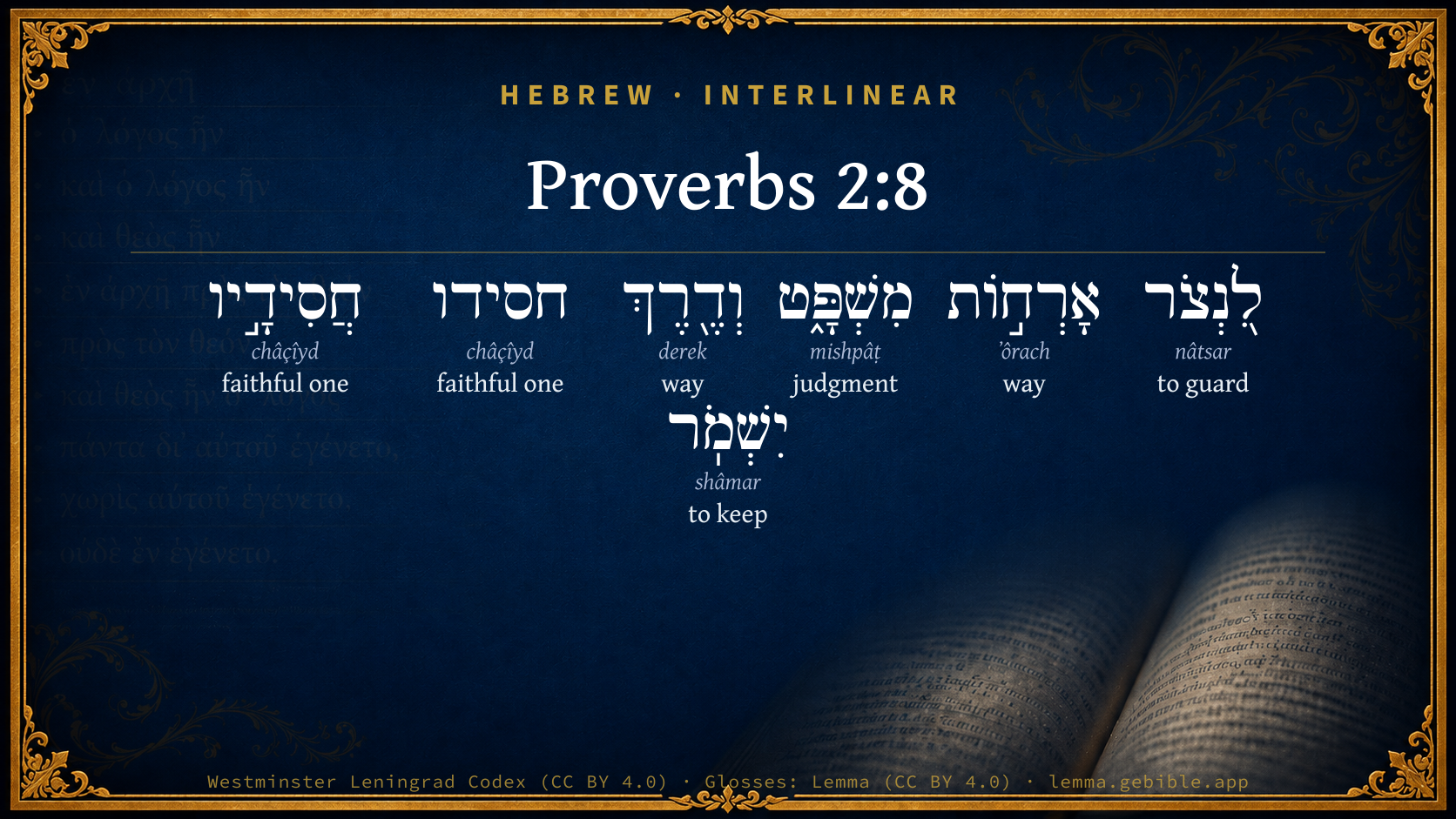
Proverbs 2:8

Hebrew (Westminster Leningrad Codex) Proverbs 2:8 appears in the Hebrew Old Testament. The text above is from the Westminster Leningrad Codex. Each word links to its Strong’s number, a concise gloss, and parsing drawn from the Open Scriptures Hebrew Bible morphology. Click any word for its full Brown-Driver-Briggs (BDB) entry.
Download image
Cite this verse

Proverbs 2:8 (World English Bible). Public Domain. Lemma interlinear Bible study tool, https://lemma.gebible.app/v/proverbs/2/8.

Show BibTeX & RIS
BibTeX
RIS
English Translation
That he may guard the paths of justice, And preserve the way of his saints.
World English Bible · Public Domain
Download a study sheet

One document with this verse’s original text, its word-by-word gloss line, the meaning frame, cross-references with their text, attributed commentary, and full source and license credits — printable, and it pastes into notes with its structure intact.

This verse Autodidact and up

Study sheet (.html) Plain text (.txt)

A passage Seminary Student

Up to 50 verses in one chapter. A passage sheet keeps up to 6 commentary sources and 12 cross-references per verse, in the order this page ranks them, and says so on the sheet whenever that leaves anything out. Ask for a single verse and you get the Autodidact verse sheet above.

Everything on this page stays free to read, with no account — the sheet is a download of what is already on screen, not access to it.

Want to remove ads? Support Godless Engineer
Compare translations 3

The same verse in 3 English versions, stacked beneath the original-language interlinear above. Click any original word for its lexicon entry.

Each is an independent rendering of the whole verse — the interlinear is not word-aligned to these translations.

Highlighted words mark where these versions differ — a whole-verse word diff, not a word-by-word alignment.

  • World English Bible Public Domain
    That he may guard the paths of justice, And preserve the way of his saints.
  • King James Version Public Domain
    He keepeth the paths of judgment, and preserveth the way of his saints.
  • unfoldingWord Literal Text CC BY-SA 4.0
    to guard the paths of justice, and the way of his faithful ones he will preserve.

unfoldingWord Literal Text — © unfoldingWord, licensed CC BY-SA 4.0. Word-aligned USFM3 via Door43 (git.door43.org/unfoldingWord/en_ult).

Versions to compare (up to 4)

3 of 4 selected

Show all 18 translations

Every available English version of this verse, each an independent rendering of the whole verse.

  • World English Bible Public Domain
    That he may guard the paths of justice, And preserve the way of his saints.
  • Berean Standard Bible Public Domain
    to guard the paths of justice and protect the way of His saints.
  • Majority Standard Bible Public Domain
    to guard the paths of justice and protect the way of His saints.
  • King James Version Public Domain
    He keepeth the paths of judgment, and preserveth the way of his saints.
  • American Standard Version (1901) Public Domain
    That he may guard the paths of justice, And preserve the way of his saints.
  • Revised Version (1885) Public Domain
    That he may guard the paths of judgment, and preserve the way of his saints.
  • Geneva Bible (1599) Public Domain
    That they may keepe the wayes of iudgement: and he preserueth the way of his Saintes)
  • Douay-Rheims (1899) Public Domain
    Keeping the paths of justice, and guarding the ways of saints.
  • Young's Literal Translation Public Domain
    To keep the paths of judgment, And the way of His saints He preserveth.
  • Literal Standard Version CC BY-SA 4.0
    To keep the paths of judgment, || And He preserves the way of His saints.
  • Unlocked Literal Bible CC BY-SA 4.0
    he guards the paths of justice and he will preserve the way of those who are faithful to him.
  • unfoldingWord Literal Text CC BY-SA 4.0
    to guard the paths of justice, and the way of his faithful ones he will preserve.
  • Darby Bible Public Domain
    guarding the paths of just judgment and keeping the way of his godly ones.
  • World Messianic Bible Public Domain
    that he may guard the paths of justice, and preserve the way of his holy ones.
  • Webster's Bible Public Domain
    He keepeth the paths of judgment, and preserveth the way of his saints.
  • Free Bible Version CC BY-SA 4.0
    He supports those who act fairly and protects those who trust in him.
  • Bible in Basic English Public Domain
    He keeps watch on the ways which are right, and takes care of those who have the fear of him.
  • JPS Tanakh (1917) Public Domain
    That He may guard the paths of justice, and preserve the way of His godly ones.

Literal Standard Version (2020), Covenant Press — licensed CC BY-SA 4.0. Text via the HelloAO Bible API (eBible.org). Unlocked Literal Bible (unfoldingWord) — licensed CC BY-SA 4.0. Text via the HelloAO Bible API (eBible.org). unfoldingWord Literal Text — © unfoldingWord, licensed CC BY-SA 4.0. Word-aligned USFM3 via Door43 (git.door43.org/unfoldingWord/en_ult). Free Bible Version, Dr. Jonathan Gallagher — licensed CC BY-SA 4.0. Text via the HelloAO Bible API (eBible.org).

Word by word

More ways to search: Search by grammar → Find every occurrence → Compare this word →

Practice this passage: Drill this verse → Learn its vocabulary →

About this verse

These counts appear in no published source. They are computed here, from the morphology-tagged text and Lemma’s own curated glosses. What Lemma adds →

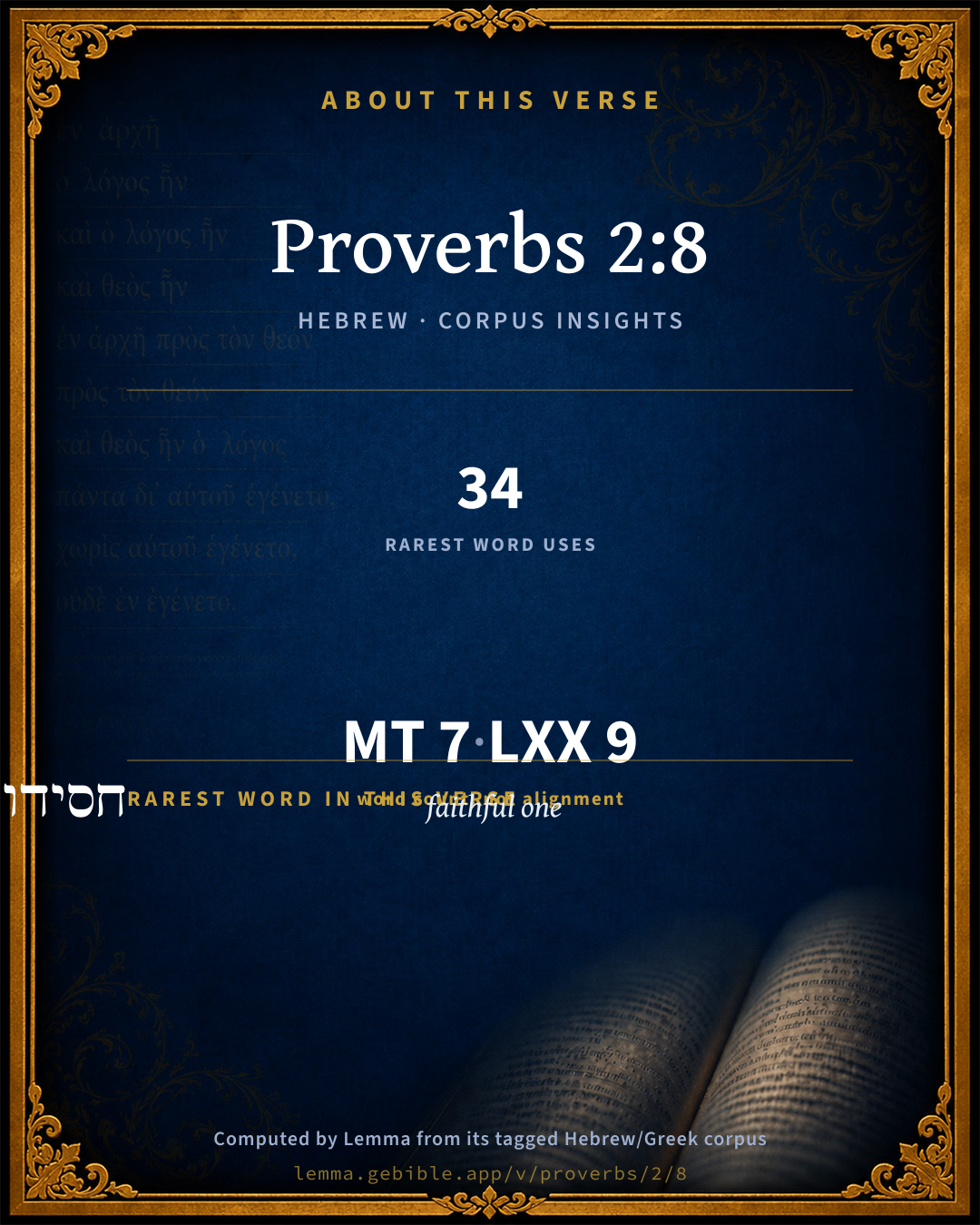
7
words
6
distinct lemmas
Wisdom
section

Shared distinctive vocabulary

חסידו faithful one H2623 occurs in 32 verses of the Hebrew Bible. Also found in:

Grammatical profile

  • 2 verbs
  • 3 nouns
  • 2 adjectives

Verb forms

  • לִ֭נְצֹר Qal · Infinitive Construct
  • יִשְׁמֹֽר Qal · Imperfect

Repetition

A word recurs within this verse — often emphatic in Hebrew:

  • חסידו faithful one H2623 ×2

Hebrew & Septuagint length

In English translation the verse runs 15 words from the Hebrew and 18 from the Septuagint (LXX English) — closely comparable.

A rough comparison of the two English renderings, which tokenize alike — not a word-level alignment.

Word counts can differ between the Hebrew and the Greek without any difference in meaning — e.g. the Hebrew direct-object marker אֵת has no separate Greek word, and Greek often adds the article ὁ.

In the original languages it is 7 Hebrew tokens and 9 Greek tokens — but the two are counted differently (Hebrew bundles its prefixes and suffixes into one token; the Greek is in lemma form), so that isn’t a like-for-like length.

Cross-references

19

Topical passages linked to Proverbs 2:8 in the Treasury of Scripture Knowledge — connected by theme and wording, ordered by reader-vote popularity; previews shown in the World English Bible.

  • Psalms 23:3 He restores my soul. He guides me in the paths of righteousness for his name's sake.
  • 1 Samuel 2:9 He will keep the feet of his holy ones; But the wicked shall be put to silence in darkness; For by strength shall no man prevail.
  • John 10:28–29 I give eternal life to them. They will never perish, and no one will snatch them out of my hand.
  • Psalms 145:20 Yahweh preserves all those who love him, But all the wicked he will destroy.
  • Psalms 66:9 Who preserves our life among the living, And doesn't allow our feet to be moved.
  • Psalms 37:23–24 A man's goings are established by Yahweh. He delights in his way.
  • Psalms 37:28 For Yahweh loves justice, And doesn't forsake his saints. They are preserved forever, But the children of the wicked shall be cut off.
  • Jude 1:24 Now to him who is able to keep them from stumbling, and to present you faultless before the presence of his glory in great joy,
  • Deuteronomy 33:3 Yes, he loves the people; All his saints are in your hand: They sat down at your feet; [Everyone] shall receive of your words.
  • Psalms 1:6 For Yahweh knows the way of the righteous, But the way of the wicked shall perish.
  • Proverbs 8:20 I walk in the way of righteousness, In the midst of the paths of justice;
  • 1 Peter 1:5 who by the power of God are guarded through faith for a salvation ready to be revealed in the last time.
  • Deuteronomy 33:26–29 There is none like God, Jeshurun, Who rides on the heavens for your help, In his excellency on the skies.
  • Psalms 37:31 The law of his God is in his heart. None of his steps shall slide.
  • Psalms 121:5–8 Yahweh is your keeper. Yahweh is your shade on your right hand.
  • Proverbs 3:21–24 My son, let them not depart from your eyes. Keep sound wisdom and discretion:
  • Isaiah 35:9 No lion shall be there, nor shall any ravenous animal go up thereon; they shall not be found there; but the redeemed shall walk [there]:
  • Isaiah 49:9–10 saying to those who are bound, Go forth; to those who are in darkness, Show yourselves. They shall feed in the ways, and on all bare heights shall be their pasture.
  • Jeremiah 32:40–41 and I will make an everlasting covenant with them, that I will not turn away from following them, to do them good; and I will put my fear in their hearts, that they may not depart from me.

Cross-references courtesy of OpenBible.info (CC BY 4.0).

Hebrew and Greek witnesses Masoretic Hebrew ↔ Greek Septuagint

The same verse in the two great witnesses to the Old Testament, shown verse-for-verse.

These are two independent witnesses, not word-aligned to each other, and the Septuagint is shown in lemma (dictionary) form.

Hebrew Proverbs 2:8 Masoretic · Westminster Leningrad Codex

לִ֭נְצֹר אָרְח֣וֹת מִשְׁפָּ֑ט וְדֶ֖רֶךְ חסידו חֲסִידָ֣יו יִשְׁמֹֽר

That he may guard the paths of justice, And preserve the way of his saints.

World English Bible · Public Domain

Greek LXX Proverbs 2:8 Septuagint · lemma form

ὁ φυλάσσω ὁδός δικαίωμα καί ὁδός εὐλαβέομαι αὐτός διαφυλάσσω

that he may guard the righteous ways: and he will preserve the way of them that fear him.

LXX2012 (modern English Septuagint) · Public Domain

Hebrew: Westminster Leningrad Codex (CC BY 4.0). Greek: Septuagint (public domain); English from LXX2012 (modern English Septuagint) (Public Domain). How the Septuagint differs from the Hebrew →

Commentary

Notes on Proverbs 2:8 from classic Christian and Jewish commentators (each source and its license shown beneath its notes). The classic Christian expositions comment on the surrounding passage and are grouped to its opening verse, so a note may address several verses; the Jewish commentaries on the Tanakh (Rashi and others) are per-verse, so they appear only where the commentator wrote on this verse.

Lemma curates 59 commentaries, every one of them public domain or Creative Commons licensed, each selected and text-cleaned for this edition rather than reprinted as found. About our sources →

Trapp's Complete Commentary

John Trapp

Pro 2:8 He keepeth the paths of judgment, and preserveth the way of his saints.

Ver. 8. He keepeth the paths of judgment.] Well may they walk uprightly that are so strongly supported. God’s hand is ever under his; they cannot fall beneath it. "He keepeth the feet of his saints." {1Sa 2:9}

John Trapp, A Commentary or Exposition upon All the Books of the Old and New Testament (1647–1656) — public domain. Text from a community e-Sword module.

Joseph Benson's Commentary

Pro 2:8-9. He keepeth the paths of judgment — Hebrew, לנצר ארחות, To keep the paths, &c. It seems to be spoken of those who walk uprightly, mentioned in the preceding verse, and it would be better translated, That they, namely, the upright, may keep the paths of judgment: that is, God is a buckler, or defence, to the upright, to protect and keep them from those temptations and snares which would seduce them from, or prevent their continuance in, the paths of judgment; as it is further explained in the following clause. Then — When thou hast done thy part, as expressed Pro 2:1-3, and God, in answer to thy desires, hath given thee wisdom, Pro 2:6. Shalt thou understand righteousness, &c. — All the parts of thy duty to man, as well as the fear of God; every good path — The practice of all virtues and graces.

Joseph Benson's Commentary on the Old and New Testaments (1811–1818) — public domain. Text from a community e-Sword module.

Jamieson, Fausset & Brown

Robert Jamieson, A. R. Fausset & David Brown

keepeth . . . way--God defends the right way, and those in it.

saints--objects of favor (compare Psa 4:3, &c.). He guides and guards them.

Jamieson, Fausset & Brown — Commentary Critical and Explanatory on the Whole Bible (1871) — public domain (CC PDM 1.0). Text via the HelloAO Bible API.

Ellicott's Commentary for English Readers

(8) He keepeth the paths of judgment—i.e., protects those who walk in them.

His saints.—Or rather, His ardent worshippers (chasîdîm), a term used in the Pentateuch (Deu_33:8) of the tribe of Levi, for their zeal in God’s service (Exodus 32), and of very frequent occurrence in the Psalter. The word “saint” rather implies dedication to God, as Israel was a “holy nation (Exo_19:6) to God, and Christians (Php_1:1) are now in the same position. The term châsîd, at the time of the Maccabees, was assumed by such “as were voluntarily devoted to the law” (1Ma_2:42), in opposition to those who favoured the Greek religion and culture.

A Bible Commentary for English Readers, edited by Charles John Ellicott (1878–1897) — public domain. Text from a community e-Sword module.

The Cambridge Bible for Schools and Colleges

gen. ed. J. J. S. Perowne

8. He keepeth] Lit. to keep, which may mean, for them (those that walk in integrity) to keep, that they may keep, R.V. marg. But it is better to retain God as the subject still, and at the same time to preserve the parallelism with the 2nd clause of the verse. The two verses (7, 8) will then read, with R.V. text,

He layeth up sound wisdom for the upright,

He is a shield to them that walk in integrity;

That he may guard the paths of judgement,

And preserve the way of His saints.

The Cambridge Bible for Schools and Colleges (gen. ed. J. J. S. Perowne; Cambridge University Press, 1878–1918) — public domain. Text from a community e-Sword module.

John Gill's Exposition

He keepeth the paths of judgment,.... That is, the Lord keeps them; he does that which is just and right himself, in the course of his providence, and in the methods of his grace; and as he guides the feet of his people in the ways of righteousness and holiness, he keeps them there from turning out of them. The words may be rendered, "to keep the paths of judgment" (q); and so expresses the end, fruit, and effect of the Lord's being a buckler to them, as he is said to be in Pro 2:7, he is their shield and protection, so as either to keep them in the right ways in which they should go; or that they might studiously observe them, and keep walking therein, without stumbling in them, or declining from them;

and preserveth the way of his saints; to whom he has been kind and bountiful; or who have been merciful, liberal, and generous to others; who having partook of the grace of God themselves, are useful to men: the Targum calls them "righteous ones". These the Lord preserves by his power and grace, in the way in which he has led them, and which is his own way, safe to his kingdom and glory: for none of his saints, his holy and righteous ones, shall ever perish; the way in which he directs them, and in which he keeps them, leads to everlasting life; see Sa1 2:9.

(q) "ad custodiendum", Pagninus, Montanus; "ad servandum", Baynus, Schultens.

John Gill's Exposition of the Whole Bible (1746–1763) — public domain (CC PDM 1.0). Text via the HelloAO Bible API.

Albert Barnes' Notes on the Bible

saints - The devout and God-fearing. Compare Psa 85:8 etc. The occurrence of the word here, in a book that became more and more prominent as prophetic utterances ceased, probably helped to determine its application in the period of the Maccabean struggles to those who especially claimed for themselves the title of “devout” (Chasidim, the ̓Ασιδαῖοι Asidaioi of 1 Macc. 7:13).

Albert Barnes' Notes on the Bible (1834–1885) — public domain. Text from a community e-Sword/MySword module.

Haydock's Catholic Bible Commentary

Justice. In his servants. (Calmet) --- God gives them grace to follow virtue, (Haydock) and protects them from every danger. (Calmet)

George Leo Haydock (1774–1849), Haydock's Catholic Family Bible and Commentary, 1859 edition — public domain. Excludes Psalms (Douay-Rheims chapter numbering differs from Protestant) and Deuterocanonical books (Catholic canon only).

Matthew Poole's English Annotations

He keepeth the paths of judgment; he guardeth and guideth the paths or ways, i.e. the counsels and actions, of good men, as the next clause explains this, which are called

paths of judgment, or righteous paths; judgment being here put for righteousness, as it is in Psa 99:4, and oft elsewhere. And keeping of paths may be put for keeping them in their paths, so as they shall neither swerve from them, nor stumble and fall in them. And preserve the way of his saints; the same thing repeated in other words.

Matthew Poole's English Annotations on the Holy Bible (1683–1685) — public domain. Text from a community e-Sword/MySword module.

Whedon's Commentary on the Bible

Daniel D. Whedon

8. He keepeth the paths of judgment — He watches over the paths of justice; that is, to guard those who walk in them. This verse is an enlargement of the idea of the preceding one, especially of the defensive conception of the latter clause of Pro_2:7.

The way of his saints — His pious, devout, or zealous ones. That is, he superintends them in all their walks and ways. The word חסידים, (hhasadhim,) saints, occurs also in Psa_85:8; Psa_148:14; Psa_149:9.

Daniel D. Whedon (gen. ed.), Commentary on the Old and New Testaments (1874–1909) — public domain. Text from a community e-Sword module.

The Pulpit Commentary

He keepeth the paths of judgment. This verse is explanatory of the latter hemistich of ver. 7, and points out more fully in what way God is a Protector of his saints. Some connect the Hebrew infinitive dxOnli (lin tsor), "to watch or keep," with "them that walk uprightly," and translate, "them that walk uprightly by keeping the paths of judgment;" but this is to transfer the idea of protection from God to such persons. The verb signifies specially "to defend, to preserve from danger," as in Pro_22:12, "The eyes of the Lind preserve knowledge; i.e. defend or protect it from danger." It is God who "keepeth the paths of judgment," as he alone has the power to do so. He watches over all that walk therein, guides, superintends, and protects them. The paths of judgment; or rather, justice, fpvmi twOhra (atkhoth mishpat). The abstract is here used for the concrete, and the phrase means "the paths of the just," i.e. the paths in which the just walk, or "those who walk justly" (Mercerus). This expression corresponds with "the way of his saints," just as "keep" and "preserve" are synonymous verbs, both meaning "to guard, keep safe, or protect." He preserveth the way of his saints. God does this

(1) by his preventing grace, as in Psa_66:9, "He suffereth not our feet to slip." Cf. Hannah"s song, "He will keep the feet of his saints"; (1Sa_2:9)

(2) by angelic agency, as in Psa_91:11, "He shall give his angels charge over thee to keep thee in all thy ways." The saints are ever under the watchful care and mighty protection of Jehovah. His saints (wdysij, khasidav); i.e. the pious towards God, the godly, those in whose hearts the principles of sanctity have been implanted, and who cherish earnest inward love to God, and "walk righteously" and "speak uprightly". (Isa_33:15) It is remarkable that the word saints only occurs once (in this passage) in the Proverbs. During the period of the Maccabaean Wars, a party or sect, which aimed at ceremonial purity, claimed for themselves the title of Chasidim or Asidaeans (Asidaioi ), as expressive of their piety or devotion. They are those whom Moses called "men of holiness," Exo_22:31 (vdqoAyvenaw, vanshev-kodesh); cf. Psa_89:5 Psa_149:1 Psa_89:8 Deu_33:3 Dan_7:18, Dan_7:22, Dan_7:22, Dan_7:25. Under the Christian dispensation, the saints are those who are sanctified in Christ Jesus, (1Co_1:2 1Jn_5:1) and who are holy in all manner of conversation; (1Pe_1:25 RAPC 1Ma 2:42 7:13 2Ma 14:6) see Bishop Lightfoot, "Colossians and Philemon," diss. 2, p. 355.

The Pulpit Commentary (1880–1919), ed. H.D.M. Spence-Jones & Joseph S. Exell — public domain. Text from a community e-Sword module.

John Wesley's Explanatory Notes

Path of judgment - Righteous paths, judgment being here put for righteousness. And keeping of paths may be put for keeping them in their paths.

John Wesley, Explanatory Notes Upon the Whole Bible (1754–1765) — public domain. Text via the GEBible commentary corpus.

Rashi

Rabbi Shlomo Yitzchaki (Rashi)

to keep the paths of justice For through it, they will keep the paths of justice, and He will guard the way of His pious so that they do not stumble.

Rashi on the Tanakh — English translations: “The Judaica Press complete Tanach with Rashi, translated by A. J. Rosenberg” (CC BY 4.0); “Pentateuch with Rashi's commentary by M. Rosenbaum and A.M. Silbermann, 1929-1934” (public domain); “The Metsudah Tanach series, Lakewood, N.J” (CC BY 4.0); and “The Book of Joshua, Metsudah Publications, 1997” (CC BY 4.0). Text via Sefaria.

Lesson kit

Teaching starters — assembled from the data on this page, not authored interpretation. Every prompt links to the verse data it draws on. Edit before teaching.

Proverbs, in the Wisdom, opens this verse with 7 words (6 distinct Hebrew lemmas). Its most distinctive word is châçîyd (“faithful one”). A historical commentator’s framing appears above. Read the whole chapter for the surrounding context.

Discussion questions

  1. How does “faithful one” (châçîyd) shape what this verse is saying?
  2. How does Deuteronomy 33:8, which shares the word «faithful one», read alongside this verse?
  3. What does the repetition of “faithful one” (2× in this one verse) do in this verse?
  4. The translations on this page render this verse differently — a whole-verse word diff, not a word-by-word alignment. What might account for the different wordings?
  5. «לִ֭נְצֹר» is a Qal Infinitive Construct verb. How does that grammatical form shape the action described?
  6. Compare how Trapp's Complete Commentary and Joseph Benson's Commentary read this verse. Where do they agree or differ?

Things to notice

Reading settings

Reading text

Shown beneath each verse's original-language words.

Old Testament
Old Testament edition

Read the OT as the Masoretic Hebrew (MT) or the Greek Septuagint (LXX).

English shown for the Greek Septuagint (in the Hebrew ↔ Greek comparison).

Comparing translations? Open the Compare panel on any verse page to stack up to four side by side.