
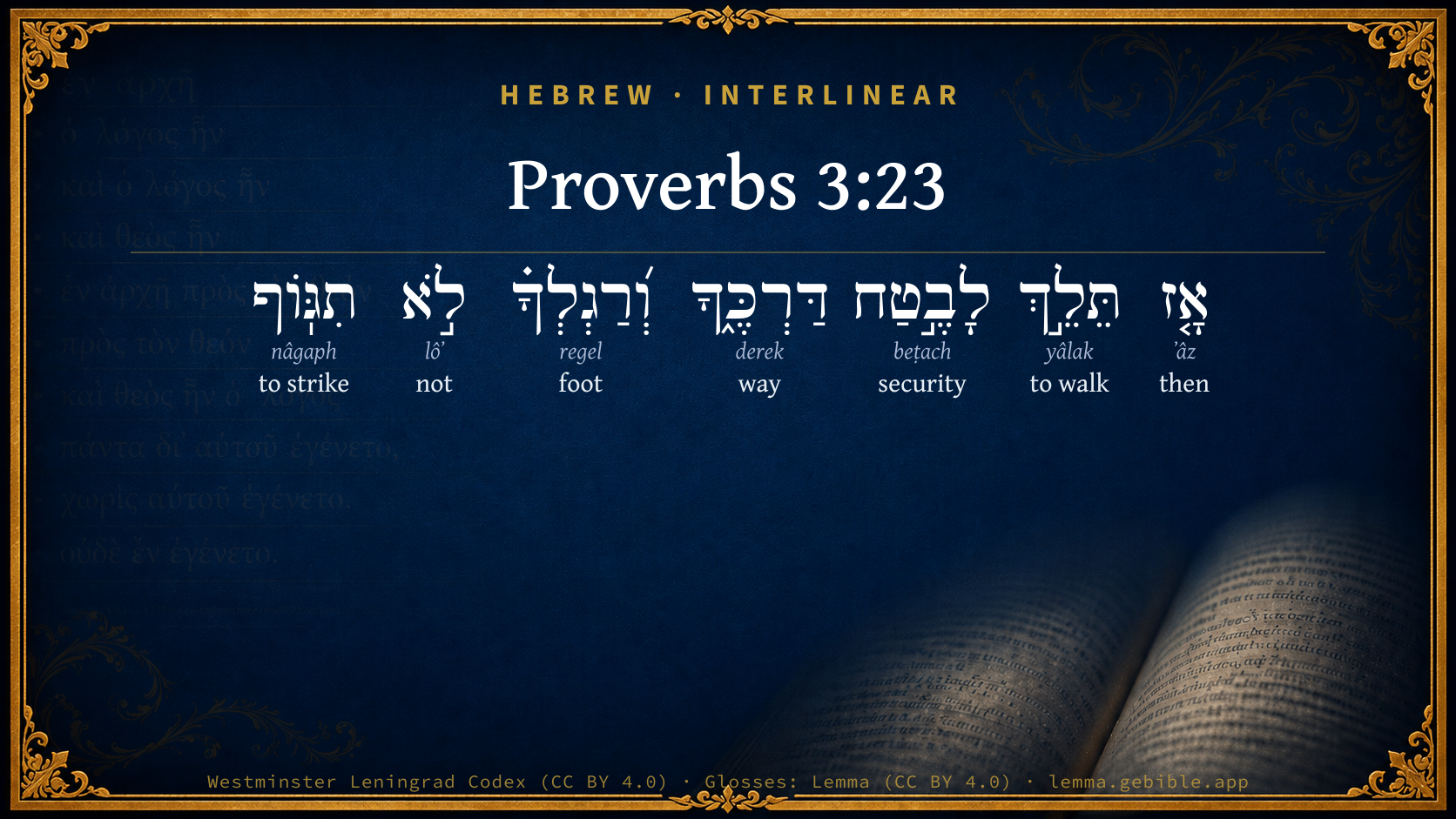
Proverbs 3:23

Hebrew (Westminster Leningrad Codex) Proverbs 3:23 appears in the Hebrew Old Testament. The text above is from the Westminster Leningrad Codex. Each word links to its Strong’s number, a concise gloss, and parsing drawn from the Open Scriptures Hebrew Bible morphology. Click any word for its full Brown-Driver-Briggs (BDB) entry.
Download image
Cite this verse

Proverbs 3:23 (World English Bible). Public Domain. Lemma interlinear Bible study tool, https://lemma.gebible.app/v/proverbs/3/23.

Show BibTeX & RIS
BibTeX
RIS
English Translation
Then you shall walk in your way securely. Your foot won't stumble.
World English Bible · Public Domain
Download a study sheet

One document with this verse’s original text, its word-by-word gloss line, the meaning frame, cross-references with their text, attributed commentary, and full source and license credits — printable, and it pastes into notes with its structure intact.

This verse Autodidact and up

Study sheet (.html) Plain text (.txt)

A passage Seminary Student

Up to 50 verses in one chapter. A passage sheet keeps up to 6 commentary sources and 12 cross-references per verse, in the order this page ranks them, and says so on the sheet whenever that leaves anything out. Ask for a single verse and you get the Autodidact verse sheet above.

Everything on this page stays free to read, with no account — the sheet is a download of what is already on screen, not access to it.

Want to remove ads? Support Godless Engineer
Compare translations 3

The same verse in 3 English versions, stacked beneath the original-language interlinear above. Click any original word for its lexicon entry.

Each is an independent rendering of the whole verse — the interlinear is not word-aligned to these translations.

Highlighted words mark where these versions differ — a whole-verse word diff, not a word-by-word alignment.

  • World English Bible Public Domain
    Then you shall walk in your way securely. Your foot won't stumble.
  • King James Version Public Domain
    Then shalt thou walk in thy way safely, and thy foot shall not stumble.
  • unfoldingWord Literal Text CC BY-SA 4.0
    Then you will walk your way to security and your foot will not stumble.

unfoldingWord Literal Text — © unfoldingWord, licensed CC BY-SA 4.0. Word-aligned USFM3 via Door43 (git.door43.org/unfoldingWord/en_ult).

Versions to compare (up to 4)

3 of 4 selected

Show all 18 translations

Every available English version of this verse, each an independent rendering of the whole verse.

  • World English Bible Public Domain
    Then you shall walk in your way securely. Your foot won't stumble.
  • Berean Standard Bible Public Domain
    Then you will go on your way in safety, and your foot will not stumble.
  • Majority Standard Bible Public Domain
    Then you will go on your way in safety, and your foot will not stumble.
  • King James Version Public Domain
    Then shalt thou walk in thy way safely, and thy foot shall not stumble.
  • American Standard Version (1901) Public Domain
    Then shalt thou walk in thy way securely, And thy foot shall not stumble.
  • Revised Version (1885) Public Domain
    Then shalt thou walk in thy way securely, and thy foot shall not stumble.
  • Geneva Bible (1599) Public Domain
    Then shalt thou walke safely by thy way: and thy foote shall not stumble.
  • Douay-Rheims (1899) Public Domain
    Then shalt thou walk confidently in thy way, and thy foot shall not stumble:
  • Young's Literal Translation Public Domain
    Then thou goest thy way confidently, And thy foot doth not stumble.
  • Literal Standard Version CC BY-SA 4.0
    Then you go your way confidently, || And your foot does not stumble.
  • Unlocked Literal Bible CC BY-SA 4.0
    Then you will walk on your way in safety and your foot will not stumble;
  • unfoldingWord Literal Text CC BY-SA 4.0
    Then you will walk your way to security and your foot will not stumble.
  • Darby Bible Public Domain
    Then shalt thou walk in thy way securely, and thy foot shall not stumble;
  • World Messianic Bible Public Domain
    Then you shall walk in your way securely. Your foot won’t stumble.
  • Webster's Bible Public Domain
    Then shalt thou walk in thy way safely, and thy foot shall not stumble.
  • Free Bible Version CC BY-SA 4.0
    You will be able to walk confidently on your way, and you won't trip up.
  • Bible in Basic English Public Domain
    Then you will go safely on your way, and your feet will have no cause for slipping.
  • JPS Tanakh (1917) Public Domain
    Then shalt thou walk in thy way securely, and thou shalt not dash thy foot.

Literal Standard Version (2020), Covenant Press — licensed CC BY-SA 4.0. Text via the HelloAO Bible API (eBible.org). Unlocked Literal Bible (unfoldingWord) — licensed CC BY-SA 4.0. Text via the HelloAO Bible API (eBible.org). unfoldingWord Literal Text — © unfoldingWord, licensed CC BY-SA 4.0. Word-aligned USFM3 via Door43 (git.door43.org/unfoldingWord/en_ult). Free Bible Version, Dr. Jonathan Gallagher — licensed CC BY-SA 4.0. Text via the HelloAO Bible API (eBible.org).

Word by word

More ways to search: Search by grammar → Find every occurrence → Compare this word →

Practice this passage: Drill this verse → Learn its vocabulary →

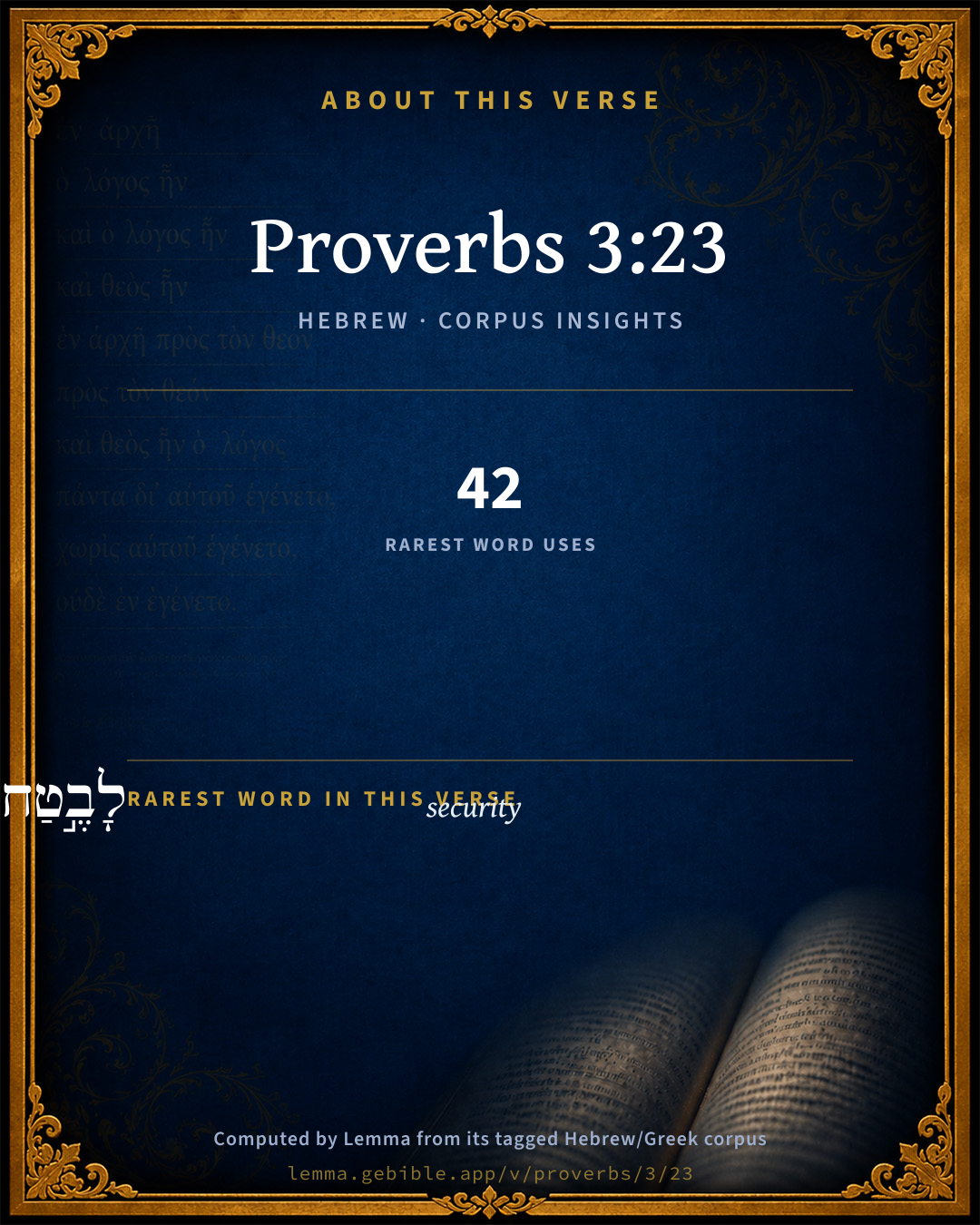
About this verse

These counts appear in no published source. They are computed here, from the morphology-tagged text and Lemma’s own curated glosses. What Lemma adds →

7
words
7
distinct lemmas
Wisdom
section

Shared distinctive vocabulary

לָבֶ֣טַח security H983 occurs in 41 verses of the Hebrew Bible. Also found in:

Grammatical profile

  • 2 verbs
  • 3 nouns
  • 1 adverb
  • 1 particle

Verb forms

  • תֵּלֵ֣ךְ Qal · Imperfect
  • תִגּֽוֹף Qal · Imperfect

Hebrew & Septuagint length

In English translation the verse runs 12 words from the Hebrew and 18 from the Septuagint (LXX English) — the Septuagint runs noticeably longer here. See the side-by-side →

A rough comparison of the two English renderings, which tokenize alike — not a word-level alignment.

Word counts can differ between the Hebrew and the Greek without any difference in meaning — e.g. the Hebrew direct-object marker אֵת has no separate Greek word, and Greek often adds the article ὁ.

Cross-references

9

Topical passages linked to Proverbs 3:23 in the Treasury of Scripture Knowledge — connected by theme and wording, ordered by reader-vote popularity; previews shown in the World English Bible.

  • Proverbs 4:12 When you go, your steps will not be hampered. When you run, you will not stumble.
  • Proverbs 10:9 He who walks blamelessly walks surely, But he who perverts his ways will be found out.
  • Psalms 91:11–12 For he will give his angels charge over you, To guard you in all your ways.
  • Psalms 121:3 He will not allow your foot to be moved. He who keeps you will not slumber.
  • Psalms 37:23–24 A man's goings are established by Yahweh. He delights in his way.
  • Psalms 37:31 The law of his God is in his heart. None of his steps shall slide.
  • Psalms 121:8 Yahweh will keep your going out and your coming in, From this time forth, and forevermore.
  • Proverbs 2:8 That he may guard the paths of justice, And preserve the way of his saints.
  • Zechariah 10:12 I will strengthen them in Yahweh; And they will walk up and down in his name," says Yahweh.

Cross-references courtesy of OpenBible.info (CC BY 4.0).

Hebrew and Greek witnesses Masoretic Hebrew ↔ Greek Septuagint

The same verse in the two great witnesses to the Old Testament, shown verse-for-verse.

Here the Septuagint runs noticeably longer than the Hebrew — LXX2012 (modern English Septuagint) 18 words vs World English Bible 12. A rough length comparison of the two English translations, not a word-level alignment — read both below.

These are two independent witnesses, not word-aligned to each other, and the Septuagint is shown in lemma (dictionary) form.

Hebrew Proverbs 3:23 Masoretic · Westminster Leningrad Codex

אָ֤ז תֵּלֵ֣ךְ לָבֶ֣טַח דַּרְכֶּ֑ךָ וְ֝רַגְלְךָ֗ לֹ֣א תִגּֽוֹף

Then you shall walk in your way securely. Your foot won't stumble.

World English Bible · Public Domain

Greek LXX Proverbs 3:23 Septuagint · lemma form

ἵνα πορεύομαι πείθω ἐν εἰρήνη πᾶς ὁ ὁδός σύ ὁ δέ πούς σύ οὐ μή προςκόπτω

that you may go confidently in peace in all your ways, and that your foot may not stumble.

LXX2012 (modern English Septuagint) · Public Domain

On this verse, Keil & Delitzsch discusses the Septuagint’s reading. Read the note in Commentary ↓

Hebrew: Westminster Leningrad Codex (CC BY 4.0). Greek: Septuagint (public domain); English from LXX2012 (modern English Septuagint) (Public Domain). How the Septuagint differs from the Hebrew →

Commentary

Notes on Proverbs 3:23 from classic Christian and Jewish commentators (each source and its license shown beneath its notes). The classic Christian expositions comment on the surrounding passage and are grouped to its opening verse, so a note may address several verses; the Jewish commentaries on the Tanakh (Rashi and others) are per-verse, so they appear only where the commentator wrote on this verse.

Lemma curates 59 commentaries, every one of them public domain or Creative Commons licensed, each selected and text-cleaned for this edition rather than reprinted as found. About our sources →

Trapp's Complete Commentary

John Trapp

Pro 3:23 Then shalt thou walk in thy way safely, and thy foot shall not stumble.

Ver. 23. Then shalt thou walk in thy way safely.] Fiducialiter, saith the Vulgate - confidently and securely. Every malvoy shall be a salvoy to thee: thou shalt ever go under a double guard, the "peace of God" within thee, {Php 4:7} and the "power of God" without thee. {1Pe 1:5} "Thou shalt be in league also with the stones of the field, and the beasts of the field shall be at peace with thee." {Job 5:23}

John Trapp, A Commentary or Exposition upon All the Books of the Old and New Testament (1647–1656) — public domain. Text from a community e-Sword module.

Joseph Benson's Commentary

Pro 3:23. Then shalt thou walk in thy way — Manage all thy employments and concerns safely, securely, or confidently, without danger or fear, casting thy care on God, in the discharge of thy duty. And thy foot shall not stumble — At those stumbling-blocks, trials, and temptations, at which heedless sinners commonly stumble, and by which they fall. Thy natural life, and all that belongs to it, shall be under the protection of God’s providence; thy spiritual life, and all its interests, under the protection of his grace; so that thou shalt be kept from falling into sin or trouble. Wisdom shall direct thee into and keep thee in the right way, as far as may be from temptation, and will enable thee to walk in it with holy security, and thou shalt find the way of duty to be the way of safety.

Joseph Benson's Commentary on the Old and New Testaments (1811–1818) — public domain. Text from a community e-Sword module.

Keil & Delitzsch

C. F. Keil & F. Delitzsch

But more than this, wisdom makes its possessor in all situations of life confident in God:

23 Then shalt thou go thy way with confidence,

And thy foot shall not stumble.

24 When thou liest down, thou are not afraid,

But thou layest thyself down and hast sweet sleep.

25 Thou needest not be afraid of sudden alarm,

Nor for the storm of the wicked when it breaketh forth.

26 For Jahve will be thy confidence

And keep thy foot from the snare.

The לבטח (cf. our "bei guter Laune" = in good cheer), with ל of the condition, is of the same meaning as the conditional adverbial accusative בּטח, Pro 10:9; Pro 1:33. Pro 3:23 the lxx translate ὁ δὲ πούς σου οὐ μὴ προσκόψῃ, while, on the contrary, at Psa 91:12 they make the person the subject (μήποτε προσκόψῃς τὸν κ.τ.λ.); here also we retain more surely the subject from 23a, especially since for the intrans. of נגף (to smite, to push) a Hithpa. התנגּף is used Jer 13:16. In Pro 3:24 there is the echo of Job 11:18, and in Pro 3:25 of Job 5:21. Pro 3:24 is altogether the same as Job 5:24 : et decumbes et suavis erit somnus tuus = si decubueris, suavis erit. The hypothetic perf., according to the sense, is both there and at Job 11:18 (cf. Jer 20:9) oxytoned as perf. consec. Similar examples are Pro 6:22; Gen 33:13; Sa1 25:31, cf. Ewald, 357a. ערבה (of sleep as Jer 31:26) is from ערב, which in Hebr. is used of pleasing impressions, as the Arab. ‛ariba of a lively, free disposition. שׁנה, somnus (nom. actionis from ישׁן, with the ground-form sina preserved in the Arab. lidat, vid., Job, p. 284, note), agrees in inflexion with שׁנה, annus. אל, Pro 3:25, denies, like Psa 121:3, with emphasis: be afraid only not = thou hast altogether nothing to fear. Schultens rightly says: Subest species prohibitionis et tanquam abominationis, ne tale quicquam vel in suspicionem veniat in mentemve cogitando admittatur. פּחד here means terror, as Pro 1:26., the terrific object; פּתאם (with the accus. om) is the virtual genitive, as Pro 26:2 חנּם (with accus. am). Regarding שׁאה, see under Pro 1:27. The genitive רשׁעים may be, after Psa 37:18, the genit. subjecti, but still it lies nearer to say that he who chooses the wisdom of God as his guiding star has no ground to fear punishment as transgressors have reason to fear it; the שׁאה is meant which wisdom threatens against transgressors, Pro 1:27. He needs have no fear of it, for wisdom is a gift of God, and binds him who receives it to the giver: Jahve becomes and is henceforth his confidence. Regarding ב essentiae, which expresses the closest connection of the subject with the predicate which it introduces, see under Psa 35:2. As here, so also at Exo 18:4; Psa 118:7; Psa 146:6, the predicate is a noun with a pronominal suffix. כּסל is, as at Psa 78:7; Job 31:24, cognate to מבטה and מקוה,

(Note: According to Malbim, תּקוה is the expectation of good, and כּסל, confidence in the presence of evil.)

the object and ground of confidence. That the word in other connections may mean also fool-hardiness, Psa 49:14, and folly, Ecc 7:25 (cf. regarding כּסיל, which in Arab. as belı̂d denotes the dull, in Hebr. fools, see under Pro 1:22), it follows that it proceeds from the fundamental conception of fulness of flesh and of fat, whence arise the conceptions of dulness and slothfulness, as well as of confidence, whether confidence in self or in God (see Schultens l.c., and Wnsche's Hosea, p. 207f.). לכד is taking, catching, as in a net or trap or pit, from לכד, to catch (cf. Arab. lakida, to fasten, III, IV to hold fast); another root-meaning, in which Arab. lak connects itself with nak, nk, to strike, to assail (whence al-lakdat, the assault against the enemy, Deutsch. Morgenl. Zeitsch. xxii. 140), is foreign to the Hebr. Regarding the מן of מלכד, Fleischer remarks: "The מן after the verbs of guarding, preserving, like שׁמר and נצר, properly expresses that one by those means holds or seeks to hold a person or thing back from something, like the Lat. defendere, tueri aliquem ab hostibus, a perculo."

(Note: Hitzig rejects Pro 3:22-26 as a later interpolation. And why? Because chap. 3, which he regards as a complete discourse, consists of twice ten verses beginning with בּני. In addition to this symmetry other reasons easily reveal themselves to his penetration. But the discourses contained in chap. 1-9 do not all begin with בני (vid., Pro 1:20); and when it stands in the beginning of the discourse, it is not always the first word (vid., Pro 1:8); and when it occurs as the first word or in the first line, it does not always commence a new discourse (vid., Pro 1:15 in the middle of the first, Pro 3:11 in the middle of the fourth); and, moreover, the Hebr. poetry and oratory does not reckon according to verses terminated by Soph Pasuk, which are always accented distichs, but they in reality frequently consist of three or more lines. The rejected verses are in nothing unlike those that remain, and which are undisputed; they show the same structure of stichs, consisting for the most part of three, but sometimes also only of two words (cf. Pro 3:22 with Pro 1:9, Pro 1:10), the same breadth in the course of the thoughts, and the same accord with Job and Deuteronomy.)

Keil & Delitzsch — Biblical Commentary on the Old Testament (1861–1891) — public domain (CC PDM 1.0). Text via the HelloAO Bible API. (Old Testament only.)

The Cambridge Bible for Schools and Colleges

gen. ed. J. J. S. Perowne

23. thy foot shall not stumble] Lit. thou shalt not dash thy foot, R.V. margin. Comp. Psa_91:12, where “against a stone” is added.

The Cambridge Bible for Schools and Colleges (gen. ed. J. J. S. Perowne; Cambridge University Press, 1878–1918) — public domain. Text from a community e-Sword module.

John Gill's Exposition

Then shall thou walk in thy way safely,.... In the way of thy duty and business, without fear of any enemy; having in sight the Captain of salvation gone before, and walking in such ways of pleasantness and peace as Wisdom's are; and having such a lamp to the feet, and such a light unto the paths, as the Gospel and its doctrines be;

and thy foot shall not stumble; at the word and the truths of it, as some men do, being thereunto appointed; and at Christ, the stumbling stone laid in Zion, particularly at his justifying righteousness; see Pe1 2:8.

John Gill's Exposition of the Whole Bible (1746–1763) — public domain (CC PDM 1.0). Text via the HelloAO Bible API.

Matthew Poole's English Annotations

Walk in thy way; manage all thy employments and concerns.

Safely, or securely, or confidently, without danger or fear; casting thy care upon God in the discharge of thy duty.

Shall not stumble at those stumbling-blocks and temptations at which heedless sinners commonly stumble and fall. Thou shalt thereby be kept from falling into sin, and that mischief which generally attends upon it.

Matthew Poole's English Annotations on the Holy Bible (1683–1685) — public domain. Text from a community e-Sword/MySword module.

Whedon's Commentary on the Bible

Daniel D. Whedon

23. Then shalt thou walk… safely — “Then the journey of thy life shall be safe and smooth.” — Stuart.

Daniel D. Whedon (gen. ed.), Commentary on the Old and New Testaments (1874–1909) — public domain. Text from a community e-Sword module.

The Pulpit Commentary

Then shall thou walk in thy way safely. The first of the promises of protection, which follow from vers. 23-26. He who keeps "sound wisdom and discretion" shall enjoy the greatest sense of security in all situations of life. Safely (lavetakh); either in confidence, as Vulgate fiducialiter, i.e. confidently, because of the sense of security (cf. LXX, pepoiywnh , and ver. 26); or in security: the adverb lavetakh is equivalent to betakh in Pro_1:30 and Pro_10:9. The allusion is obvious. As he who is accompanied by an escort proceeds on his way in safety, so you protected by God will pass your life in security; or, as Trapp, "Thou shalt ever go under a double guard, "the peace of God" within thee, (Php_4:7) and the "power of God" without thee." (1Pe_1:5) And thy foot shall not stumble; literally, and thou shall not strike thy foot. Stumble in the original is thiggoph, 2 singular kal future of nagaph, "to smite, .... strike against with the foot." So in Psa_91:12. The Authorized Version, however, correctly gives the sense. The LXX, like the Authorized Version, makes "foot" the subject, O de pouv sou su mh proskoqh , "(That) thy foot may not stumble." For a similar assurance, see Pro_4:12. The meaning is: You will not stumble, because you will be walking in the way of wisdom, which is free from stumbling blocks (Lapide). You will not fall into sin.

The Pulpit Commentary (1880–1919), ed. H.D.M. Spence-Jones & Joseph S. Exell — public domain. Text from a community e-Sword module.

Bridges on Proverbs

Charles Bridges

The habitual eyeing of the word keeps the feet in a slippery path. (Pro 4:11-12 . Psa 17:4 ; Psa 37:23 ; Psa 119:9, Psa 119:11, Psa 119:133 .) David, from inattention to wisdom’s words, "well-nigh slipped." (Psa 73:2-17 .) Peter from the same neglect fearfully stumbled. (Mat 26:33-35, Mat 26:69-75 .) But our sleeping hours, no less than our waking steps, are divinely guarded. "So he giveth his beloved sleep." (Psa 127:2 . Compare Psa 121:3-4 .) "Underneath them are the everlasting arms." (Deu 33:27 . Compare Lev 26:6 .) They enjoy a child-like repose, sleeping in his bosom without fear. Thus did David ’sleep in God, and in a state of salvation,’ amid the tumultuous warfare with his undutiful son.†1 Peter in prison, in chains, between two soldiers, on the eve of his probable execution, when "there seemed but a step between him and death" — Yet in such a place, in such company, at such a moment, did he lie down so fearless, and sleep so sweetly; that even the shining light failed to disturb him, and an angel’s stroke was needed to awaken him.†2 What would not many in troublous times, waking at every stir, give for one night of this sweet sleep! And yet how many such nights have we enjoyed; waking, as Jacob on his stony — we might add — downy, pillar, in the consciousness of our Father’s keeping! But where has been our renewed dedication to God? (Gen 28:11, Gen 28:18-22 .)

But sudden fear may come. Yet be not afraid. (Job 5:21-24 . Compare 2Ki 6:16-17 ; Jer 39:15-18 .) It is the desolation of the wicked. They must fear. (Isa 57:20-21 .) Child of God! run you to your confidence, and "be safe." (Pro 14:26 ; Pro 18:10 . Isa 26:1, Isa 26:20 .) Surely he shall keep thy foot from being taken. (Psa 91:1-3 .) Noah found this security in the flood of the ungodly; Lot in the destruction of Sodom (2Pe 2:5-9 ); the Christians in Pella, in the desolation of the wicked city. Luther sung his song of confidence — "God is our refuge and strength." (Psalm 46.) In the consummating desolation, when it cometh — what will then be the sudden fear — the undismayed confidence? "All the tribes of the earth will mourn" at the sight of their despised Savior — then their Judge. (Pro 1:27 . Luk 21:26 . Rev 1:7 ; Rev 6:15-17 .) But, "when ye see these things, then look up, and lift up your heads, for your redemption draweth nigh." (Luk 21:28 . Compare 2Th 1:7-10 .)

Footnotes

†1 ’Obdormit in Deo, et in statu salutis.’ — Lyra. — Psa 3:1-8 . Psa 4:8 . Compare the beautiful picture, Eze 34:25-28, in contrast with Pro 4:16 . Deu 28:66 .

†2 Act 12:6-7. Our Martyrologist records of John Rogers, the proto-martyr in the Marian persecution, that ’on the morning of his execution, being found fast asleep, scarce with much shogging could he be awaked.’ — Foxe, vi. 699.

Charles Bridges, An Exposition of the Book of Proverbs (1846) — public domain. Text from a community e-Sword module.

unfoldingWord translationNotes

Door43 World Missions Community

you will walk on your way in safety

The writer speaks of living one's life as if the person were walking along a path. AT: "you will live your life in safety" (See: Metaphor)

your foot will not stumble

The word "foot" represents the whole person. The writer speaks of doing wrong as if a person stumbled over an object in his path. AT: "you will not do things that are wrong" (See: Synecdoche and Metaphor)

when you lie down

It is implied that a person lies down in order to sleep. The meaning of this can be made clear. AT: "when you lie down to sleep" (See: Assumed Knowledge and Implicit Information)

your sleep will be sweet

The writer speaks of sleep that is peaceful and refreshing as if it tasted sweet to the person sleeping. The word "sleep" can be translated as a verb. AT: "your sleep will be pleasant" or "you will sleep peacefully" (See: Metaphor and Abstract Nouns)

translationWords

walk

stumble

fear

unfoldingWord translationNotes — © Distant Shores Media and the Door43 World Missions Community, licensed CC BY-SA 4.0. Source: git.door43.org/Door43/en_tn.

Rashi

Rabbi Shlomo Yitzchaki (Rashi)

shall not stumble Heb. לא תגוף. This is an expression of stumbling, (achopper in French, straucheln in German. And so in Jeremiah 13:16 Psalms 91.12.) And so (Ps. 91:12). “Lest your foot stumble (תגף) on a stone”; and so (Jer. 13:16): “And before your feet stumble (יתנגפו)” and so (Ex. 21:22): “and they dash (ונגפו) a pregnant woman.”

Rashi on the Tanakh — English translations: “The Judaica Press complete Tanach with Rashi, translated by A. J. Rosenberg” (CC BY 4.0); “Pentateuch with Rashi's commentary by M. Rosenbaum and A.M. Silbermann, 1929-1934” (public domain); “The Metsudah Tanach series, Lakewood, N.J” (CC BY 4.0); and “The Book of Joshua, Metsudah Publications, 1997” (CC BY 4.0). Text via Sefaria.

Lesson kit

Teaching starters — assembled from the data on this page, not authored interpretation. Every prompt links to the verse data it draws on. Edit before teaching.

Proverbs, in the Wisdom, opens this verse with 7 words (7 distinct Hebrew lemmas). Its most distinctive word is beṭach (“security”). The Greek Septuagint runs longer here. A historical commentator’s framing appears above. Read the whole chapter for the surrounding context.

Discussion questions

  1. The word beṭach carries the sense “security.” How does it shape the verse?
  2. How does Genesis 34:25, which shares the word «security», read alongside this verse?
  3. The Septuagint runs longer here than the Hebrew. What might account for the difference?
  4. These translations render this verse differently; the difference is in the English rendering, not the original. What questions does that raise?
  5. «תֵּלֵ֣ךְ» is a Qal Imperfect verb. How does that grammatical form shape the action described?
  6. Compare how Trapp's Complete Commentary and Joseph Benson's Commentary read this verse. Where do they agree or differ?

Things to notice

Reading settings

Reading text

Shown beneath each verse's original-language words.

Old Testament
Old Testament edition

Read the OT as the Masoretic Hebrew (MT) or the Greek Septuagint (LXX).

English shown for the Greek Septuagint (in the Hebrew ↔ Greek comparison).

Comparing translations? Open the Compare panel on any verse page to stack up to four side by side.